RabbiTRAILS is now AD FREE We hope you enjoy the less-cluttered format!
Balloons…
We spent three nights in the Albuquerque area during the Balloon Fiesta (2025 Balloons and Beyond Ep 6, Ep 7, Ep 8). Despite several balloon launches and glows cancelled due to rain, Friday was a perfect day with a spectacular morning ascension and wonderful evening glow-flicker, drone show and fireworks. It was the highlight of our trip!
And Beyond!
We left Albuquerque headed east on I-40 and spent the night in Tucumcari, NM.
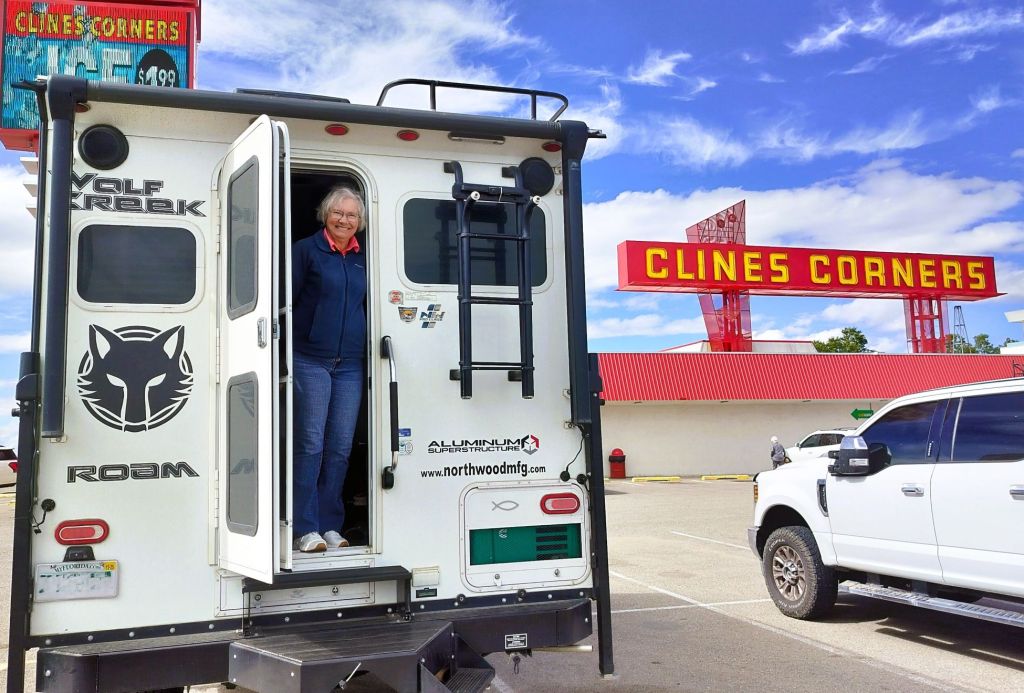
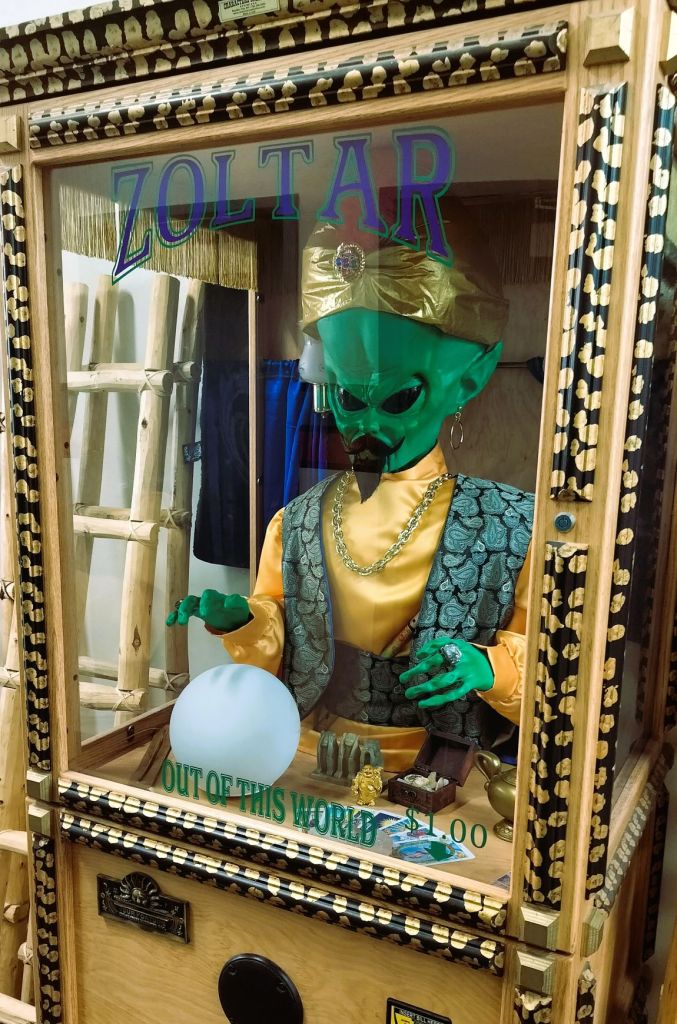
We ate lunch at Clines Corners, a gas station/kitschy tourist store a couple hours east of Albuquerque on I-40In addition to souvenir T-shirts, caramel nuts and toy slingshots, Clines Corners has several old-fashioned fortune-telling vending machines like Love Tester and Zoltar. Zoltar’s advice? Don’t drive truck campers through tunnels!
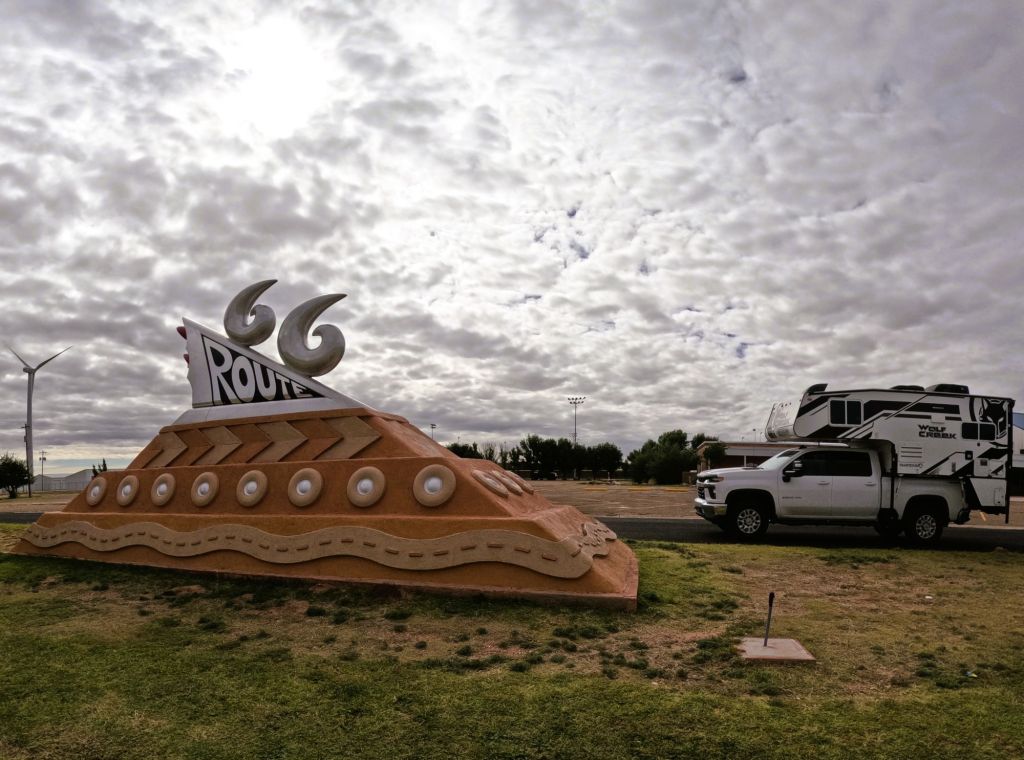
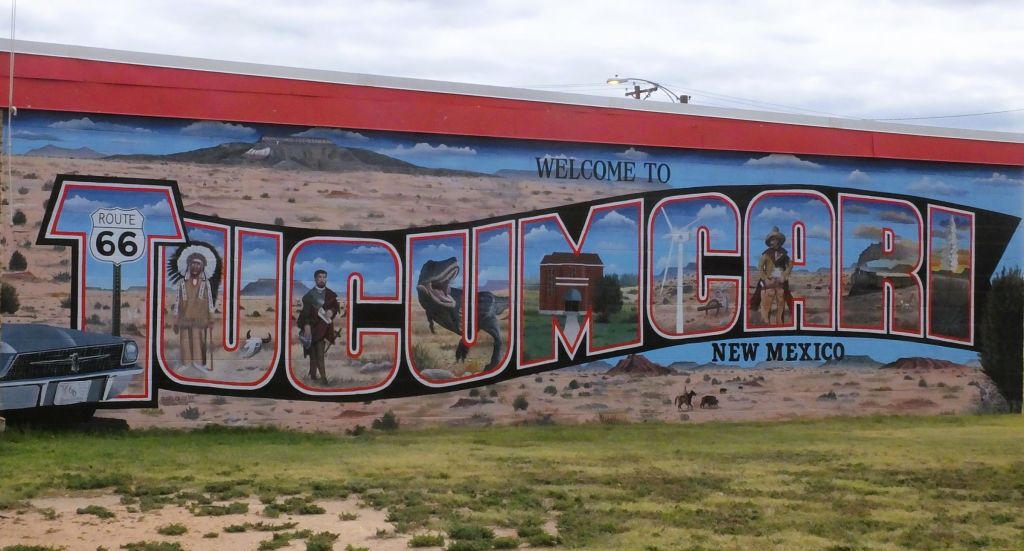
Tucumcari was once a major stop for travelers on Route 66, America’s Mother Road. On the edge of town there’s a whimsical Route 66 monument with a sloped sandstone base inscribed with tires and serpentine two-lane highway. It is topped with stylized sixes atop a 1950s tail fin and lights.
Tucumcari’s monument to Route 66, the Mother RoadMany towns have welcome murals like this one in Tucumcari
There are lots of small motels with names like Palomino Motel, Roadrunner Lodge, Relax Inn, Motel Safari, Pow Wow Inn and Buckaroo Motel that are closed or repurposed. A few remain open to offer lodging to nostalgic travelers.
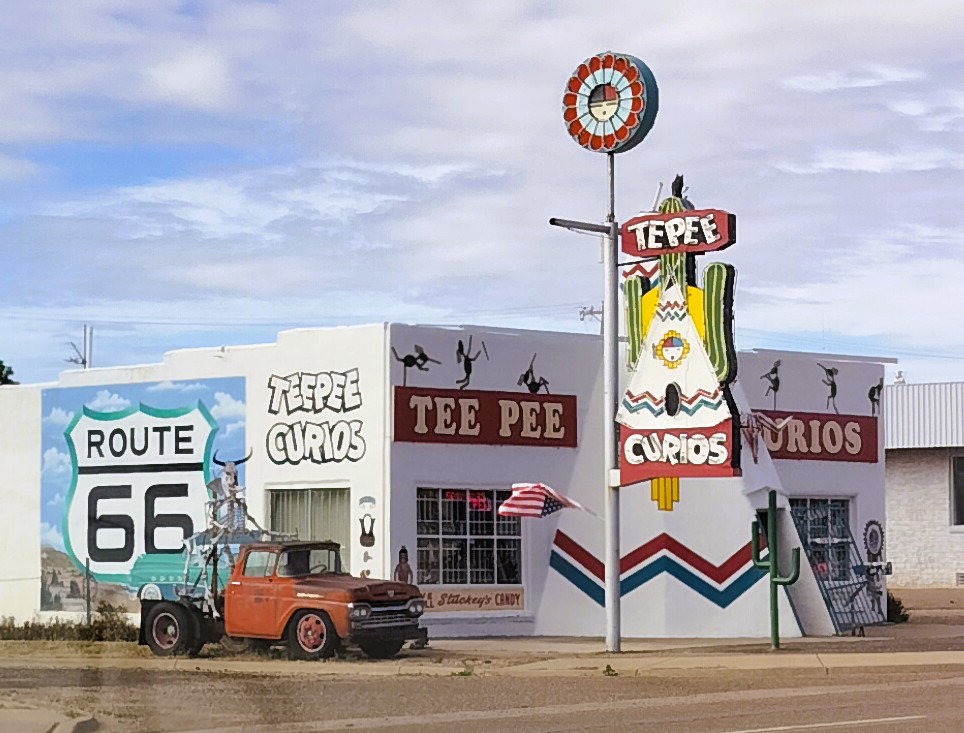
Tucumcari also has a variety of curio shops
Cambodian Donut Cartel?
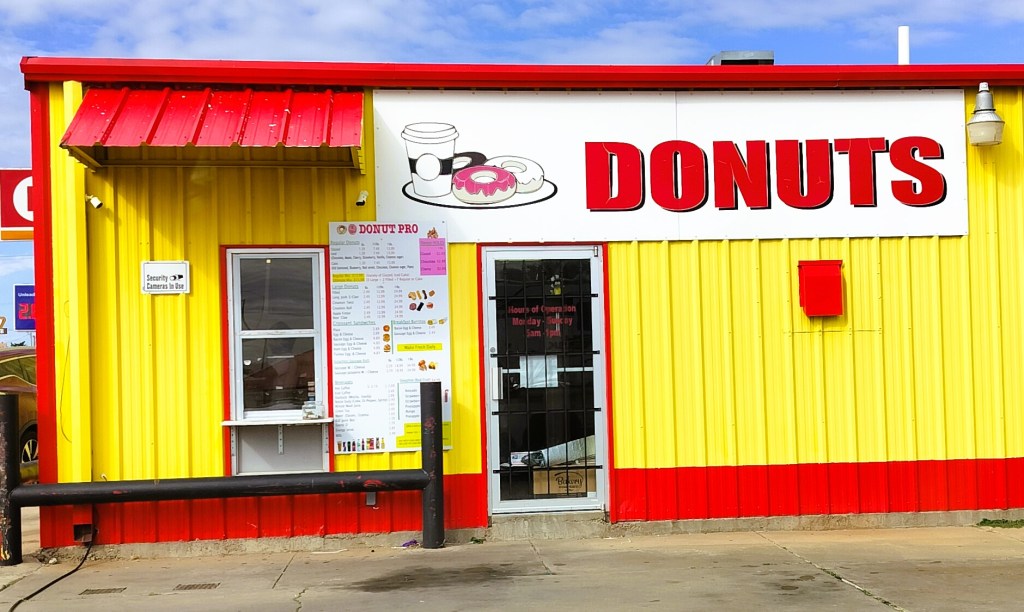
At Tucumcari Donuts we learned an interesting piece of the American story.
Tucumcari Donuts – part of the Cambodian Donut cartel?
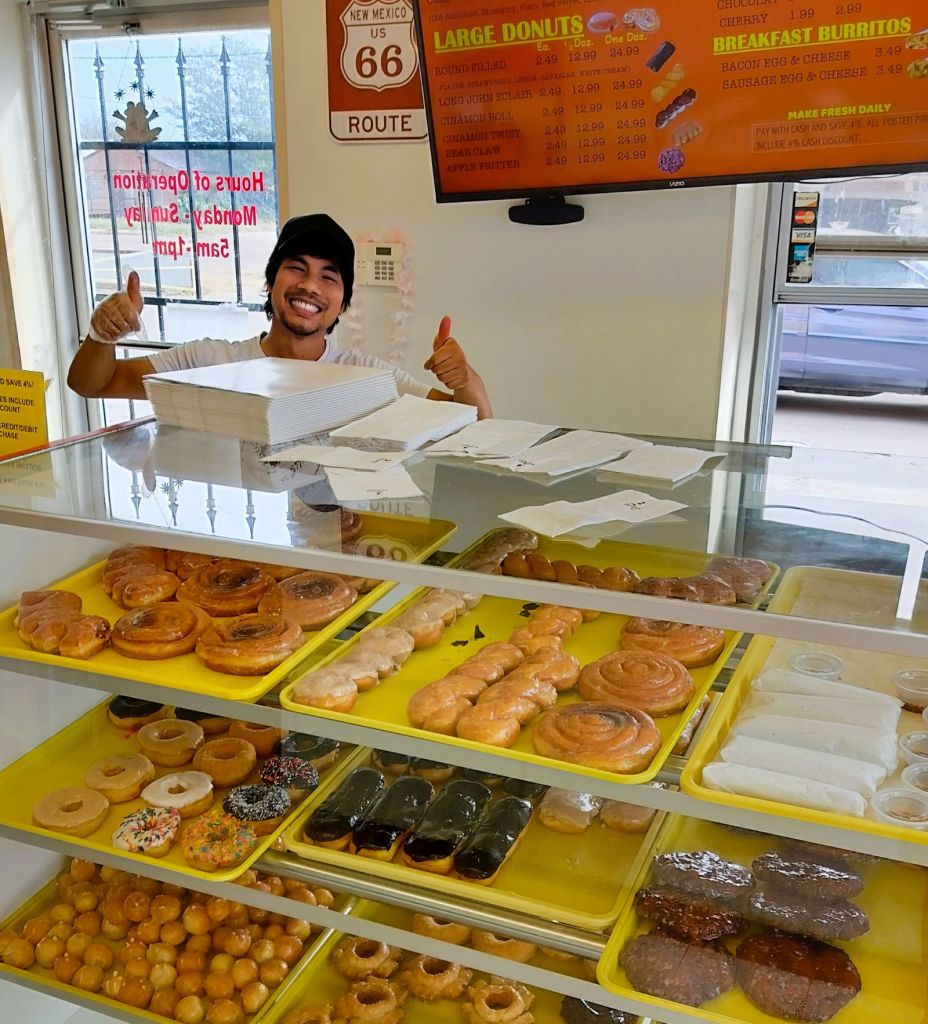
A young Asian man served us donuts and coffee and told us his family was from Cambodia. At similar donut shops in Missouri, Colorado and east Texas we learned the employees were also of Cambodian descent.
This friendly fellow with Cambodian heritage poses with amazing donuts!
Cambodian-owned donut shops are a huge part of the American donut scene, many stemming from refugees finding opportunity in America in the 1980s. The shops were pioneered by Cambodian Ted Ngoy (the Doughnut King), who helped fellow refugees start their own businesses.
Not Up to the Challenge
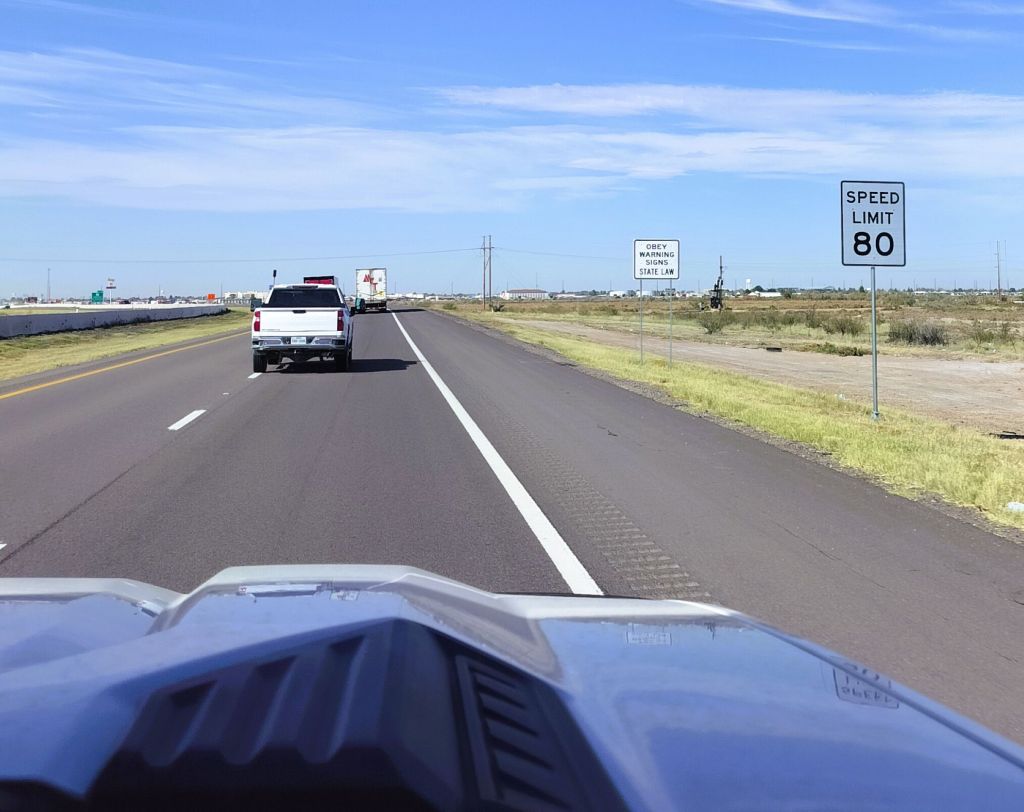
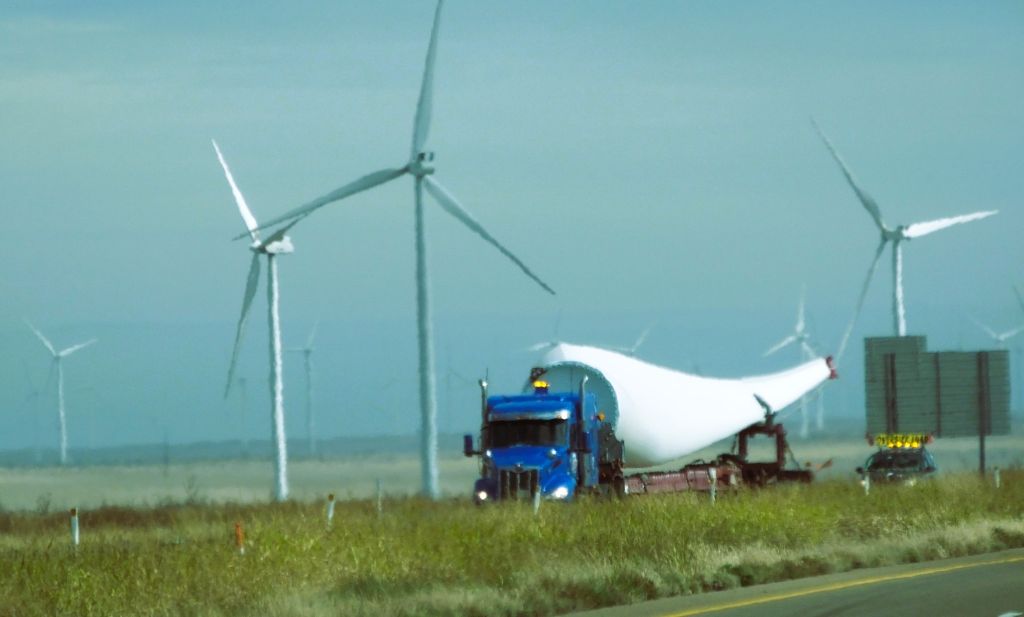
Trucks and cars zipped by us on Texas I-40. We poked along at 60 mphA long windmill blade traveling along I-40 will be added to one of the thousands of already-installed windmills on the Texas panhandle
We continued east to the Texas panhandle. The flat terrain was punctuated with THOUSANDS of Texas-sized spinning windmills.
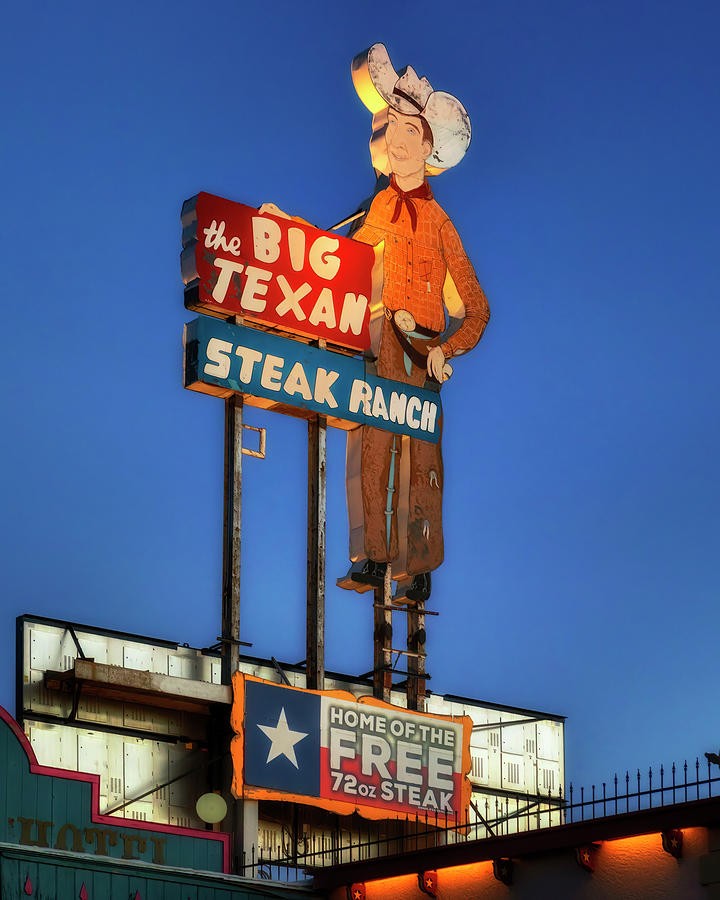
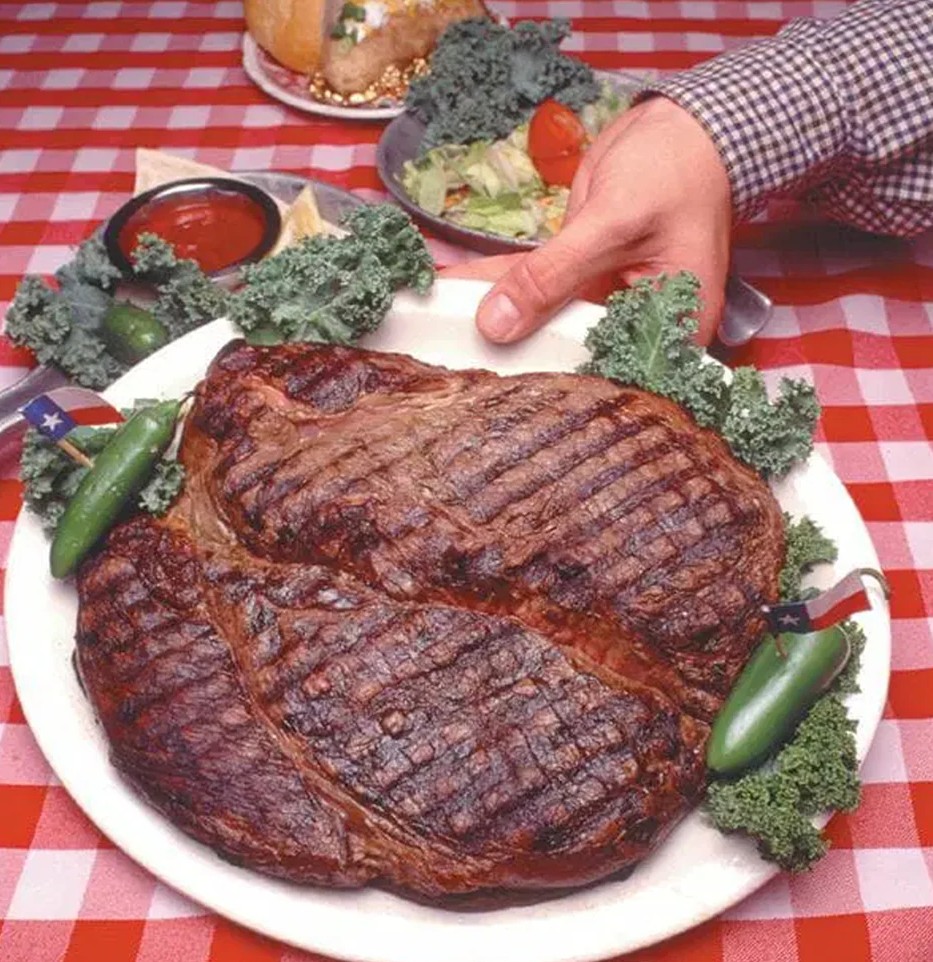
Like the omnipresent Buc-ee’s signs on interstate highways elsewhere, there were frequent signs encouraging a stop at The Big Texan Steak Ranch in Amarillo. The steakhouse is home of the world famous 72-ounce steak challenge: eat a 4½ pound steak and fixings in less than an hour and it’s free. Otherwise, the belly-busting meal will set you back $72!
Eat the 72-ounce steak at the Big Texan Steak Ranch in less than an hour and it’s free!
We weren’t up to the challenge. Full of our mid-morning donut snack, we passed by and turned south toward the second largest canyon in the United States.
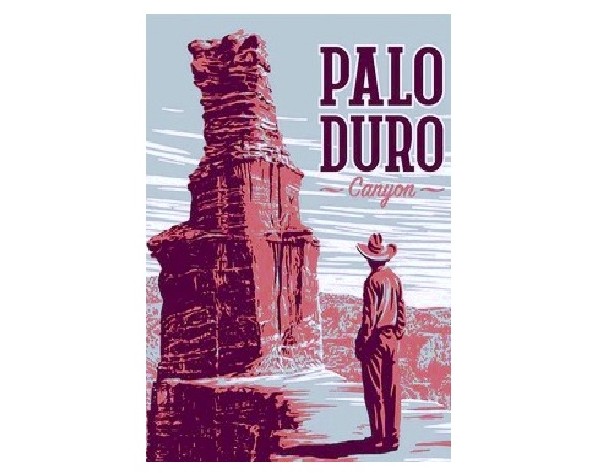
Palo Duro Canyon
Nicknamed “The Grand Canyon of Texas” both for its size and dramatic multicolored rock layers and steep mesa walls, Palo Duro is about 40 miles long, six miles wide (20 miles wide at places) and 800 feet deep.
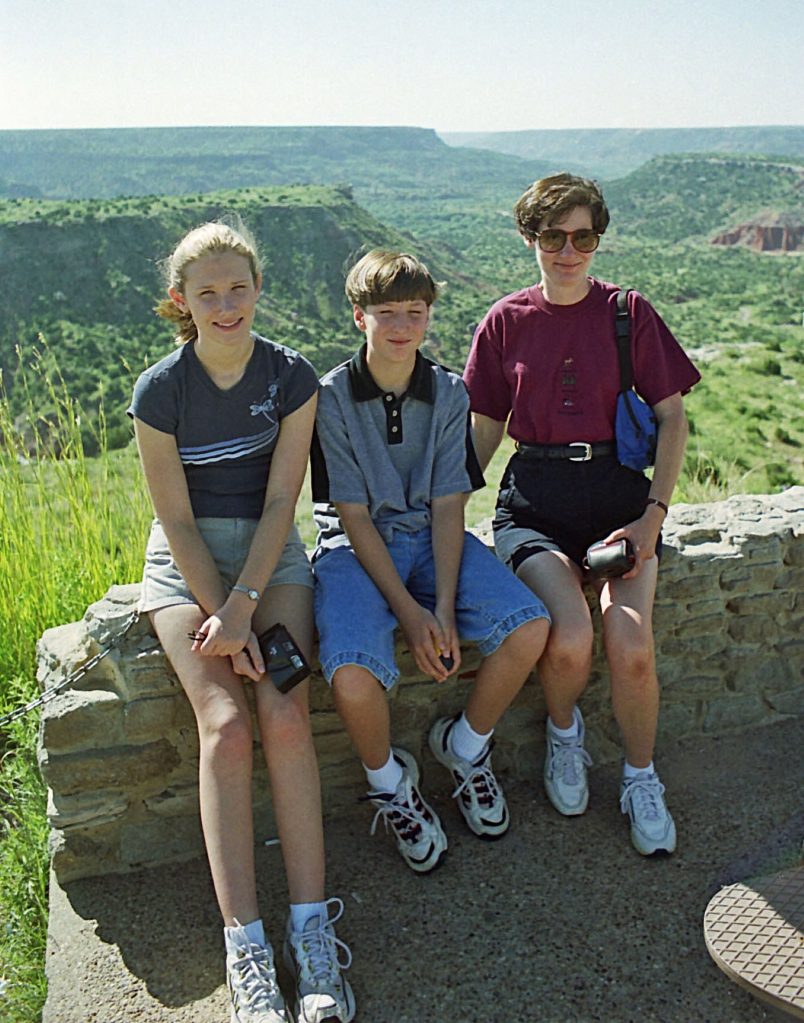
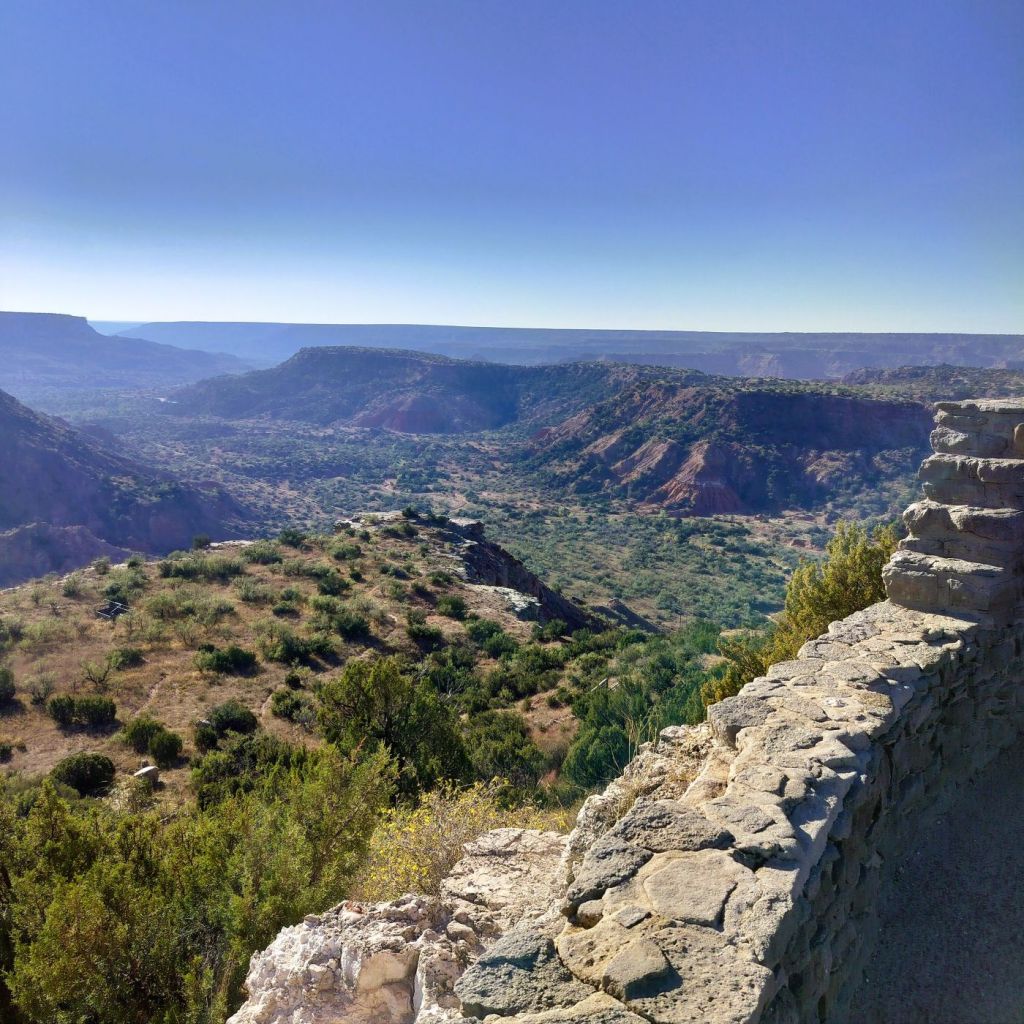
Liz, Phil and Pat during a 1999 visit to Palo Duro Canyon.2025 view of Palo Duro Canyon from same rock wall as 1999 family photo
Much of the canyon is contained within a Texas state park. The visitor center at the canyon’s rim has sweeping canyon views and in 1999 I took the family photo above as we enjoyed our first view of the canyon. How time flies!
From the viewpoint, the road quickly descends to the bottom of the canyon. The layered and multicolored canyon framed the road as we drove to the campground where we would stay for the next two nights.
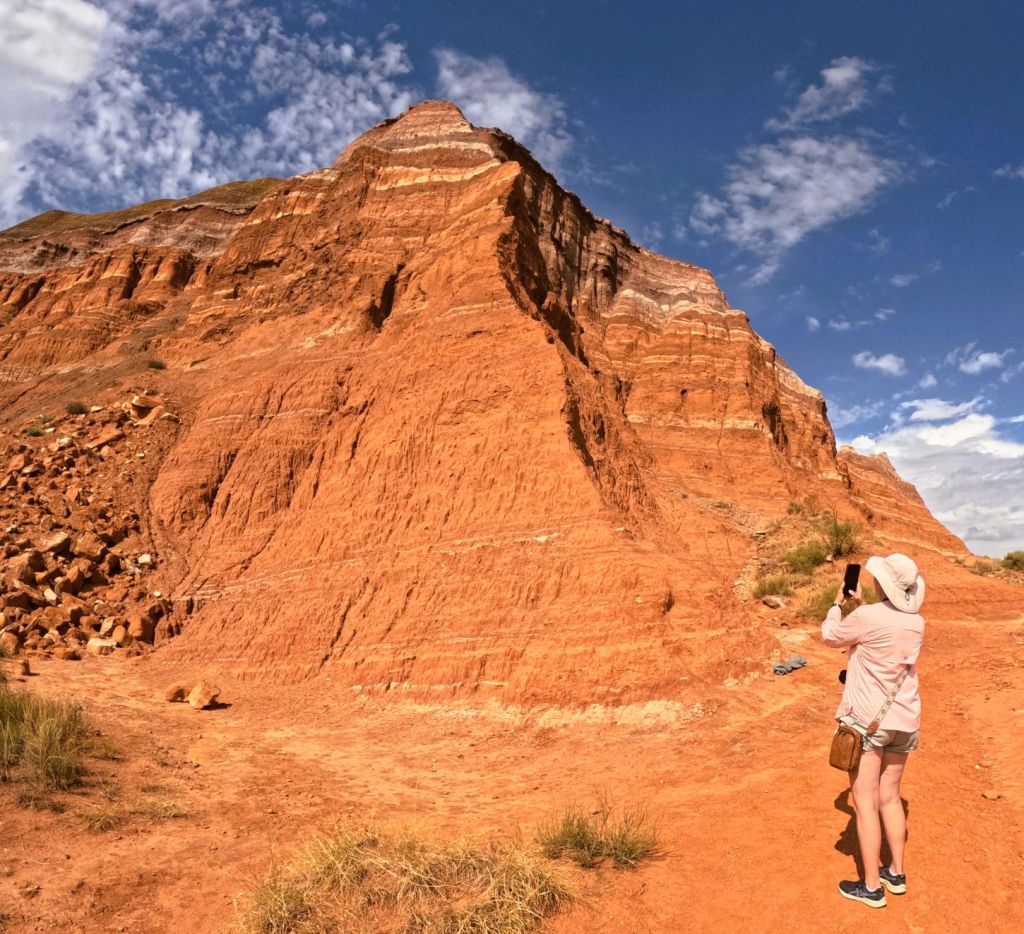
Photographing the colorful layered canyon wall at Palo Duro State Park
We were greeted by Bullet (his real name), a campground host originally from Amarillo. He was a rodeo cowboy in his teens and later owned an Amarillo copier service business. Now retired, he has been a fulltime volunteer at three different Texas state parks for more than a dozen years.
He helped us set up and provided useful details about the campground and things to do in the park.
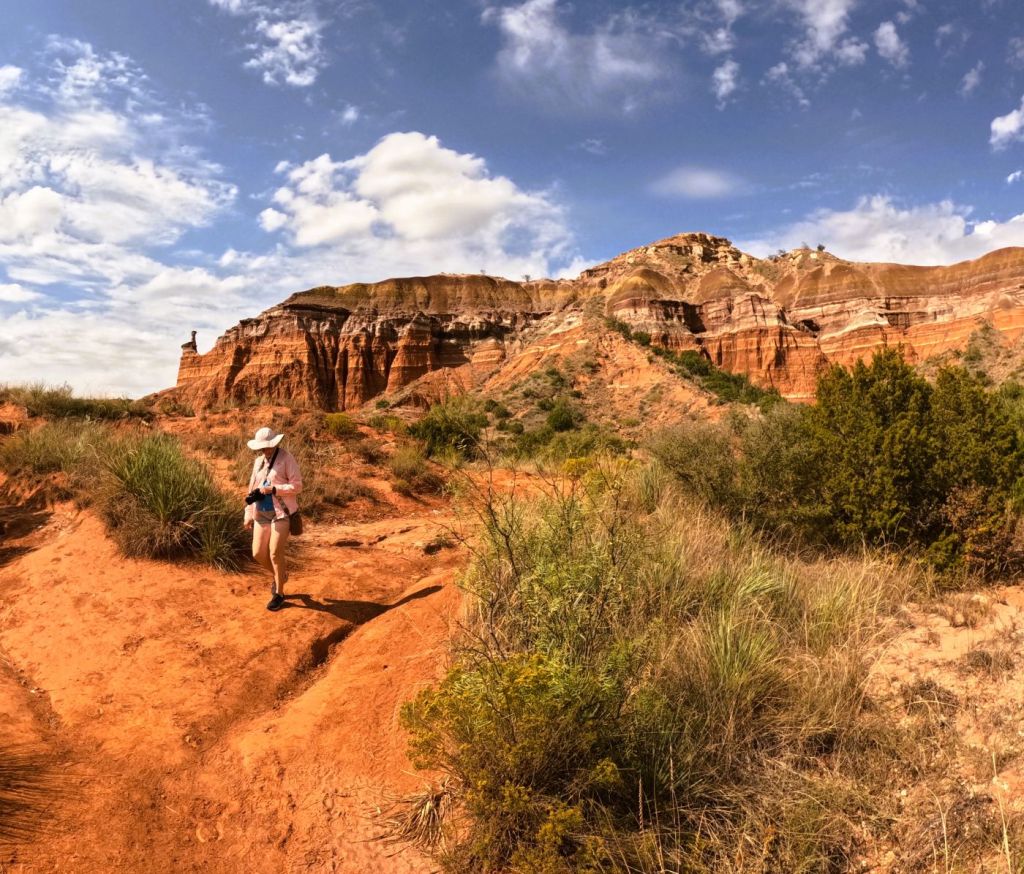
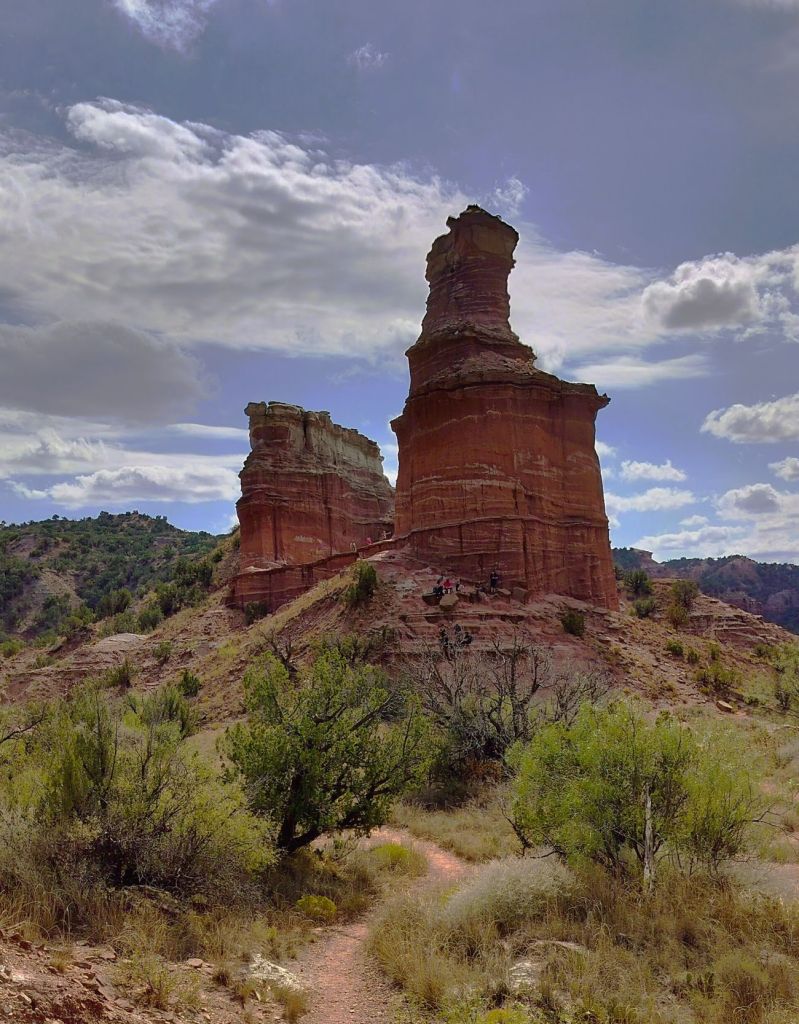
Pat carefully hikes into a low area along the Lighthouse TrailZoom this photo to see people on the ledge between the two formations – the Lighthouse is on the right
Six miles = Muscle Aches?
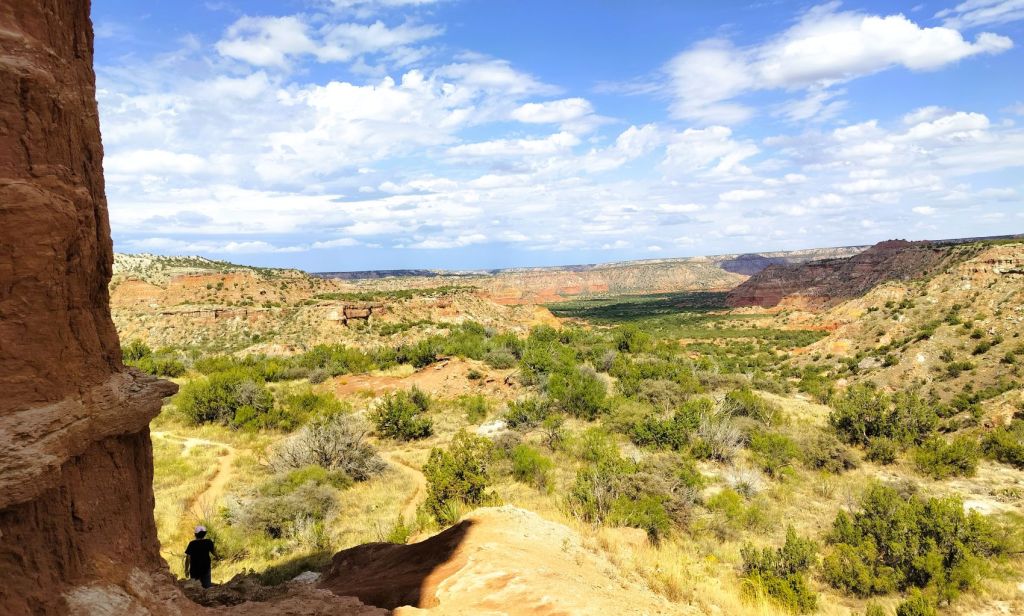
We decided to hike three miles to the iconic Lighthouse formation, prominently displayed in park promotional brochures. The mostly flat trail weaves through several canyons before the steep quarter-mile climb to the Lighthouse. After a precarious scramble to the base of the formation, we had great views of the broad canyon.
Sweeping view of Palo Duro Canyon from the Lighthouse
The hike was worth a few minor muscle aches!
Balloons and Beyond – Wrap-up
Palo Duro was our first Texas state park during our fall 2025 Balloons and Beyond travels. Next episode we wrap up the series with visits to five more Texas state parks as we cross the state on our way home.
Don’t forget to LIKE our blog posts and to SUBSCRIBE for future updates
We left New England enjoying the warm, hazy days and cool nights of mid-August.
We endured several days of heavy rainfall as we crossed Vermont and New York. While camping on the St. Lawrence River, we watched big ships and wondered if any would be traveling nearly 2500 miles across the Great Lakes to Duluth, MN, a stop we made earlier this summer.
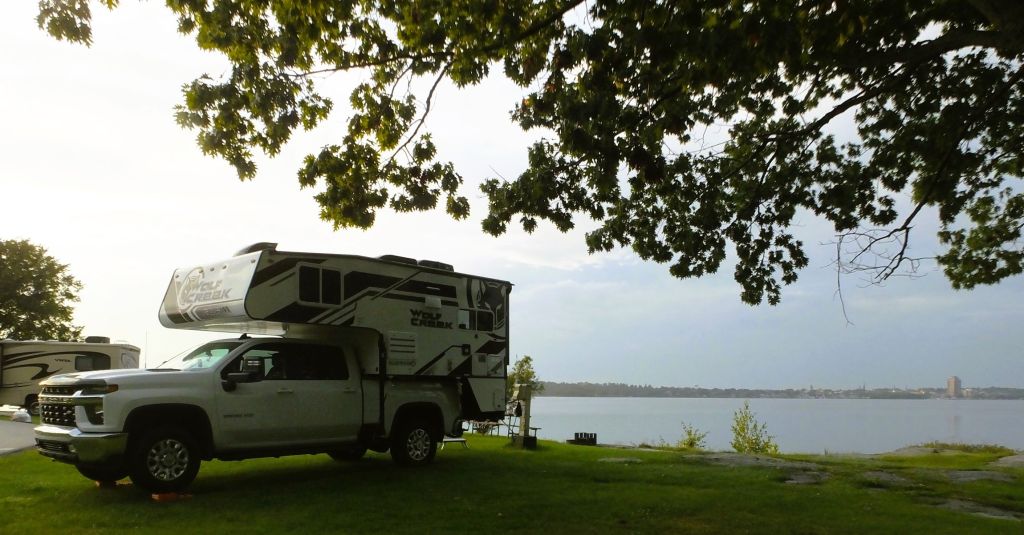
Camping on the St Lawrence River. The far shore is Ontario, Canada.
The next night we camped close to where the St Lawrence flows out of Lake Ontario. Our campground was covered with large puddles and the ground was squishy everywhere. We left our shoes on the back step of Pap to avoid tracking mud into the camper!
Fishes and Falls
The next morning, we visited a fish hatchery nearby on the Salmon River. The hatchery was opened in 1981 to raise king and silver salmon and trout.
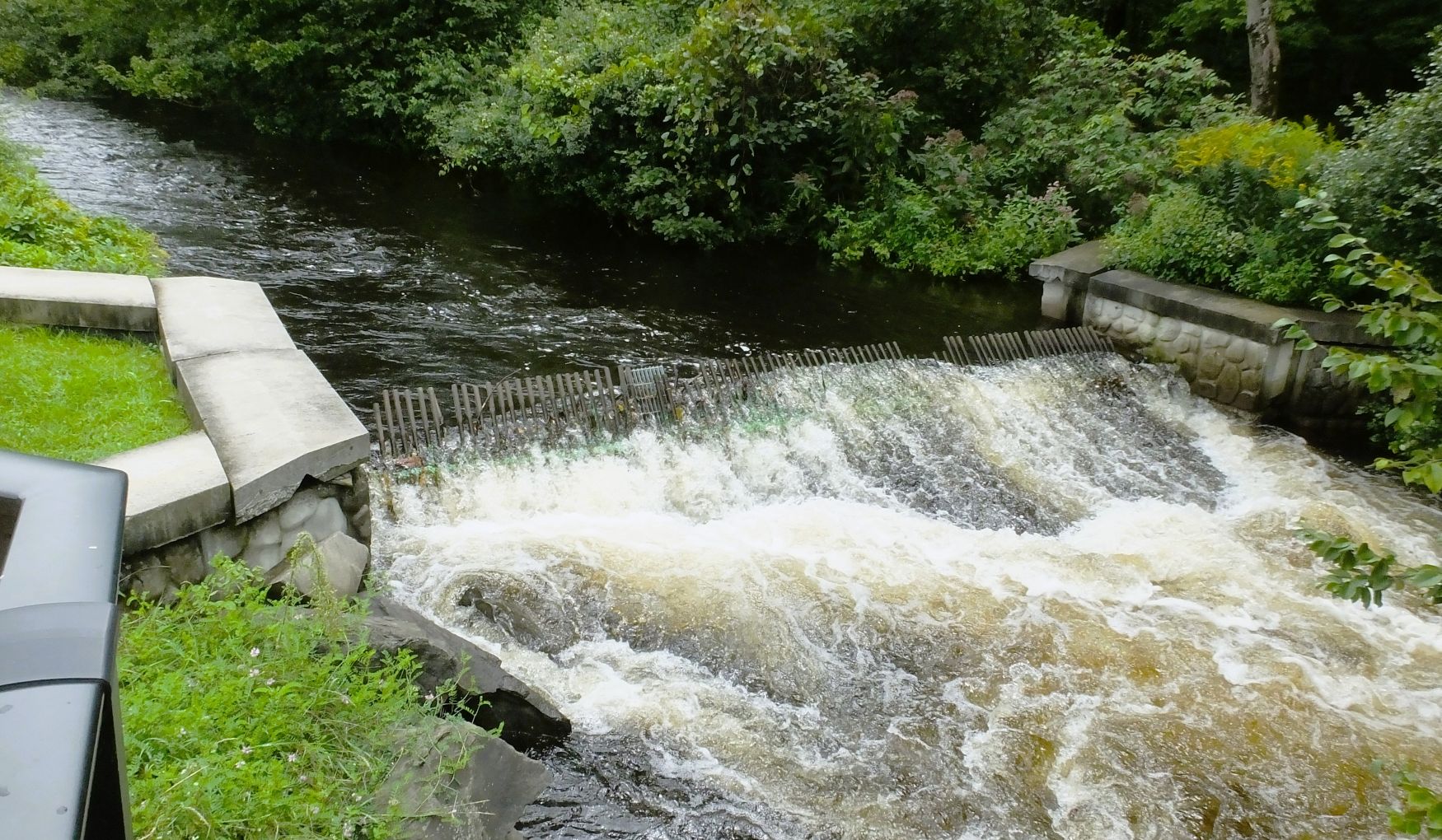
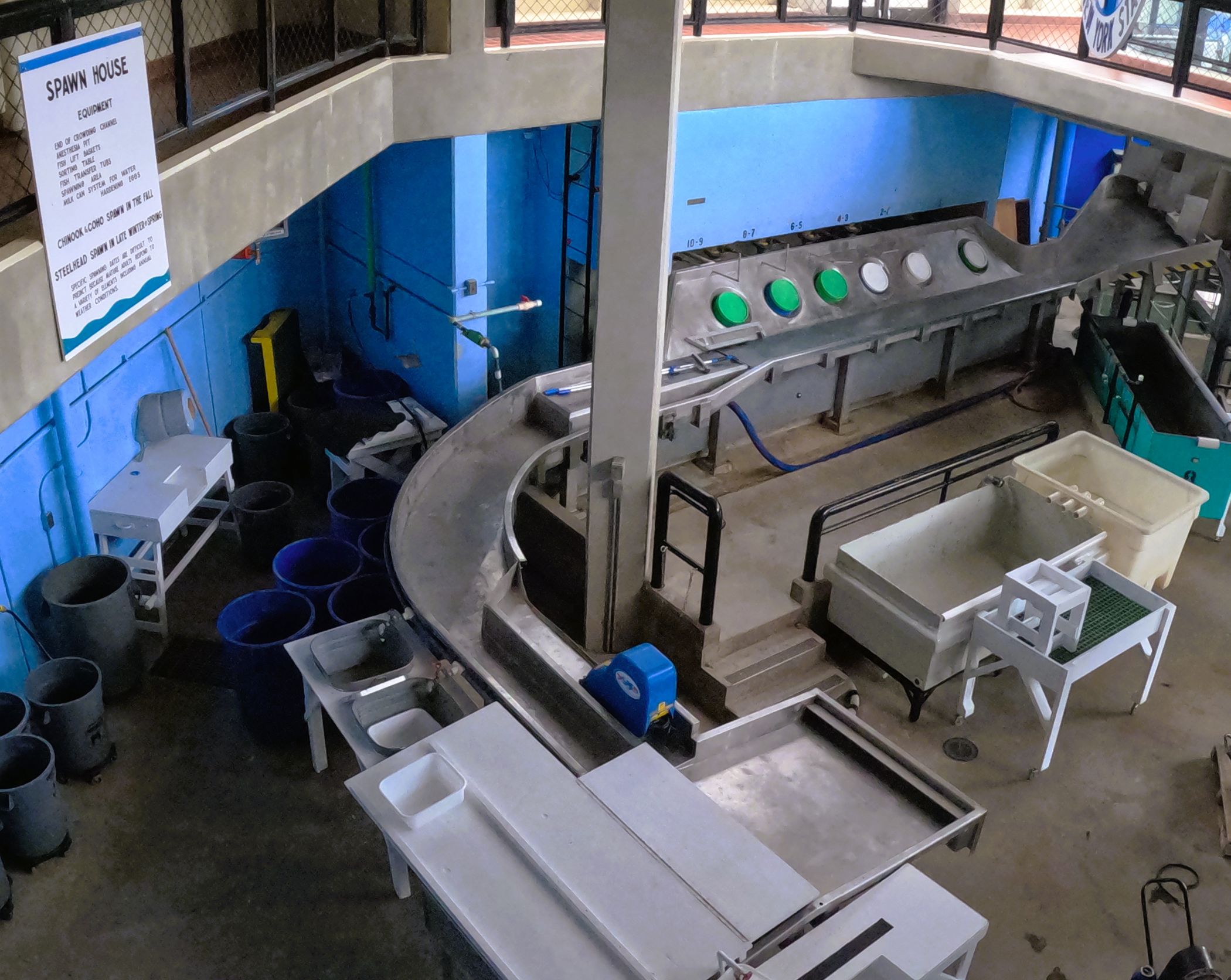
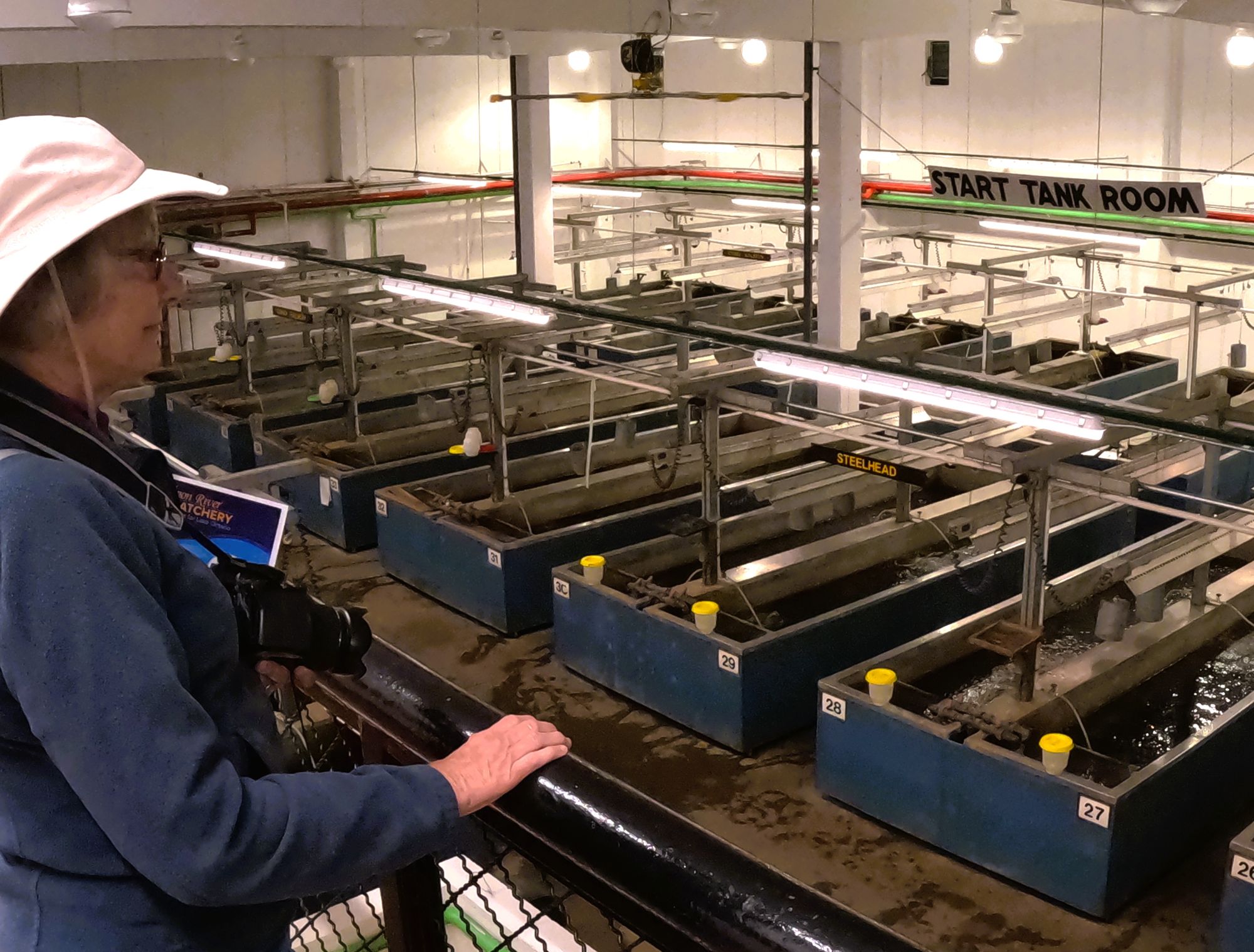
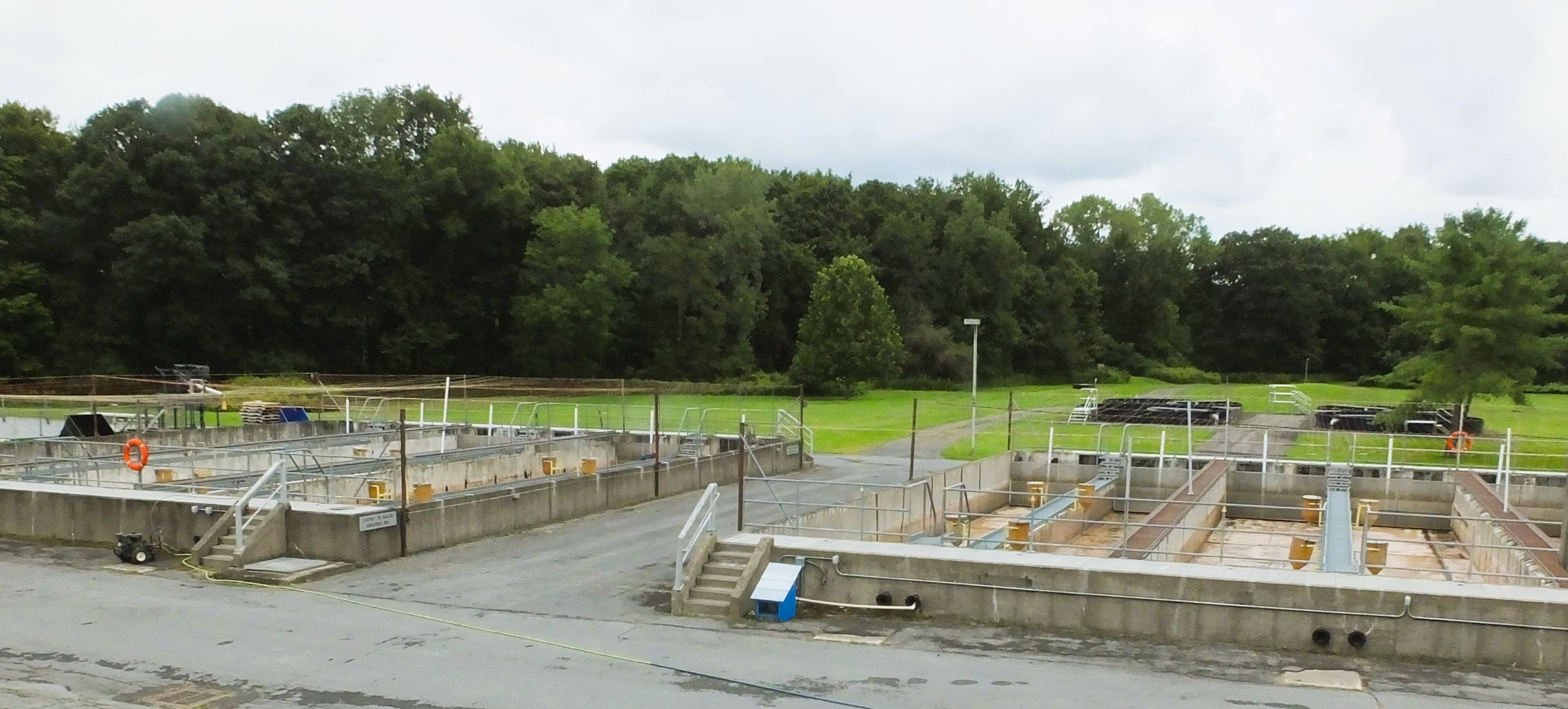
Salmon River Fish hatchery: stream where fish are directed to fish ladder, room where eggs and milt are harvested, developing fish are raised in indoor tanks and then transferred to outdoor tanks before being released
Millions of eggs are collected from adult fish, hatched, raised and released throughout New York’s Great Lakes and the rest of the state. Egg harvesting takes place in the spring and fall, so it was quiet during our visit (mid-August). We were reminded of hatcheries visited on past trips to Alaska and Oregon.
The Salmon River Falls were nearby, and we decided to check them out.
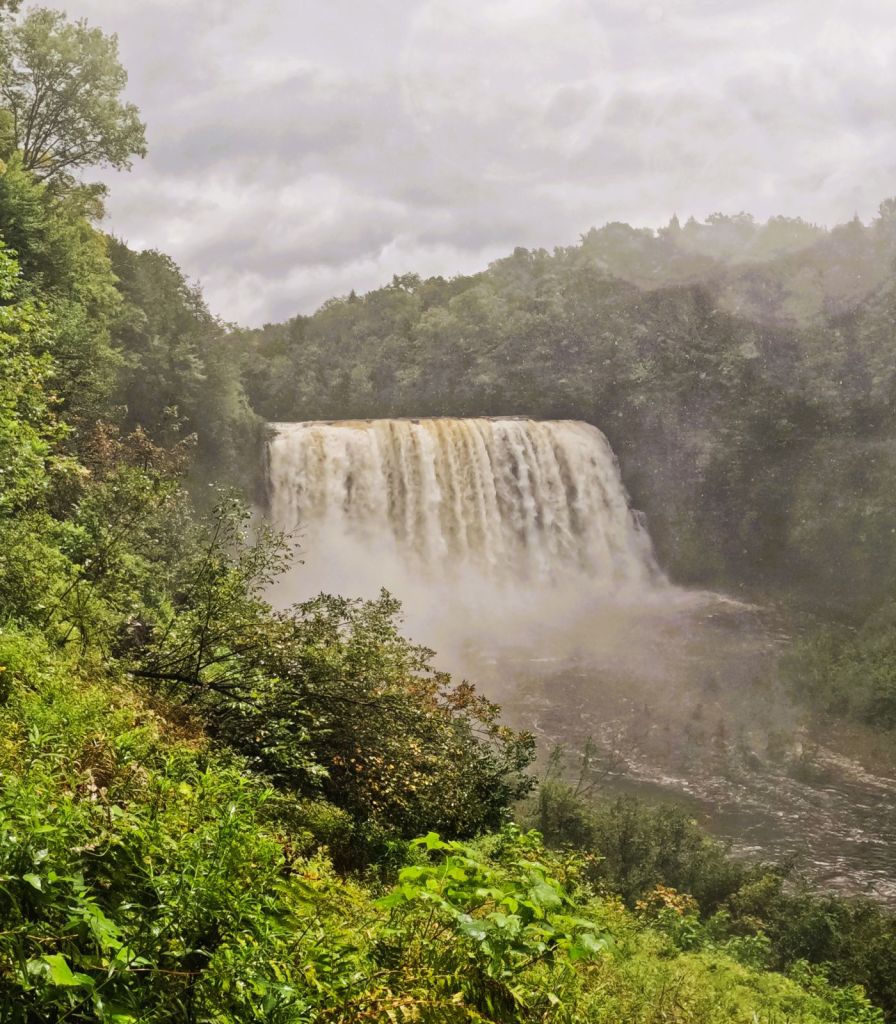
Salmon River Falls, swollen by the recent heavy rains
The falls were amazing! Swollen from the recent rains, we could hear the falls nearly a mile away. We carefully walked down a steep trail towards the base of the 110-foot falls but had to turn back to avoid being soaked by the falls’ mist cloud!
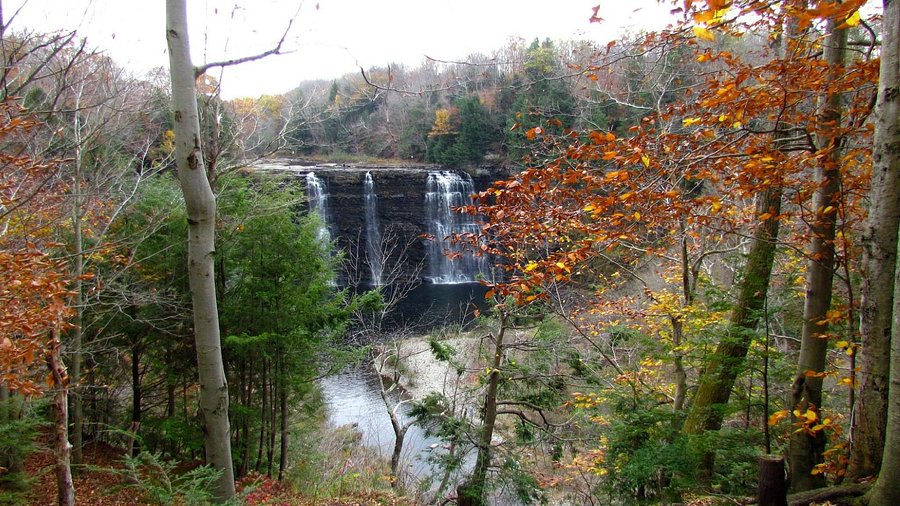
Salmon River Falls at normal water levels
More Waterfalls
Our travels continued south into Pennsylvania, enroute to Ricketts Glen State Park.
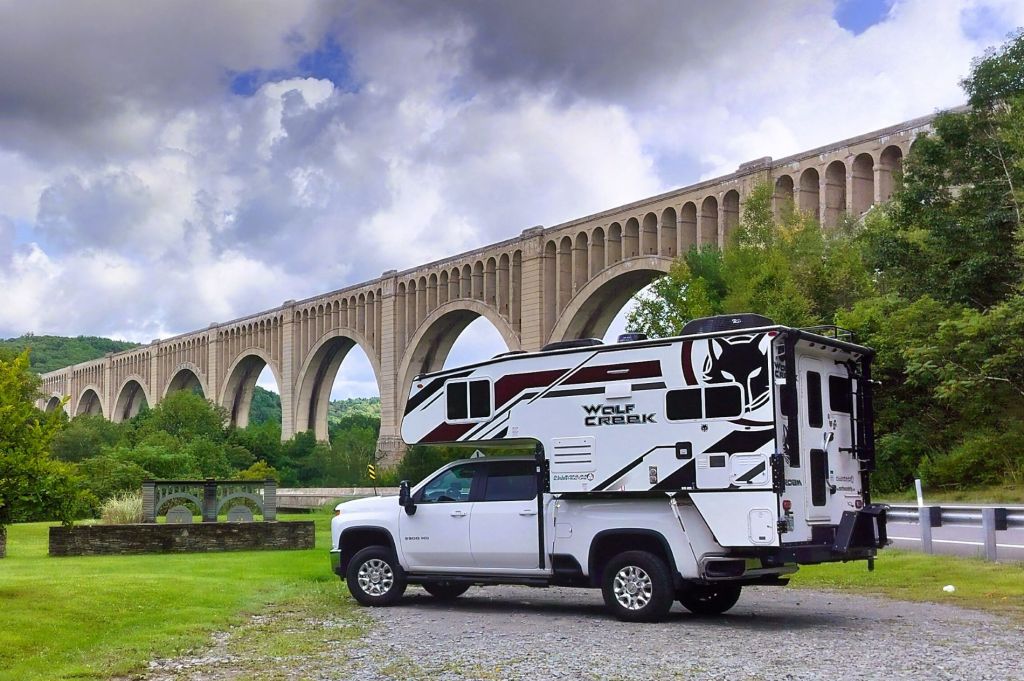
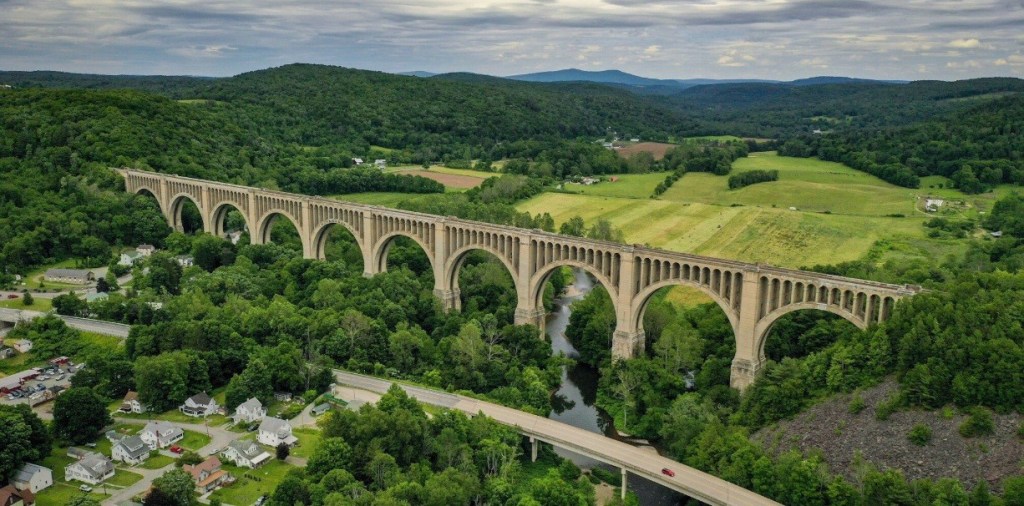
Percy and Pap posing at Tunkhannock Creek ViaductAerial view of the viaduct (image from Google)
Passing through Nicholson, PA, we stopped at the Tunkhannock Creek Viaduct. Completed in 1915, the half-mile long viaduct was the largest concrete bridge in the world at the time and regarded by some as the ninth wonder of the world. The impressive structure is nearly 300 feet tall and still in use by Norfolk Southern freight trains.
22 Falls at Ricketts Glen
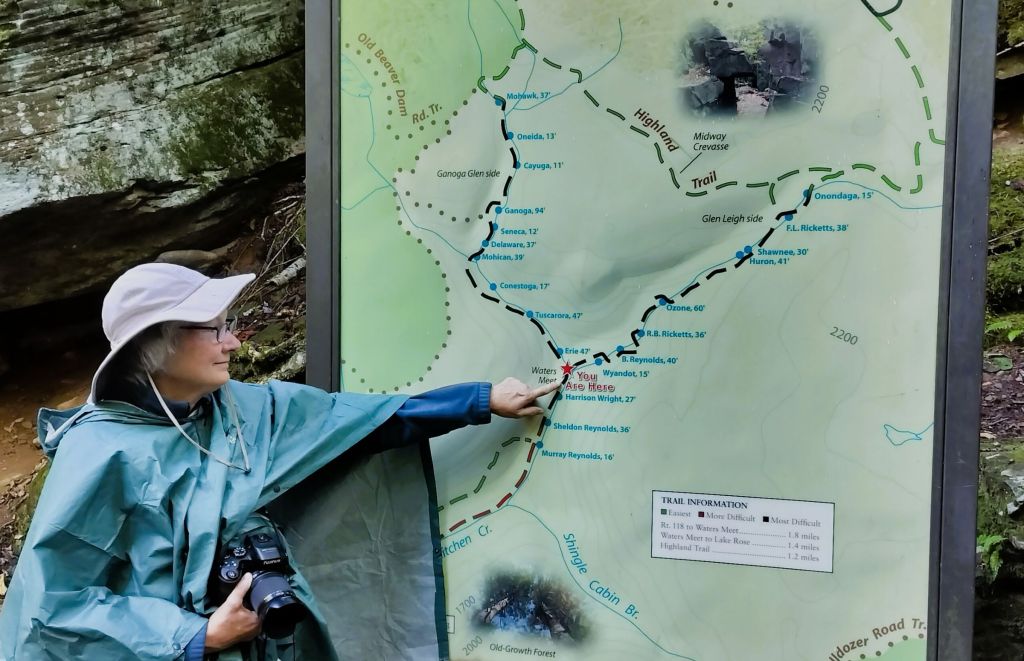
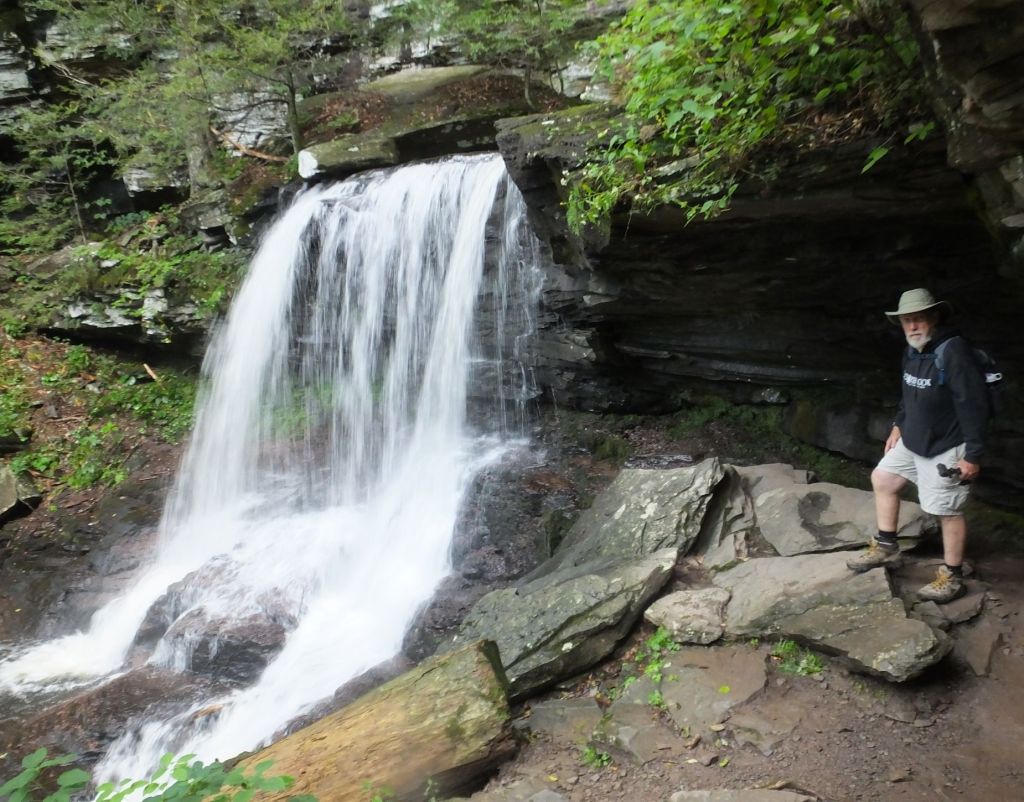
If you have a wish to see waterfalls, Ricketts Glen SP is the place for you. In just over five miles of rocky, steep trails you can view 22 named waterfalls. At 94 feet, the park’s tallest waterfall isn’t the size of Niagara (or Salmon River) Falls, but it and the other falls are beautiful.
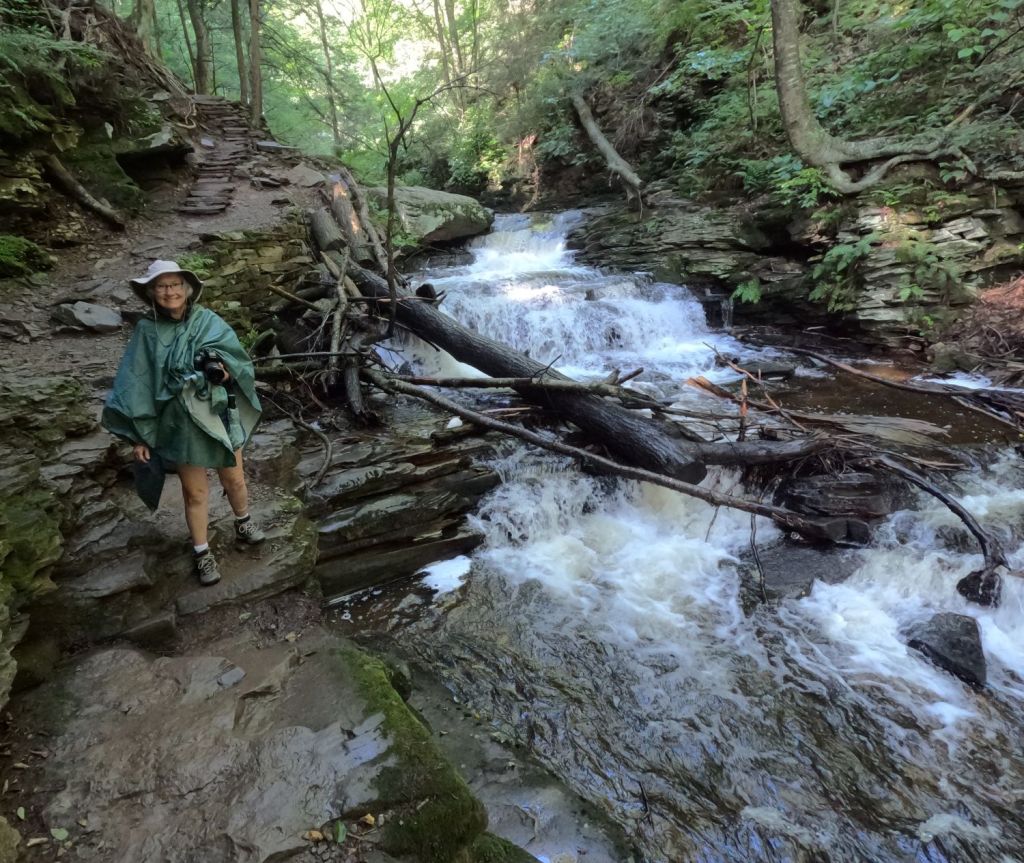
Waterfall hiking at Ricketts Glen
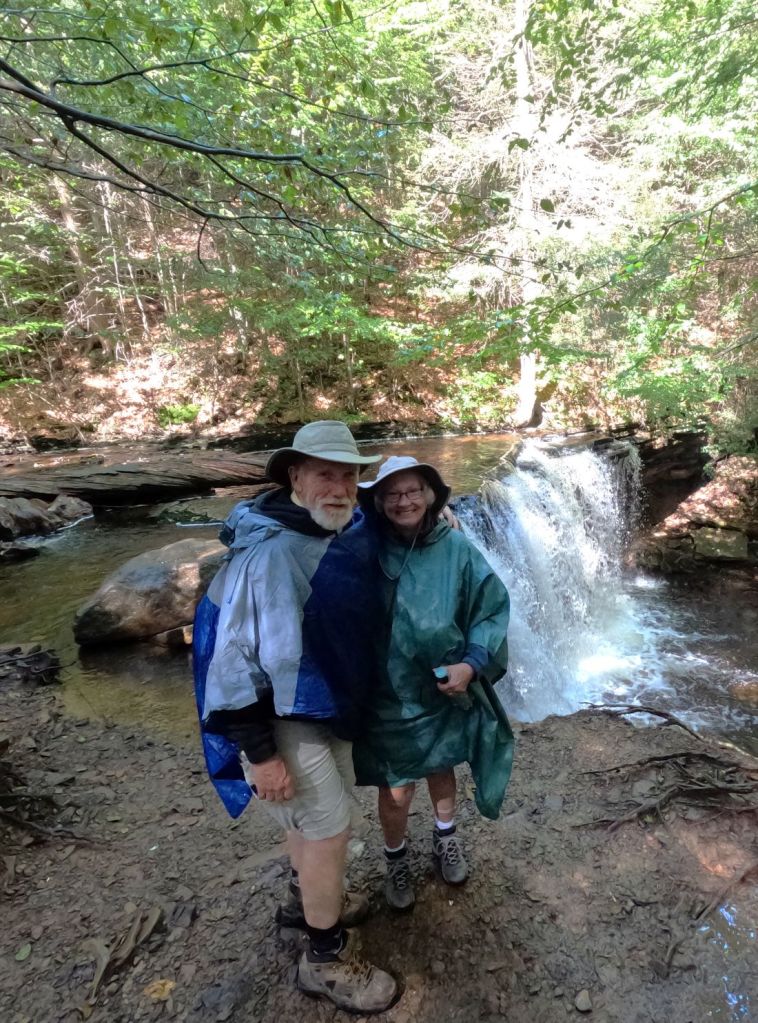
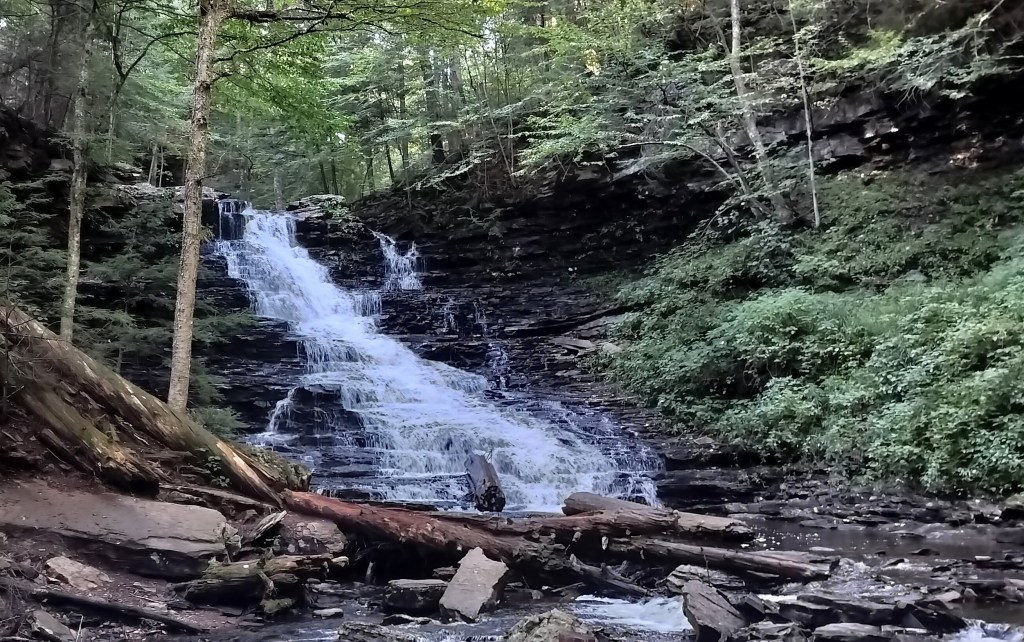
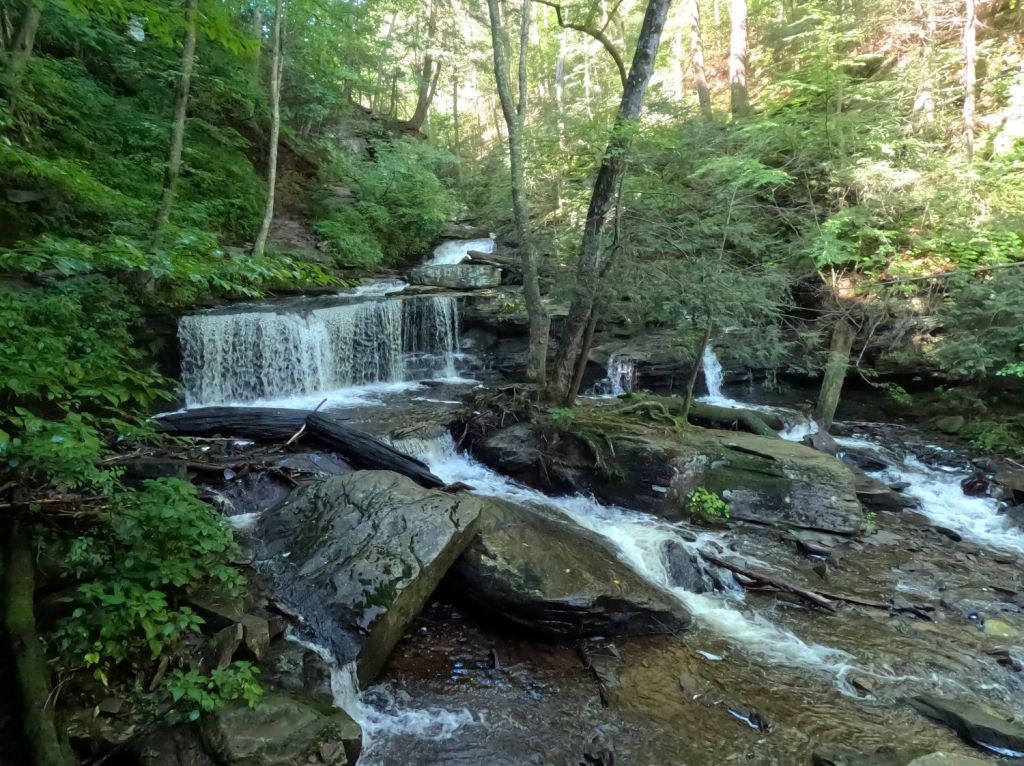
Our 3.5-mile waterfall hike went past 18 of the falls (the others are on a side trail that we didn’t take). It was raining when we started, so we carefully descended nearly 500 feet down steep slick stairs and across large boulders. The falls were various sizes, and we stopped at each to enjoy the peaceful tranquility.
Various photos of our hike to 18 waterfalls at Ricketts Glen SP
The rain had stopped by the time we reached the bottom of our descent. We paused for a snack and enjoyed talking with other hikers, comparing the falls and reviewing trail conditions.
Stopping to look at another beautiful waterfall
The return part of the trail was a little easier. Conditions were drier and, for us anyway, it always seems easier to climb a steep trail and stairs than the opposite.
The park has other trails and a nice lake. It is well worth a visit if you travel through central Pennsylvania.
Harper’s Ferry
We drove southward from Pennsylvania into Maryland, then a tiny bit of Virginia and finally West Virginia.
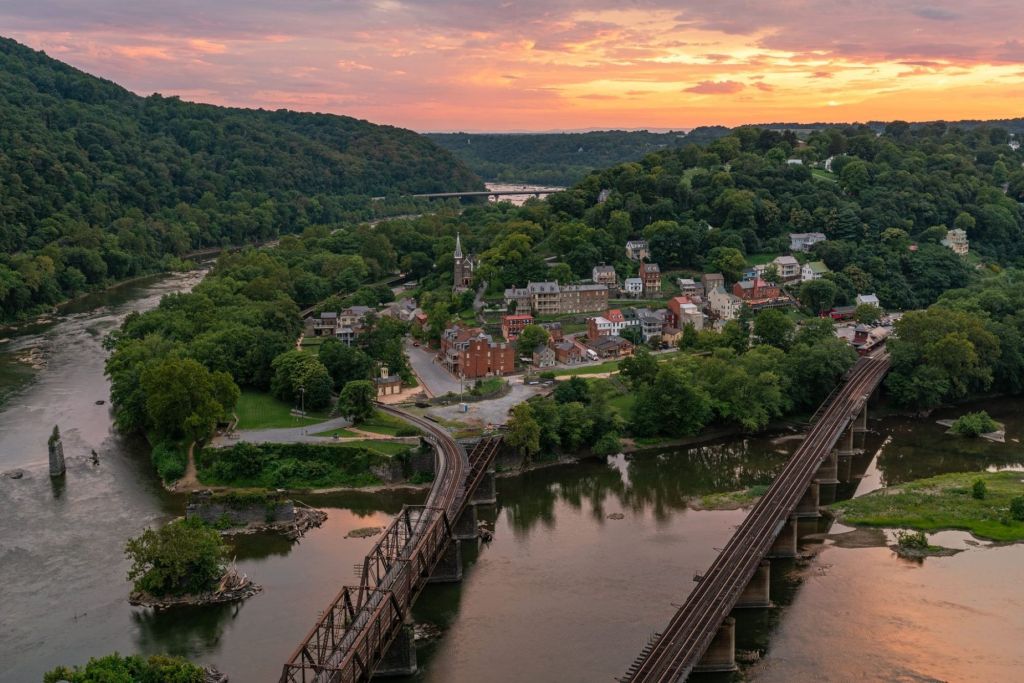
Harpers Ferry, WV (image from Google)
We visited Harpers Ferry National Historic Park at Harpers Ferry, WV. The town is at the confluence of the Potomac and Shenandoah Rivers where Maryland, Virginia and West Virginia meet. It is interesting looking around the well-preserved historic area.
We learned the town was the northernmost point of the Confederacy during the Civil War. It is also where abolitionist John Brown led a raid on the federal armory in 1859, hoping to start a slave rebellion.
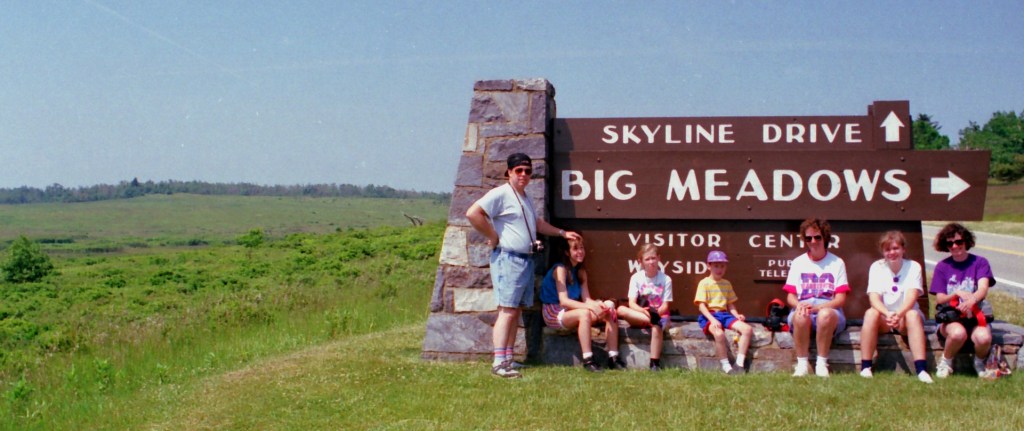
1993 Visit to Big Meadows with Pat’s sister and family
Driving the Shenandoah Skyline
Some of our favorite vacations over the years have been driving the Skyline Drive in Virginia’s Shenandoah National Park and the Blue Ridge Parkway in Virginia and North Carolina.
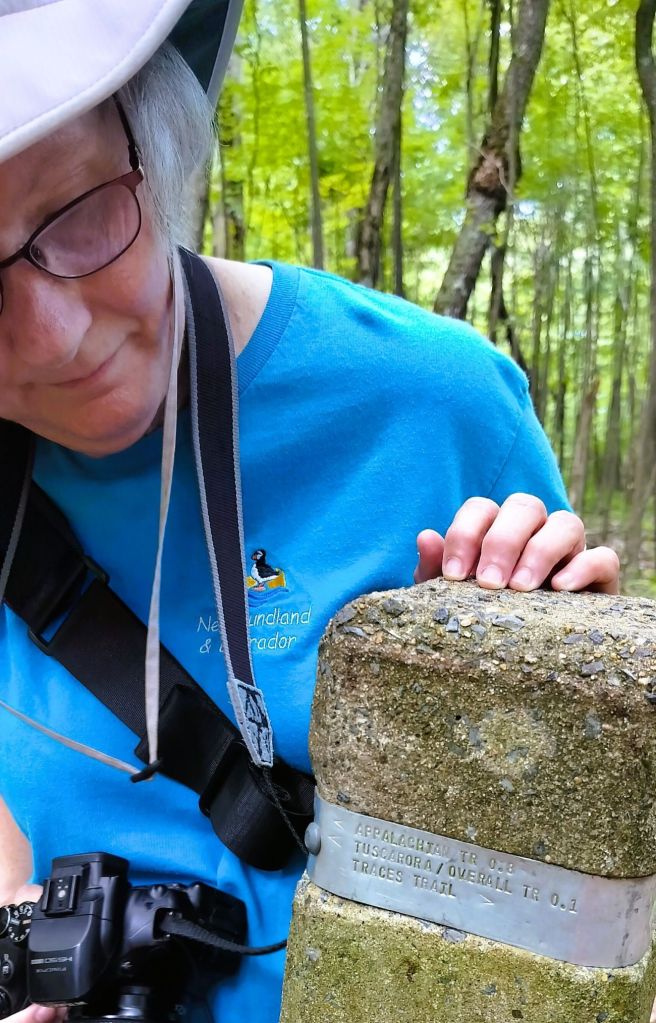
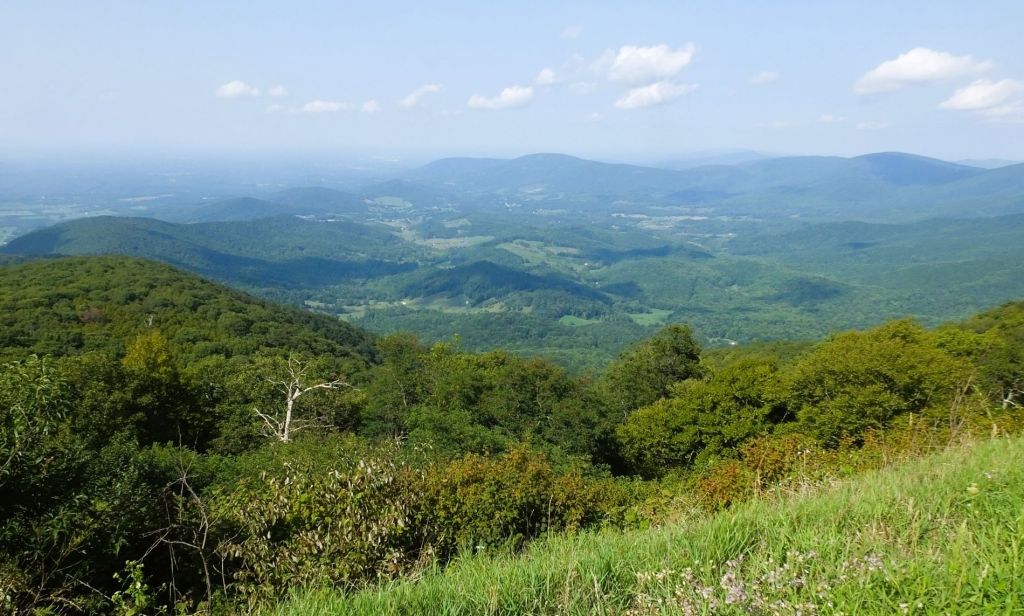
This trip we camped several nights at Matthew’s Arm campground at the northern end of the drive. We hiked several short trails that took us along the Appalachian Trail. The views of nearby valleys and distant mountains were nice, but not spectacular due to haze from fires in the far west.
Pat examines a band imprinted with trail information
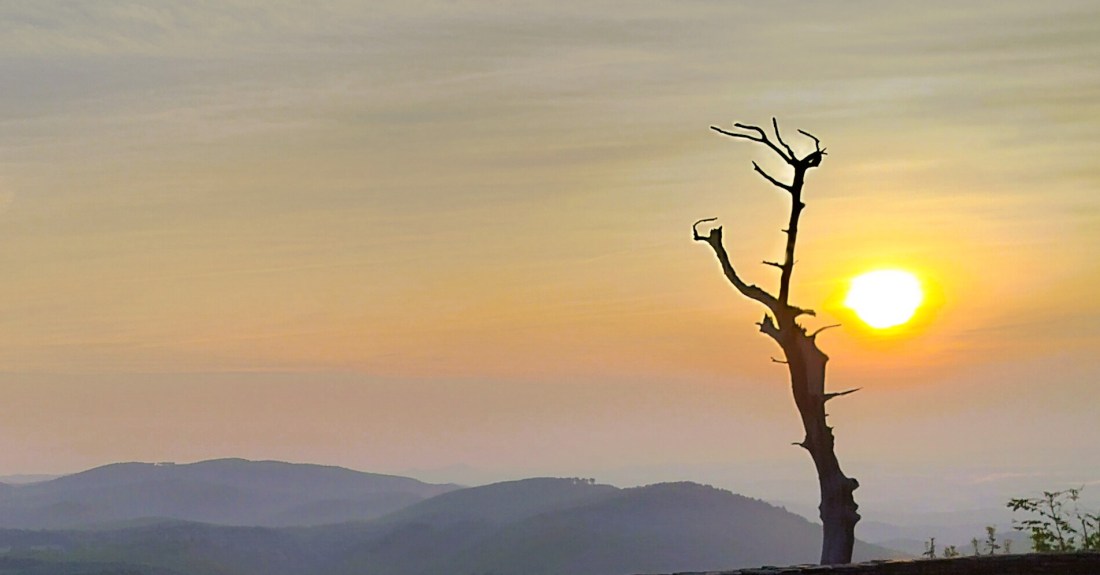
This hazy view of the valley and distant mountains was still beautiful
We stopped for lunch at Big Meadows, midway on the drive, as we continued south. Maintained by periodic burning, the 136-acre meadow is the largest open area in the park. It is covered with a variety of flowering plants as well as blueberry and blackberry bushes.
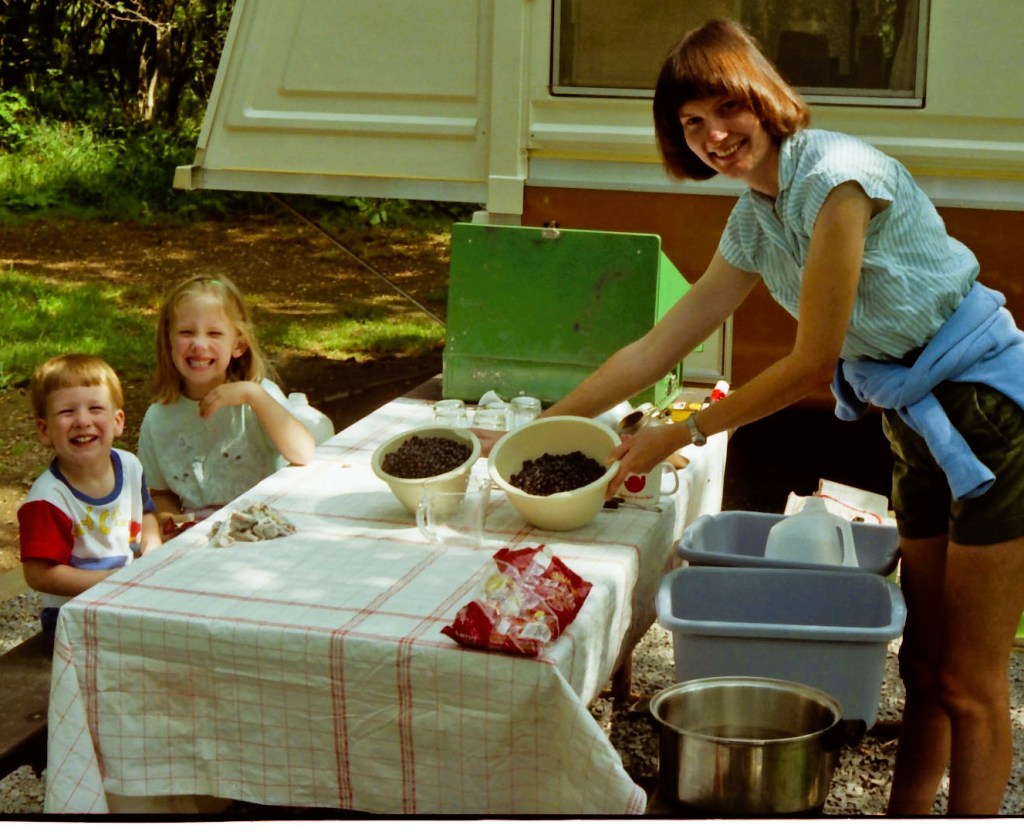
Making blueberry jam at Big Meadows in 1989
We recalled a trip with our children 35 (!) years ago when we picked blueberries and made jam at our campsite.
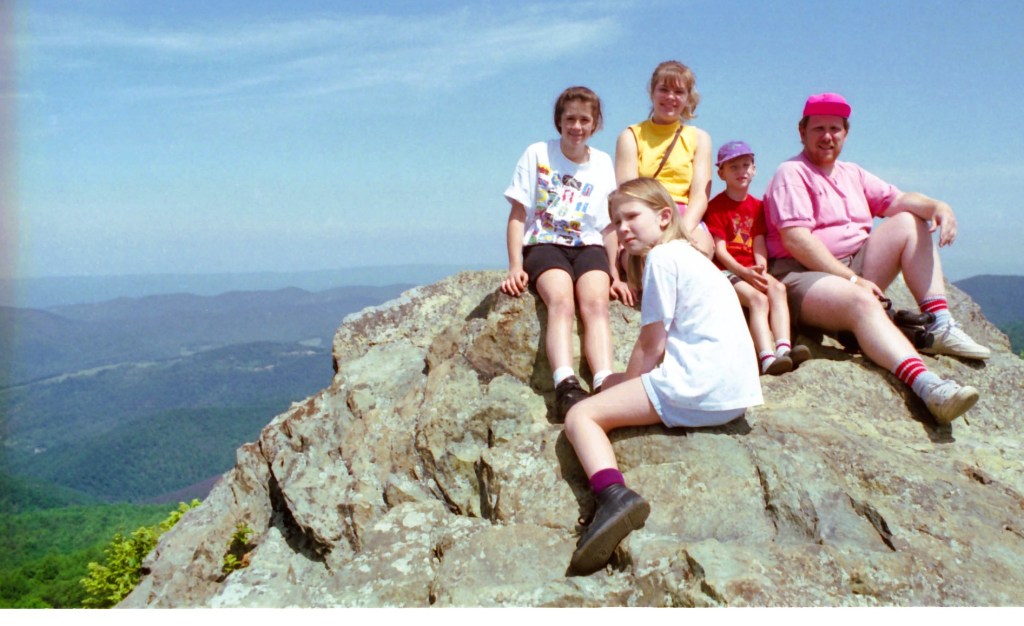
Bearfence rock scramblers, 1993
Further along we passed the trail to Bearfence. Over the years we scrambled over large, exposed boulders to a magnificent view of the distant mountains and Shenandoah Valley. One rock scaling adventure in 1993 is captured above with a photo of our children and nieces.
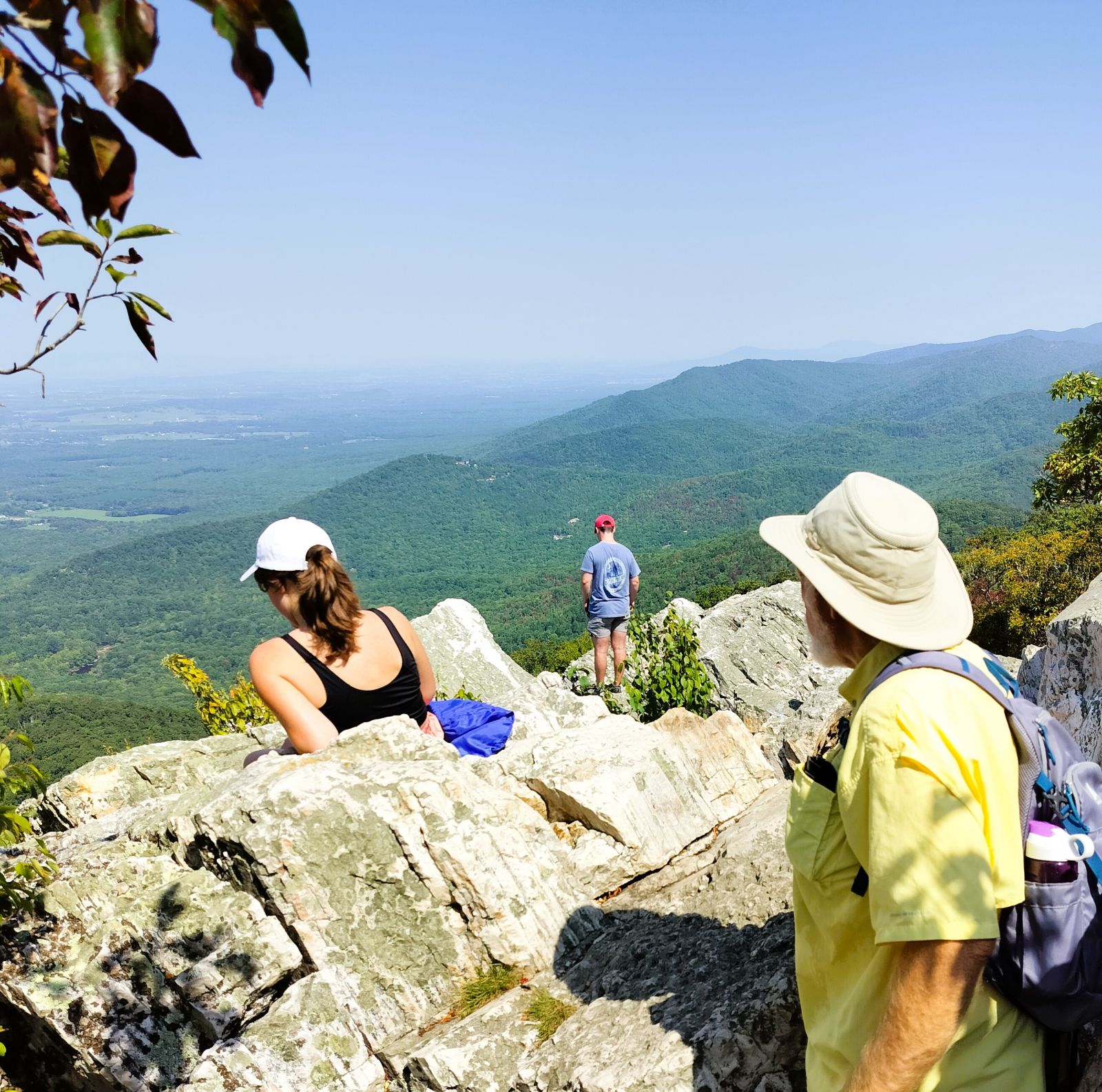
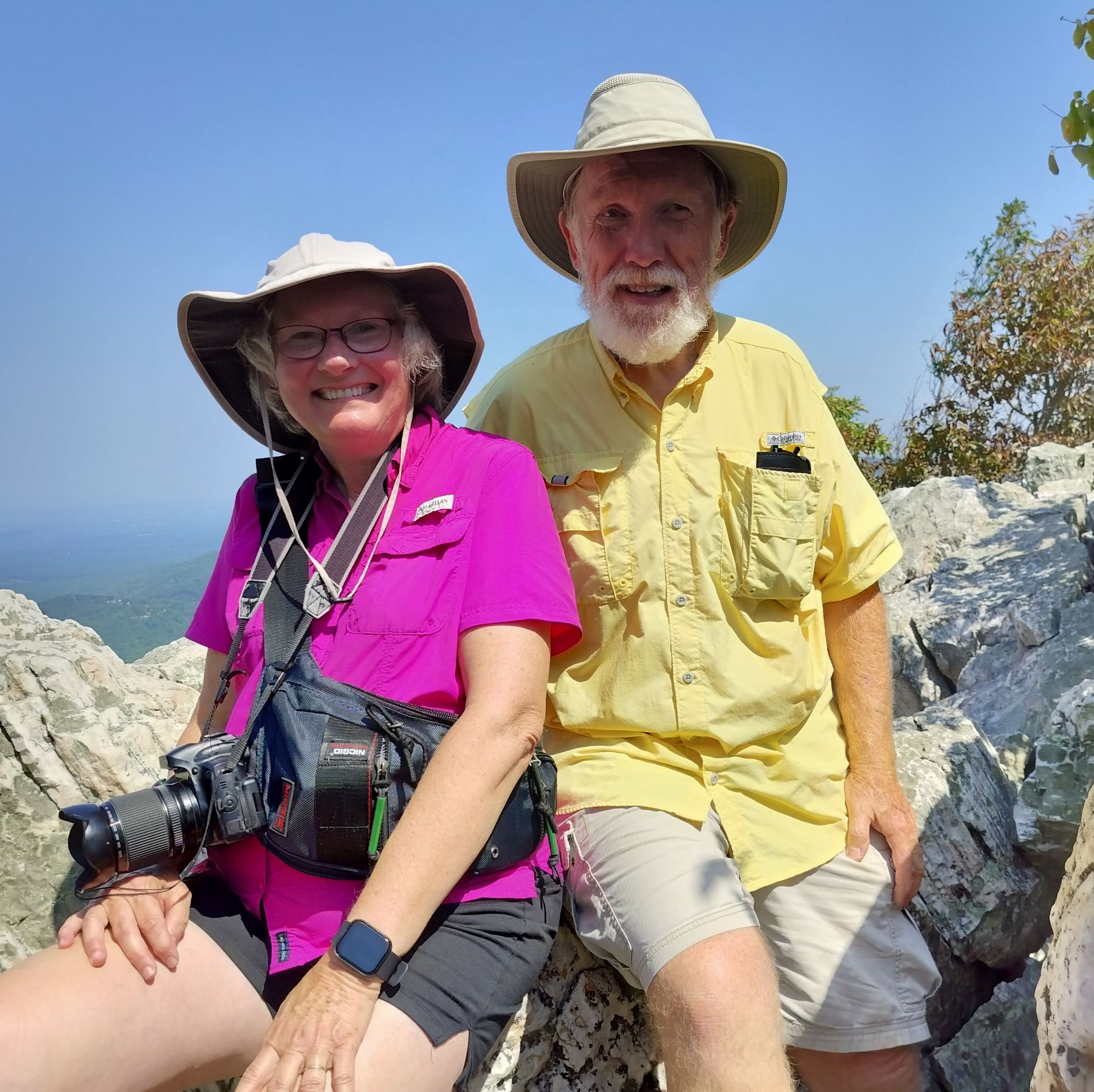
We spent a night at Lewis Mountain Campground, a new campground to us. The next day we ended our tour of the Skyline Drive with a hike to Turk Mountain. The 2.2-mile trail was steep with a 690-foot elevation gain. It ended with a short rock scramble to an outcropping with wonderful valley views. We caught up with a group of college students who passed us earlier and learned about their plans for the future. One of them took our picture to prove we made it all the way!
Photos taken at Turk Mountain viewpoint
Skylines to Blue Ridges
At the end of the 105-mile Skyline Drive the 469-mile Blue Ridge Parkway begins.
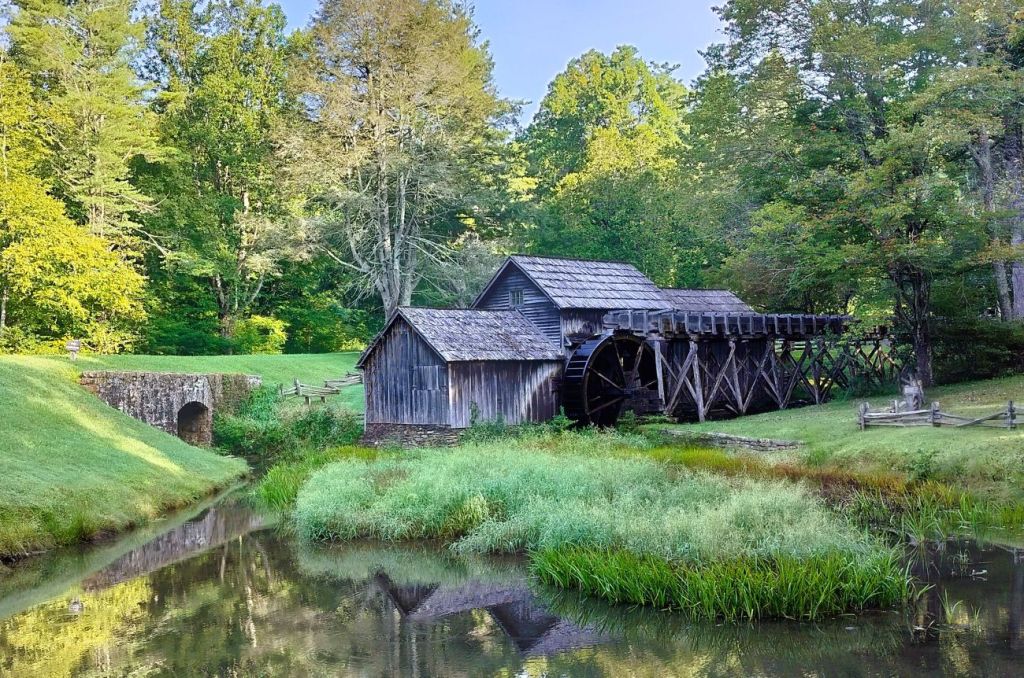
Iconic Mabry Mill at MP 176 on the Blue Ridge Parkway
We stopped at several favorite landmarks as we drove south on the parkway and made an early morning stop at picturesque Mabry Mill. The iconic landmark was built more than 100 years ago and was both a sawmill and grist mill. It is one of the most visited sites on the parkway.
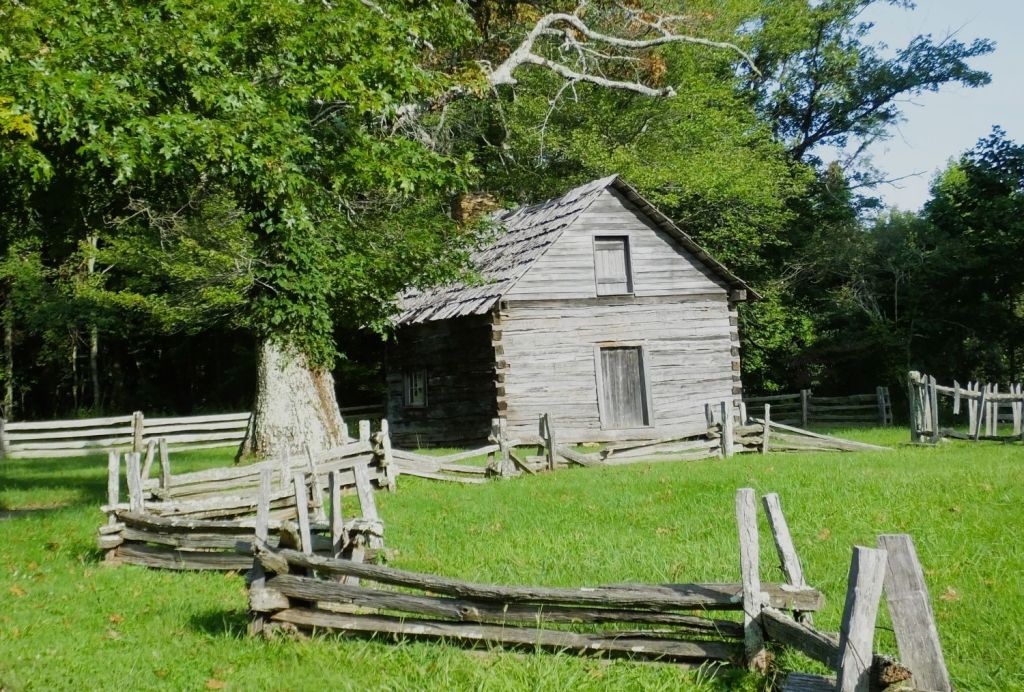
Our final stop on the parkway was at Puckett Cabin. We marveled at the story of “Aunt” Orelena Hawks Puckett, who lived in the cabin during the latter half of her 102-year life. She had a long career of midwifery, where she assisted at the births of more than 1000 babies. What an impact she had on the people in that area!
Puckett’s Cabin at MP 189 on the Blue Ridge Parkway
A few miles beyond the cabin, we left the parkway to begin the two-day trip home.
Our original plans were to spend more time in New England before returning home in late September or early October. Because of hazy conditions throughout the east, we moved more quickly than expected though.
Accustomed to longer trips, we wondered if we were going home early for some reason. We found out soon enough.
A few days after our return, intense weather struck our area.
After two evenings of considerable rainfall, the small creek in our back year rose above its banks. The creek flooded our backyard and continued to rise until it crossed the road next to our house. This has happened only one other time in nearly 40 years.
Although the rising creek never hit the house, rising groundwater began to seep into our semi-basement downstairs room. The sump pump we installed years ago (and tested right before our trip) had failed.
After an emergency late evening trip to Lowes to purchase a drill-powered pump, we drained the sump pit and began the timely process of drying out the room over the next week.
Had we not returned earlier than expected, water would have covered floor of the room. Carpet and furniture would have been damaged, and we would likely have had to deal with mold and mildew.
Giving Thanks
We are thankful!
God is our refuge and fortress in whom we trust for safety and protection – during our 2024 Heartland travels, trips in the past and journeys yet to come!
Welcome to RabbiTRAILS as we get underway with our summer 2024 travels.
After an epic 2023 journey to Alaska, we are staying (much) closer to home this year.
Why 2024 Heartland?
Much of our trip this year will be traveling through the central United States heartland from Texas to Minnesota. We’re bound to see oilwells, windmills, cattle herds, cicadas and miles of cornfields. Hopefully we won’t encounter tornadoes and hailstorms!
Other affairs of the heart will be at play as we travel: catching up with family in Texas, Oklahoma, Kansas and possibly Connecticut, and a visit with a close friend in New Hampshire.
We top it all off with something near and dear to our hearts: two weeks serving at Camp Cedarbrook camps in Texas and Ohio. As we connect all of this together, we’ll be on the lookout for interesting RabbiTRAILS to follow and share with you.
Before things get underway, there’s some catching up needed since our last blog post in December: 2023 Alaska Revisited Recap.
Catching Up, Part 1
Earlier this year Percy, Pap and a new addition carried us on a couple trips.
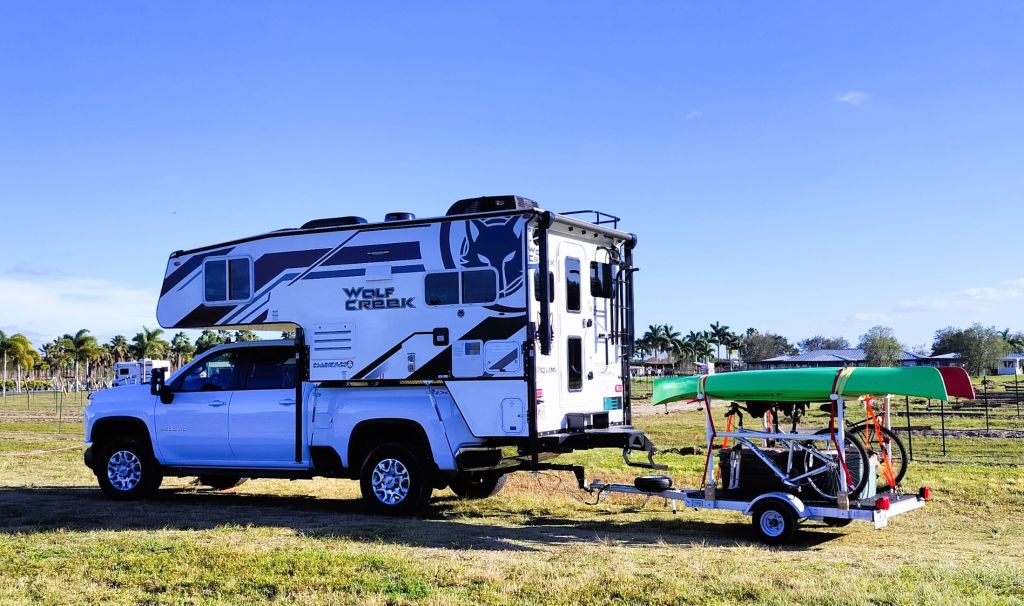
When we travel closer to home, Pat and I enjoy kayaking in addition to biking. There’s no easy way to take kayaks with our current setup, so we purchased a small utility trailer and configured it to haul two kayaks, our bikes and assorted other camping gear. Introducing Junior, Percy and Pap’s first cousin!
Junior, our little utility trailer, joins Percy and Pap
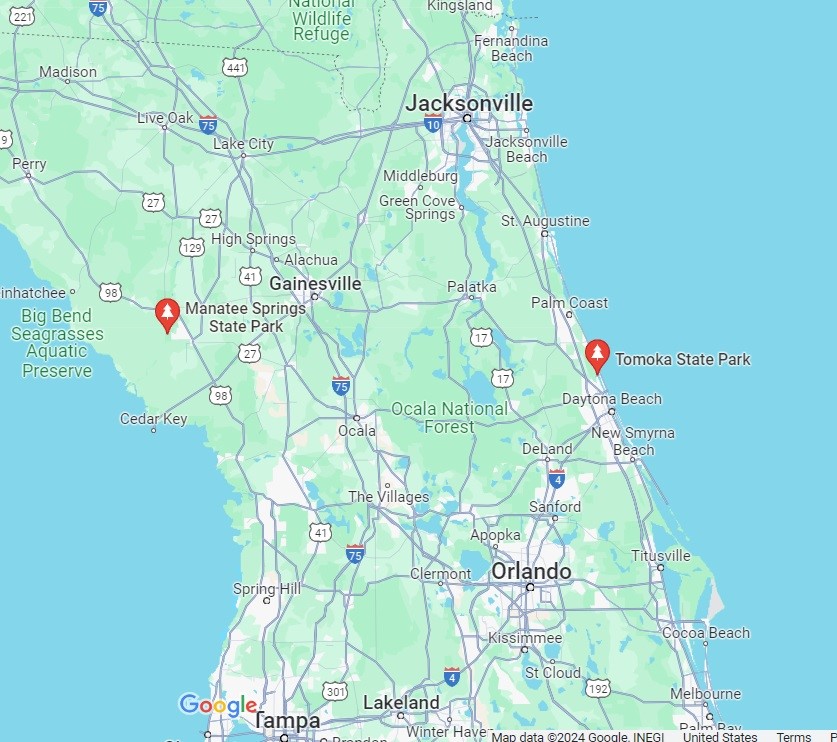
Our travels included Tomoka and Manatee Springs State Parks in Florida
Tomoka State Park
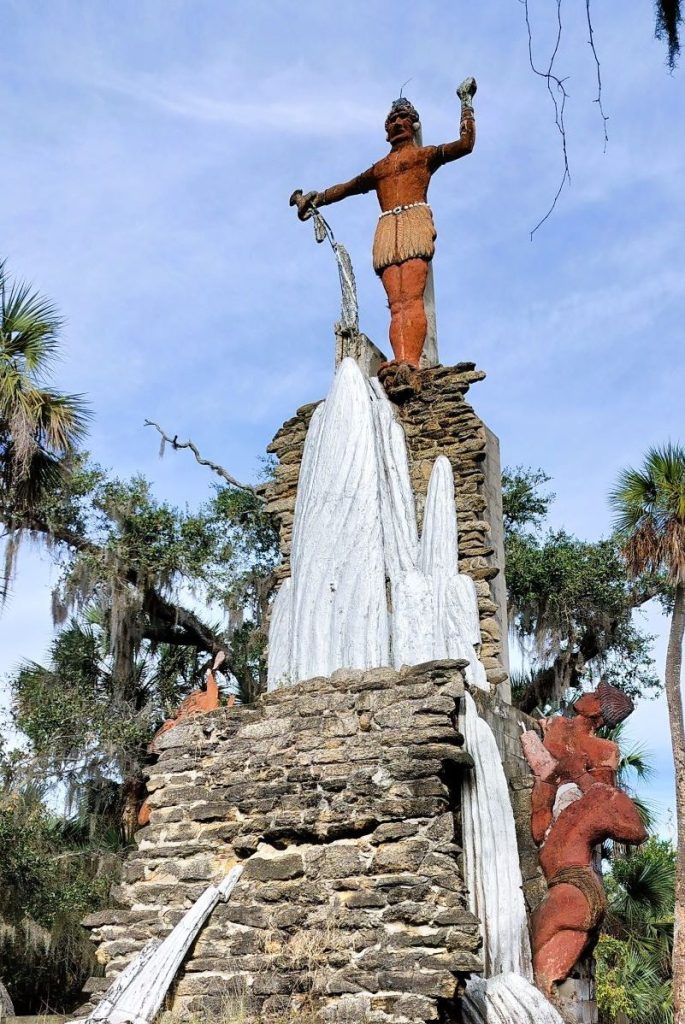
In January, we camped with longtime friends, John and Carol, at Tomoka State Park a few miles north of Daytona Beach. Located on the Tomoka River, the park includes the site of an ancient Timucuan Indian village and a large statue of Timucuan Chief Tomokie. The monument is a reminder that the area was populated by Native Americans for centuries before Europeans arrived.
Chief Tomokie statue in Tomoka State Park
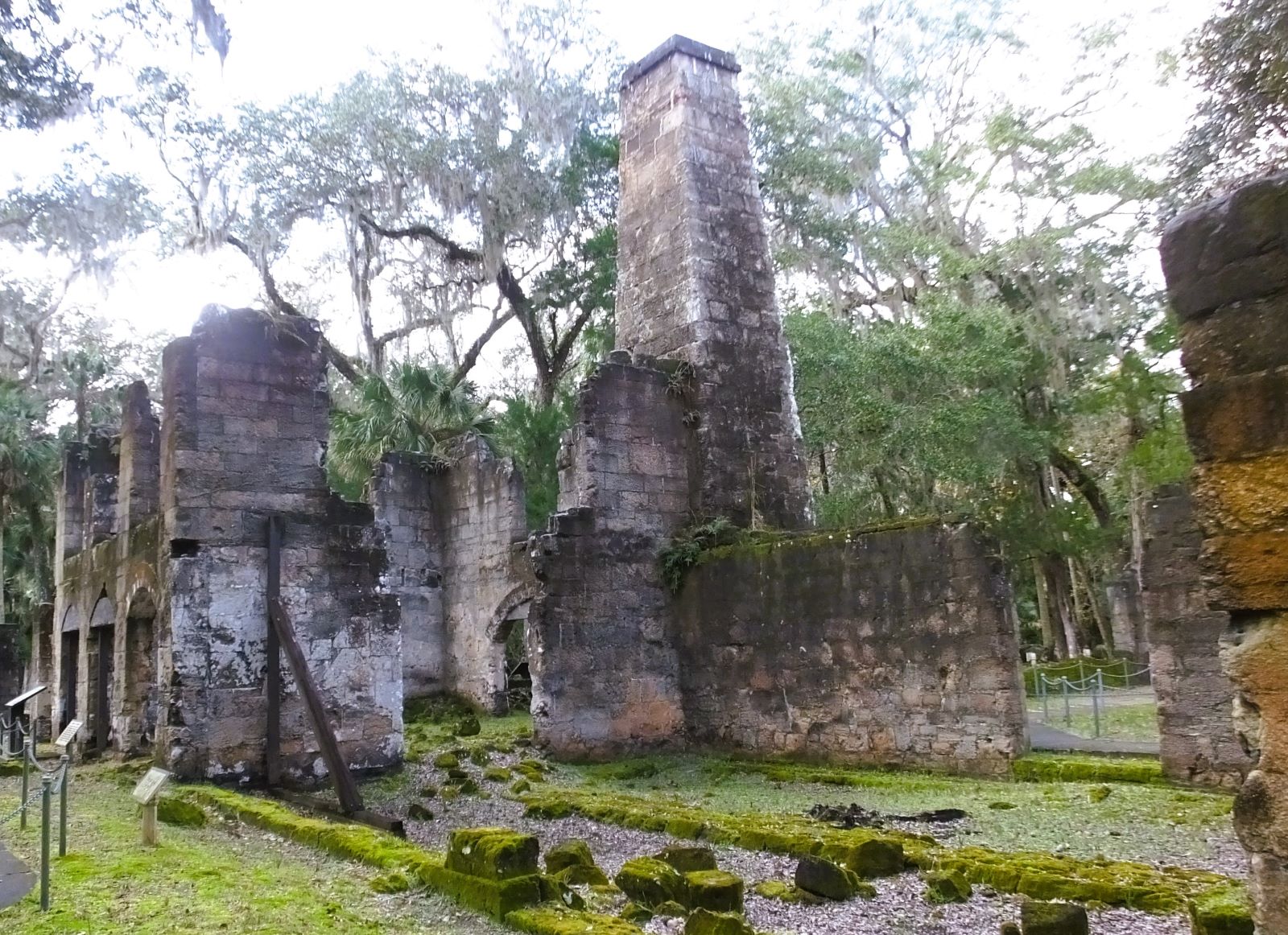
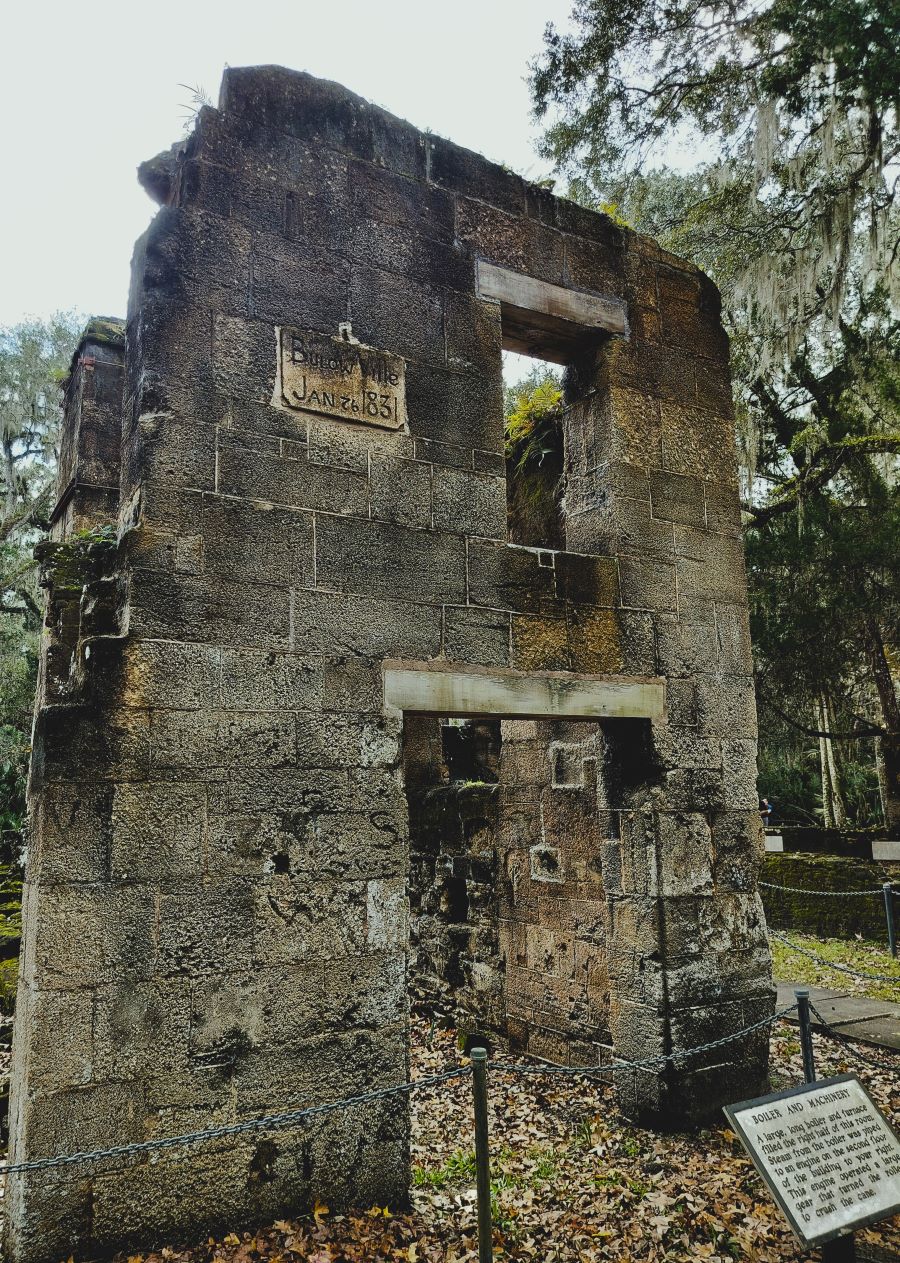
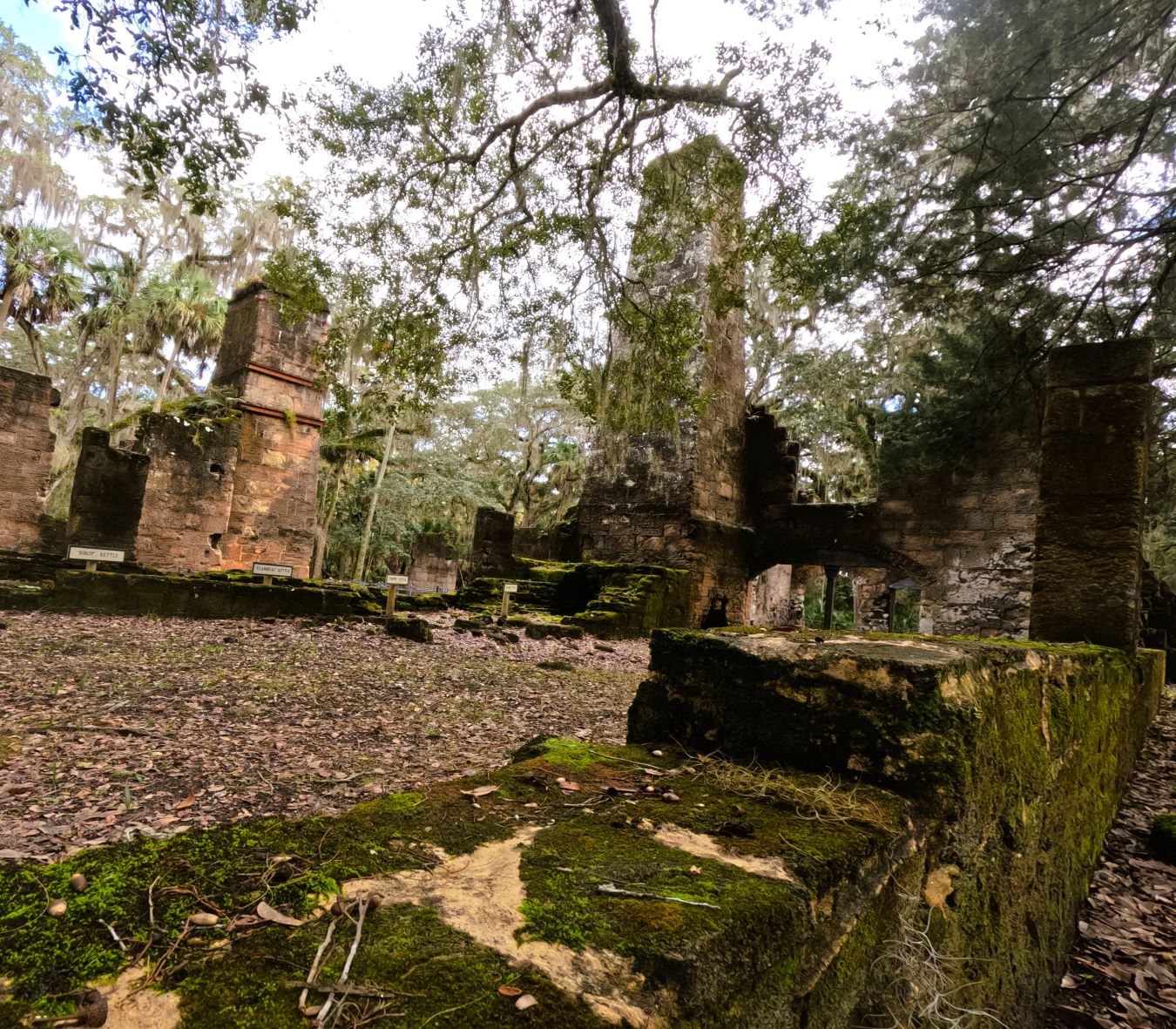
For several days we kayaked, biked and took several local side trips. We toured nearby Bulow Plantation Ruins Historic State Park. Developed in 1821, the plantation was once the largest plantation in East Florida where indigo, cotton, rice and sugarcane were cultivated. The plantation was destroyed in the Seminole War of 1836, and, although many of the original plantation structures no longer exist, sizeable remnants of a large sugar mill can still be seen. The plantation is an interesting part of Florida history.
Ruins of the sugar mill at Bulow Ruins Historic State Park
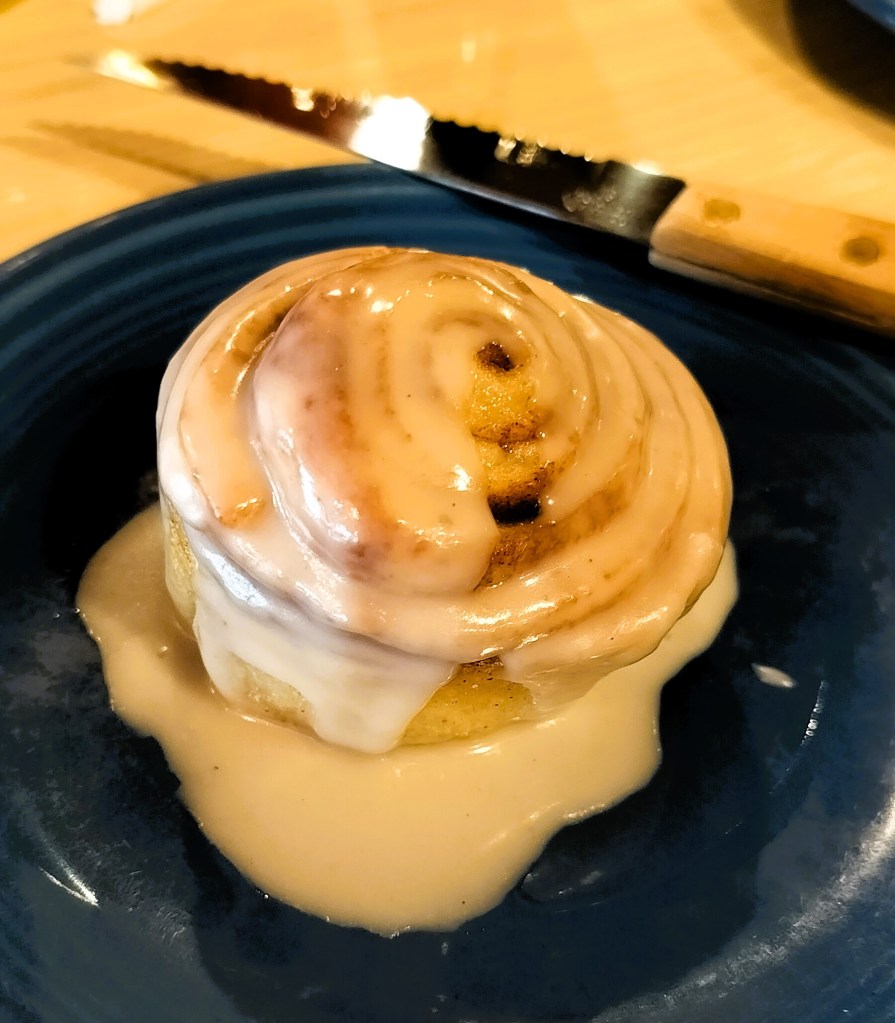
Aunt Catfish’s Cinnamon Bun
We stopped for lunch at Aunt Catfish’s on the River restaurant in Port Orange. The menu offerings were what one would expect at a southern-style seafood restaurant. We learned they served homemade cinnamon buns and it was game on! Although the buns were smaller than the ginormous buns we sampled on our 2023 Alaska Revisited journey, they were wonderfully sweet and cinnamony. We had to have more than one to satisfy our bun craving!
Manatee Springs State Park
We left Tomoka and crossed the state, where we camped at Manatee Springs State Park.
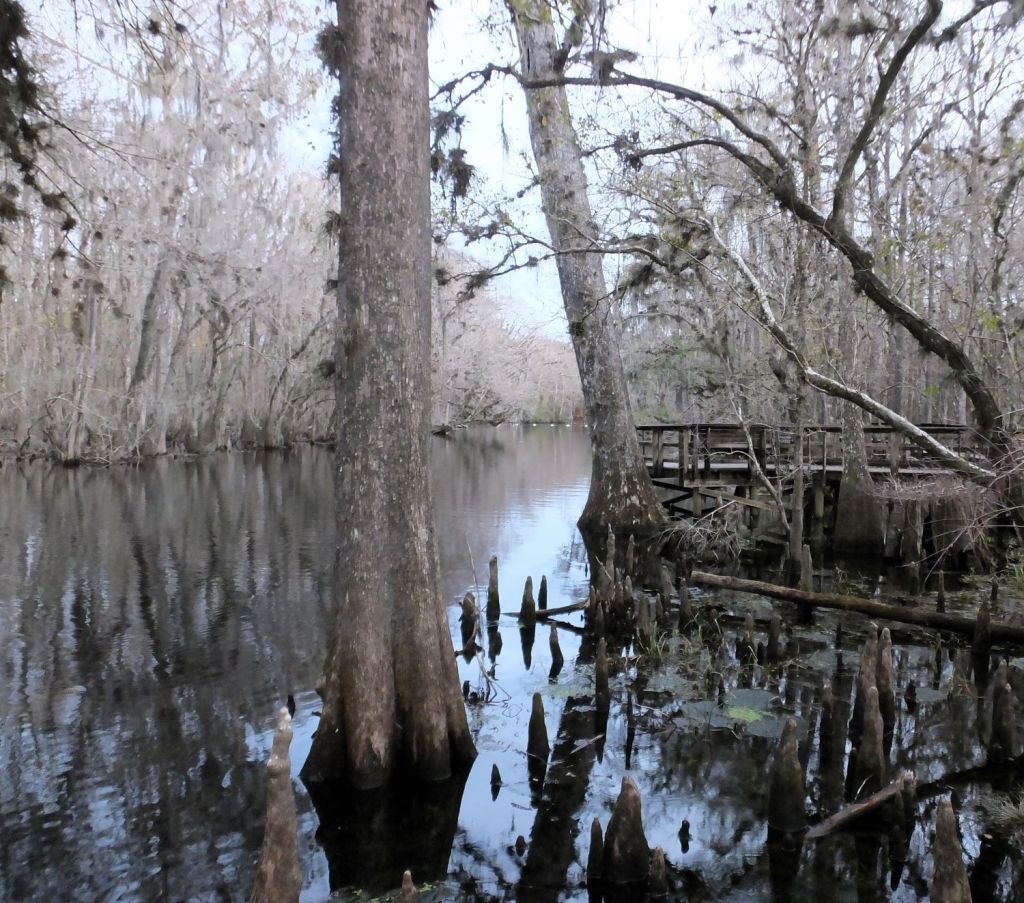
Manatee Springs is a first magnitude (e.g. large) spring that flows into the Suwannee River. A boardwalk extends nearly a quarter mile from the spring through a swampy area with tall Spanish moss-covered cypress trees. The boardwalk ends at a small pier on the Suwannee River.
A quarter mile boardwalk runs from Manatee Springs to the Suwannee River
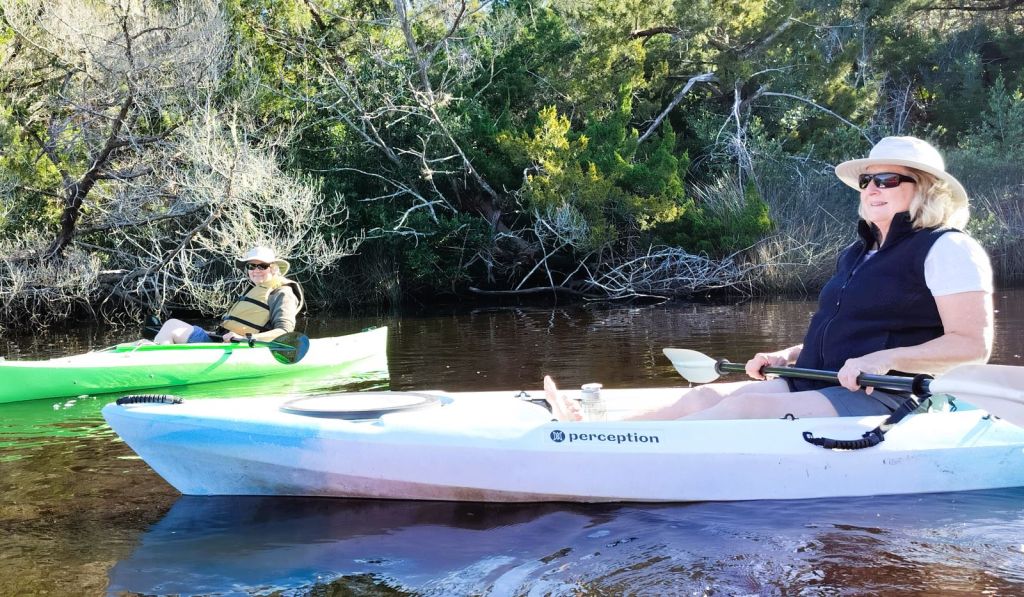
One morning we kayaked the run and along the Suwannee for several miles, where we enjoyed the sunny, cool and quiet surroundings.
Pat and Carol kayaking near Manatee Springs
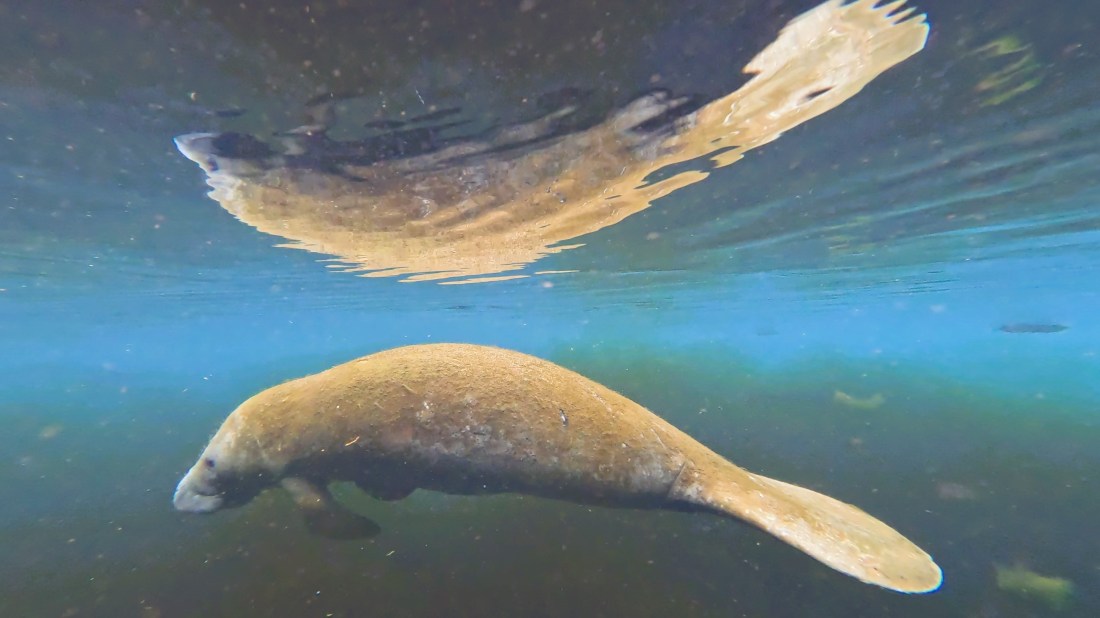
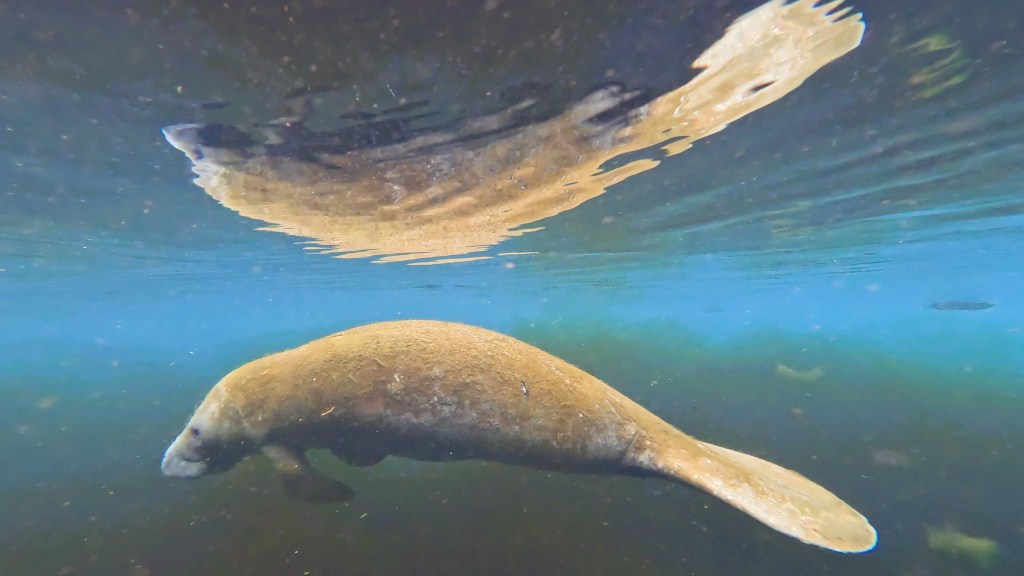
When we returned to the spring, we were delighted to find several manatees swimming near the boat launch area. We paused for several minutes to watch the large potato-shaped animals swim about and surface from time to time. I used my GoPro camera to capture some underwater photos of the spectacle.
Manatee and reflection at Manatee Springs SP
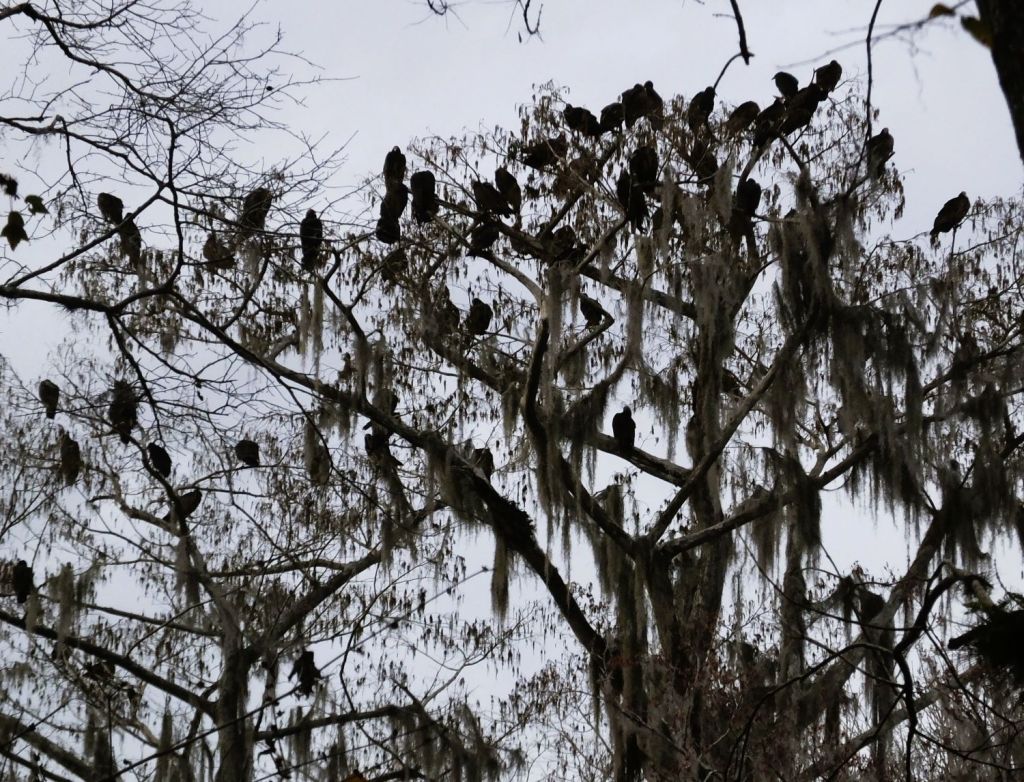
As we walked along the boardwalk one evening, we noticed the cypress trees surrounding the spring run were filled with hundreds of large, American black vultures. It was a rather Gothic spectacle in the evening twilight.
Hundreds of vultures watched us from cypress trees near the springs
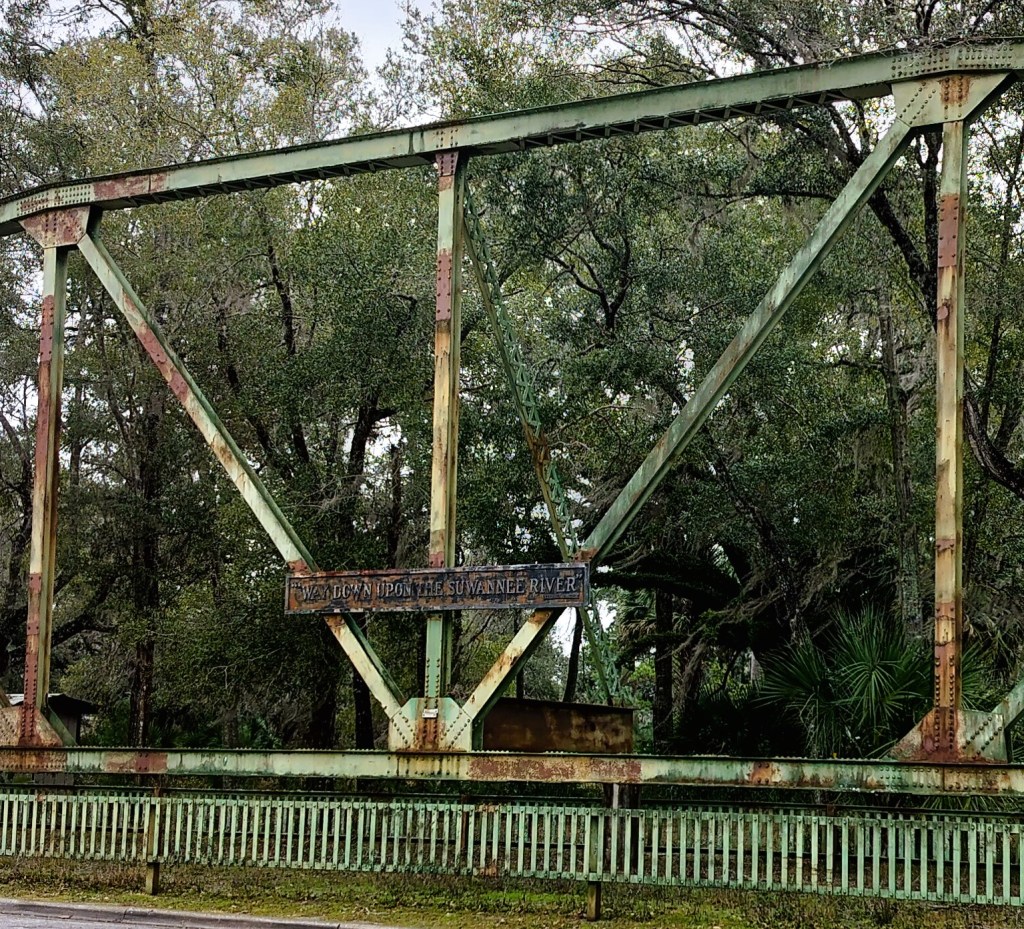
Our Manatee Springs stay included visits to Cedar Key, where we rode our bicycles around the small Gulf Coast community, and Fanning Springs, where we admired a remnant of an old bridge that crossed the Suwannee River inscribed with the title of Stephen Foster’s memorable song, “Way Down Upon the Suwannee River!”
One of four spans from the bridge that crossed the Suwannee River at Fanning Springs has been preserved. The bridge was built in 1934.
Henry Turns 6
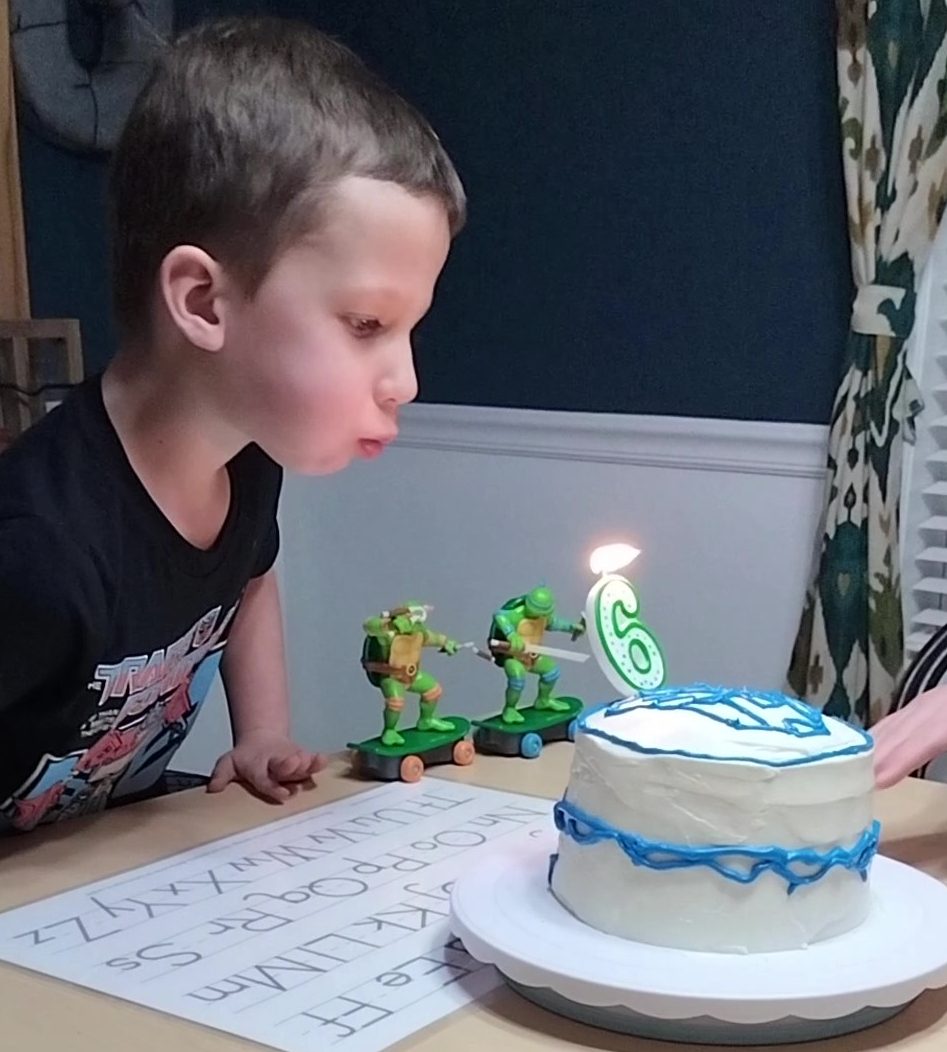
Our trip ended near Macon, GA with a sixth birthday celebration for our grandson, Henry.
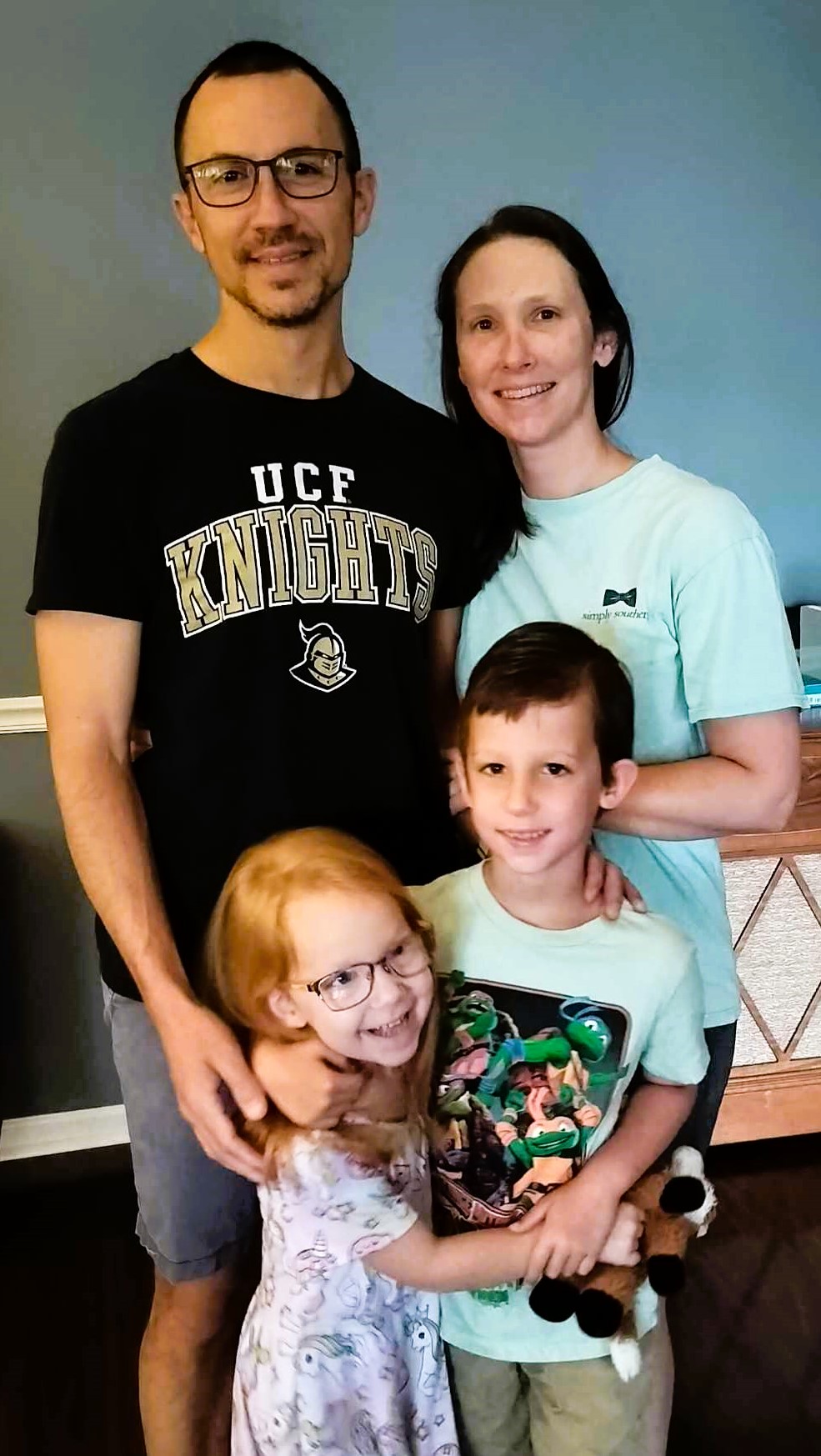
Son-in-law Josh, daughter Liz, and grandkids, Emilia and Henry; Henry celebrates his birthday
Next Week
Catching Up (part 2): Florida Keys and Everglades National Park
From the Utica area, we drove southwest through New York hill country past small towns, lush vineyards and fertile farms. Our destination was a Harvest Host location and state park in Watkins Glen, NY.
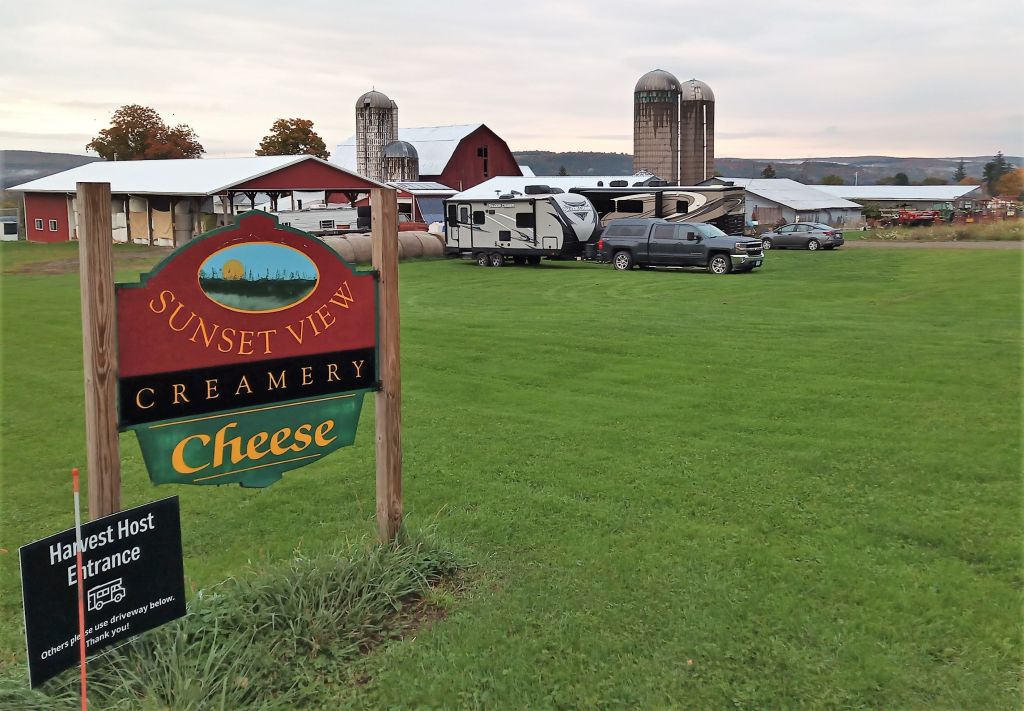
Camping at the Creamery
We camped for the night in a field at Sunset View Creamery. The creamery is a large dairy farm with a nice store where we sampled (and purchased) several types of cheese along with other local farm products.
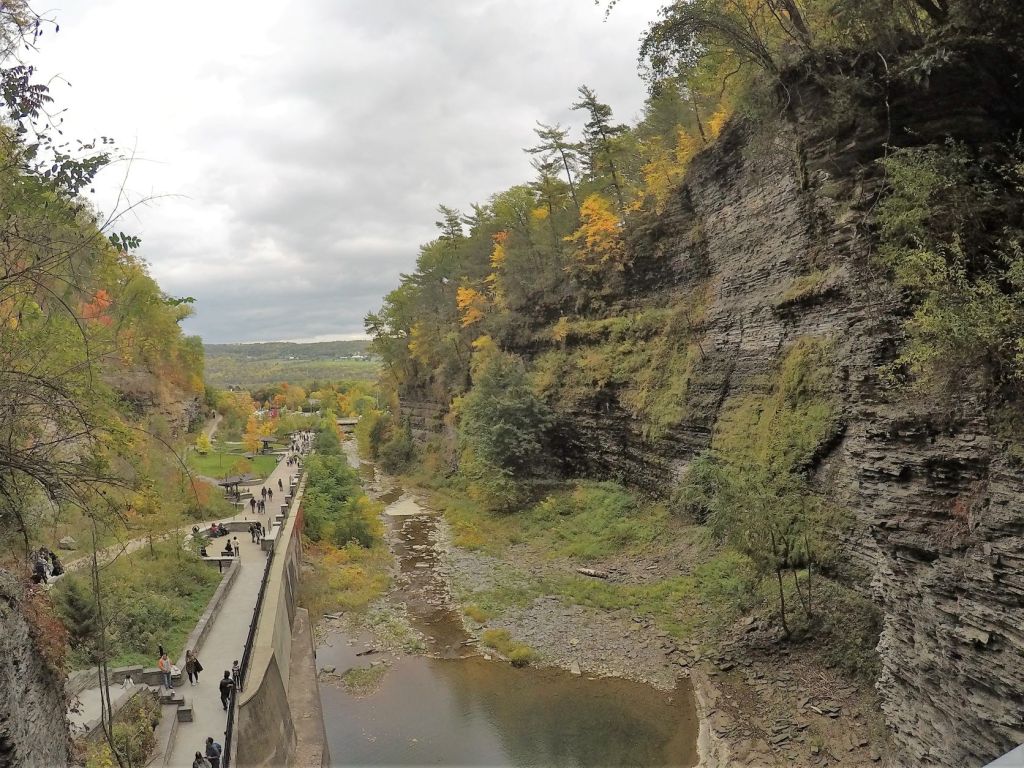
By then, it was mid-afternoon and we had to hurry to visit Watkins Glen. Although the town is noted for its role in auto racing, our visit was to see the gorge at Watkins Glen State Park
The large parking lot was crowded when we arrived. There is a charge to park but entrance to the state park and gorge is free. We crossed a busy street and the entrance to the gorge trail was ahead.
Entrance to the Gorge
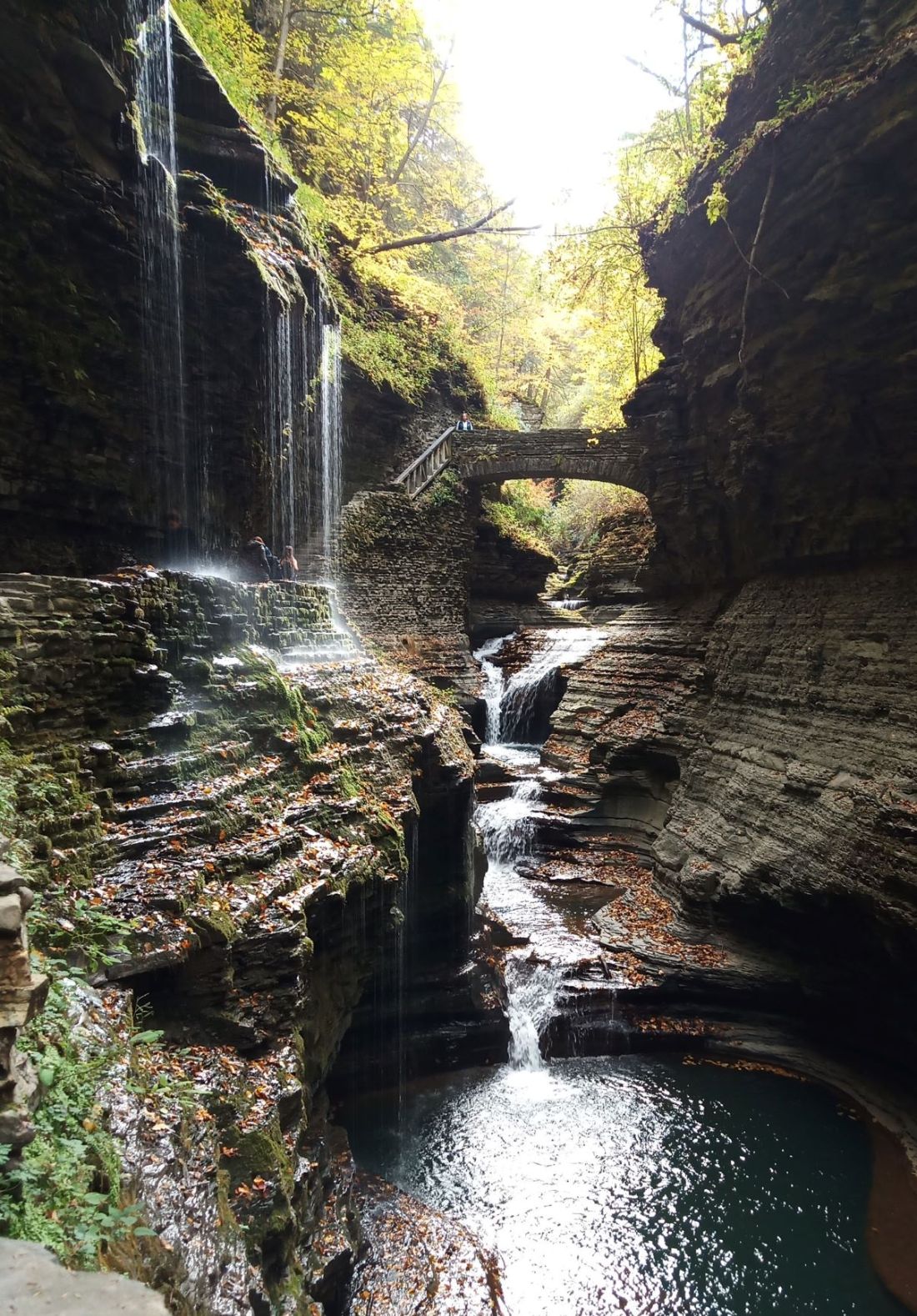
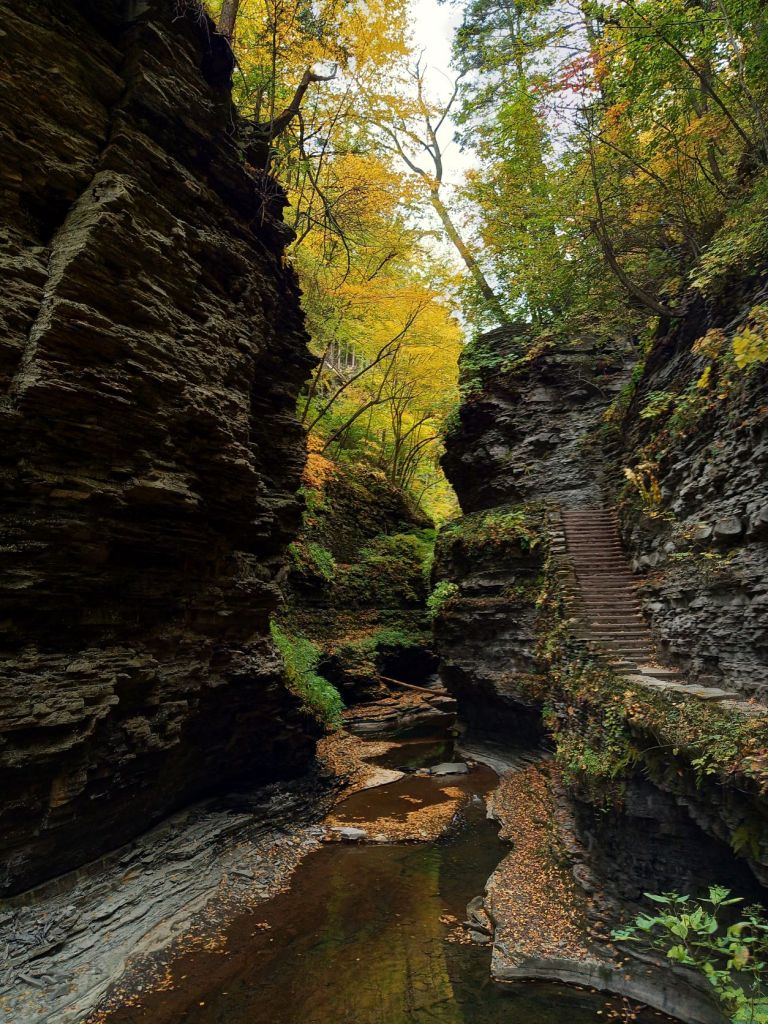
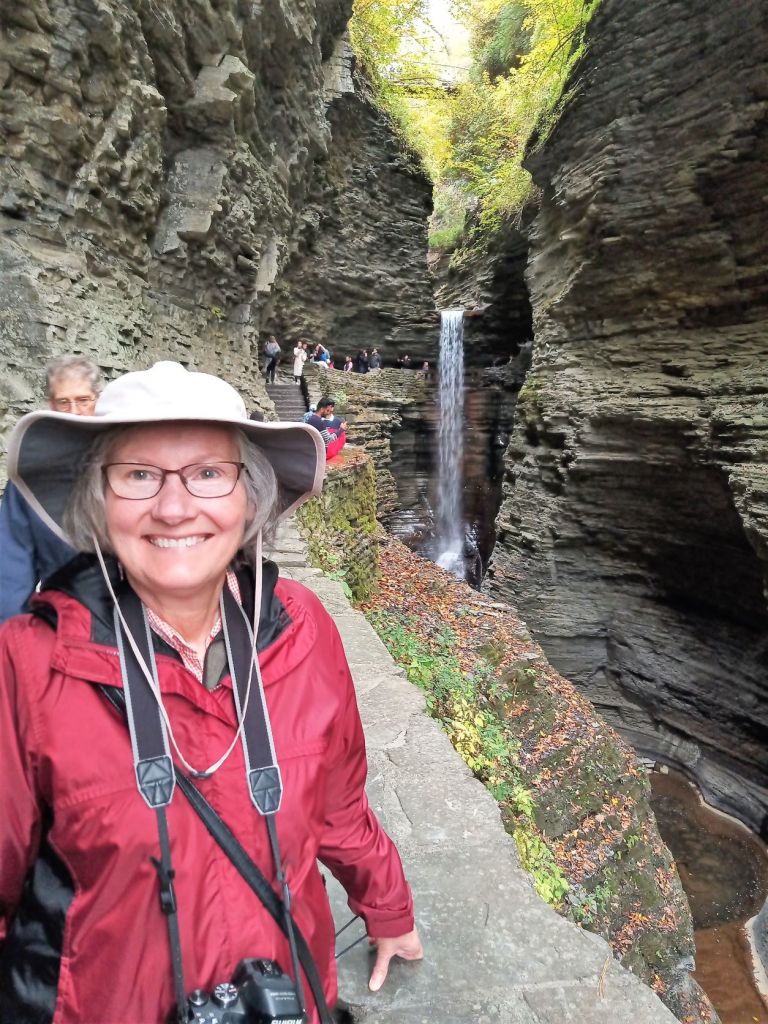
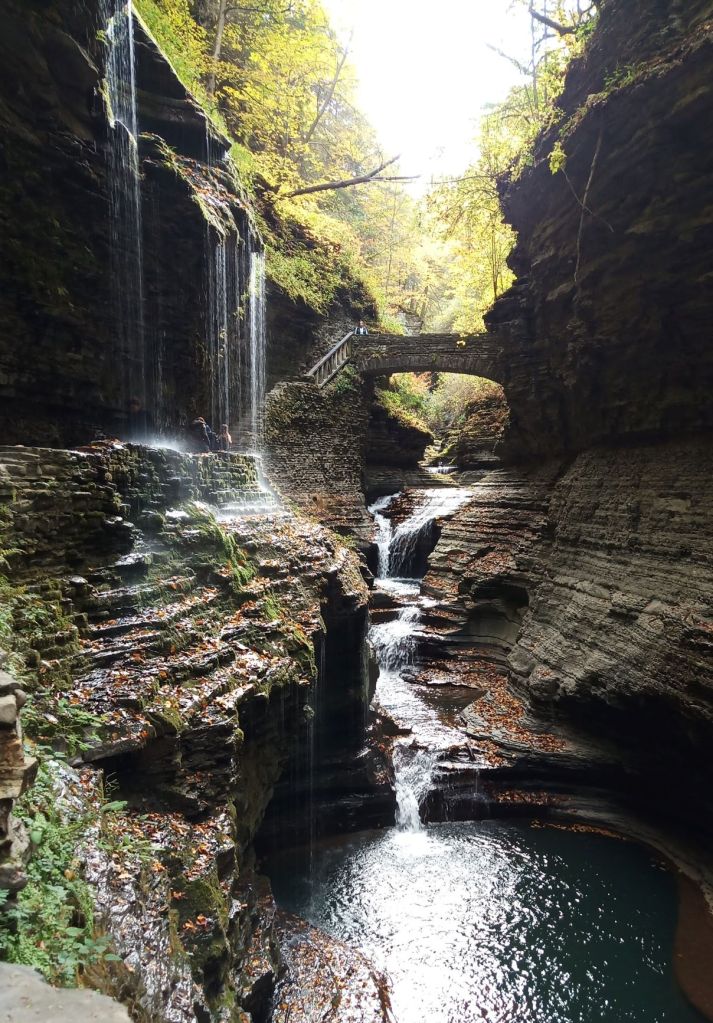
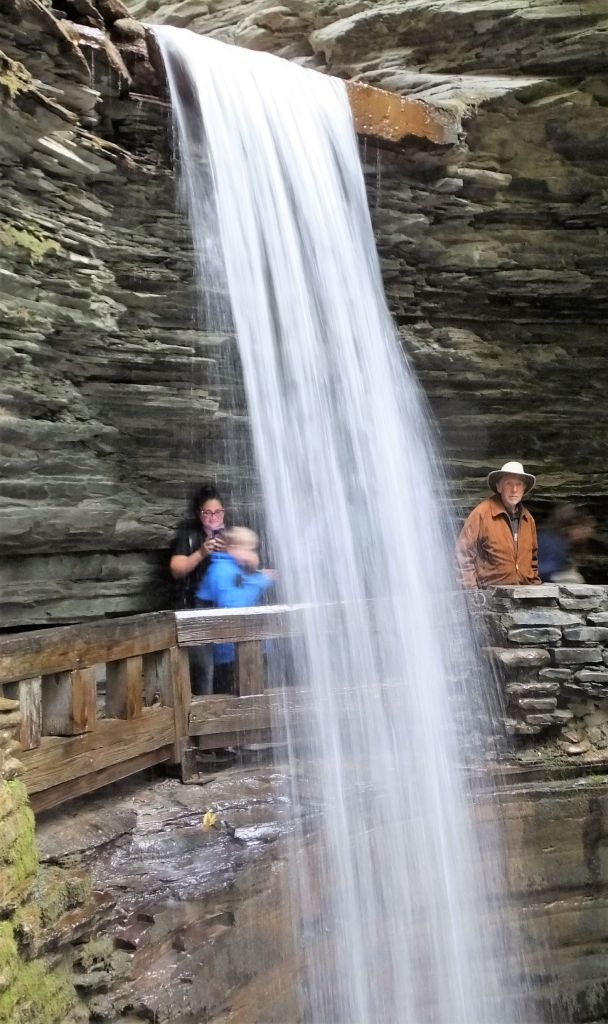
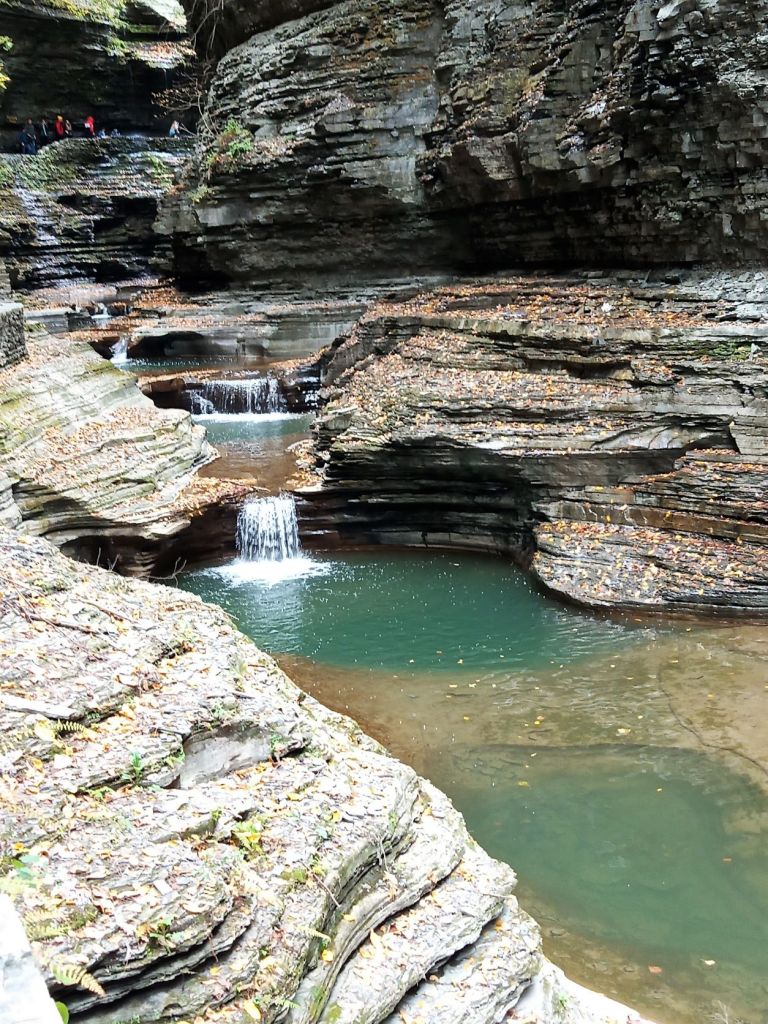
The trail starts at the bottom of the 400-foot deep gorge and continues for 1.5 miles as it follows a small stream up 832 steps. The paved trail goes over and under waterfalls, bridges and tunnels. The layered sides of the gorge were accented here and there with trees displaying colorful autumn leaves.
Gorgeous gorge views
The trail ends at the top of the gorge, where you can hike one of two trails along the top of the gorge or take an inexpensive shuttle back to the bottom of the gorge. Some visitors start with the shuttle and then take the steps down to the entrance. We think the views are better hiking up the gorge however.
The park has a lot to offer in addition to the gorge – a campground and cabins (both were closed for the season when we visited), biking and other hiking trails.
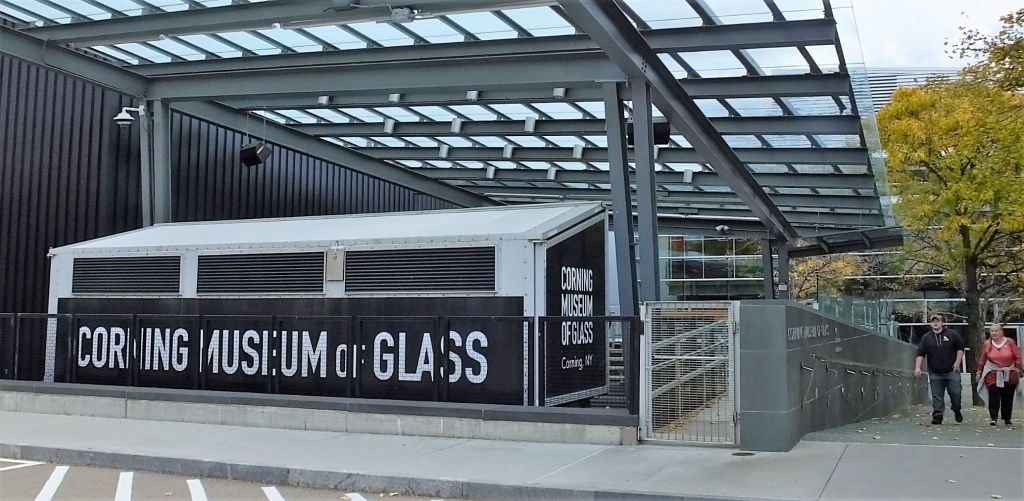
After a chilly no-hookups night at the Creamery, we arose early the next morning for a short drive to Corning NY to visit the Corning Museum of Glass.
The museum and town of Corning are worthy of a day or two visit, but we only had a few hours to explore the museum.
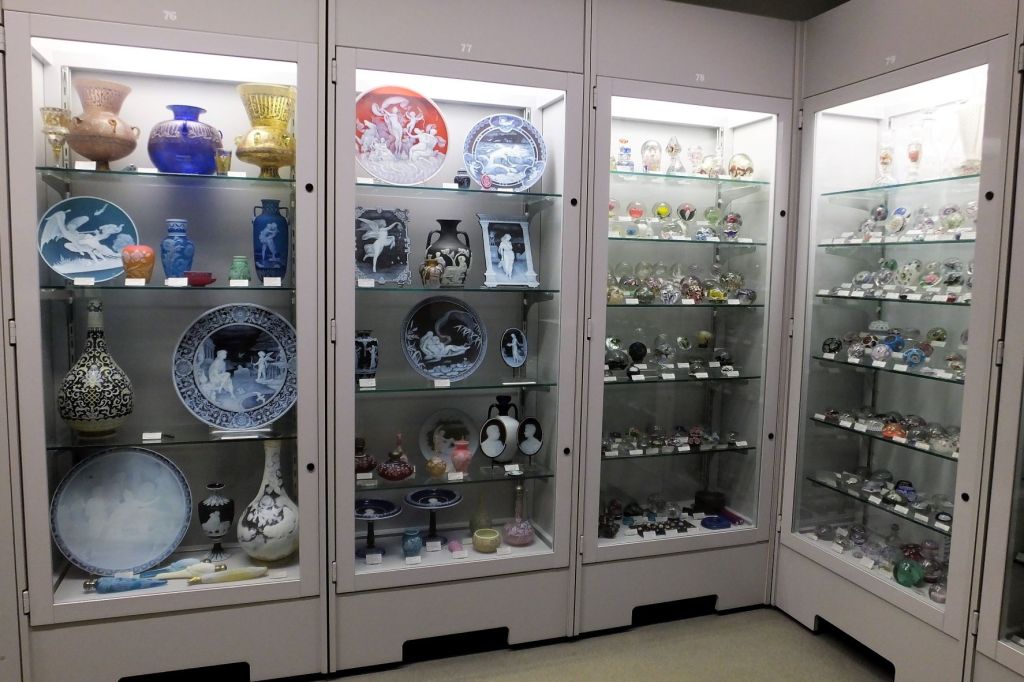
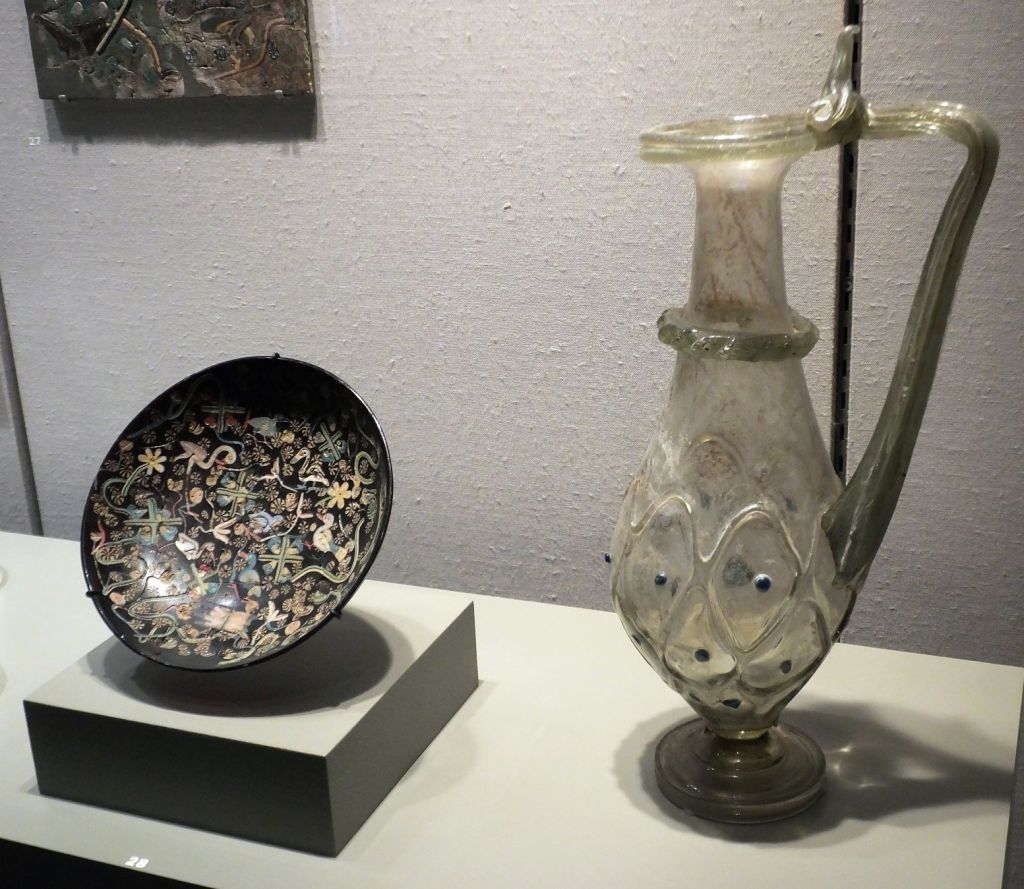
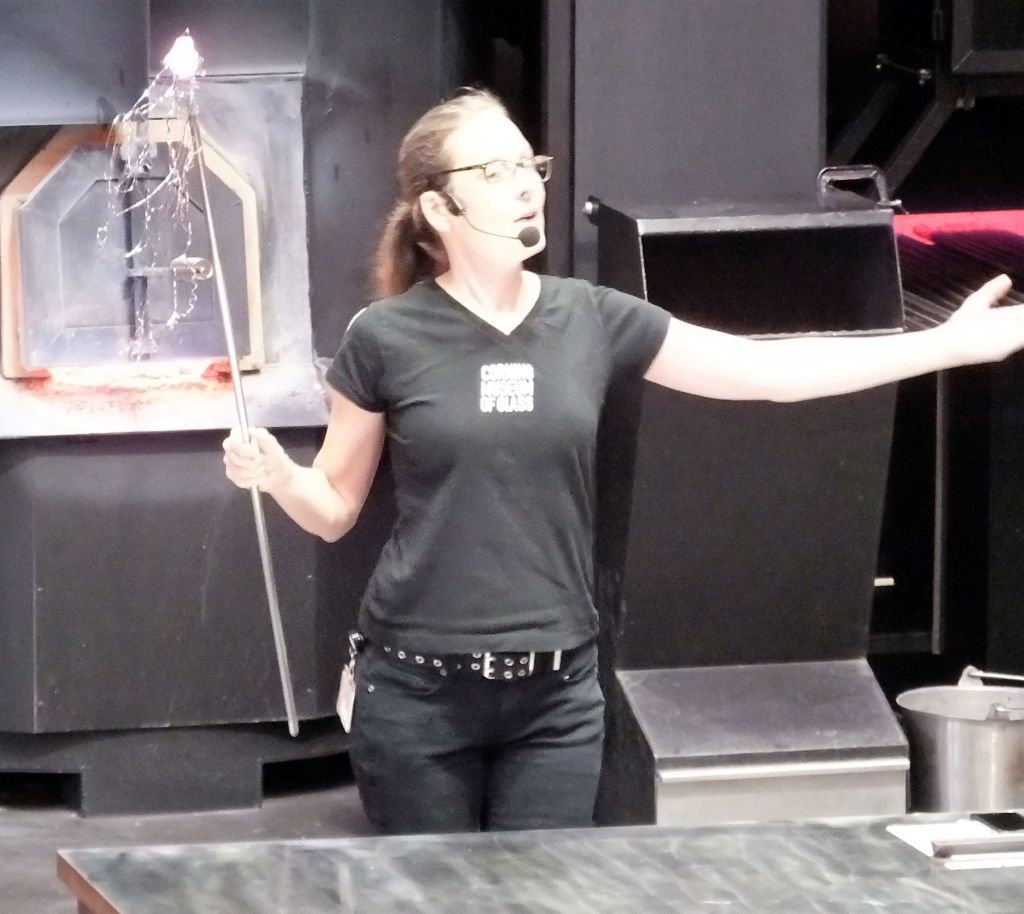
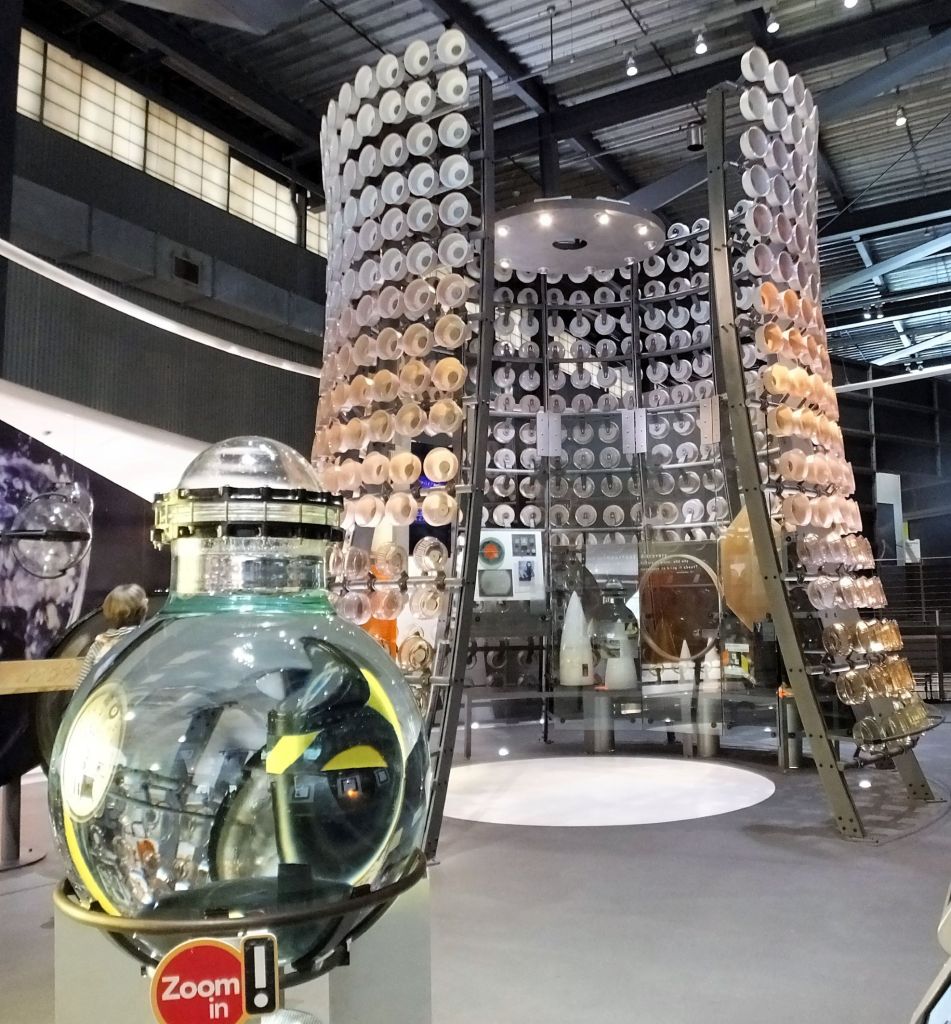
The museum has exhibits ranging from ancient glass artifacts more than 3500 years old to contemporary glass art, as well as various scientific and practical uses of glass in modern society. There were also several live glass-blowing demonstrations.
CMOG has glass antiquities and modern art displays, plus live glassblowing demonstrations
Who’d have thought there was so much to see at a glass museum!
After a quick lunch we were on the road again heading south to spend the night in Pennsylvania. We were on the way to Virginia and the Blue Ridge Parkway.
Next week: our plans take yet another unexpected turn.
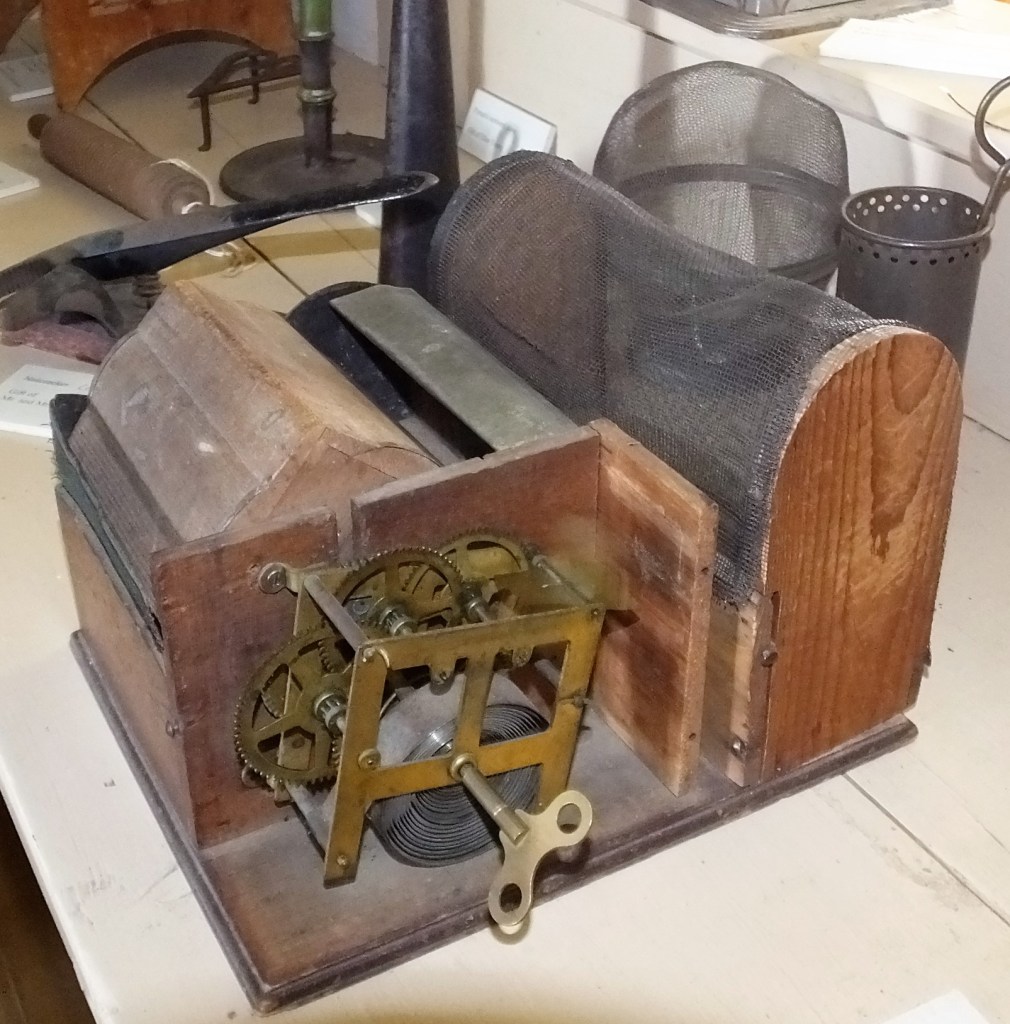
The device is a MOUSE TRAP! When triggered, a portion of the trap rotates and deposits the mouse in the adjacent screened box. This trap is more humane than a spring-loaded mouse crusher!
After spending New Year’s Day 2020 at Three Rivers State Park, we headed a half hour west for a visit to Florida Caverns State Park on January 2. The park is a few miles outside Marianna, Florida.
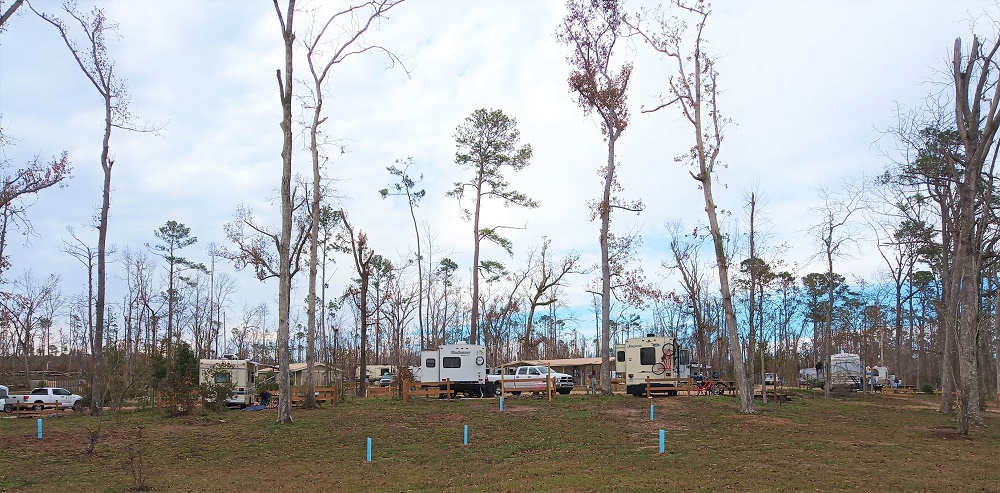
As we entered the park, the effects of Hurricane Michael were still very visible. Once dense forests that lined the road to the visitor center parking area are gone and the terrain is much like Three Rivers State Park – wide open areas with haggard trees here and there. Homes and other development are visible not far away. It will take years for the forest to recover.
At the visitor center we purchased tickets for the one-hour guided cave tour. Tours fill quickly, so it is a good idea to get tickets when you first arrive and then tour the visitor center and park store while waiting for your tour to begin.
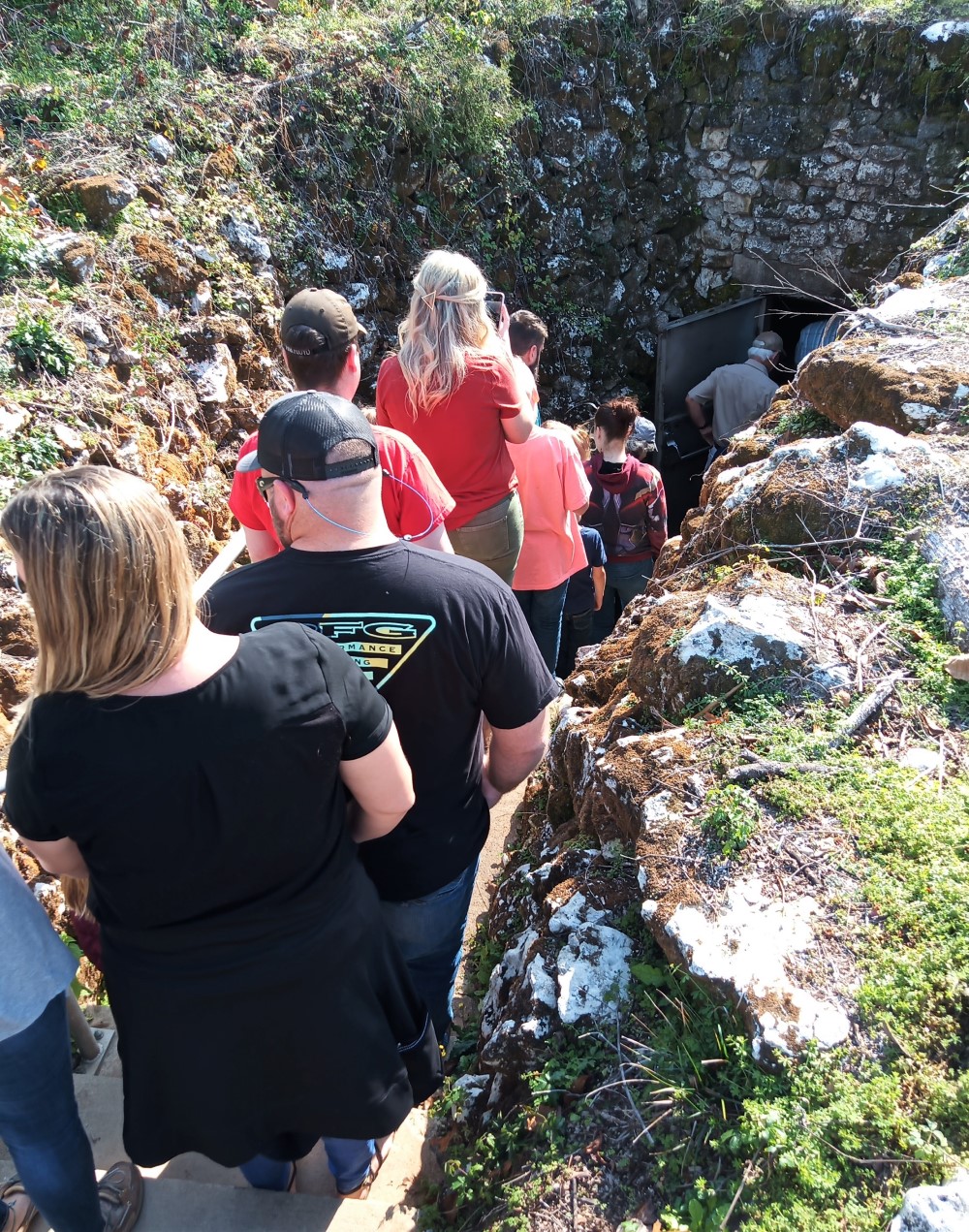
Entering Florida Caverns
The Caverns
Florida sits atop layers of limestone and caves are pretty common. Most of Florida’s caves, however, are underwater connected to beautiful freshwater springs and reached only using SCUBA equipment. Florida Caverns is the only air-filled cave in Florida to offer tours.
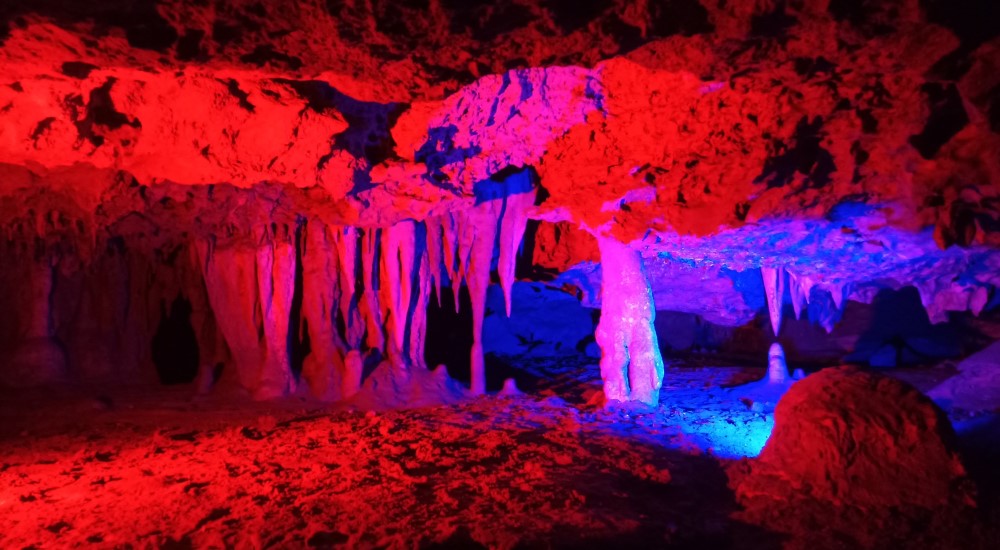
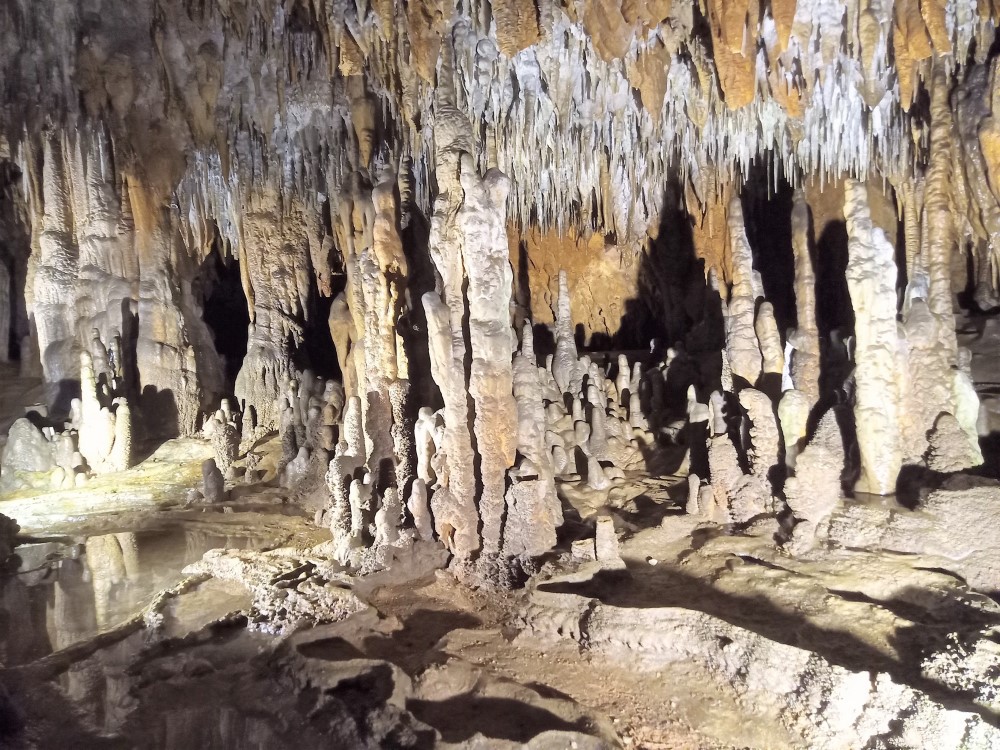
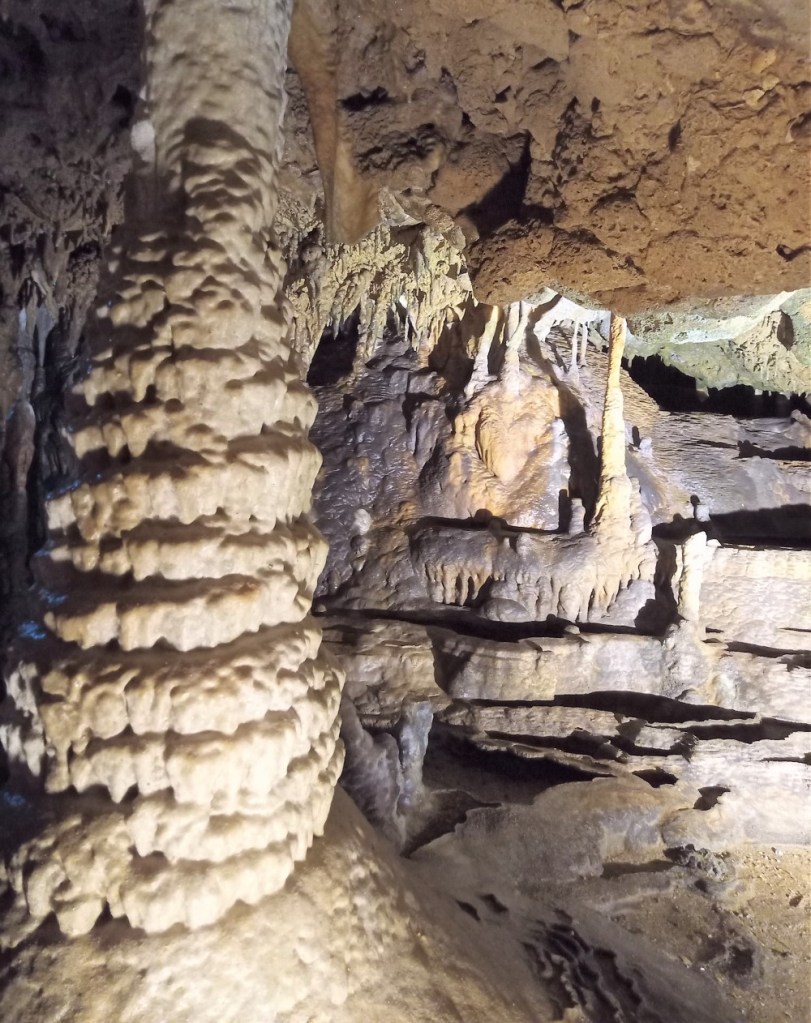
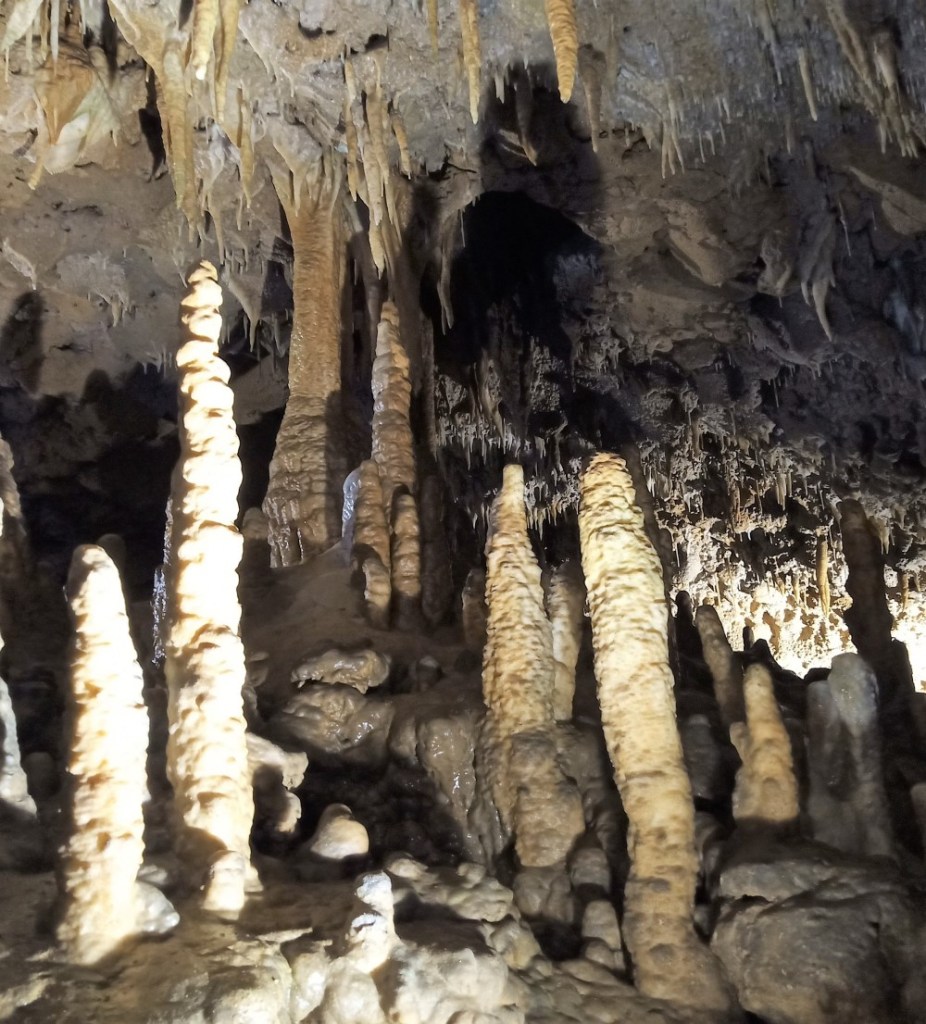
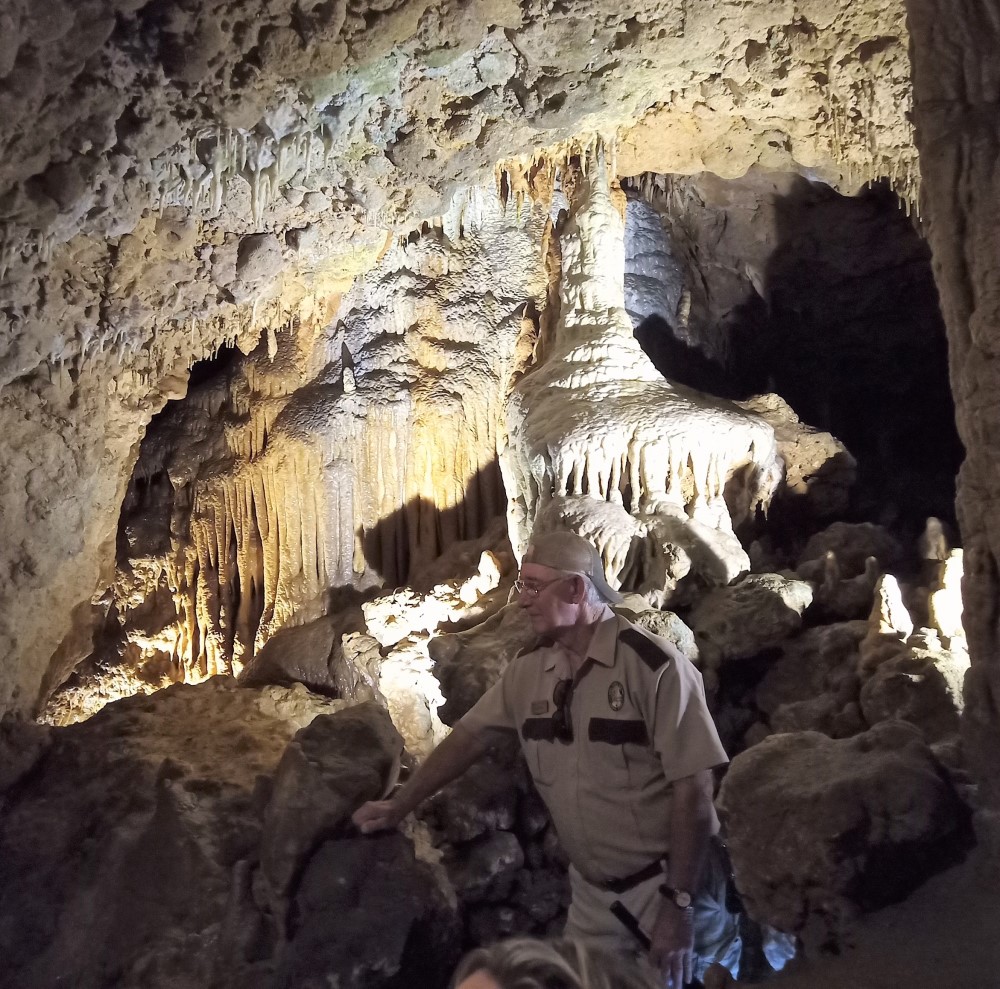
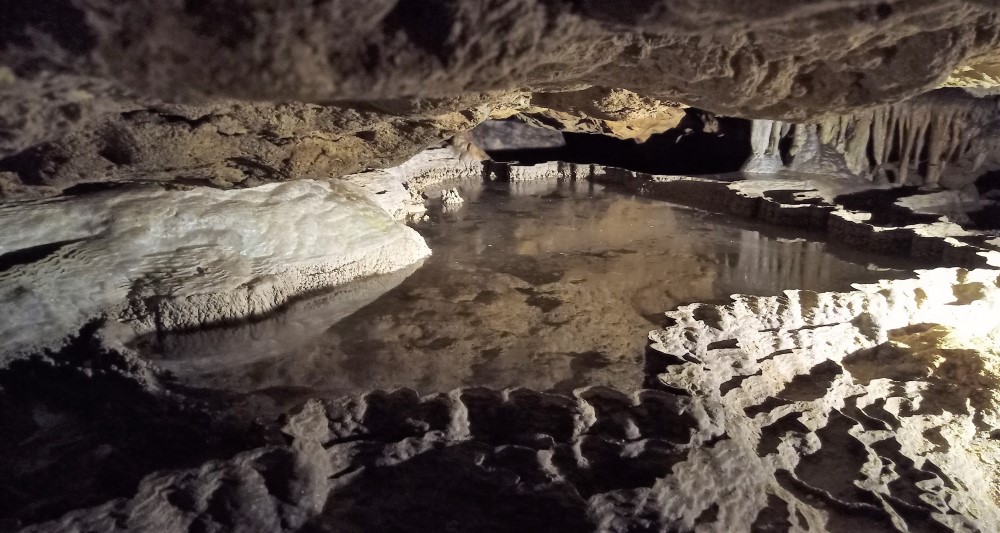
The main cave entrance and portions of the tour were inaccessible due to flooding from recent rains, so we entered the cave through a secondary entrance nearby. We descended down more than 30 stairs, and once inside, we enjoyed stunning rock formations, including limestone stalagmites and stalactites, flowstones, soda straws, draperies, and more.
View of amazing cave formations
Beginning in the 1930s, the Civilian Conservation Corps excavated the tour cave using pickaxes and hand tools. Most of the cave passages were originally only a few feet tall. Tours of the cave have been offered since 1942 and span an area of nearly two acres under the surface.
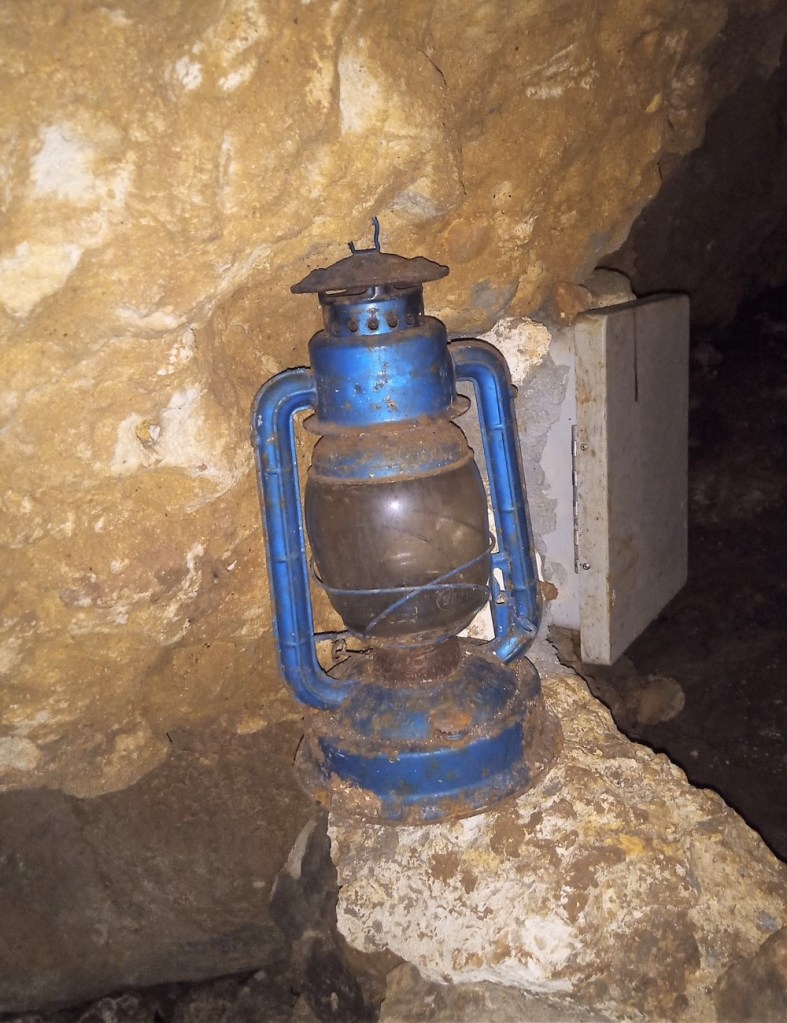
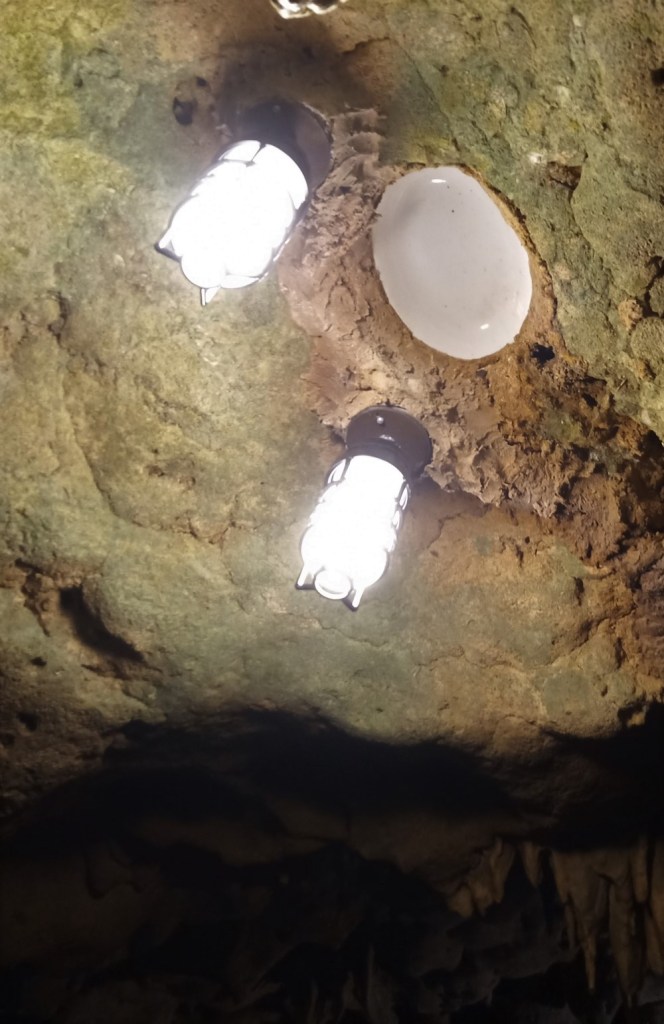
Interesting artifacts that can be viewed in the cave include CCC lanterns and white bowls embedded in the ceilings to reflect the lights.
Artifact 1: CCC lanternArtifact 2: white bowls imbedded in ceiling to reflect lights
We learned various animals call the cave home – bats, mice, cave crickets, salamanders, cave spiders and occasionally snakes and frogs. Fortunately we didn’t encounter any of these during our visit.
Here are additional views of the cavern formations:
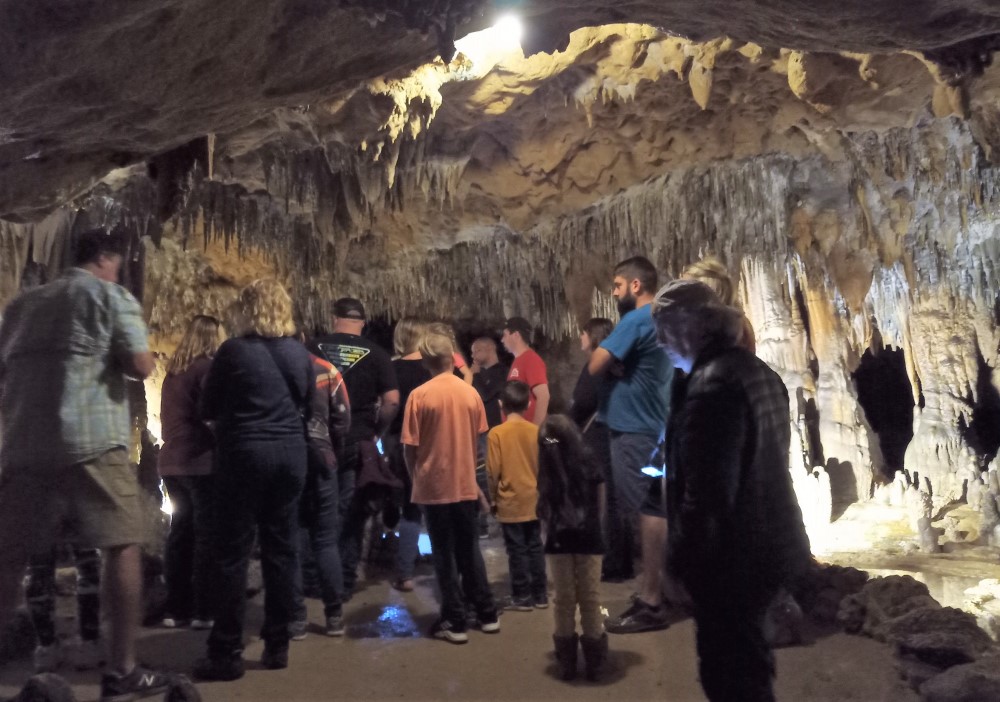
The cave tour takes you up close and personal to the formations in a dozen or so cave rooms, unlike tours of much larger caves like Carlsbad Caverns and Mammoth Cave.
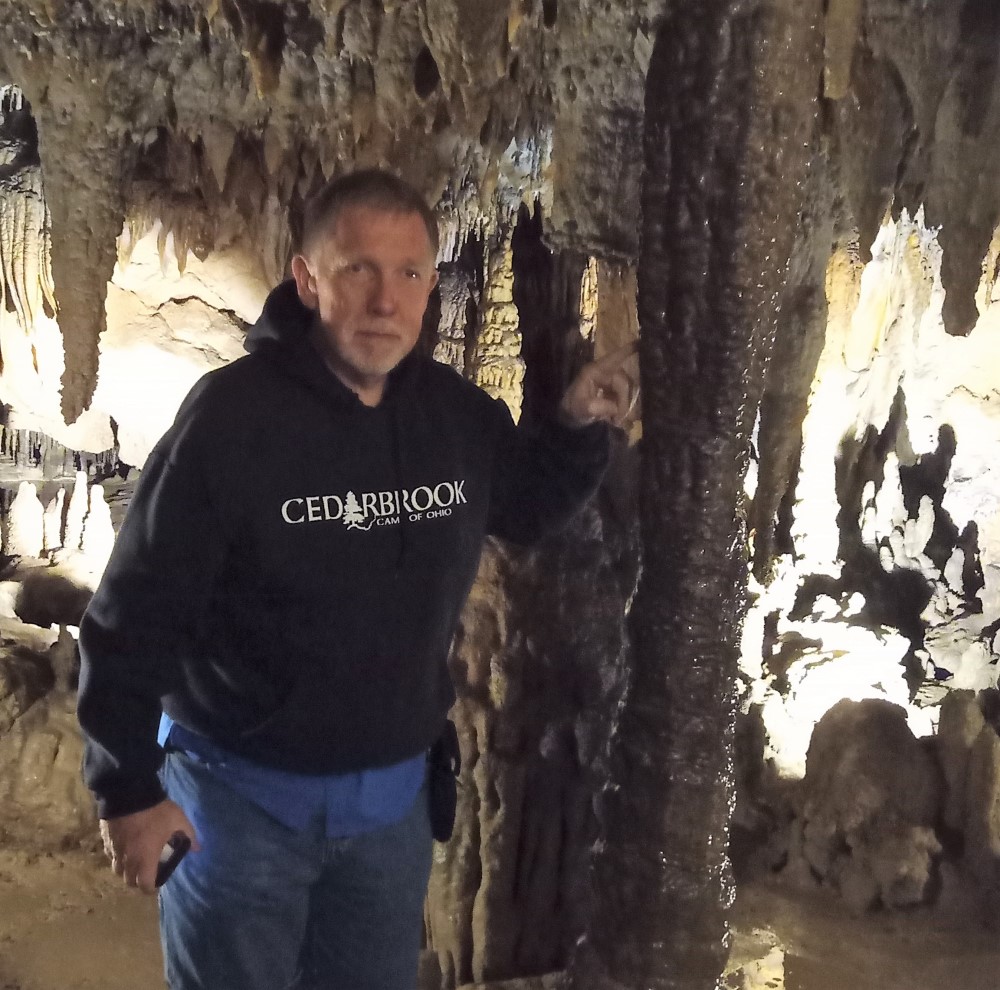
Our tour group in one of the cave roomsVisitors were allowed to touch only one formation in the cave, so I took the opportunity!
Florida Caverns are an enjoyable and cool way to spend a morning or afternoon while in the area.
Next week: we take a blog break as we head to Juniper Springs and Anastasia State Park in search of new rabbit trails!
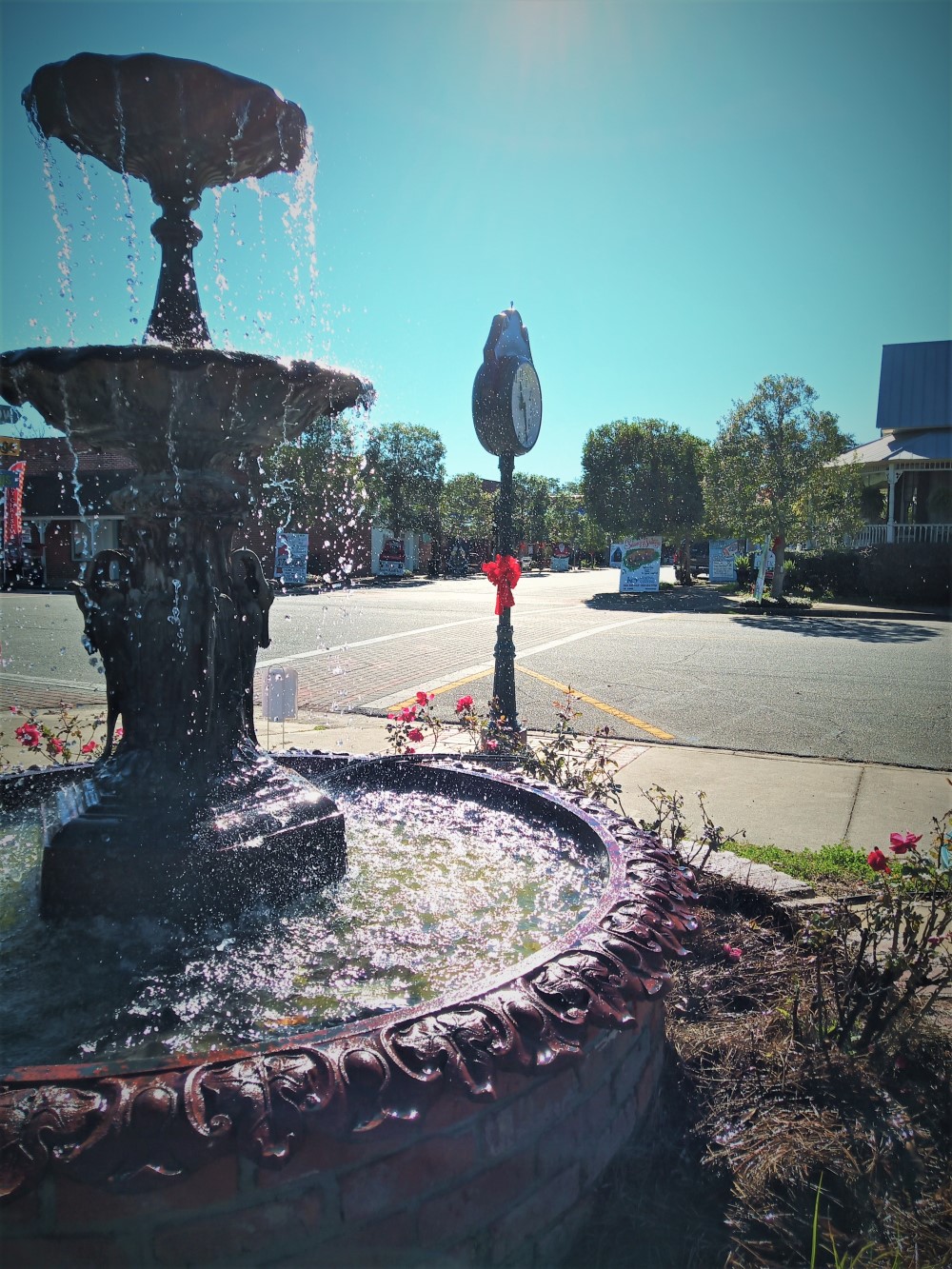
We put a hold on outdoor activities and decided to take a day trip to Havana instead. Not THE Havana in Cuba, but Havana, Florida, some 45 minutes away.
Fountain Entry to Havana
Havana is a small town located a few miles outside Tallahassee. In 1906, the town was named for its Cuban cousin because of shade tobacco, a major crop grown in the area. Shade tobacco was used to wrap fine cigars and Havana was one of two areas in the United States suitable for growing the tobacco.
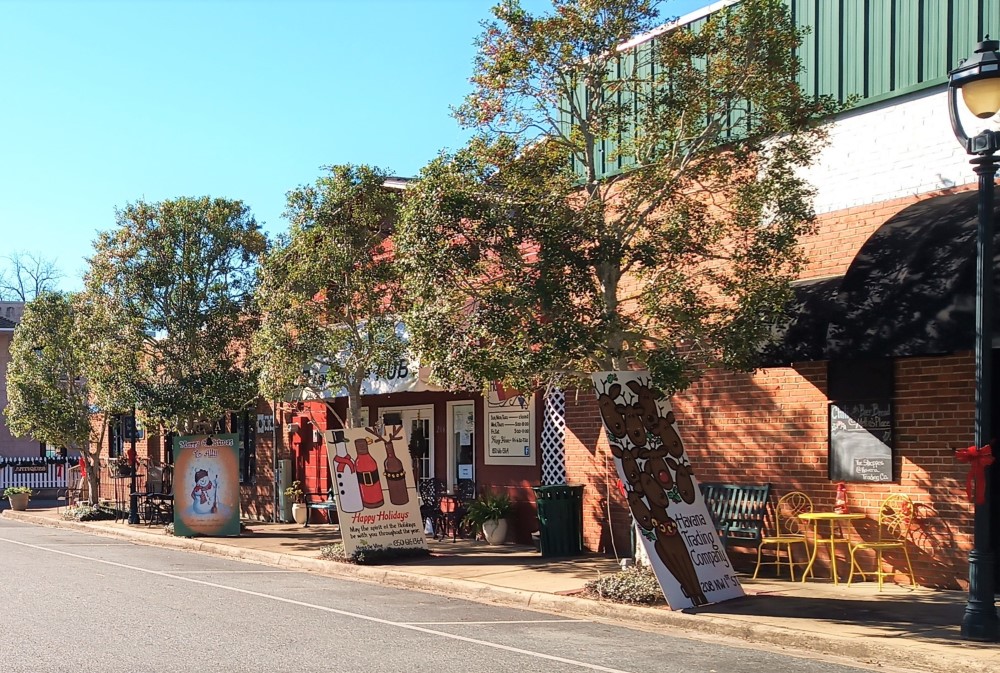
Havana Christmas Decorations
In the 1960s, the town fell on hard times when shade tobacco production moved to Central America and elsewhere. Some 20 years later an antique shop opened in Havana, and the town has since become a quaint destination for antique stores and art galleries.
We visited on 2020 eve, planning to enjoy a relaxed lunch as we looked around. Christmas displays, lights and large painted wooden greeting cards throughout the town gave it a friendly and inviting appeal.
However, except for a couple furniture galleries, all of the other shops, galleries and restaurants were CLOSED! We presume this was to get a head start on New Year’s Eve celebrations.
A bit disappointed, we decided to continue our day trip to Thomasville, Georgia. We resolved, however, to return one day to enjoy what Havana has to offer.
Our route to Thomasville took us through rural Florida into rural Georgia. We passed by fertile farmlands, dense woods and numerous creeks.
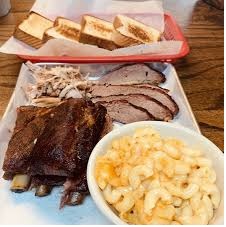
Lunchtime stopSample Q
It was lunchtime when we arrived and we stopped at Fallin’s Real Pit Barbeque. Fallin’s is an old time barbecue that serves mouthwatering ribs, pork, brisket, chicken and much more. We left completely satisfied.
Our next stop was downtown Thomasville.
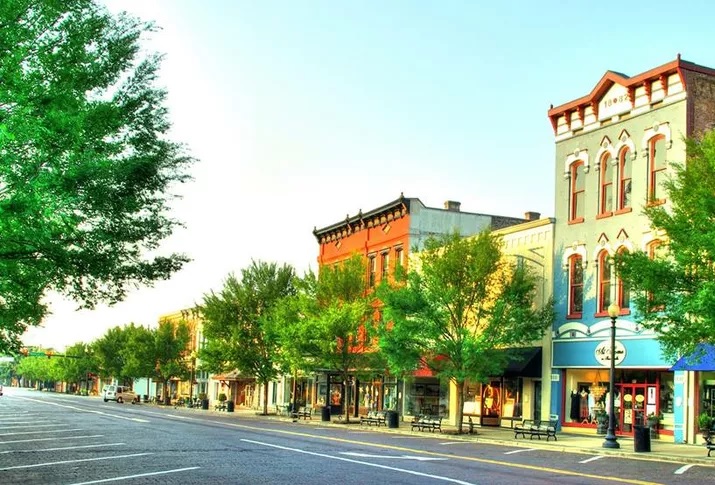
Downtown Thomasville
The town’s central shopping district is nicely done, with interesting shops and restaurants. We visited a few open shops and before long, decided to head back to the campground.
There is a LOT MORE to see in Thomasville and it would be a great weekend destination for an anniversary or other special occasion.
Pebble Hill Plantation
On our return trip we stopped at Pebble Hill Plantation, located a few miles south of Thomasville.
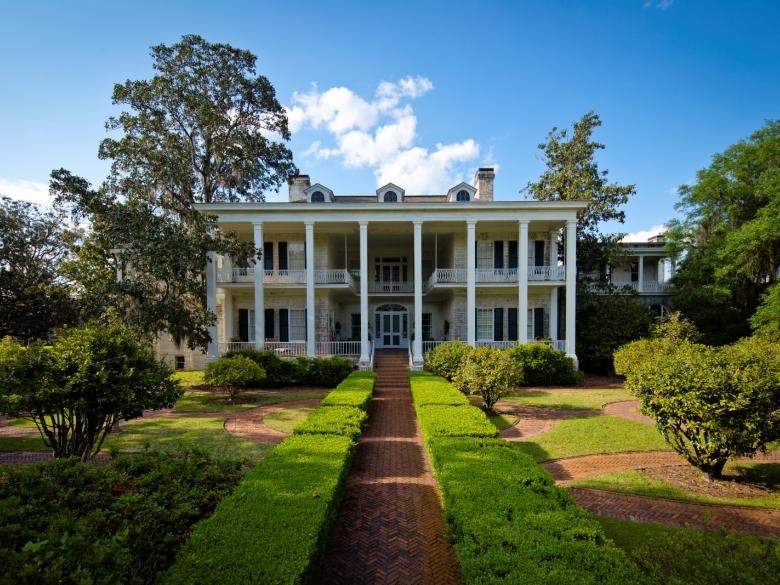
The plantation was established in the 1820s and now includes a beautiful mansion with horse barns and finely manicured grounds. We took a guided tour of the multi-roomed mansion and an amazing upstairs art collection that included several original Picasso paintings.
After the tour, we walked through the horse stables and several other buildings, and then around the grounds for more than hour.
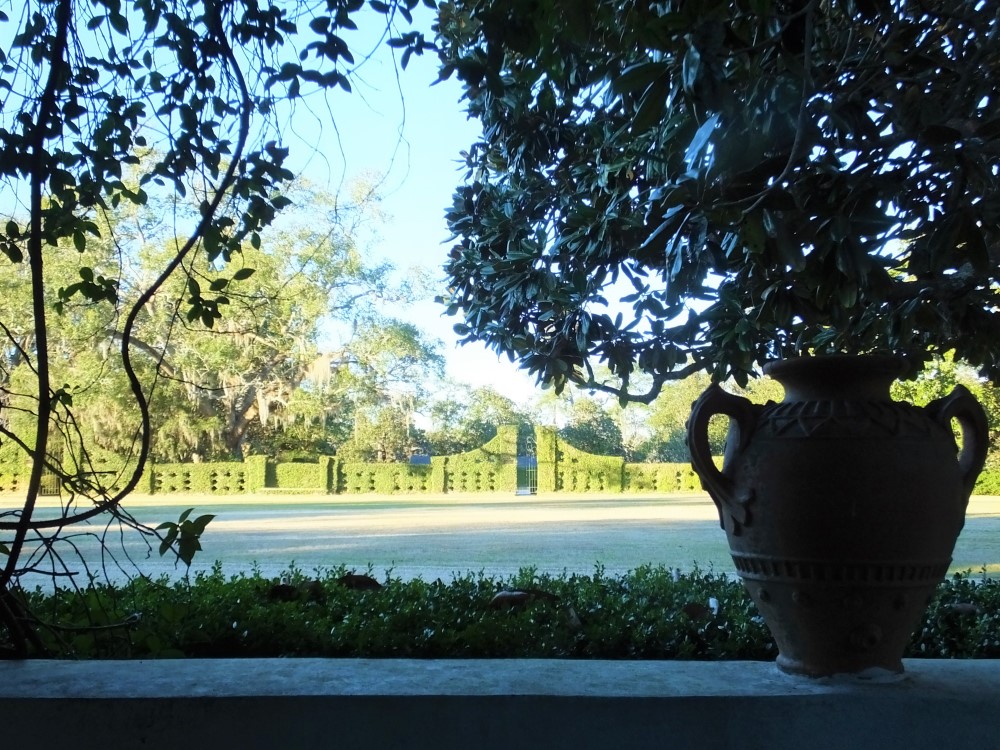
Pebble Hill MansionPebble Hill Grounds
Pebble Hill has an interesting history. The plantation offers a nice half day diversion while in the area.
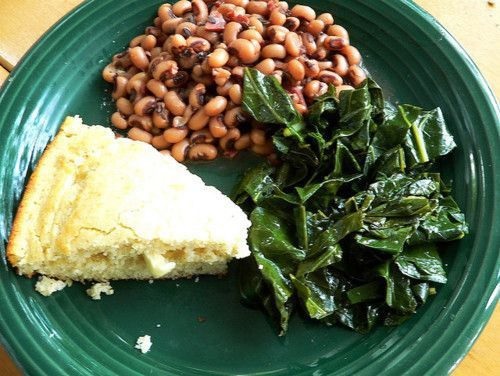
Black-eyed peas and greens – starting 2020 right!
Back at the campground, we ate dinner and settled down for a quiet New Years’ Eve. Our New Years’ Day dinner plans included black-eyed peas and collard greens – for good luck in 2020 of course!
Next week: after a low key New Year’s Day. we travel to Florida Caverns, Florida’s version of the famous cave located near Carlsbad, New Mexico.
After setting up at and exploring Three Rivers State Park, we wanted to know more about Lake Seminole. This meant a short drive east from Three Rivers State Park toward the small town of Chattahoochee and the Apalachicola River.
Jim Woodruff Dam
As we crossed the Apalachicola River, the impressive Jim Woodruff Dam was to our left. It captured our attention as such a dam is rather unusual for Florida.
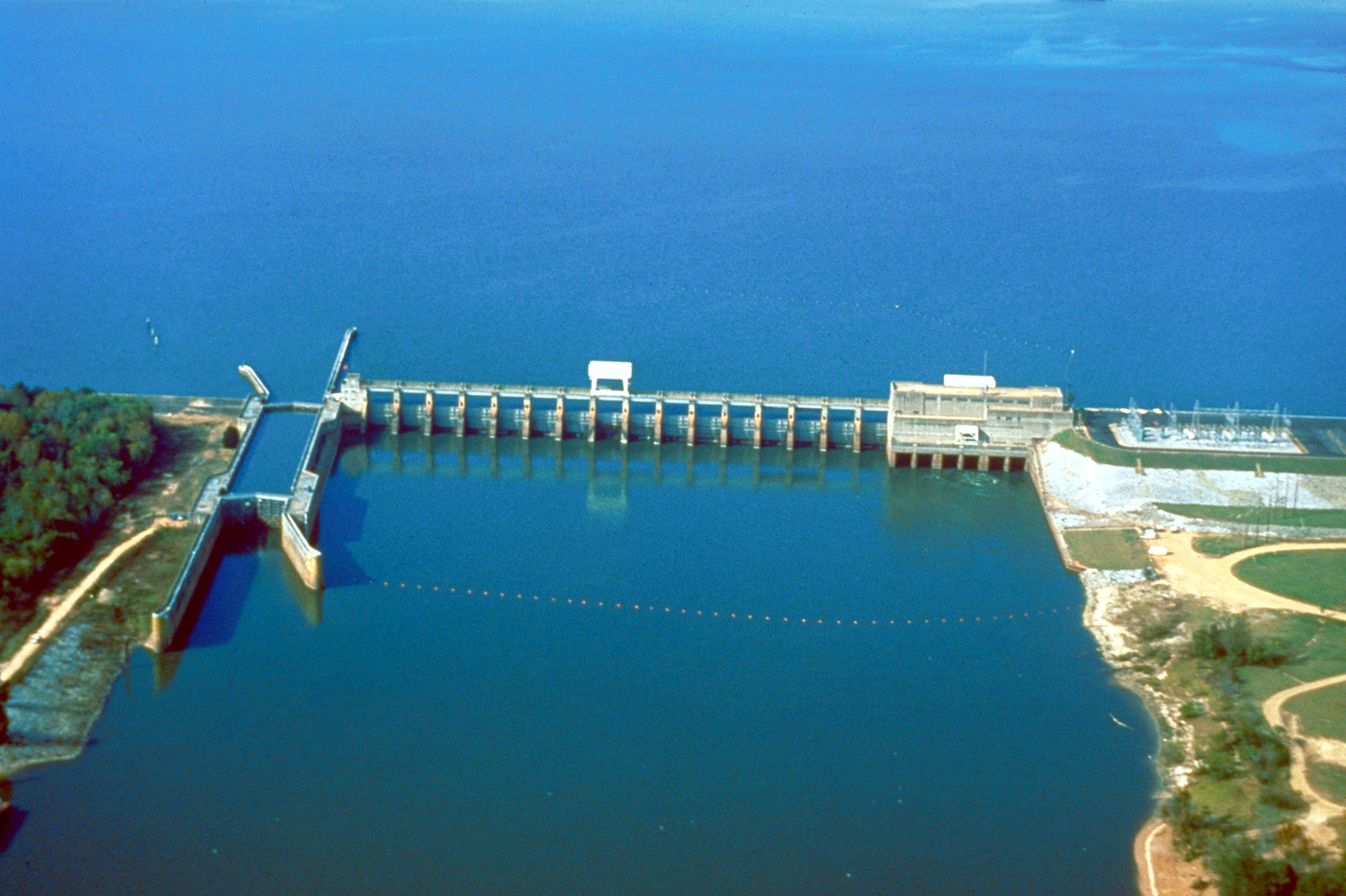
Aerial View (U.S. Army Corps of Engineers photo)
Completed in 1952, the Woodruff Dam includes a single lock for boats and hydroelectric generators that can power 43,000 homes!
Lake Seminole backs up behind the 1000 ft long earthen dam. The lake is located where the Flint and Chattahoochee Rivers originally came together, covers 37,500 acres and has a shoreline of more than 350 miles. There are plenty of recreational opportunities in the more than 30 parks and 5 campgrounds all around the lake.
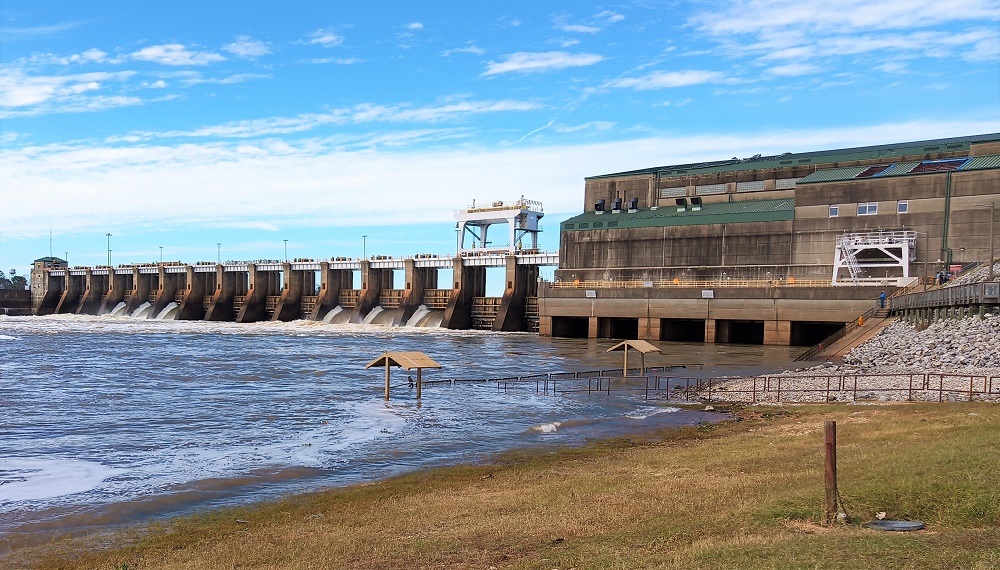
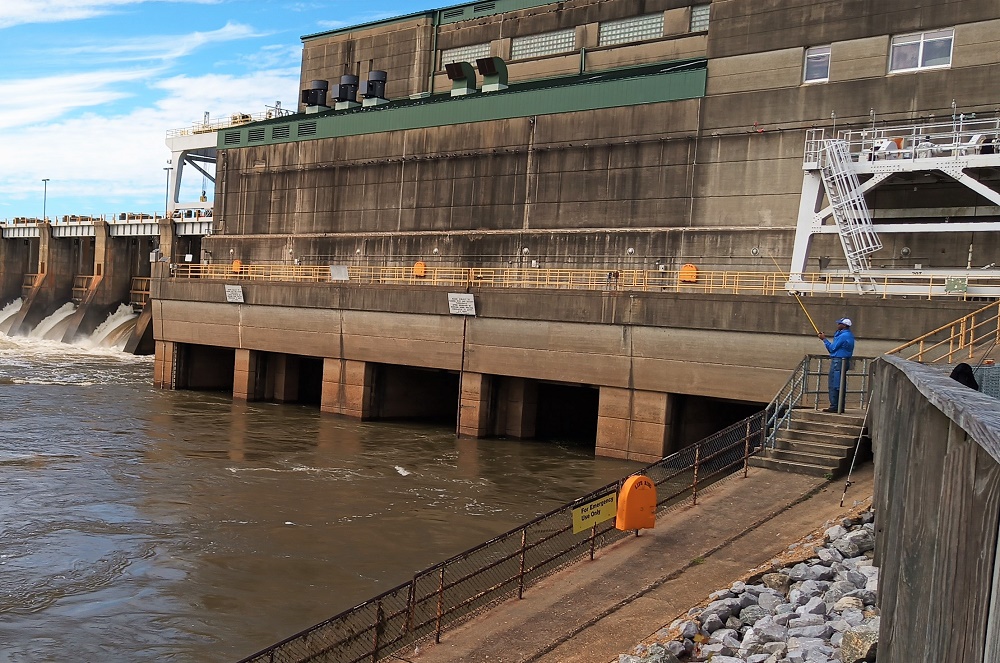
Powerhouse/spillway viewFishing at the powerhouse
We wanted a closer look at the dam and drove a few miles from Chattahoochee to the dam itself. We crossed from Florida into Georgia, and then back into Florida before arriving.
After parking below the dam, we followed a steep sidewalk to get a closer look at the multiple spillways and power generating plant. From the high sidewalk, several persons held study fishing poles hoping to catch one of large catfish said to live in the deep water below the powerhouse.
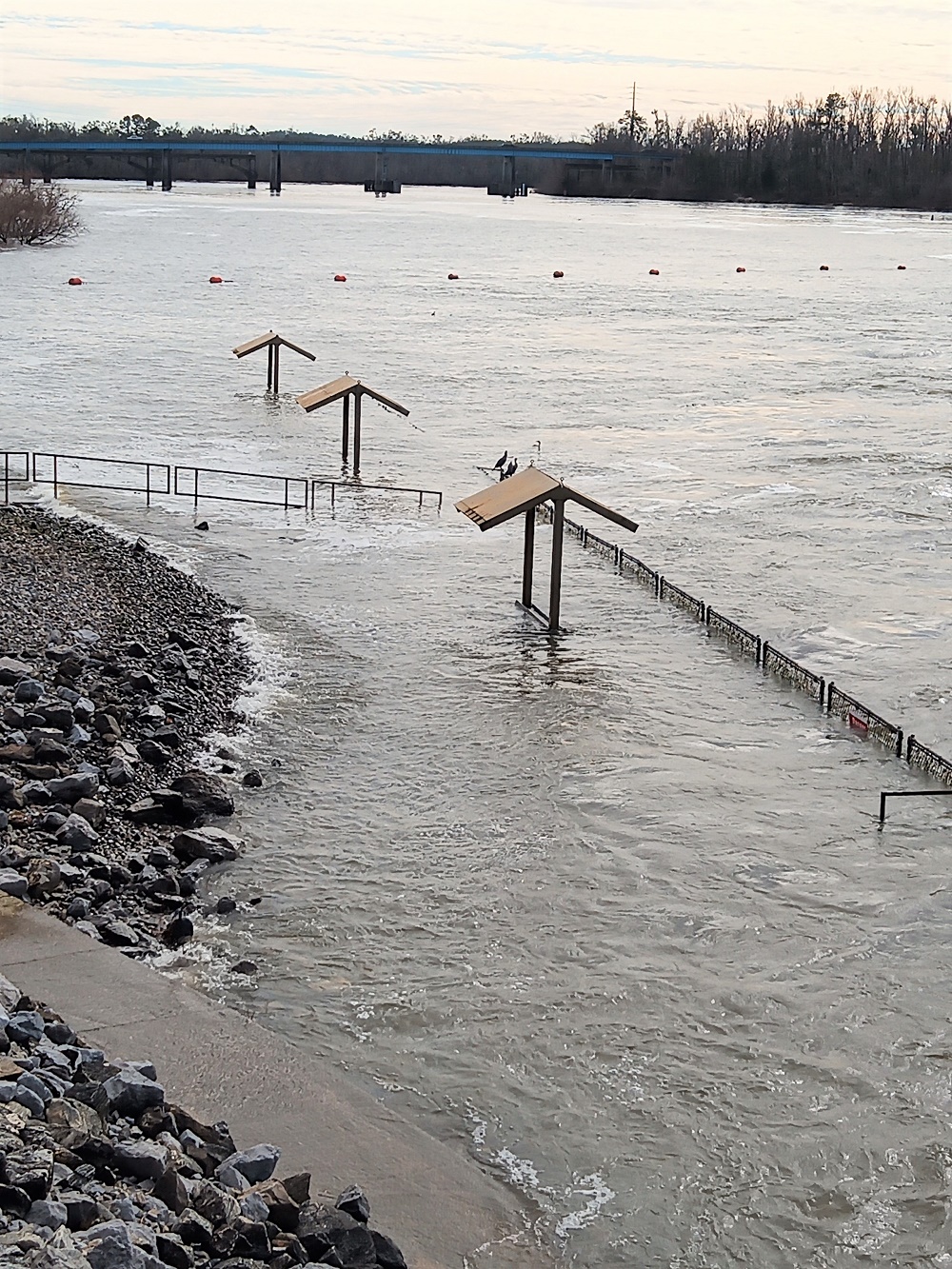
High waters below the dam
There is also a sidewalk and a few covered tables next to the river, but these were temporarily flooded as excess water from recent rains was being released from the dam.
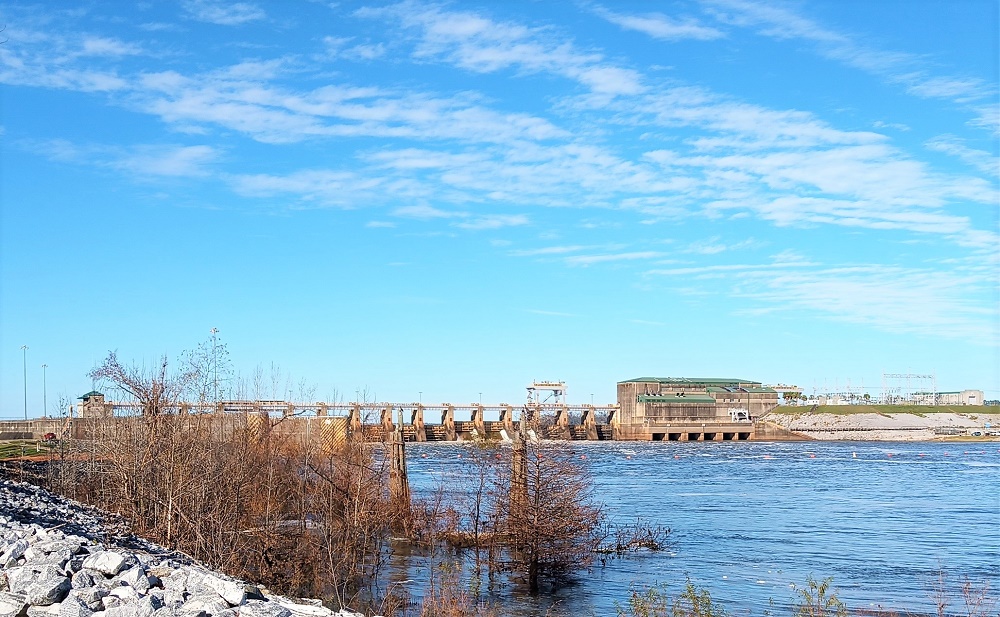
From another parking area nearby, we had a broader view of the dam, lock and spillways, and the bridge we had driven across earlier.
The dam is a nice half day diversion from Three Rivers State Park, with opportunities to walk a bit and look around. A small Corps of Engineers visitor center is nearby with additional information about the dam and Lake Seminole.
Next week we’ll explain why the best time to visit Havana is NOT just before New Years. We had to continue on to Thomasville, Georgia – a beautiful southern town with great bar-b-que, a scenic downtown and historic plantation nearby.
Philip Spyckaboer hunkered down in his solid brick home waiting for Hurricane Michael. It was October 10, 2018 and the hurricane was approaching Three Rivers State Park from the Gulf of Mexico some 75 miles away.
As the hurricane eye passed overhead, he emerged to inspect the damage. In the eerie stillness he knew his job as head ranger would be dramatically changed forever.
Pat and I spoke with Spyckaboer during a recent five-night camping trip to the state park. Although considerable recovery efforts have been taken place over the last 15 months, damage from the category 5 hurricane is still very much evident. Recovery will continue for years in the future.
He explained recovery efforts have included debris removal and replanting. Some cleared areas now have growths of new grasses and small trees, while tree removal continues in other areas. Some areas will be burned to stimulate new growth.
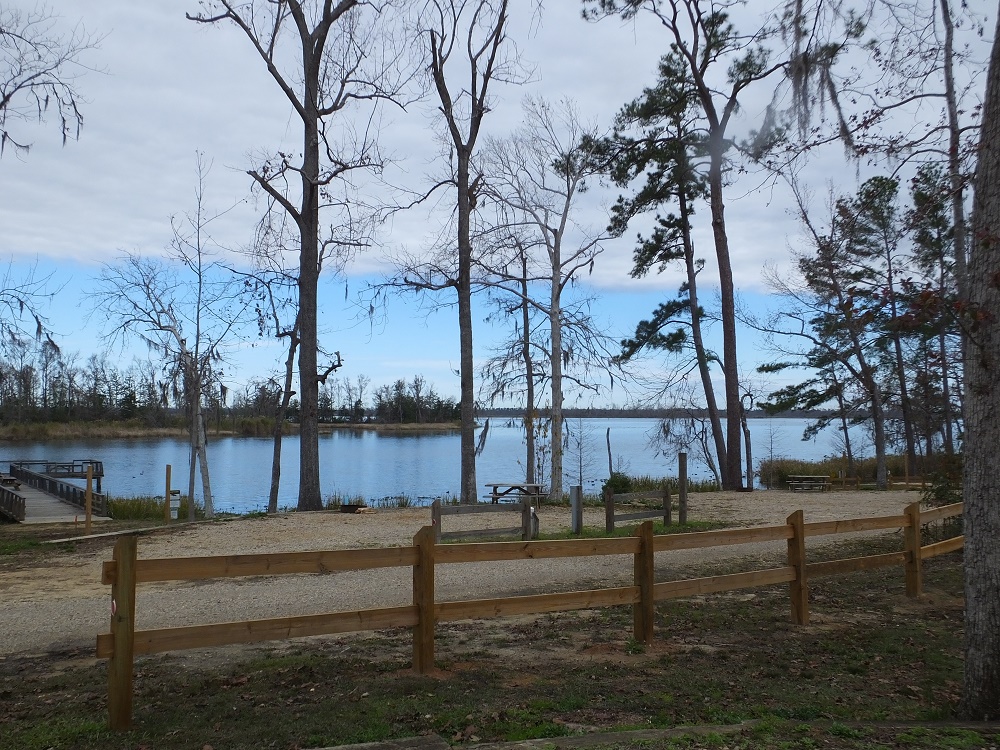
We proceeded slowly along the potholed entry road and enjoyed views of Lake Seminole. The popular fishing lake was formed in the 1950s by Jim Woodruff Dam built at the confluence of the Flint and Chattahoochee Rivers. The dam empties into the Apalachicola River on its way to the Gulf of Mexico.
Lake Seminole from our campsite
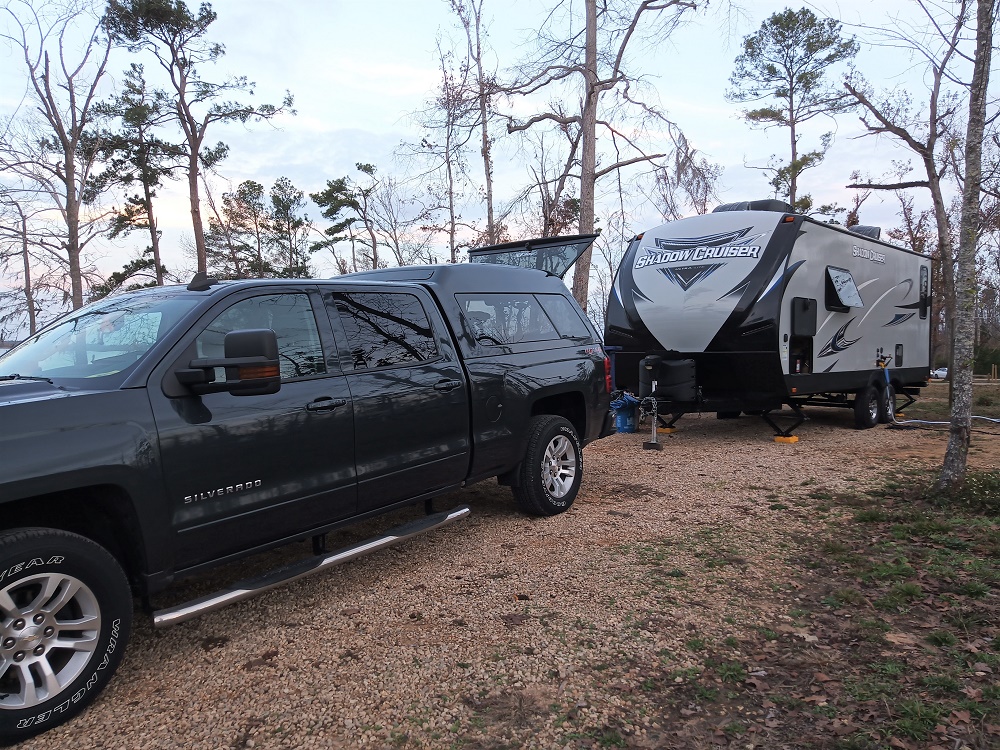
Our campsite had views of the lake, a small fishing pier and threadbare trees nearby. We could only imagine how the park looked before the storm and how it will appear as the forest recovers.
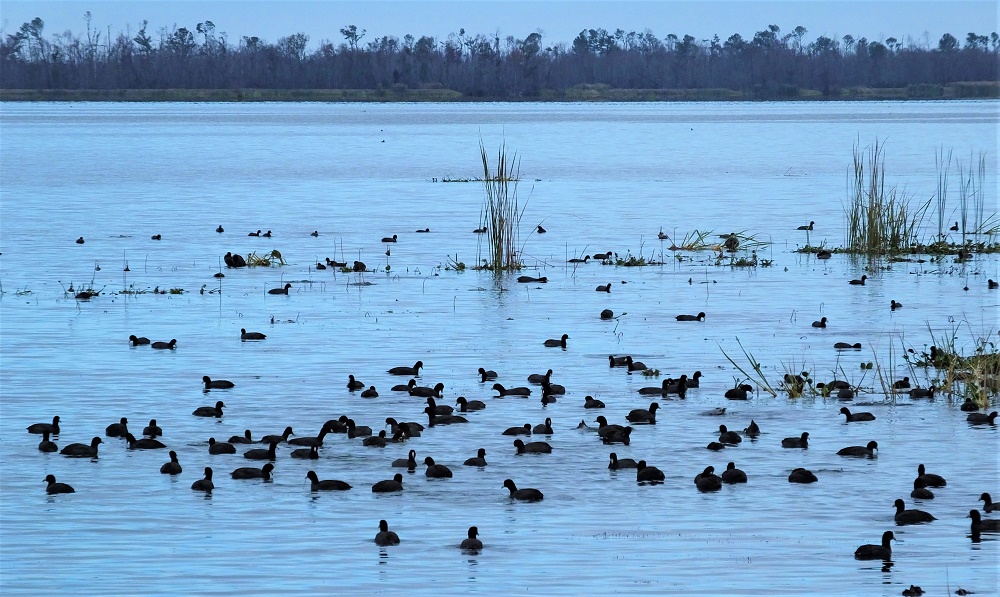
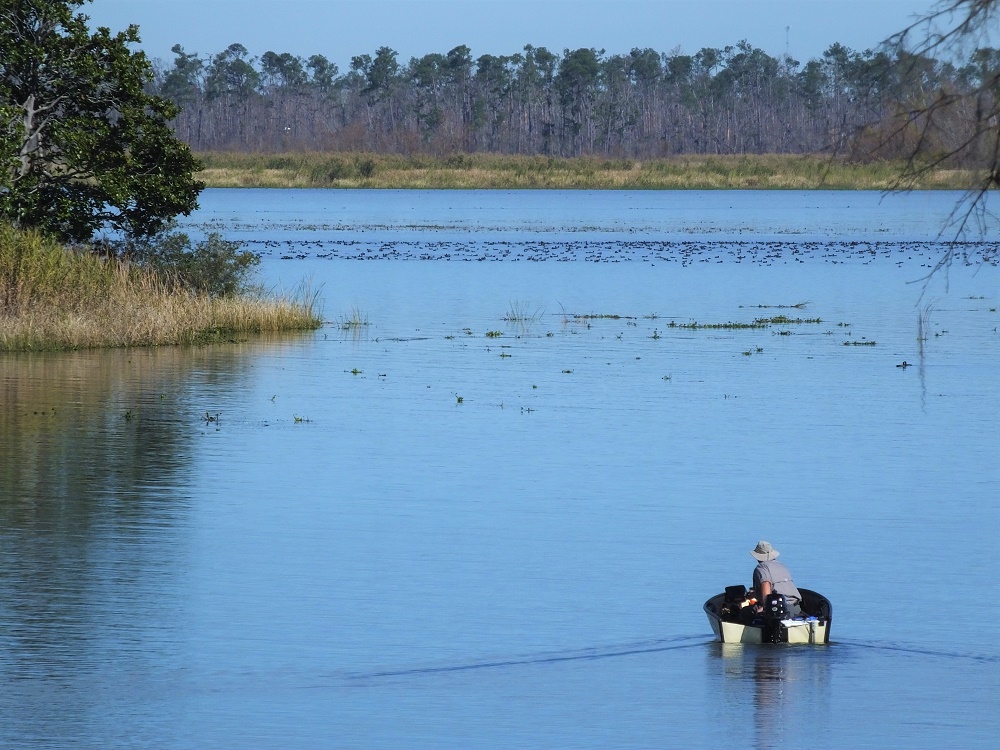
From the campground there is a half mile trail that leads to a picnic/playground area for day visitors. Although we can’t report seeing any animals during our visit, we did see various birds, including lots of ducks, several woodpeckers and a bald eagle. We hoped to rent a canoe or kayak to try our luck at fishing, but the weather and strong winds made us decide otherwise.
Ducks on Lake SeminoleLake Seminole fisherman
We took several interesting day trips during our stay. More on these next week.
Three Rivers State Park Essentials
Location – 53 miles west of Tallahassee, easy access from I-10 (9 miles)
Closest town – Sneads (3 miles). Chattahoochee (8 miles) or Marianna (21 miles) have a better selection of restaurants and supplies, however.
Campground amenities – the campground has 30 campsites (each with 30/50 amp electric, water, picnic table, fire ring), dump station, clean restrooms with showers, washer/dryer and dish washing sink. Firewood and canoe/kayak rentals. Fishing pier and boat launch. One cabin is also available.
Connectivity – 4G AT&T cell service very good (4 bars). I tethered and completed a blog update during our stay. We received nearly 30 over-the-air TV channels
Hiking/Biking – there are several short hiking trails. Biking on park roads only, closest rail trail is 50 miles away, near Tallahassee.
Lasting Impressions – beautiful lake view, awesome night sky, peaceful and quiet. Several interesting day trips available in the area.
From Capitol Reef National Park we headed northeast towards Moab and Canyonlands/Arches national parks. About half way there were signs for Goblin Valley State Park and decided to sidetrack a few miles.
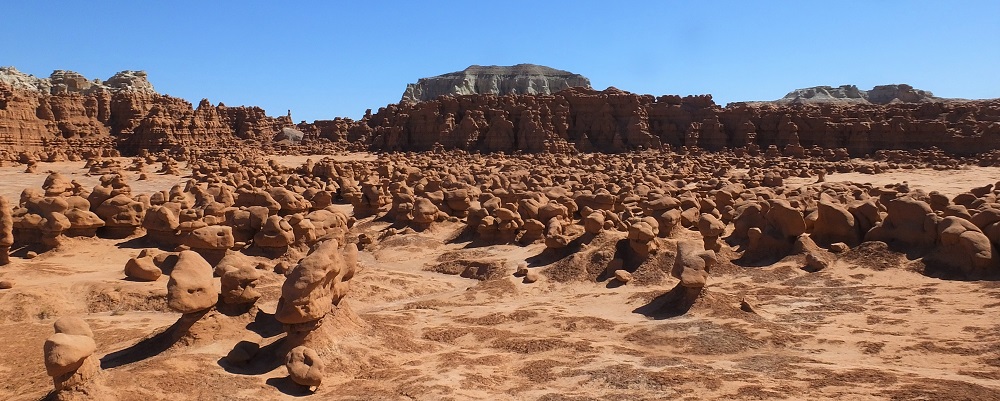
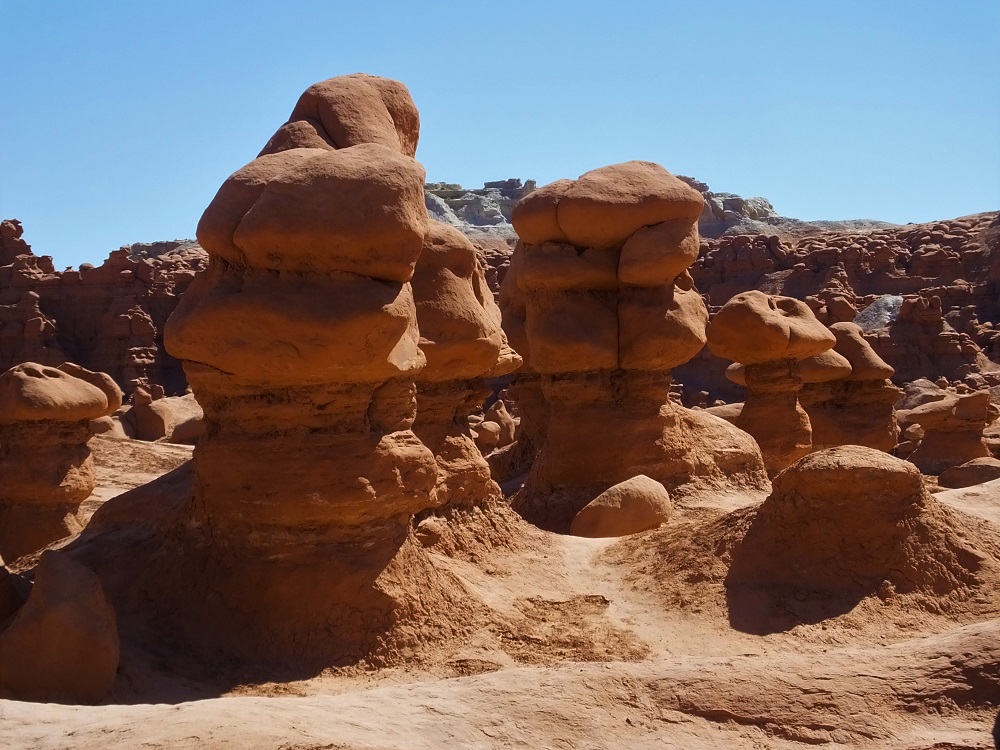
Located in a remote area about eight miles off the main highway, Goblin Valley State Park has thousands of hoodoos, referred to locally as goblins. The goblins are mushroom-shaped rock formations that are 10-20 foot in height.
Across several valleys, hundreds of these formations cast interesting shadows that look like goblins advancing on the visitor.
Goblin Valley
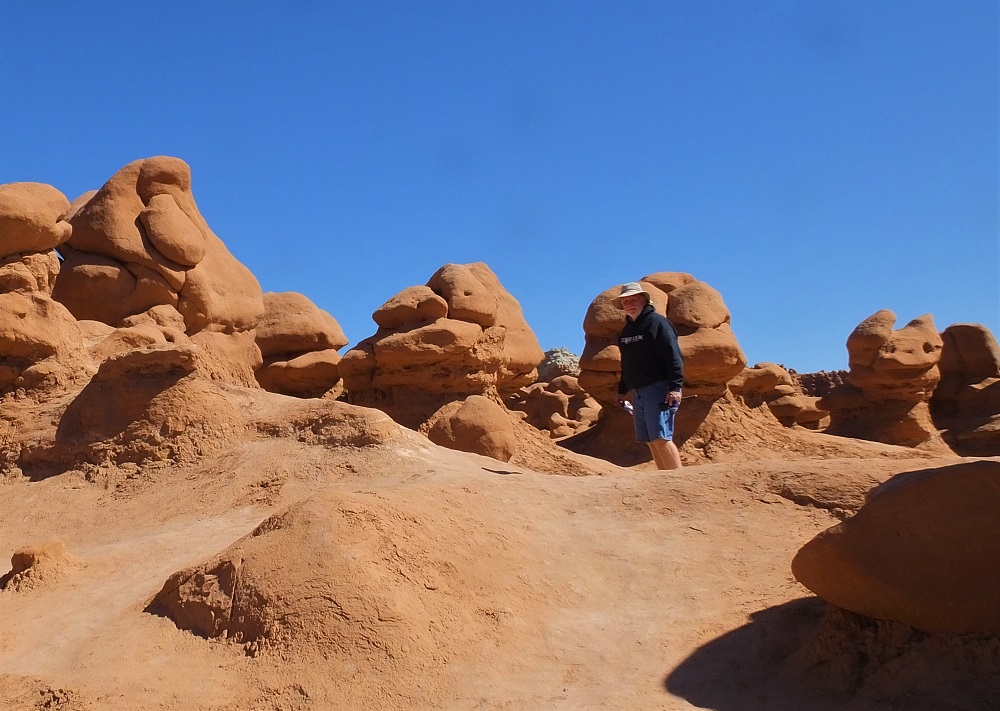
After lunch, we took a few moments to walk in one of the valleys, among the goblins/hoodoos.
Among the goblins/hoodoos
Here is a short video taken during our walk (please bear with us as we learn how to create and post Youtube videos).
After a safe escape from Goblin Valley, we continued to on Moab, where we found ourselves among many other visitors during one of the busiest times of the year.
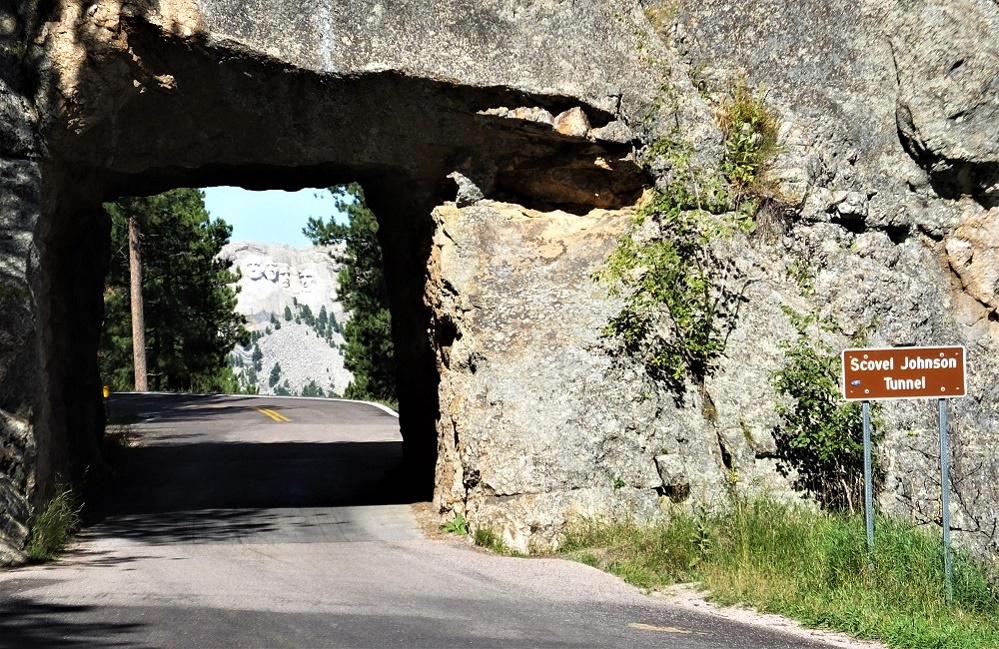
After enjoying the bison, burros, pronghorns and prairie dogs of Custer State Park, we decided to drive the Iron Mountain Road (US 16A) from Custer State Park to Mt. Rushmore National Monument the next morning. It took nearly an hour to drive the 20 mile road. Included were three single lane tunnels (e.g. very narrow and around 10 foot tall) and several pig tails, where the road makes a complete 360 degree loop under itself. Glad we weren’t towing our camper!
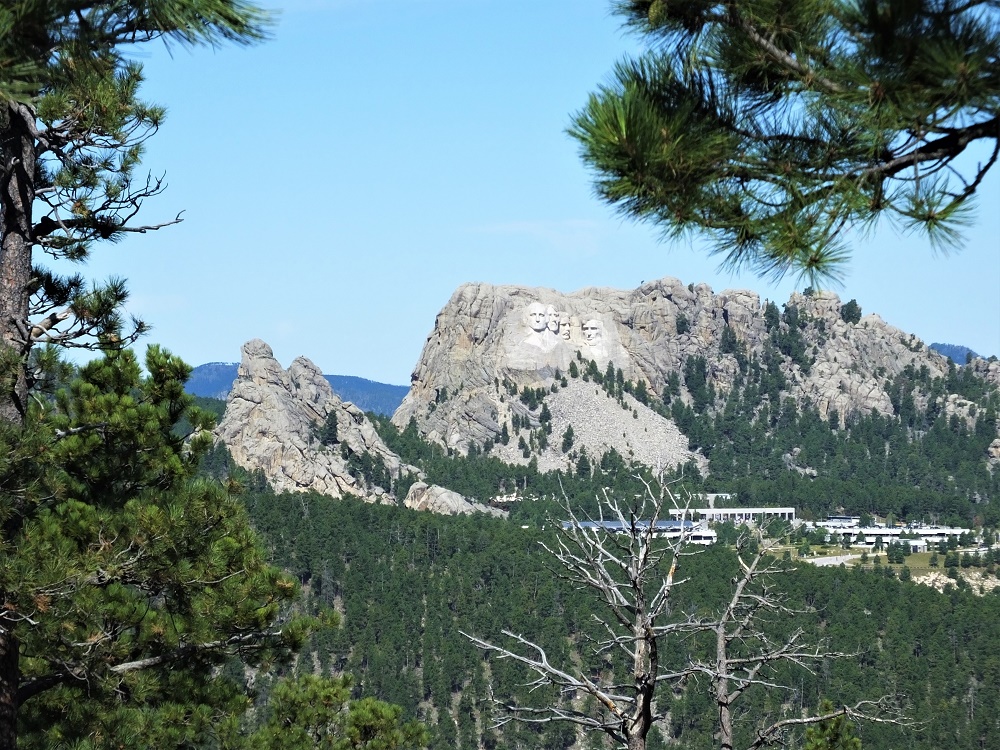
Mt. Rushmore is visible through tunnelDistant view of the memorial
When we drove through the first tunnel we realized Mt Rushmore was visible through the tunnel. We turned around and drove through it a second time to get the full impact and to take photos. The third tunnel has a similar view of Mt. Rushmore. Tip: it is better to drive the Iron Mountain Road from south to north for the Mt. Rushmore views.
Mt. Rushmore
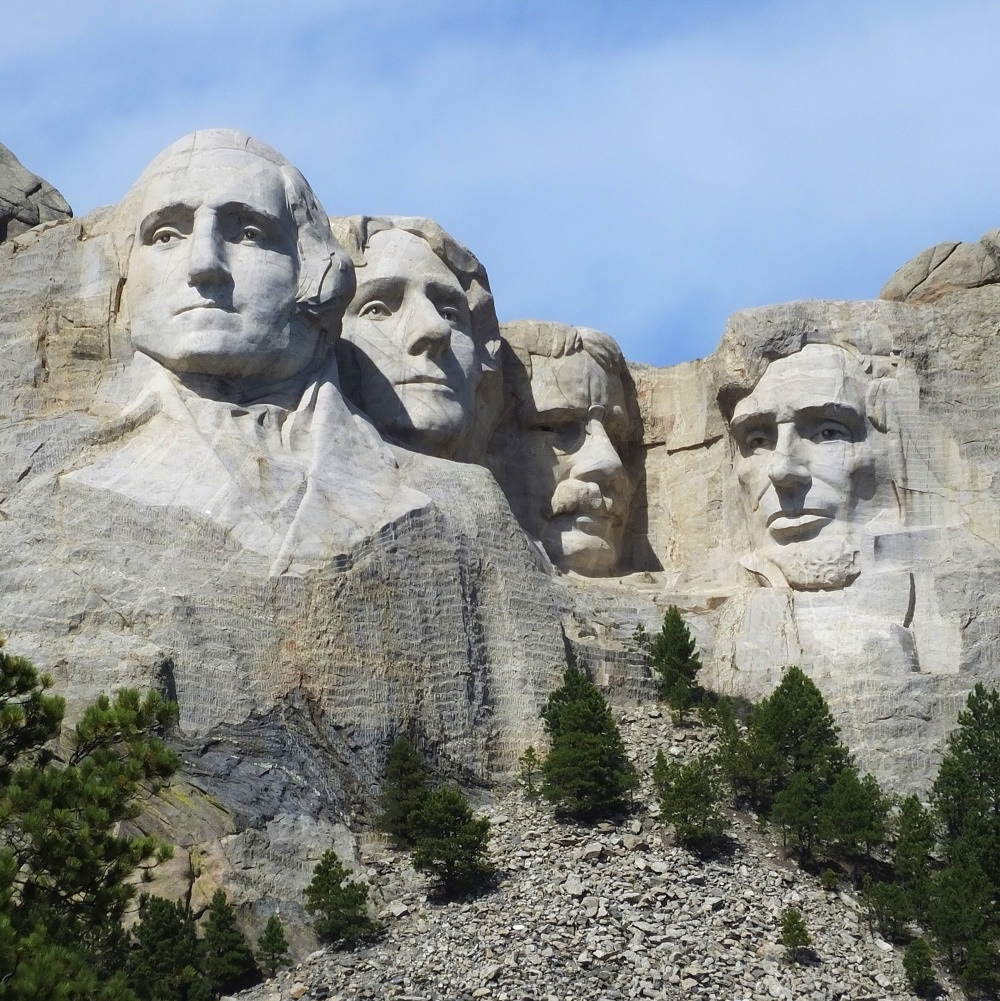
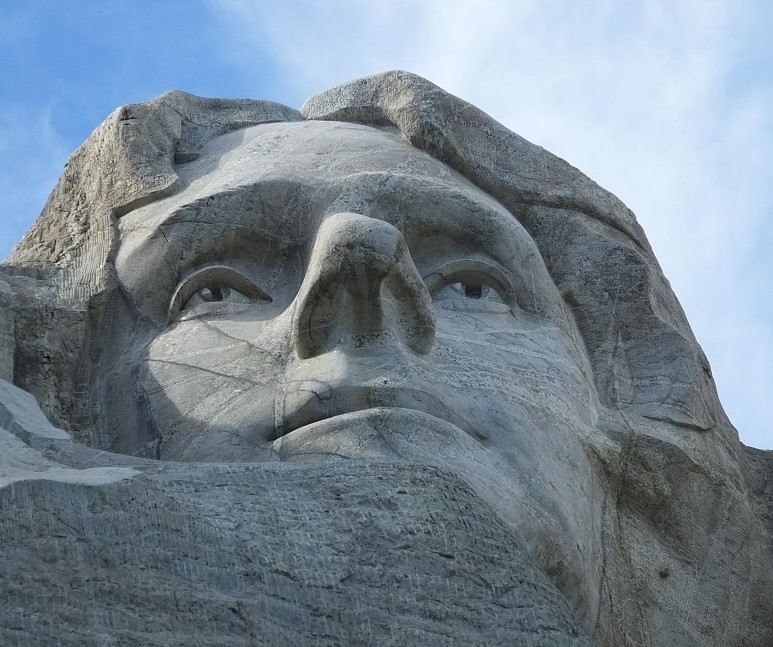
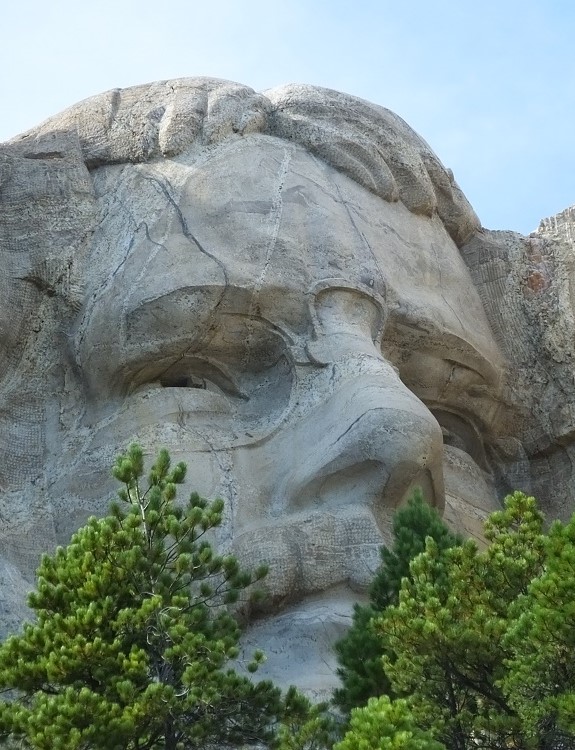
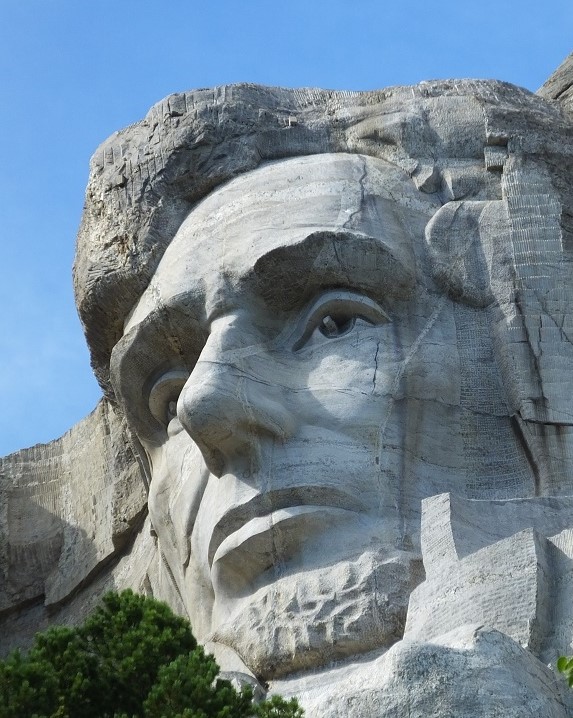
Although the previous day was overcast with occasional showers, we arrived at Mt Rushmore under crystal clear blue skies. The presidential views were awesome!
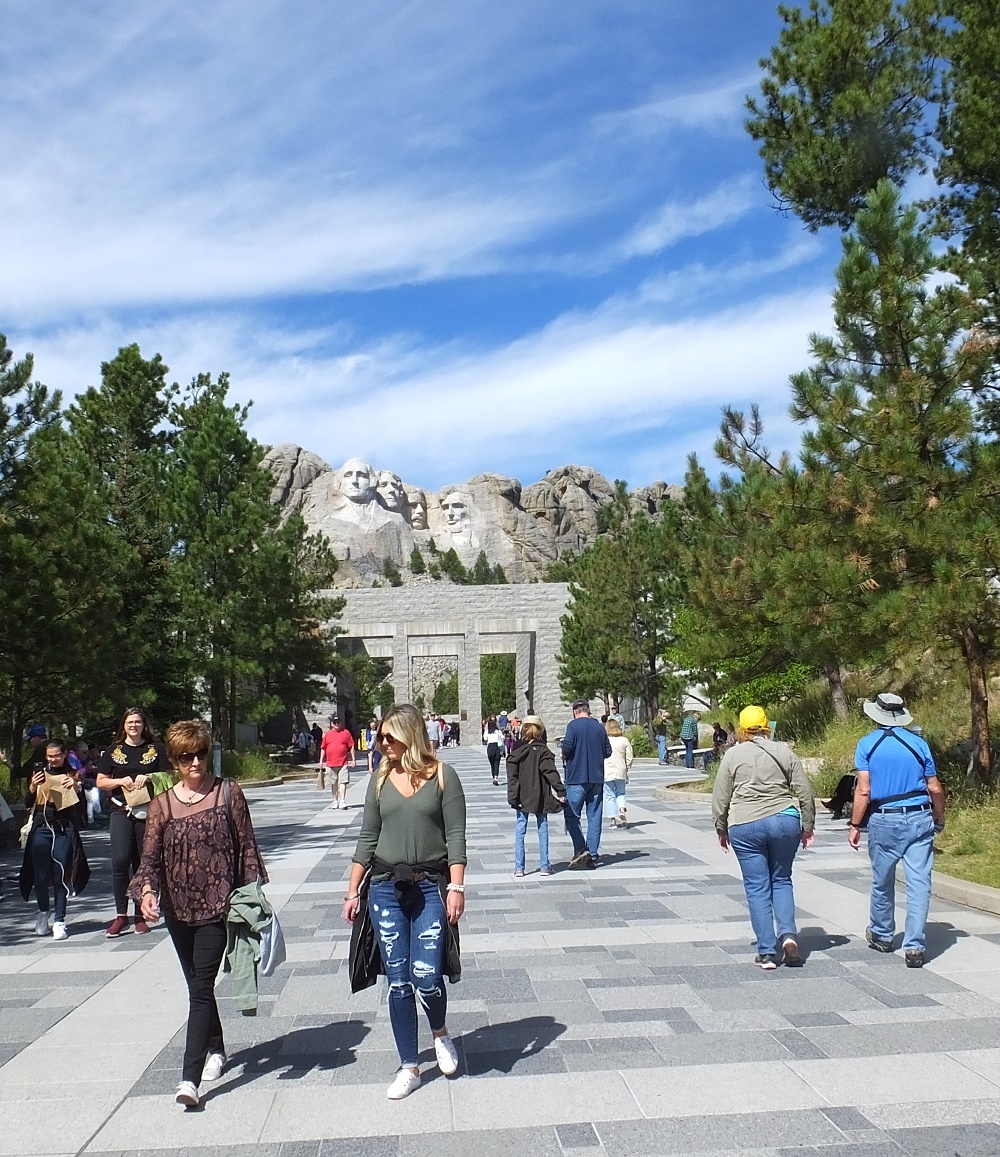
Courtyard in front of Mt. Rushmore
A large parking garage has been built just outside the entrance because lots of people visit the memorial, so finding a parking place was easy. From the entrance, a wide stone courtyard extends up to an amphitheater below the stone faces. There was construction on the front part of the courtyard so we were unable to walk only about halfway to the amphitheater. The views were fantastic nonetheless.
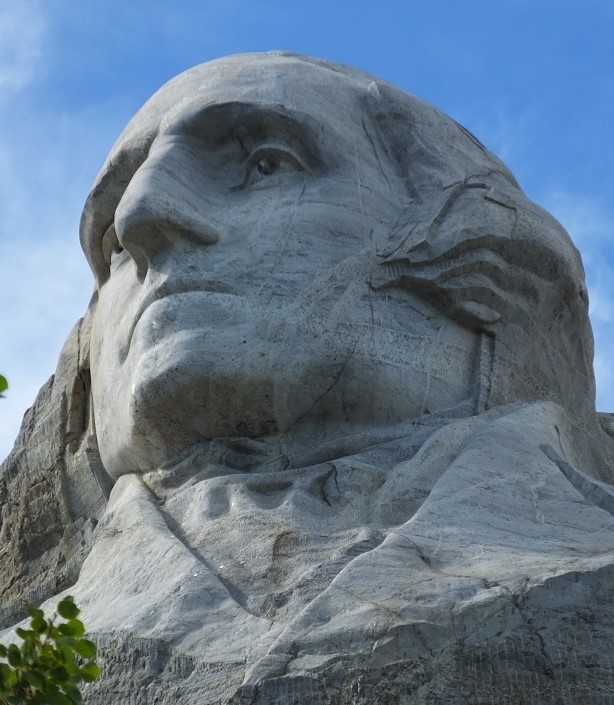
George WashingtonThomas JeffersonTeddy RooseveltAbraham Lincoln
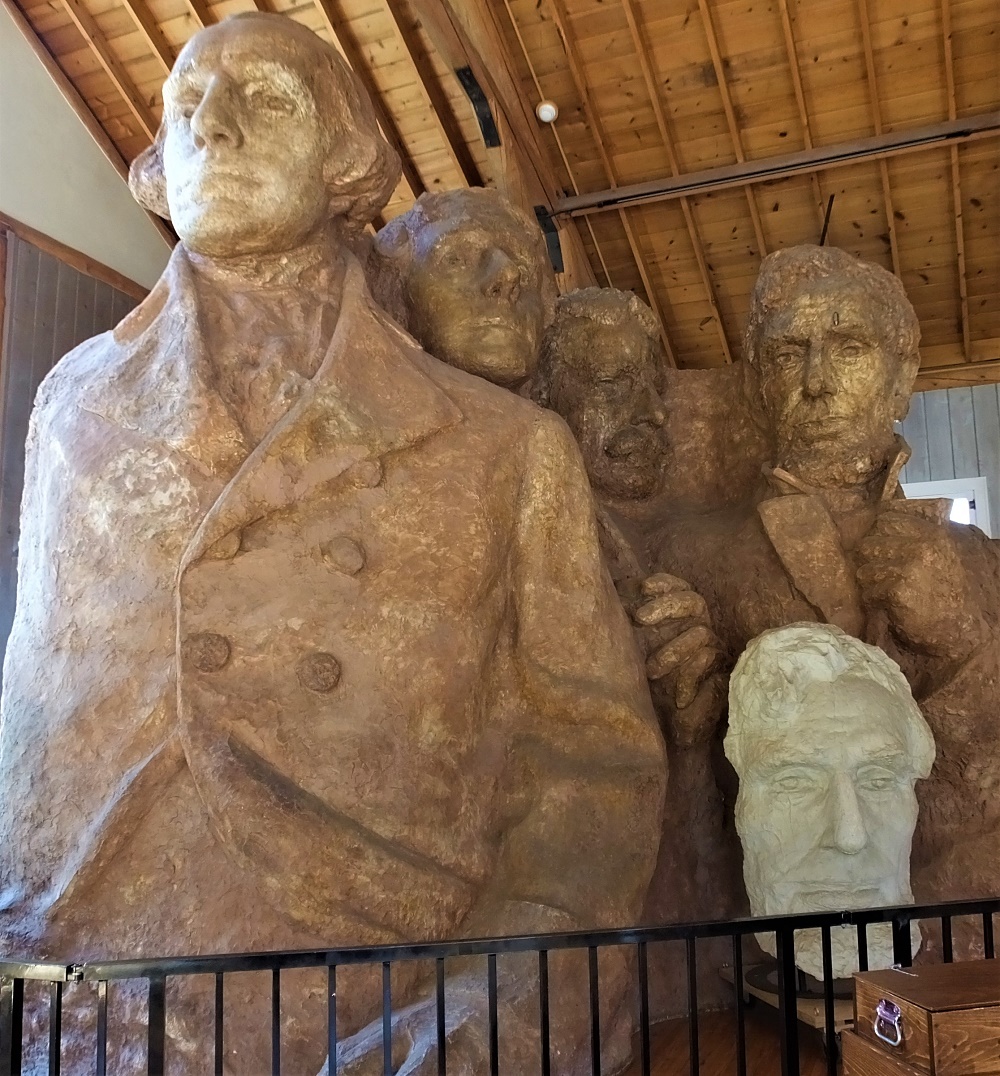
We also walked the trail that goes immediately under the sculptures. We climbed more than 200 stairs to get a special nosehair view of the presidents. As we returned we stopped by a studio that had the original sculpture from which Mt Rushmore was modeled.
Sculpture from which Mt. Rushmore was modeled
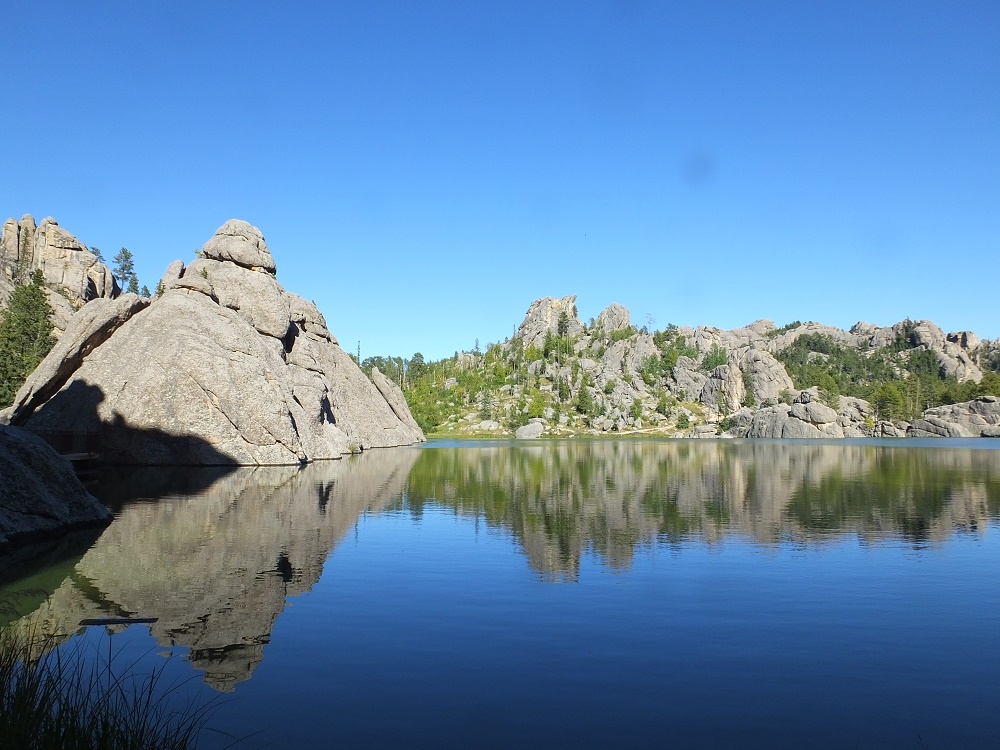
We left Mt Rushmore and reentered Custer State Park at the Sylvan Lake/Needles Highway Entrance. We hiked around Sylvan Lake, a tranquil lake at the top of the Black Hills, and then continued along the Needles Highway.
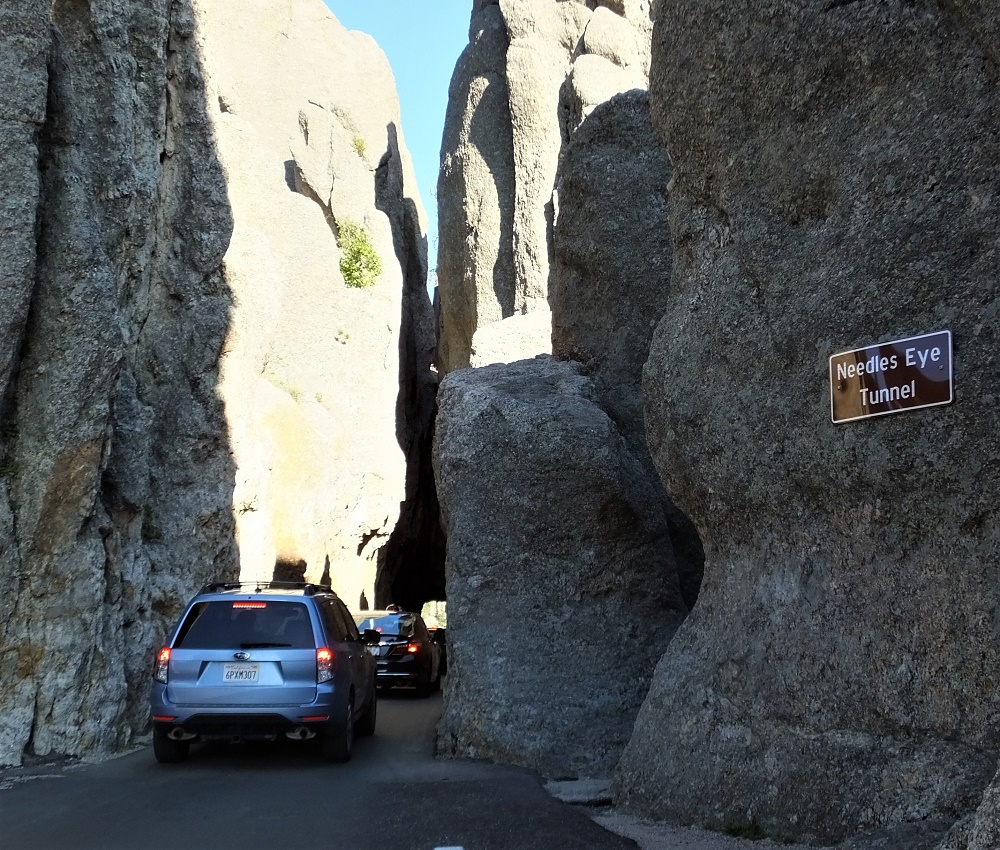
The highway makes its way through some stunning needle-like formations that culminate with a tricky drive through a very narrow (8.5 ft) tunnel. We had to fold in our truck side mirrors to avoid hitting the sides!
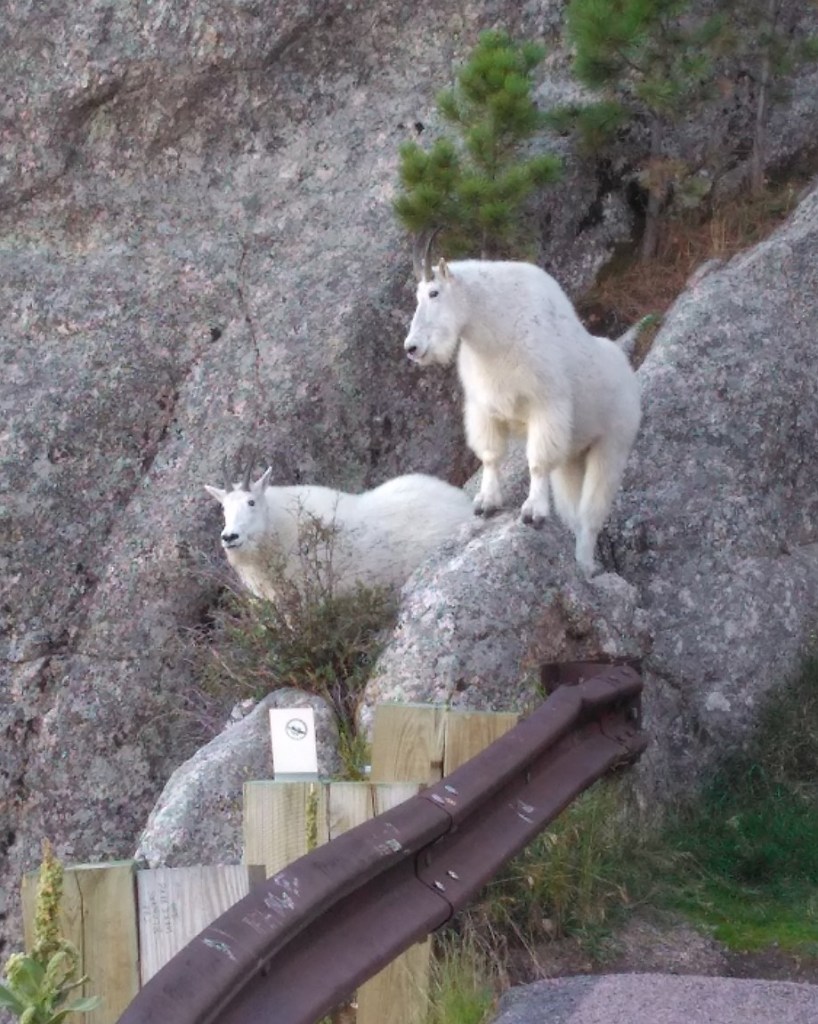
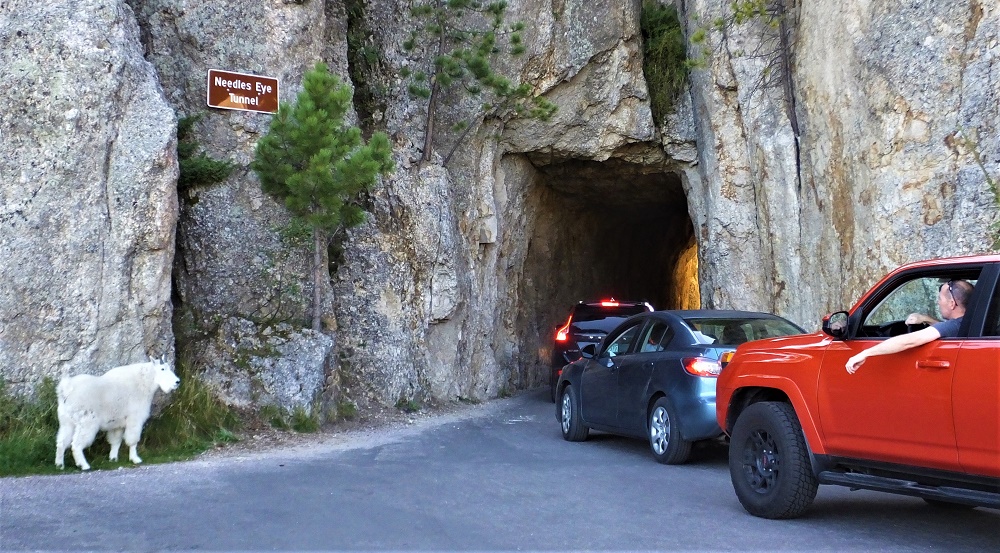
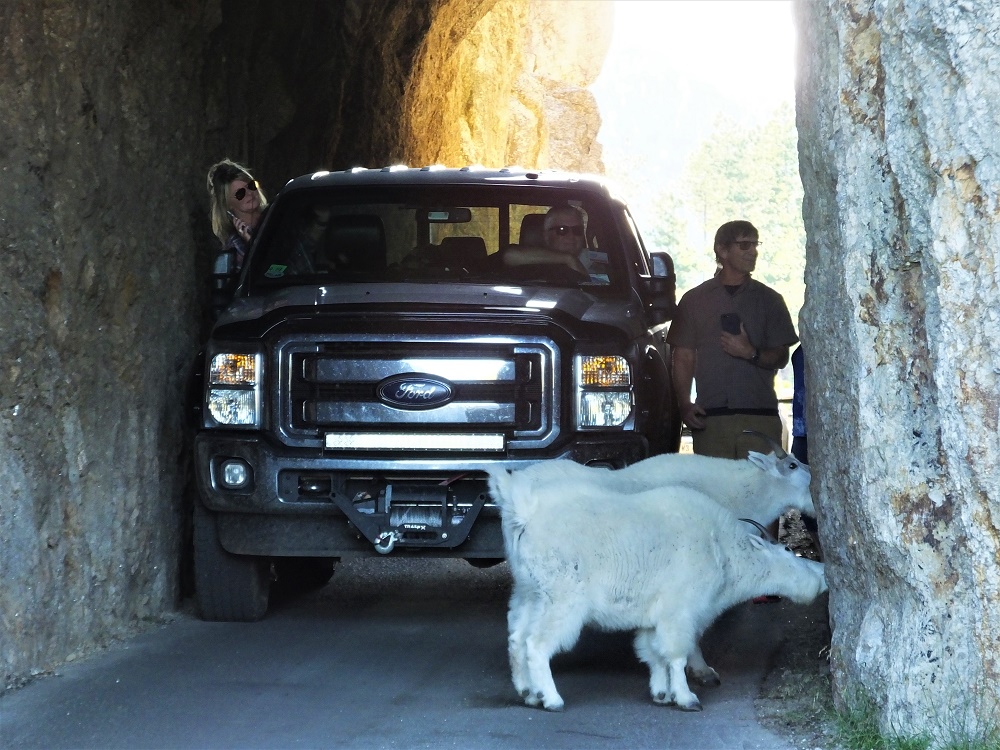
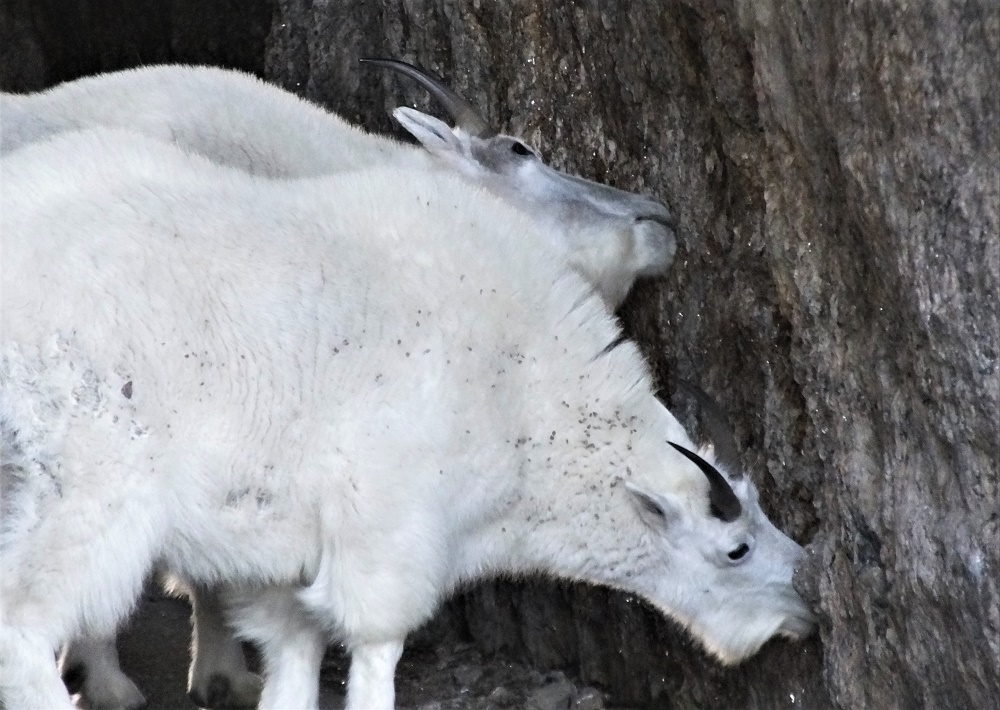
There were delays as cars drove through the tunnel – some more than 10 minutes. Our turn came and as we exited the other end of the tunnel we discovered the reason. There were two white mountain goats perched on a rock outside the end of the tunnel. During breaks in the traffic, the goats reentered the tunnel and began licking the minerals on the inside of the tunnel. Only after some assertive coaxing by drivers would they move and let cars pass!
Entering the narrow tunnelGoat sentries on the other sideWatching for a break in the trafficGoats blocking trafficCloseup – goats eating minerals from cave wall
We returned to our campsite and anticipated our drive the next day to the interesting formation made famous by the 1977 movie Close Encounters of the Third Kind.



 Take the LONG Road...