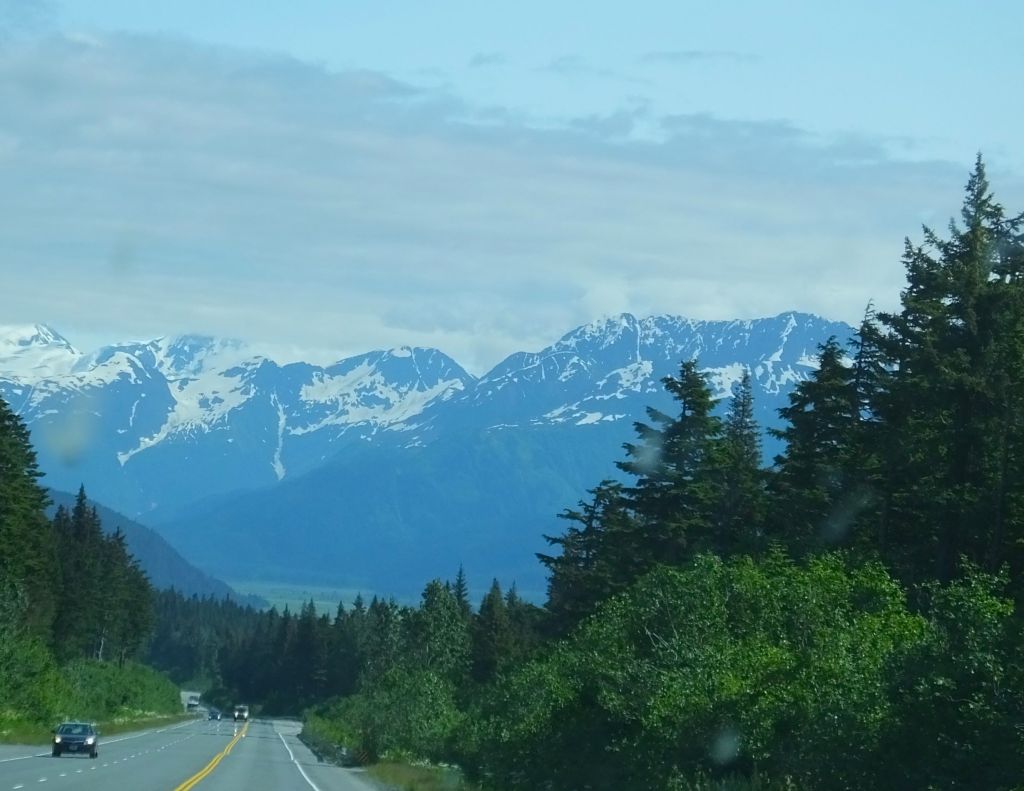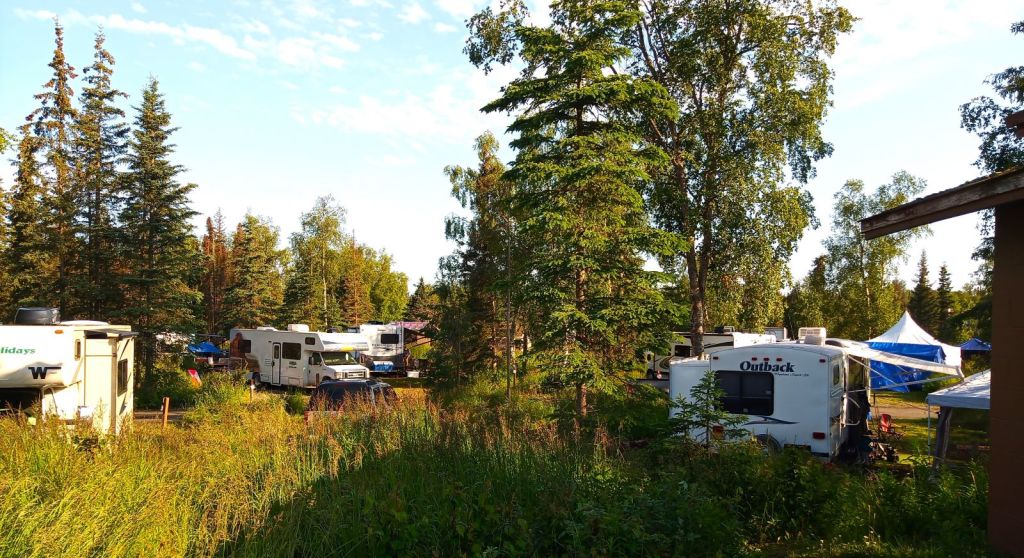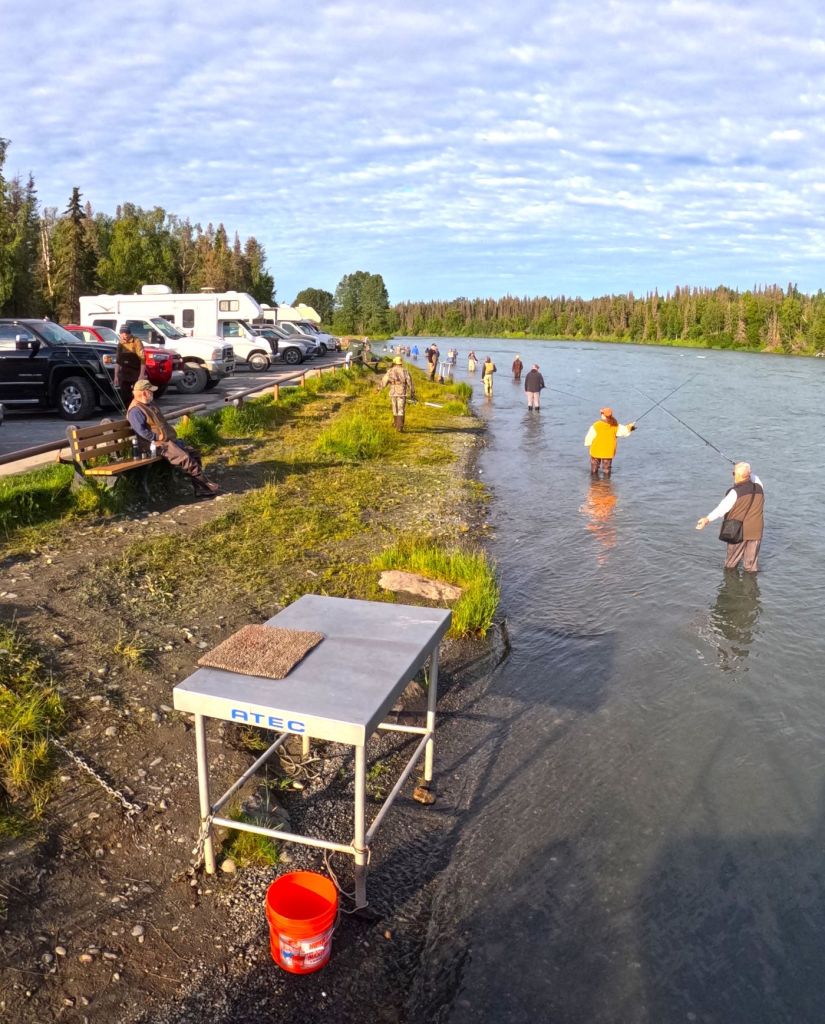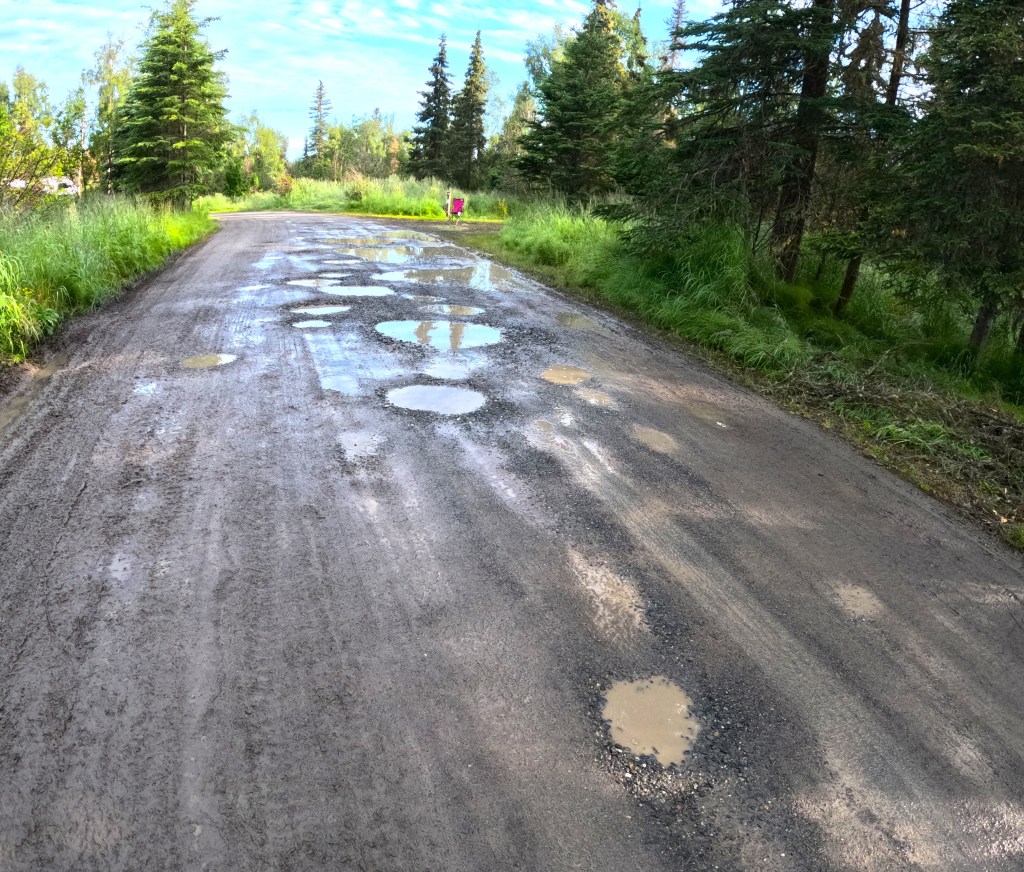
Camping on the Kenai Peninsula

(2023 Alaska Revisited Ep 17)

From Denali State Park where we viewed the Great One, we continued to Anchorage, Alaska’s biggest city.  Anchorage has a typical big city feel, with multiple lane highways, urban sprawl, tall downtown buildings, shopping districts with the same chain stores found in the lower 48, and a sizeable homeless population.

Anchorage also has wonderful parks and bike trails, and a beautiful backdrop of tall mountains in Chugach State Park. 

Patriotic 4th of July at Anchorage’s Delaney Park

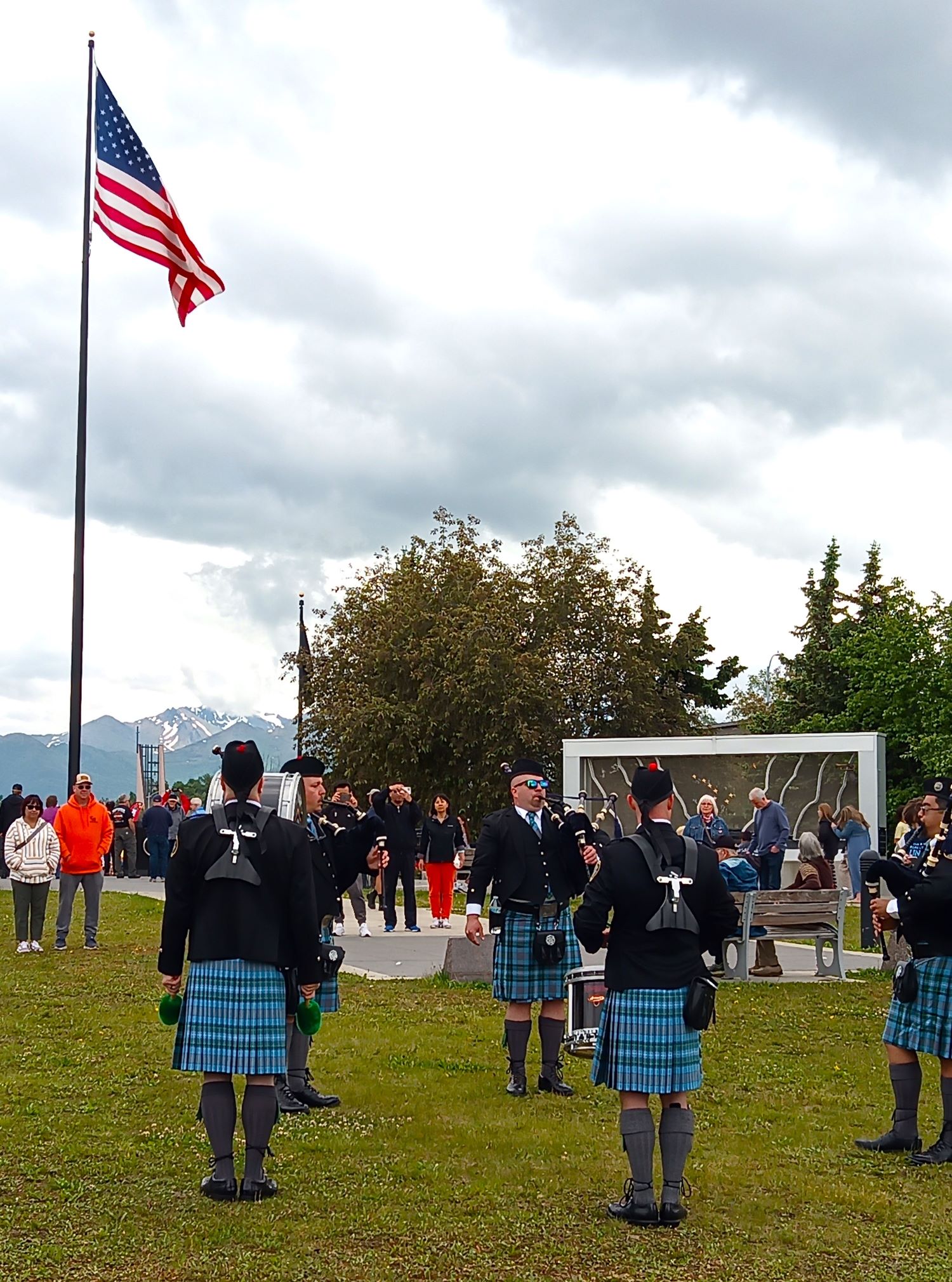
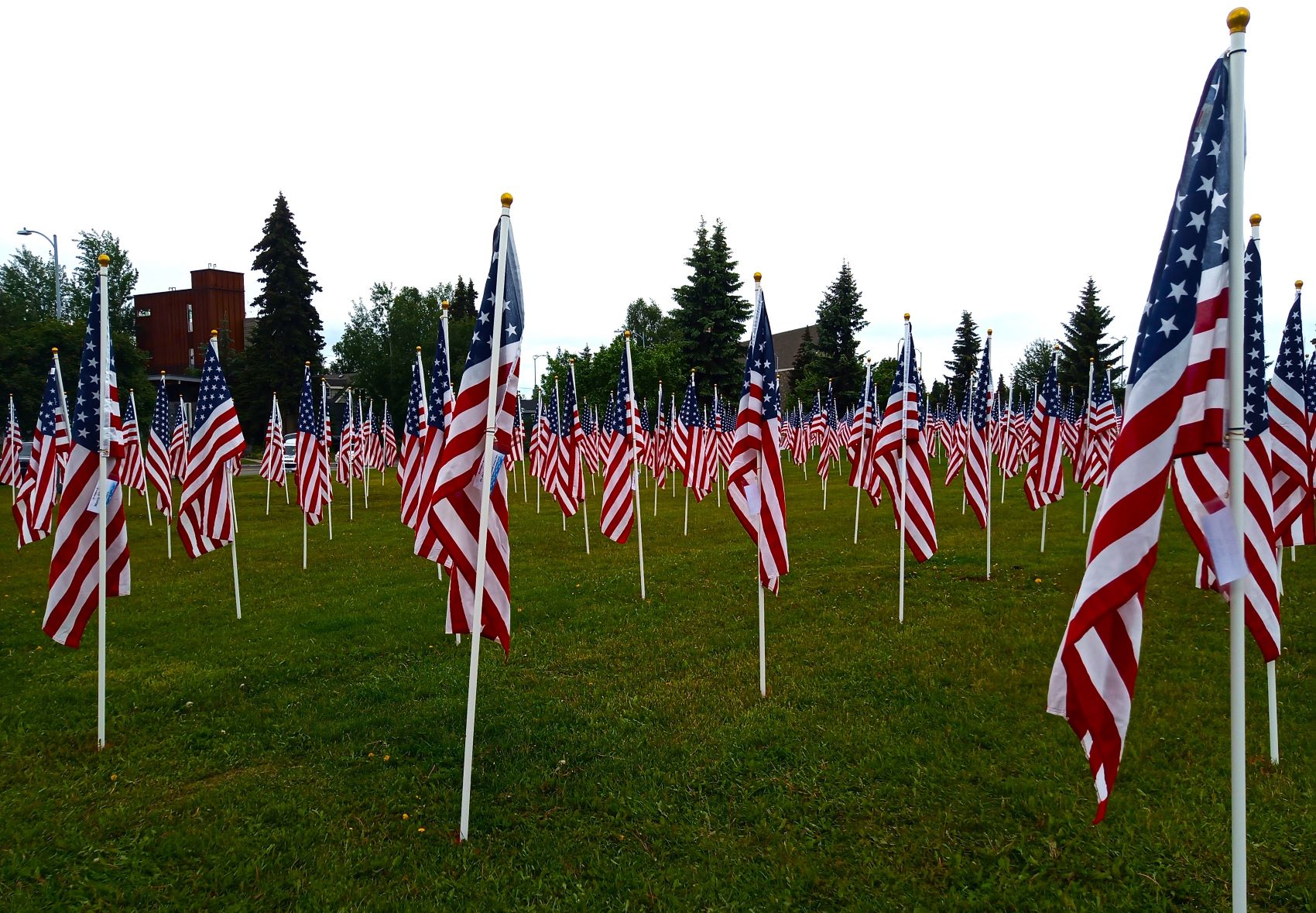
We spent July 4th in the city, opting to visit the patriotic celebration at Delaney Park.  While kilted bagpipers performed in a field of American flags and suited dignitaries gave speeches, the sizeable crowd enjoyed carnival rides and festival foods that included several types of salmon, halibut and chips, and reindeer sausage. 

Unlike the sunny and very warm (80s) July 4th celebration we attended in 2018, this year’s event was overcast and sweatshirt cool.  We enjoyed the festivities but decided not to come back for the fireworks.   They were scheduled at midnight after the (very) late evening sunset in Anchorage.    

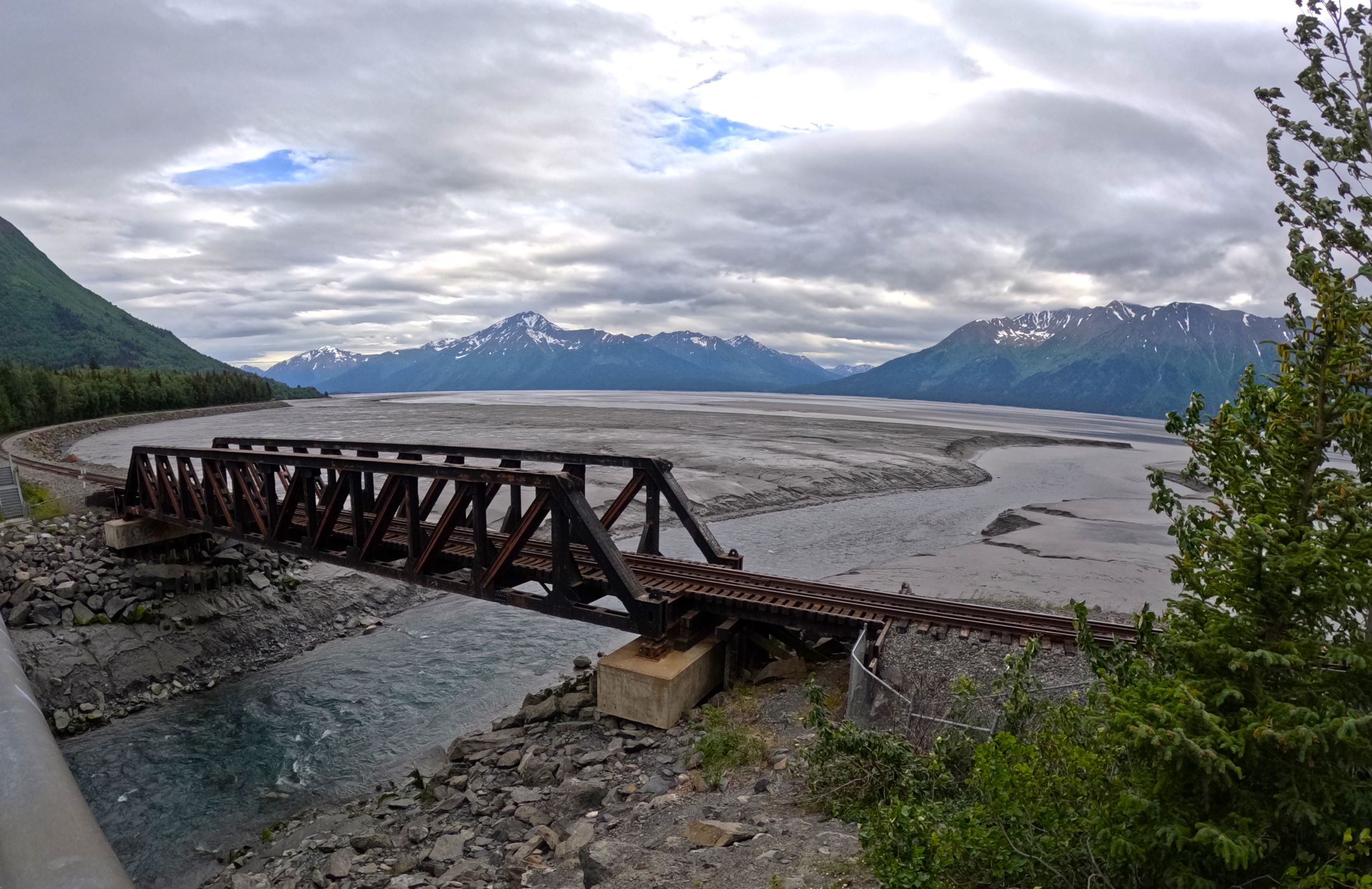
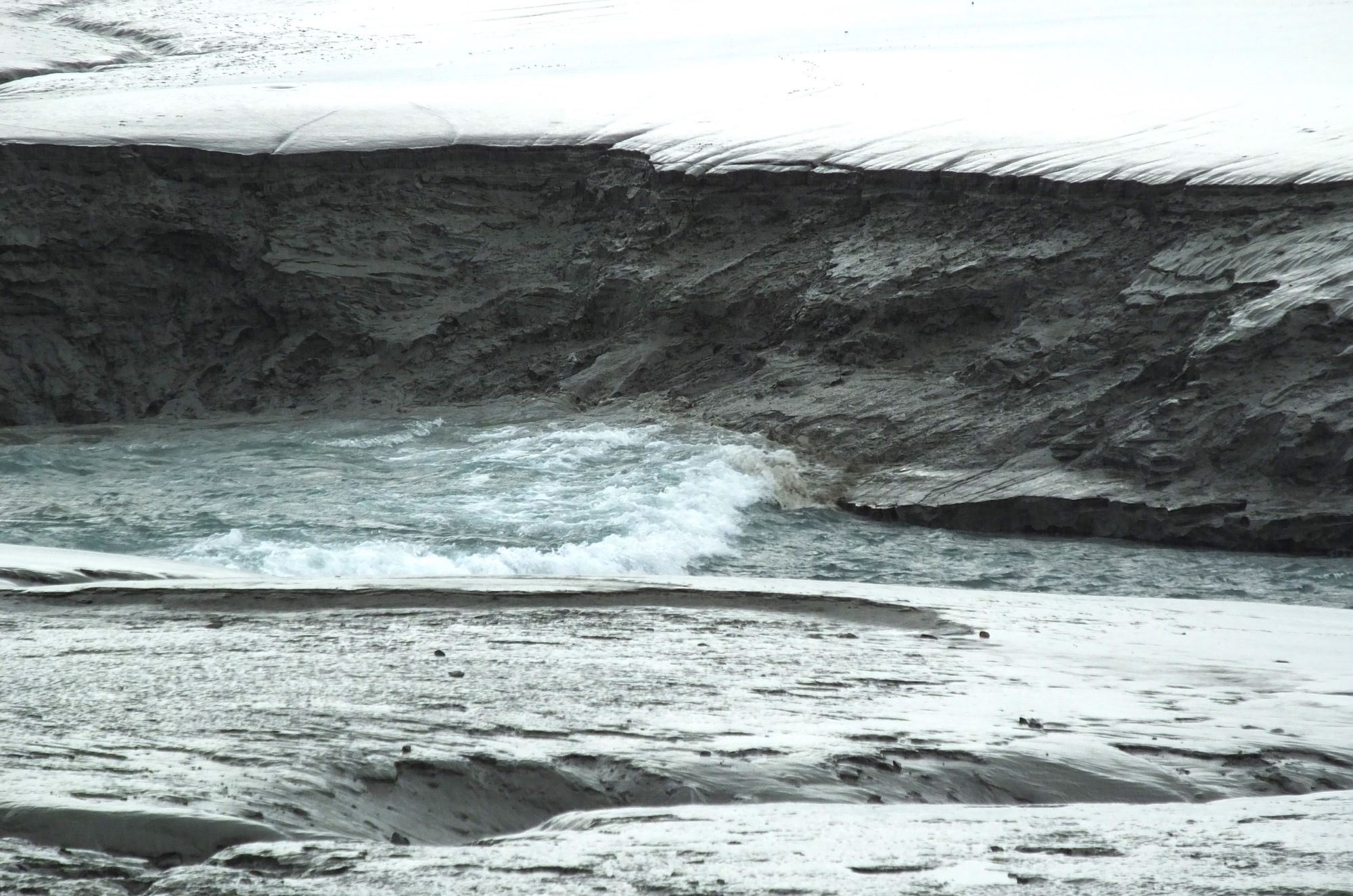
A view across Turnagain Arm showing broad low tide mud flats; tidal bore wave as the sea rapidly flowed up Bird Creek

Turnagain Arm     

We left the city for the Kenai Peninsula and our route took us along Turnagain Arm, a 40-mile-long bay southeast of Anchorage with 30-foot tidal fluctuations.   Broad mudflats and deep mud canyons are revealed at low tide. 

We walked a half mile from our campsite at Bird Creek SP and watched the tidal bore come up Bird Creek.  The wave, at times several feet tall, moved quickly.

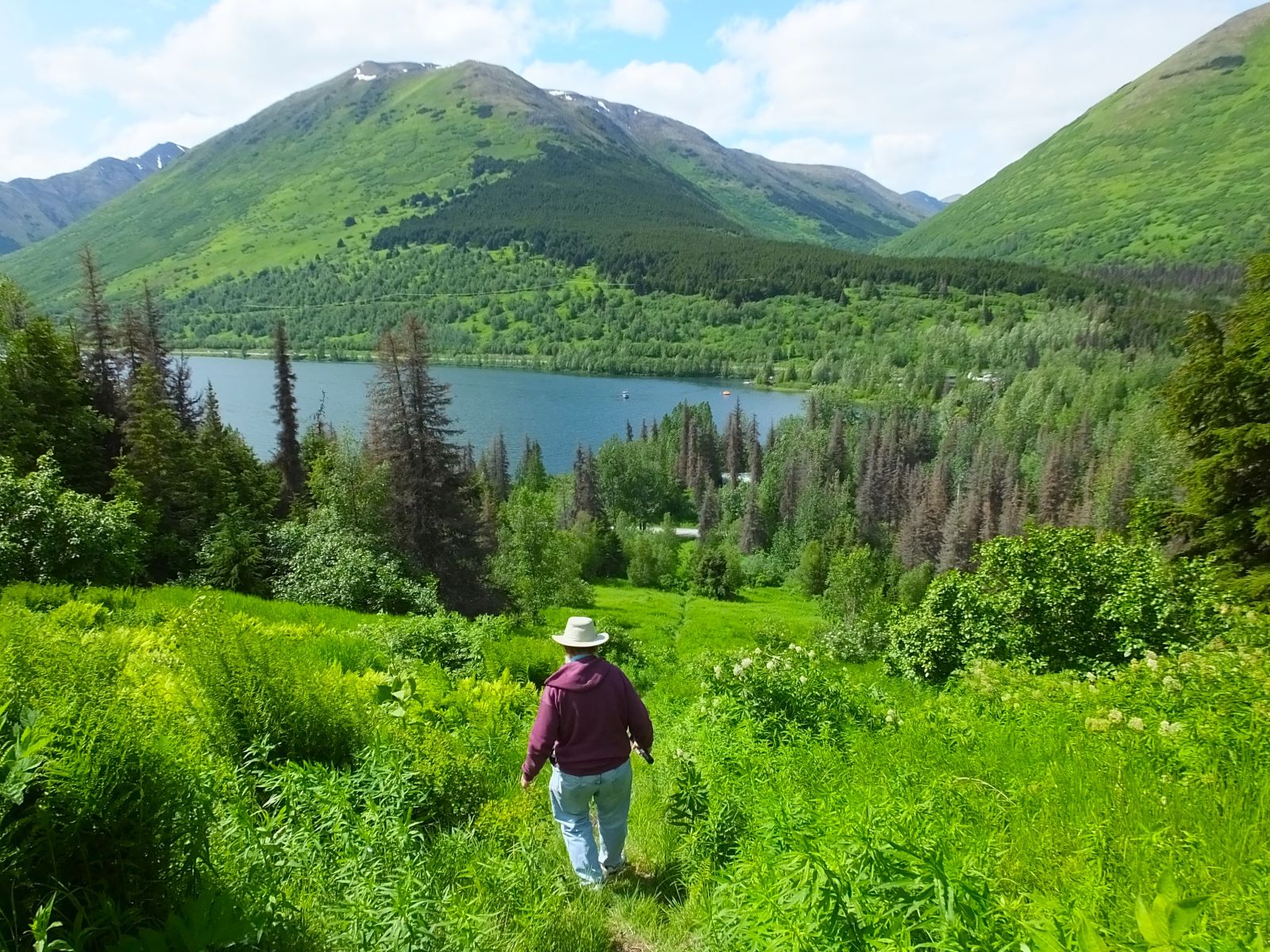
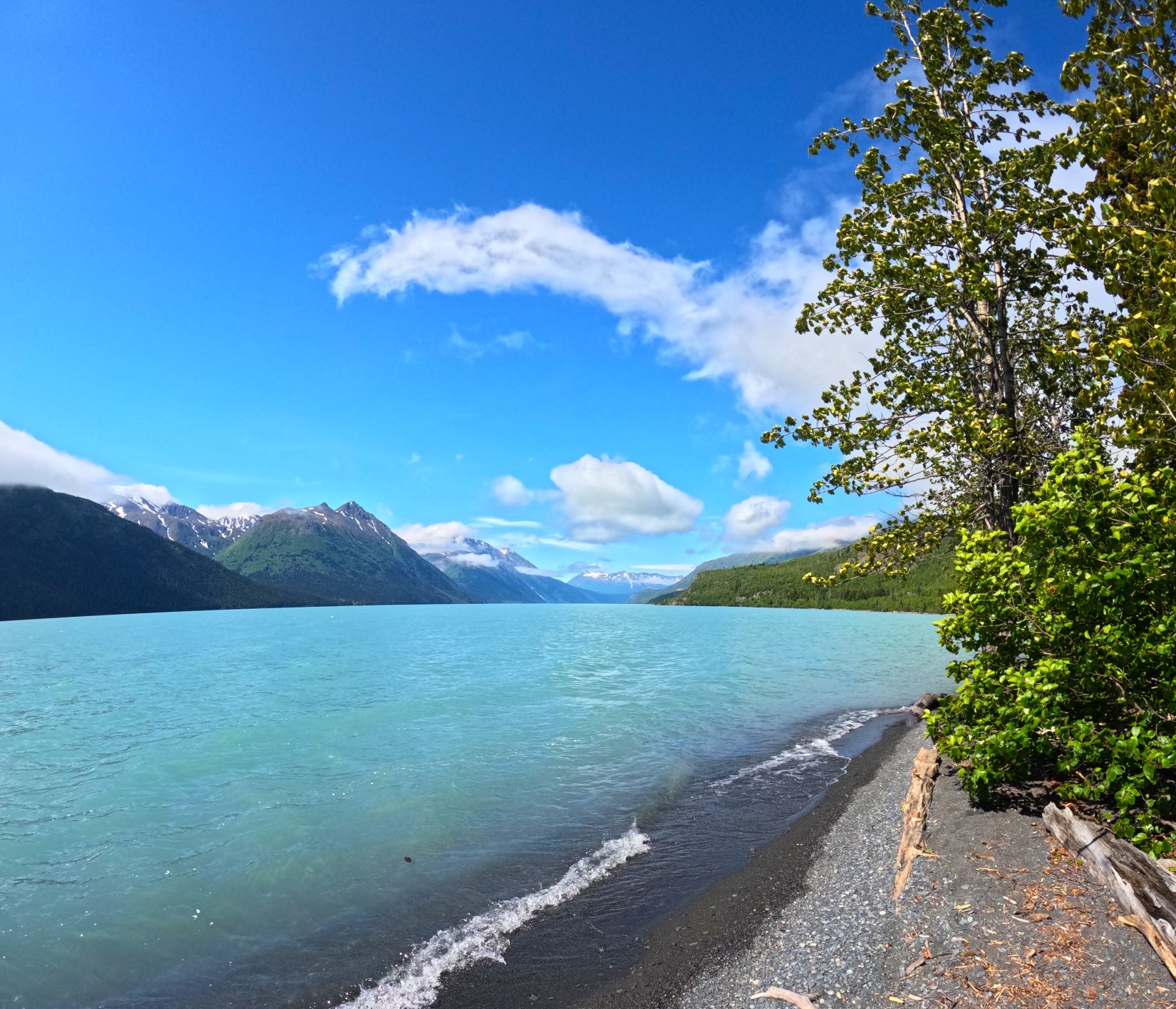
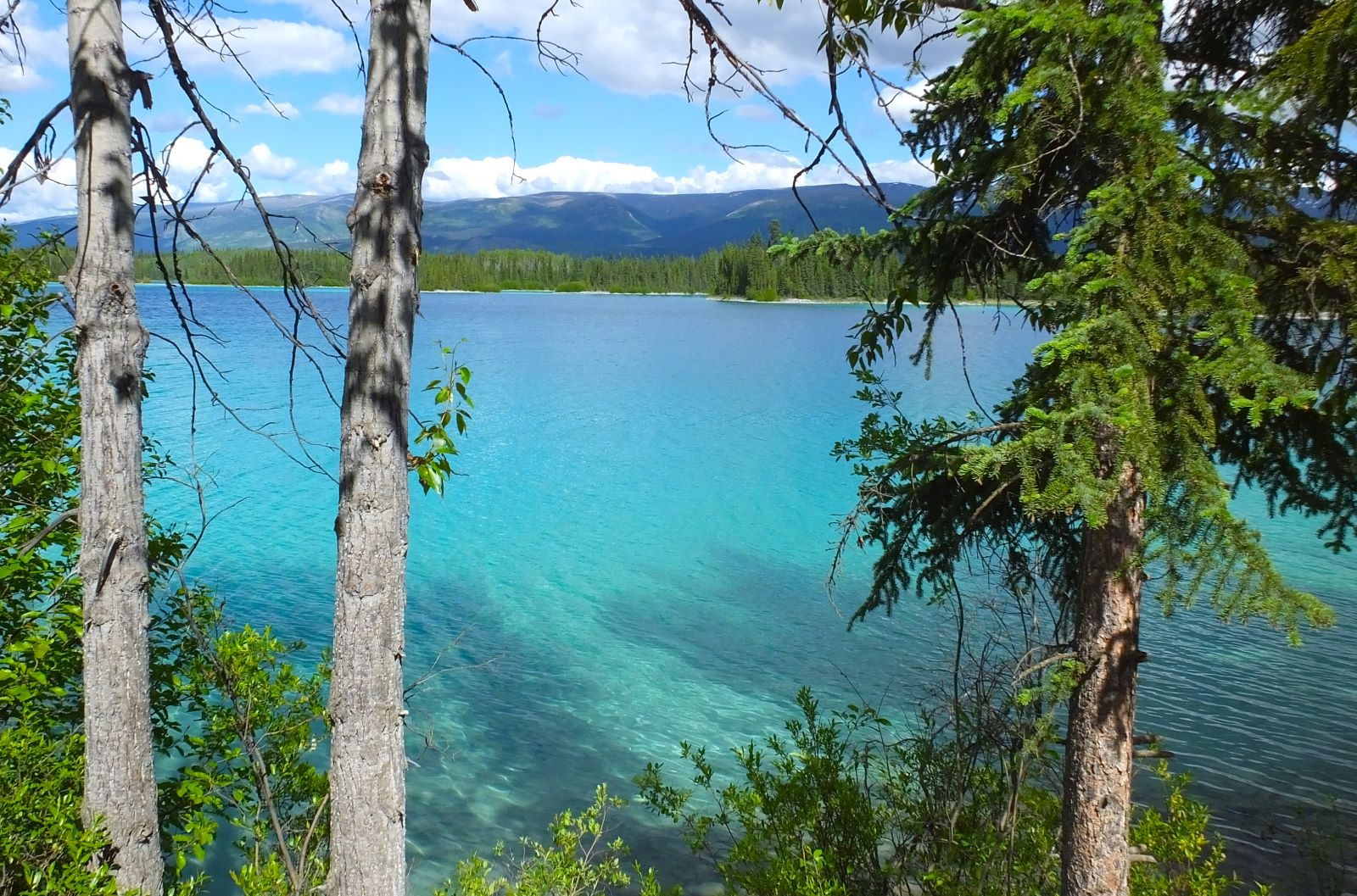
Kenai Views: hiking above Summit Lake and a shoreside view of turquoise Kenai Lake

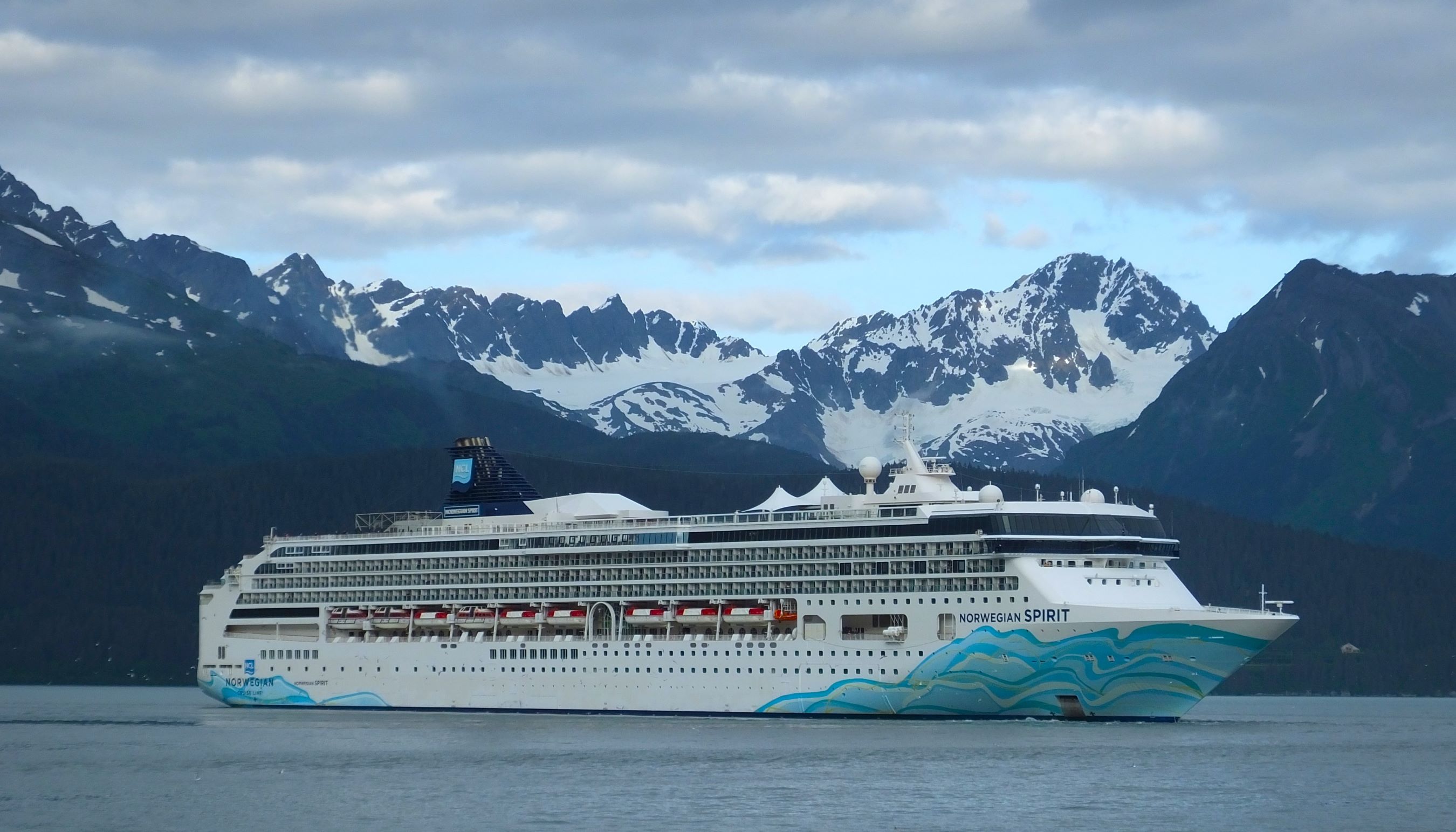
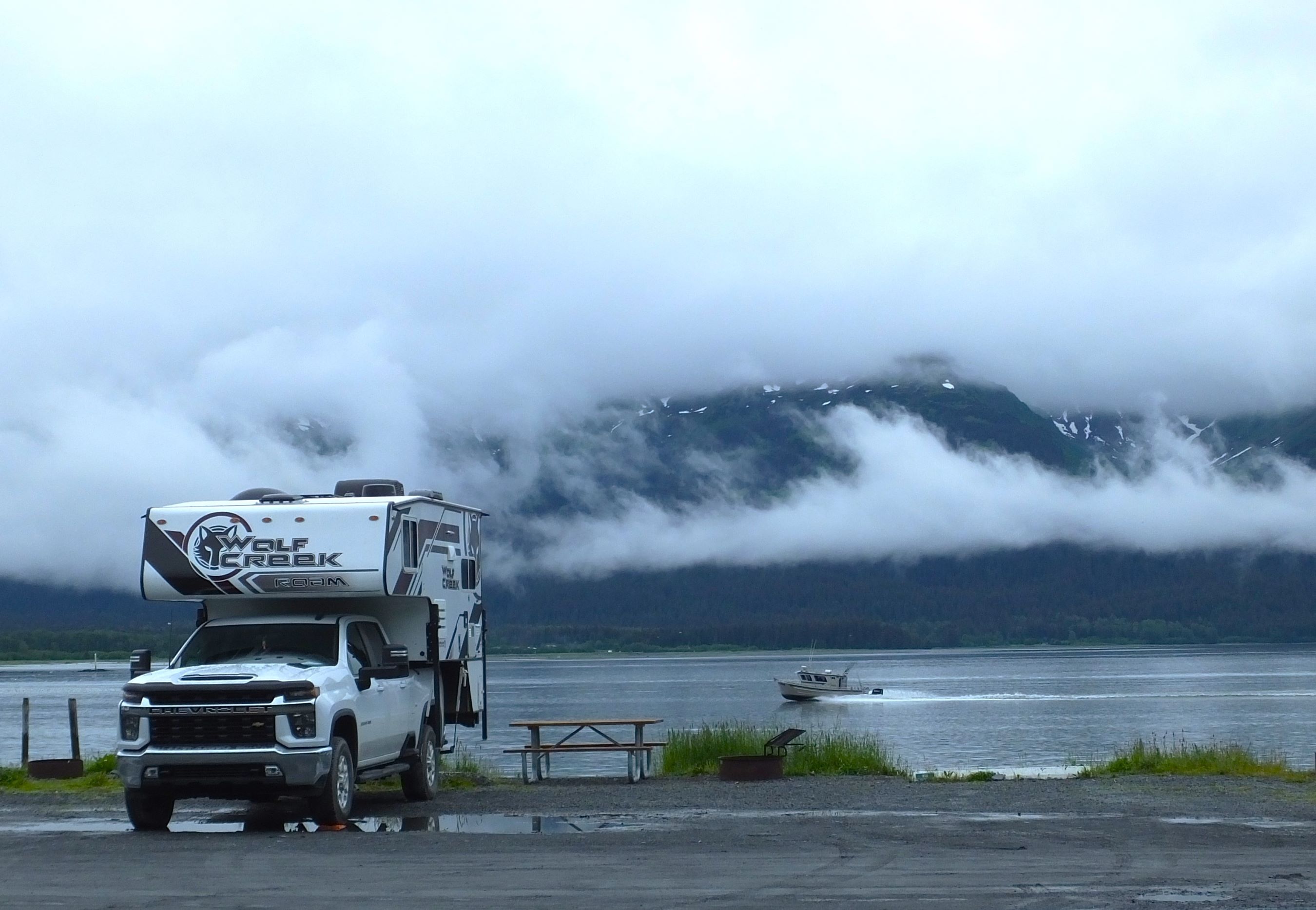
Norwegian Spirit departing the Seward Harbor; at first, fog and low clouds blocked the view from our campsite

Waterfront Camping in Seward

We drove on to Seward, a small town on the Prince William Sound.  From Seward, cruise ship passengers can journey by train to Anchorage, Denali and Fairbanks.  Others take day trips to Kenai Fjords National Park to see tidewater glaciers, whales, seals and sea lions, and a variety of coastal birds.  Many go on fishing charter boats as well. 

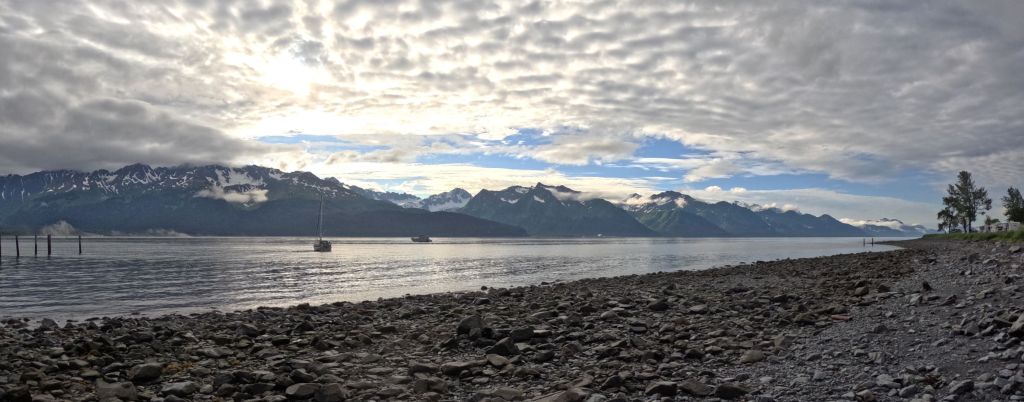
We camped at a city campground on the waterfront.  It was raining when we arrived and the mountains that surround the town were shrouded in fog and rain.  The weather slowly cleared over the next day and a half. By mid-day thick morning fog burned off and we could see the bottom half of the mountains across the inlet.  Finally, the entire mountains were visible the next morning, framed by the beautiful sky.  The wait was worth it!

After fog and low clouds cleared, we enjoyed this amazing view

Typical of many campgrounds in Alaska, our campground was a gravel parking lot with deep potholes everywhere. There were few amenities. Other campers were just a few feet away. 

Despite these shortcomings, the location was amazing.  We enjoyed magnificent mountain views, rode our bikes throughout the town, and discussed our Alaska experiences with other campers. 

We met a dad, mom and teenaged son from Bend, Oregon camped in a small teardrop camper next to us.  Dad was between jobs and mom, a schoolteacher, was free for the summer.  They were excited to visit Alaska for the first time.

Brad, another camper from Washington, stopped by to say hello.  It was the fourth time we met during this trip.   He, his wife and two golden retrievers were camping at a Yukon Provincial Park in June when we first met.  We later connected at Whitehorse and Tok.  It’s very possible we may meet again!              

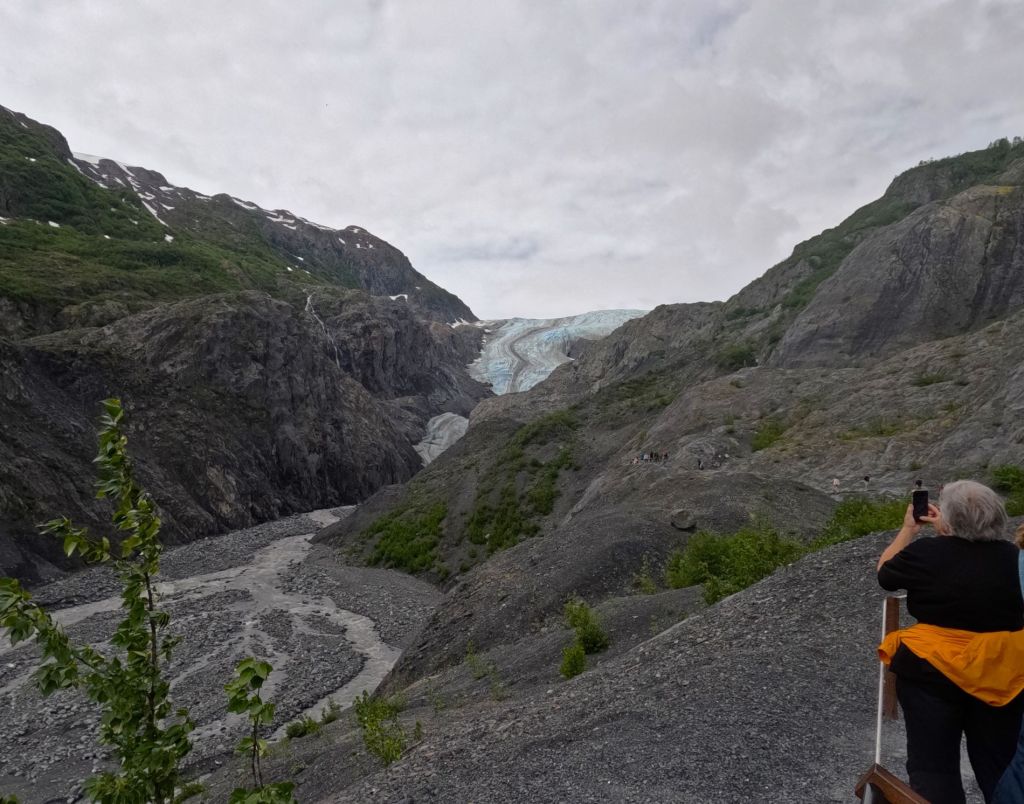
Exit Glacier and outwash river in Kenai Fjords NP

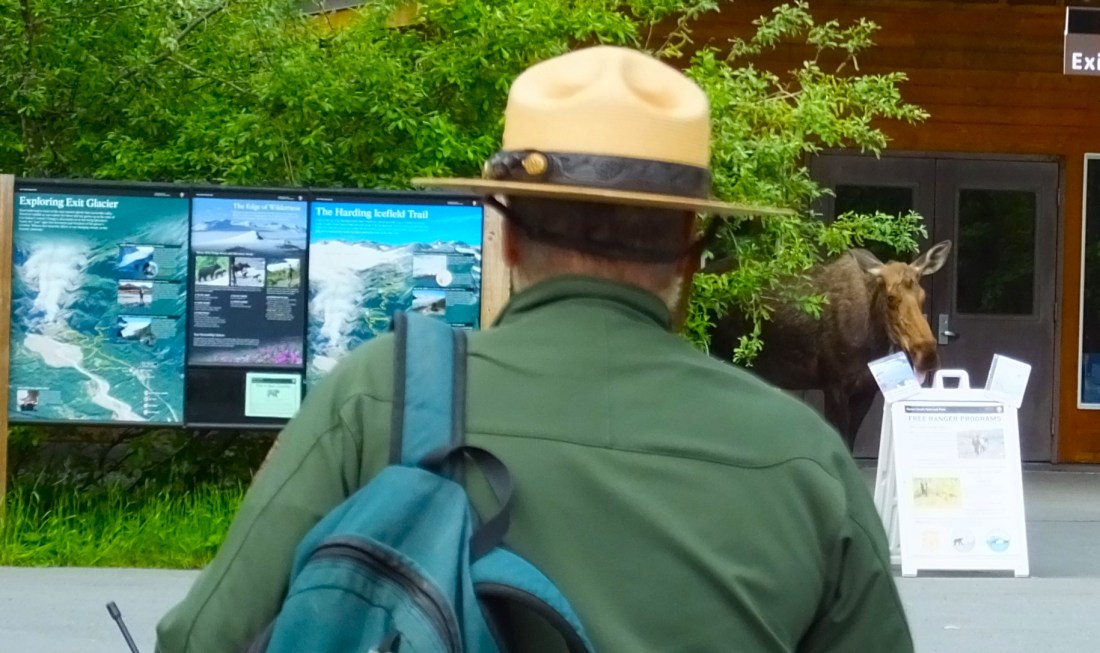
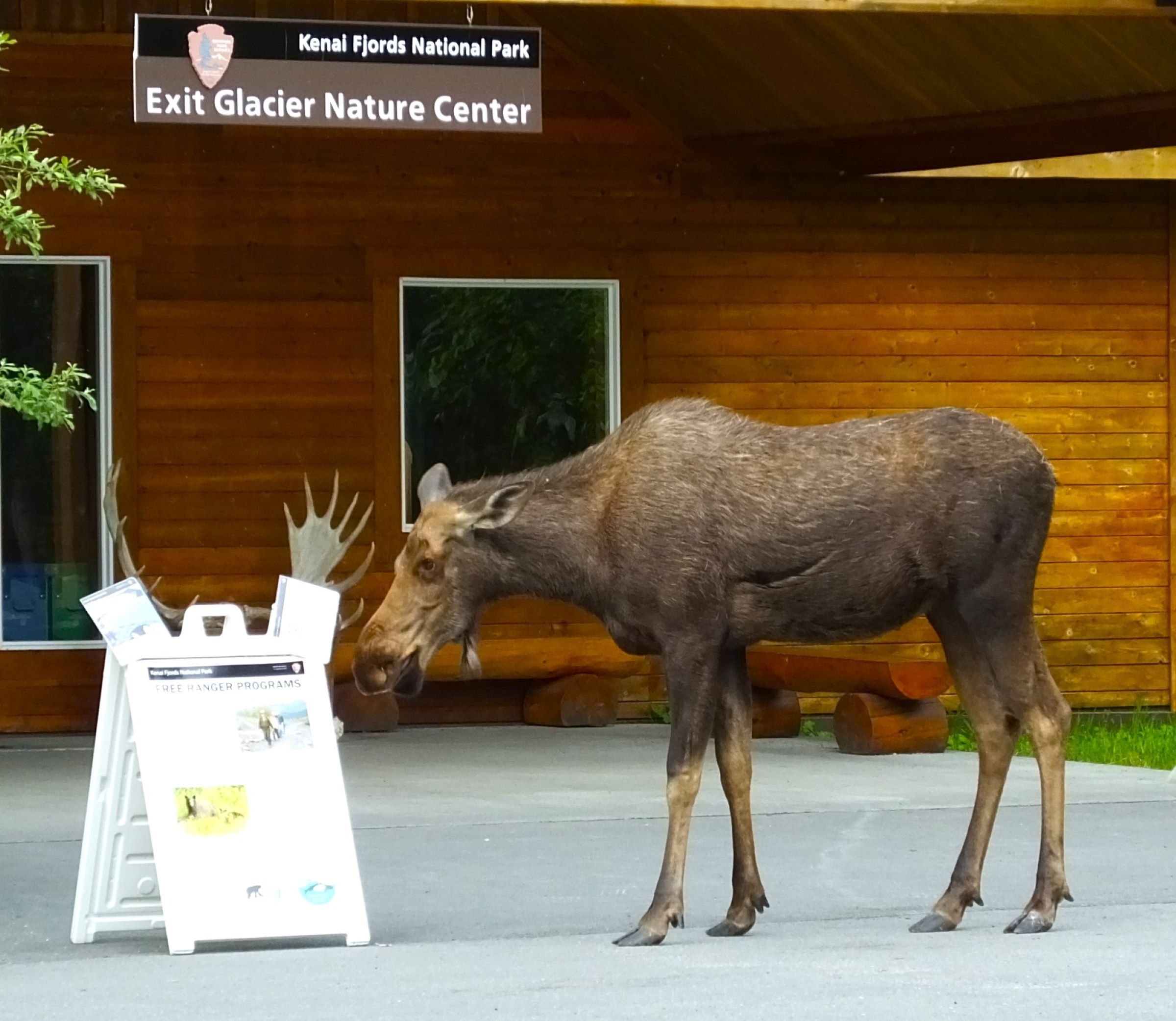
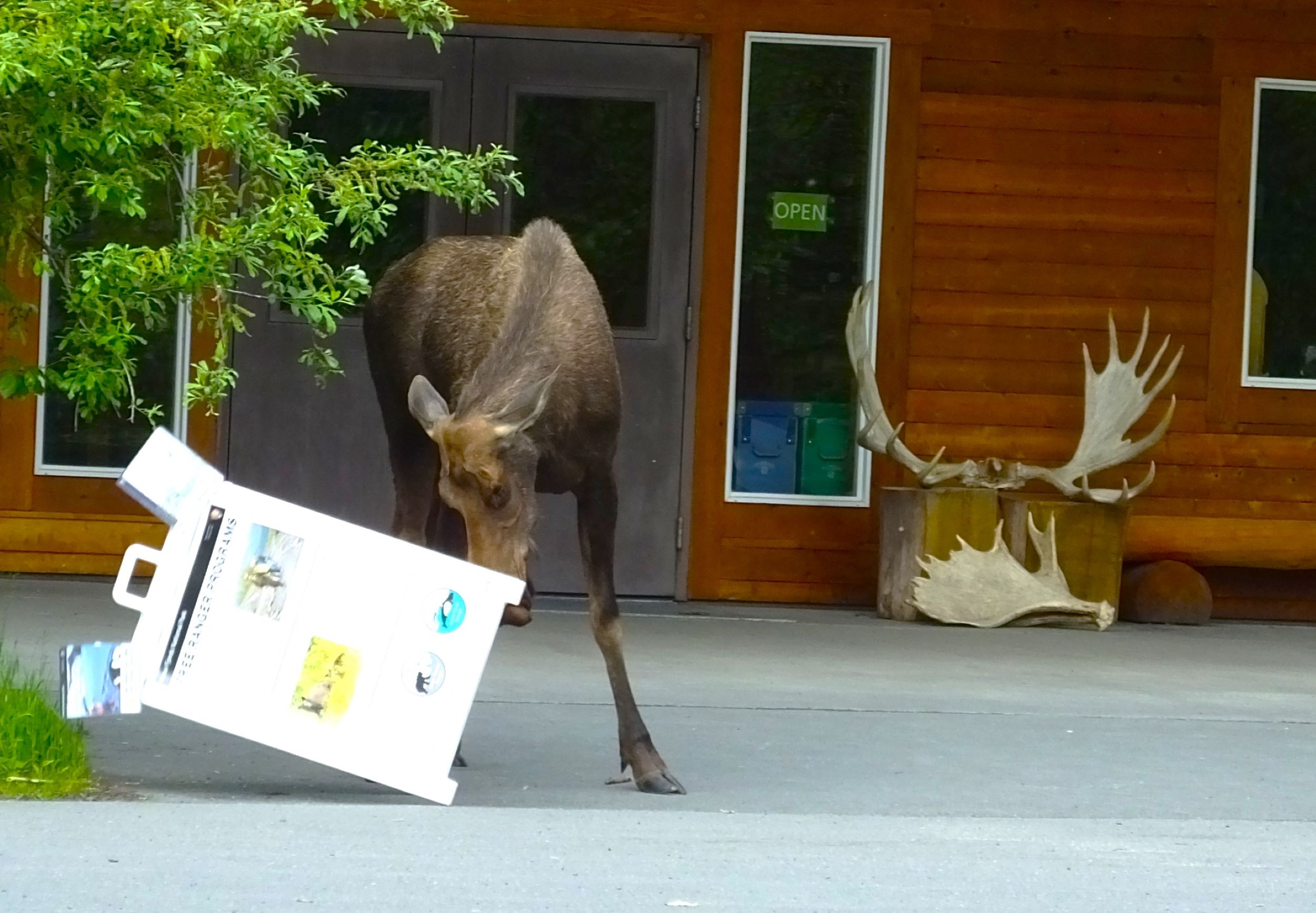
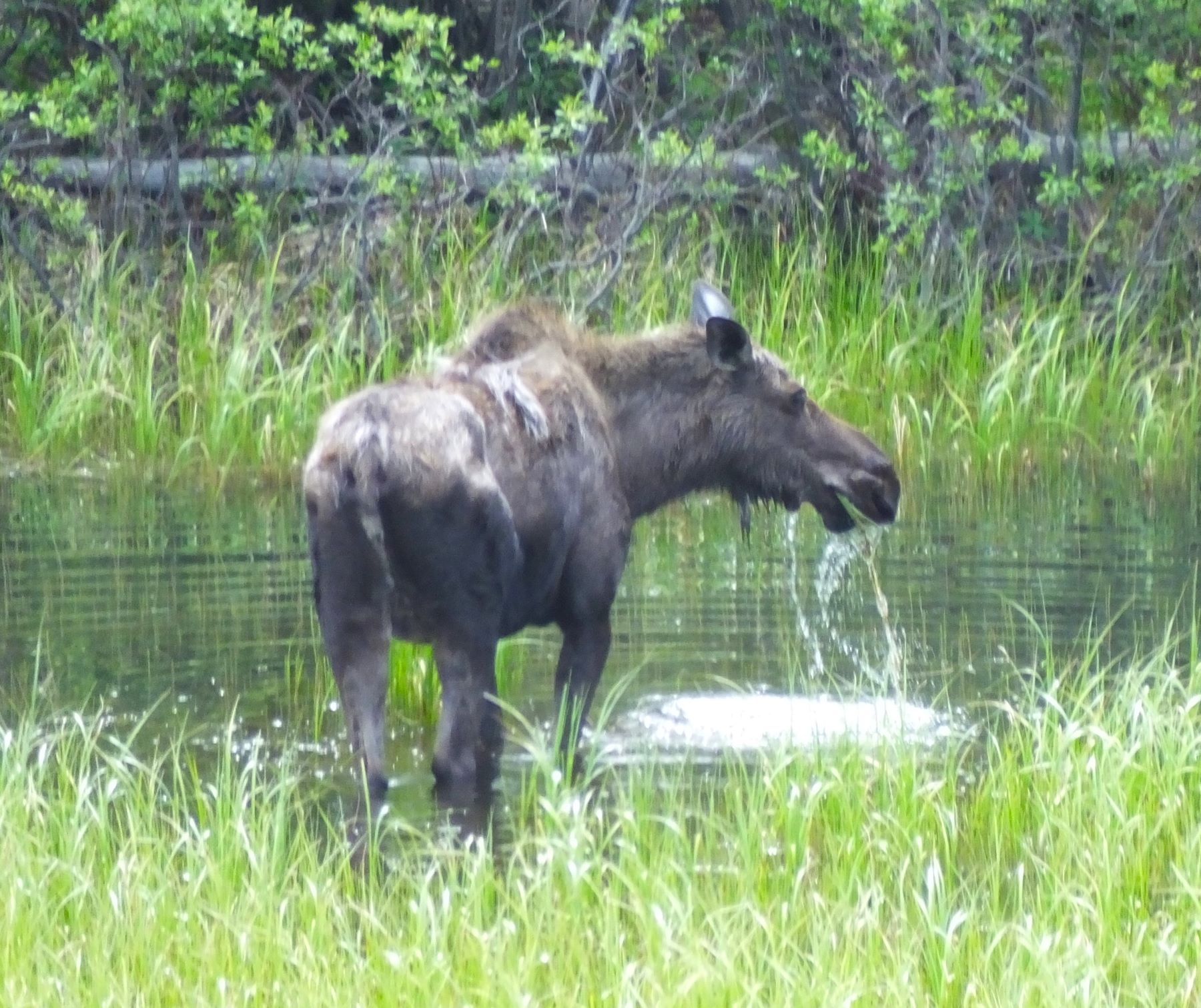
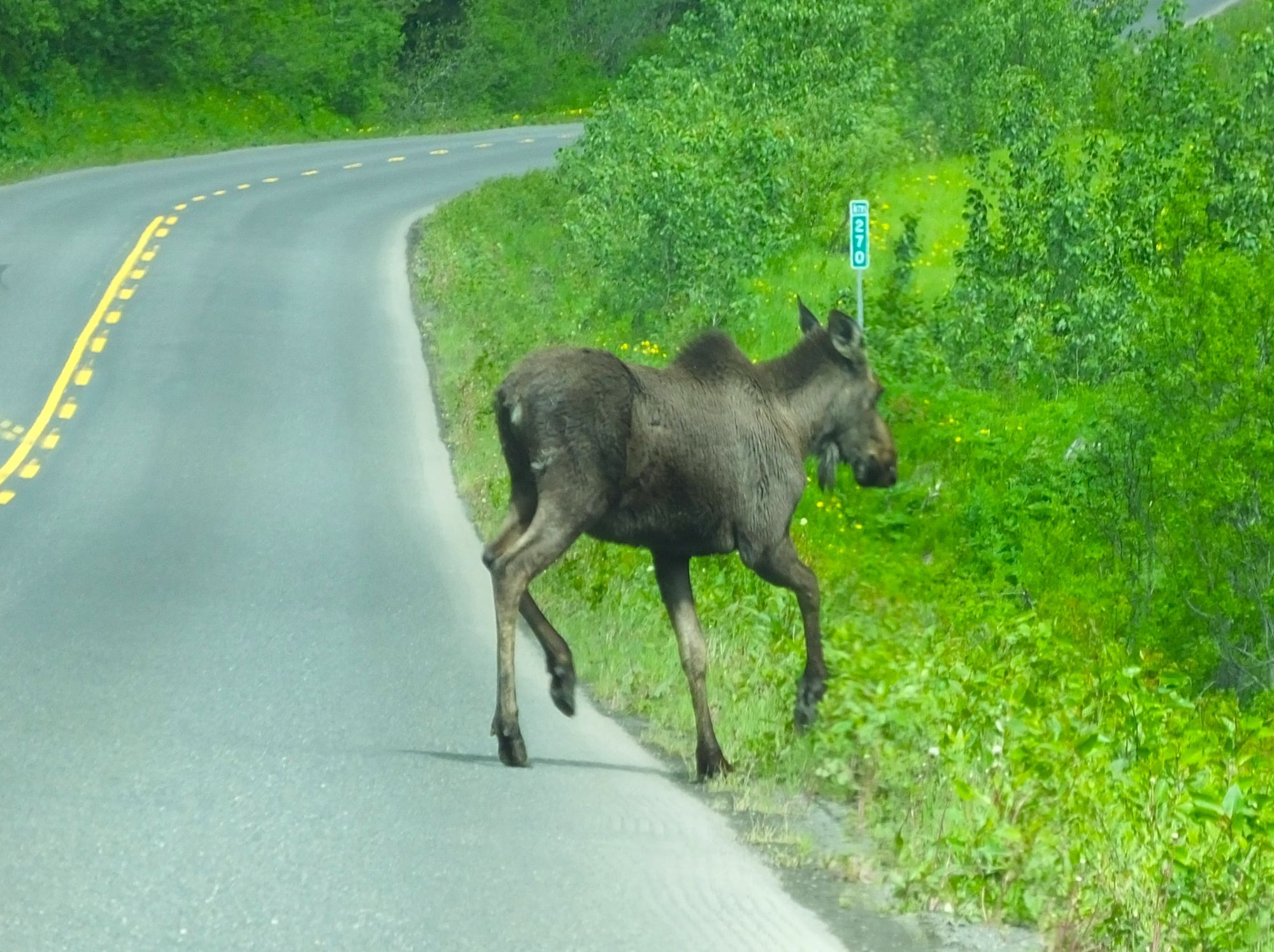
The next morning, we visited Kenai Fjords NP, a few miles outside Seward.  Our hike up a short trail to view the base of Exit Glacier was delayed 30 minutes as we endured a Moose Encounter of the Kenai Kind (photos below).

The restless moose wandered around the parking lot and nature center, while park staff kept visitors at a safe distance. She snacked on grass and tree branches, and even examined the center activity board before knocking it over. When she finally wandered into the woods, we were able to continue our hike.

From a viewpoint at the end of the trail, we could see the blue ice of the glacier well above the valley floor.  It extends downward from the massive Harding Ice Field at the top of the mountains.  We later explored the broad rocky outwash plain below the glacier, where we were amazed at how much meltwater continually flows from the glacier and icefield.

Williwaw and Whittier

The weather was clear when we left Seward after three days.  We decided to detour a few miles to visit Williwaw Campground and Portage Glacier, and to drive to Whittier via a 2.5-mile tunnel.  We endured heavy rains in 2018 at both stops and were looking forward to clearer weather this time.

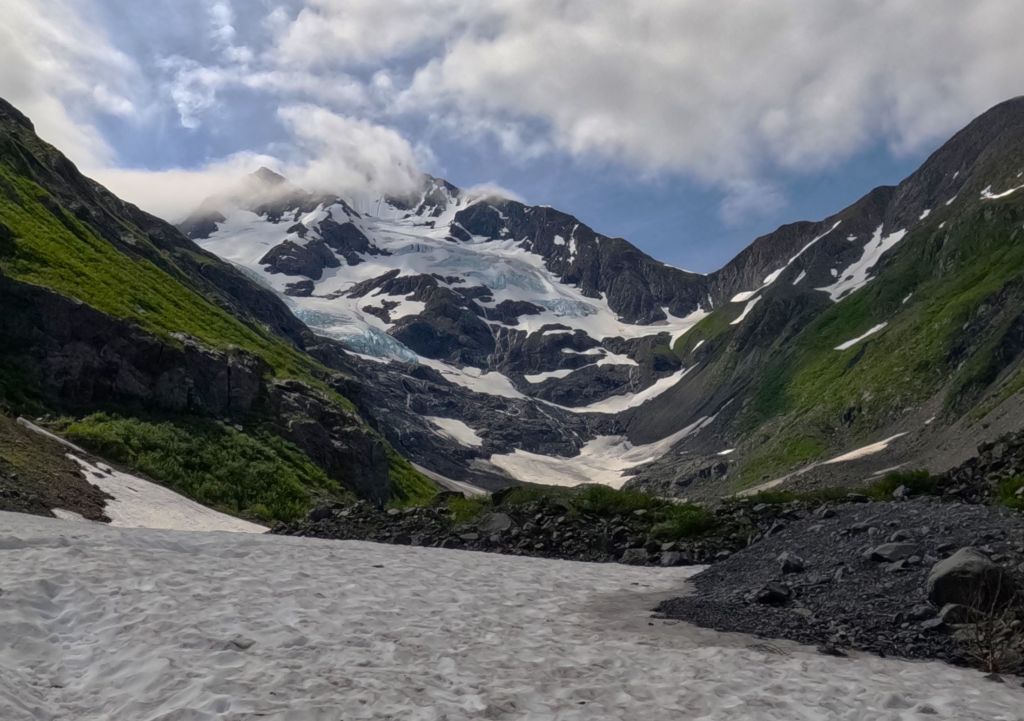
Byron Glacier has retreated to the upper left area of the valley

From the campground, we rode our bikes to Portage Glacier Visitor Center.  Located on a beautiful lake beneath the glacier, the center has interesting natural history and geology exhibits.  Outside, it was clear, breezy and cool, and after eating a sack lunch, we secured our bikes and hiked to Byron Glacier.  Like most of the glaciers in the region, the melting glacier is quickly retreating up the valley.

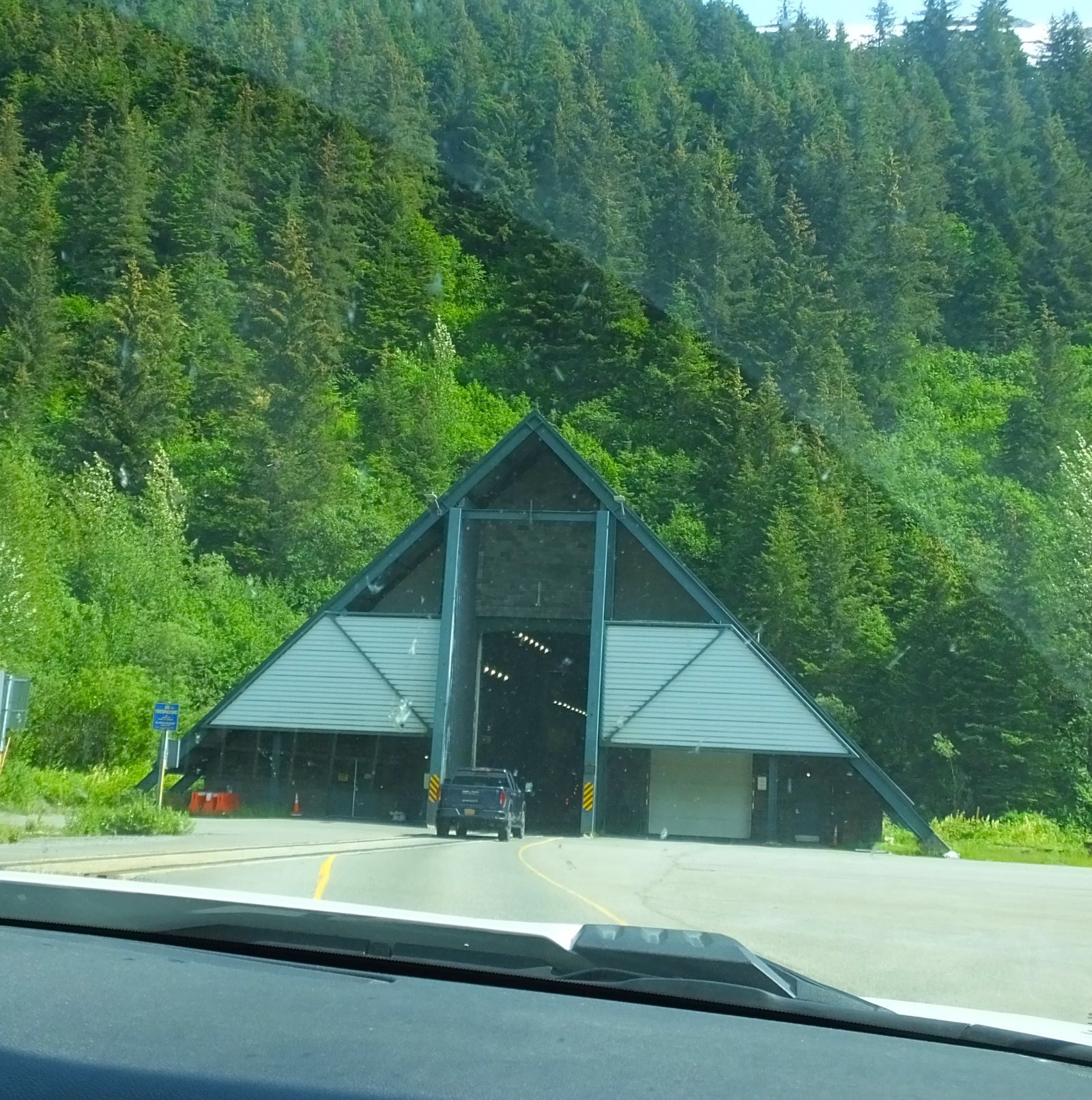
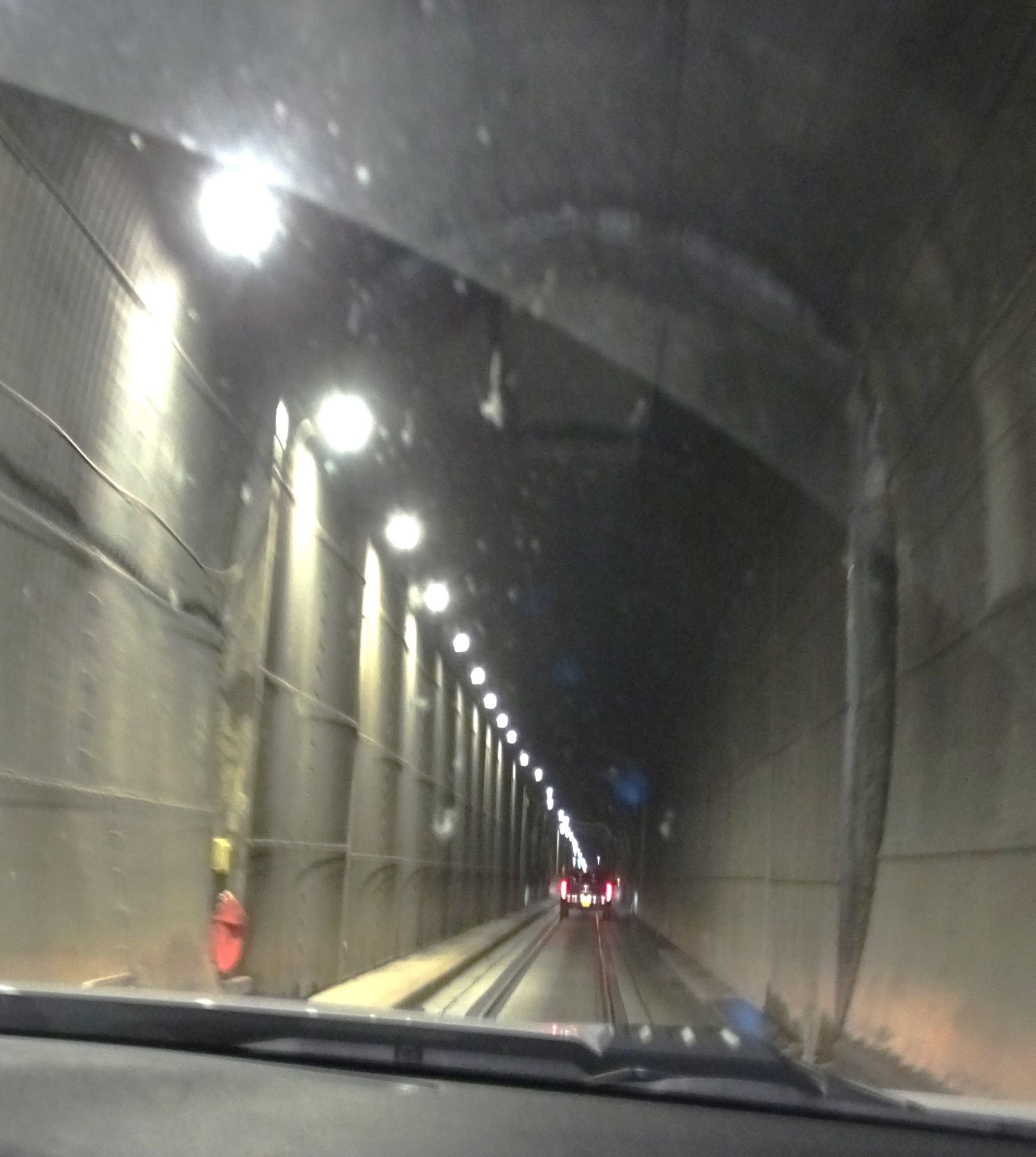
Narrow entrance to 2.5 mile single lane tunnel to Whittier; trains and vehicles share the tunnel

That afternoon we drove through the long and narrow tunnel to Whittier.

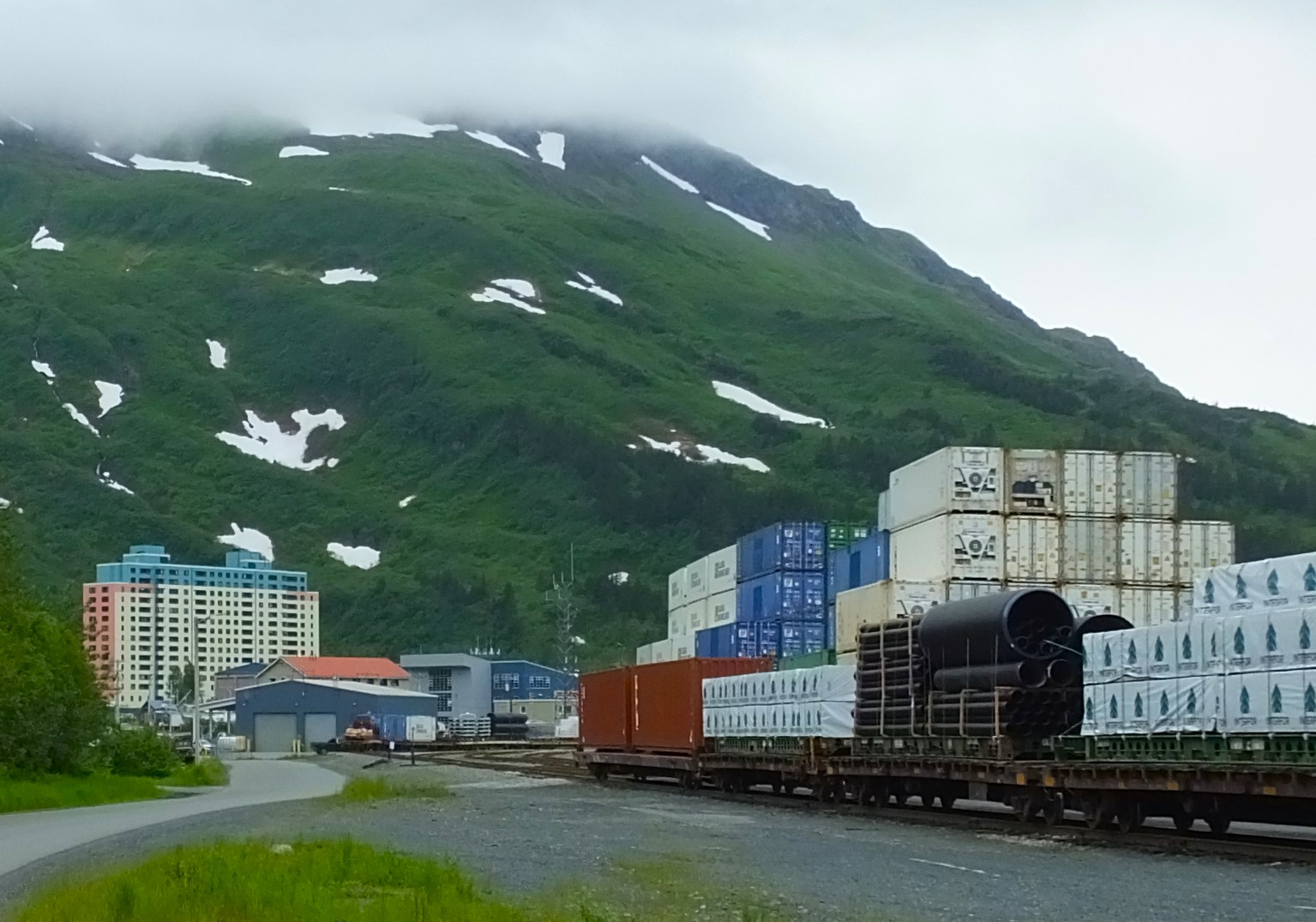
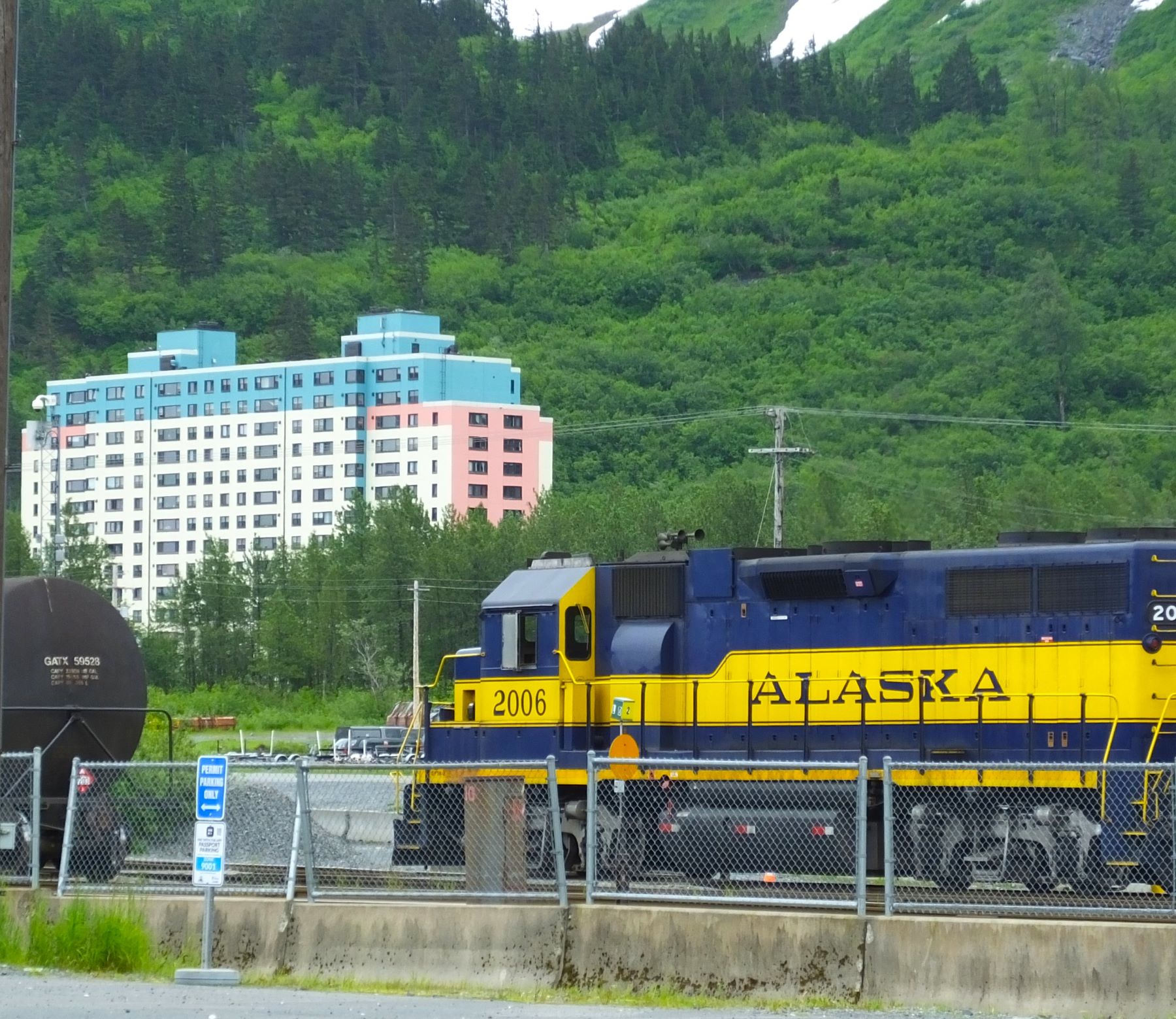
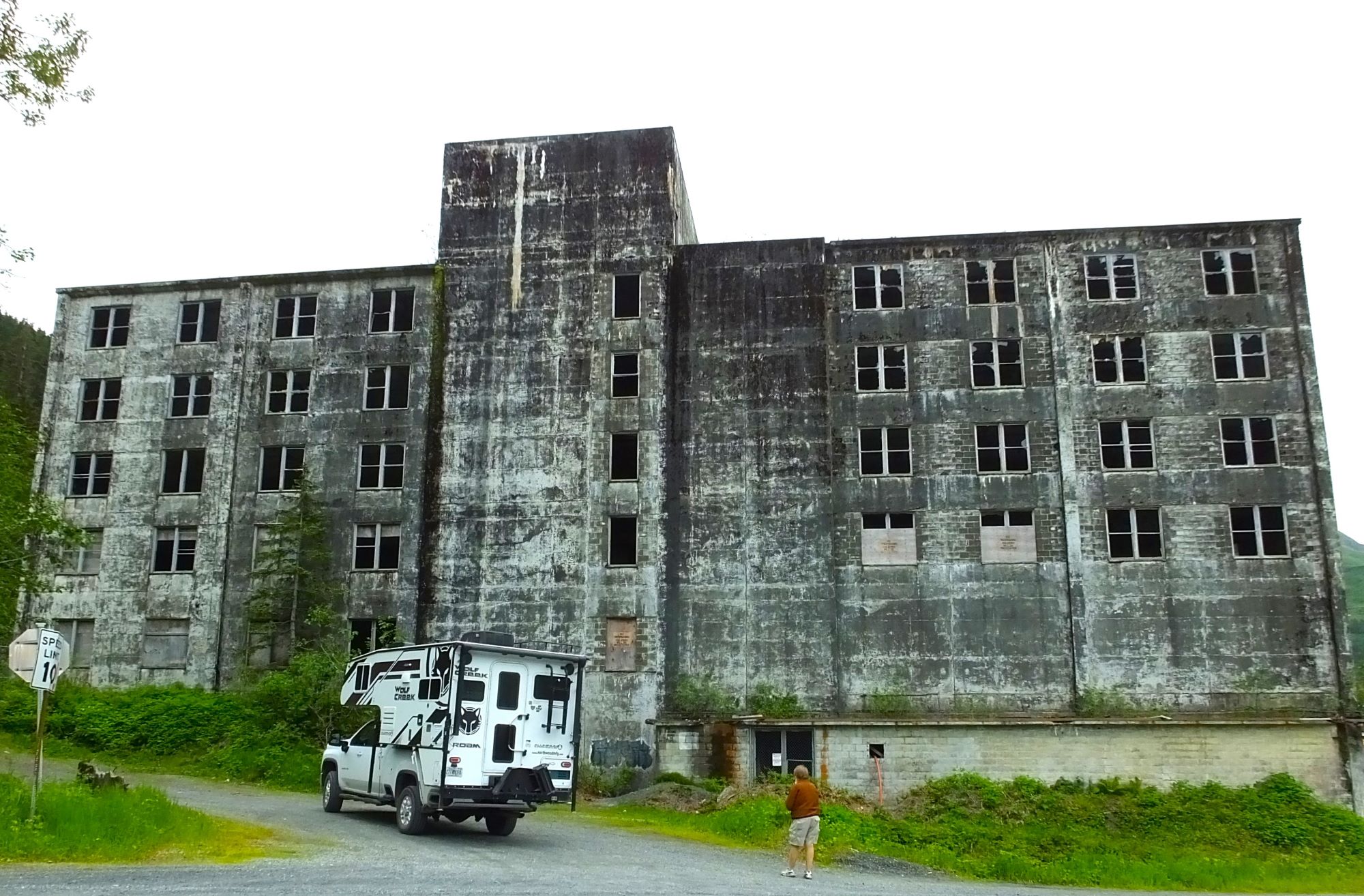
Views of Whittier and Begich Towers; exploring the abandoned Buckner Building nearby

Whittier is a working town, with stacks of cargo containers, loading cranes, ships and a railroad yard.  Many of Whittier’s residences, business offices and city services are housed in Begich Towers, a 14-story building that overlooks the port area. 

The Buckner Building, an abandoned military ‘city under one roof’ is nearby. It was completed in 1949 and abandoned in 1966. There is also a cruise ship dock, along with a few restaurants and souvenir shops.  All are situated along a narrow fjord that is surrounded by tall mountains.

Our 2023 tour of Whittier was much better than the rainy and cold visit in 2018. It took two visits for us to finally agree with local expression: “Things are prettier in Whittier!

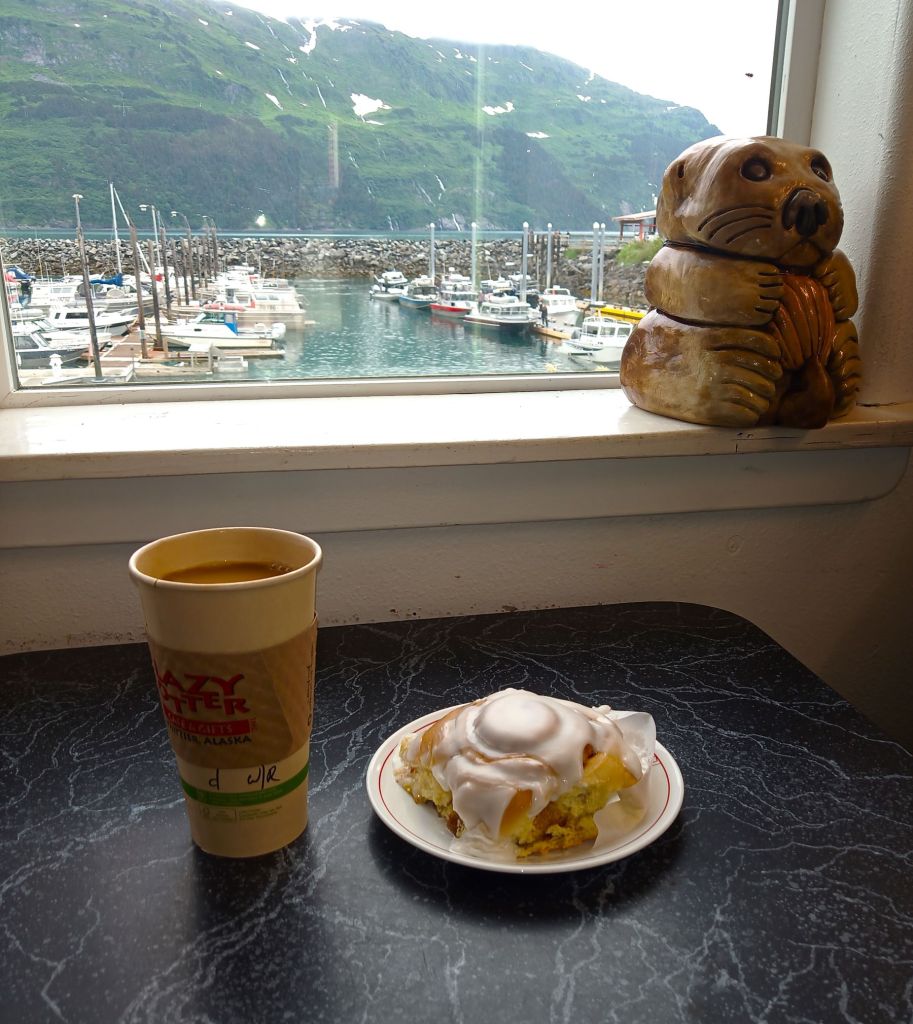
Bun Report: Lazy Otter Cafe

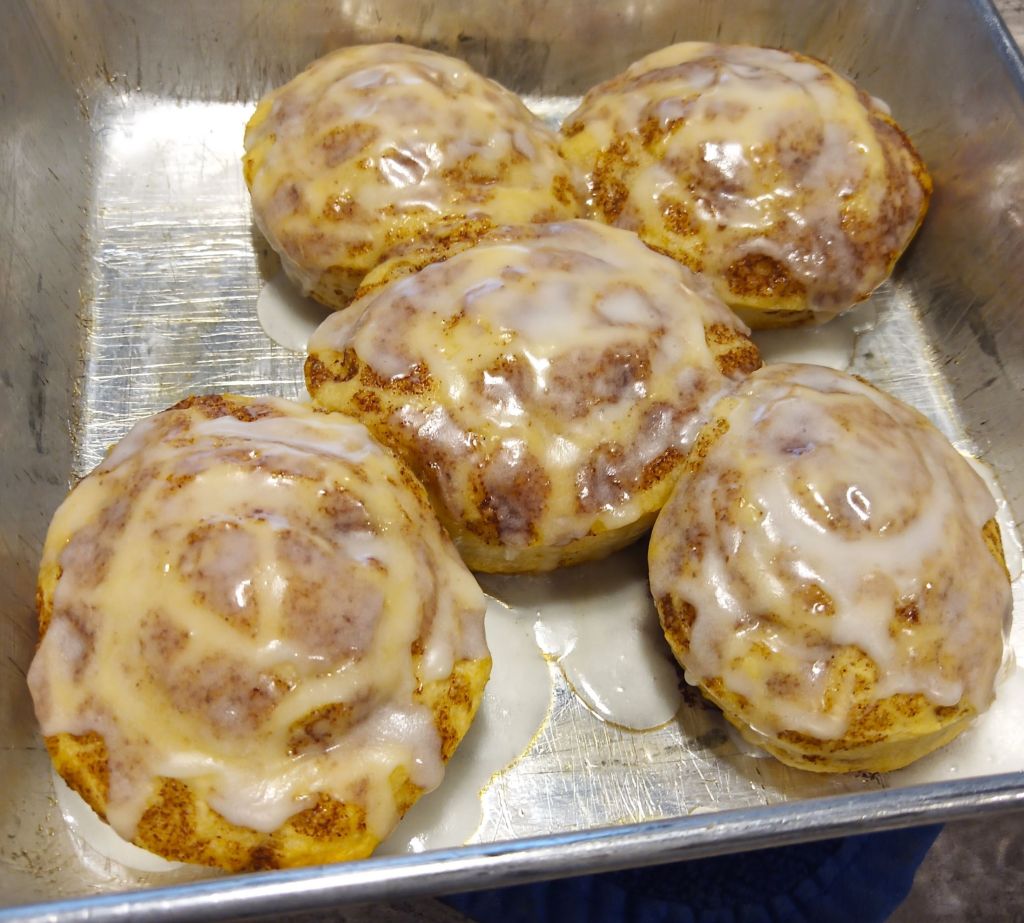
While in Whittier, we stopped at Lazy Otter Café for coffee and a cinnamon bun.  The warmed bun, baked earlier that day, had a familiar taste and appearance.  We think it was a grocery store Grands cinnamon roll!   Although the bun tasted good and was nicely iced, it was nothing remarkable.  Our bun score: 3.5 out of 5.   

Enjoying a cinnamon bun and coffee, along with the view of the Whittier harbor and mountains


Critter count

Moose – 1

Otters – 2

Eagles – 10+

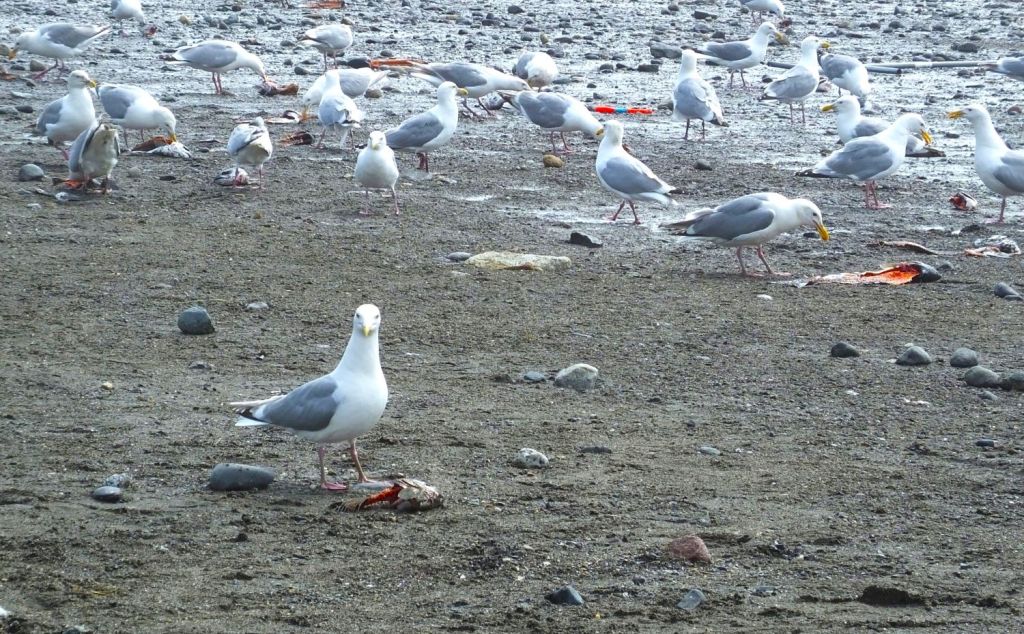
Seagulls – lots

A curious moose checks the daily activity board at Exit Glacier Nature Center before knocking it over

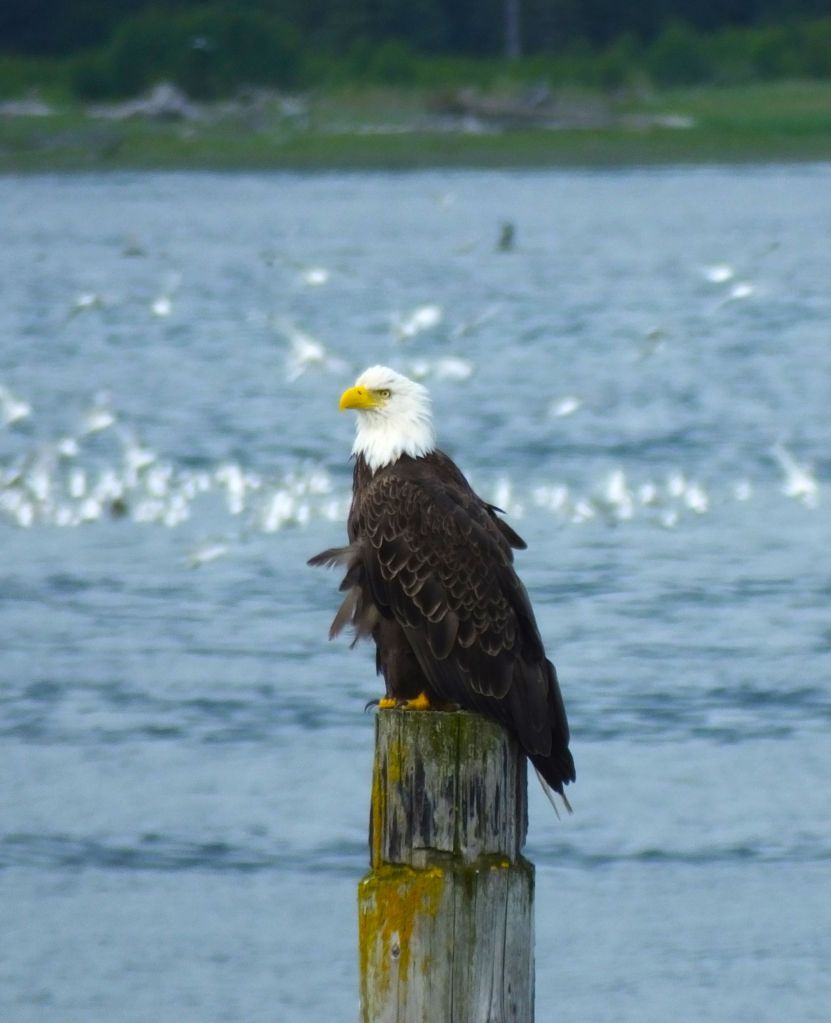
Photo of eagle taken from our campsite
Next week:

Find out what one word best describes the Kenai River and Soldotna!

Alaska: Long Days and Interesting Stays

(2023 Alaska Revisited Ep 16)

With repairs completed on our leaking tire and frayed wires, we left Tok for Fairbanks. 

The roads were very good, unlike those near the US-Canada border that had frost heaves, potholes and road construction.   We were thankful for the smoother ride.

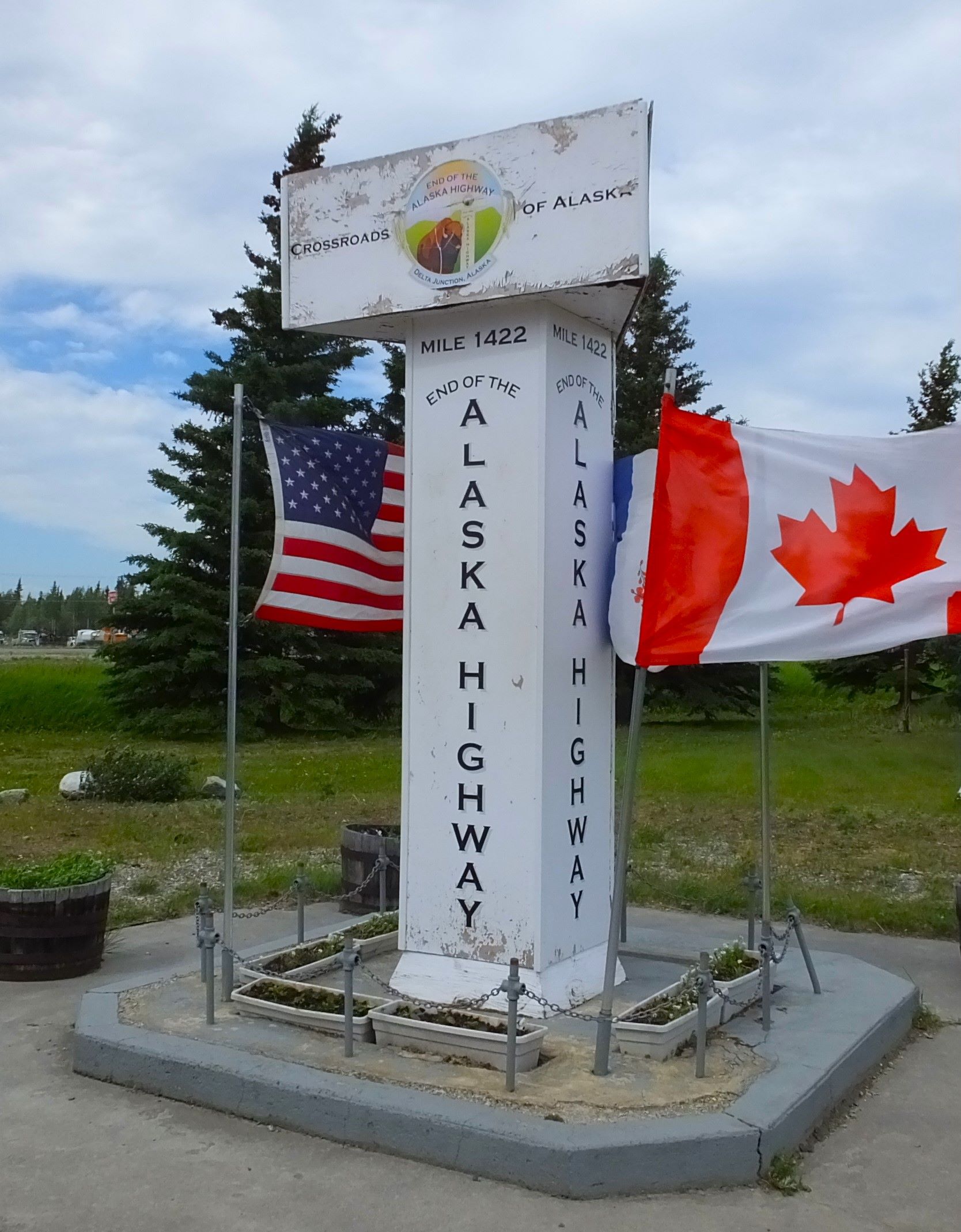
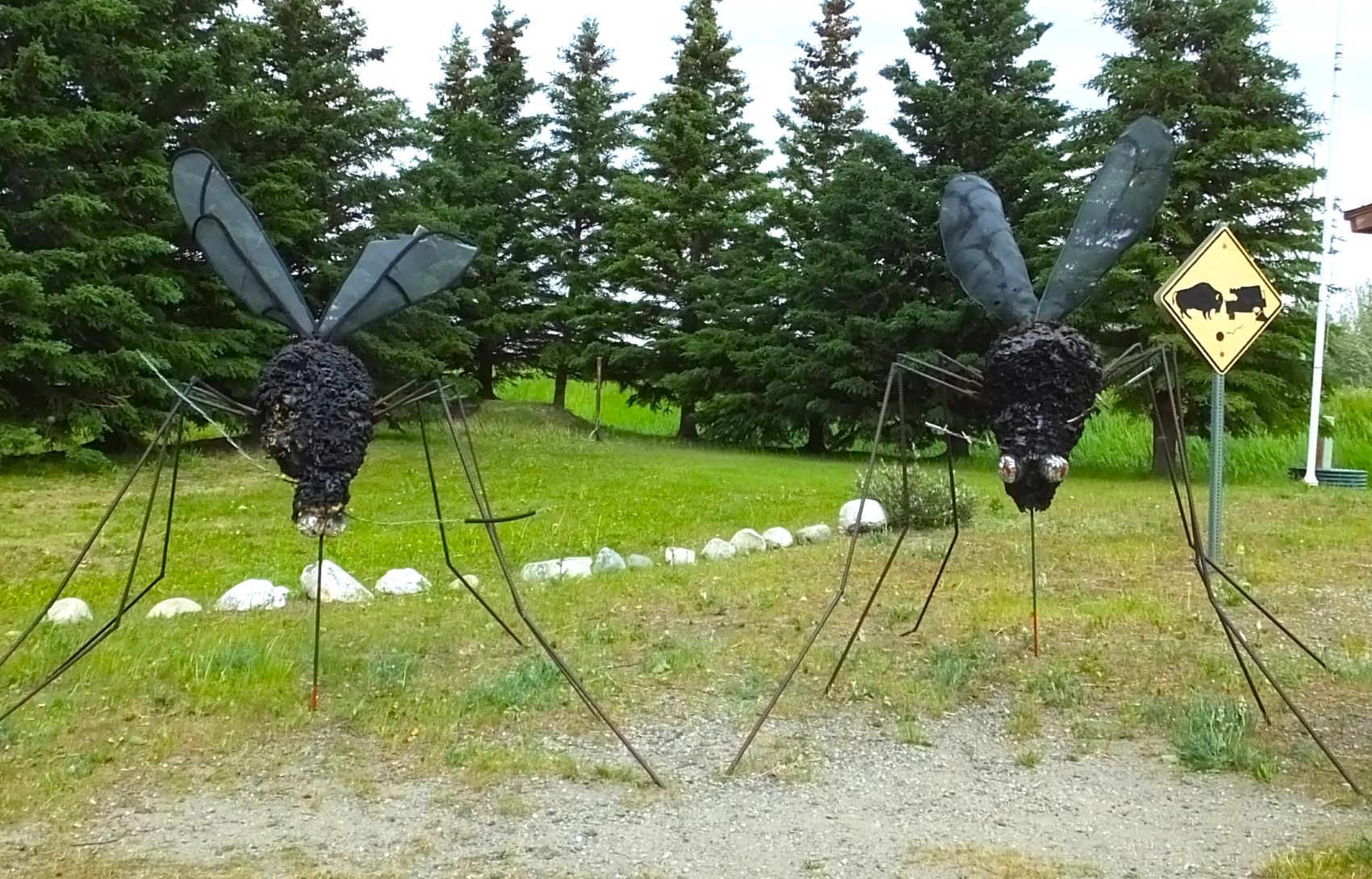
Monument marking end of Alaska Highway; Alaska-sized mosquitoes

Midway between Tok and Fairbanks we visited Delta Junction, the original ending of the 1390-mile Alaska Highway (the highway was originally 1422 miles).  From there, the highway continues northwest to Fairbanks or south toward Anchorage.  We drove past broad, swift-flowing rivers filled with snowmelt from distant mountains. A strong, chilly wind rocked Percy and Pap as the skies cleared.

Tanana River with snow capped mountains in the distance – a common Alaska landscape
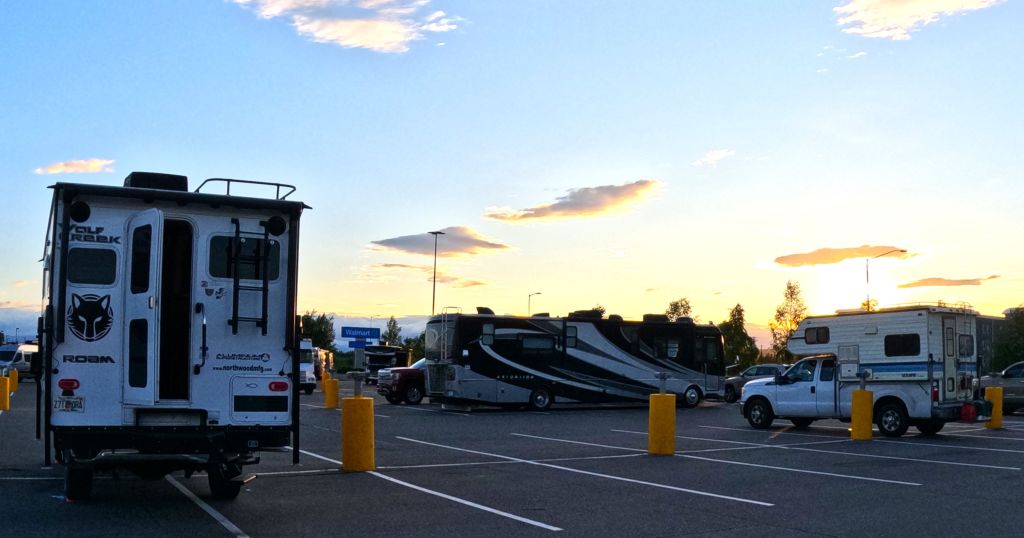
Walmart parking lot at 12:19 am – the sun wouldn’t set for another 30 minutes

We ‘wallydocked’ (overnighted) at the Fairbanks Walmart, where we replenished our supplies.   Sleep was a challenge – the sun rose before 3 am and set after 12:30 am. And after the sun set, it never really got DARK.

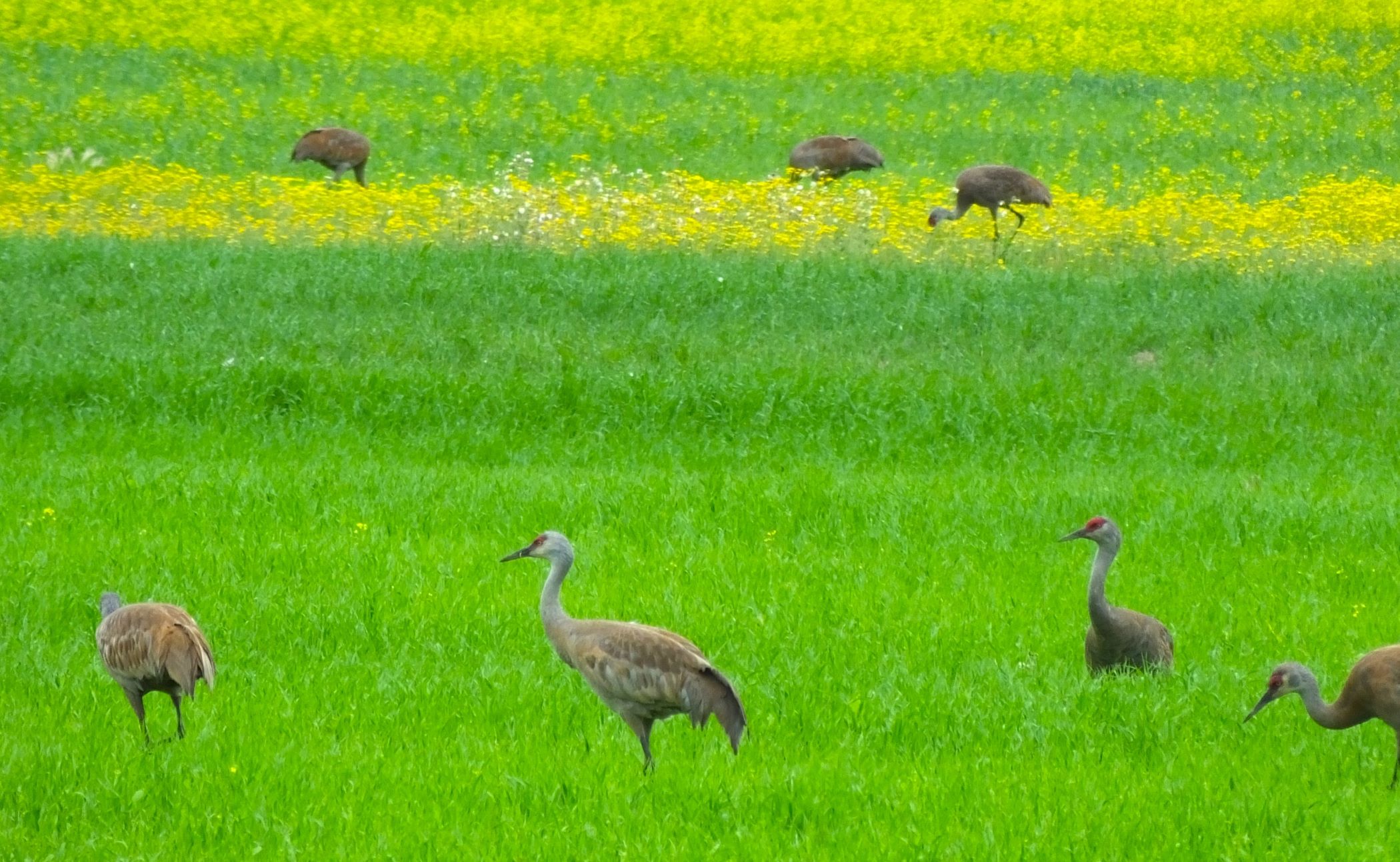
We visited Creamer’s Dairy, a one-time dairy farm that is now a migrating bird sanctuary.  Hundreds of sandhill cranes foraged in the fields along with many other birds. 

Other stops in the Fairbanks area include Pioneer Park, an amusement park with interesting historical and cultural displays, the Museum of the North, a natural history museum at the University of Alaska, and the Alaska oil pipeline. We visited these during our 2018 trip to Alaska.

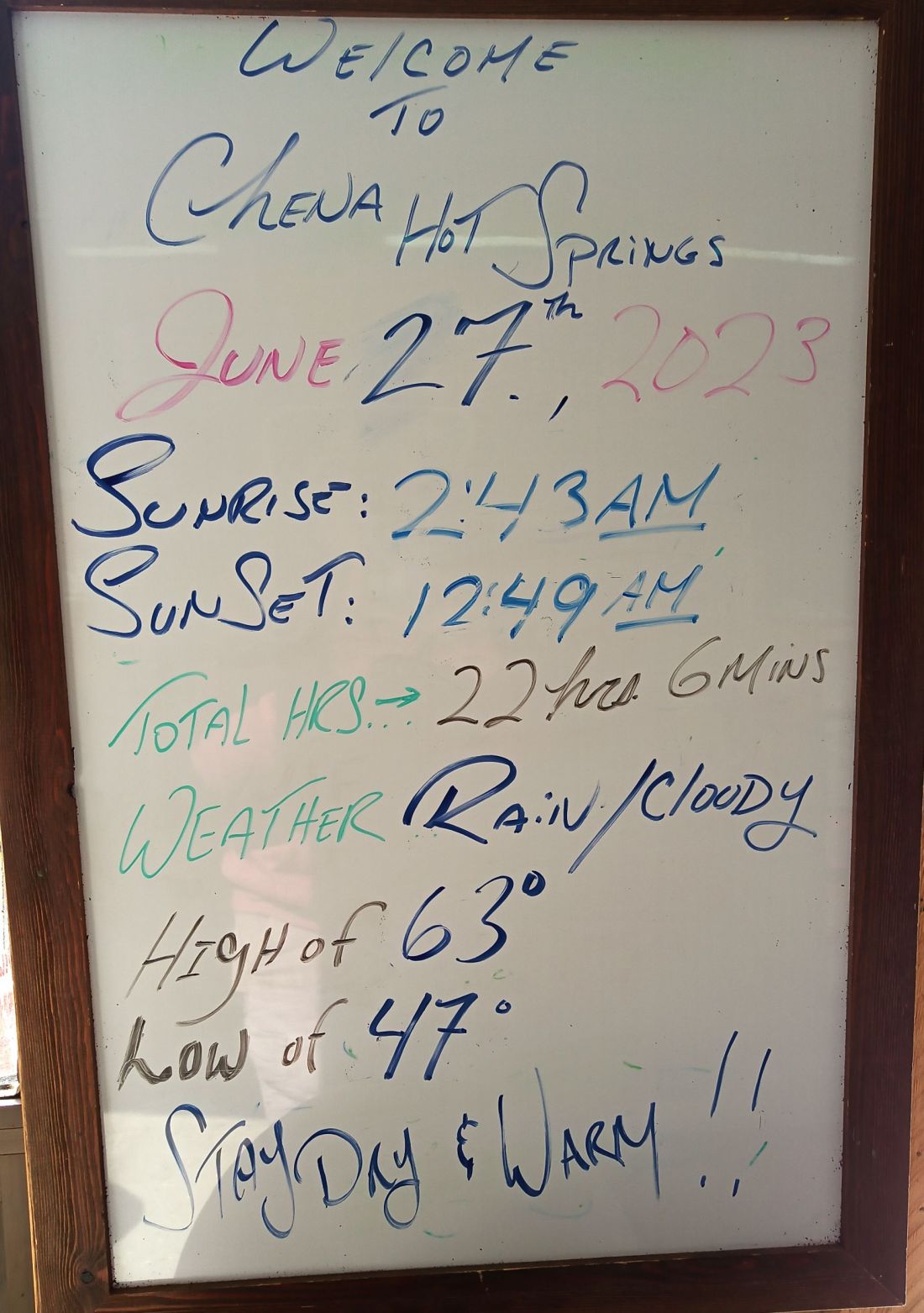
At the recommendation of a friend, we drove two hours from Fairbanks to visit Chena Hot Springs. 

We hoped to camp a night or two on the way to the springs but our plans quickly changed when we stopped for a short hike.  The cool, wet weather had resulted in an outbreak of hungry Alaska mosquitoes that descended on us in thick swarms.  We were reminded of the mosquito-infested hardwood hammocks in the Florida Everglades.

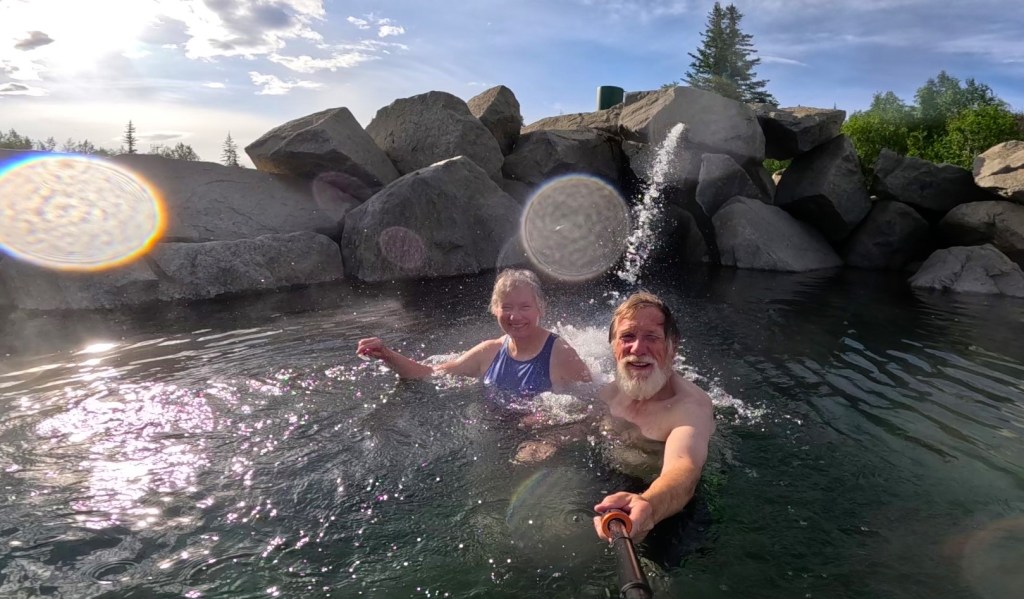
Pat and I soak in the outdoor pool at Chena Hot Springs

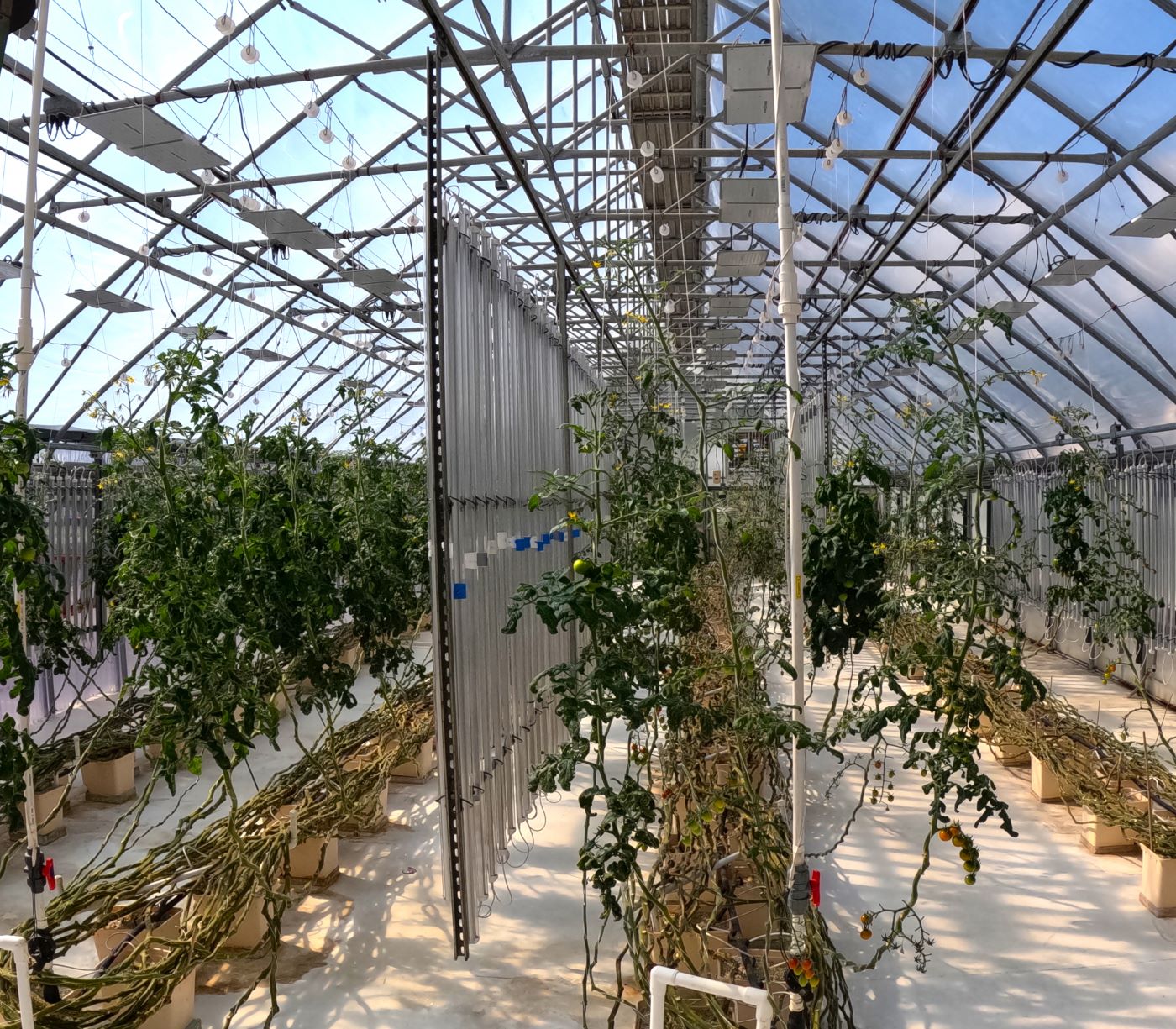
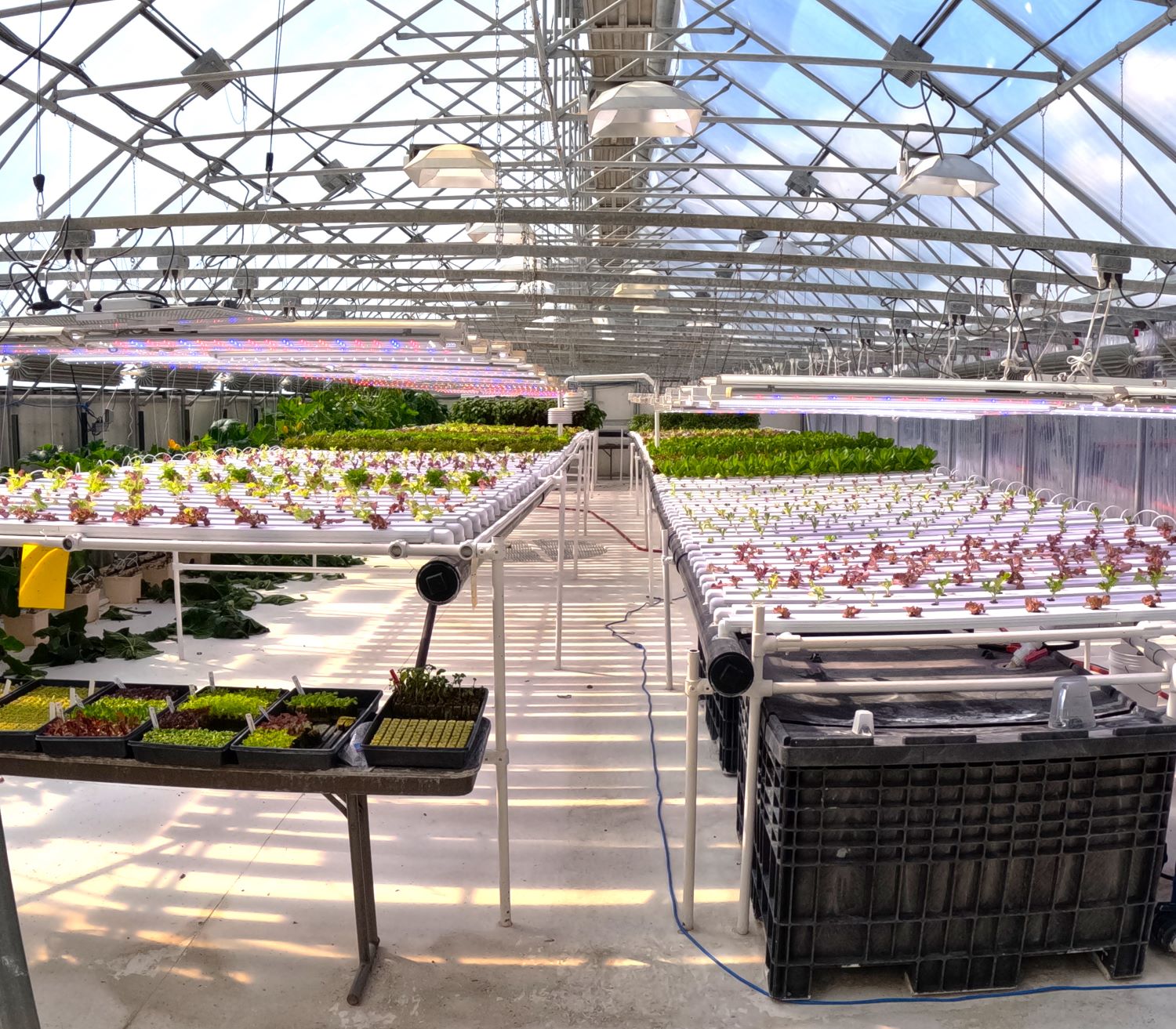
We decided to continue to the springs, where we enjoyed an early morning soak in a warm outdoor pool.  Chena is an interesting destination, with a lodge, campground and hiking, biking and ATV trails.  Hot water from deep wells in the area is used to generate electricity and heat large greenhouses where tomatoes, lettuce and other vegetables are grown all year round. 

Chena greenhouses use geothermal energy to produce vegetables

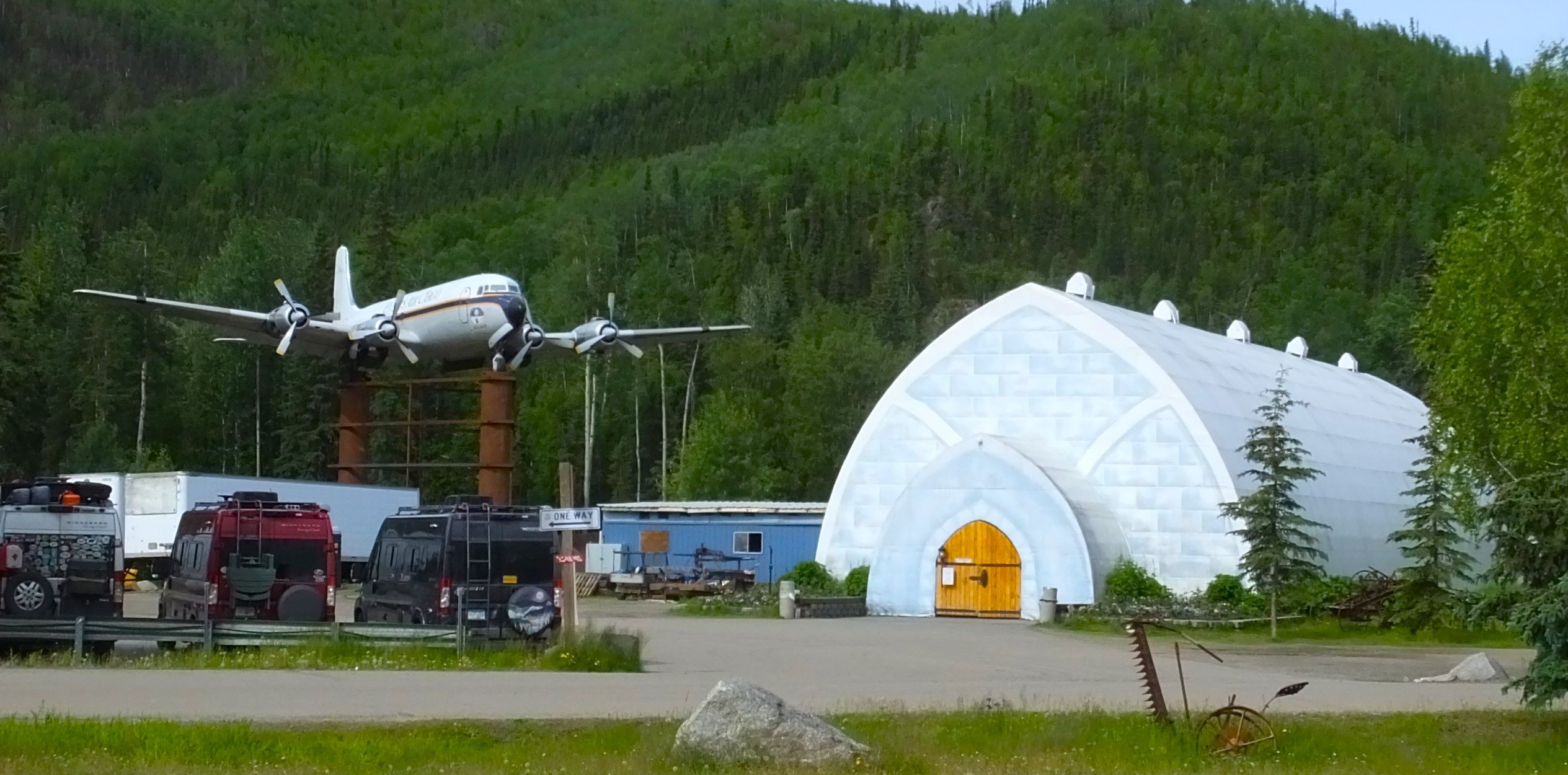
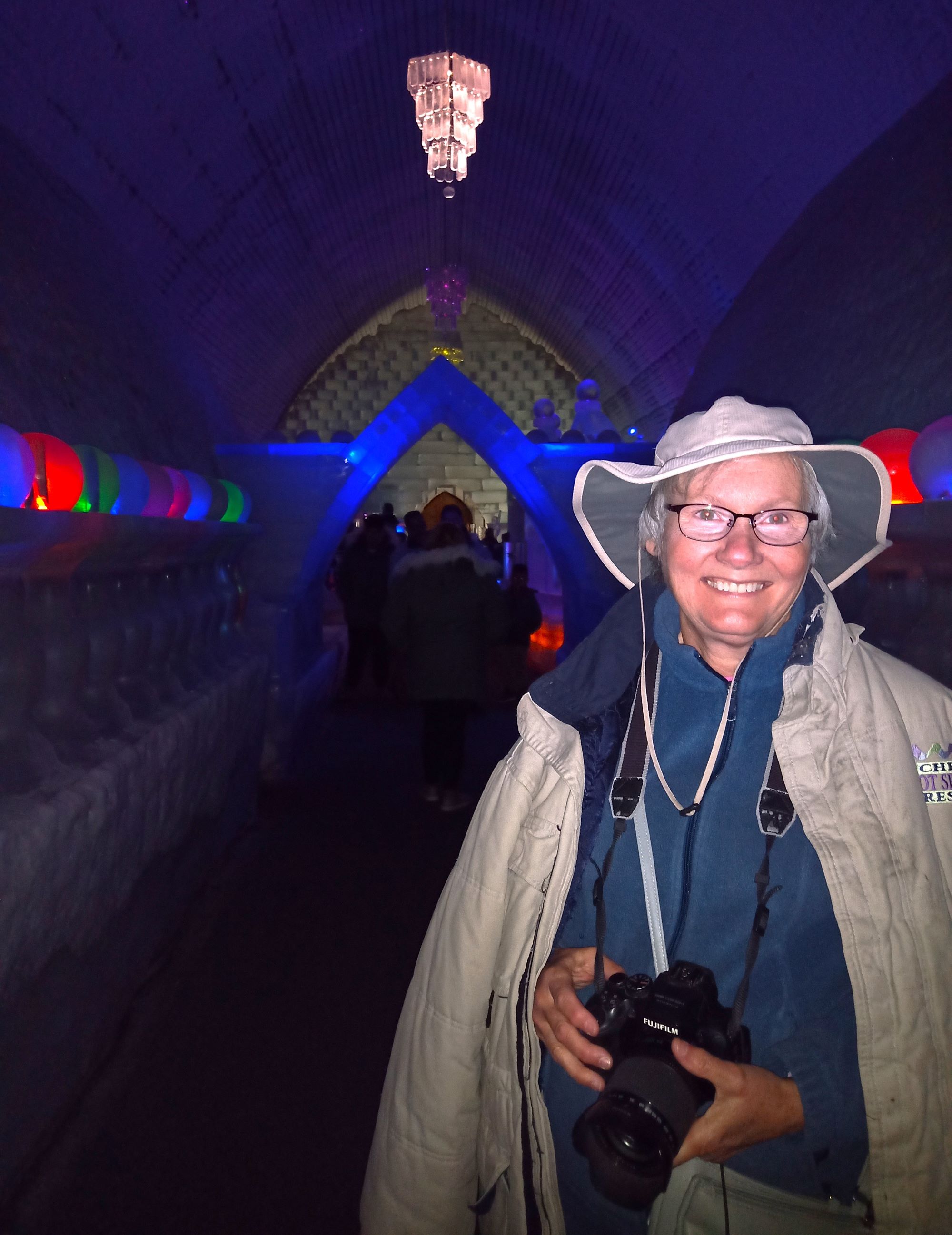
Ice museum exterior along with an elevated DC6 (future hotel); Pat wore a heavy parka to keep warm; inside the ice museum

Chilling in the Chena Ice Museum

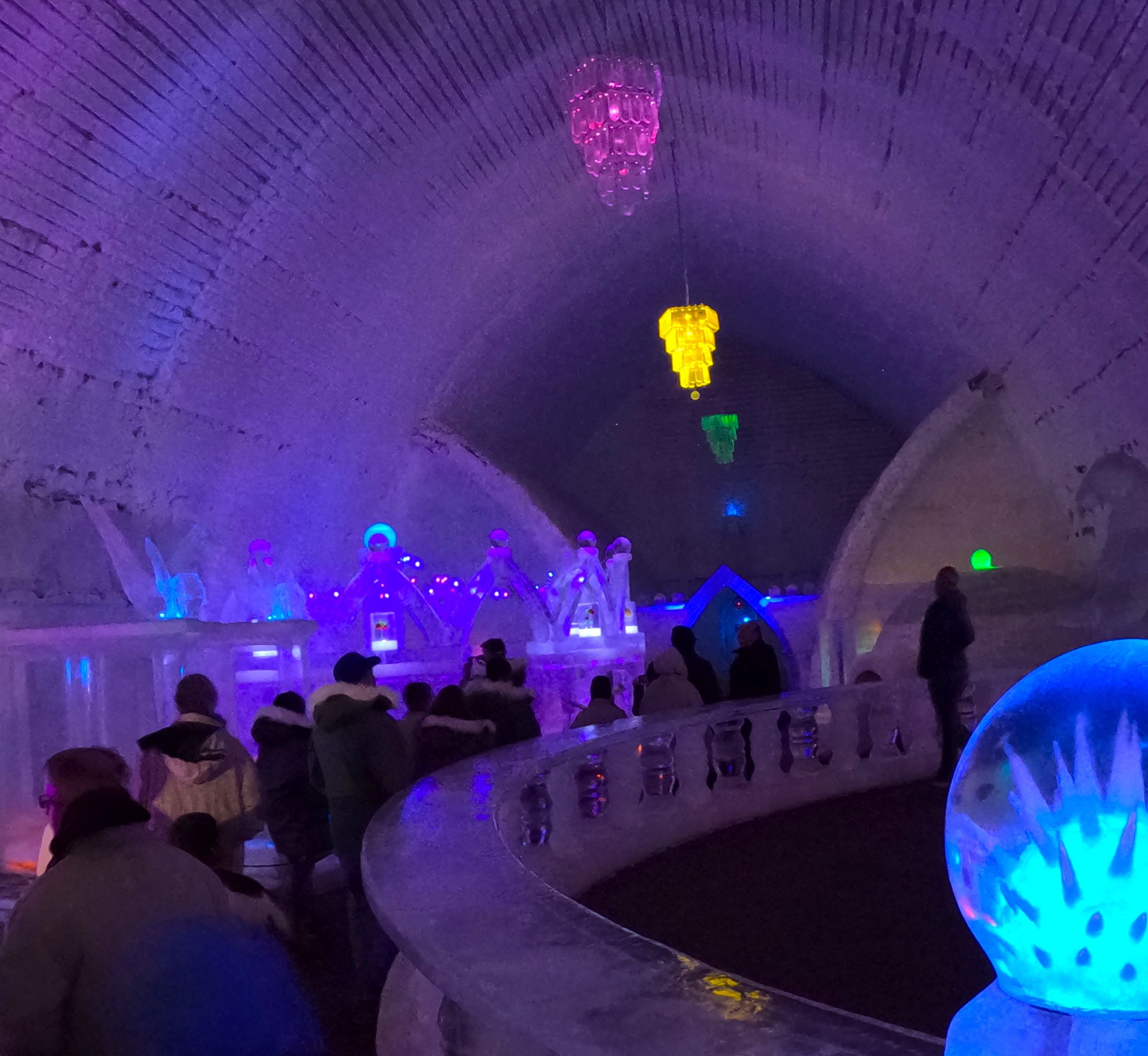
We donned heavy parkas to see sculptures in the Chena Ice Museum.  The museum includes an altar for wedding ceremonies and rooms where the brave of heart can spend the night. 

Not us however – we opted for our nice warm camper instead!

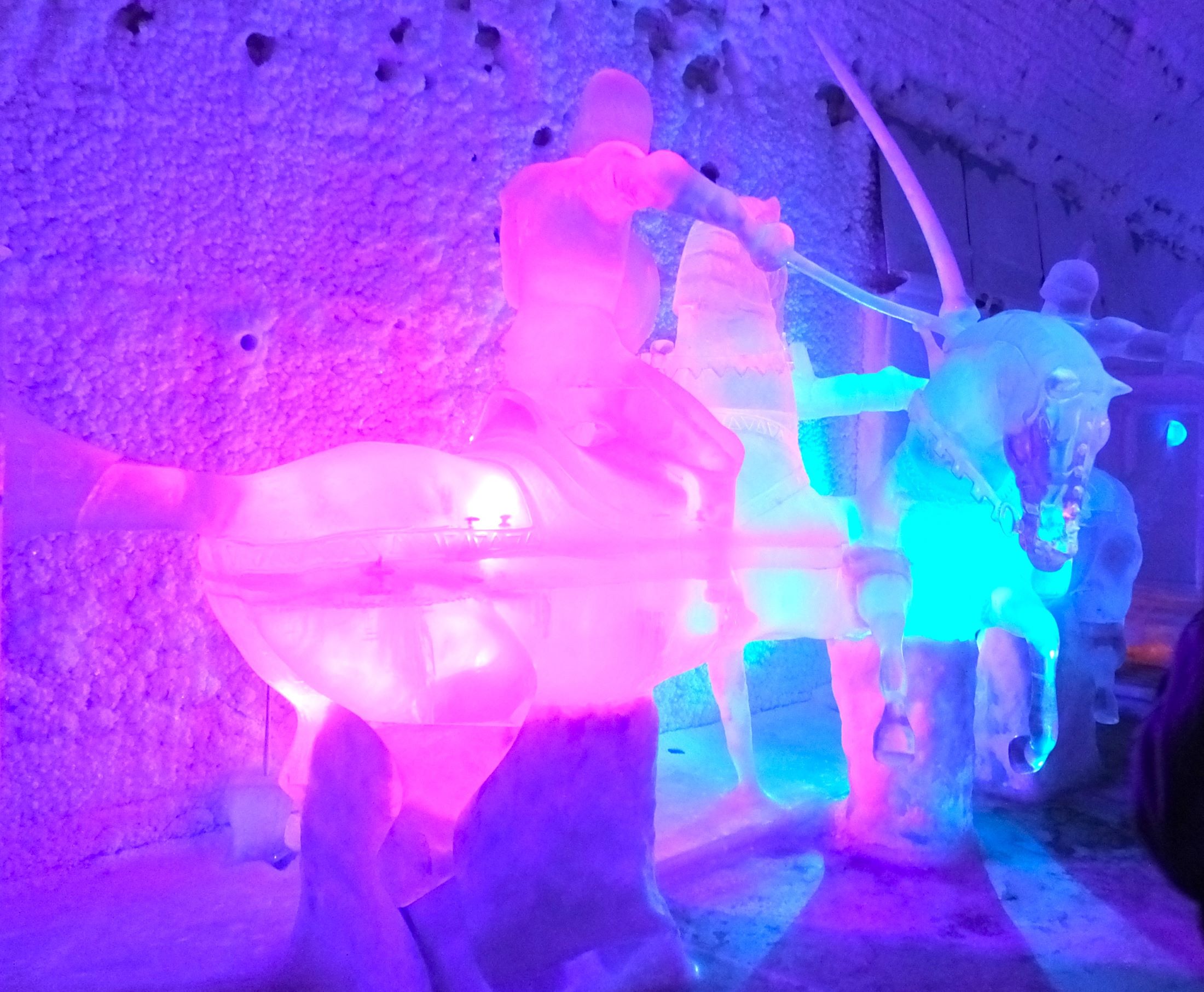
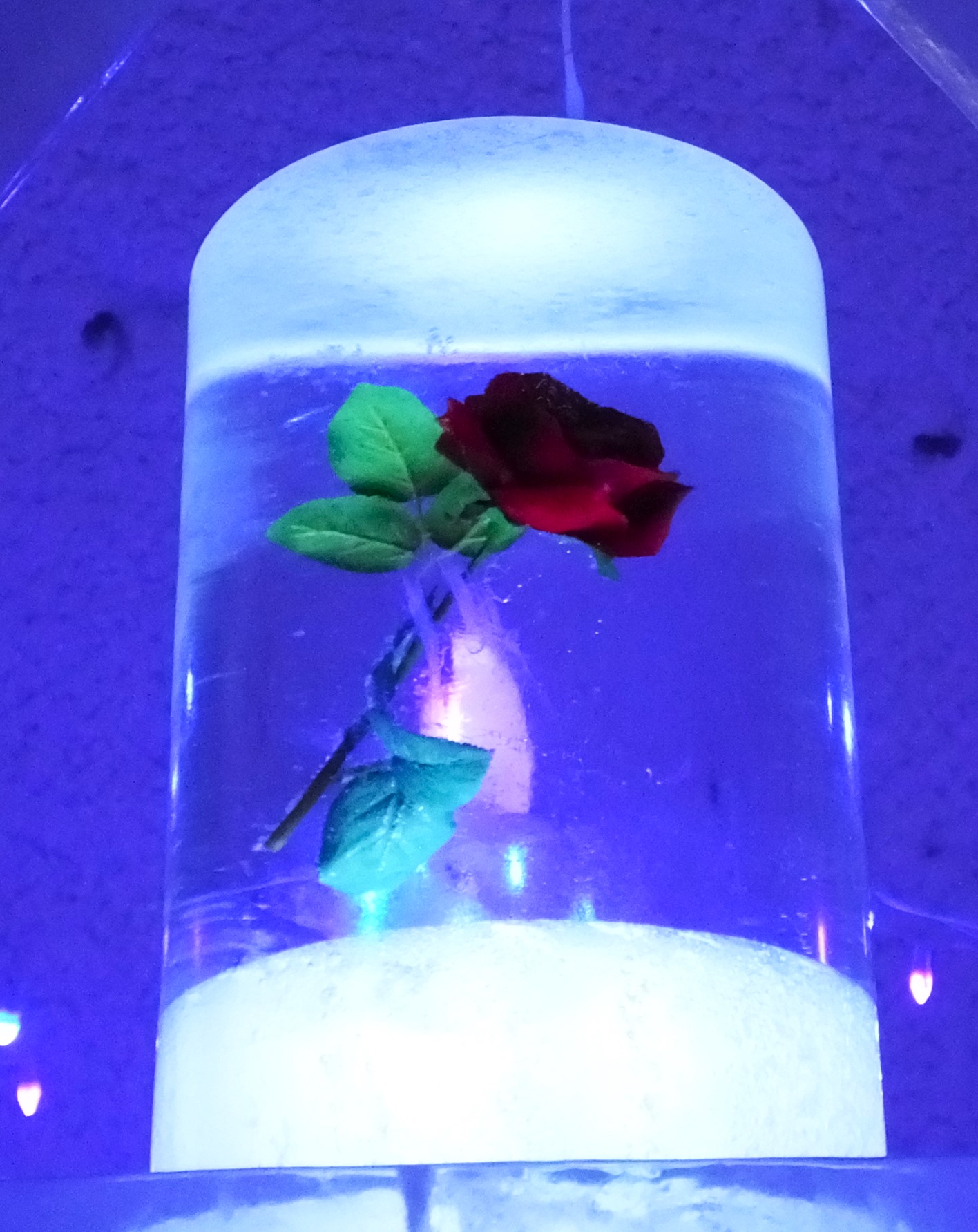
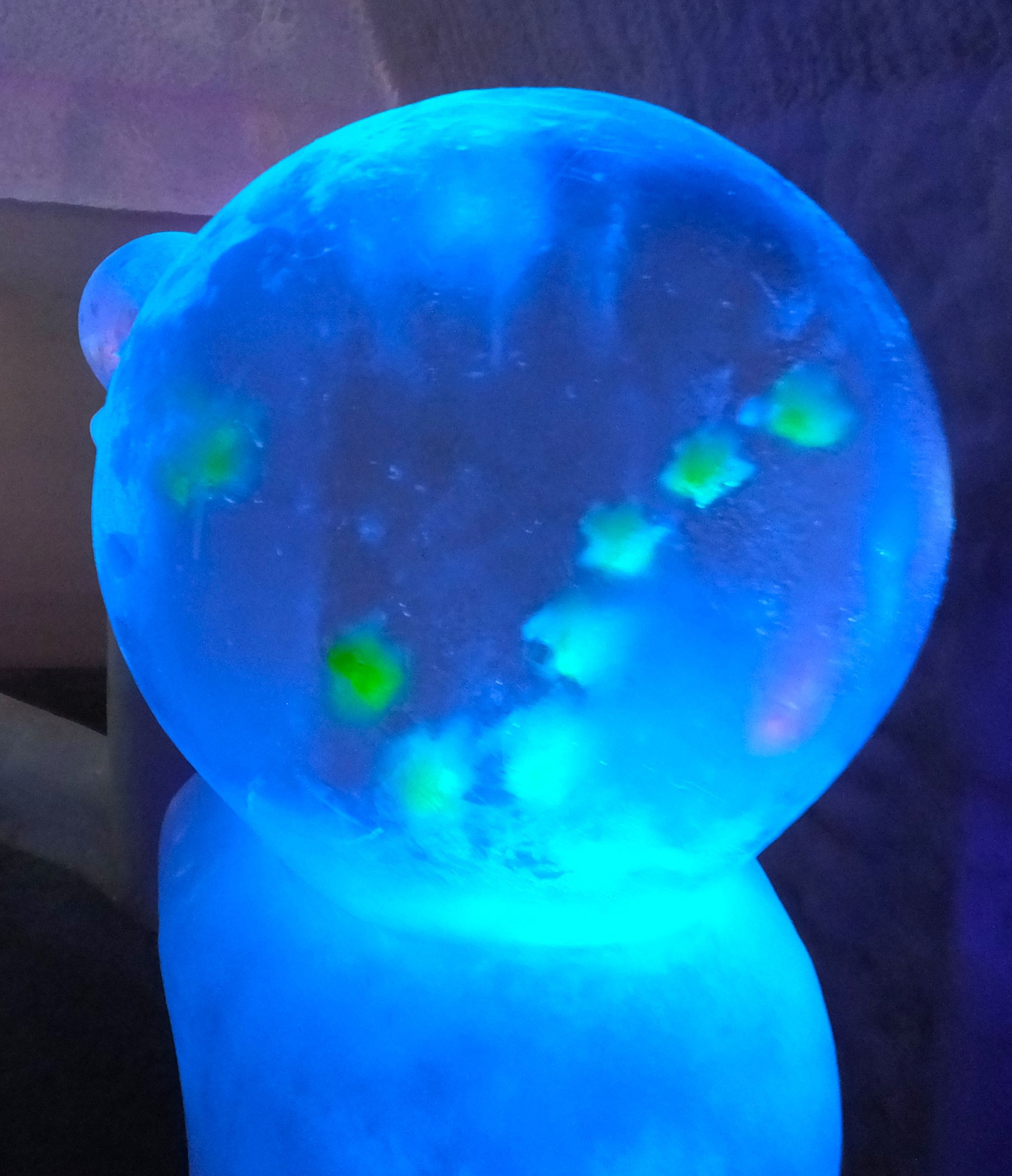
One of several elaborate ice sculptures in the museum; interesting items in ice

Nenana

Leaving Chena and Fairbanks, we turned south toward Anchorage on the Parks Highway. 

At Nenana, a small town on the Alaska railway where the train and cruise buses stop, we toured the original train station that houses an interesting assortment of train relics. It’s the kind of place Pat’s dad would have really enjoyed.

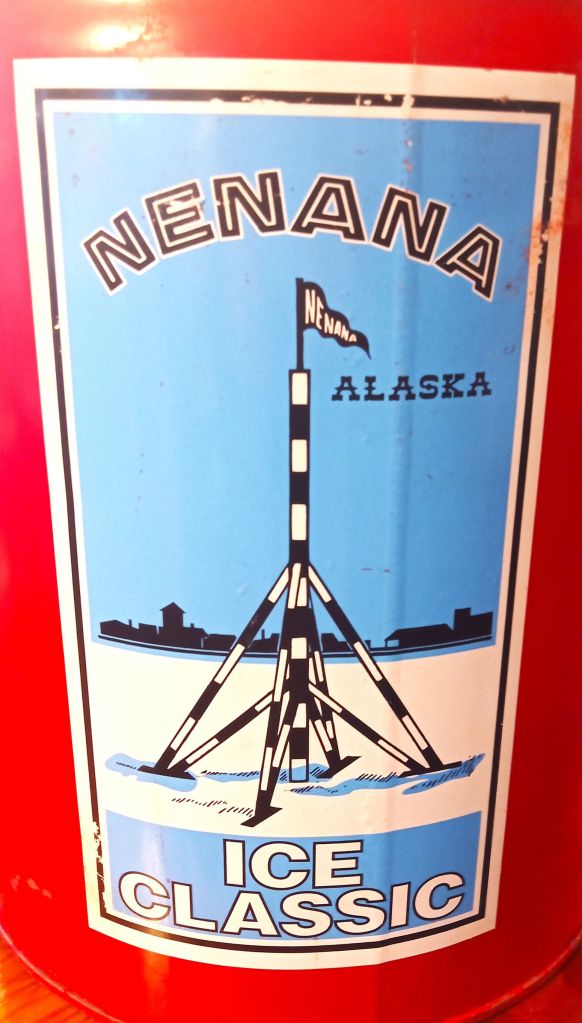
Nenana is known for the Nenana Ice Classic, said by some to be Alaska’s best guessing game. 

Each winter since 1917 a tall wooden structure has been placed on the frozen Tanana River adjacent to the town. Ticket purchasers predict when the structure will fall through the ice during the spring thaw and the person whose prediction is closest to the actual fall receives a sizeable jackpot. 

The 2023 prize was $222,101 and the winning time was 4:01 PM AST on May 8.  Money raised by the event is used to fund college scholarships for local students.

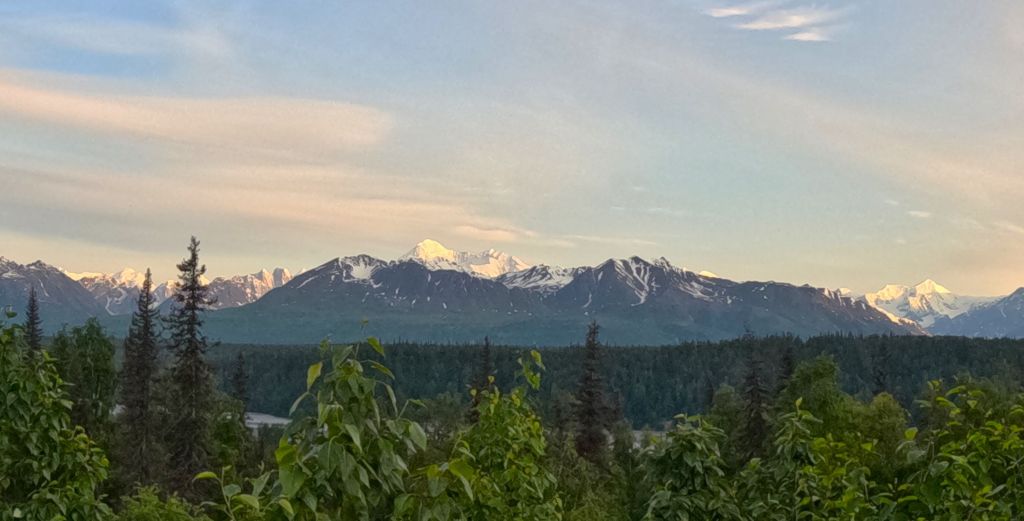
Views of The Great One

The Parks Highway took us past the entrance to Denali National Park. We plan to return in August for five nights of camping and hiking in the park. 

An early morning view of Denali, the Great One

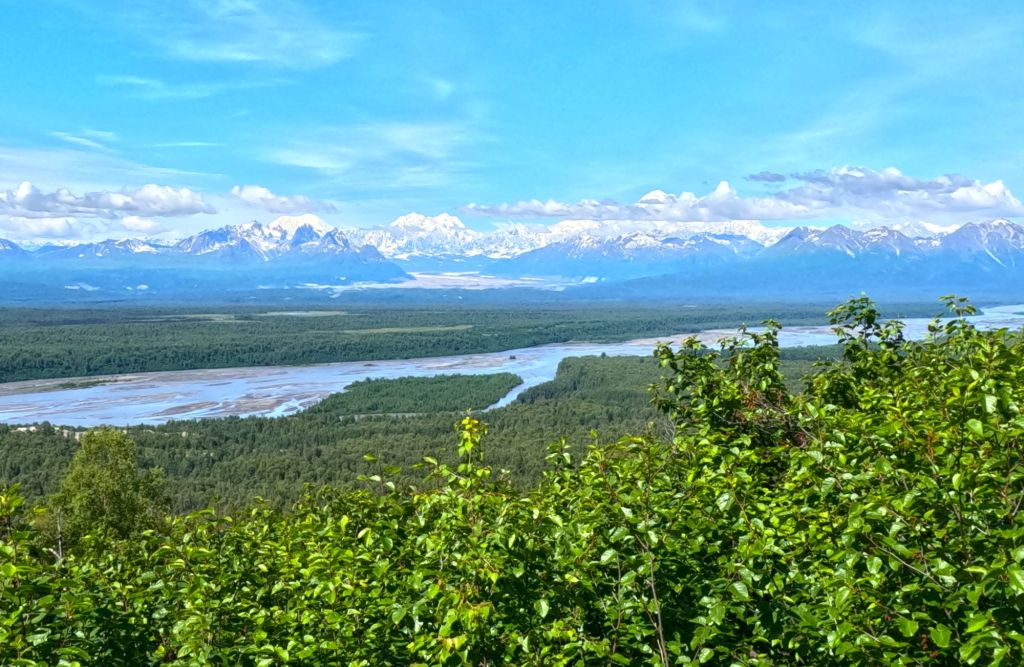
A few miles further we visited Denali State Park, where we were rewarded with a spectacular view of Denali early the next morning. The Great One is North America’s tallest mountain at 20,310 ft. Later that day we hiked a steep trail for a better view of Denali and the Alaska Range.

The Alaska Range; Denali is covered in a layer of clouds

Denali is often covered with clouds and only 1 in 3 visitors see the mountain.  We were thankful for clear weather and the great view.

Mary Carey’s Cinnamon Buns   

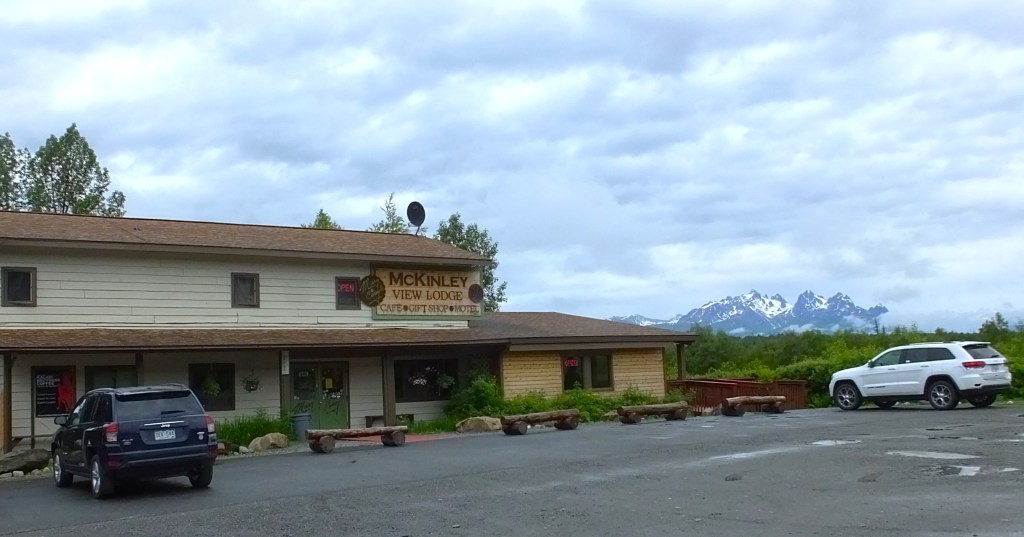
Mary Carey’s McKinley View Lodge near Denali State Park offers a phenomenal view of Denali from their back patio. When we learned the lodge sells cinnamon buns using Mary’s recipe from nearly 50 years ago, we had to try one. 

Warmed in the microwave, the pillowy bun had a nice cinnamon flavor. It was topped with thick, sweet icing dusted with additional cinnamon.

It was the best bun so far in our travels. We’d give it a bun score of 4 out of 5.

McKinley View Lodge; Mary Carey was a true Alaska legend – check out her interesting story.
Critter Count

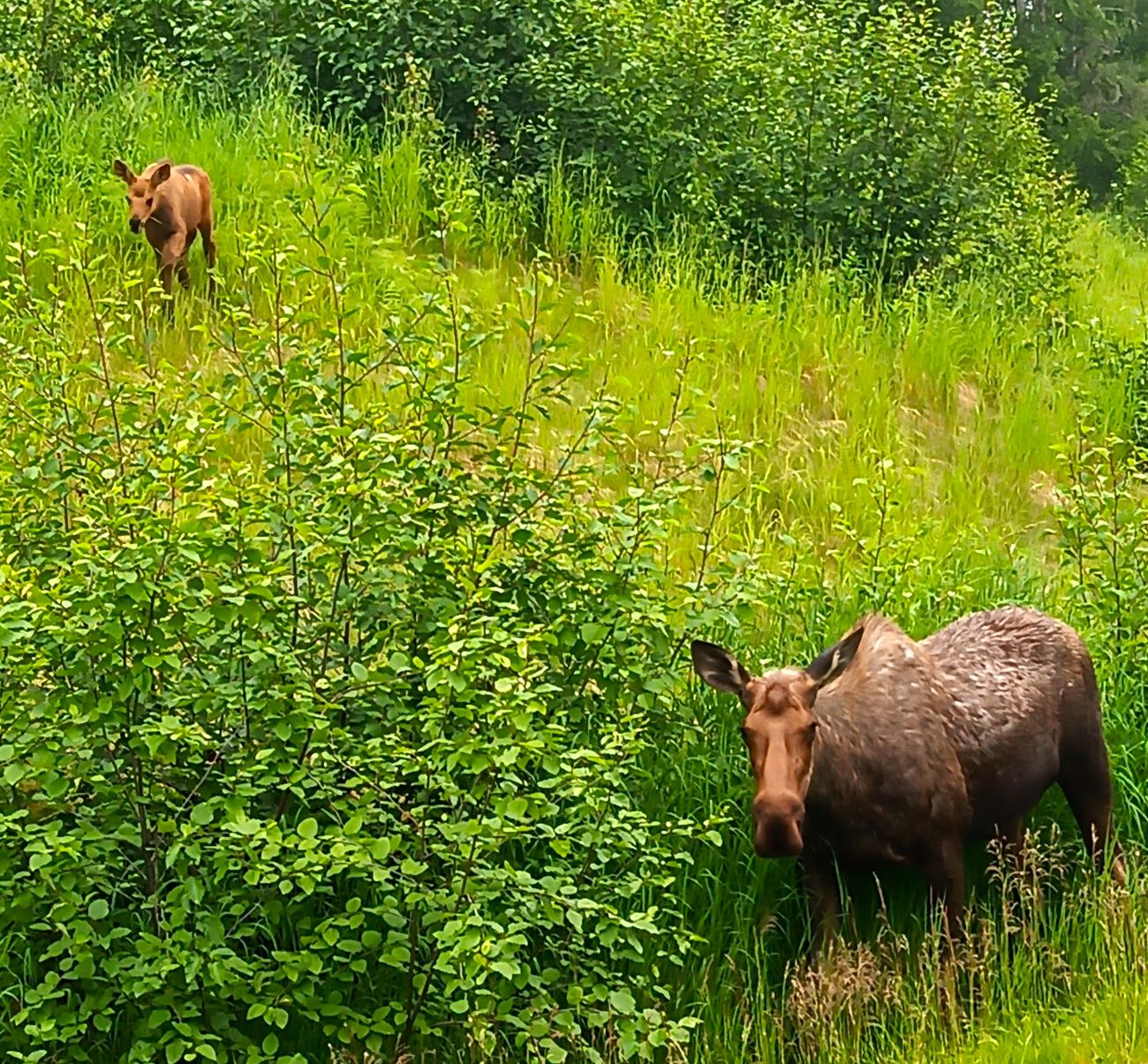
Moose – 4  (cows and babies, no bulls)

Grizzly bears – 2

Sandhill cranes – many

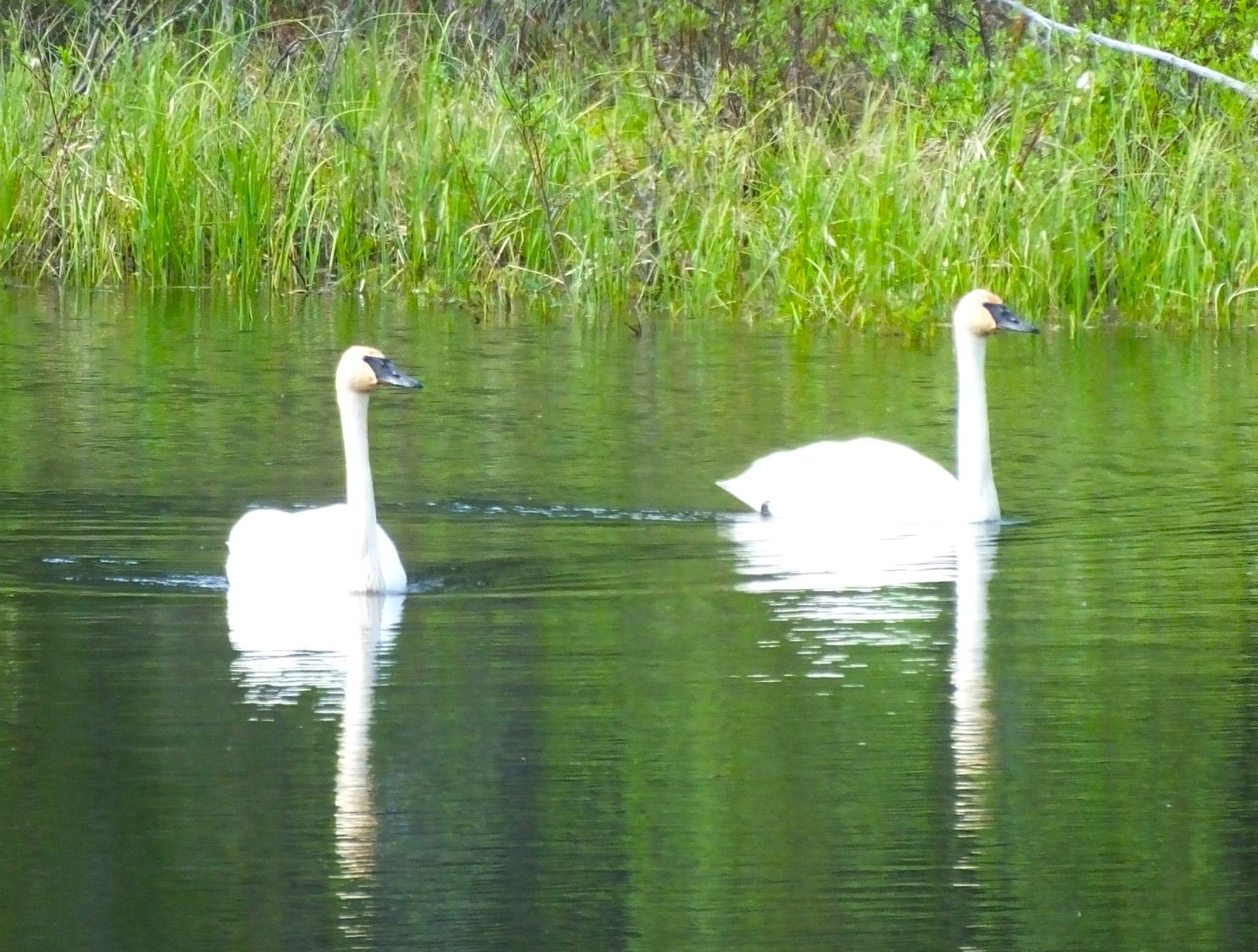
Swans (8), eagles (4) and other birds

Sandhill cranes at Creamer’s Dairy in Fairbanks; a watchful mama moose and her baby

Next week: 

We visit Alaska’s biggest city, Anchorage, and continue to the scenic Kenai peninsula.         

Protection and Provision at the Alaska Border

(2023 Alaska Revisited Ep 15)
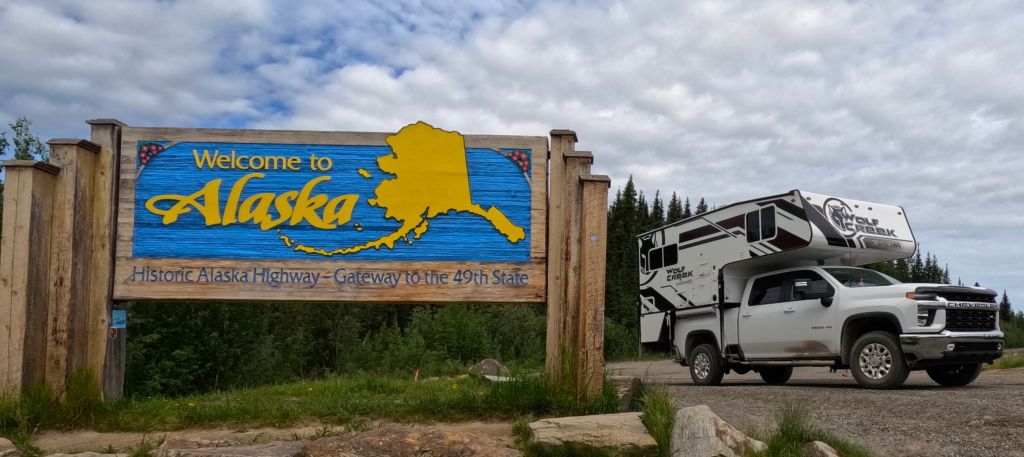
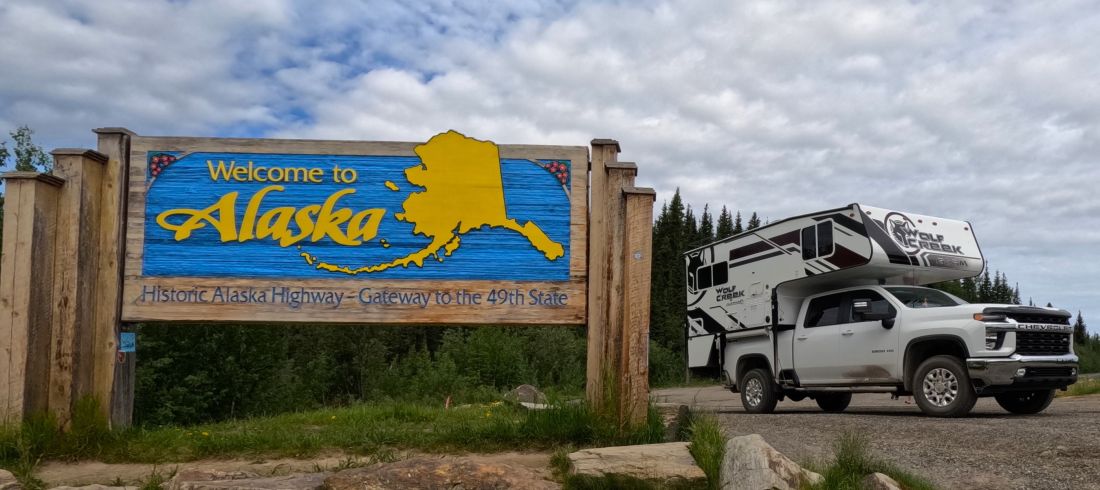
Welcome to Alaska!

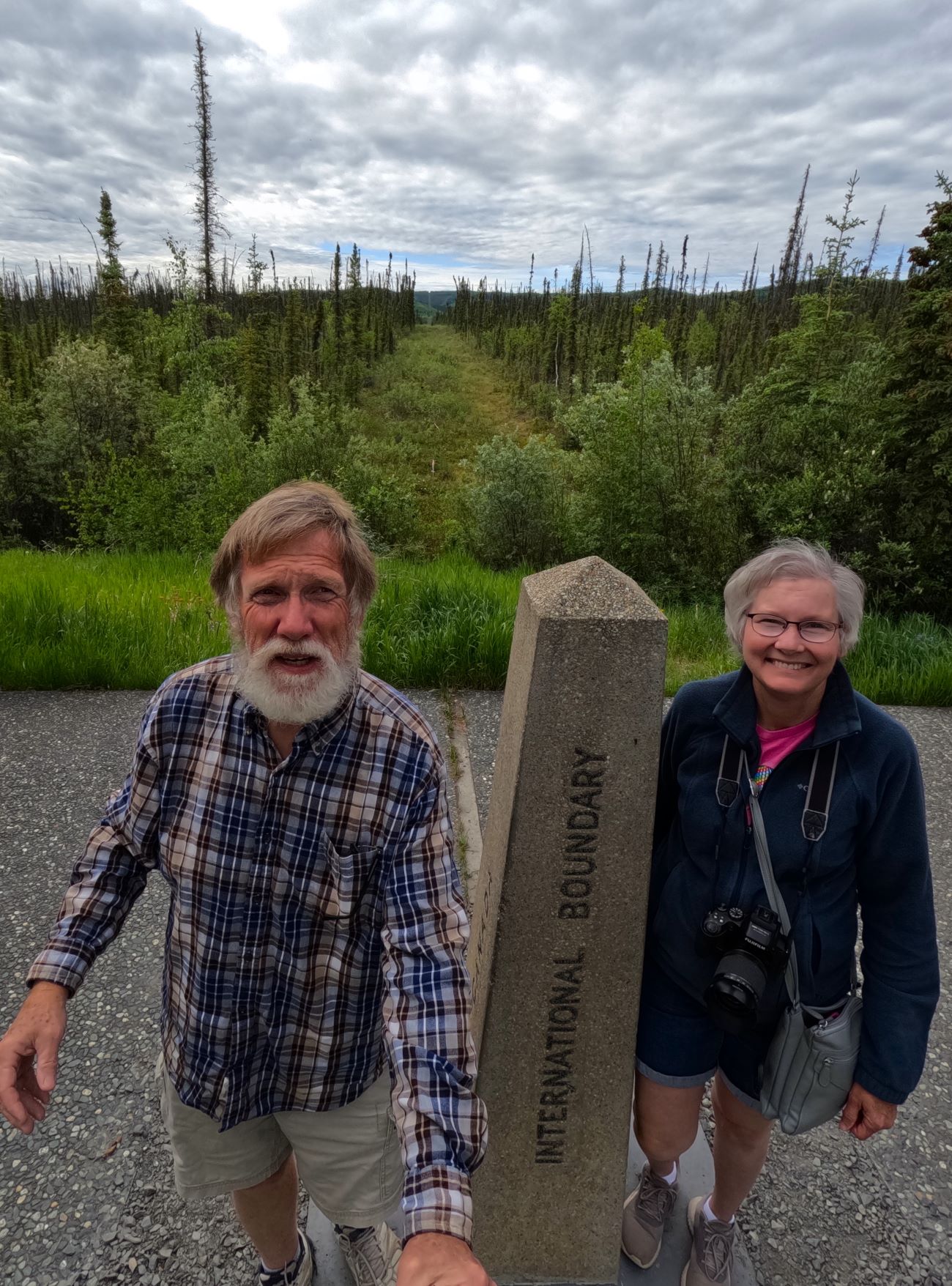
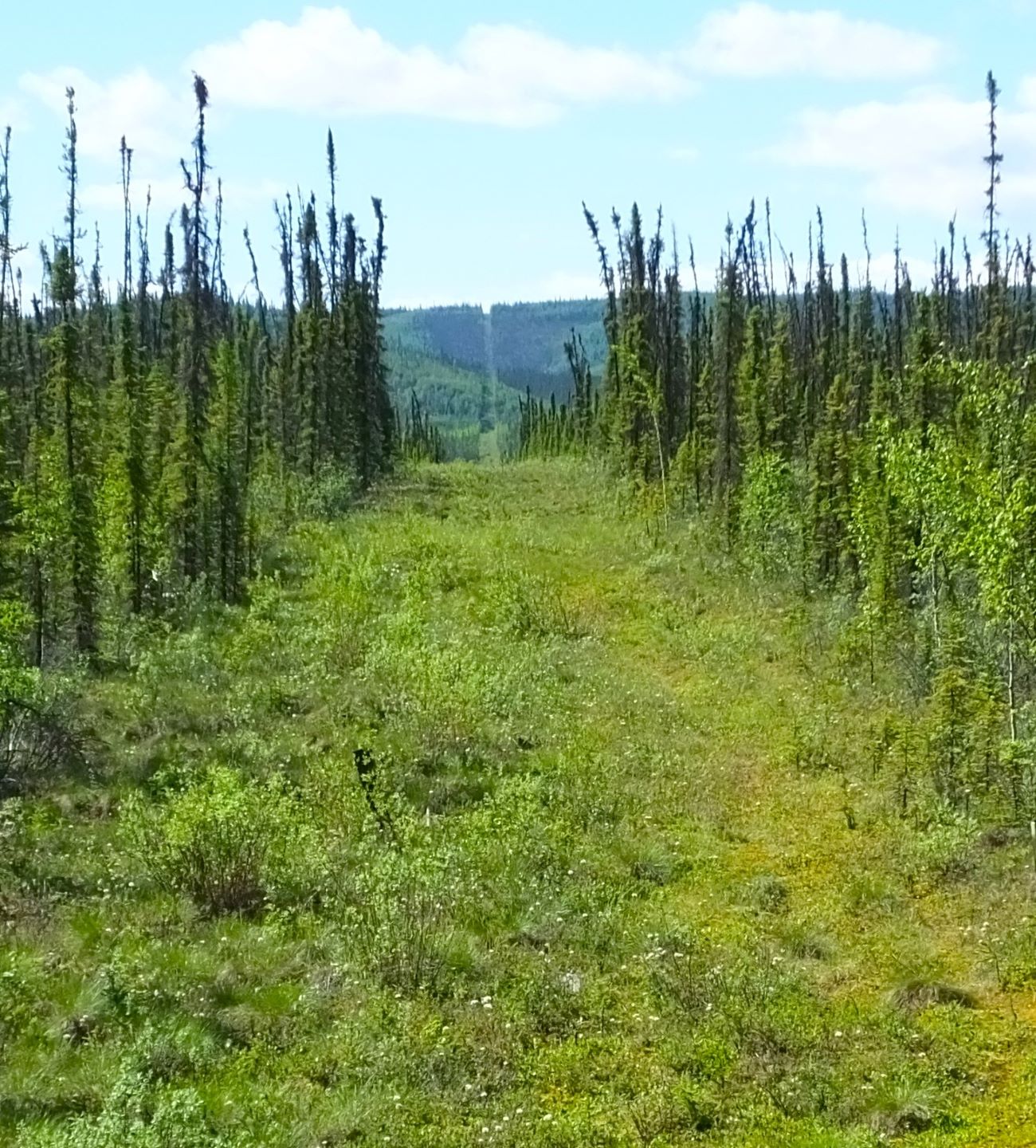
Last week’s RabbiTRAILS included a photo of the sign that welcomed us to Alaska.  There is a nearby stone marker that is on the actual border with Canada.  We found it interesting that there is a wide cleared area that extends to the north and south from the marker showing where the border is.  We wondered if the clearing extends for the thousands of miles of border between the US and Canada. 

Ed is in Canada, Pat is in the US; the border clearing extends to the horizon (and beyond!)

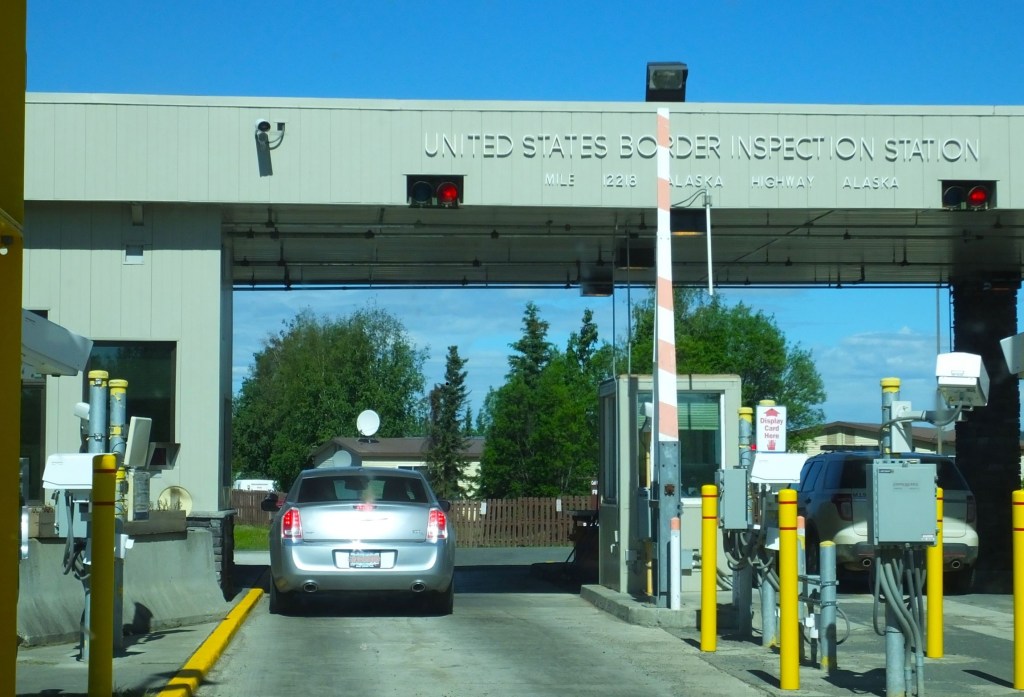
A few miles further, we stopped at the border checkpoint for entry into the US.   The checkpoint is remote – 20 miles from Beaver Creek in the Yukon and 100 miles from Tok, Alaska.    

US border checkpoint

We pulled up to the checkpoint and handed the border control agent our passports.  She asked the standard questions:  where are you from (Florida), why are you traveling to Alaska (vacation), do you have any firearms (no) or illegal substances (no).   We’ve heard they sometimes ask about and confiscate food (eggs and produce mainly) and some travelers have even been detained while their vehicles were searched.   I guess we look like we are honest or we don’t pose a threat.  We were cleared to proceed with no issues.

TPMS alert!

Well almost. 

As we pulled away Pat pointed out a message on Percy’s dashboard.  A TPMS alert indicated the front passenger tire was at 41 lbs PSI, not the normal 65 lbs.   We pulled into a parking spot just past the checkpoint, presumably where vehicles are searched.   I inspected the tire, verified the PSI, and used our tire inflator to add air.

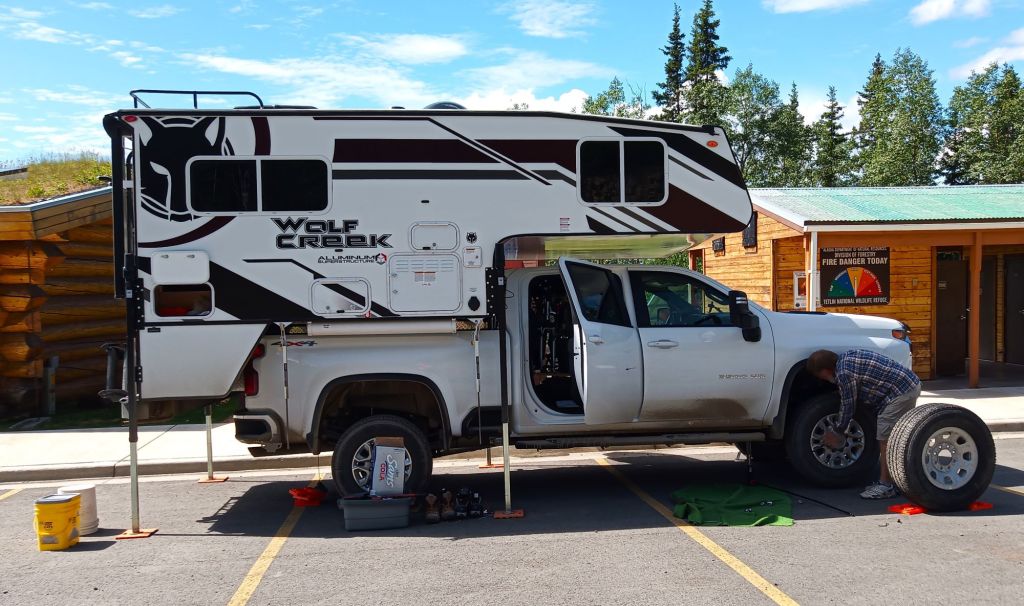
We continued on, keeping an eye on the TPMS.  Almost immediately the pressure started dropping – it was clear we had a leak.  At the Tetlin National Wildlife Refuge Visitor Center, 20 miles from the border, the pressure had fallen by nearly 10 psi.  We decided to put on the spare.

Calling for roadside assistance wasn’t an option – we were outside the cell service area (not uncommon on the Alaska Highway) and even if we were able to reach someone, it could have been hours before they arrived to swap the tire.  So we let a ranger at the visitor center know we would be swapping our tire in their parking lot. 

Percy is jacked up as Ed works on a parking lot tire swap

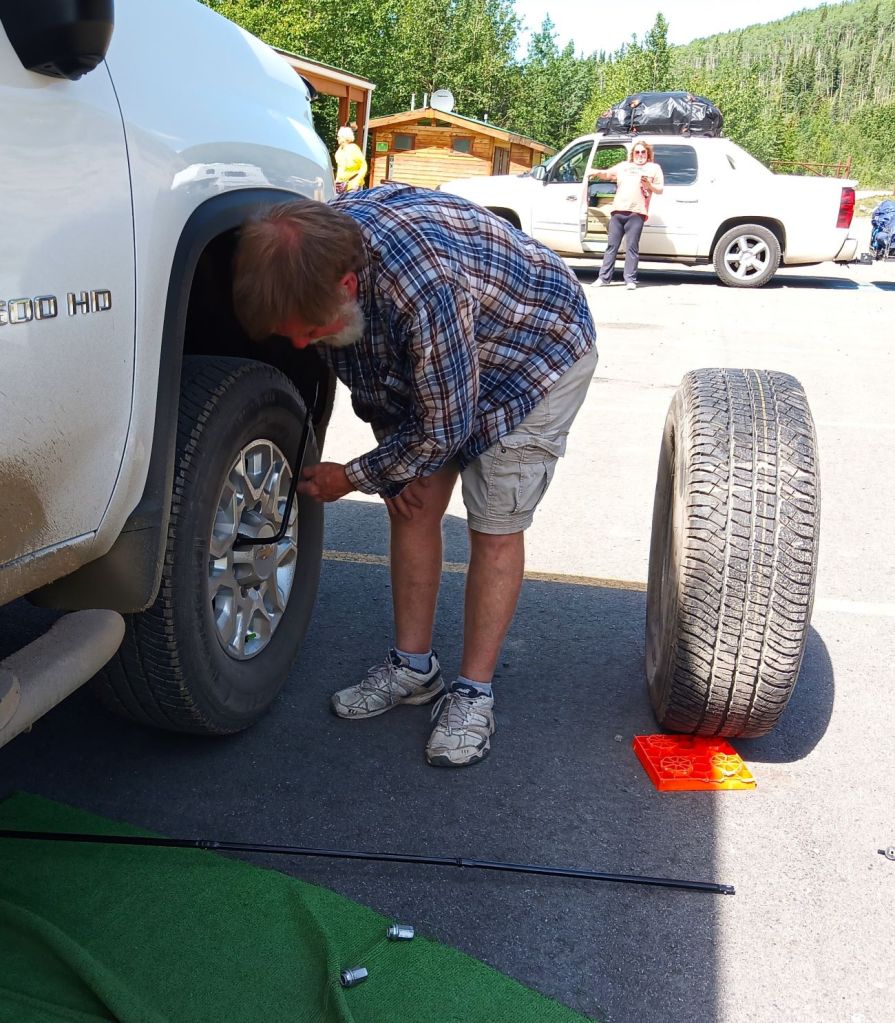
Such an endeavor is a challenge with a truck camper.  We raised the camper a few inches off the bed of the truck to lessen the weight on the jack. Then we lowered the spare from under the back of the truck, loosened the lug nuts, jacked up the right front, removed the tire, put on the spare and finally stowed the bad tire back under the truck.   In case you are wondering, an 18-in truck tire is heavy!

Loosening and removing the tire lugs before putting on the HEAVY spare

Spare tire installed, we lowered the camper back onto the truck.  It was at this point we made a BIG MISTAKE.  We did not notice we lowered the camper on the wire that connects the camper to the truck.

We arrived in Tok and as we were setting up for the evening, we noticed there was no power in the camper.  I started troubleshooting.  After unplugging the camper from the truck, I verified the camper battery.  It was OK, so I thought perhaps there was a blown fuse or flipped breaker. 

It was late afternoon, so we decided to connect the camper to shore power, hoping it would work, and to troubleshoot the power problem later.

Shore power worked – everything powered on as normal.  So, I disconnected shore power and everything still worked!  Hmmm, perhaps there was some sort of power transfer/relay issue.

The next morning, we were preparing to leave and to have our tire checked out at a nearby garage.  When I plugged camper into the truck I heard an arcing noise and noticed a cloud of smoke at the rear of the camper. 

THAT WAS NOT GOOD!  I quickly disconnected the camper plug. 

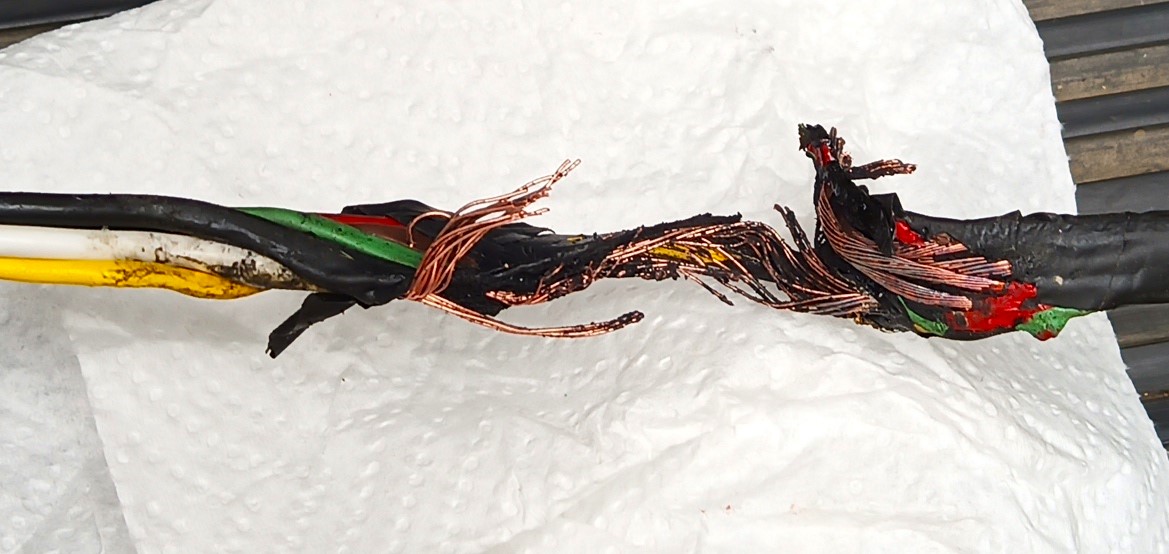
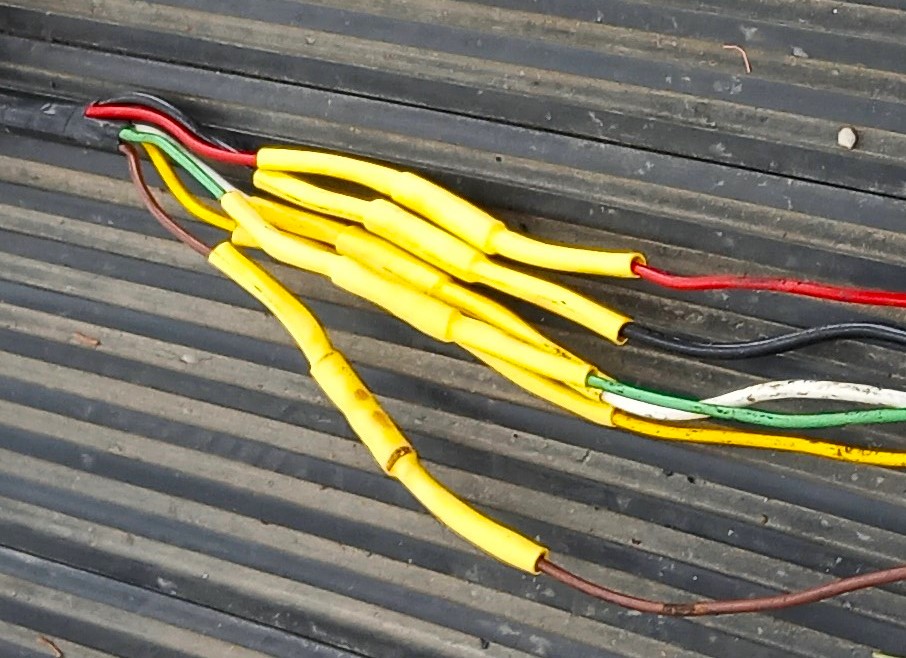
Pat and I discussed what might be going on. We realized that when we lowered the camper after swapping the tire, we didn’t check the location of the connection wire.  We raised the camper and it was obvious we had lowered the camper on top of the wire. Several of the wires were rubbed bare and there was a silver dollar-sized hole melted into the rubber mat under the camper.

Frayed wires (and nerves); repaired wires, almost as good as new

Although Tok is a very small, remote town, they have a NAPA auto parts store.  We purchased some wire connectors and sleeves, and after removing the frayed portions, we repaired and tested the wires.

Later that morning our leaky tire (caused by a small piece of metal) was repaired and reinstalled, and we were on our way to Fairbanks.

Pat and I praise God for His protection and provision.

  • Protection from a remote roadside breakdown or even an accident.   
  • Provision for a safe place to swap the tire on a paved, level parking lot and a tire that only needed to be repaired and not replaced. 
  • Protection from shorted, frayed wires that could have damaged our camper or truck (or even caused a fire).
  • Provision for a relatively simple repair and for the needed parts that were locally available.

One final provision: it was lunchtime as we swapped our tire.  One of the rangers was grilling something on the deck behind the visitor center.  He stopped by the truck to check our tire-swap progress and handed us a plate with grilled halibut and vegetables. 

We thanked the ranger and praised God.  Lunch never tasted so good!   

Next week:

We arrive in Fairbanks, battle mosquitoes on the way to Chena Hot Springs and see The Great One. Critter counts and cinnamon bun reviews will also resume.

Crossing the Yukon to Alaska

(2023 Alaska Revisited Ep 14)
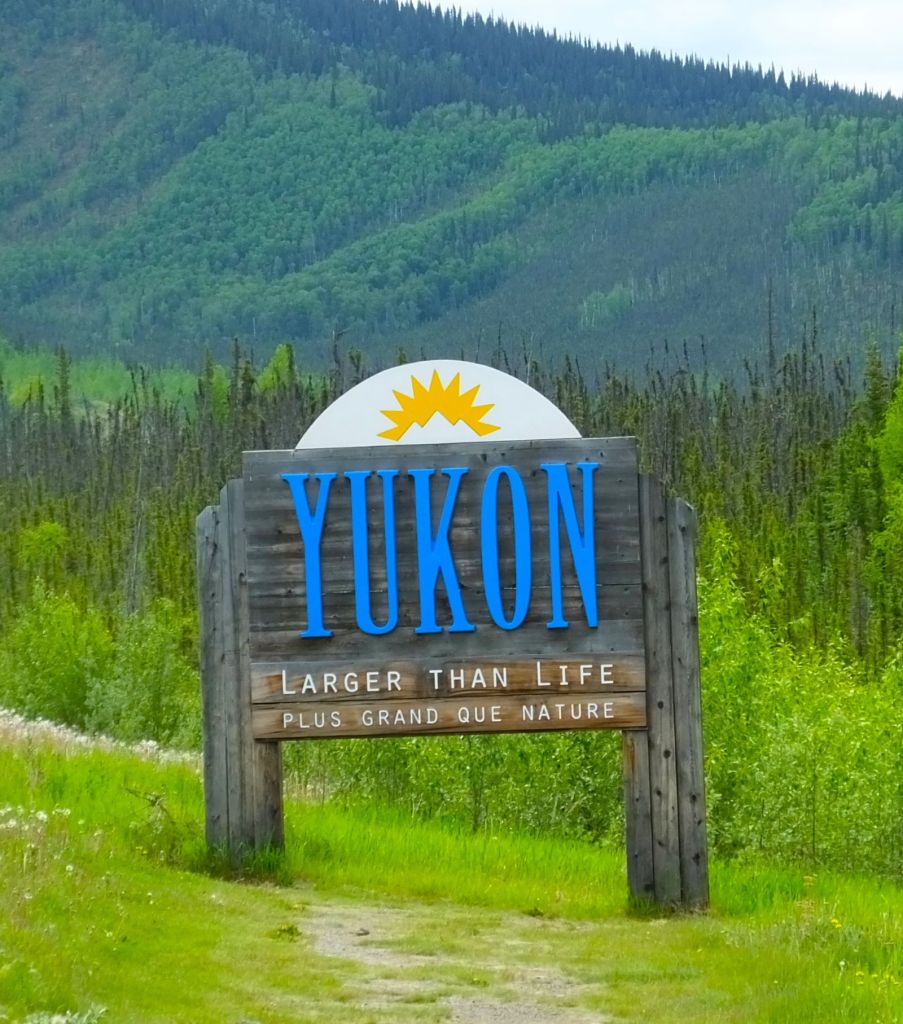
Welcome to the Yukon wilderness

After adding our sign to the Watson Lake Sign Post Forest, we were ready to continue across the Yukon Territory to Alaska!

Crossing the Yukon

The Yukon Territory is in the far northwest of Canada, extending from the top of British Columbia to the Arctic Ocean. A few roads crisscross the territory, with the Alcan, or Alaska Highway, being the main route to Alaska.

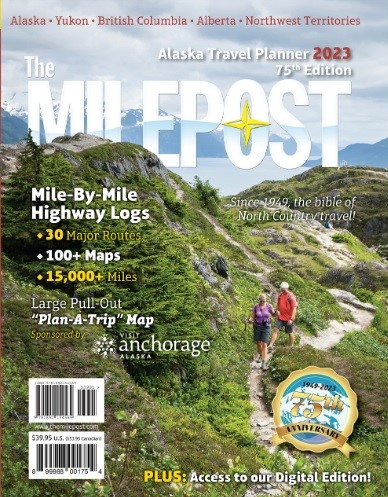
The Milepost – essential for any driving trip to Alaska

Detailed roadmaps or GPS devices are not essential for directions. The Milepost is essential, however. The thick book provides mile-by-mile (kilometer-by-kilometer?) information about highways in the region with plenty of recommendations for interesting stops along the way.

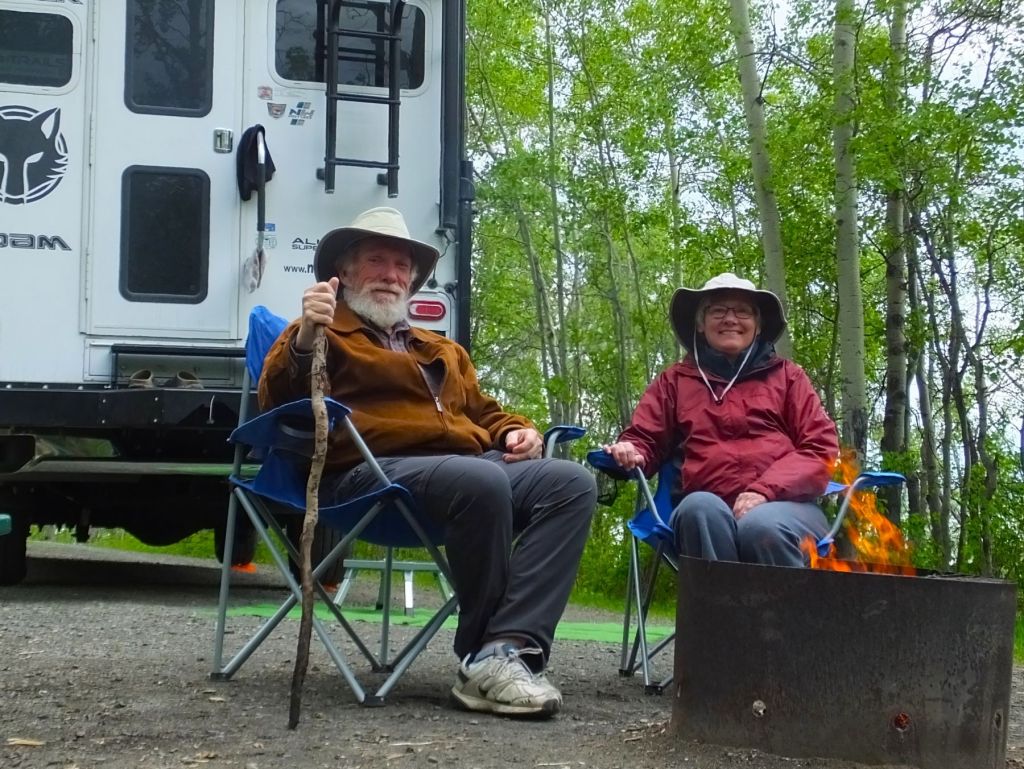
We enjoyed evening campfires – in Yukon the firewood is free and the mosquitoes are plentiful

That night we camped at a scenic lakeside territorial park between Watson Lake and Whitehorse and enjoyed sitting by the campfire.

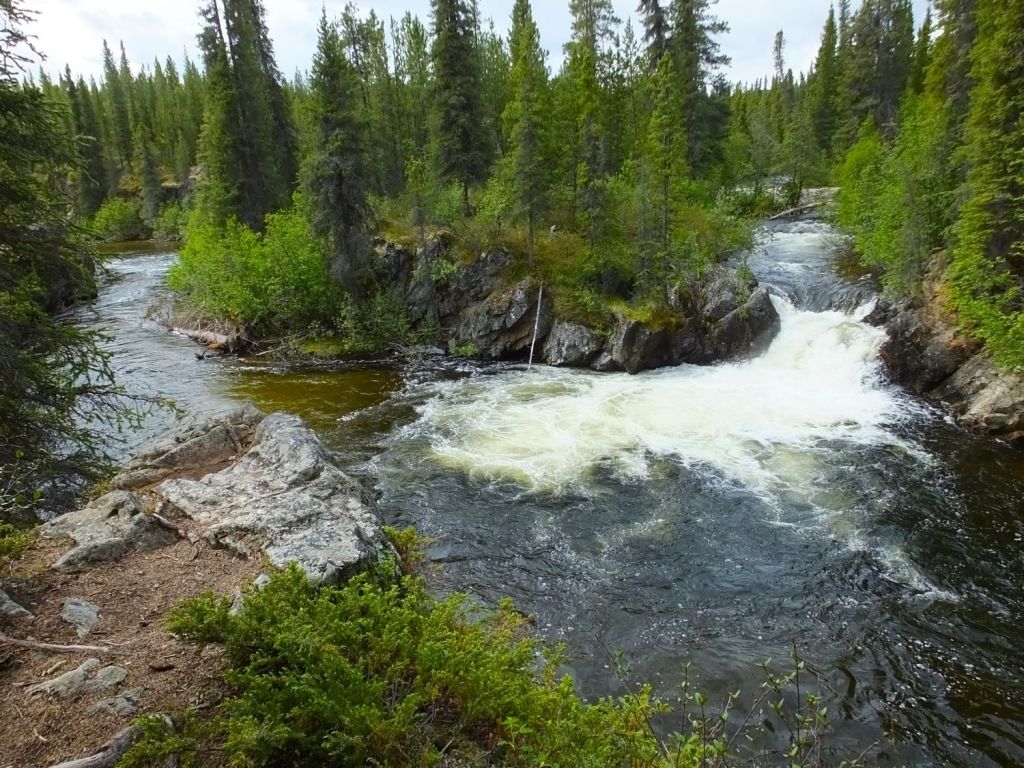
The next morning, we took a short walk to Rancheria Falls and watched two fly fishermen try their luck on the beautiful river. 

Rancheria Falls
Alcan Cinnamon Buns

Later that morning we stopped at Johnson’s Crossing Lodge for what they claimed to be the world’s best cinnamon buns.  The coffee was hot and the buns were sweet, cinnamon goodness. But they weren’t fresh (baked the previous day) and contained raisins, not our favorite ingredient for such buns. Our eval: good but not the world’s best.  Bun score: 3 out of 5.

(Like Nanaimo Bars on Vancouver Island, fresh coffee and homemade cinnamon buns lure travelers all along the Alaska Highway. Many places claim to have the world’s best cinnamon buns. As a public service, we’ll give them a try and provide our somewhat objective cinnamon bun score!)

On to Whitehorse

Our destination was Whitehorse, the capital and largest town in the territory (population 35,000). A few miles before Whitehorse, however, we stopped to take the photo below.

We couldn’t pass up this photo op!
Whitehorse

Whitehorse was busy, with lots of RVers and others refueling and restocking for the final drive to Alaska.  The town is located on the banks of the broad and swift-flowing Yukon River. 

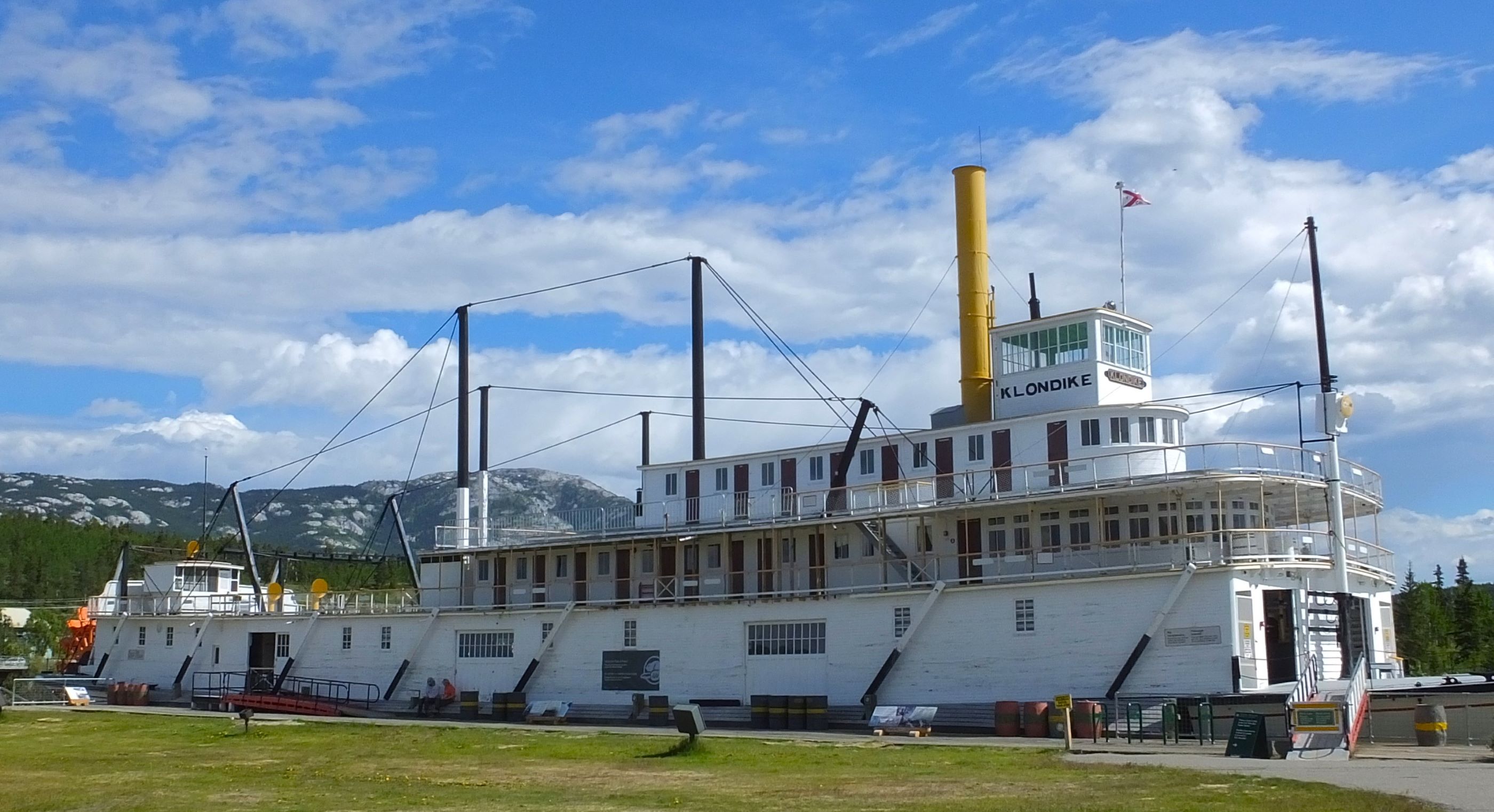
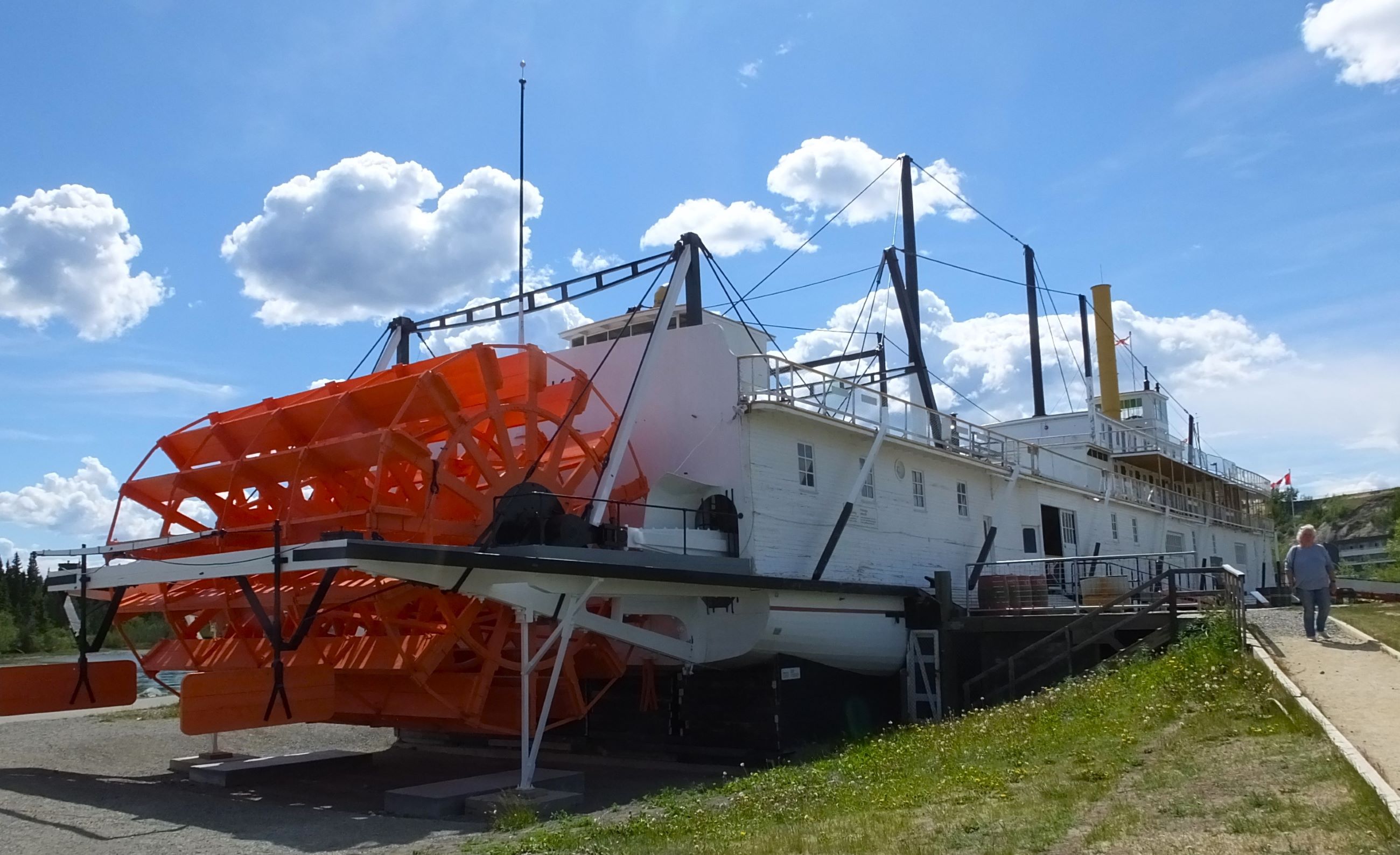
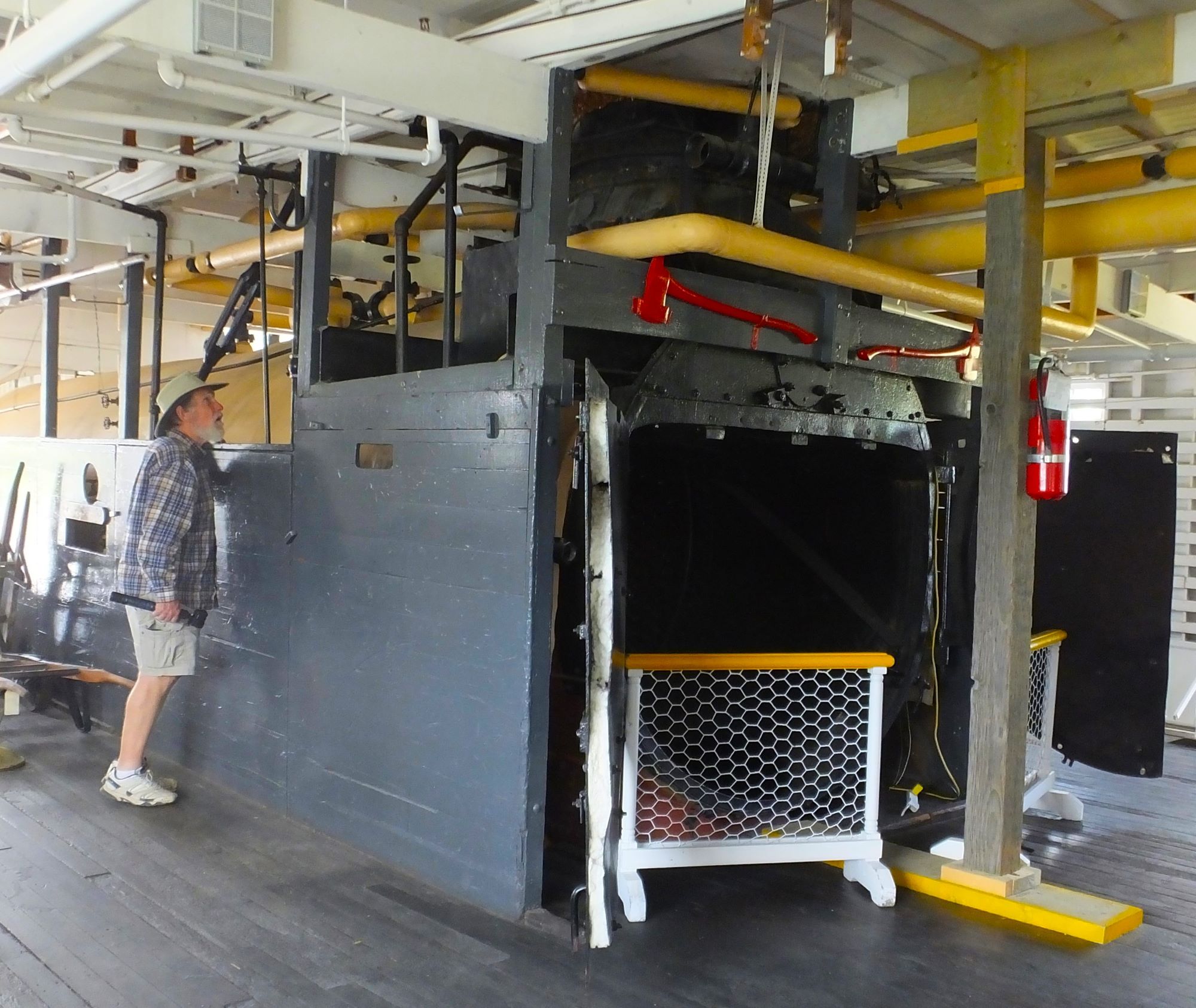
Views of the historic Klondike sternweeler

We toured the S.S. Klondike, a 210-ft long shallow draft sternwheeler that transported passengers and cargo 500 miles downriver to Dawson City, Yukon until 1950.  More than 250 sternwheelers plied the treacherous 2000-mile-long Yukon from the late-1800s gold rush days until the mid-1950s.  Massive wood lots along the river provided fuel for the steam-powered vessels, with boats like the Klondike using up to a cord of wood an hour.

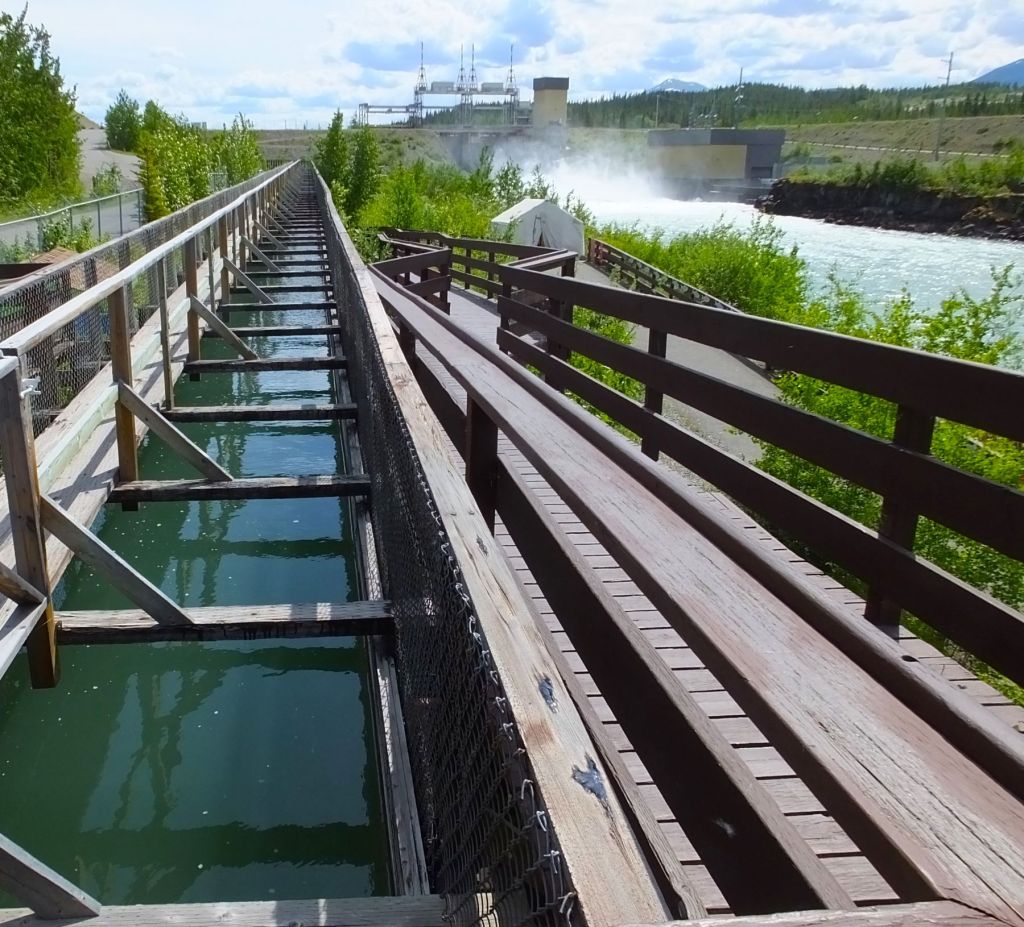
Whitehorse Dam and wooden fish ladder

The next day we rode our bicycles on a five-mile trail along the river, stopping at the Whitehorse Dam, whose hydroelectric generators produce power for the town.  We were fascinated by a wood fish ladder that provides chinook salmon returning more than 2000 miles from the Pacific access to spawning grounds further up the Yukon.  At 1200 feet, it’s the longest wooden fish ladder in the world.

We planned to celebrate Pat’s birthday at the Klondike Ribs and Salmon Restaurant, but were disappointed to learn the restaurant had recently closed.  So we settled for a nice rib-less dinner at the nearby Woodcutter’s Blanket.

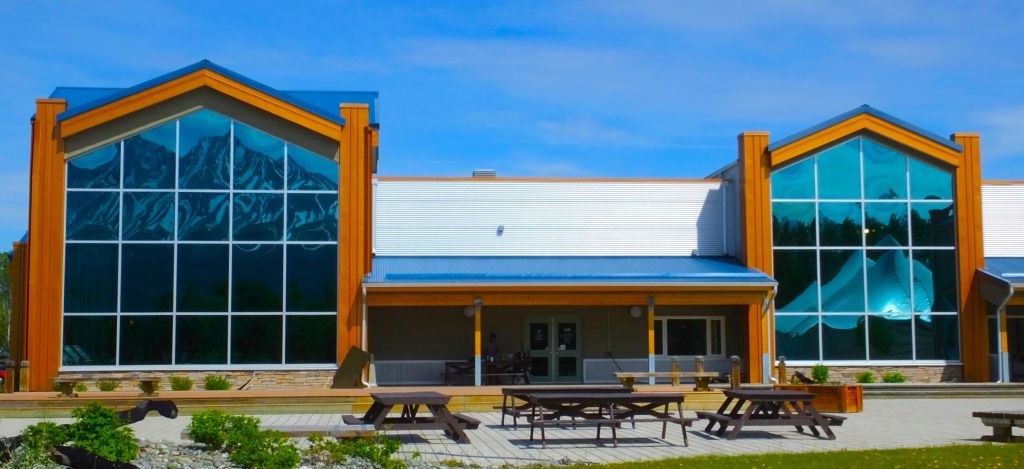
Interesting window reflections on the Haines Junction Visitor Information Center – Kluane Mountains and a large tent set up for National Indigenous Peoples Day
Lunch in Haines Junction

After four nights, we left Whitehorse and stopped several hours later for a free lunch of stew and bannock at the Haines Junction Visitor Information Centre.  It was National Indigenous Peoples Day, a celebration of the history, heritage, resilience and diversity of native people across Canada.  We learned a little about the Tlingit and other native people in the area and enjoyed their hospitality.

Views of Kluane NP

Kluane (Rhymes with Suwannee)

That night we camped at Kluane NP.  The park is rugged and beautiful, with snowcapped mountains and glaciers to the west.  When combined with the Wrangell-St Elias NP in the US, the region is the largest international protected area in the world. 

Any references to Kluane (and Alaska as well) should include mention of clouds of large and hungry mosquitoes.  We’ve learned the mosquitoes are having a big year in 2023 unlike our mostly mosquito-free 2018 trip!

After leaving Kluane NP, our route took us back through Haines Junction. We stopped at  Village Bakery for coffee, and learned they, too, had cinnamon buns. The buns were slightly better (a little fresher with great frosting) than those we tried earlier. Bun score: 3.5.

The roads were rough between Haines Junction and Tok, Alaska, with numerous construction delays

Arriving In Alaska (Finally)

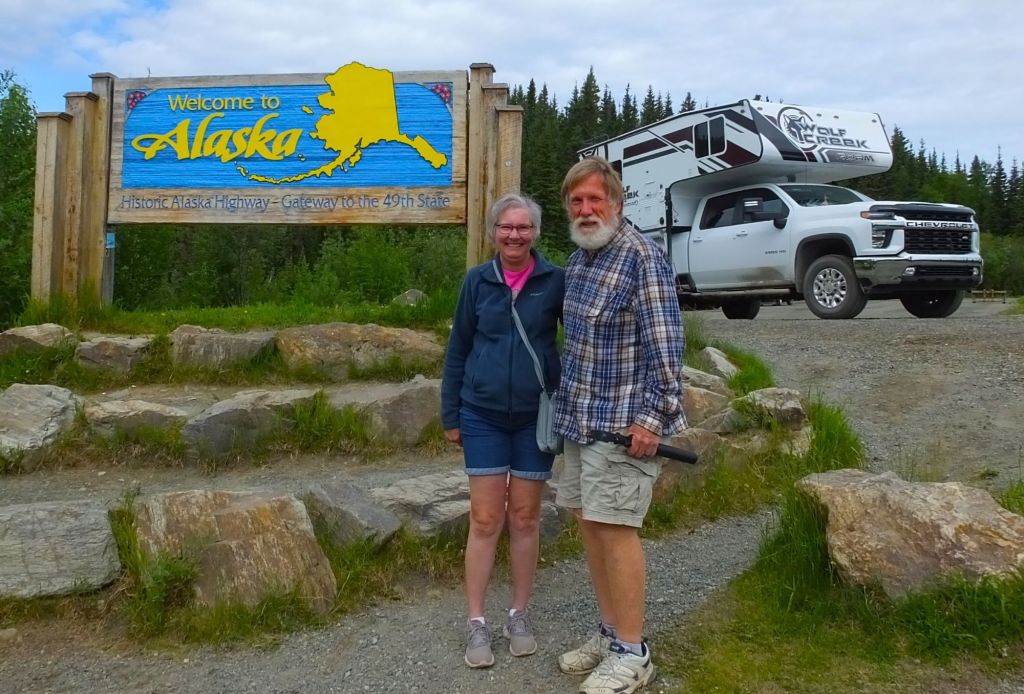
After one final night at the same Yukon territorial campground we stayed at in 2018, we reached the Alaska border, almost three months and 11000 miles since leaving home on March 25.

Posing for our welcome to Alaska!
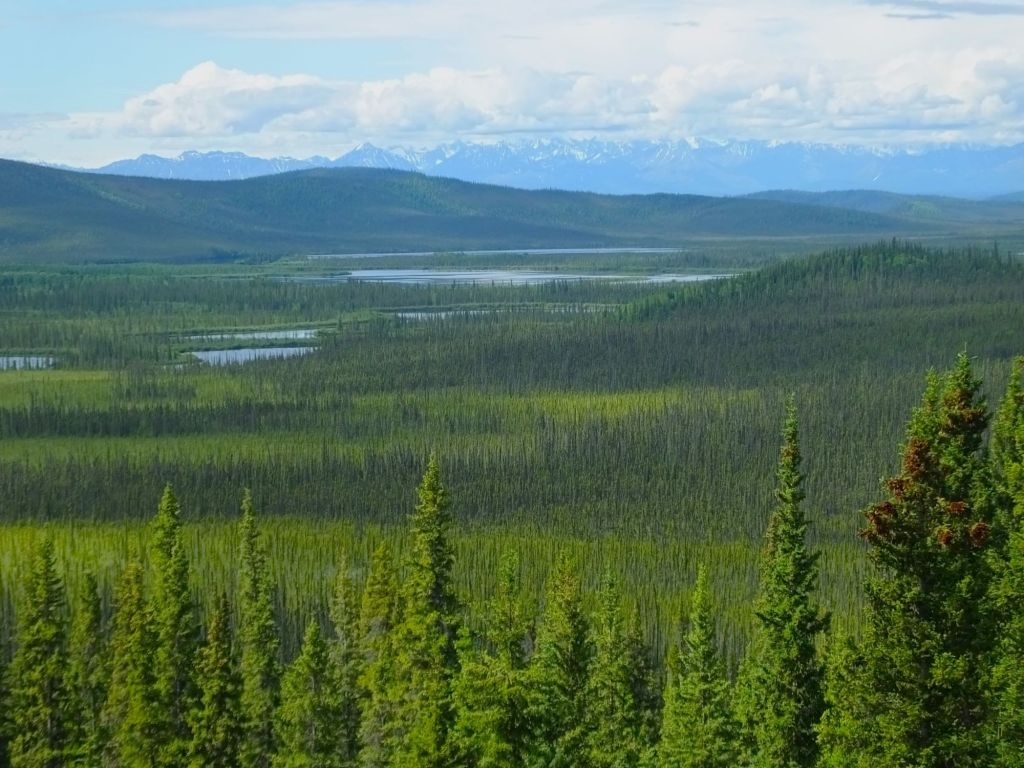
Memorable first view of Alaska – we were excited to arrive (again)

At the border we experienced two challenges that were amazing reminders of God’s protection and provision.  More on these next week as our 2023 Alaska Revisited journeys continue.

Critter Count

Swans – 9
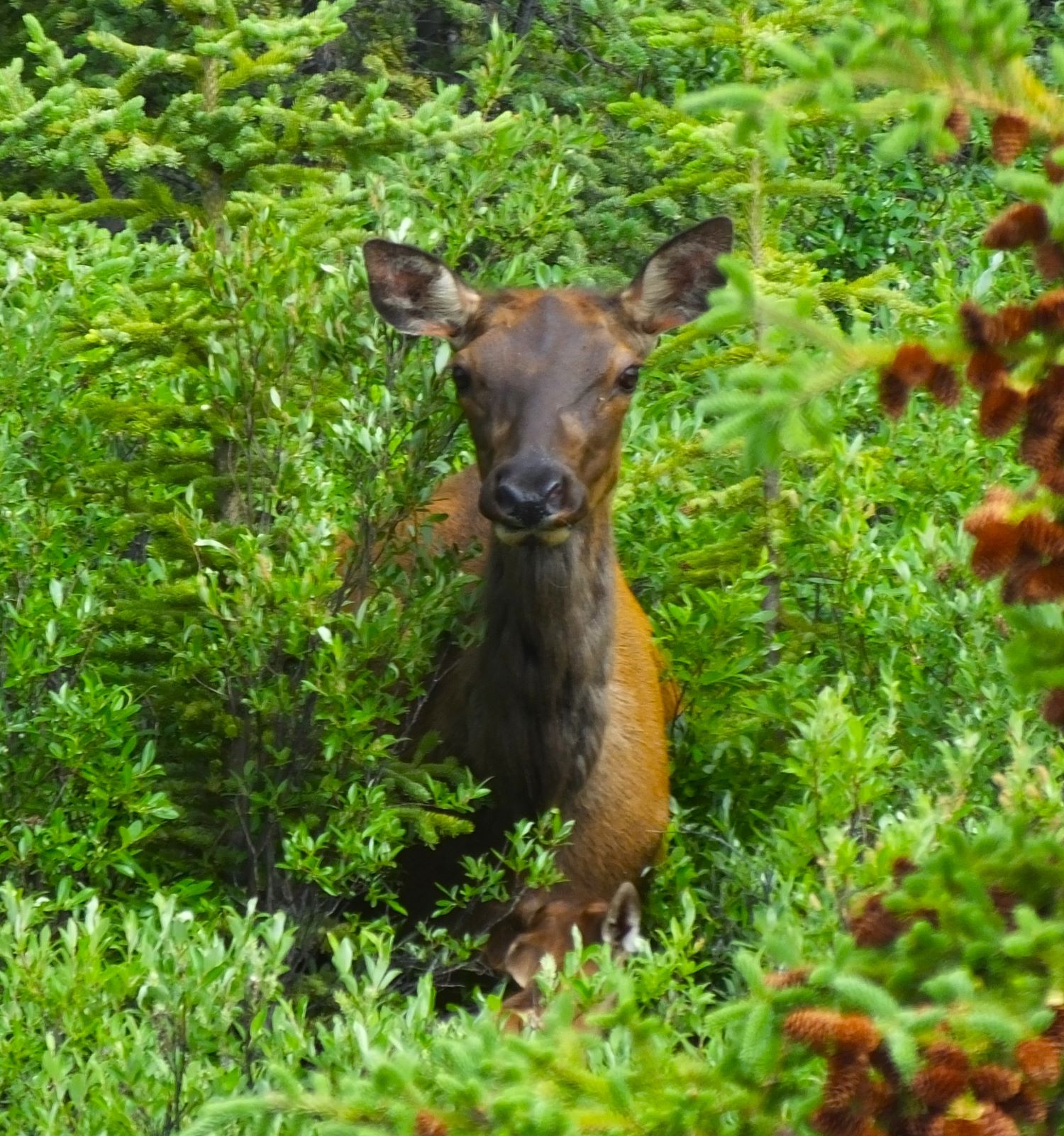
Elk – 2
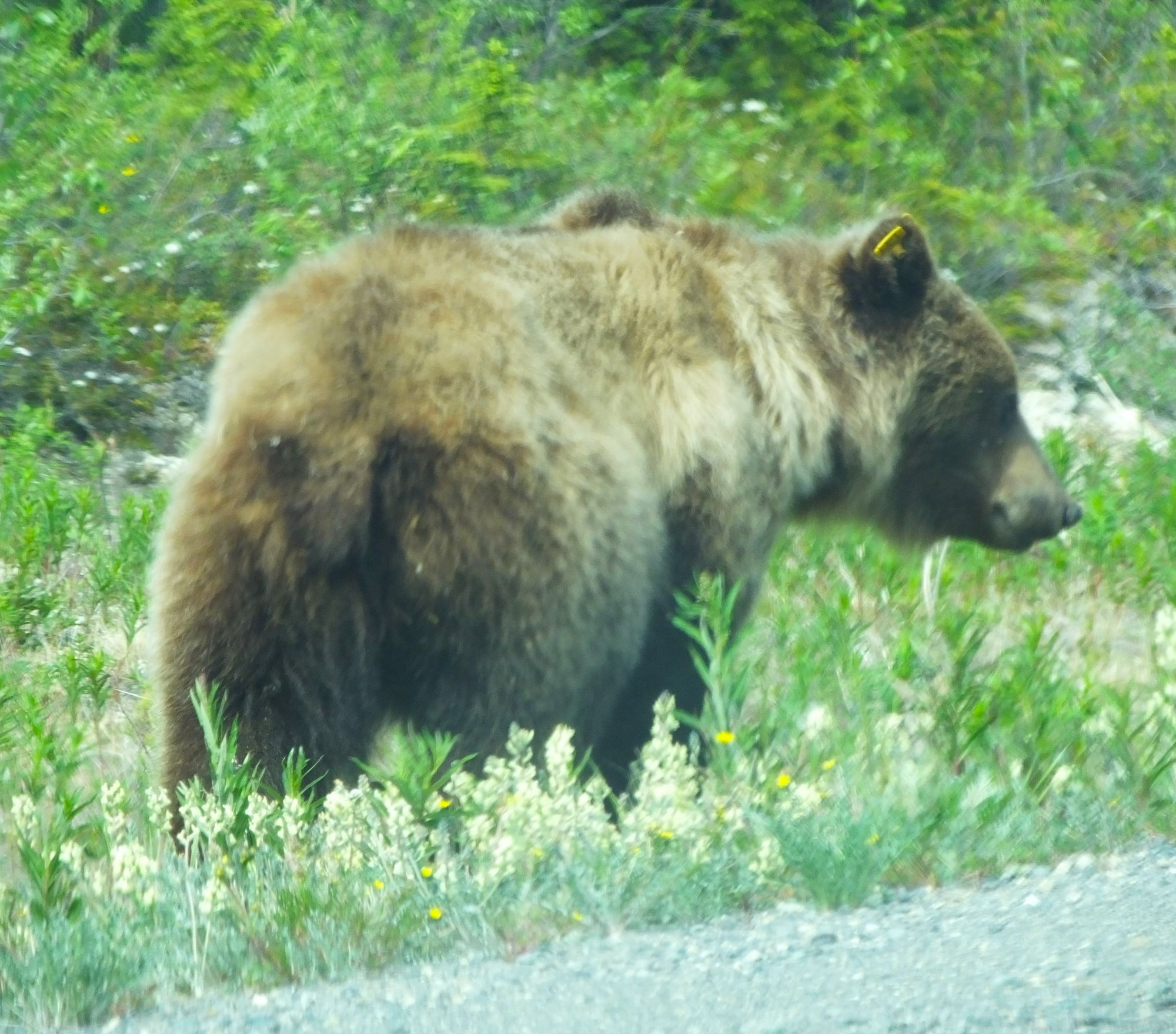
Grizzly Bears – 2
Black bear – 1
Moose – 1
Rabbits, ducks, jays, eagles – multiple
Mosquitoes – 171,213,667,123 (or more)

Next week:

Working through challenges in Alaska as we make our way to Fairbanks

Cassiar Cruising and RabbiTRAILS Runes

(2023 Alaska Revisited Ep 13)

We returned to Washington after a week on Vancouver Island to pick up an Amazon order delivered to our friend’s house and to have a minor upgrade made to Percy’s suspension.  We’re confident that air shocks and overload spring sway stops will improve the ride and safety of our Percy-Pap combination!

After an uneventful border crossing back into Canada, we continued north past Vancouver and up the Sea-to-Sky Highway. 

Lake view along the Sea-to-Sky Highway

The highway took us past the location of several of the events of the 2010 Winter Olympics and across several mountain passes.  Lush green and heavily forested western slopes gave way to drier, sparse eastern slopes. 

At Lillooet, we stopped for lunch overlooking the Fraser River.  The area is sometimes referred to as the Arizona of Canada because of extreme summer temperatures – during a 2021 heatwave, the temperature in Lillooet reached 116.2 F and temps at five other nearby towns ranged from 113 F – 121.3 F.  We are thankful our visit was a lot more pleasant!

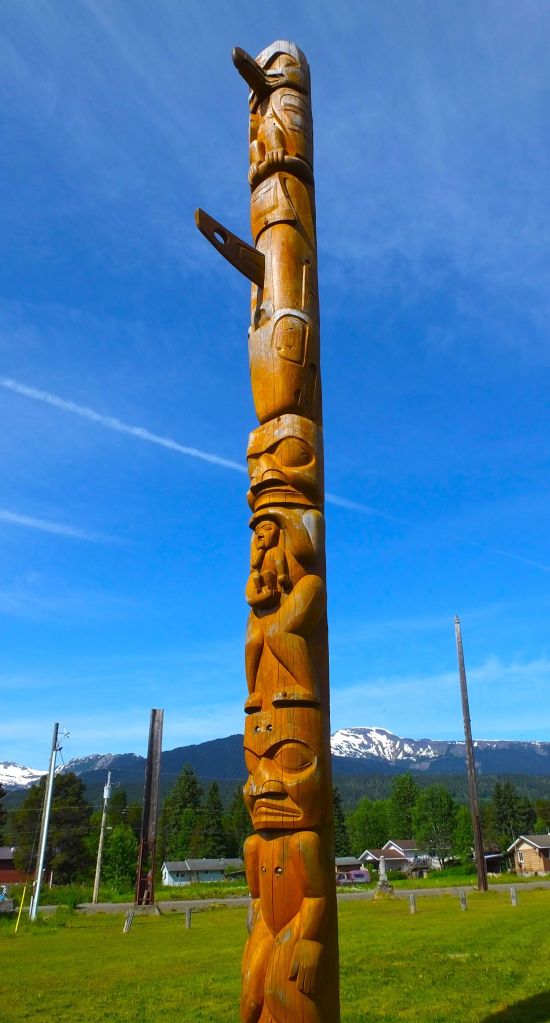
The First Nation village of Gitanyow has an impressive totem pole display at the start of the Cassiar
Cassiar Highway

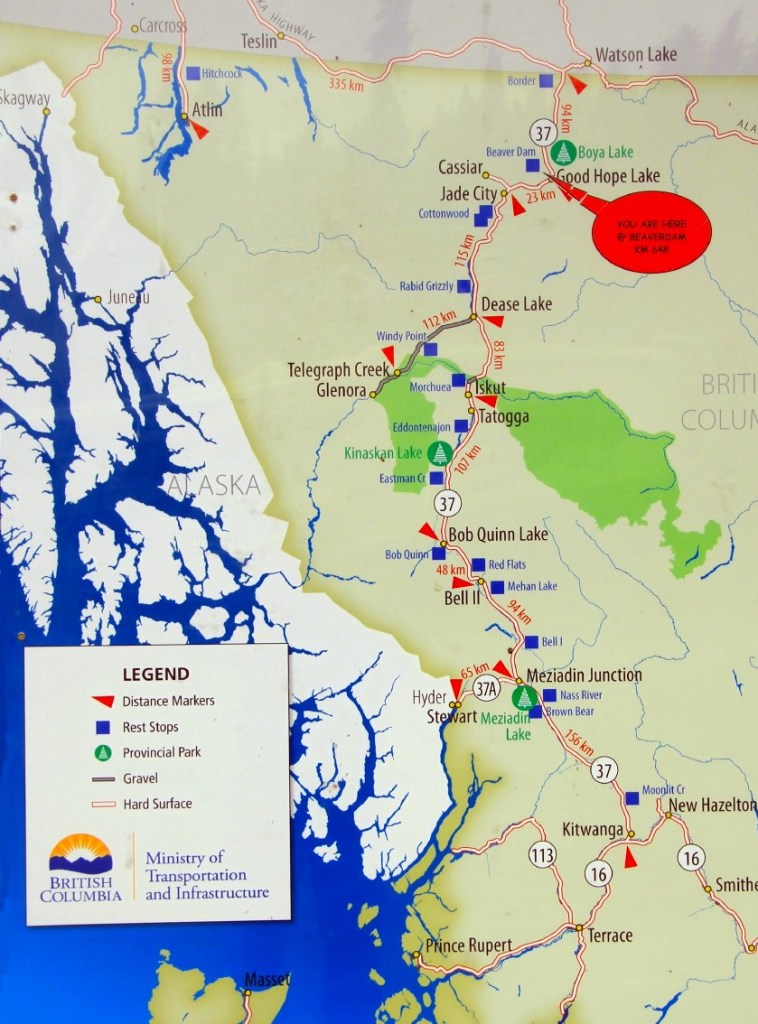
Continuing toward Alaska, we camped at several British Columbia provincial park campgrounds and finally reached the Cassiar Highway, a 450-mile highway that connects central British Columbia to the Alaska Highway in the Yukon Territory.  The highway is remote, somewhat narrow at times, with few services along the way. 

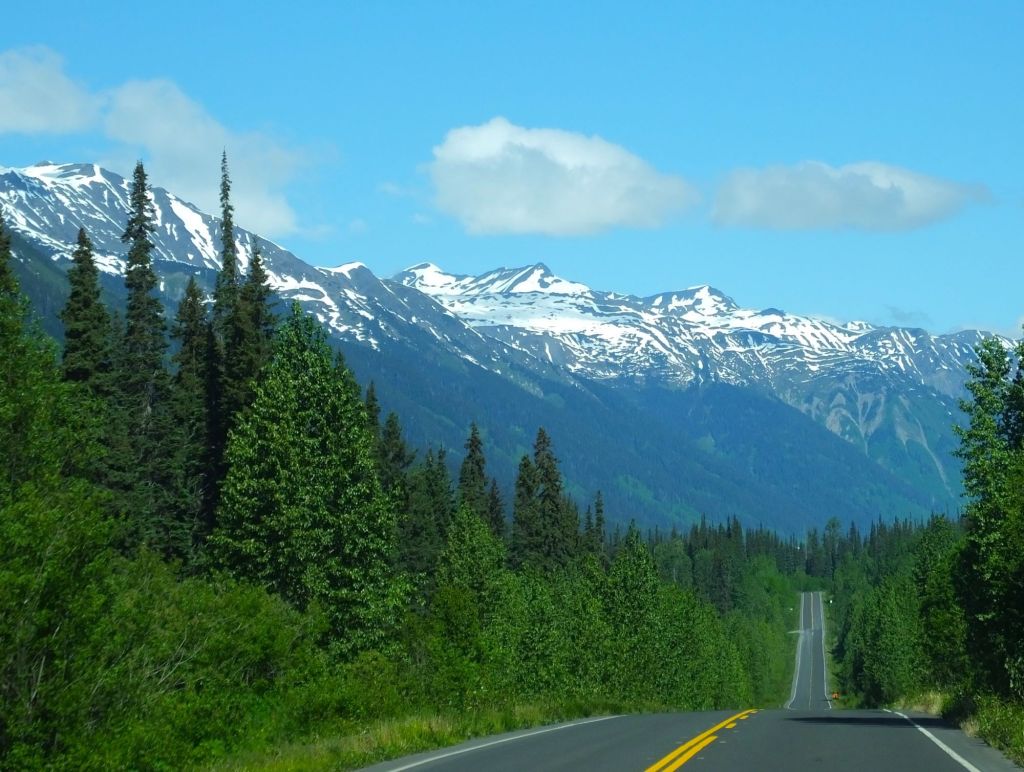
It was rainy and foggy when we drove the Cassiar in 2018 as we returned from our first trip to Alaska. We didn’t see much.  This time was different – beautiful snow-capped mountains, scenic lakes and wildlife were visible all along the route.

Roadside view on the Cassiar Highway
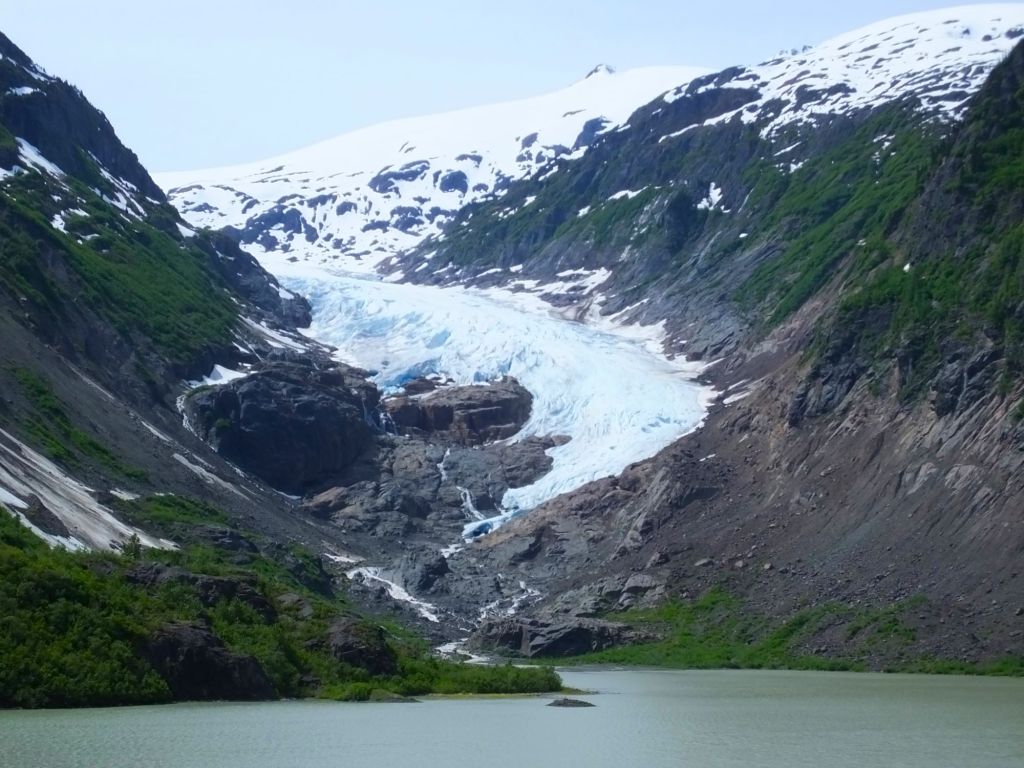
Bear Glacier along Stewart highway, it has receded since our 2018 visit
A Side Trip to Salmon Glacier (Almost)

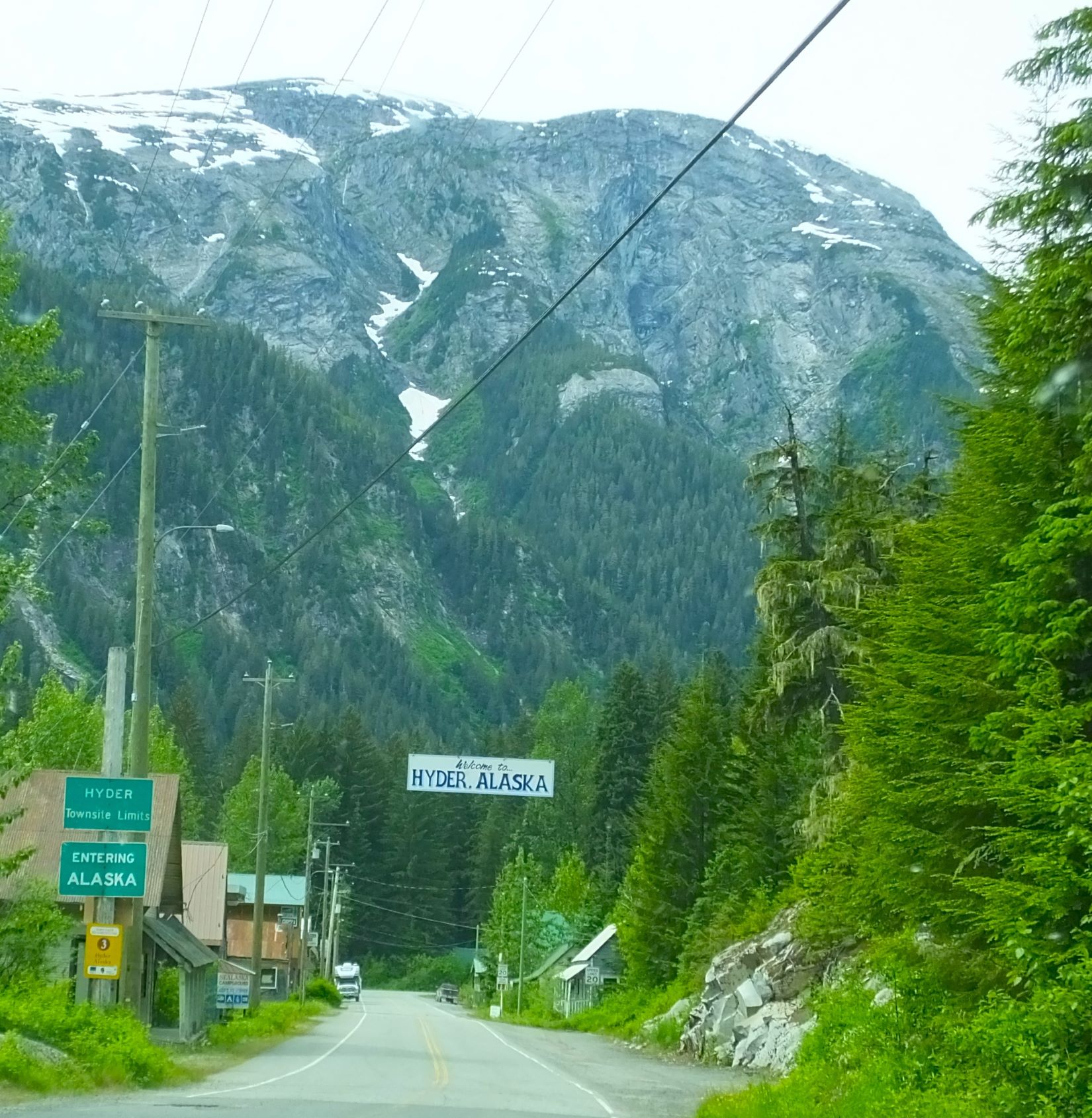
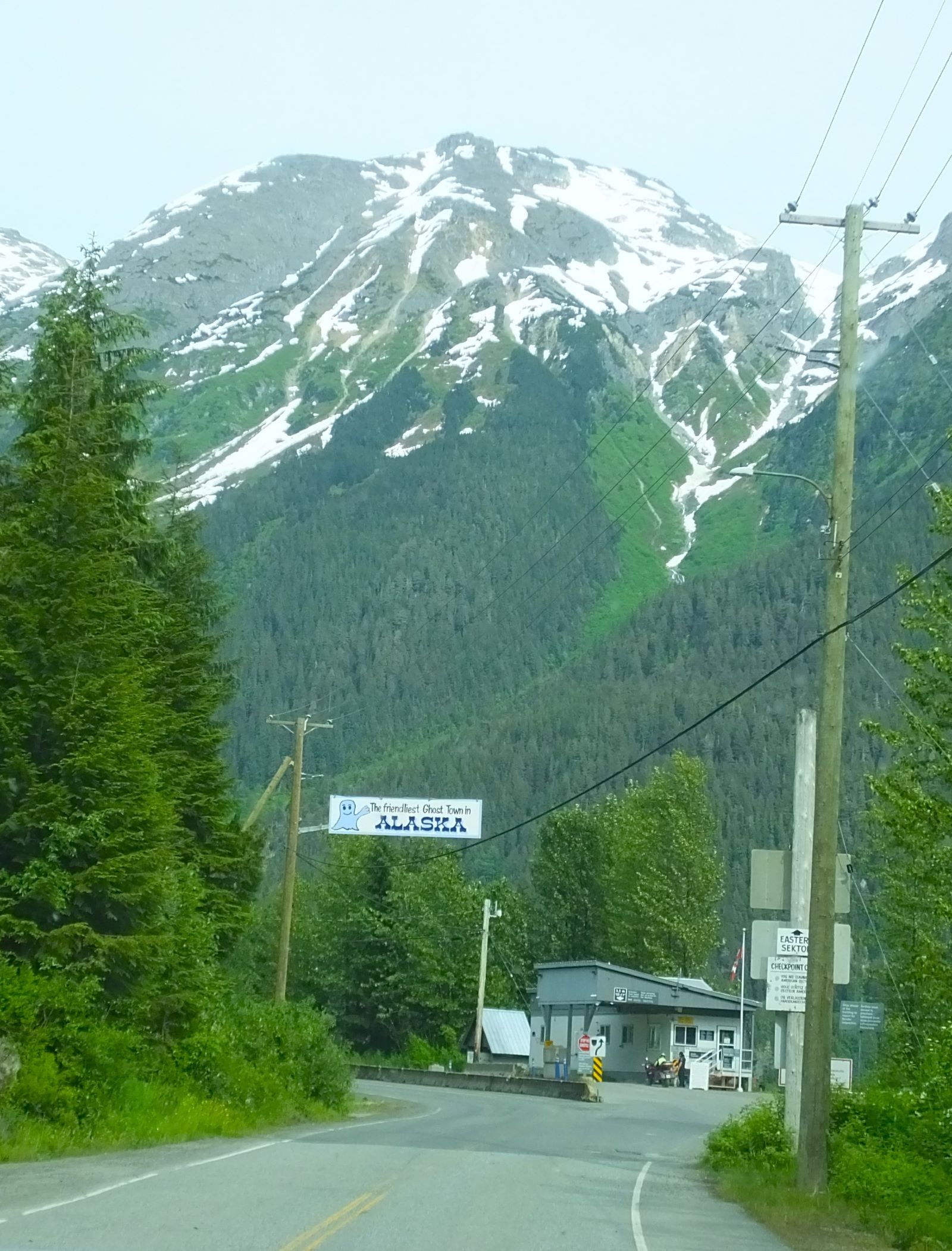
We took a side trip to Stewart, a small town near the Pacific Coast and continued to Hyder, Alaska, an even smaller town in a remote corner of Alaska just two miles away.  The Fish Creek Wildlife Observation Site is near Hyder, frequented by bears when the salmon are spawning during the late summer.  No salmon this time but there were bears nearby, waiting, perhaps, for the salmon to arrive.

Arriving and leaving Hyder, Alaska (note small Canada entry station in second photo)

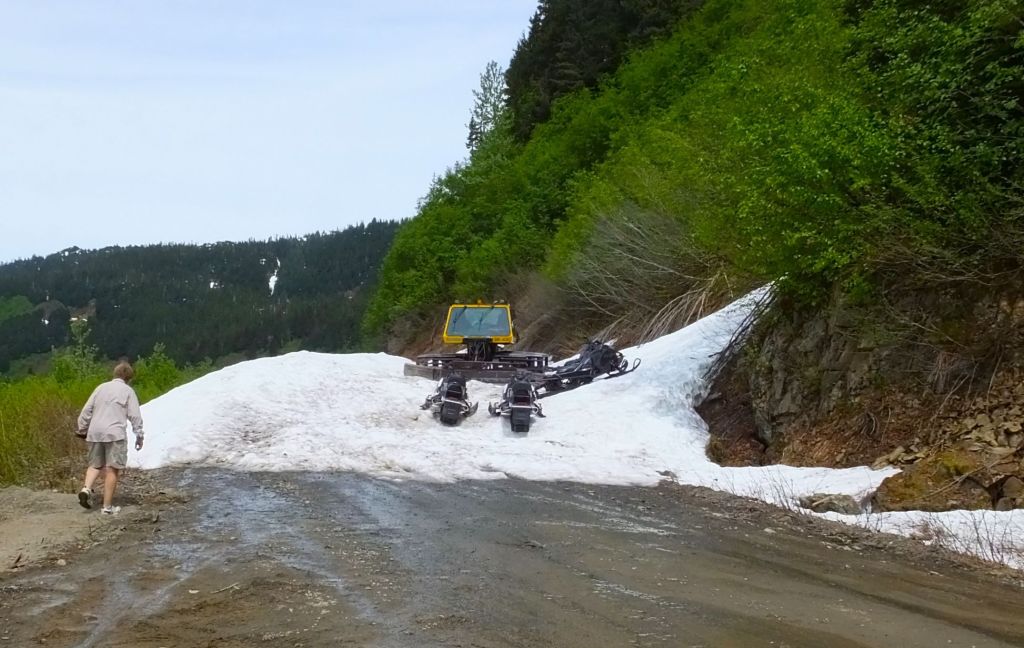
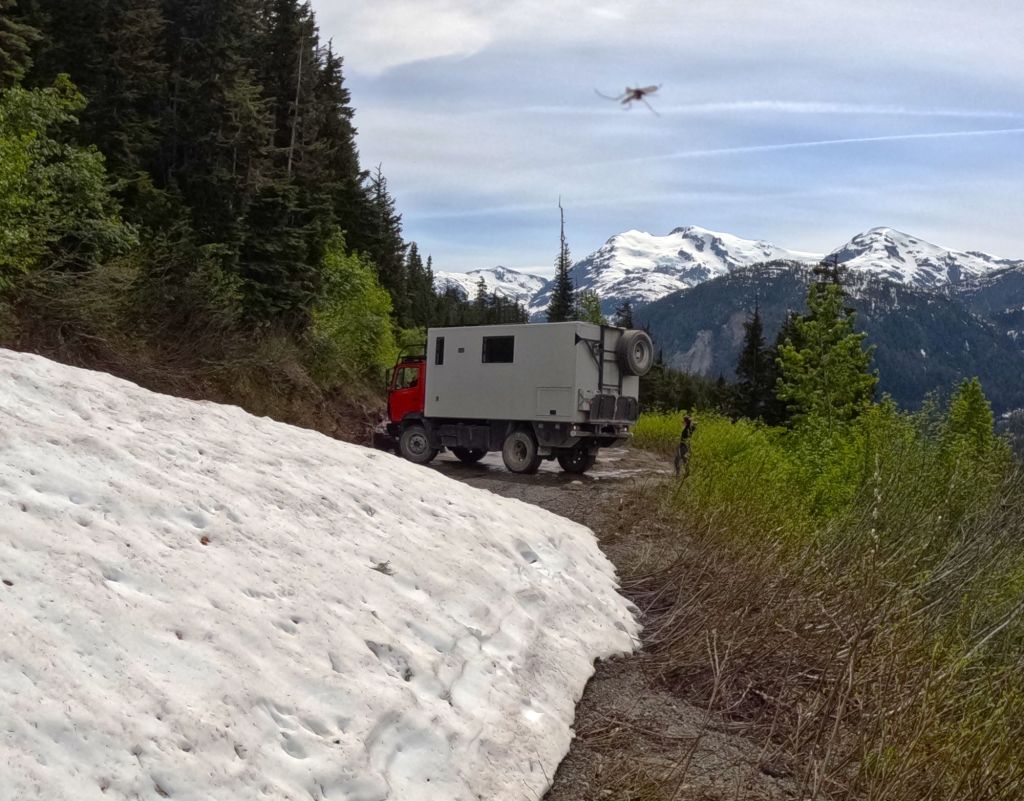
In 2018 we drove almost 20 miles from Hyder up a rutted, bumpy road to view the spectacular Salmon Glacier.  This time we hoped to camp at the glacier overlook, but after driving almost 15 miles we discovered the road was covered with snow and could go no further. 

Ed surveys snow bank blocking the road to Salmon Glacier

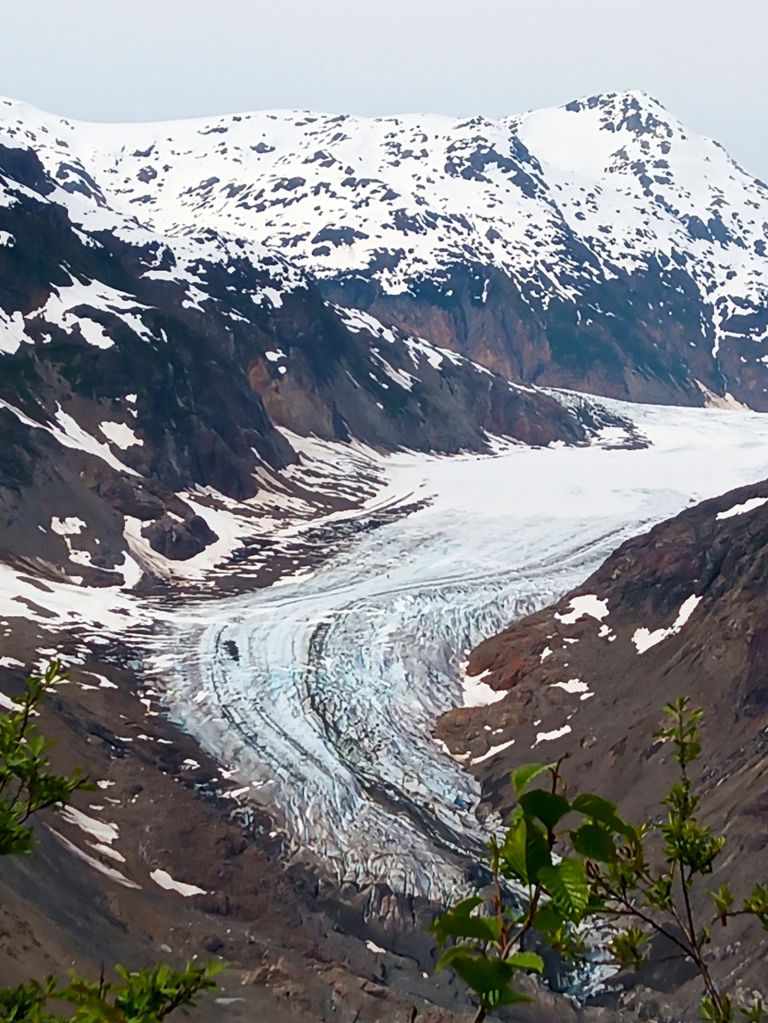
We did have a view of the toe of Salmon Glacier however.

Toe of Salmon Glacier

While we took in the view, a massive, earth roamer-style vehicle arrived.   It was being driven by a couple from Switzerland who had been on the road since early January after their vehicle was shipped from Europe to eastern Canada.  We took comfort knowing that even earth roamer vehicles had to turn around! See RabbiTRAILS blog post from 2018 with Salmon Glacier view

Even Earth Roamers had to turn around (note mosquito above mountains)
Cassiar Lakeside Camping

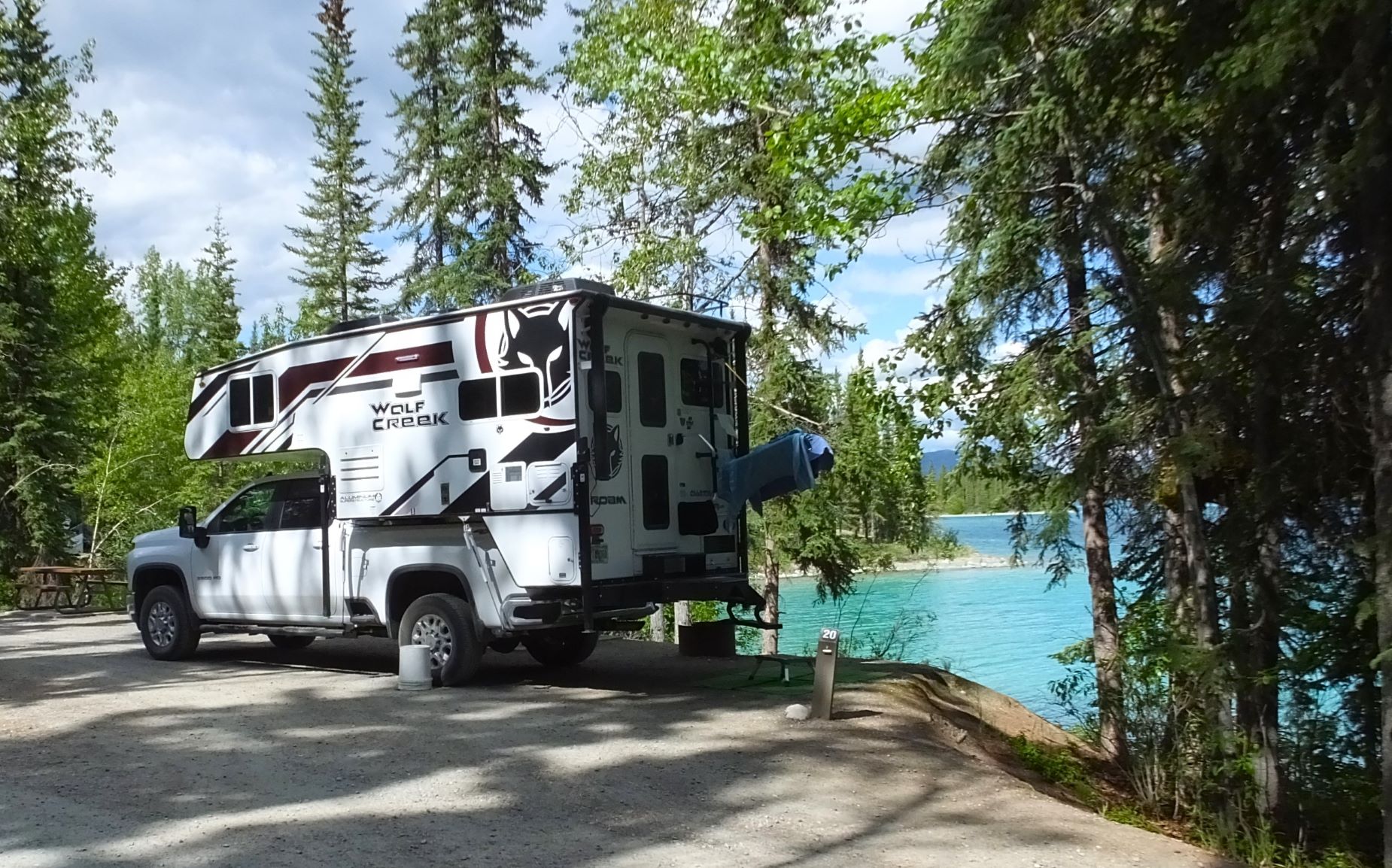
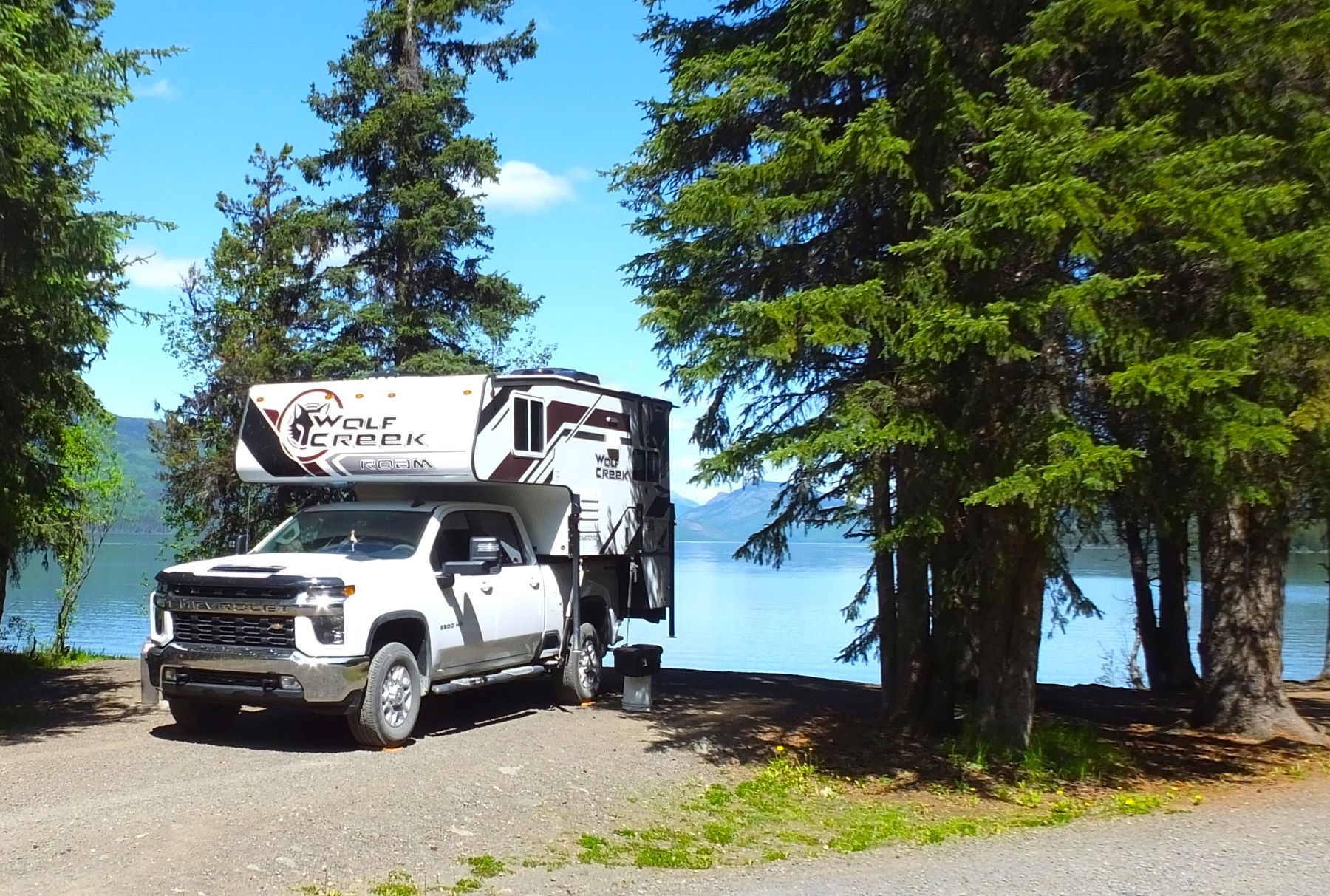
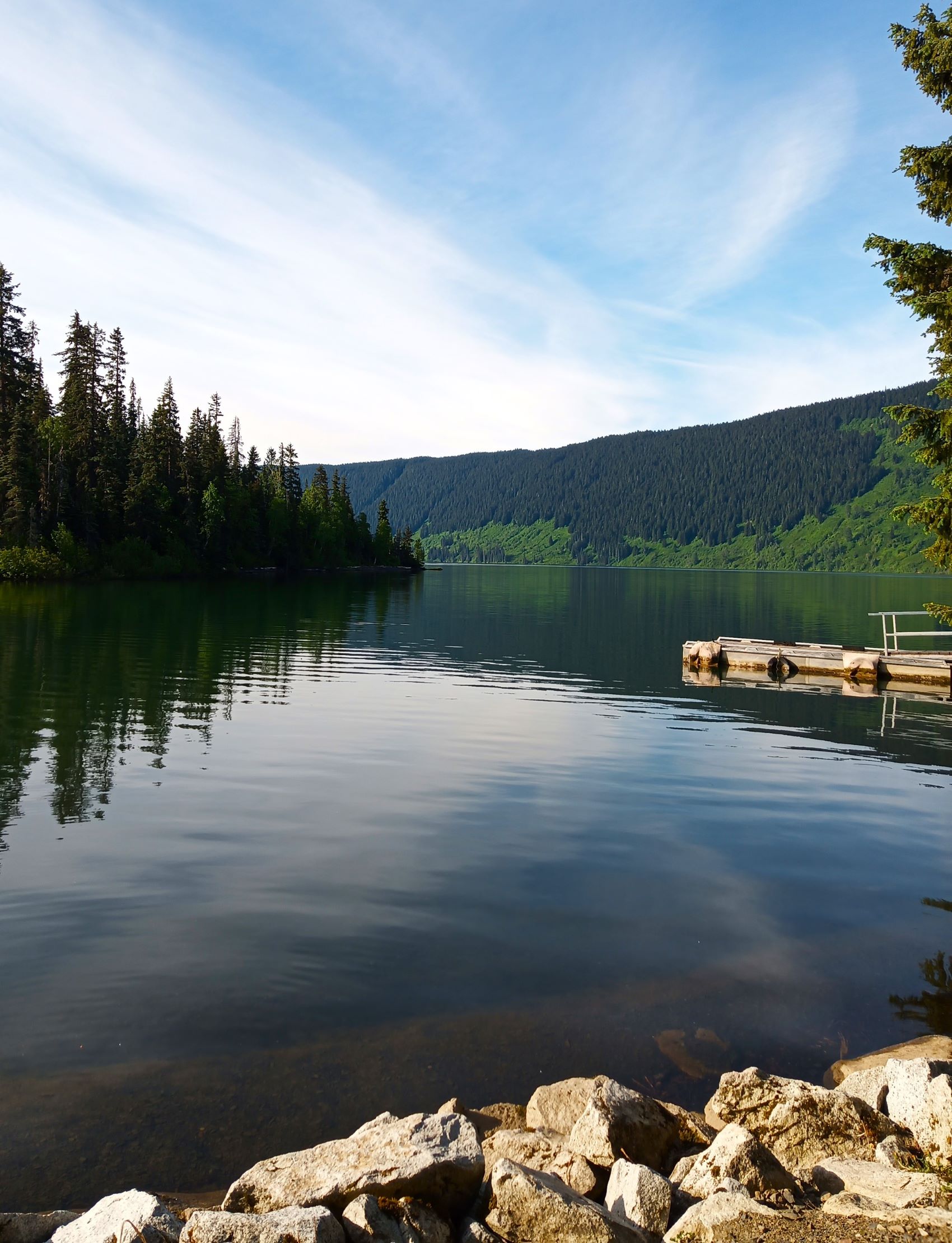
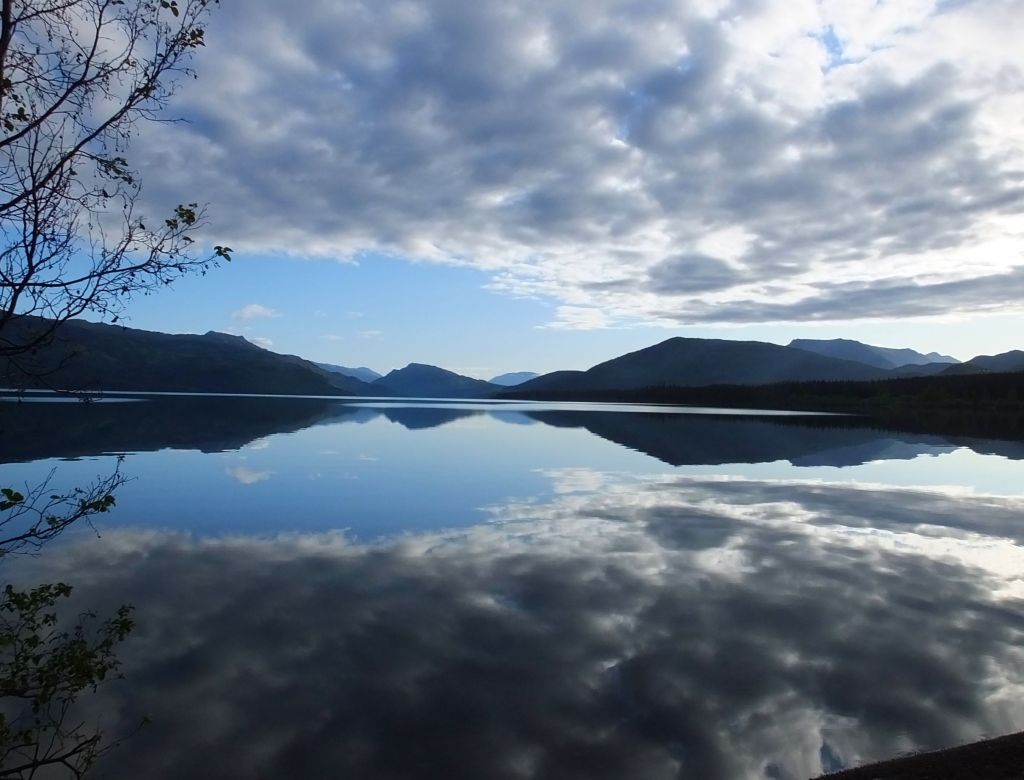
We spent three nights at several provincial parks along the Cassiar. where we camped just a few feet from the water’s edge of several beautiful lakes.  We enjoyed mountain views and calm, mirror-smooth water each morning.  Loons and their eerie, beautiful calls, as well as bugling elk, could be heard in the distance.  Our peace was interrupted only by clouds of hungry mosquitoes seeking their next meal (us)!

Lake camping along the Cassiar Highway

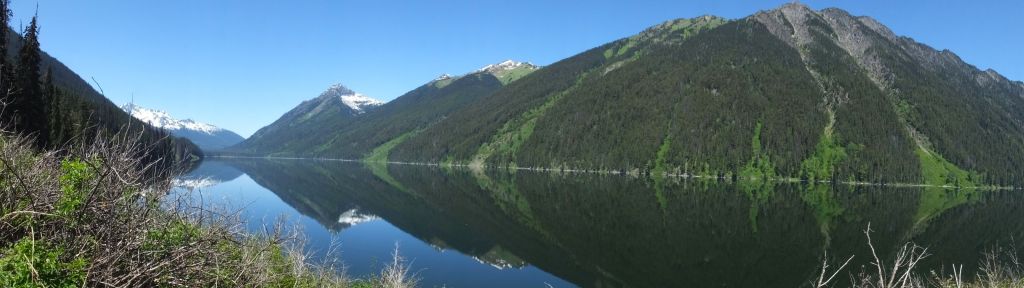
Three beautiful lakes along the Cassiar – Meziadin Lake, Boya Lake and Kinaskan Lake

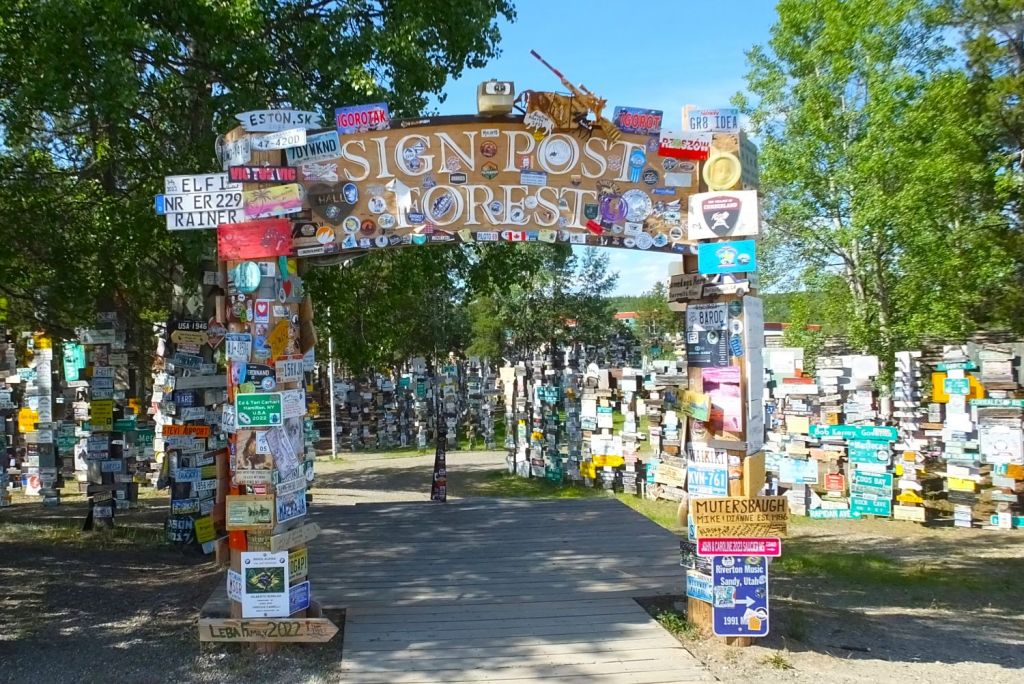
Watson Lake and the Sign Post Forest

Our Cassiar drive concluded with a night at Watson Lake, a small town on the Alaska Highway known for its sign post forest.  

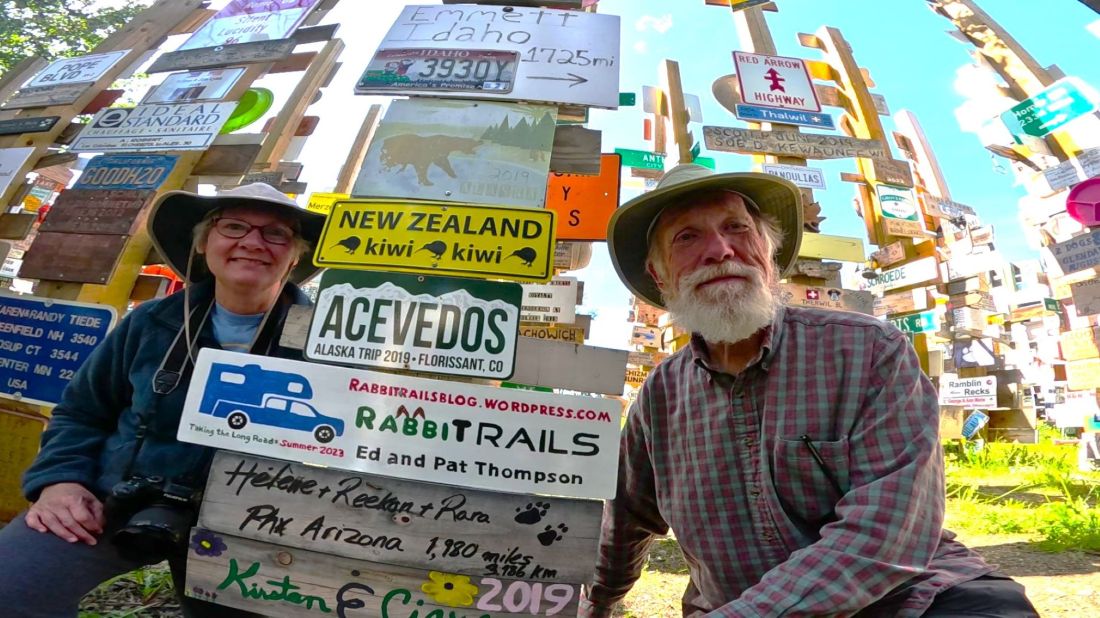
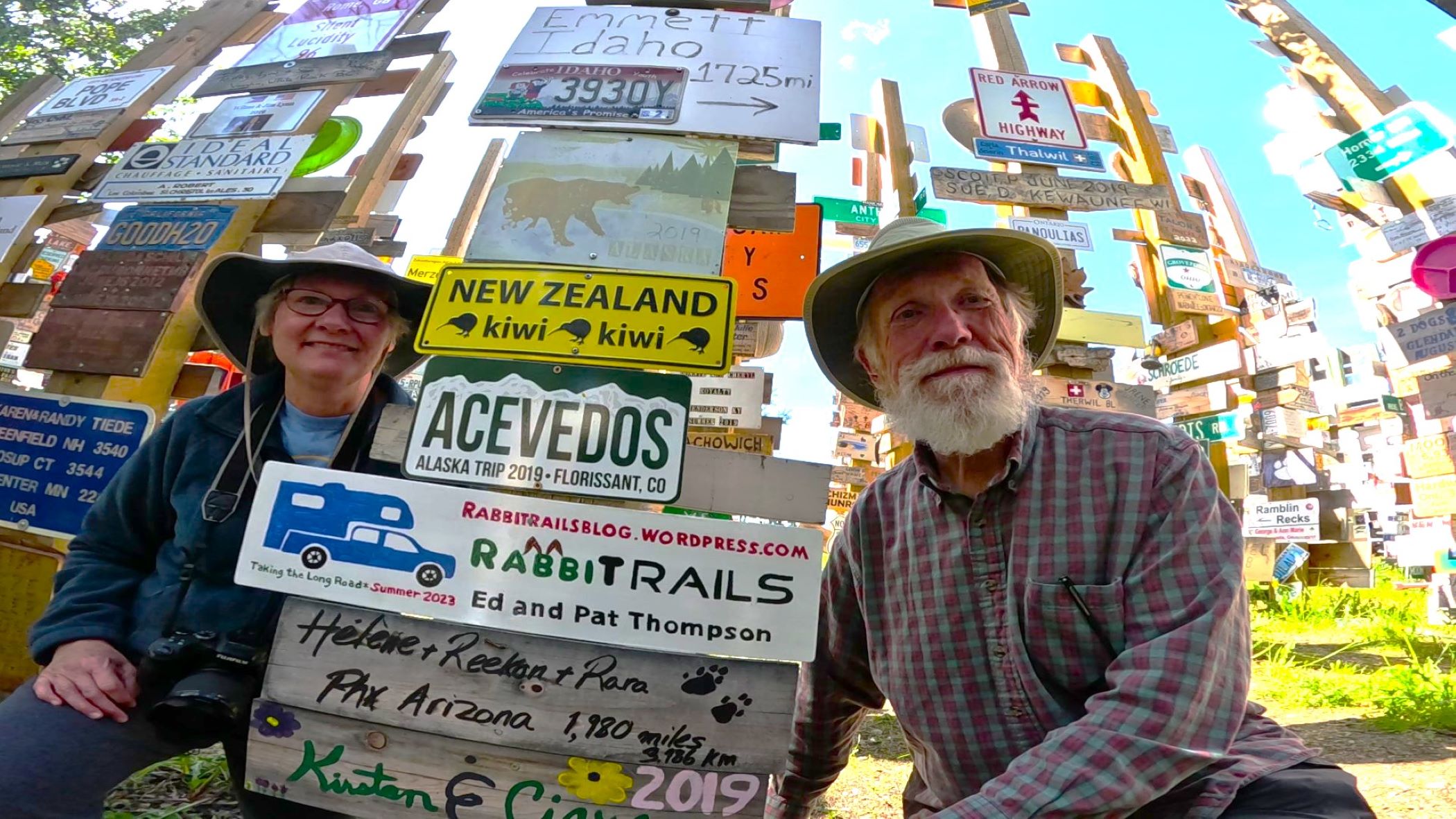
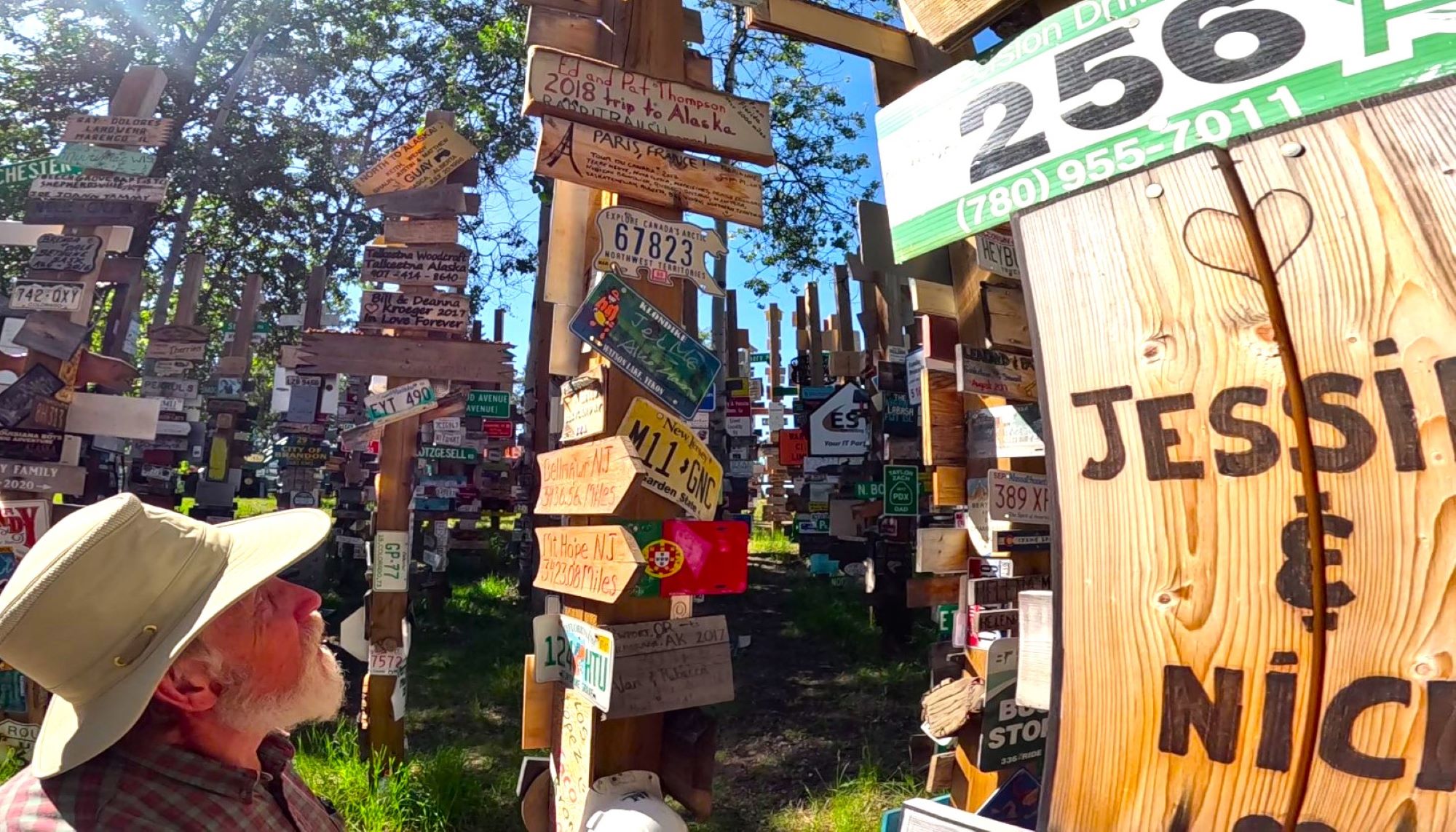
Our two signs are among 100,000+ signs at the Watson Lake Sign Post Forest

During the Alaska Highway Project in 1942, a US soldier was ordered to repair the directional signposts in the town, and while completing the job, he added a sign with the direction and mileage to his hometown.  Others added similar signs, and for 80+ years, travelers from around the world have been posting signs from their hometowns.  Nearly 100,000 signs have been posted, including two RabbiTRAILS signs!
Our 2023 and 2018 signs at the Watson Lake Sign Post Forest

Critter Count

Moose – 1 cow

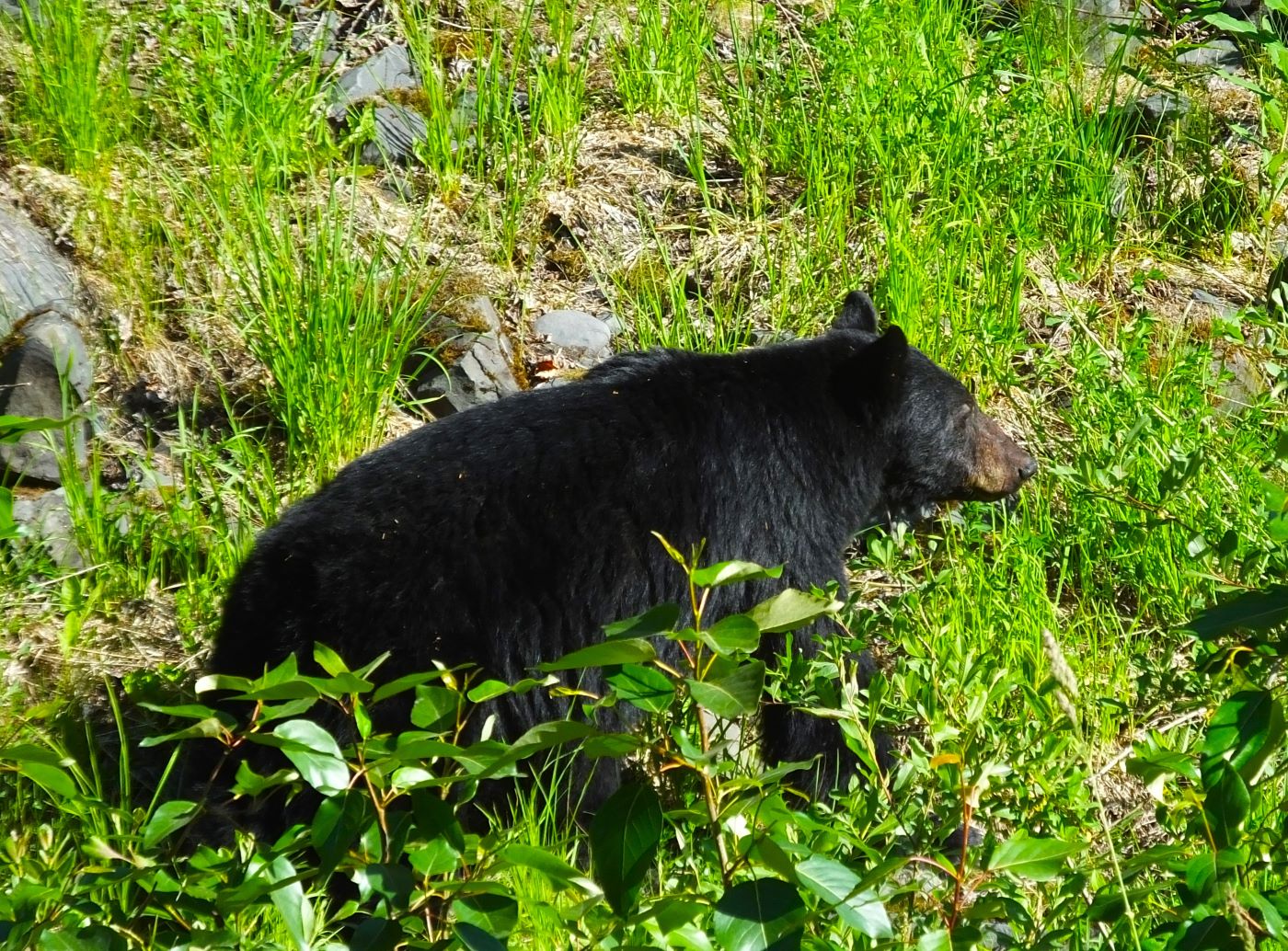
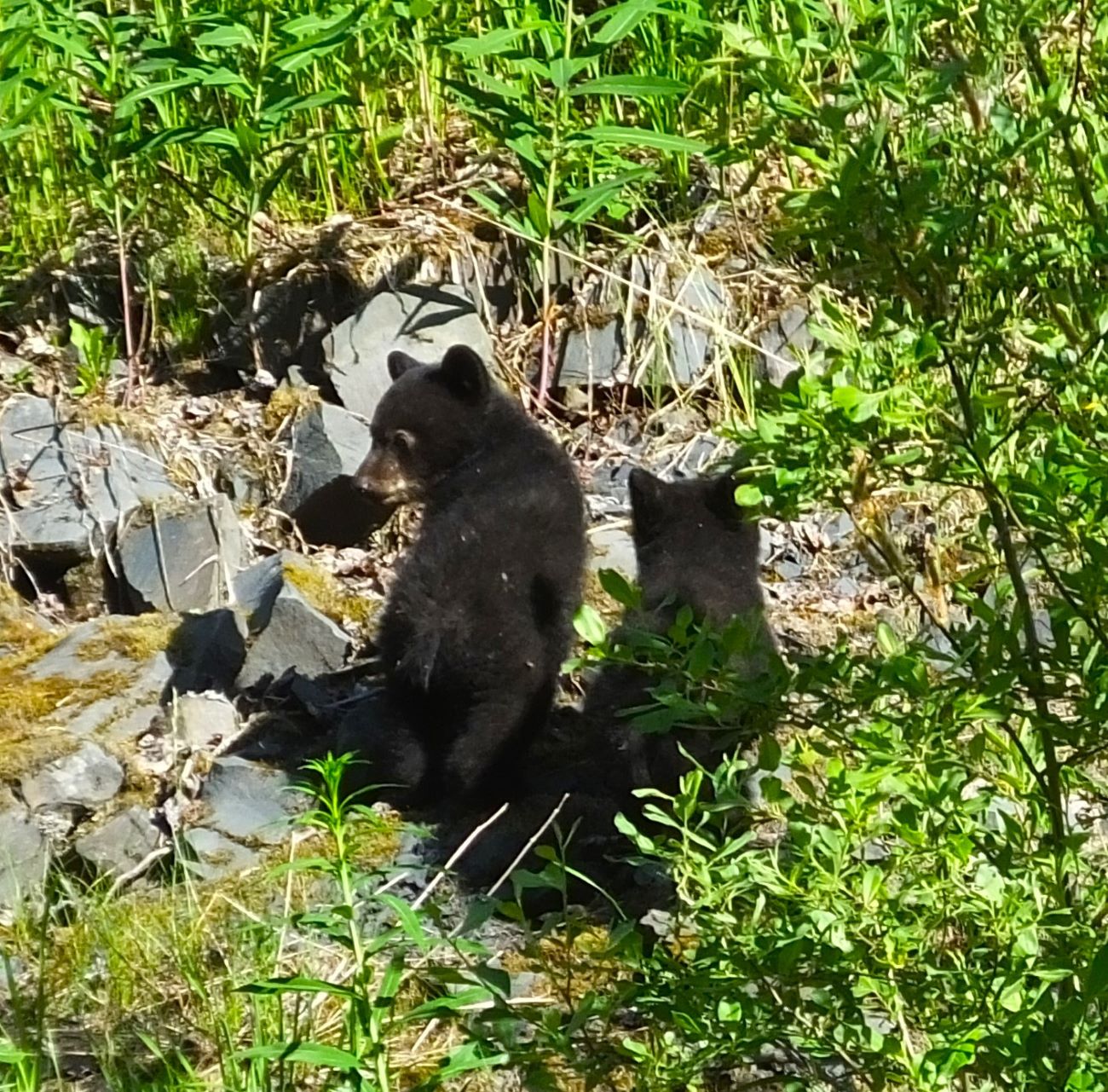
Black Bear – 5 (including 2 babies)

Highland cattle – 3

Bald eagle – 1

Ducks, swans, squirrels, rabbits, chipmunks, vole

Critters along the Cassiar – momma and baby bears, and a fleeing moose

Next week: 

We visit Whitehorse, capital of Yukon Territory, camp in Kluane NP and have a memorable arrival in Alaska.

Family, Friends and Vancouver Island

(2023 Alaska Revisited Ep 12)

From Grand Coulee Dam, our travels took us to North Cascades NP, where we camped before continuing to northwest Washington.

Crossing the North Cascades

We visited Pat’s cousin in Sedro-Wooley, northeast of Seattle, and a Florida camp friend in nearby Lynden,  ‘moochdocking’ in their driveways for the night.  Their gracious hospitality was very much appreciated.

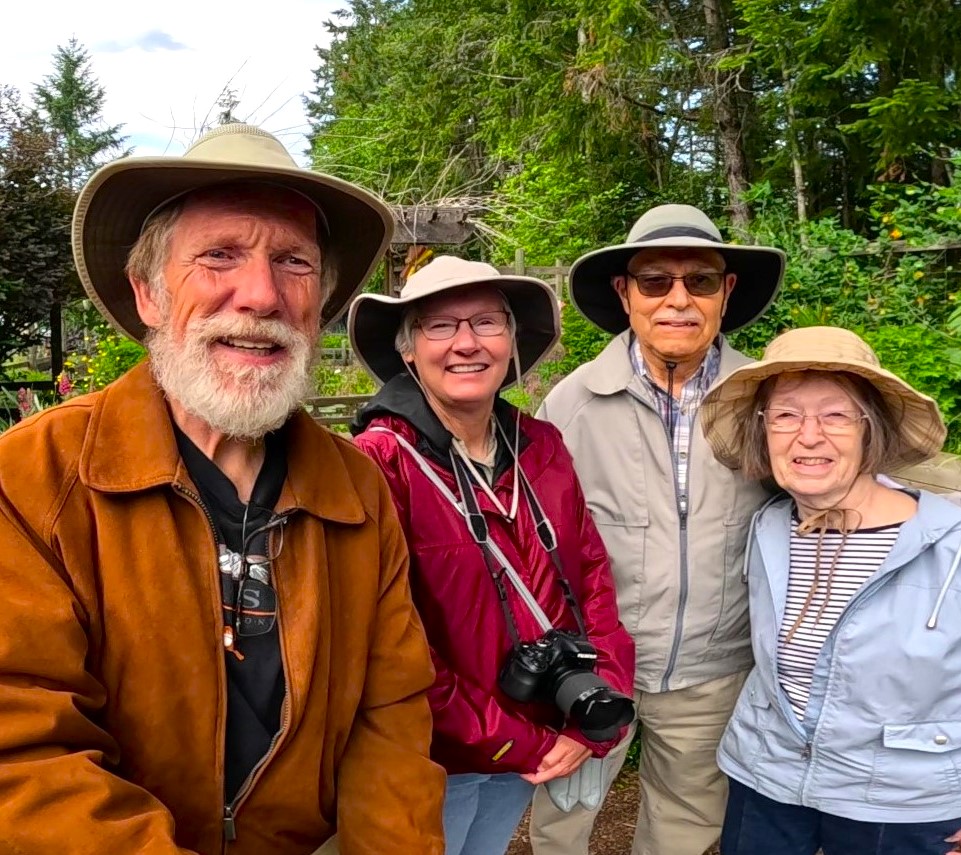
Enjoyable visits with family and friends

There are large berry farms near Lynden.  It’s too bad we were too early to enjoy the blueberries, blackberries, raspberries and more that will be ripe later in the season. 

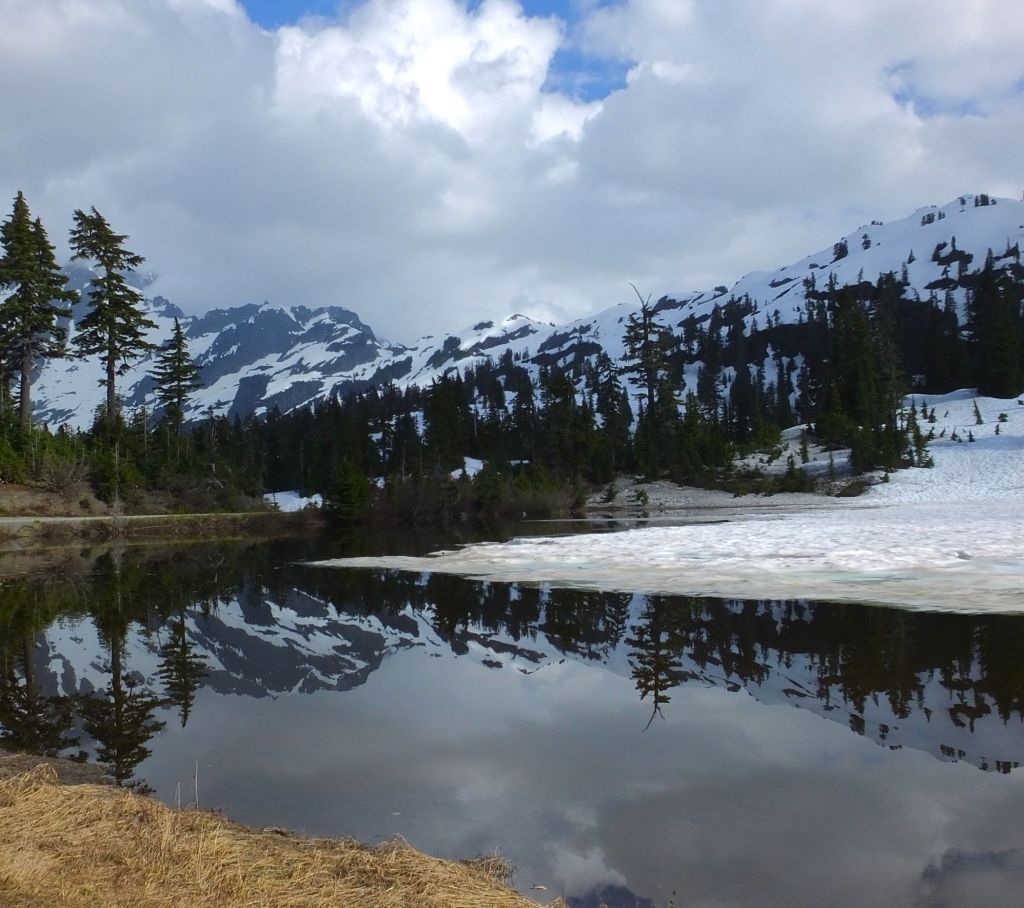
Picture Lake near Mt Baker

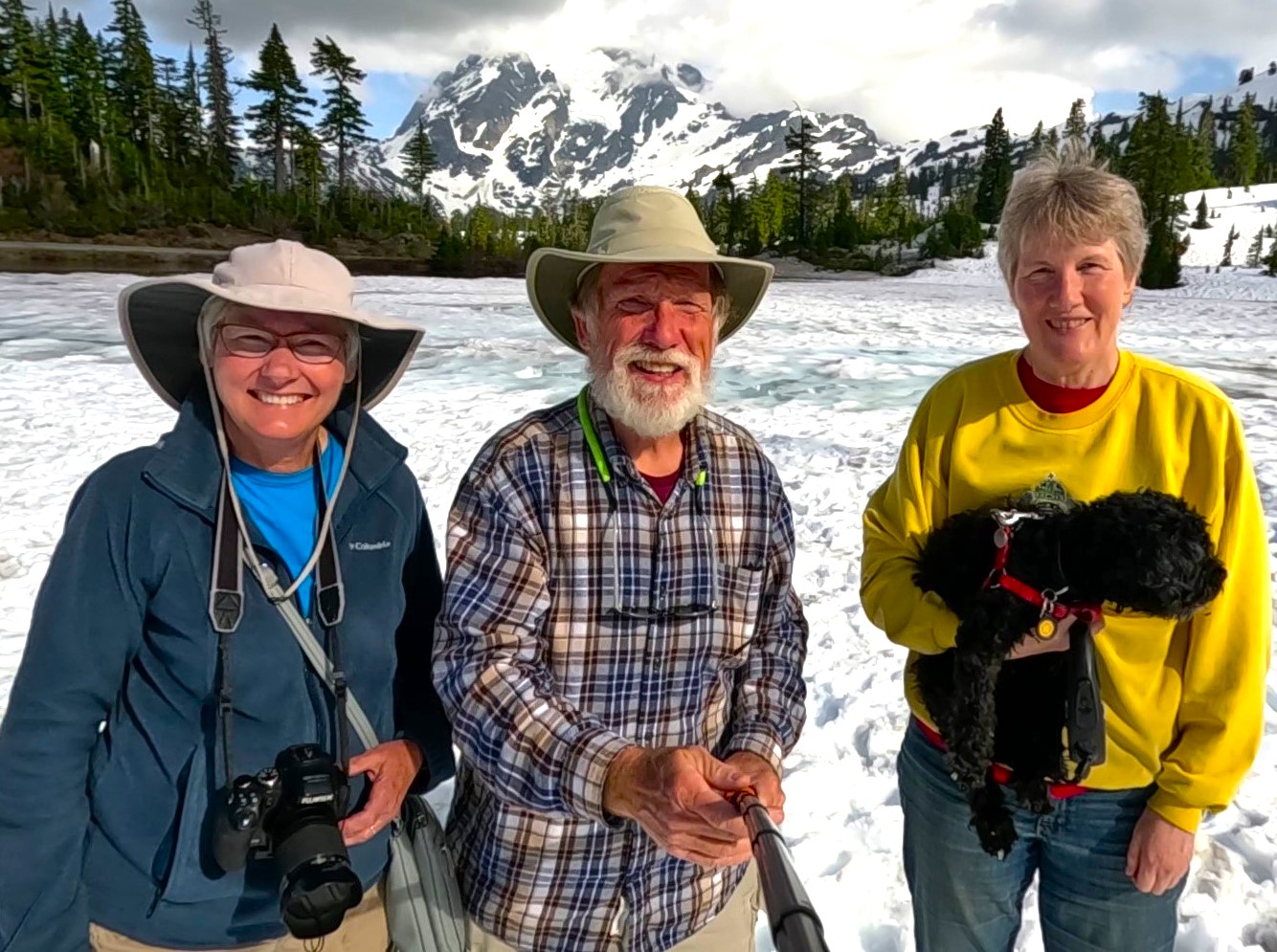
Snow-covered Mt. Baker dominates the eastern skyline and our camp friend and her little dog Bentley took us on an afternoon drive a ways up the mountain, where we visited often photographed Picture Lake and attempted a slippery hike on the snow.

Ferry Crossing to Vancouver Island

The next day we rose at 4:30 for early border crossing into Canada and a two-hour ferry to Nanaimo, a town on Vancouver Island.  The island, off the west coast of Canada, is 250 miles long and 50 miles wide, with snow covered mountains, waterfalls and rugged beaches.

Our plans were to explore the island for a week, and we started with a visit with the Burians, also friends from camp.  We spent a day in the Parksville area driving to the scenic Little Mountain Lookout and touring the North Island Wildlife Recovery and Discovery Center. 

Visiting with the Burians
All’s Fine in Tofino

From Parksville, we bypassed Victoria, a beautiful city on the southern tip of the island, and instead crossed the island midway to Tofino.  The small town is on the Pacific side of the island and is said to be the surfing capital of Canada. 

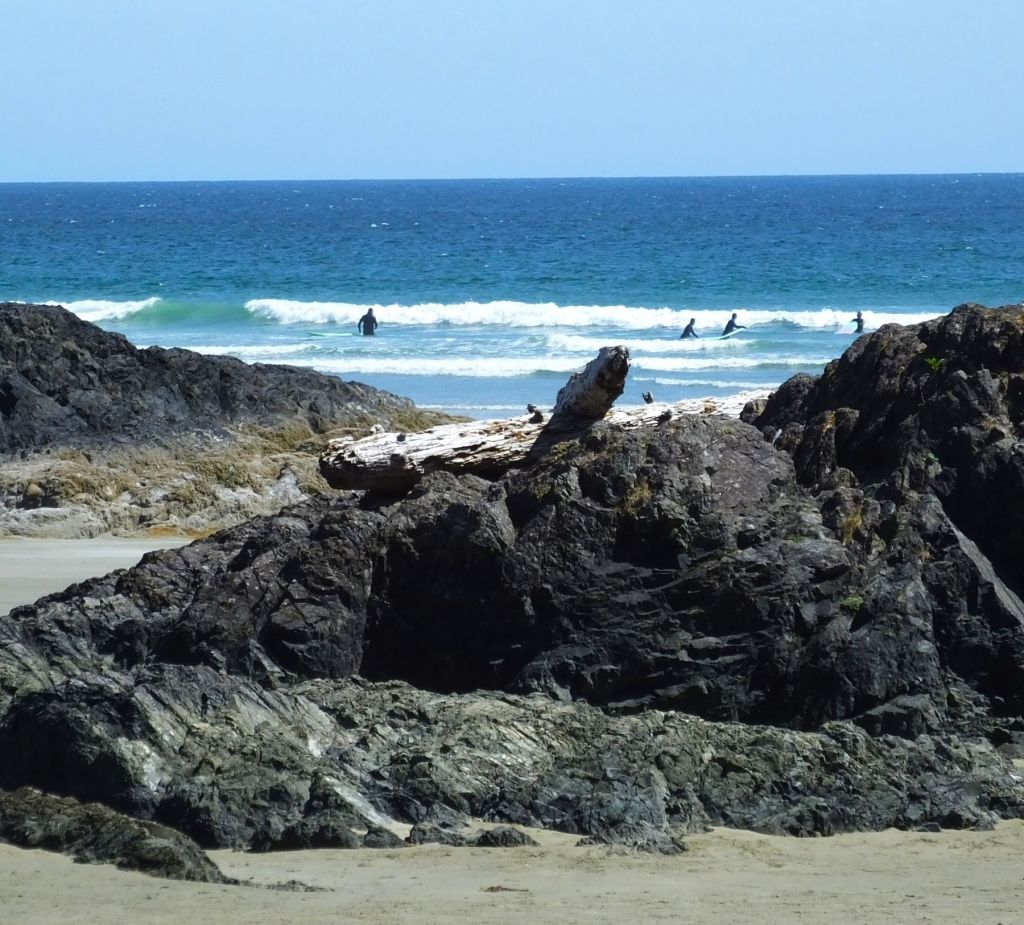
Surfers in the cold Pacific near Tofino

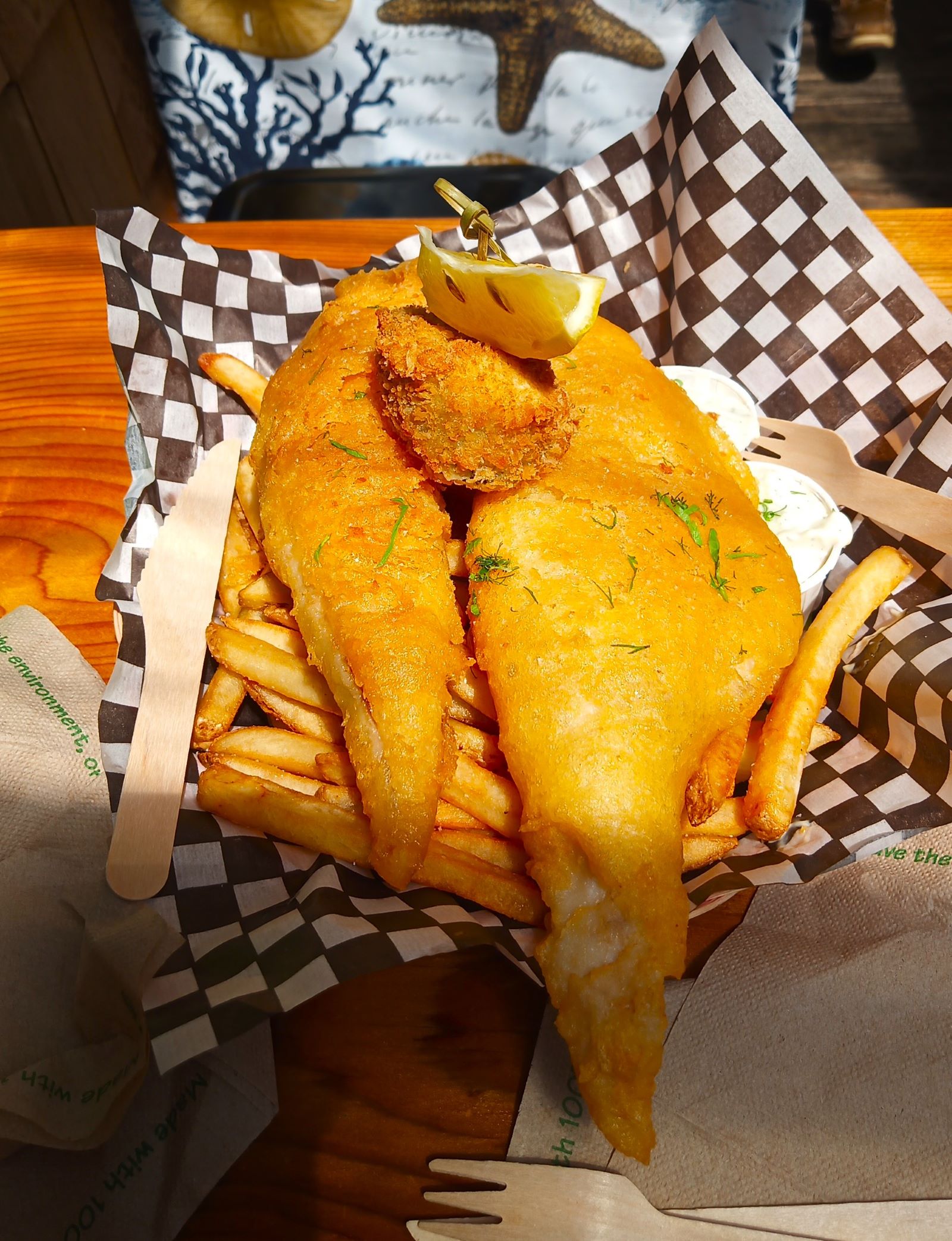
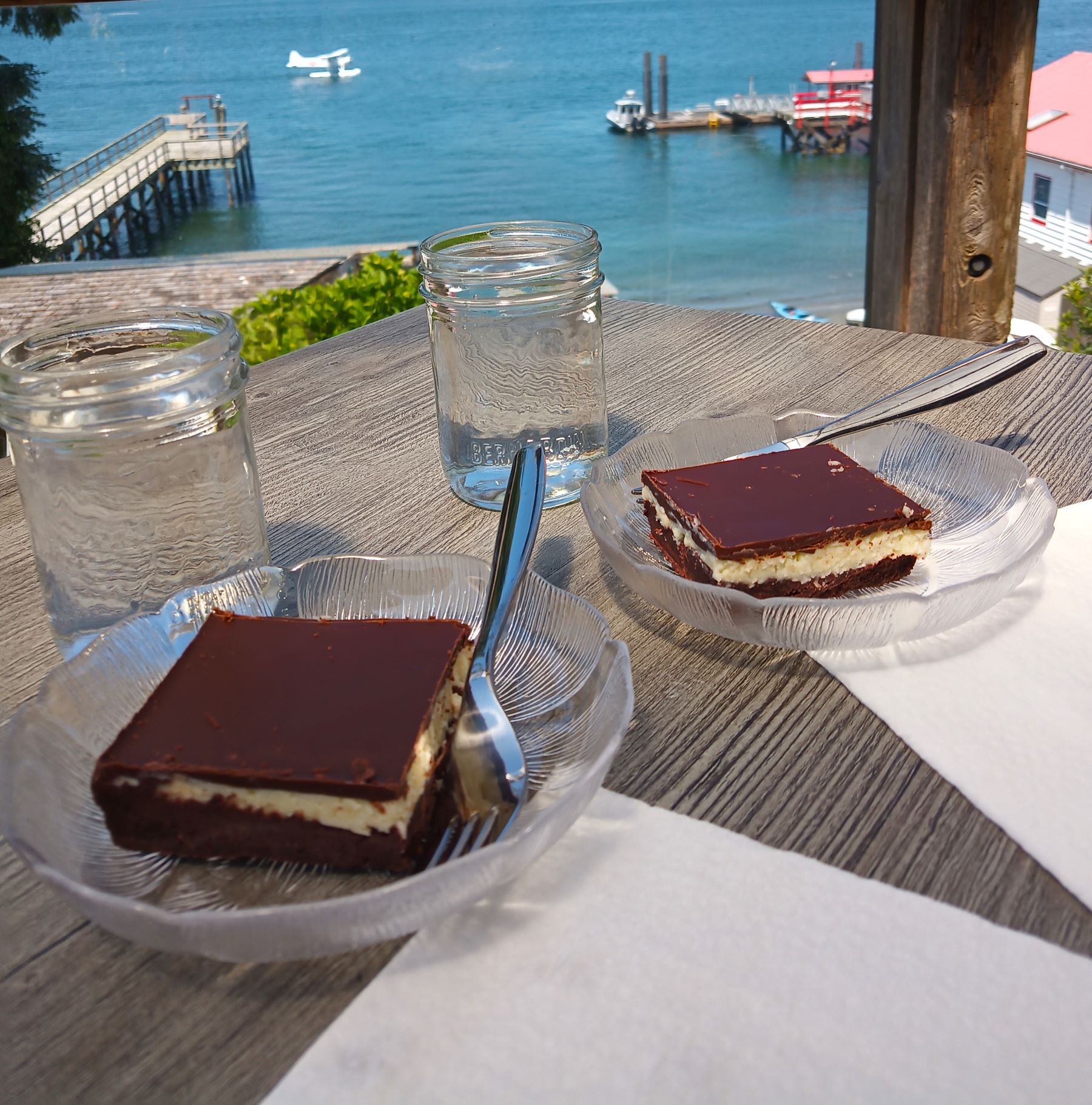
We didn’t surf but did enjoy fish and chips at a small boardwalk eatery and a couple Nanaimo bars at a coffee shop.  That evening we camped in Pacific Rim NP where we walked along Long Beach and watched wetsuit-clad surfers ride the waves.

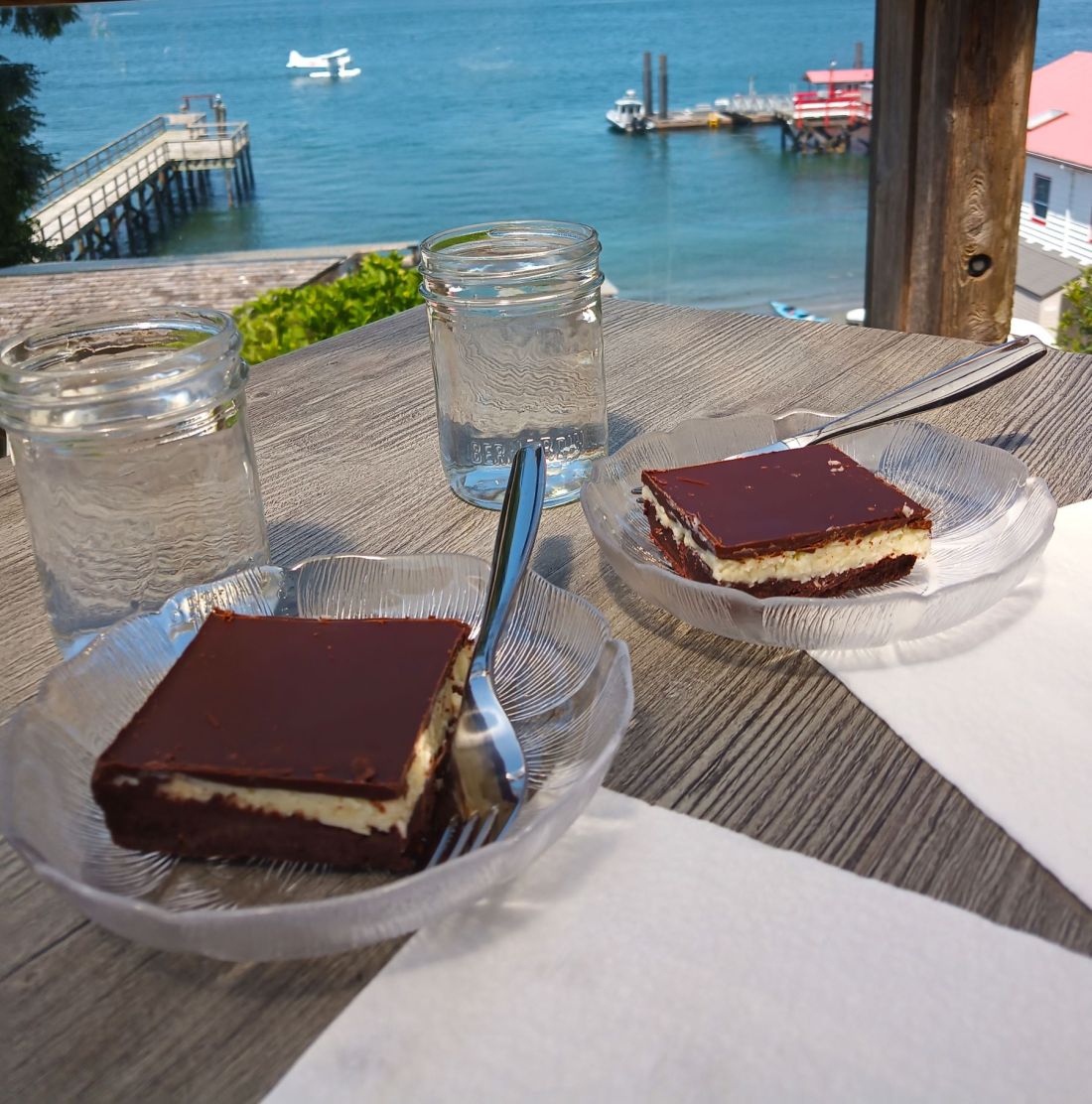
A single serving of fish and chips was enough for both of us, but we had to have our own Nanaimo Bars!

Nanaimo Bars

In case you haven’t heard of them, three-layer Nanaimo bars are a yummy dessert named after the local town.  They have a base of graham crackers and shredded coconut, a middle of butter icing and hardened chocolate on the top.  For those who can’t get enough, more than three dozen Nanaimo businesses serve up their version of the dessert on the Nanaimo Bar Trail!

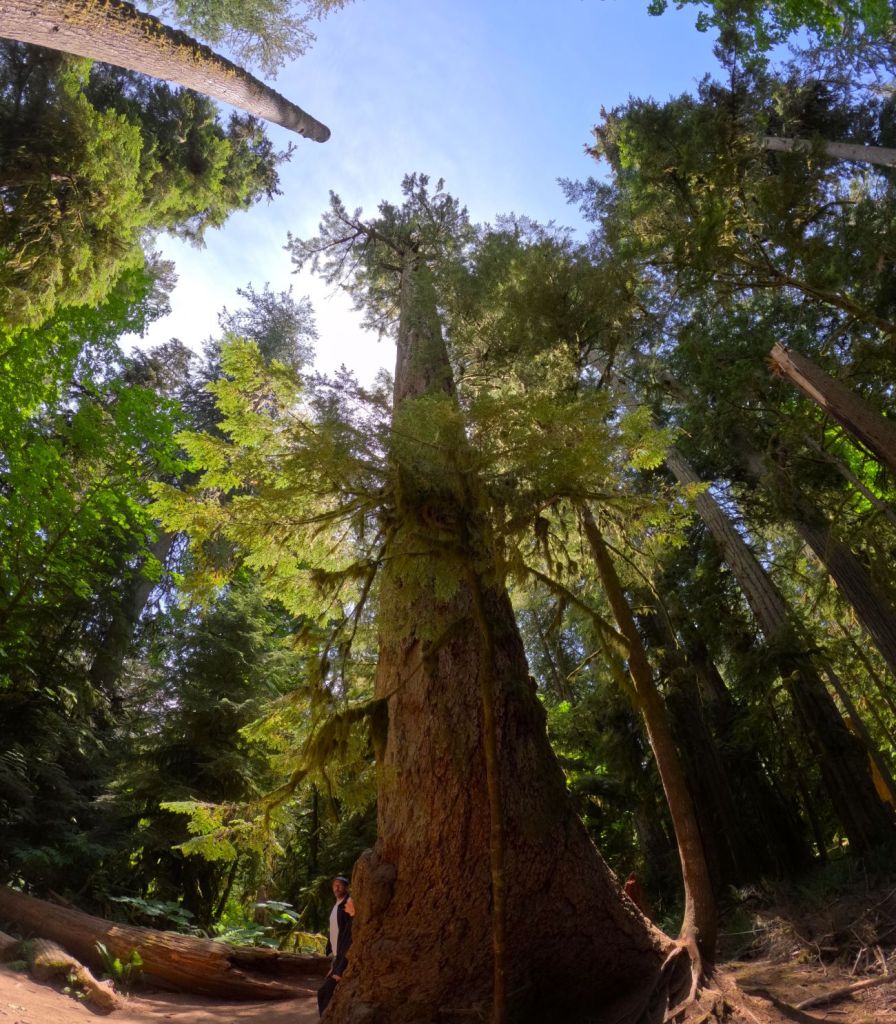
Tall trees in the Cathedral Grove
Tall Trees and Goats on the Roof

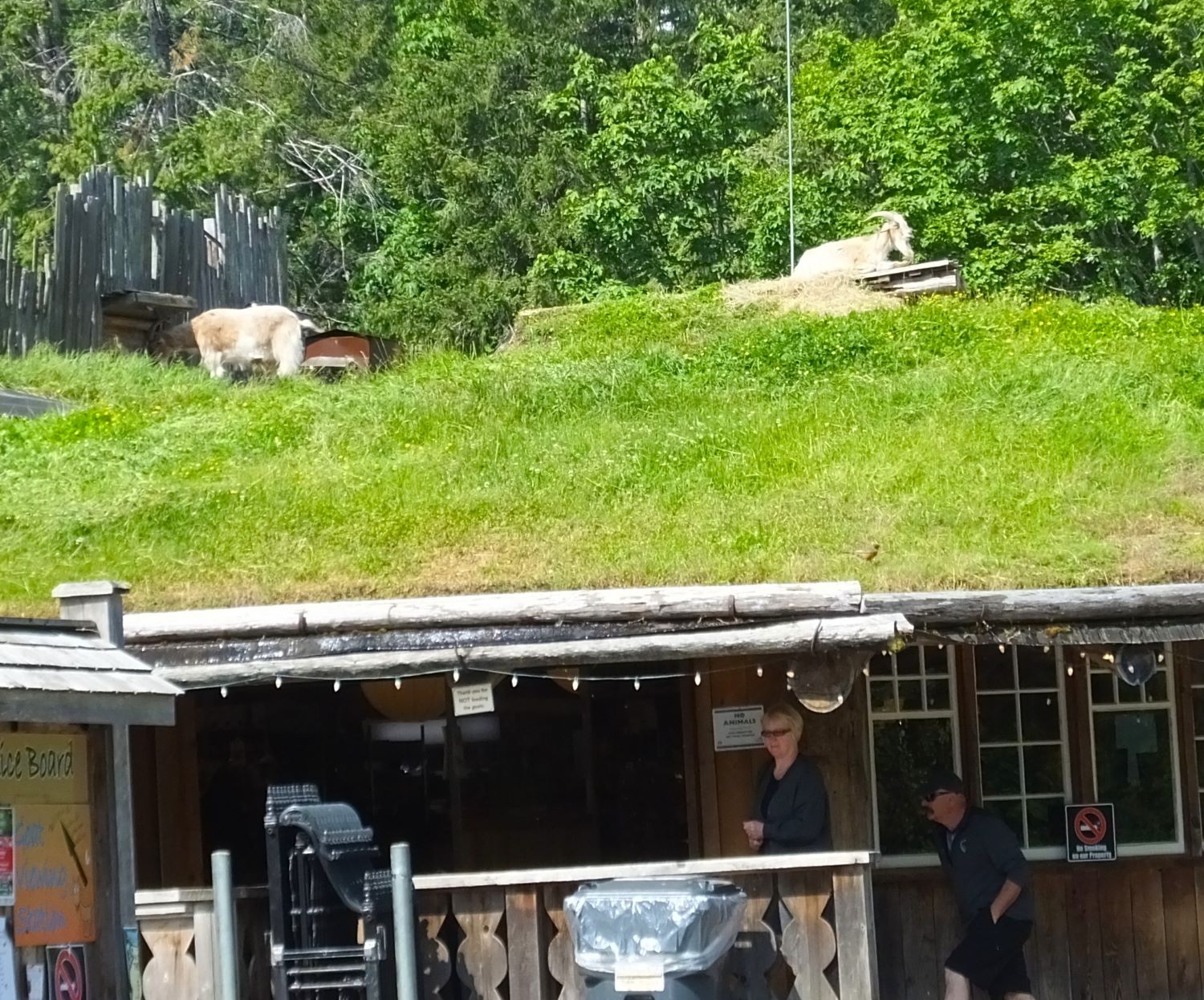
From Tofino, we drove back across the island and stopped to see Cathedral Grove, a magnificent stand of huge old growth cedar and fir trees, many several hundred feet tall.  From there, we had to stop to see the goats on the grass-topped roof of Old Country Market.  Inside the charming market is an assortment of groceries and gifts, and wonderful fresh donuts!

Goats on the roof of the Old Country Market; photo of two old goats

A Waterfall Suspension Bridge

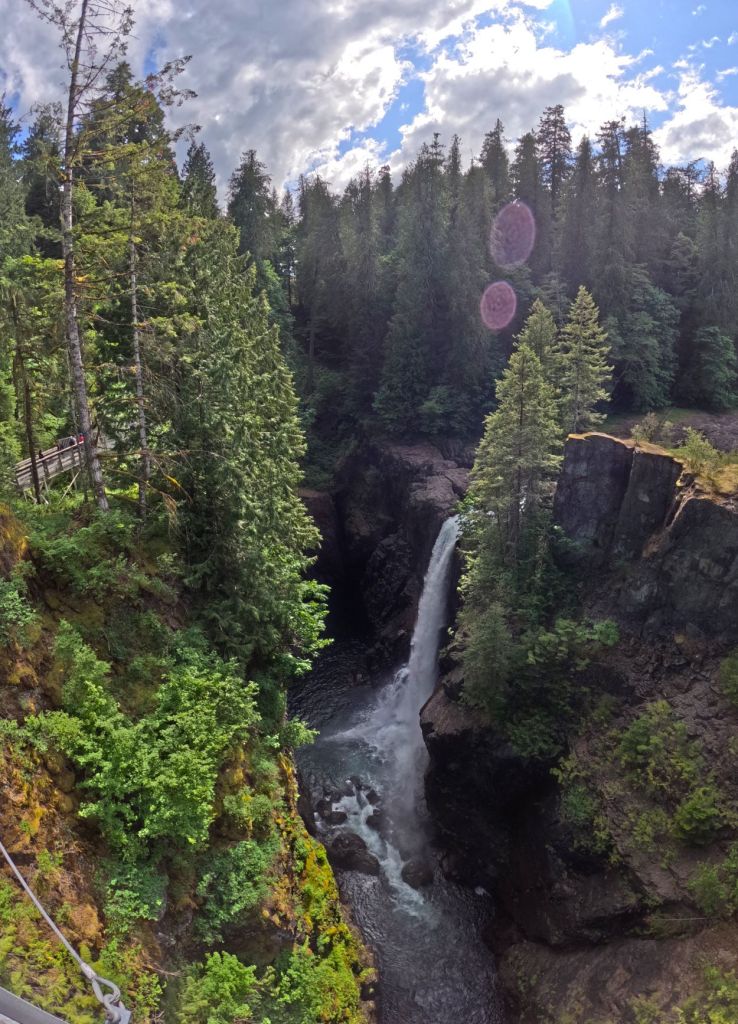
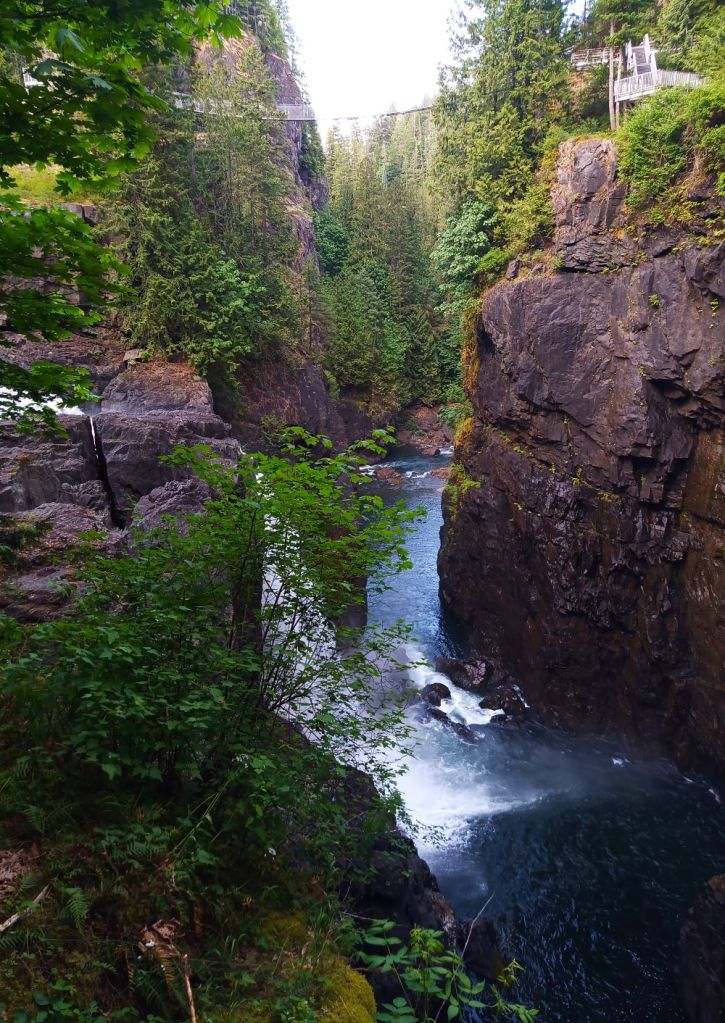
At Campbell River, a half day north, we camped at Elk Falls Provincial Park. Although no elk were to be seen, we did visit the falls.  The falls plunge 75 feet into a deep pool and can be viewed from a suspension bridge overhead.  The trail also includes a nice view of the bottom of the falls.

Elk River Falls (suspension bridge at top of right photo)

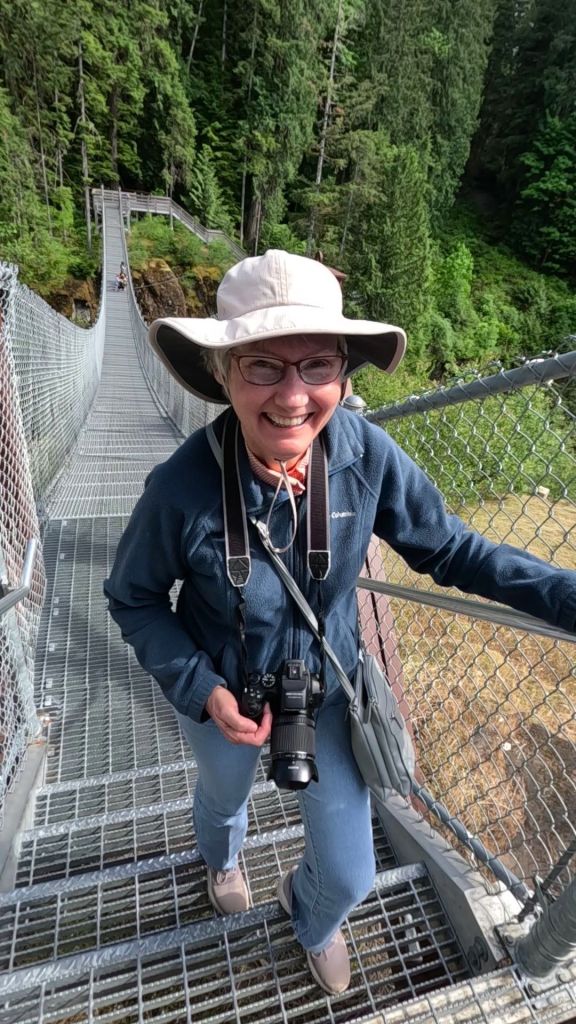
Pat was all smiles when she finished crossing the bouncy suspension bridge above Elk Falls

Before leaving Campbell River, we made our first stop of this trip at Tim Horton’s, Canada’s ubiquitous coffee and donut chain.  ‘Timmy H’ brought back tasty memories of our visit to Newfoundland last year.

Our visit concluded with another early morning ferry ride back to the mainland.  We will have fond memories of our time visiting family and friends in the area, and touring Vancouver Island.  

(Since leaving the island, we learned that the road across the island to Tofino has been closed for nearly two weeks due to a forest fire near the Cathedral Grove.  As the only road across the island, Tofino residents and visitors are stranded until the road reopens.  Had we visited a week later, we would probably still be there!  We praise God for the timing of our visit and pray the road will reopen soon!)

Next week: 

North to the Cassiar Highway and the Watson Lake Sign Forest.                           

Awesome Views and a Big Goose

2023 Alaska Revisited Ep 11

(We’re playing catch up in this week’s RabbiTRAILS.  Like many other blogs, RabbiTRAILS lags behind ‘real’ time.  We’re currently in Stewart, British Columbia near the Cassiar Highway. Later this week we will be in Watson Lake, the location of the famous traveler sign post forest (see our 2018 sign).  Meanwhile, we return to ‘blog time’…)

Oregon Coast

From the towering California redwoods, we continued to the Oregon coast.  We enjoyed the wonderful views and less expensive gas!

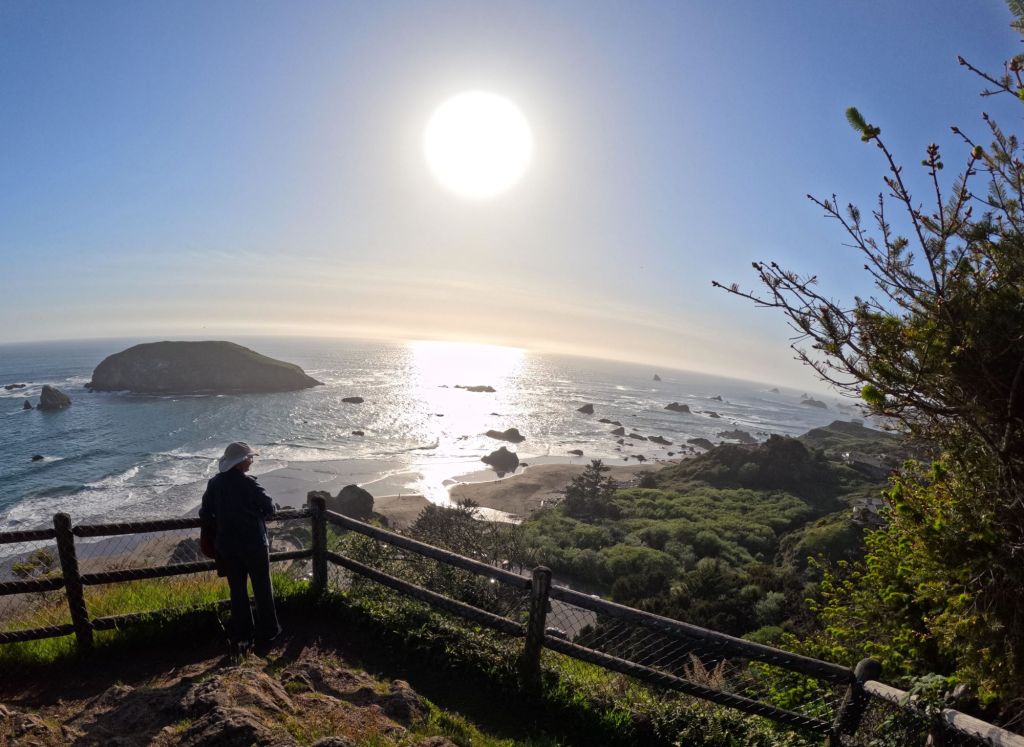
At Harris Beach SP, we hiked down a steep rocky trail to where the waves crashed against tall rocks.  Further along, there was a long flat beach where the tide was quickly coming in.  We had to step quickly to avoid getting our shoes wet! 

Late afternoon view of rugged rocks and beach from overlook

We ascended a trail to an overlook high above the rugged shoreline to get a better view of the rocks and beach.  What a view!

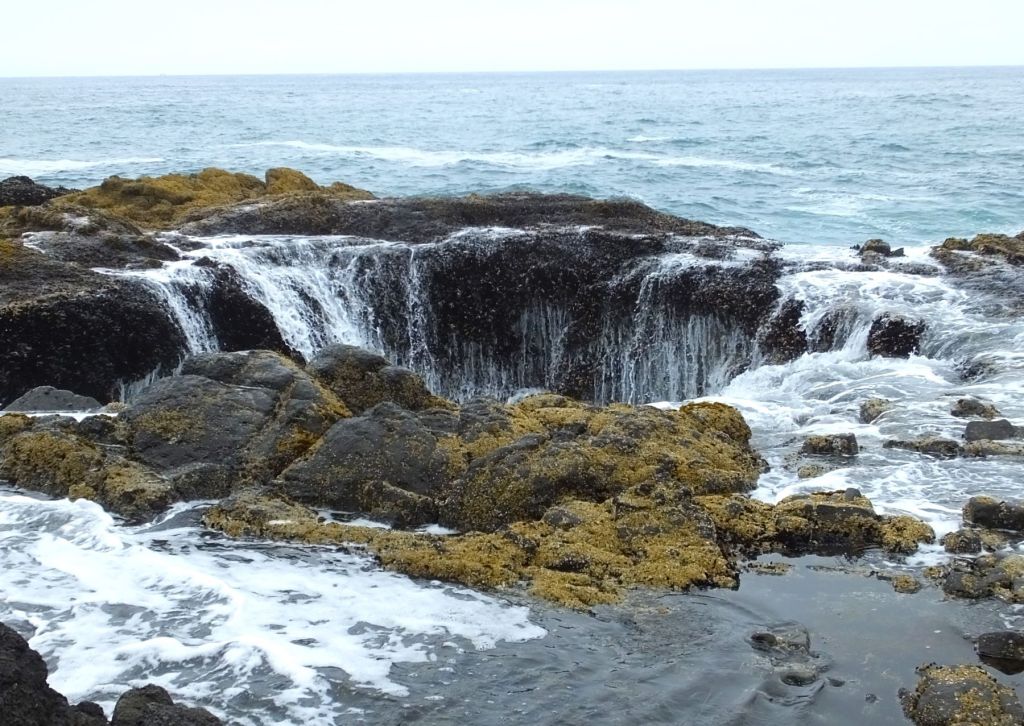
Near Cape Perpetua, we scrambled across rocks to get a view of Thor’s Well, an interesting tidal pool

We turned inland from the coast, returning to Portland for a warranty repair on Pap and a suspension upgrade for Percy. 

A Big Wooden Plane
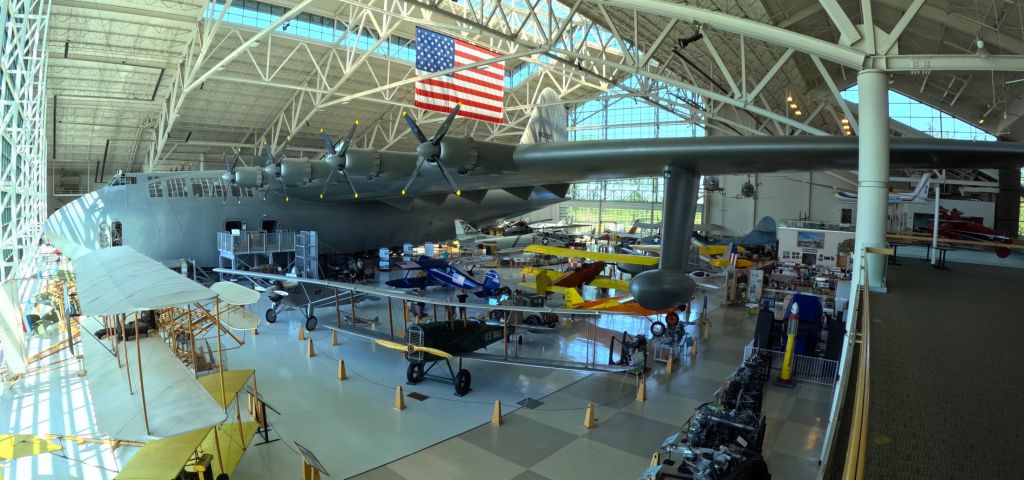
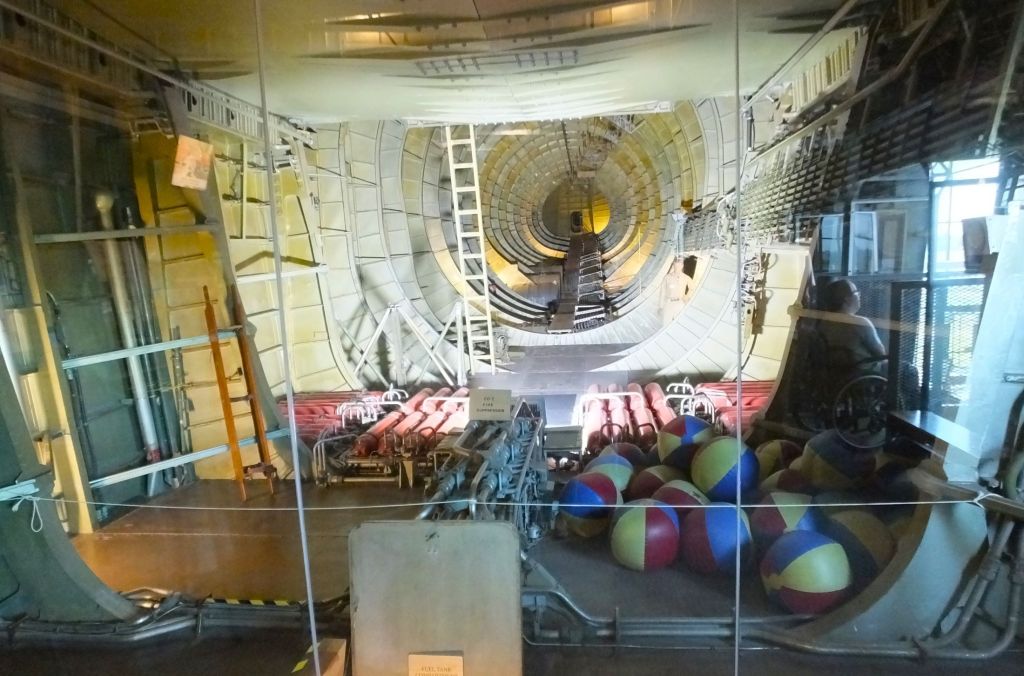
Spruce Goose in the Evergreen Aviation and Space Museum

We stopped overnight at the Evergreen Aviation and Space Museum, the home of the famous Hughes Flying Boat, better known as the ‘Spruce Goose.’

The Goose is a huge plane made entirely of wood by Howard Hughes.  It was intended to transport heavy equipment and up to 400 soldiers to Europe during WWII.   With a wingspan of 321 feet (more than a football field) and length of 219 feet, the plane was the largest ever made for many years.  It was completed in 1947, and flown by Hughes for just one 30-second flight in Long Beach, CA before being ‘mothballed.’  With the end WWII, it was no longer needed.

The plane was acquired by Evergreen in 1992 and is now the centerpiece of the museum.  It is surrounded by many other aircraft from early planes to modern miliary jets.  Experimental planes and helicopters are also on display. 

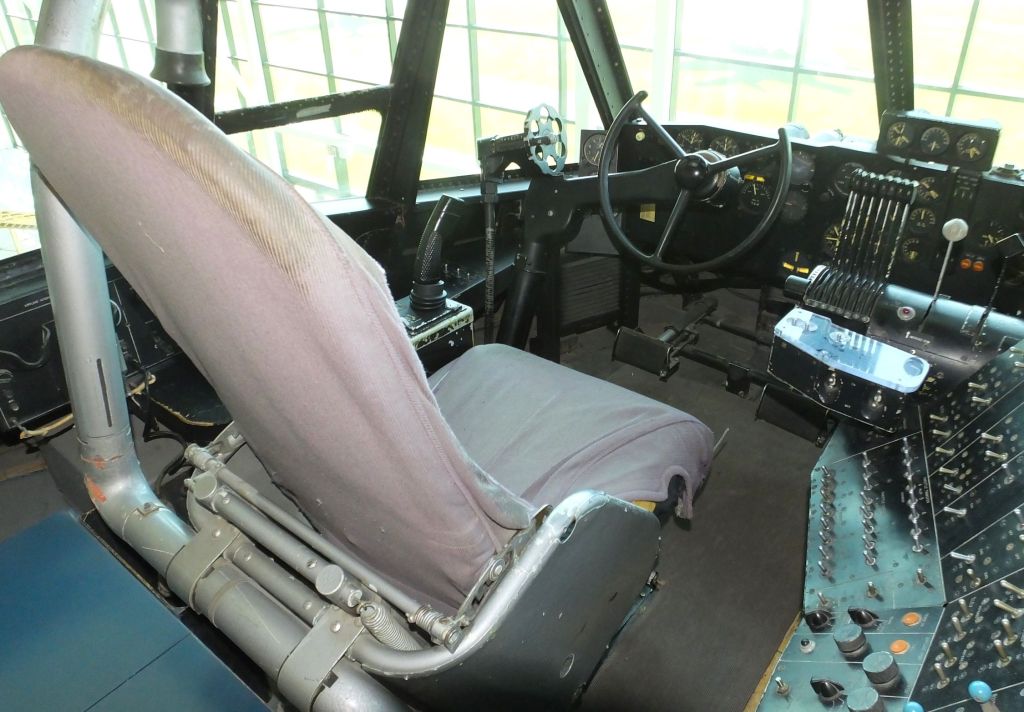
During our visit, a guide gave us a special tour of the Goose and we got to sit in the cockpit seats. Ed is sitting in the seat where Howard Hughes piloted the Goose for its one and only flight!

An adjacent space museum has displays from early rocket launches through the Space Shuttle.

The museum is a nice one-day stop on any trip to the area.


We arrived in Portland, completed our repairs and camped at Milo McIver SP, just a few miles outside the city.  For the first time on this trip, Pap spent three nights at the campsite while we explored the local area.

Musical Fish

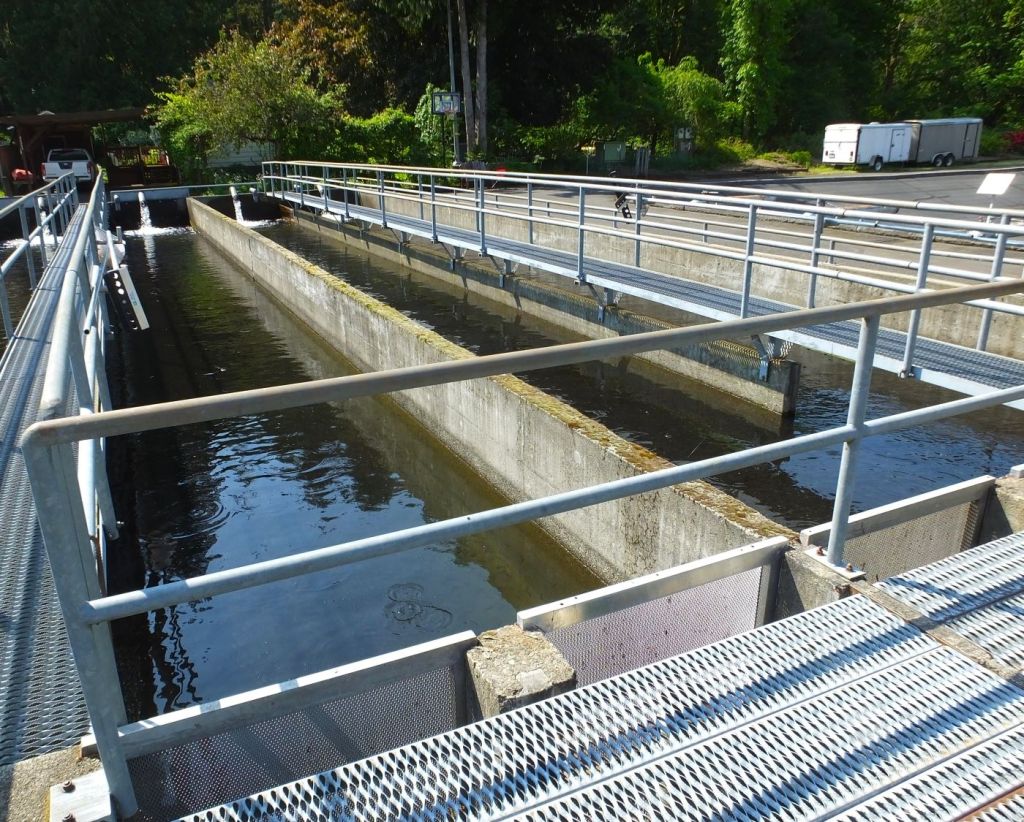
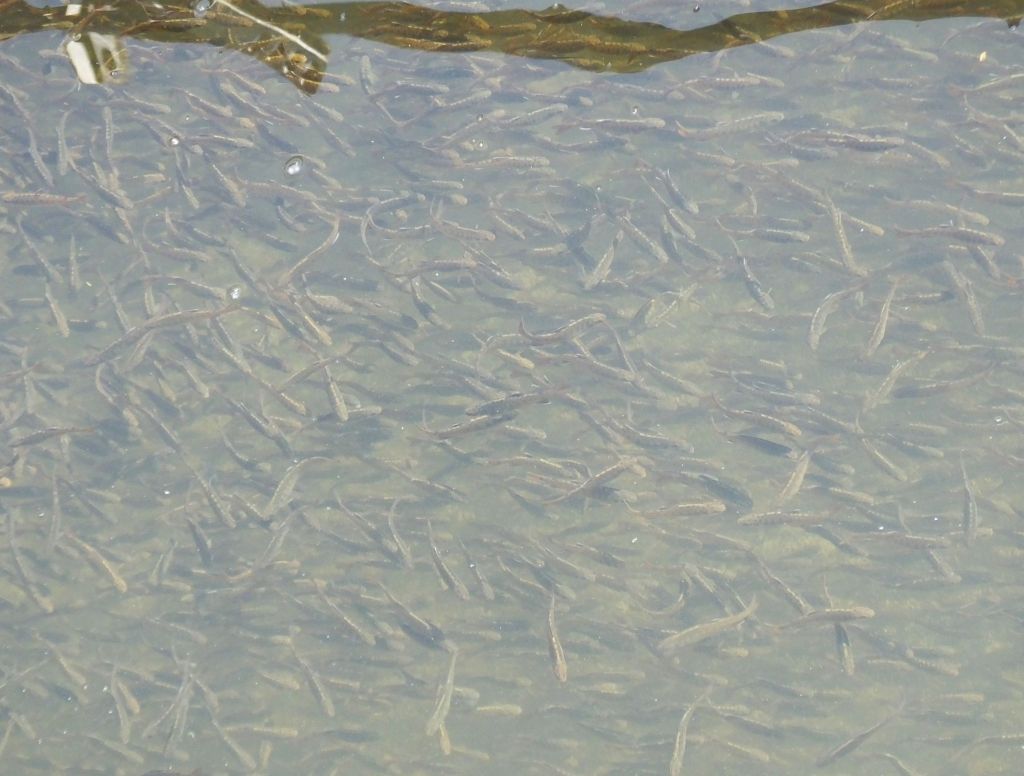
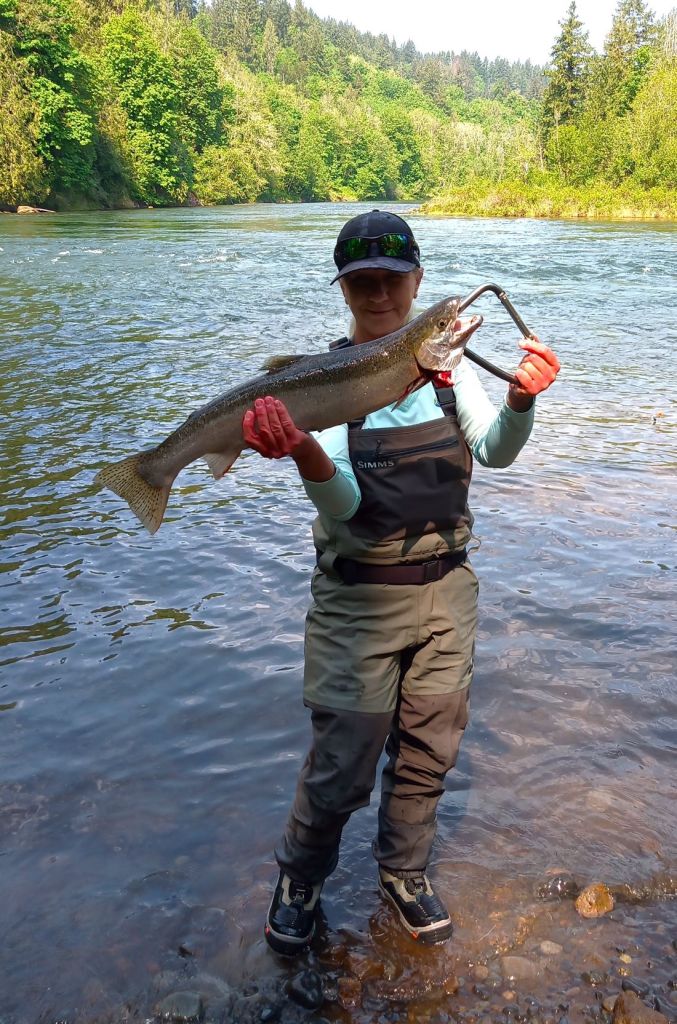
Inside the park, we visited a chinook salmon and steelhead hatchery on a tributary of the Clackamas River.  Dan, a ranger at the hatchery, explained how the Clackamas Hatchery hatches and releases 1.2 million juvenile salmon annually. 

From just a few hundred of the several thousand salmon that return to hatchery each year, eggs are ‘harvested’ and fertilized. The fertilized eggs are transported to another hatchery several miles away where they are hatched and raised.  Young salmon that are two inches or more in length (called fingerlings) are transported back to Milo McIver, where, in two months, they grow to five inches and are released.  In a year or two they return to the hatchery and the cycle is repeated.

Meanwhile, fertilized eggs from the other hatchery are trucked to Milo McIver where they are hatched, raised and eventually returned to the other hatchery where they too are released. 

Confused about the reason for the fish musical chairs?  We were.  Pathogens in the water at Milo McIver harm the developing fish, so they are transported to the other hatchery to give the young fish a better chance of survival.

We watched as Erika landed a magnificent steelhead on the Clackamas near the fish hatchery

This is an example of the considerable efforts being taken throughout the Pacific northwest, Alaska and Canada to ensure the various salmon species survive and thrive.

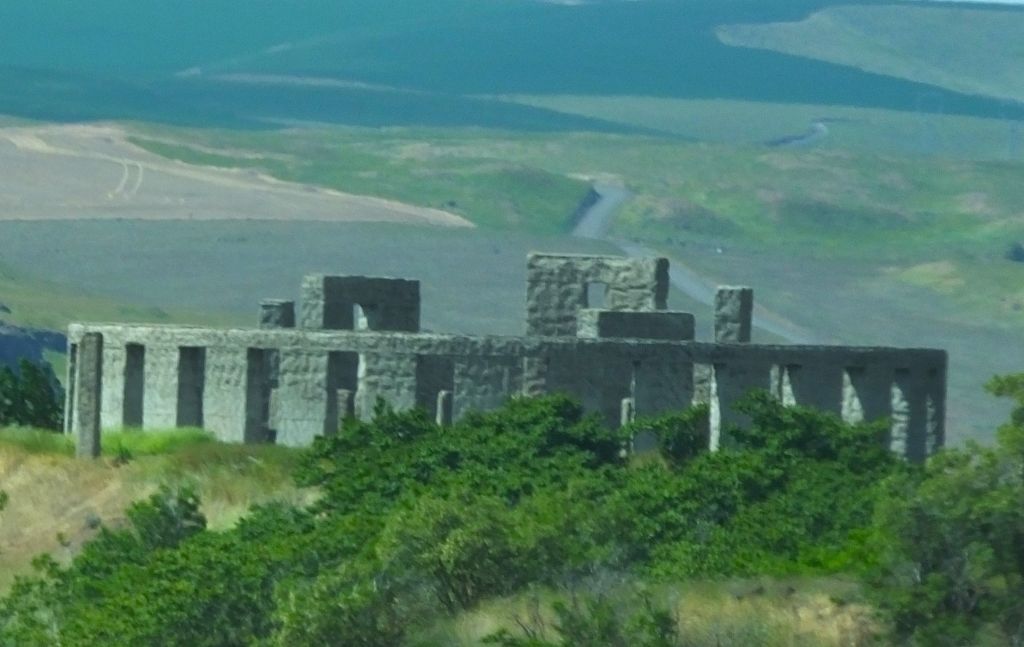
Stonehenge Memorial near the Columbia River Gorge

Fish stories aside, we continued northeast through central Washington.  We visited ‘Stonehenge,’ an interesting memorial to WWI veterans on a bluff high above the Columbia River Gorge that resembles the famous stone formation in England.   Talk about a RabbiTRAIL!

Dry Falls, the World’s Largest Waterfall
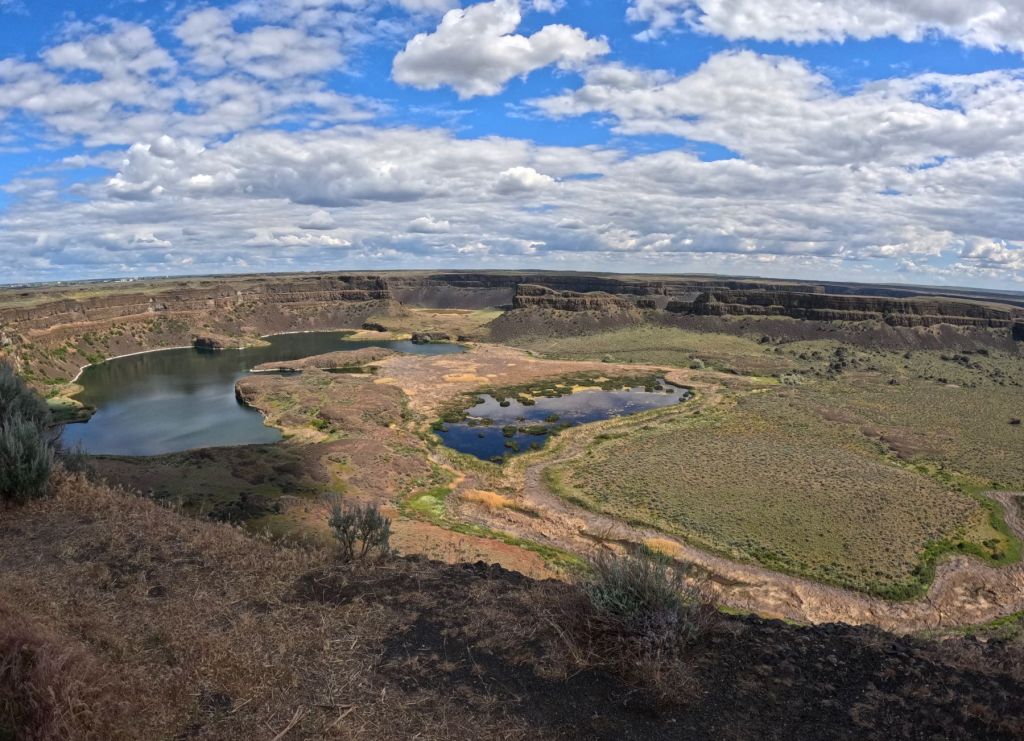
Dry falls, largest waterfall in the world
A few hours away we observed the once largest waterfall in the world, Dry Falls. 

Huh?

In a past ice age, huge ice sheets covered eastern Washington, Montana and southern Canada.  Tremendous flows of melt water raged across the area during a period of warming, carving out a huge waterfall near Coulee City, WA.  The now dry waterfall was the biggest ever in the world at 400 feet tall and 3 1/2 miles wide.  The falls would dwarf today’s 165-foot Niagara Falls.
Although the falls no longer exist, there are several small lakes at the base of Dry Falls with lots of hungry mosquitoes!

Grand Coulee Dam
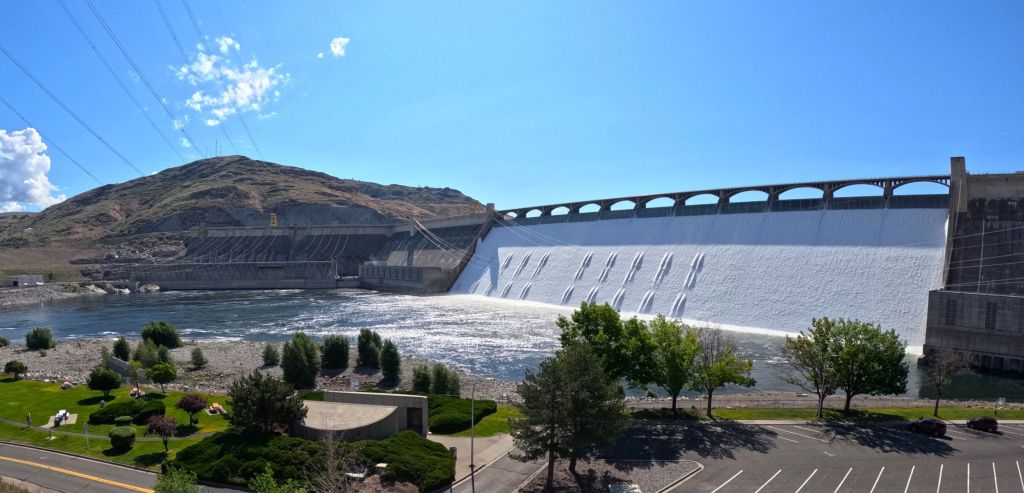
Grand Grand Coulee Dam

From Dry Falls we traveled to the site of a ‘man-made’ waterfall, the Grand Coulee Dam.  The dam is 550 feet high and almost a mile long and was completed in 1942.  It is the largest hydroelectric dam in the US, powering more than 4.2 million homes!

The water flow over the dam was impressive, enlarged by the spring snow runoff upriver.

While in central Washington, we reached the two month point of our Alaska travels.   Warmer weather meant it was time to begin traveling north through Canada to Alaska. 

Coming Soon: the 2023 Alaska Revisited CRITTER COUNT
Next Week:

We visit Pat’s cousin and several camp friends north of Seattle, and check out Vancouver Island before beginning the final leg of our journey to Alaska.        

Redwoods, Bigfoot and Banana Slugs

(2023 Alaska Revisited Ep 10)

Our redwood travels began with Humboldt State Park, located in northern California, more inland and south of Redwoods National Park.  With more than 17,000 acres of ancient coast redwoods, the park protects the largest remaining old-growth redwood forest in the world.

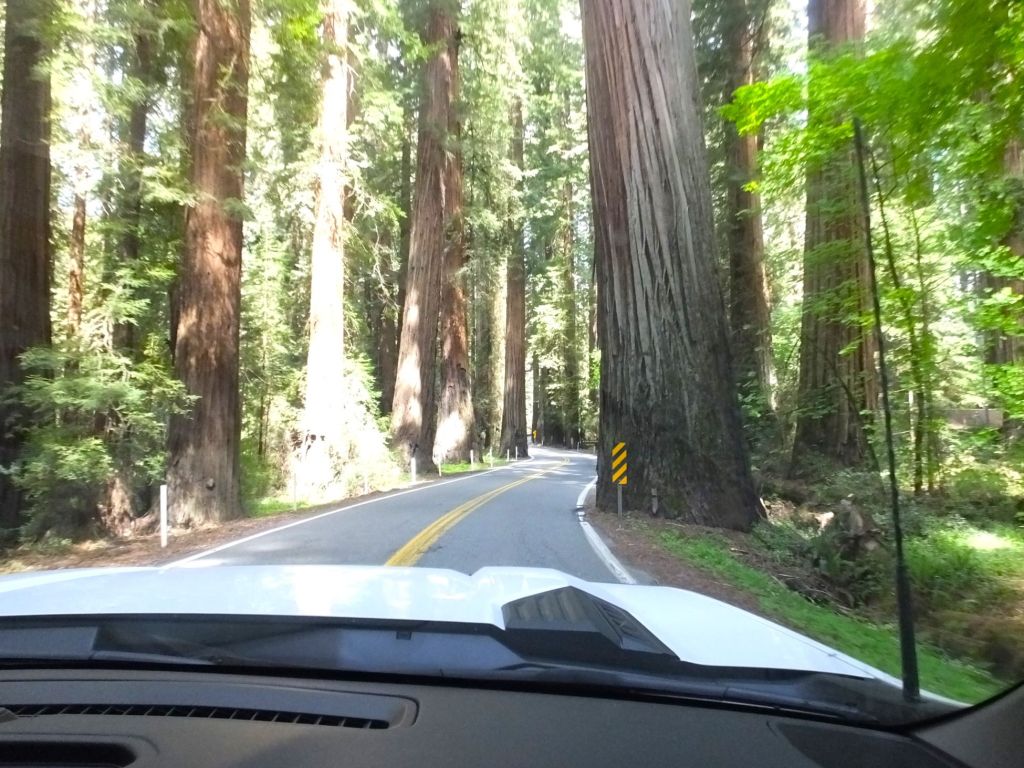
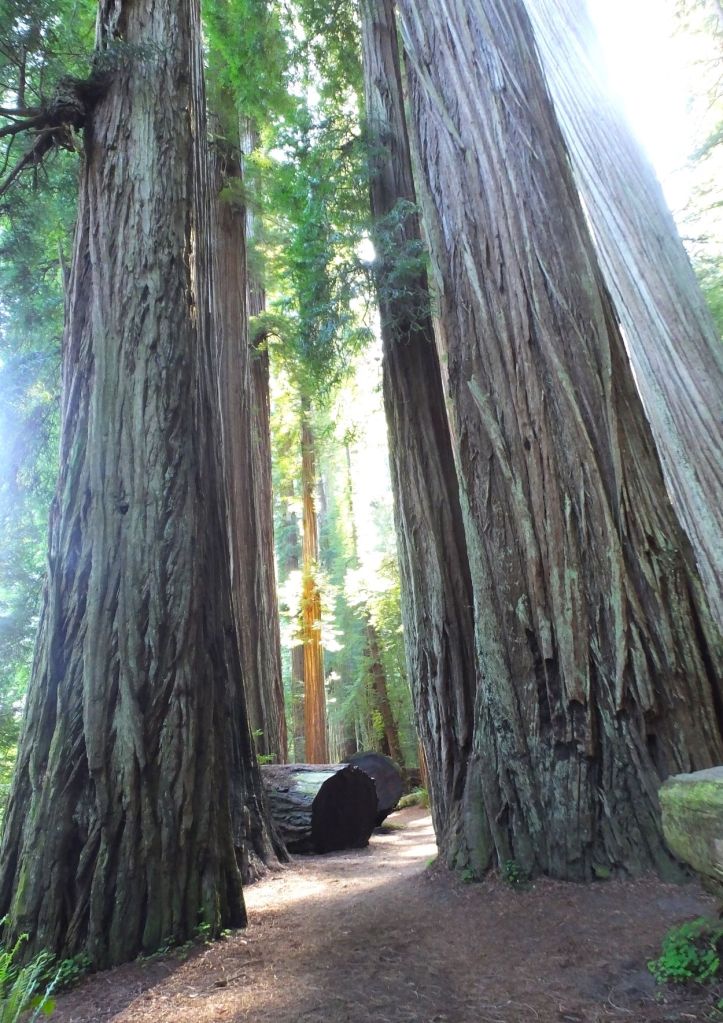
Driving between redwoods on the Avenue of the Giants

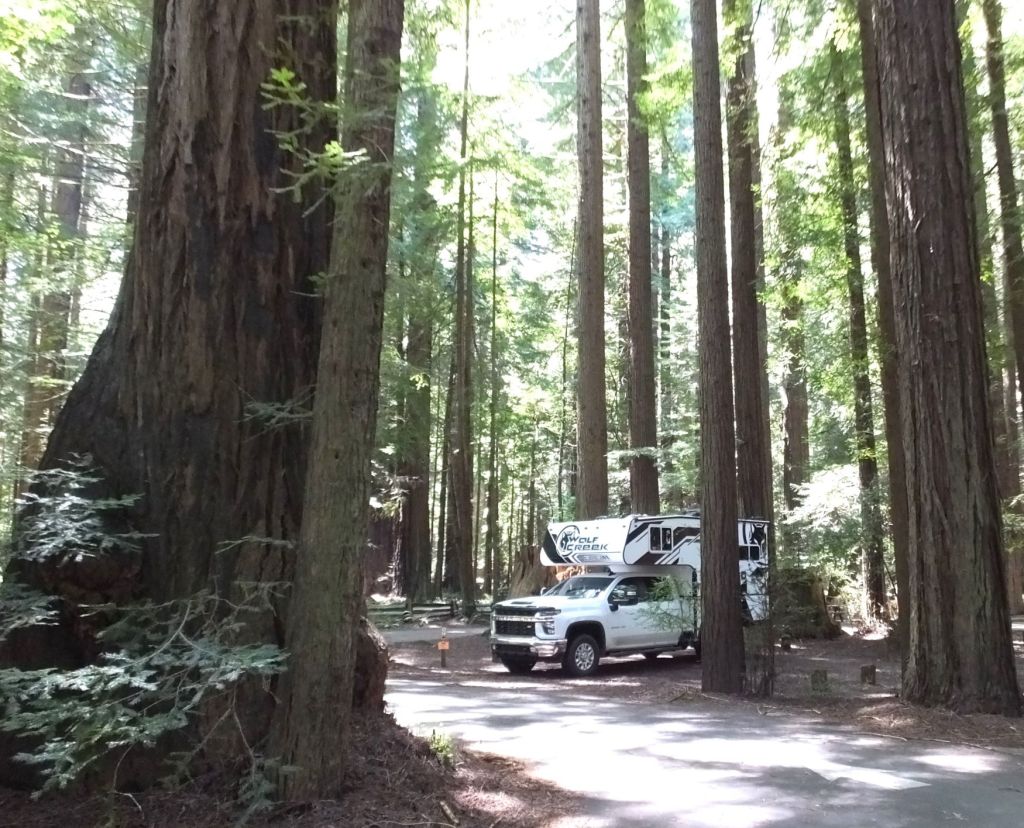
We drove the 32-mile Avenue of the Giants, surrounded by the immense trees, some just a few feet from the road.  After setting up camp for the evening, we walked a short ways to the Founders Grove. 

Camping in the redwoods of Humboldt SP

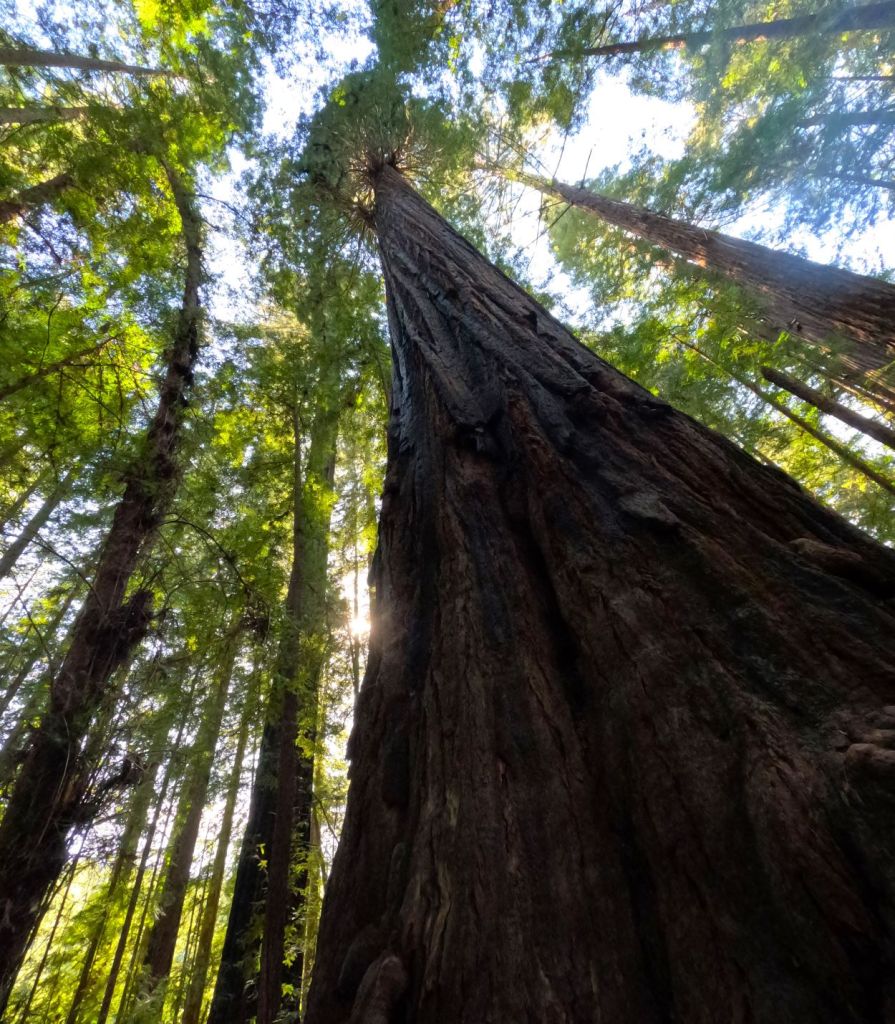
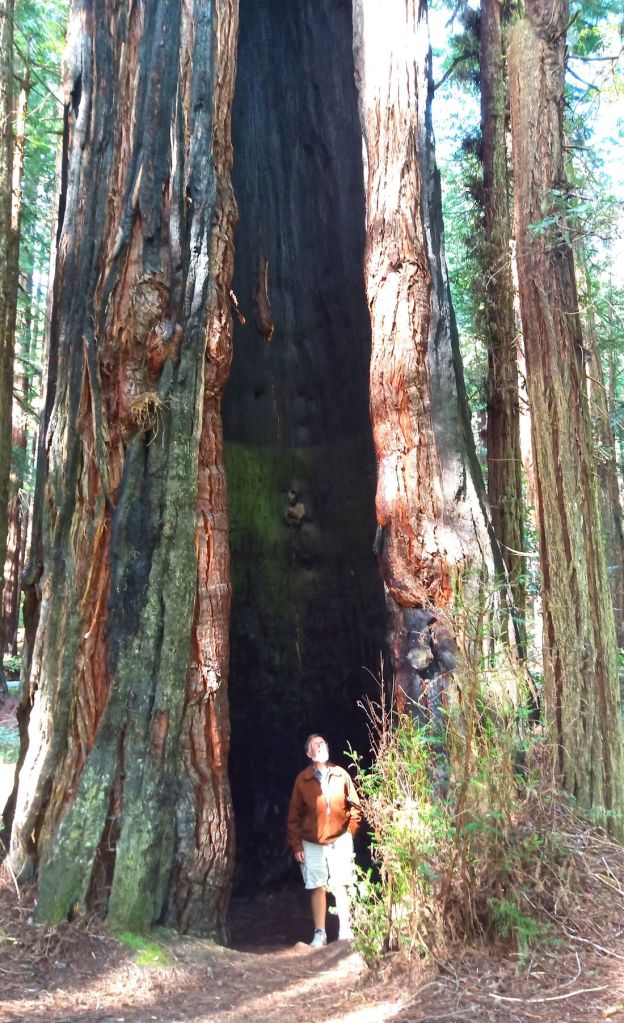
We saw our first ‘up close’ view of a redwood, the Founder’s Tree, towering more than 346 feet above us, with a diameter of almost 13 feet and circumference of 30 feet.

It’s BIG – skyward view of the Founders Tree

Although we visited the redwoods twice before, we were once again awestruck and could only say ‘WOW!’ 

It is hard to describe the ‘feel’ of the redwood forest.  The air is still, sounds are muted and the lighting subdued.   Time seems to stand still. 

Perhaps this is the closest place on earth to what it’s like to be in God’s presence.

The original redwood forests must have been amazing.  Only 5% of the original redwood forests remain – many are in redwood groves where the giant trees are preserved and protected for us and future generations. 

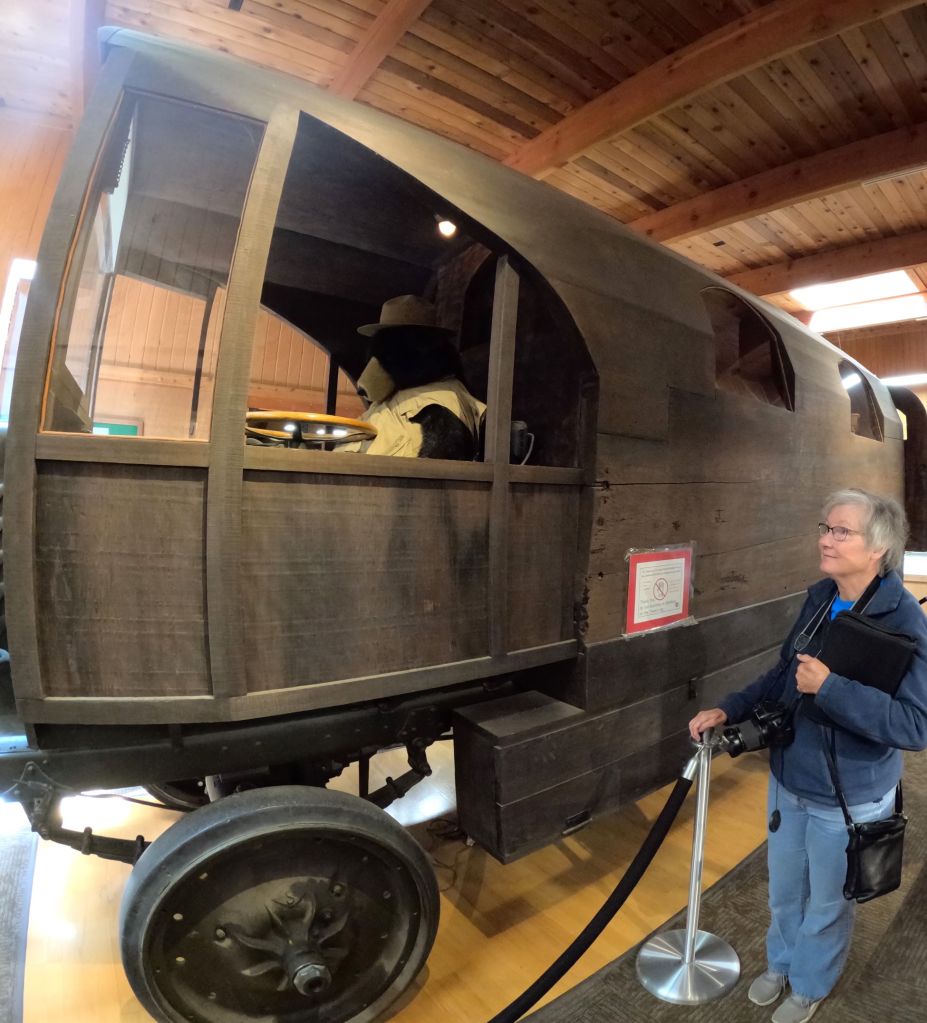
Pat examines the redwood ‘Travel-Log’, a RV, of sorts, used to promote redwood preservation

In 1917, prominent visitors to the area found the trees were not protected.  They formed the Save the Redwoods League and in 1921 the first grove was purchased by the League in what is now Humboldt Redwoods State Park.  Since then, the League has raised millions of dollars to protect more than 170,000 acres of redwood land in 35 California state parks, and Redwood and Sequoia National Parks.

From Humboldt SP we drove several hours north to Redwoods NP.  

The world’s tallest tree is at Redwoods NP:  nicknamed Hyperion, it stands more than 380 foot tall. Although the tree’s location is secret and not open to public viewing, there are other huge trees that can be visited.

We camped in Jedediah Smith Redwoods SP, where the redwoods are co-managed by California and the National Park Service. 

Morning view of redwoods in Stout Grove, Redwoods NP

In the Stout Grove, we both stood at the base of one tree, with arms extended and fingertips touching.  We didn’t come close to covering the face of the tree.

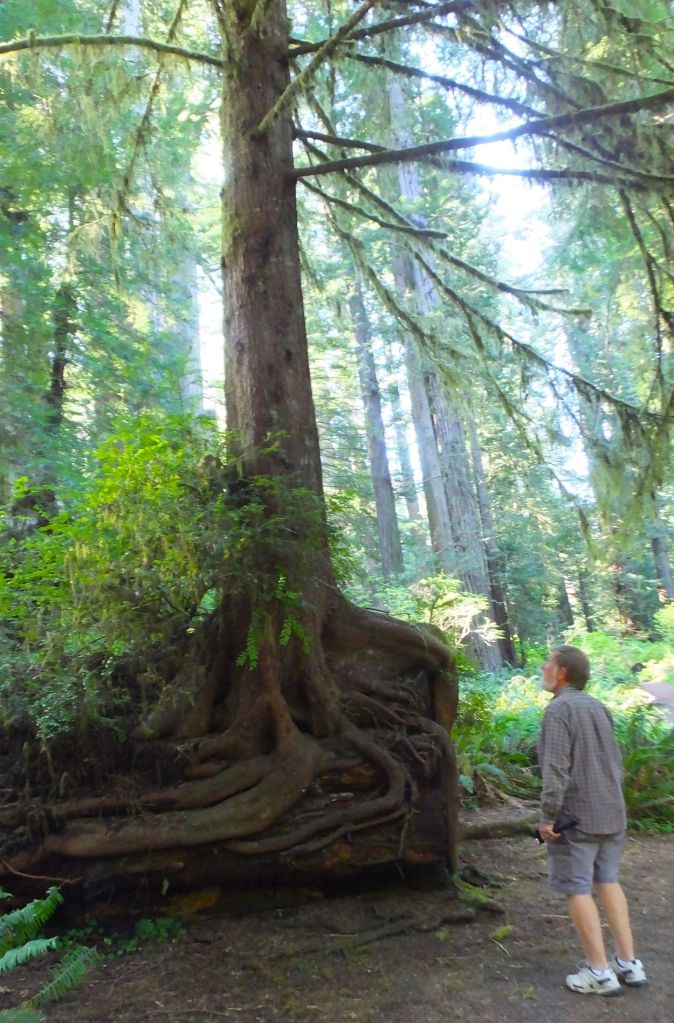
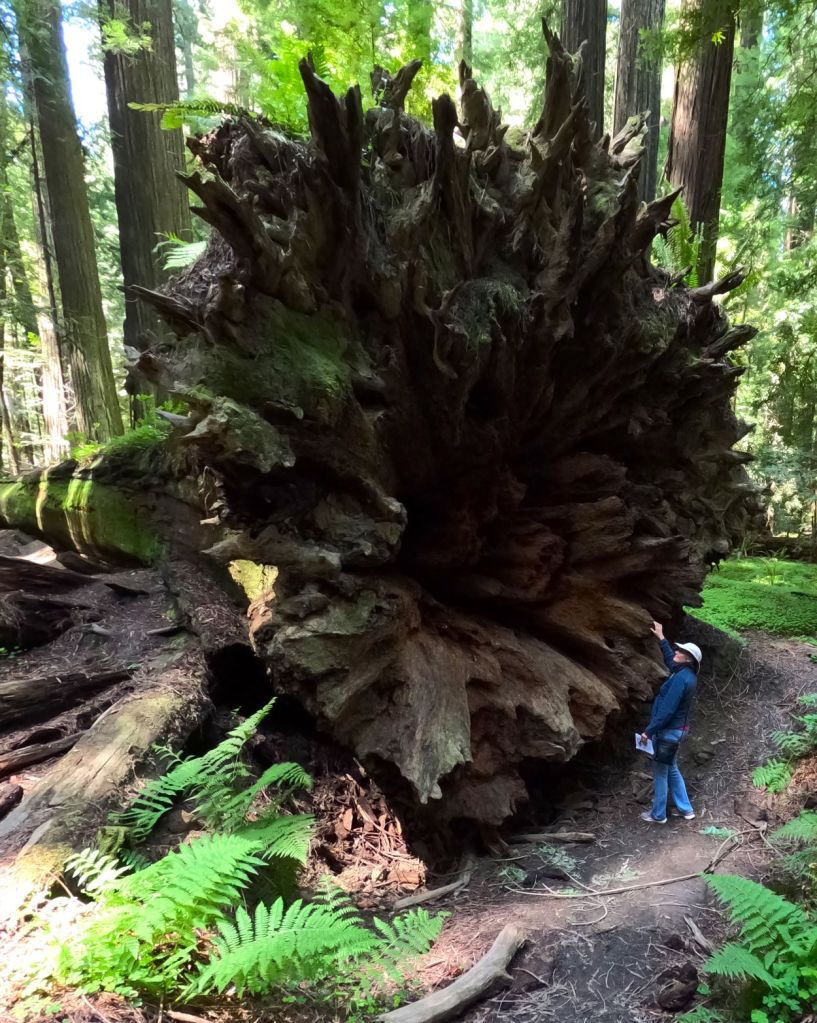
Pat and the root ball of a fallen redwood

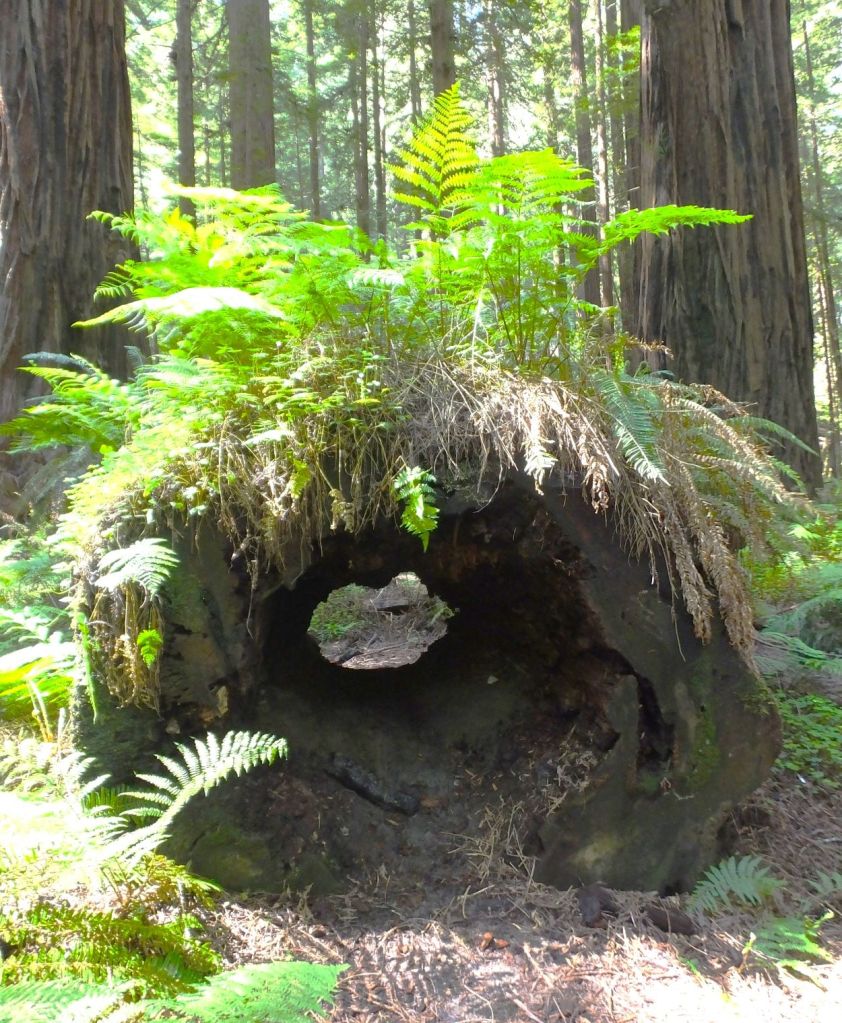
Nearby, fallen redwoods extended for hundreds of feet across the forest floor.  They take many years to decompose.  Pat was dwarfed by the roots of one fallen tree. 

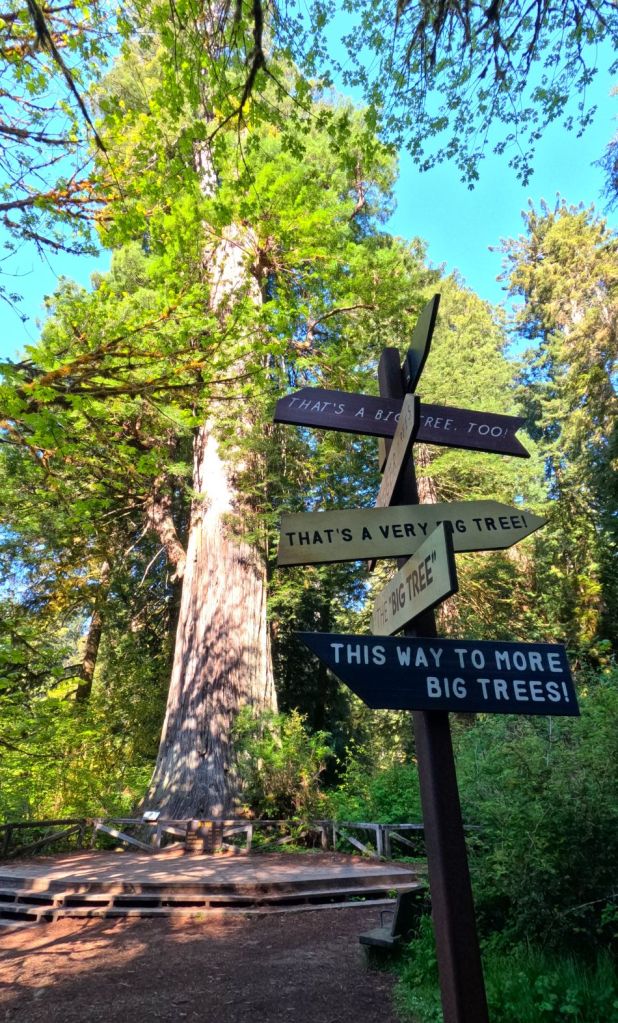
All signs point to the Big Tree

A few miles away, we camped at Prairie Creek Redwoods SP and visited the Big Tree Redwood Grove along the Nathan B Drury Parkway.  The trees can be viewed after a very short walk from the parking area. The Big Tree is a mere 286 feet tall, shorter than other redwoods we visited, but still tall indeed!

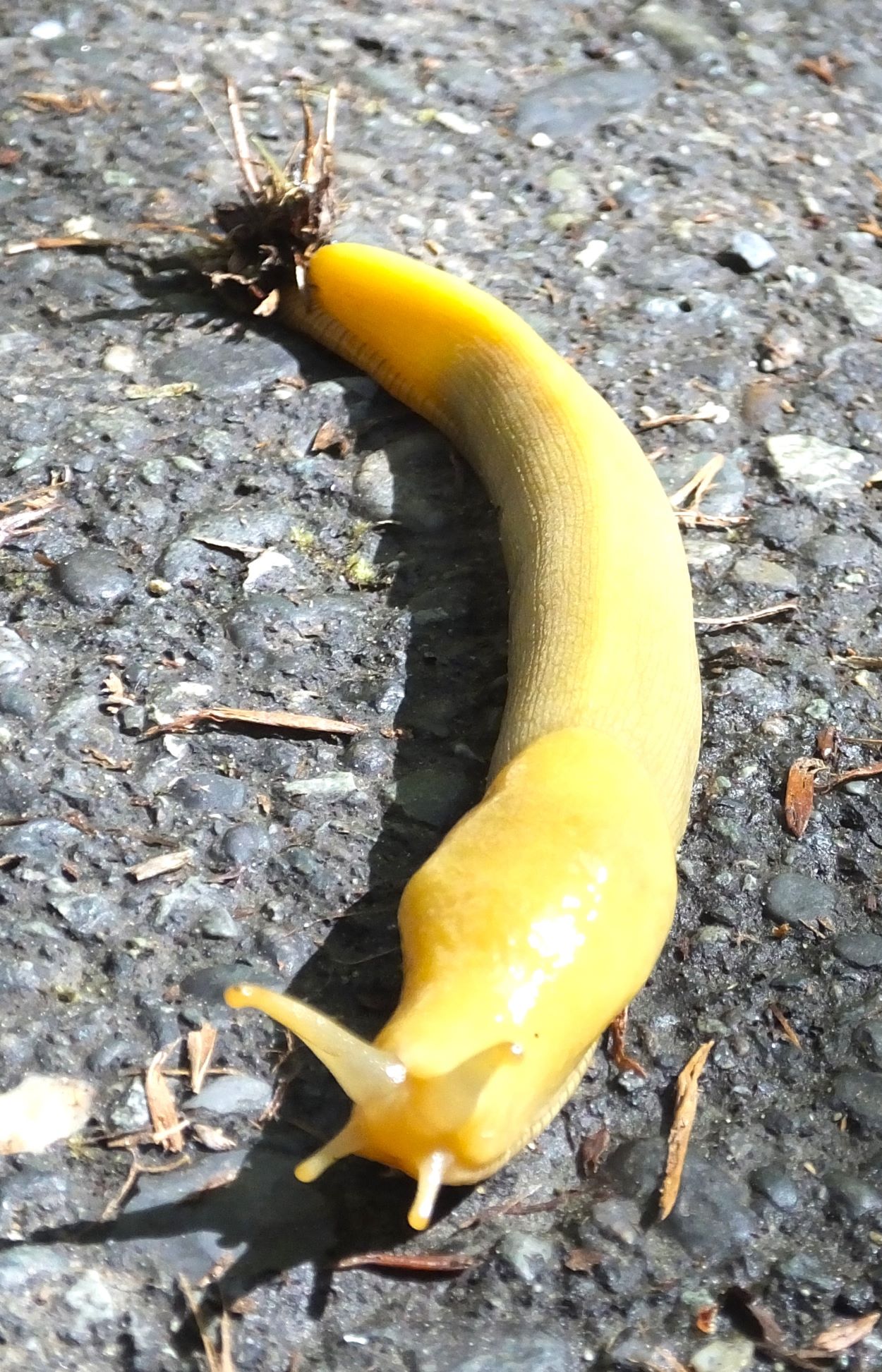
Critters in the redwoods – Big Roosevelt Elk and tiny banana slug

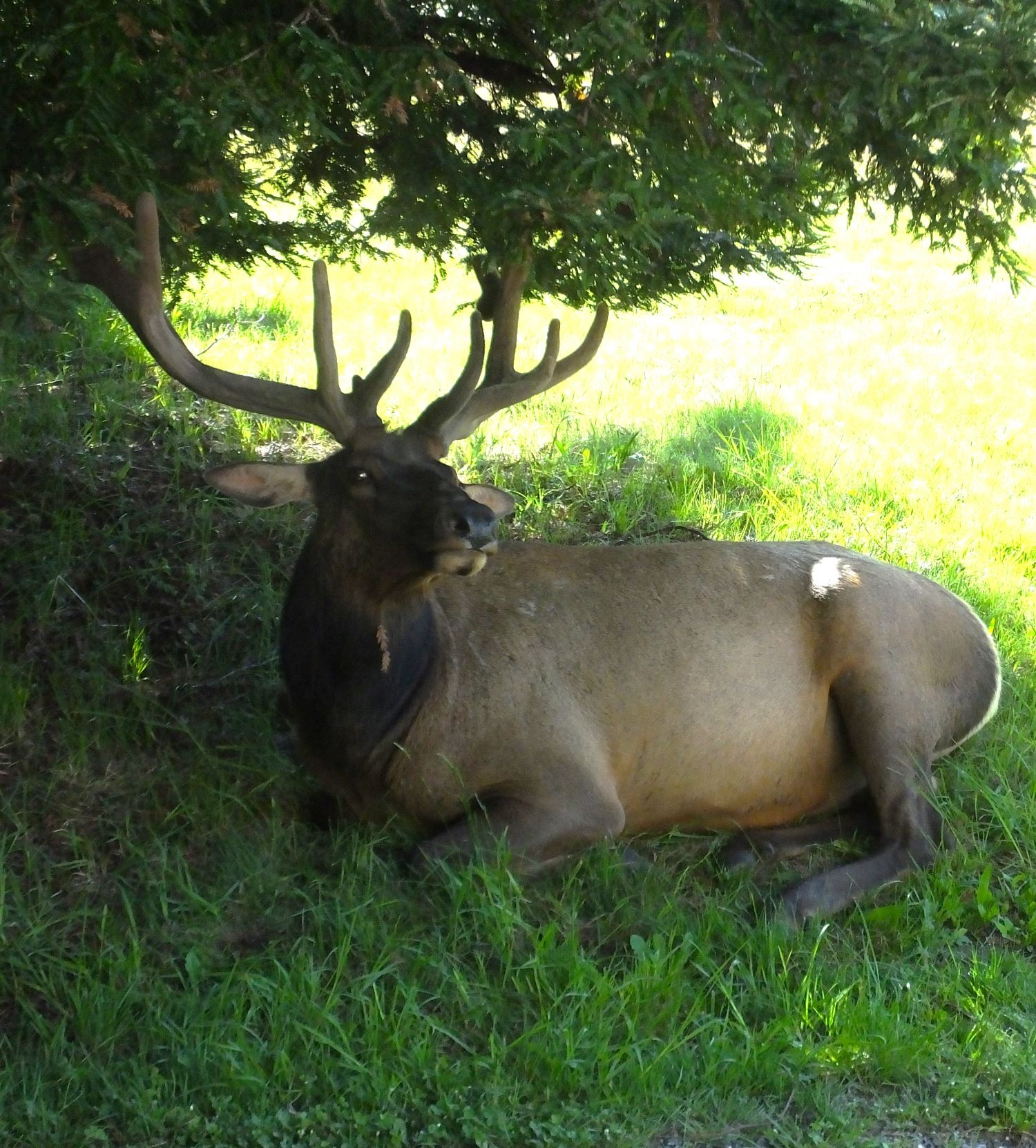
From the campground we enjoyed another impressive site – a herd of Roosevelt Elk casually grazing on a nearby field.   At the advice of rangers, we maintained a safe distance from the large animals.

We learned it is hard, if not impossible, to adequately photograph a redwood tree.  When standing at the base and looking upward, the trees seem to touch the sky. 

Bigfoot Sighting

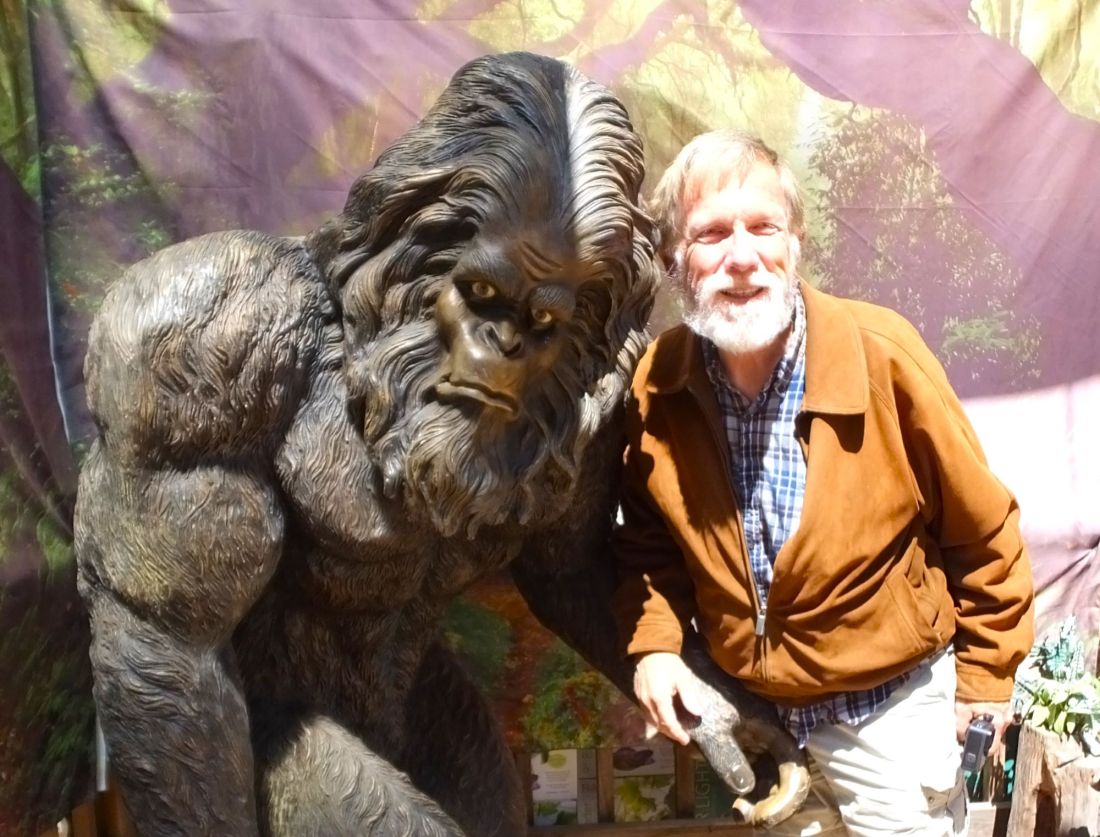
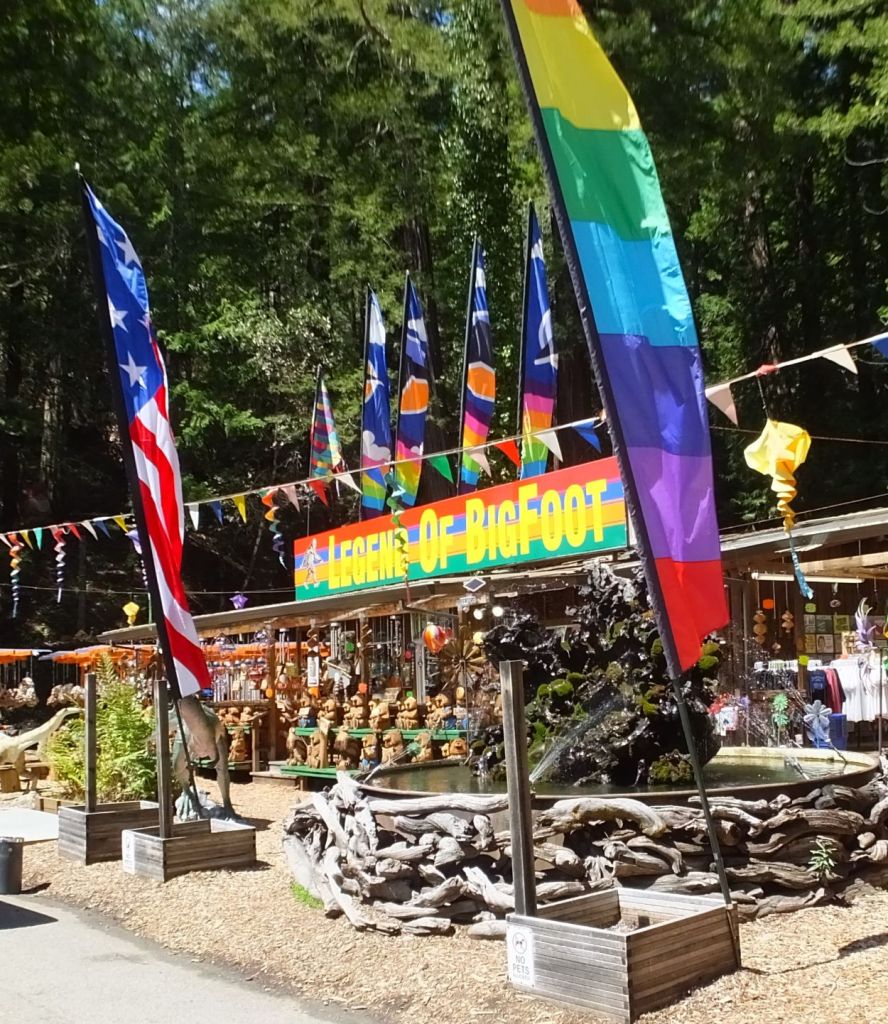
When we finished the Pacific Coast Highway and neared the redwoods, we came upon this:

Legend of Bigfoot – a MUST STOP near the redwoods

We passed this tourist trap in 1995 while on vacation and a large wooden bigfoot statue next to the road caught our attention. Twenty-eight years later we learned the old, decayed bigfoot had been removed and will be replaced with a new bigfoot. I guess Bigfoot ages like the rest of us.

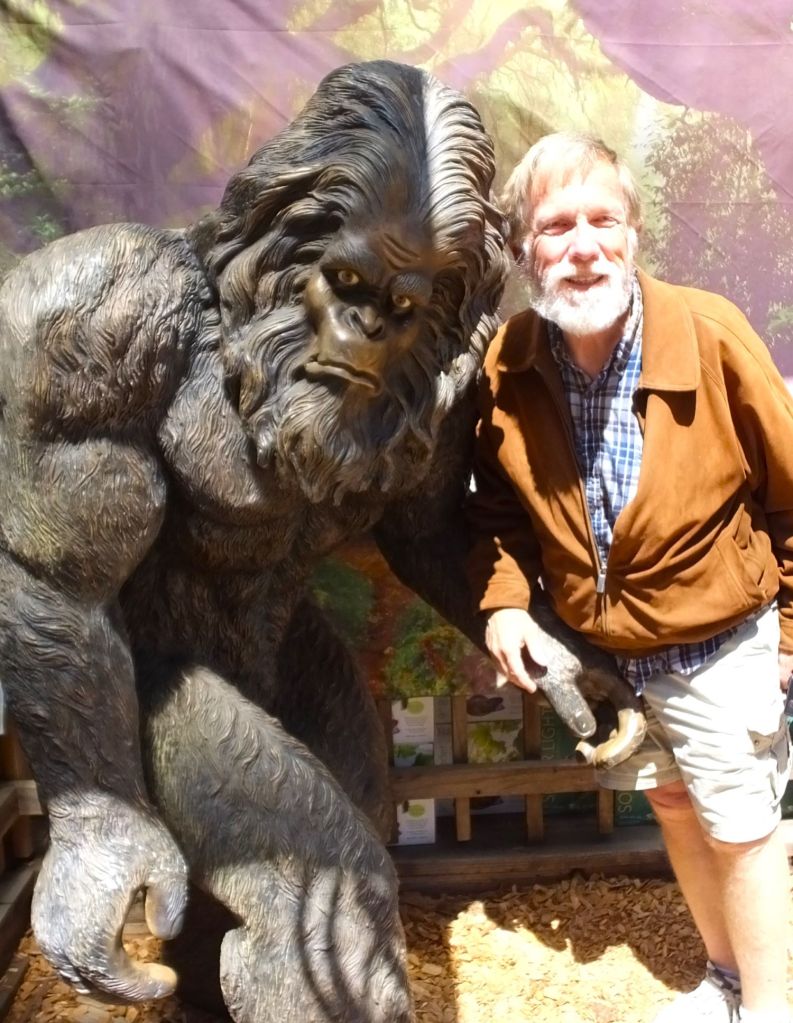
Meanwhile we had to settle for a smaller bigfoot.

Bigfoot and friend
10 Weeks of RabbiTRAILS

We’re nearly finished wandering the west and will soon continue north to Alaska.

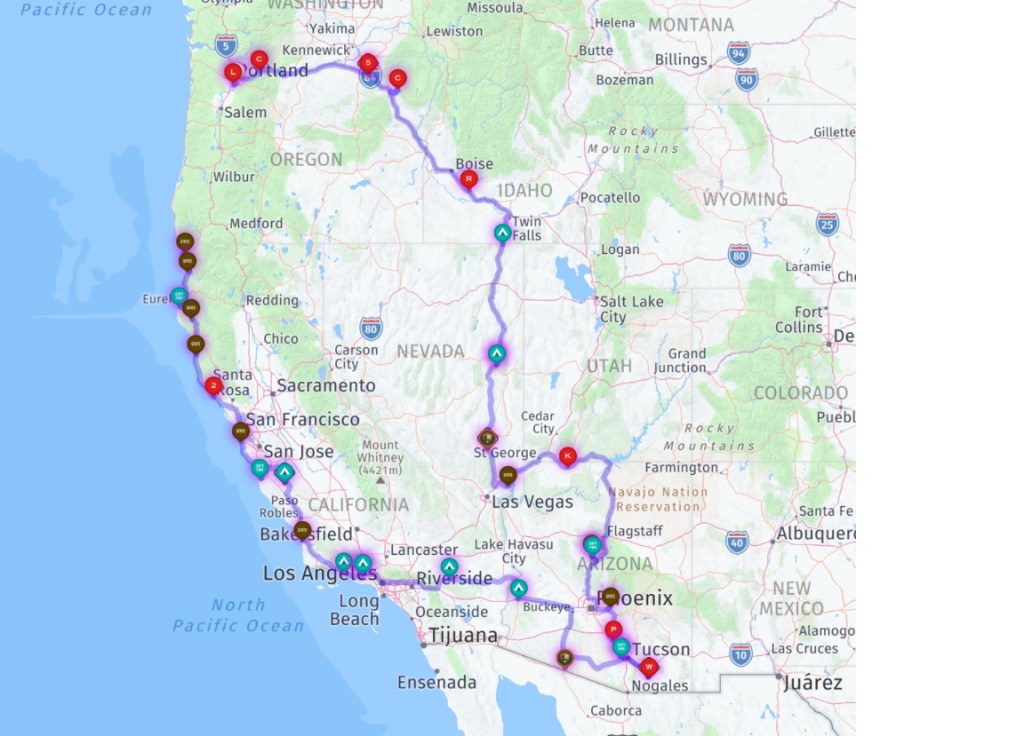
Our circuitous route through 10 episodes of RabbiTRAILS
Next Week:

RabbiTRAILS in Oregon and central Washington, including magnificent coastal views, the biggest waterfall in the world and an impressive dam.
The Good, the Bad and The Ugly of Truck Camping

(2023 Alaska Revisited Ep 9)

(Keep reading for the new names of our truck and truck camper)


We’ve been ‘trailer’ campers for a long time.

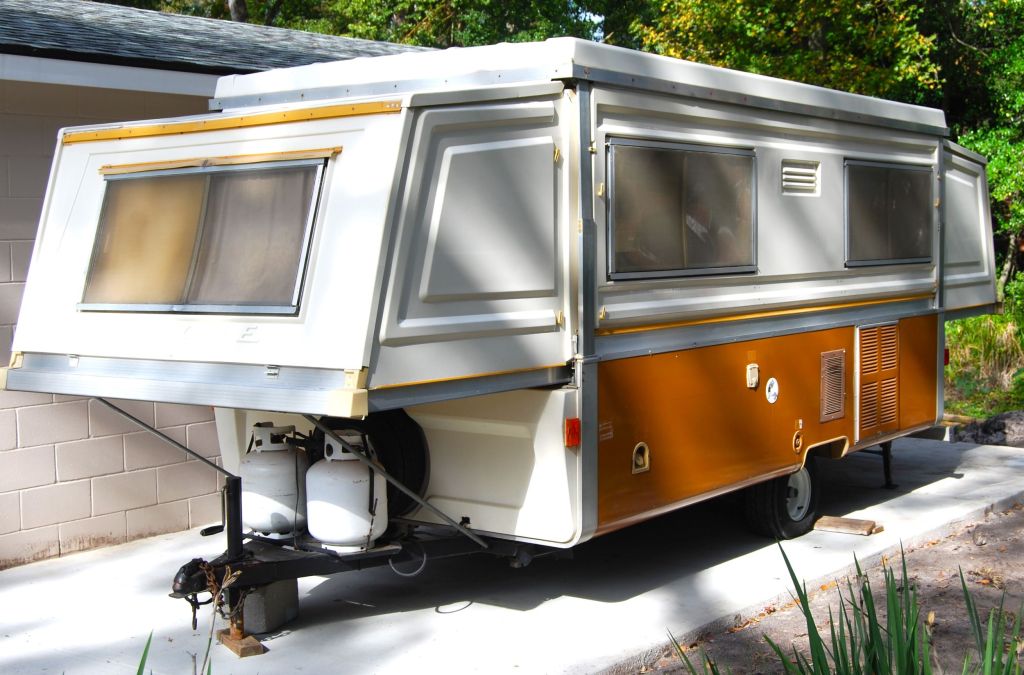
We purchased our first trailer, an Apache pop-up camper, in 1988. 

Apache camper, 1988-2011

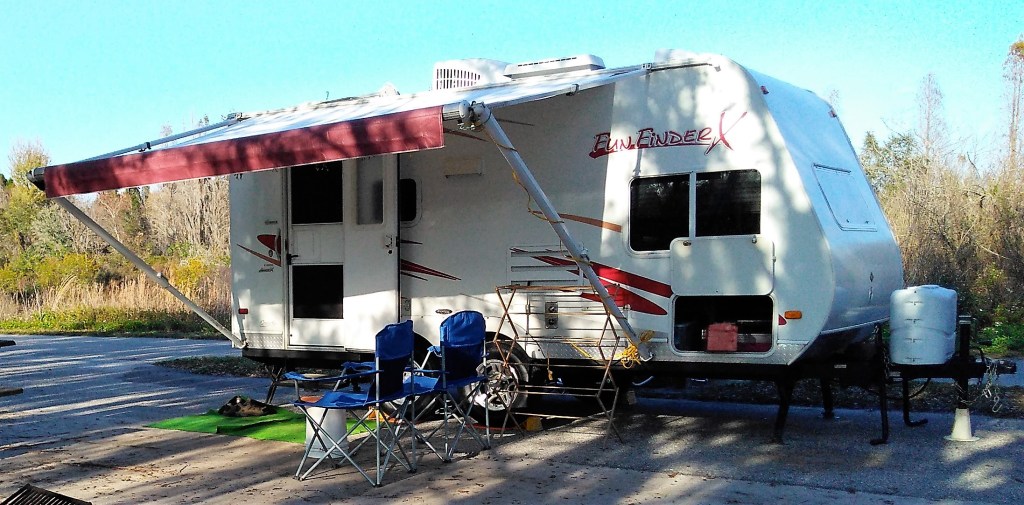
Twenty-three years later we upgraded to Pancake, a 19-foot travel trailer with a small side slide.  We took Pancake on our 23000-mile trip to Alaska. 

Pancake – 2011-2019

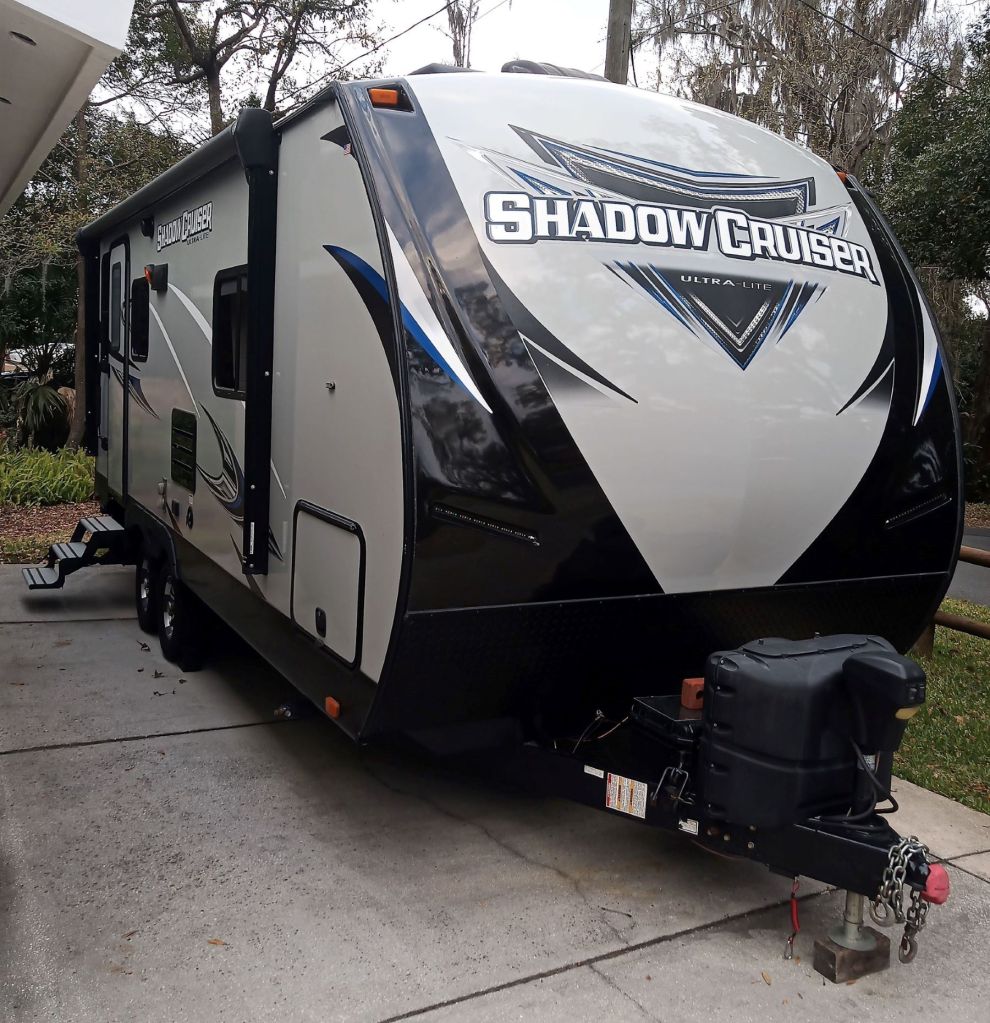
In 2019, our rig grew to a 24-foot travel trailer with rear slide that we took on trips out west, Michigan, the Blue Ridge Parkway and Newfoundland.  Oscar was great, with lots of room to spread out in, ample space to store everything, a front bedroom with walk around bed and a real bathroom with decent-sized shower.

Oscar, 2019-2023

But now we are ‘truck camper’ campers.  We’ve downsized and simplified our mode of camping.  

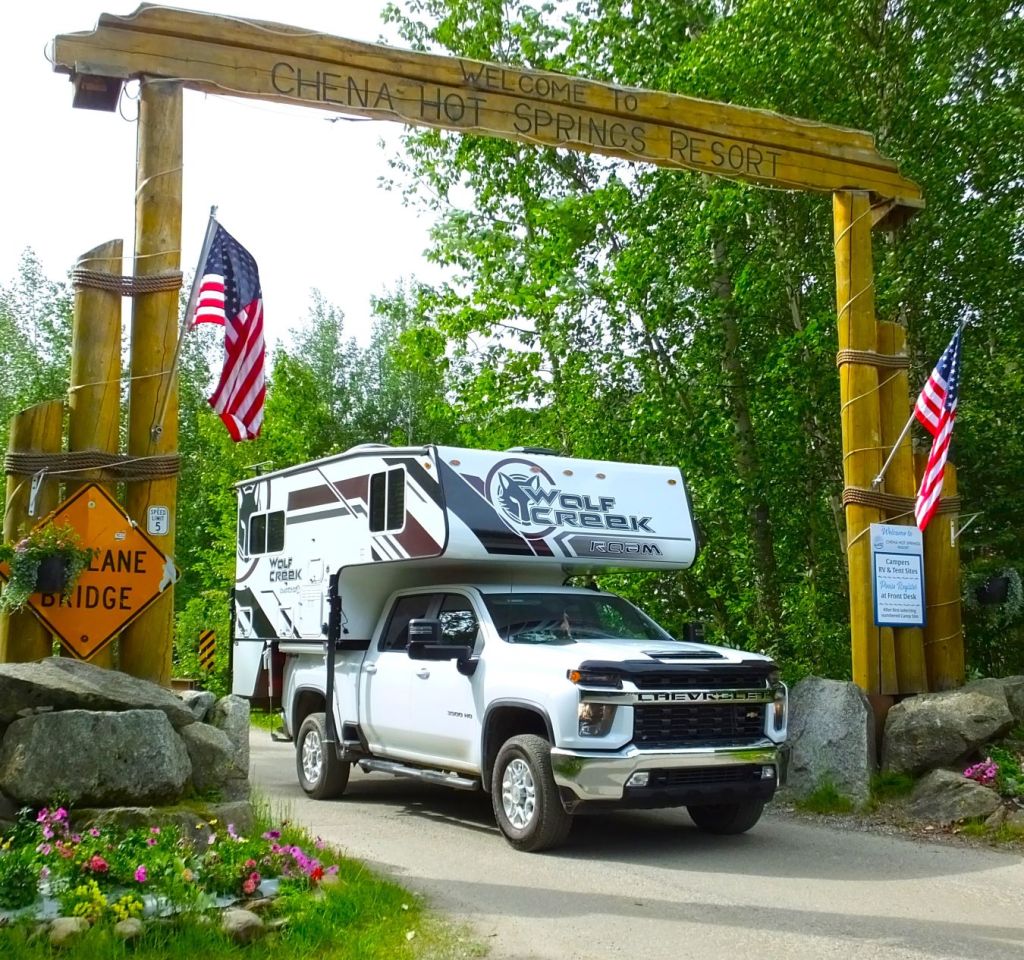
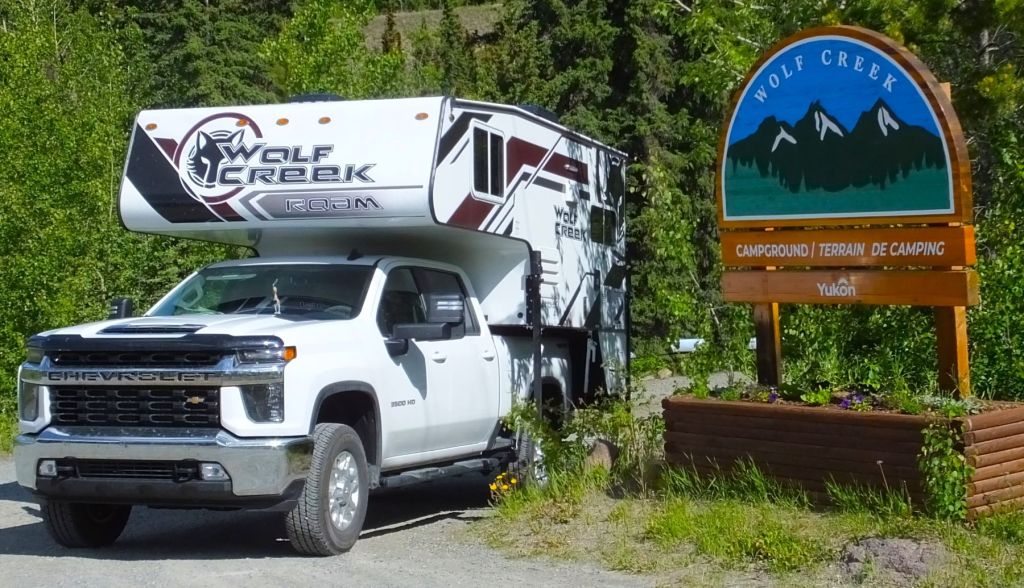
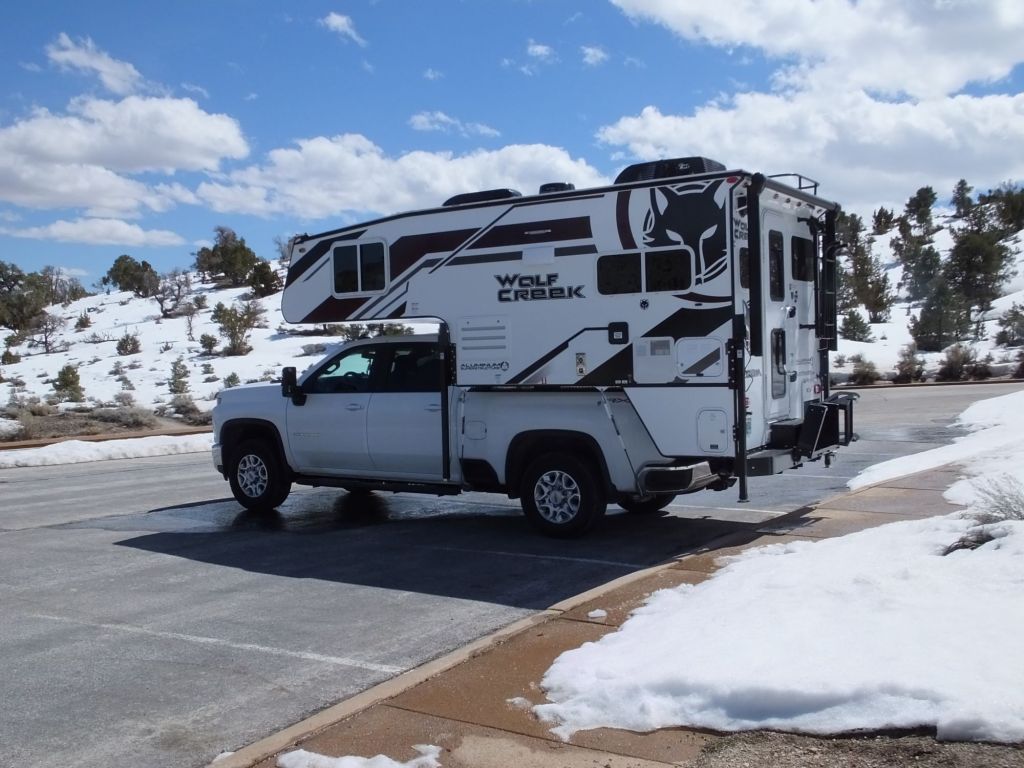
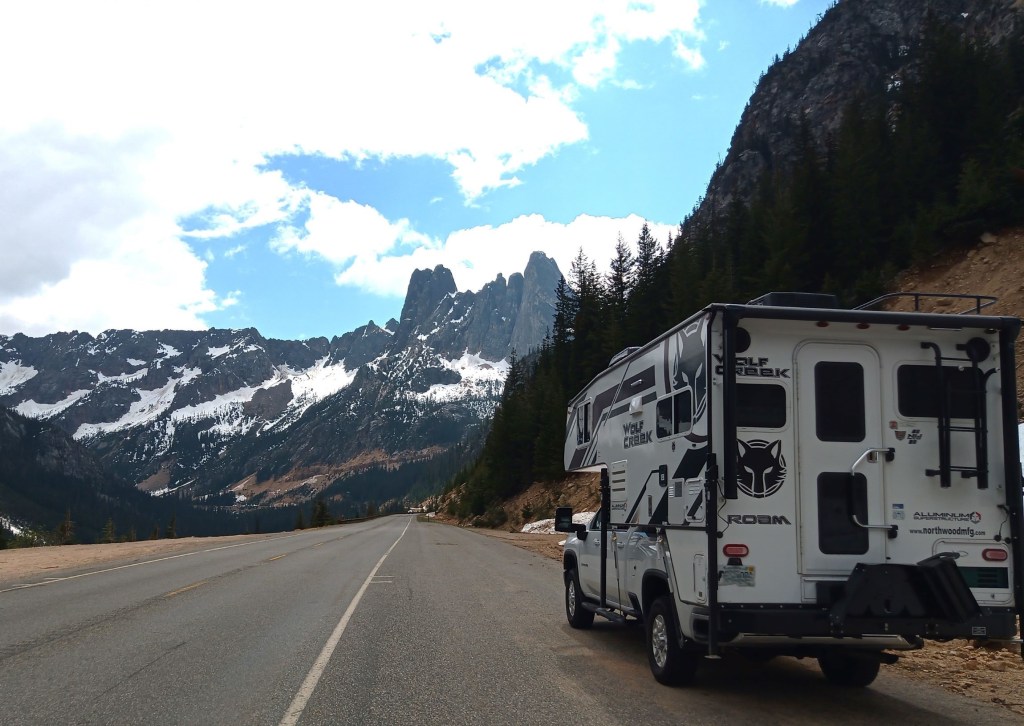
Wolf Creek 890 truck camper, 2023-?

One of our neighbors at home has predicted we won’t be happy with the new, smaller footprint and will sell the camper within six months.  Time will tell…


Clearly, every camping rig has tradeoffs.  After eight weeks and more than 5000 miles, here is the good, the bad and the ugly of truck camping with our Chevrolet 3500HD truck and Wolf Creek 890 TC.  

The Good

Setup and take down is MUCH simpler than our previous trailers.  No hitching, no tires to wear out or go flat, no axles to bend, no bearings to go bad and no slides to rebuild.  It is easier to ‘dry’ camp without water/electric connections, and when we do use hookups, we can quickly disconnect and be on our way.

Moving about. Getting into gas stations and parking lots, backing up and finding a right length campsite is pretty much a no-brainer.  Our TC is slightly longer and just a little wider than a full length pickup.  Our TC is 11.5 feet high, so we have to watch overhead clearances and tree limbs, however.

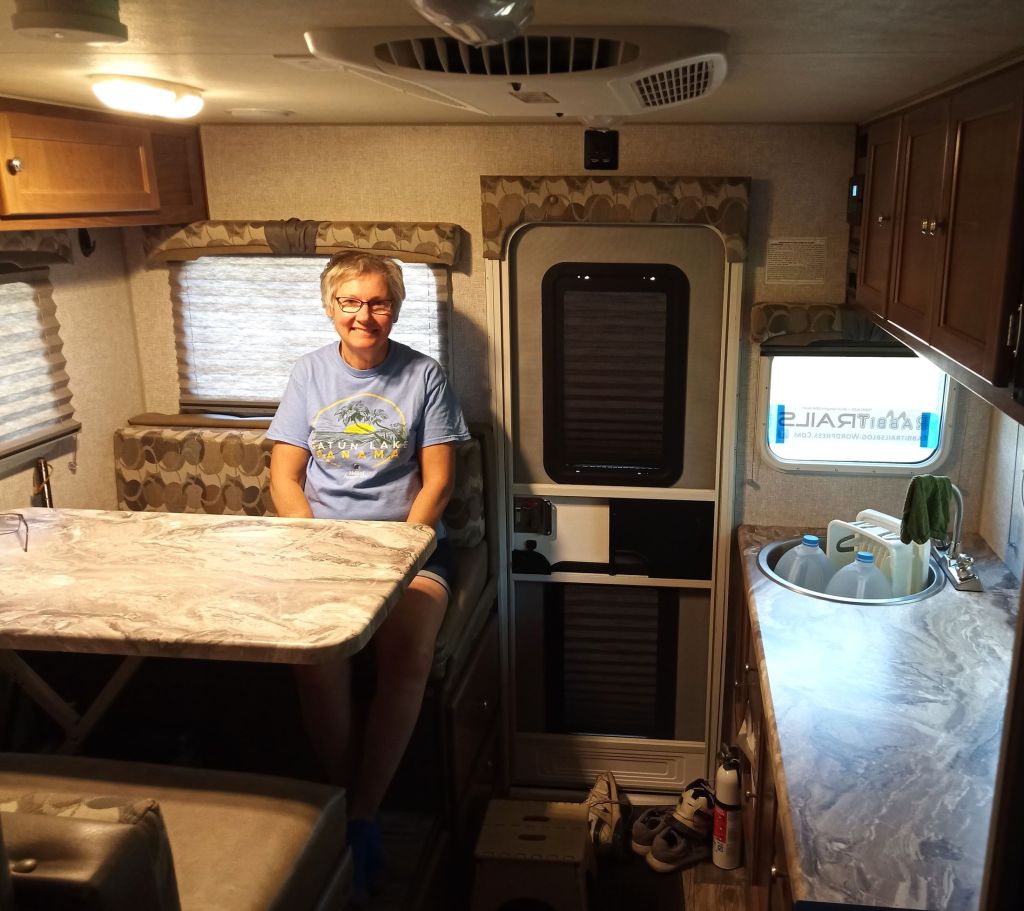
Big dinette with great view. We really like the four person dinette in our TC. It has windows on three sides.

Dinette – with wrap around windows

Nimble and flexible. Our TC setup gives us greater flexibility.  We can take our ‘home’ with us and more easily prepare meals and even shower during stops while on the road. Boondocking and moochdocking are much easier and we can take the TC off the back of the truck to use it as a base camp when we explore an area.

Better power options. We have a lithium battery and built-in generator that add to the flexibility.  We can camp without connections in remote locations.

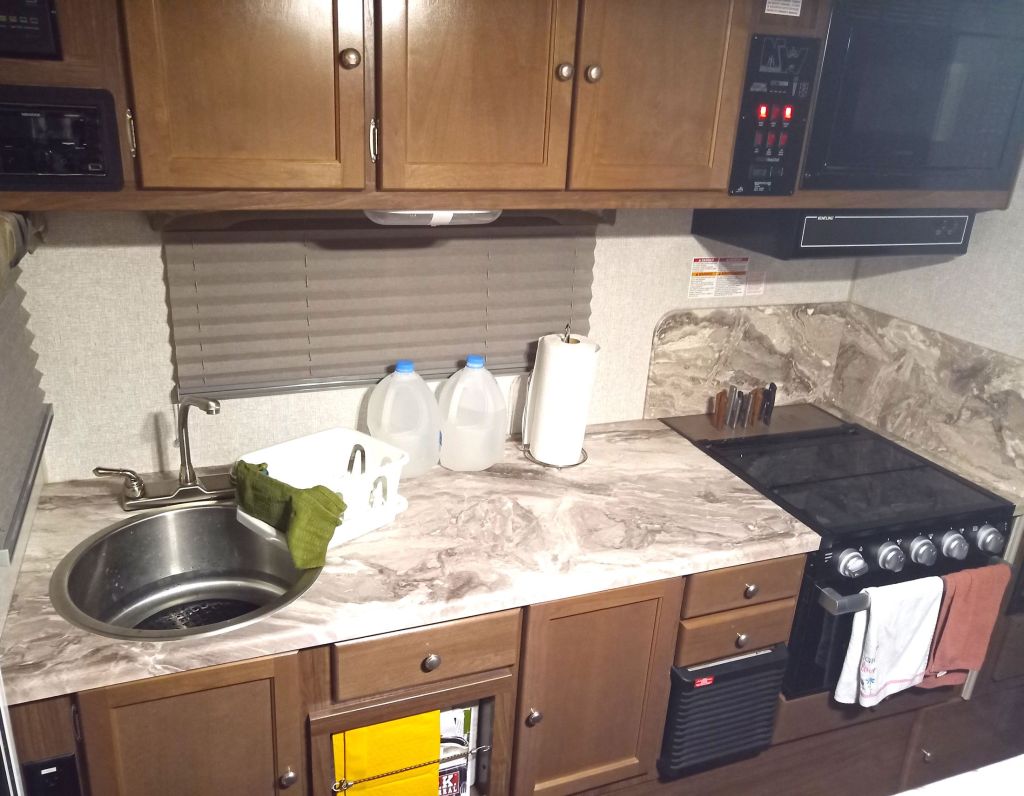
Kitchen – lots of counter space

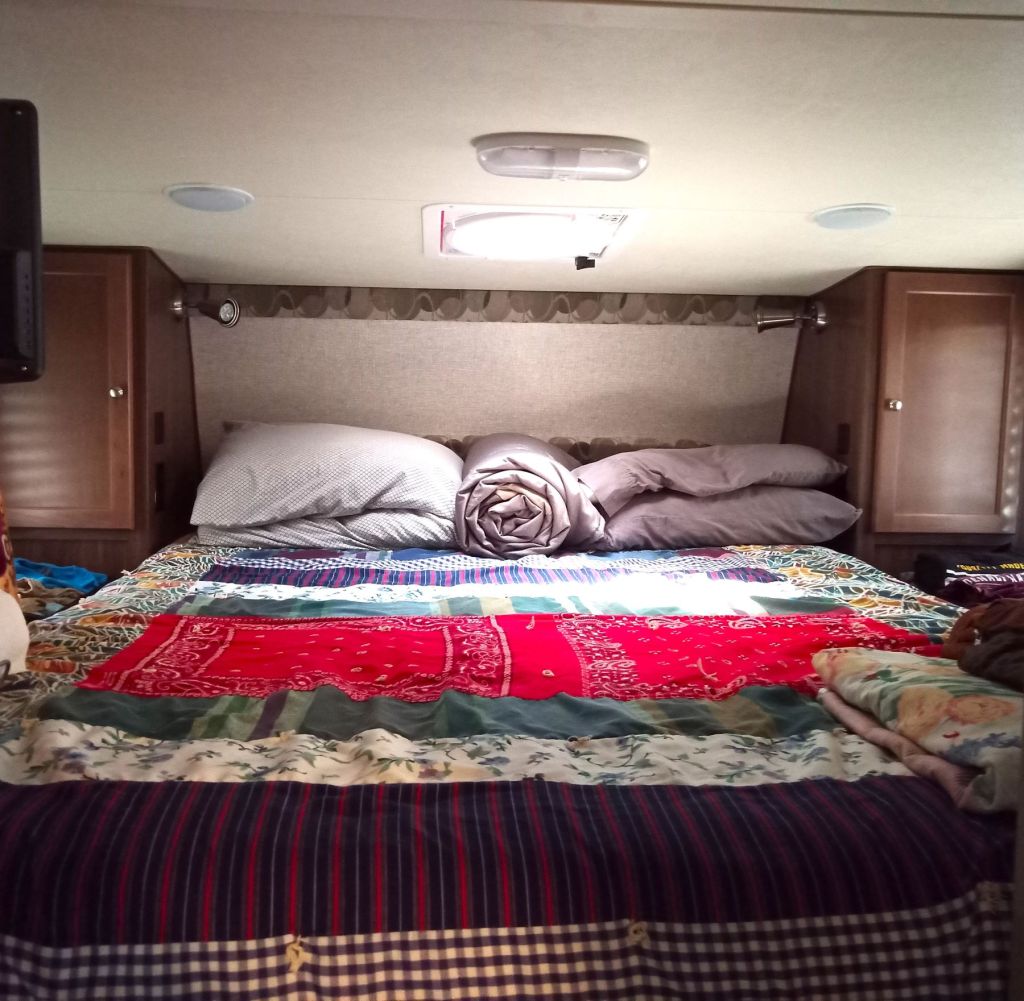
Great use of space. Our TC is smaller than Oscar and about the same size as Pancake. Space is used very efficiently.   There are lots of drawers, cabinets and storage nooks, inside and out.  There are even four closets in the sleeping area!  All three RVs had a queen-size bed.  The kitchen area is really useable in our TC, with much more counter space than our previous trailers. 

Sleeping area – with four closets

The Bad

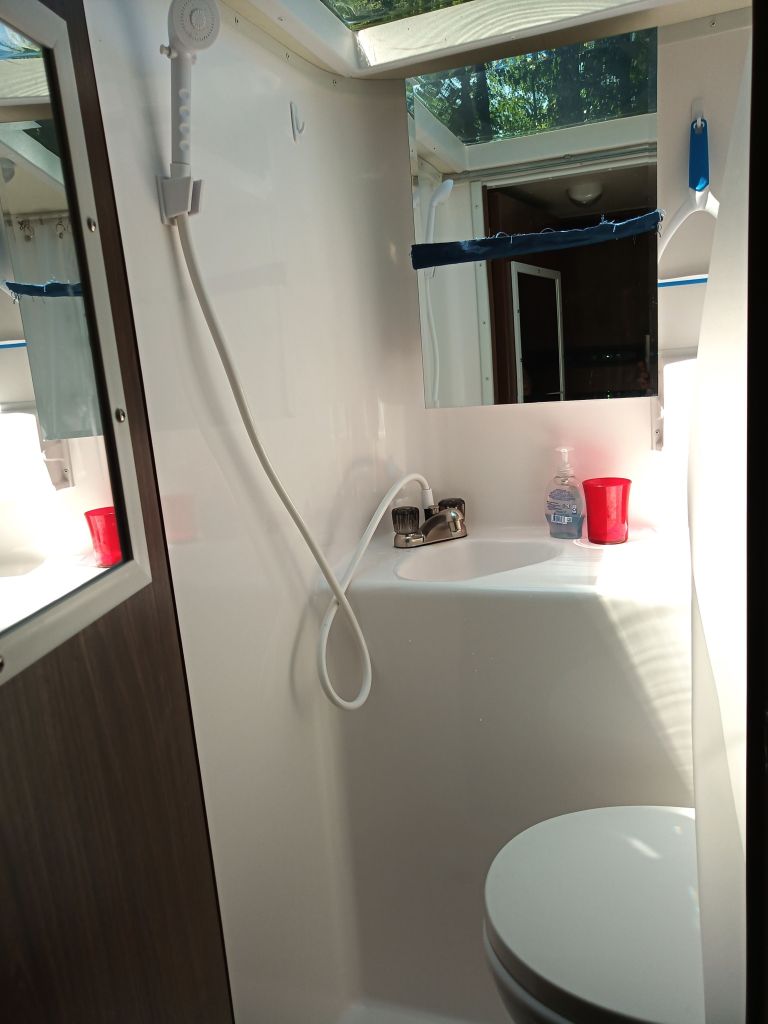
Small bathroom. Our TC bathroom is small.  It has a ‘wet bath’ with a shower, toilet and small sink combined in one small compartment, whereas Pancake had a small bathroom with tight corner shower and Oscar had a nice-sized bathroom and large (for an RV) shower.     

Small wet bath – it gets the job done

Leveling can be challenging. RV refrigerators require the camper to be reasonably level to work correctly.  It is harder to level our TC than it was to level any of our past trailers.  We’re getting better at leveling, however.

‘Fluid’ capacity is less. Every two to three days we have to fill fresh water and dump wastewater tanks.  Pancake was about the same.  Oscar had larger tanks that gave us an additional day.   

And the Ugly

Wind. Wind affects both TCs and travel trailers.  I think our steering wheel cover has permanent grooves from gripping the steering wheel so tightly while driving in high winds. 

Costly suspension upgrades. Our TC rests entirely on the truck frame and suspension, and we have experienced rear end ‘squat.’  We added air bags to reduce the squat, but sway (rocking back and forth) increased.  It will take a few more adjustments to get things right.  Unfortunately, such adjustments are pricey.

Fuel Costs. It takes a very large (one-ton) truck and a LOT of gas to carry our rig up mountains, across plains, etc. We average a little over 10 miles per gallon.  Do the math:  23000 miles driving / 10 MPG * $x.xx gallon = total cost of gas.   We expect gas will be our biggest expense during this trip.  Fortunately our MPG is actually slightly better than it was with Max and Oscar.          

Things break.  Our rig has been excellent overall. Two items have been repaired under warranty and we have made a few other minor repairs.    

On a very cold morning near Flagstaff, we pressed the button to start the generator.  When nothing happened,  I feared the worst. I looked things over and discovered a cable had slipped out of its battery connector.  We installed a new connector, and the generator was working again.      
Then the fridge quit working.  The control panel flashed a repeating pattern of five red blinks.  We reset the power to restart the fridge.  Unfortunately, the problem continued to occur.  A gas valve was replaced in Tucson and the fridge is now working fine.

A couple weeks ago we found a significant crack in the back doorstep landing.   Northwood, our TC manufacturer, quickly replaced the defective landing.

Oscar and Pancake had to have repairs as well. Time-consuming maintenance and costly repairs are an ugly reality of owning an RV.


Do you have any RV good-bad-ugly questions for us?  Post them in the comments and we’ll do our best to provide an answer.

The Big Name Announcement

We asked for your suggestions of names for our truck and TC. Thanks to all who sent such great (and interesting) ideas. 

Max, Pancake and Oscar will now have named siblings.

With no further ado, here are the names we have chosen:

(drumroll please)

We’ve named our Chevy 3500HD PERCY, in part to honor Pat’s dad, Charles PERCY Hattenstein, and because we just liked the name!

Jan Farmer, a friend from Camp Cedarbrook Texas, suggested naming our Wolf Creek 890 TC PAPOOSE.  We loved the suggestion and shortened it a bit to PAP.

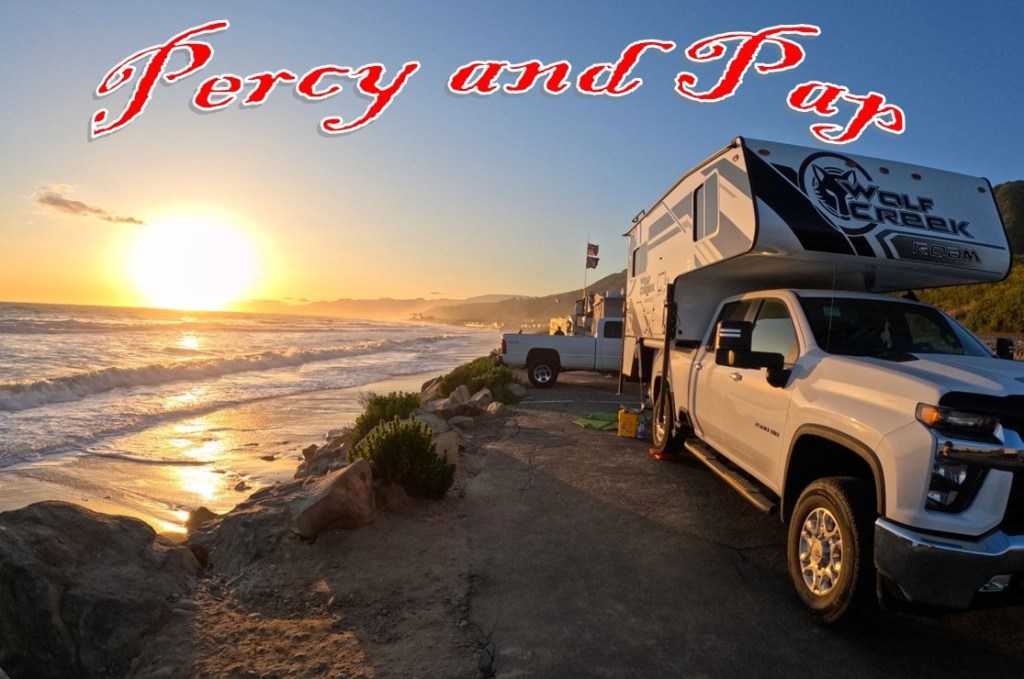
So, blog followers, meet PERCY and PAP!

Next week: 

Redwoods: big, beautiful and hard to photograph!

Nine Days on the Pacific Coast

(2023 Alaska Revisited Ep 8)

In the east, Florida A1A follows the Atlantic coastline. The highway offers wonderful seashore views and engaging stops in scenic small towns and several large cities. 

A1A’s counterpart in the far west is California 1 or the Pacific Coast Highway.   The PCH hugs the Pacific Coast for many of its 656 miles – starting between San Diego and Los Angeles in the south, continuing northward to San Francisco, and finally ending in the north California town of Leggett. 


Truck campers in Simi Valley soon to part company

We said goodbye to Pat’s brother, James, after more than a week of camping across Arizona and southern California.  It was drizzling as we left and headed south on CA 23 across the Santa Monica Mountains.  After a dozen miles of twisty-turny mountain roads, we reached the coast and clear skies.

Thus, our nine day journey on the PCH began.

We bypassed the southern 100 miles or so of the PCH that goes through Los Angeles, and started near Malibu instead.  On our left there were spectacular views of the Pacific Ocean and the rocky shoreline, and on the right we saw grassy hillsides and occasional vineyards.

The highway turned inland for a few miles and we passed fields of strawberries and other crops around Oxnard and Port Hueneme.  When I was young, my parents spoke of these places that were near where my dad was stationed while serving in the US Navy.

Oceanfront at Rincon Beach
Camping at Rincon Beach. What a view!
RVs were parked for more than a mile, some very close to the waves

A few miles north, between Ventura and Mussel Beach, we passed a long line of RVs parked along an old section of the PCH. It was Rincon Beach, a ‘campground’ that overlooks the ocean.

We joined them for the night and slept to the sounds of crashing waves and occasional passing Amtrak trains.  Rising the next morning, we could see the Channel Islands a few miles offshore, as well as several oil-drilling platforms near Santa Barbara.

Sunset at Rincon Beach
Pismo Beach and A Story to Tell

We continued along the coast to Pismo Beach where I met a man with a story to tell.

Chris, a ranger at Oceano/Pismo Beach State Park told me when he was young he lived in the Florida Keys.  I asked him what brought him to California. The bearded, 50-year-old explained that he moved often over the years and ended up in California. For years he was consumed by drug and alcohol addictions and two years ago, after a third addiction-caused coma, he awoke with no desire for drugs or alcohol.  He credits Jesus for changing his life and has been a Christ-follower since.  What a story of God’s goodness and redemptive power!

South of Big Sur – Elephant Seals

After leaving Pismo, we learned a 30-mile section of the PCH was closed near Big Sur as a result of intense weather earlier this year.  We drove as far north as possible to Ragged Point and then returned south a few miles to detour east to Pinnacles NP.

We stopped at Elephant Seal Vista Point and endured the cold coastal rain for an amazing sight.  From a bluff overlooking the rugged coast and crashing waves, we saw HUNDREDS of elephant seals.  Their rotund gray bodies were lying next to and atop one another.  Some seals scooted along with their flippers. Others seemed to be having grumpy arguments with one another.

The detour took us inland past fertile farmland.  There were immense fields of green and red leaf lettuce, vineyards and other fruit tree orchards.  It was interesting to see where our produce comes from.  

Pinnacles NP and an Amazing Connection
California Condor?

We camped the next two nights at Pinnacles NP.  The remote park has interesting rock formations and is a habitat for dozens of California condors reintroduced in recent years. We hiked a mile up the steep Condor Gulch trail to a viewpoint where we hoped to see a condor.  Several other condor-watchers were there also.  We saw several large birds soaring in the distance but are uncertain if they were condors.  The hike was worth it anyway.

We also hiked to Bear Gulch Cave where we used our cell phone flashlights to find our way through the cave.  Dripping water fell from the ceiling and collected into runoffs in various spots.  We climbed a slick stairwell out of the cave and up more steep, rocky stairs to the Bear Gulch Reservoir.

Placid Bear Gulch Reservoir

As we returned to the parking lot, we realized we had not seen Moses Spring, another scenic point along the trail. 

We backtracked a bit and met two hikers also searching for the spring.  We learned one of the hikers, Julie, is from the same city we are from in Florida.  We asked what part town she lives in and discovered we go to the same church!  Then we recognized the other hiker, Kok-Tow, who used to attend our church and now lives in another city closer to her daughter and grandchildren.  They were on a two-week tour of California.

Our amazing God had arranged encouraging fellowship in a remote part of California more than 3000 miles from home!

Julie, Kok-Tow, Pat and Ed fellowshipping in Pinnacles NP
North of Big Sur and Monterey

From Pinnacles NP, we returned to the coast where we camped several nights near Monterey.  One day we drove south on the PCH to Big Creek Vista Point where the road was closed.  Along the way we drove across several iconic PCH bridges.  The coastline views were magnificent.

Back in Monterey, we enjoyed the 17-mile Drive at Pebble Beach.  We passed by the windswept Pebble Beach Golf Course and stopped along the rugged coast where we saw otters, sea lions, elephant seals, lots of birds and a few golfers.

San Francisco and the Golden Gate Bridge

We continued north past Santa Cruz and neared San Francisco.   The PCH became increasingly busy.  After an hour or so of heavy city traffic, we crossed the Golden Gate Bridge and from a vista near the northern end of the bridge, we could see the world-renowned bridge, the San Francisco skyline and Alcatraz Island.

Finishing the PCH

The final 200 miles of the PCH from San Francisco north to Leggett follow coastal contours as they rise and fall, and zigzag around never-ending curves.  The road turns west for the final 40 miles, crossing several mountain ranges and ending a few miles from the redwood parks. 

Google shows a twisted route ahead

We drove this section of the PCH in 1995 while on a family camping vacation and were told it would take 2-3 hours to go 45 miles.  I thought that had to be an error but became a believer after enduring the road.  The road is no straighter or quicker today!

Our final night on the PCH was spent a few miles from Ft Bragg, where we camped near the ocean and walked a long boardwalk to Laguna Point.  A few seals were swimming in the turbulent waves near the rocks.  It was a beautiful ending to this chapter our Alaska journey.   

Next week: 

Thoughts on ‘downsizing’ to a truck camper plus we reveal the names of our truck and camper!