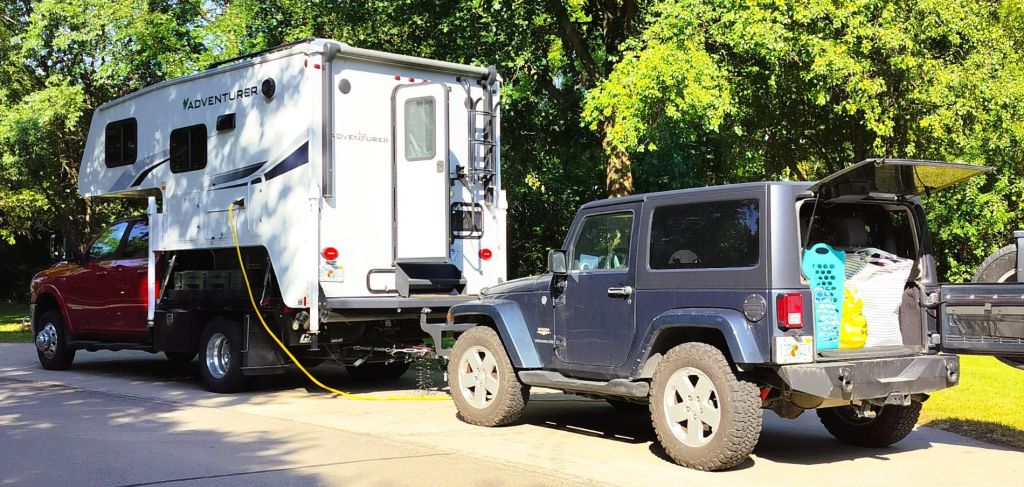
After nearly three weeks and more than 2500 miles, we were joined near Kansas City by Pat’s brother, James. He is also a truck camper owner who brings his Jeep along.
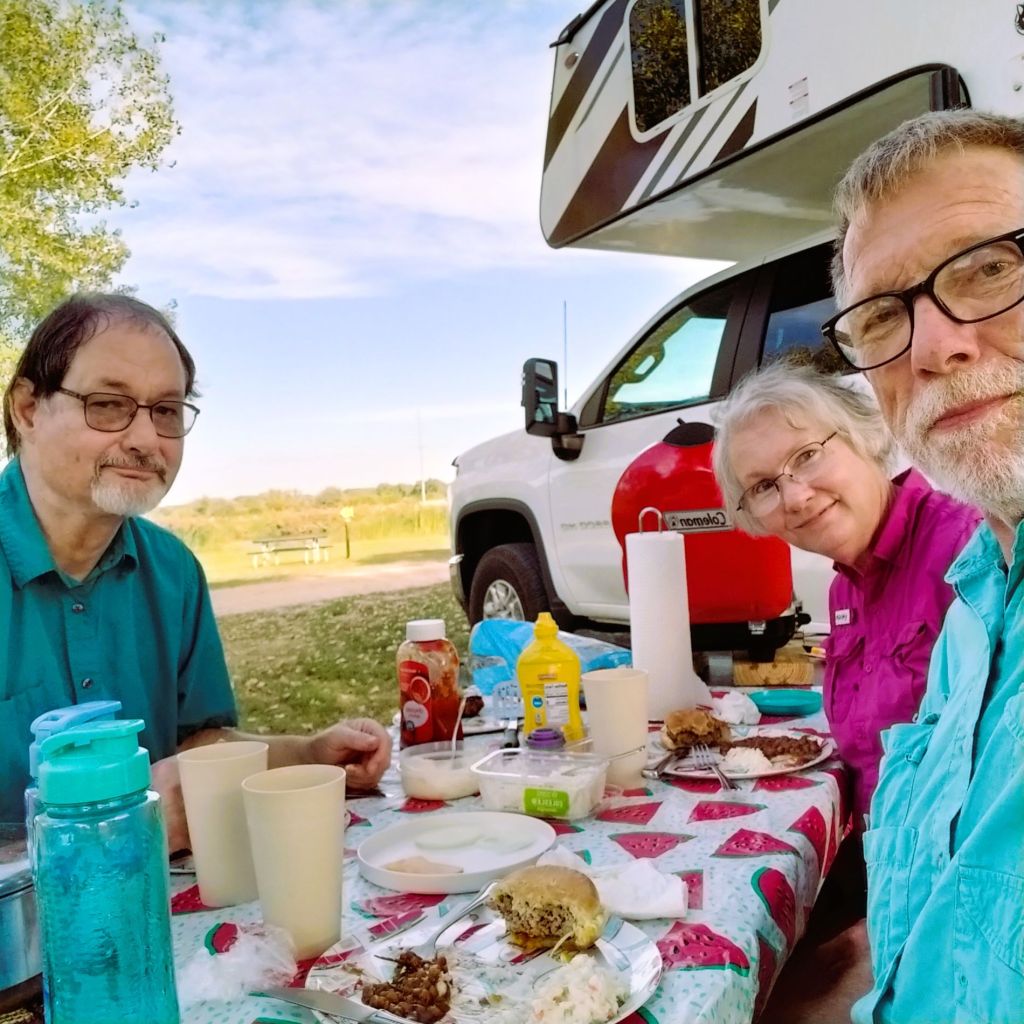
James’ truck camper and JeepWe enjoyed dinner outdoors one pleasant Nebraska evening
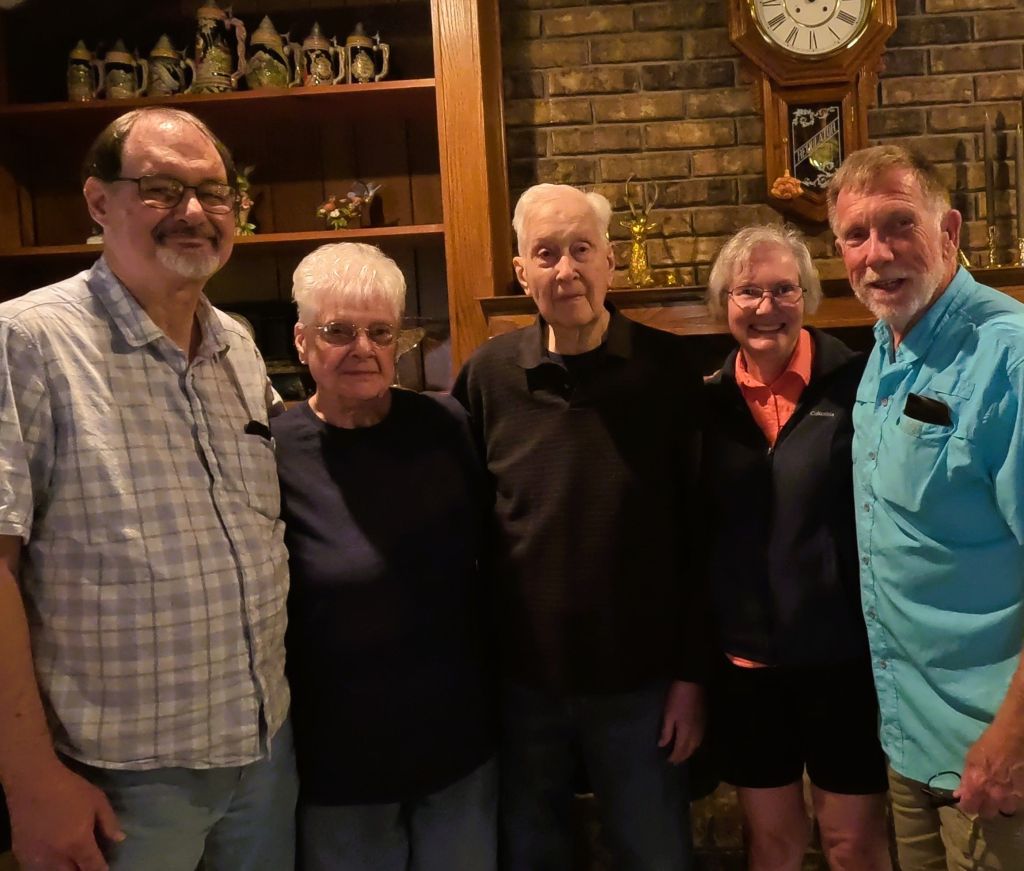
As we have done on several past trips, we visited Pat’s and James’ aunt and uncle in Shawnee, KS, near Kansas City. We enjoyed catching up with them and agreed connecting with family is an important part of travelling.
We had an enjoyable visit with Aunt Martha and Uncle David near Kansas city
A Strategic Visit
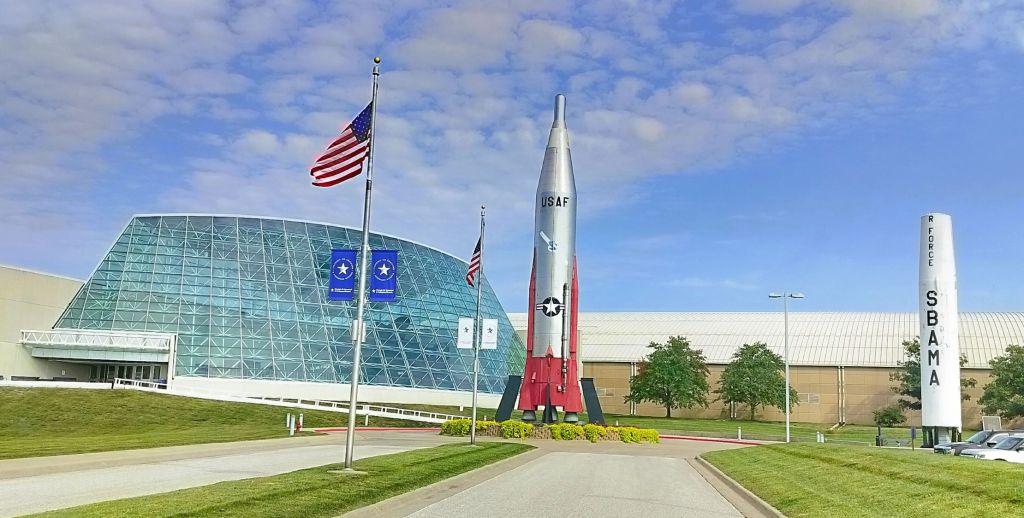
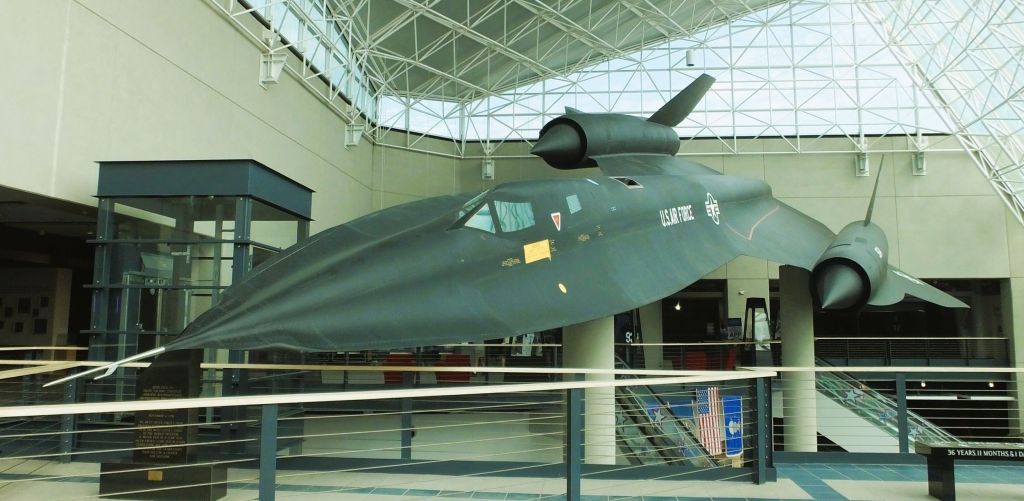
Leaving Kansas, we toured the Strategic Air Command Museum near Omaha, NE. The museum has extensive aircraft and other exhibits on display. The SAC, formed in 1946, was responsible for the US strategic bomber and intercontinental ballistic missile forces that were intended to deter aggressors and, if necessary, execute strategic nuclear attacks. In 1992 the SAC was disbanded, and its various functions were transferred to other military commands.
Entrance to the Strategic Air Command Museum near Omaha, NEDozens of planes are on display in the SAC Museum, including a SR-71 Blackbird supersonic reconnaissance aircraft
Cabbage, Really?
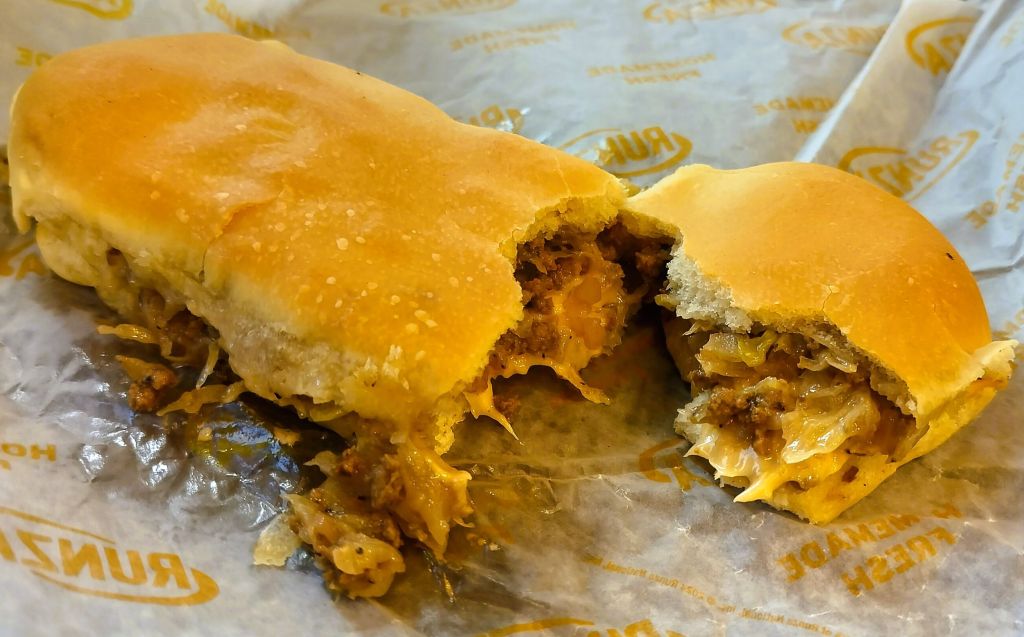
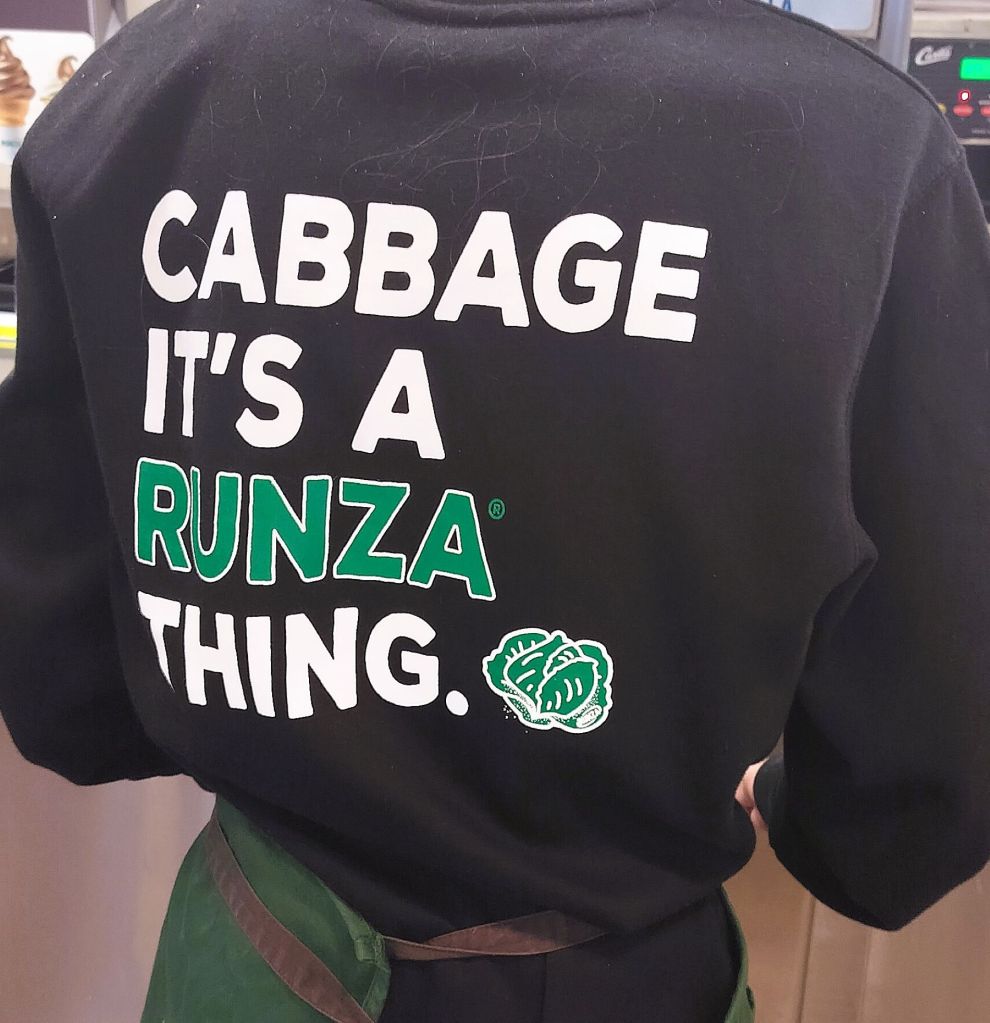
We were hungry after visiting the Kool-Aid Museum in Hastings, NE (see last week Ep 3), so we decided to lunch on a Nebraska staple – a runza. Originating from German and Russian cuisine, a runza is a baked bread pocket sandwich filled with seasoned ground beef, onions and cabbage. Our savory runzas were delicious.
Runzas are yum-za!Cabbage on a ground beef-filled pocket sandwich makes for a savory combination
North Platte – Tanks and Trains
Tankers on the North Platte River (from Google)
Continuing west in Nebraska, we spent the night in North Platte, a sizeable town not far from the river of the same name. We hoped to go tanking, where we would float a few miles down the river in a large livestock water tank. We were disappointed when we learned the tanking season was over for the year. Perhaps on a future trip…
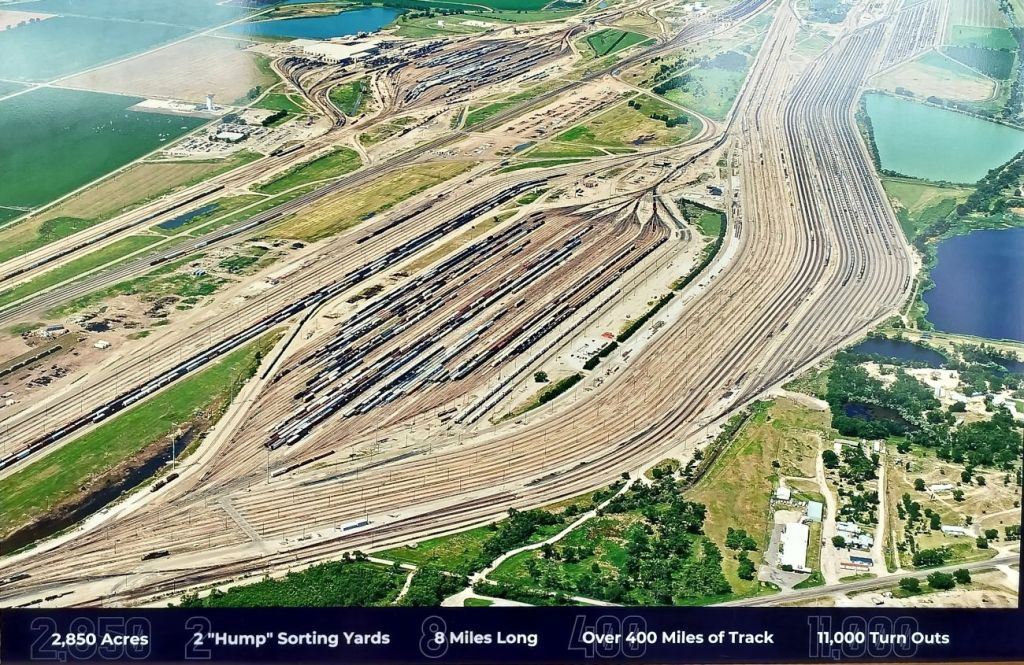
Leaving North Platte, we visited the Golden Spike Tower and Visitor Center. From the tower we could see the Union Pacific Bailey Yard, said to be largest rail yard in the world. The rail yard is an interesting spectacle with dozens of locomotives and more than a thousand rail cars all moving at once on miles of rail lines!
Organized chaos – the Union Pacific Bailey Rail Yard bustled with activityAerial view of Union Pacific Bailey Yard from a museum exhibit – the rail yard is the largest in the world
Chewy Seafood
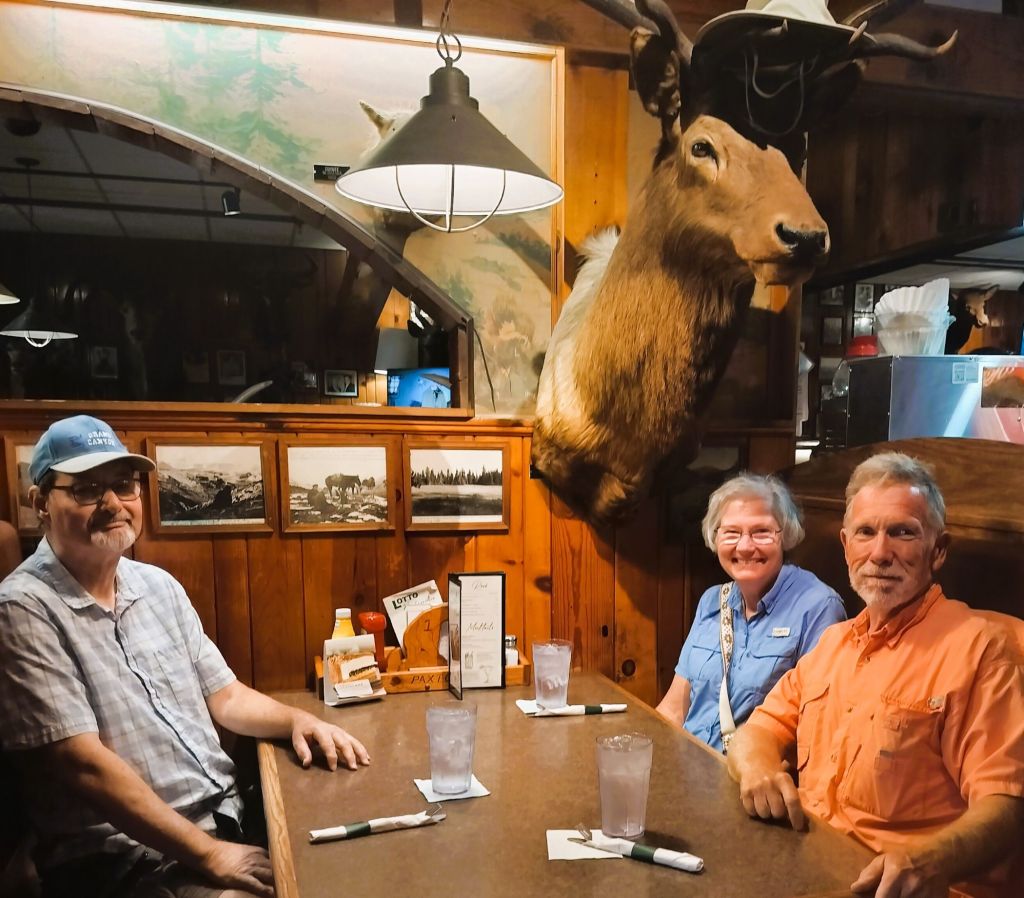
Later that day we stopped at Ole’s Big Game Steakhouse and Lounge in Paxton, NE. Rosser O. Herstedt, otherwise known as Ole, was a big game hunter who collected the more than 200 big game trophies that adorn the restaurant walls. The trophies include moose, elk, a polar bear, a jackelope and MANY more.
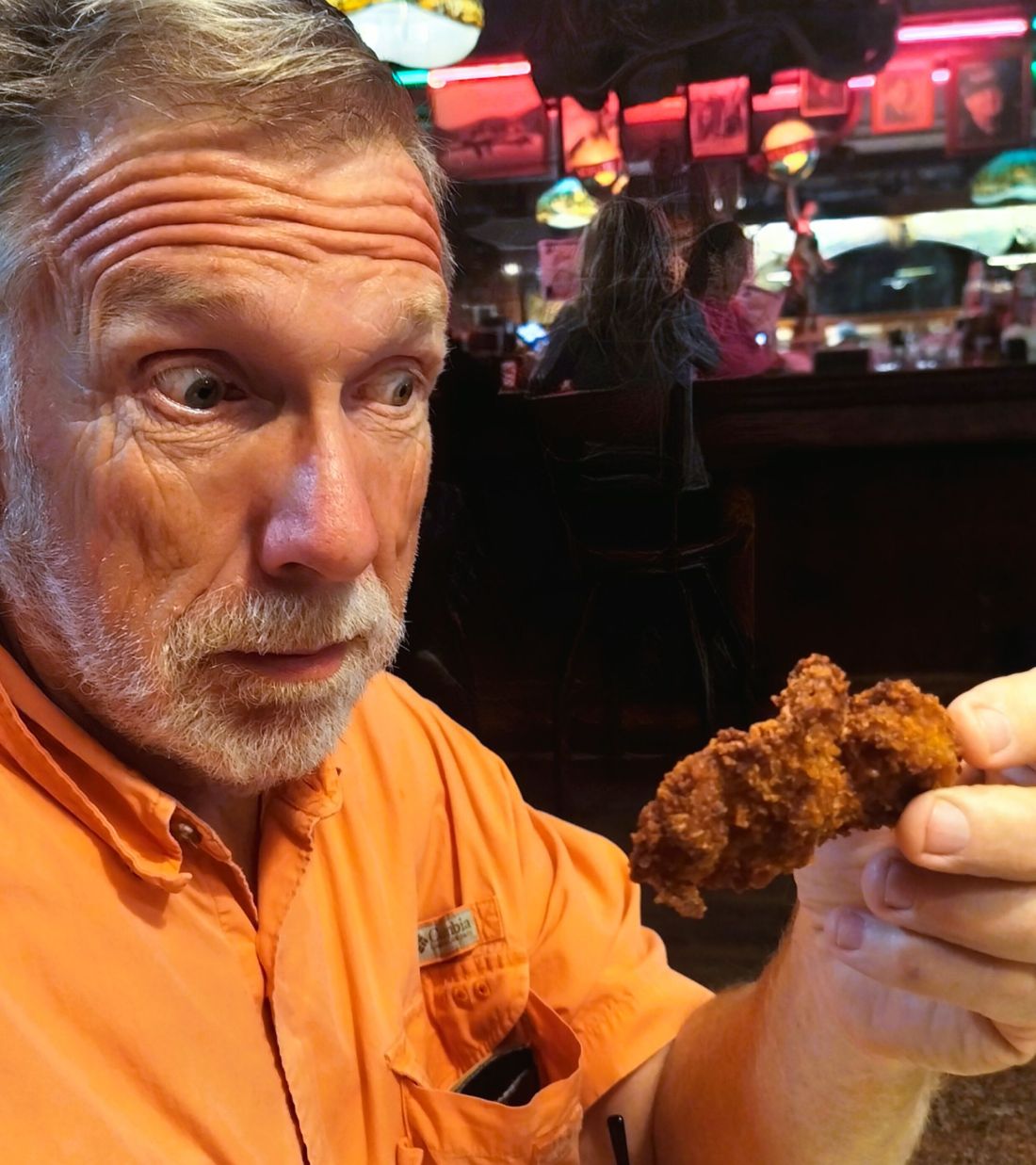
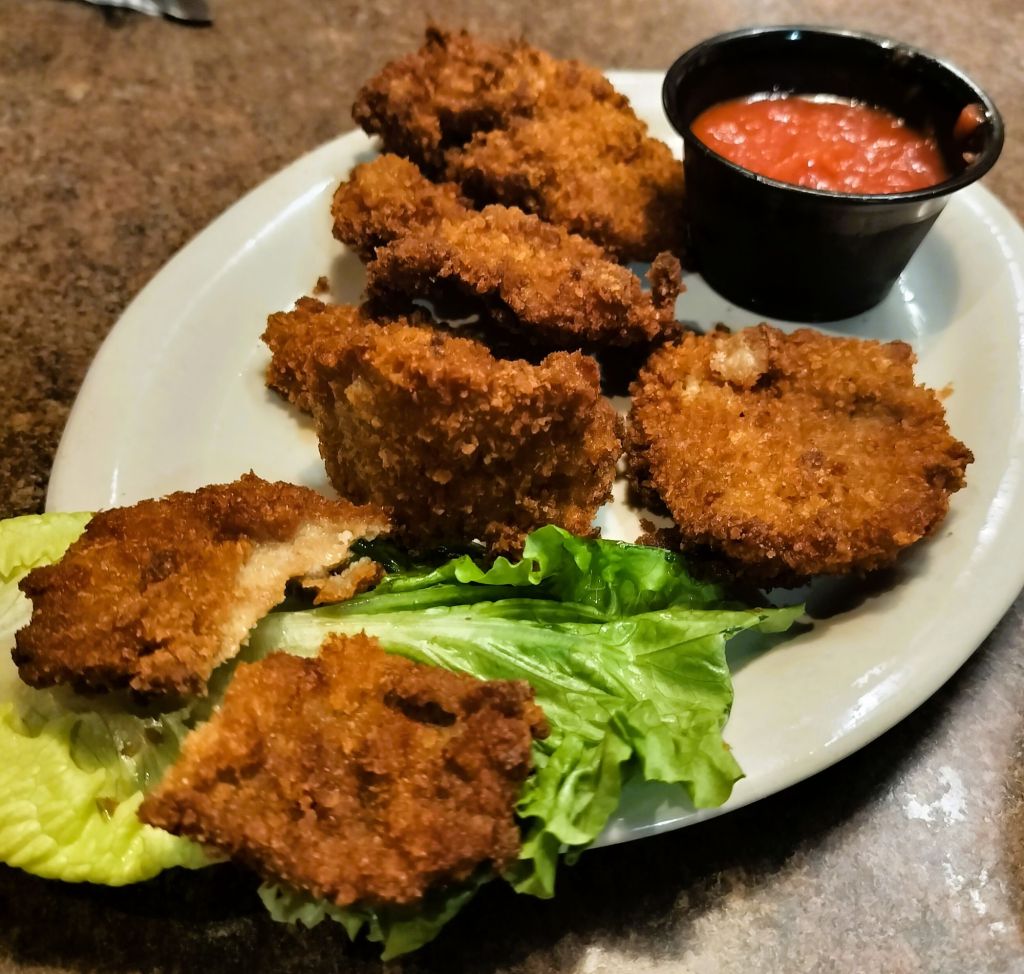
Beneath a large elk, we sampled a local seafood appetizer, otherwise known as Rocky Mountain Oysters. We tried not to think of the source of the crispy breaded and deep-fried meat filets as we dipped them in ketchup and chewed/swallowed them quickly.
Awaiting our Rocky Mountain seafood appetizer and lunch entreesRocky Mountain Oysters – once is MORE than enough!
Truck Campers Ho!
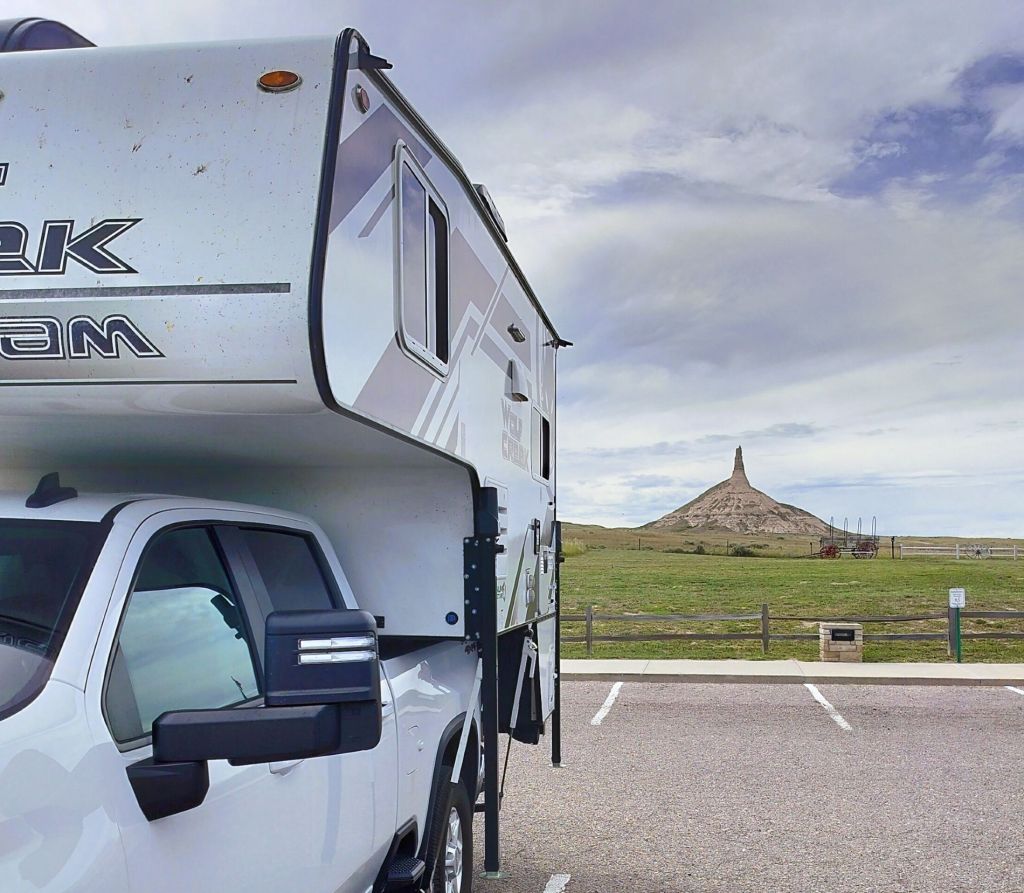
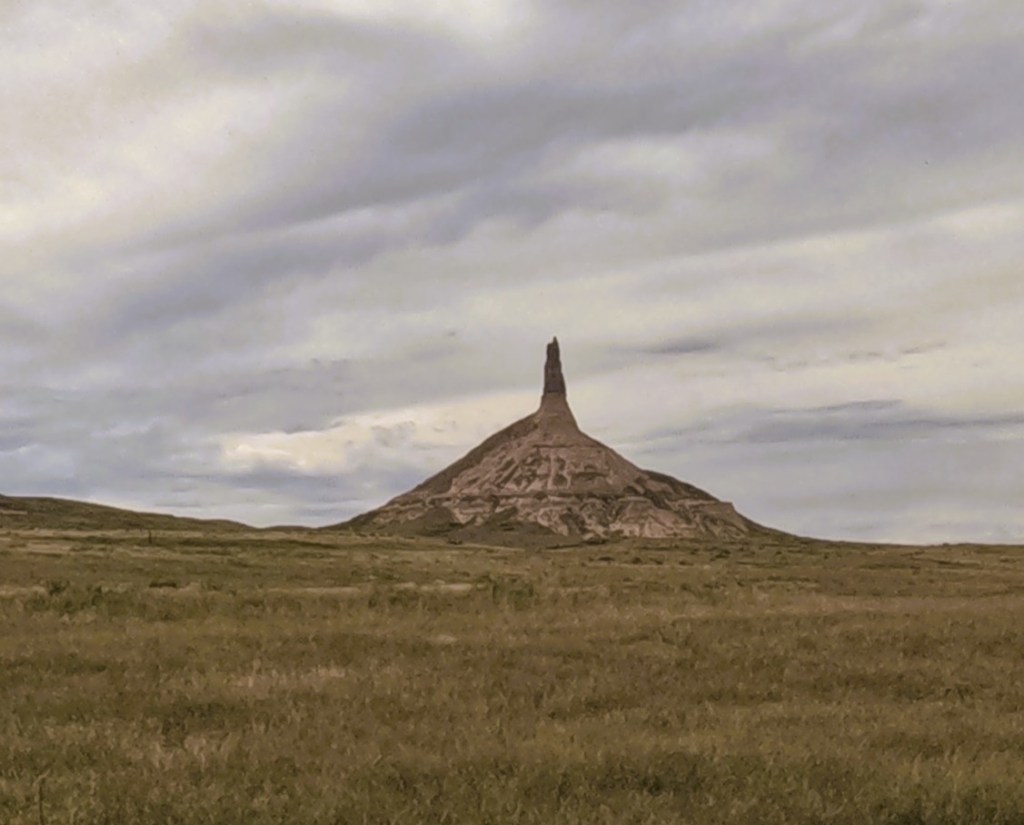
Continuing west, Nebraska’s flat endless fields of corn became rolling hills covered with grass, and then distant rocky mesas. Like 1800s pioneers following the Oregon Trail, we watched for Chimney Rock, a significant landmark that rises more than 300 feet above the surrounding landscape.
Getting ready to get a closer view of Chimney RockAt more than 300 feet, Chimney Rock can be seen for miles. It was a landmark followed by pioneers on the Oregon Trail (and by us!)
Next Week
From Chimney Rock, we continue westward to Wyoming, looking forward to the Cowboy State’s rugged, untamed beauty.
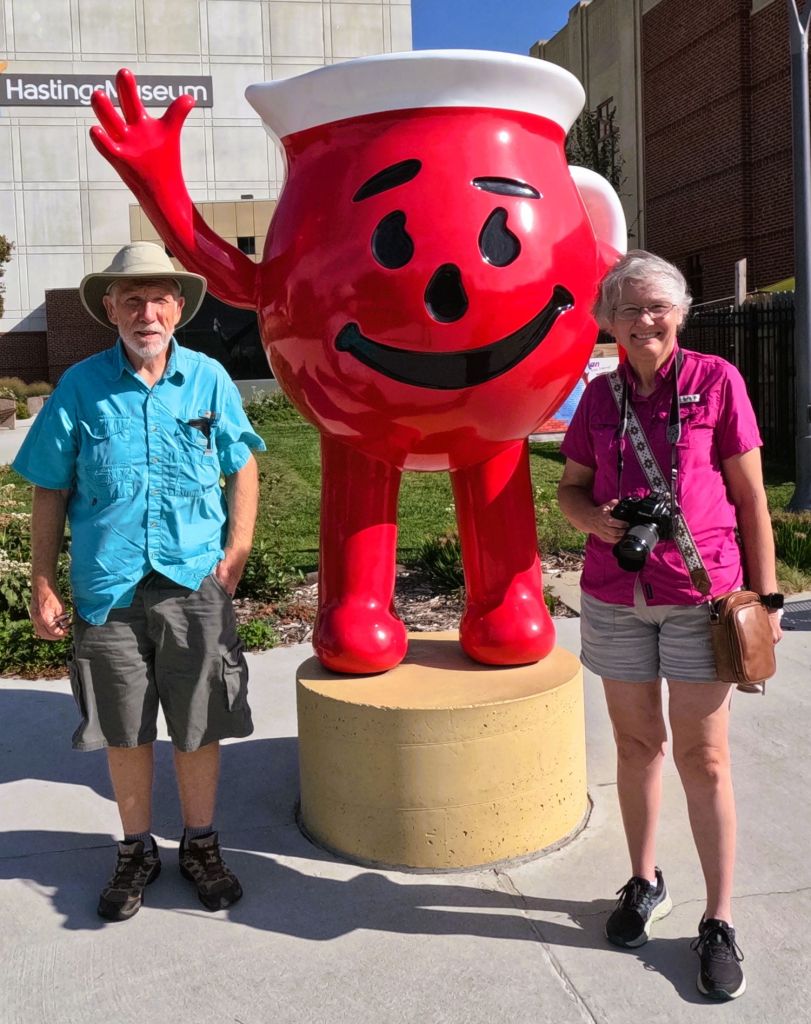
Do you have childhood memories of bread slathered with layers of peanut butter and jelly, downed with glasses of icy cold cherry Kool-Aid? Our red mustaches revealed what our tastebuds were feeling: ‘Ooh Yeah’!
Ooh Yeah!
But First…
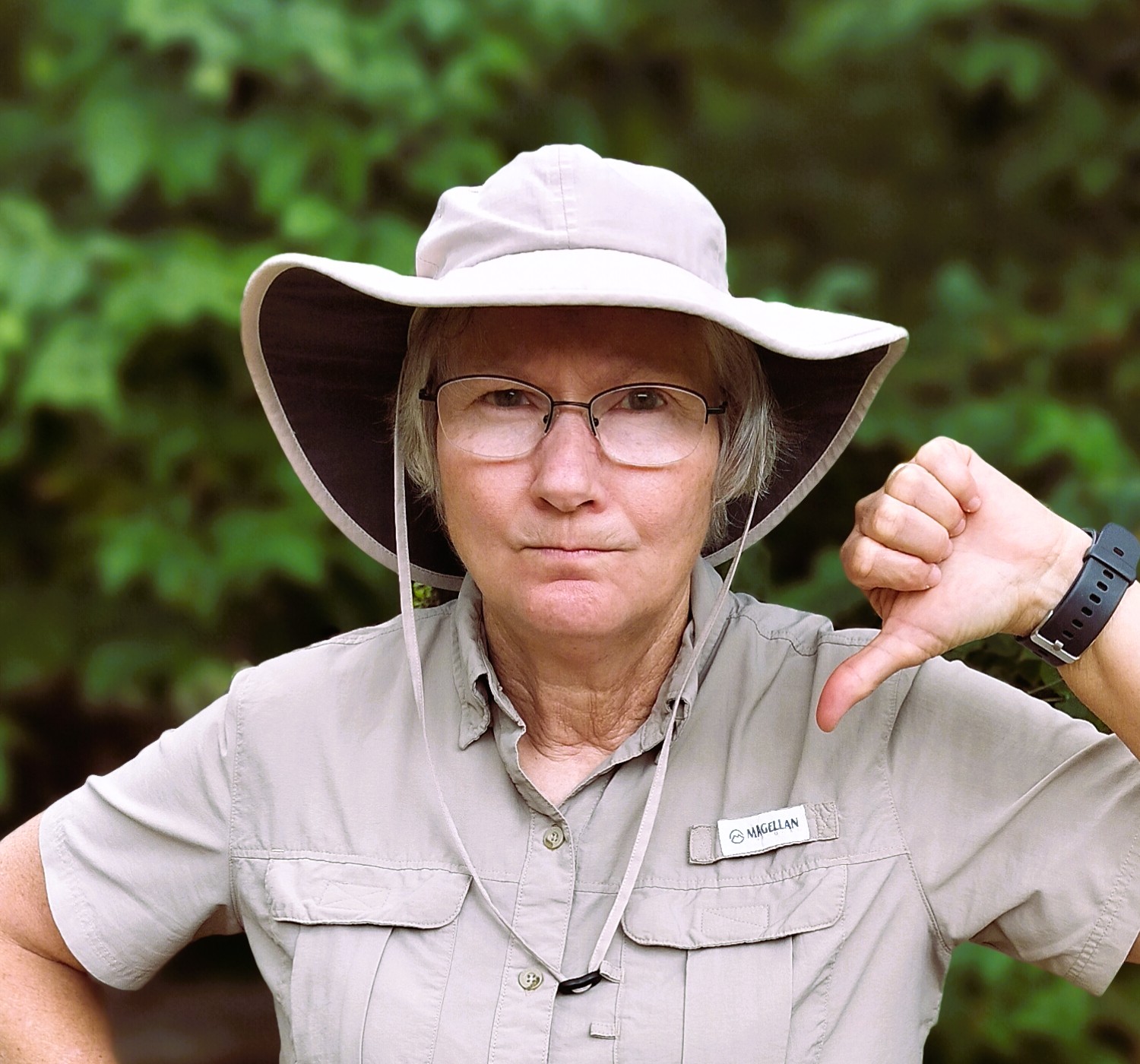
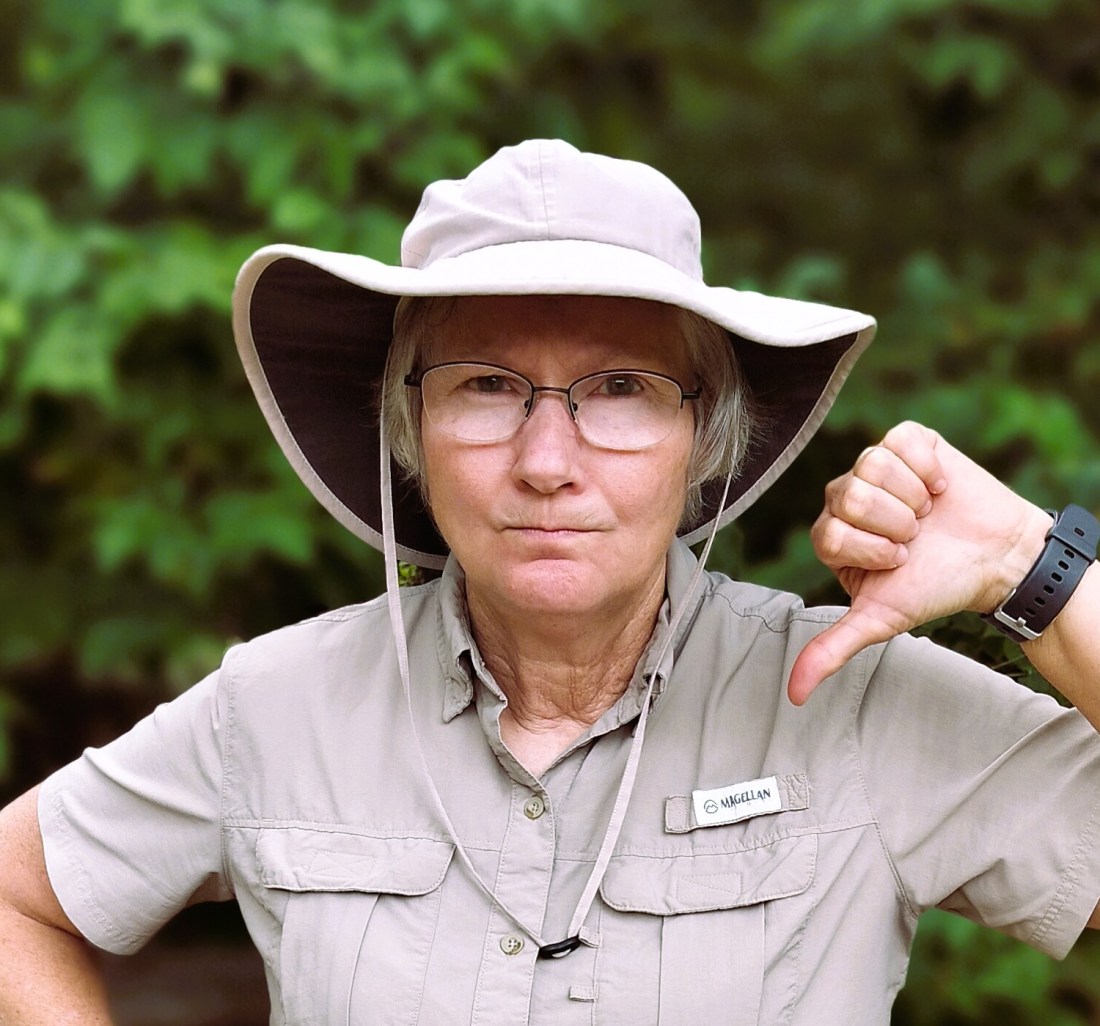
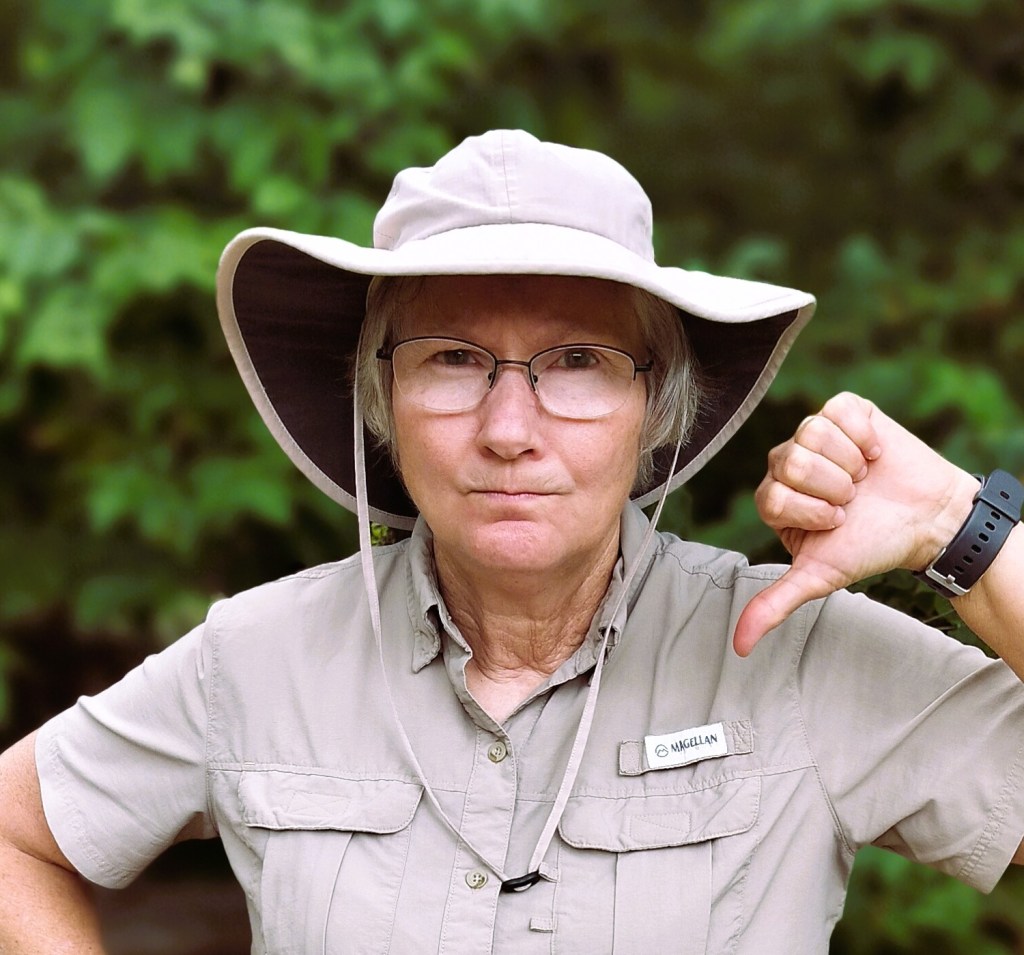
We made it through another week and nearly 1000 miles in the beyond portion of our trip with no Pap mishaps. For those of you who don’t know my bride, the title photo of Pat with a thumbs down scowl isn’t like her at all (unless I do something like drive Pap through a narrow tunnel).
Signs, Signs and More Signs
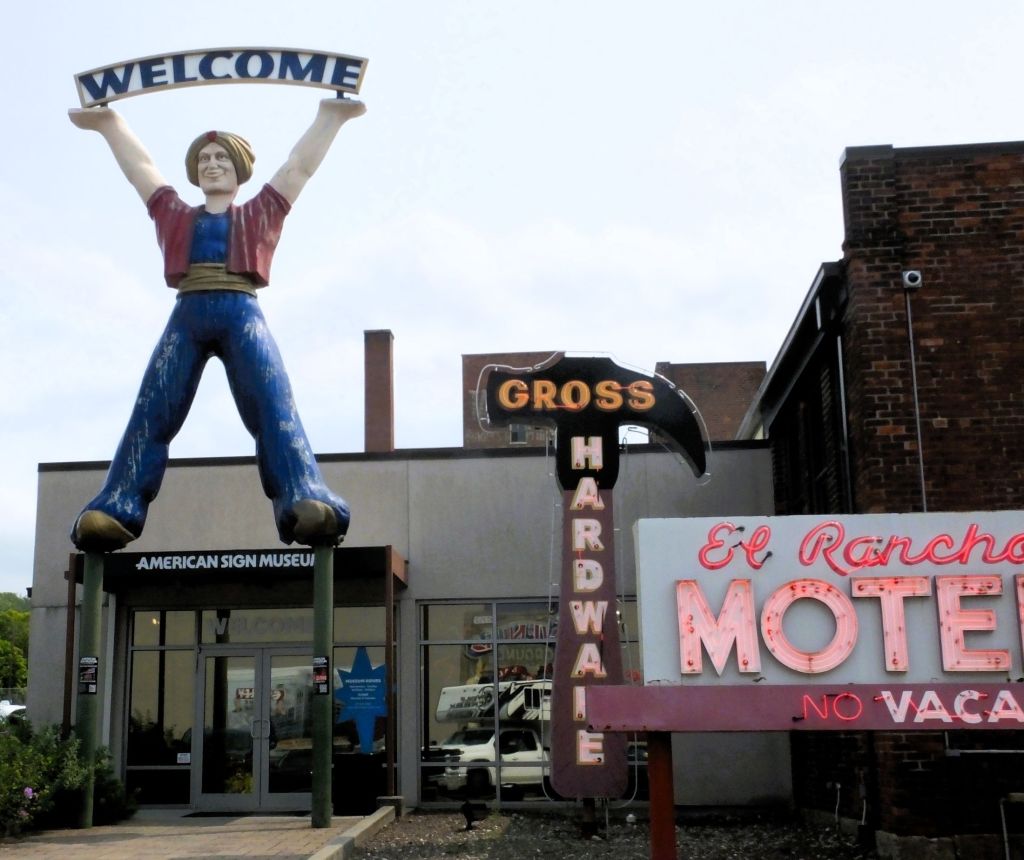
A genie greets us at the entrance to Cincinnati’s American Sign Museum
Our continued route west took us thru Cincinnati OH. The area is memorable to us as we had the only flat tire of our trip to Alaska in 2018 with Max and Pancake. We visited the Ark Encounter attraction and the Creation Museum nearby in northern Kentucky.
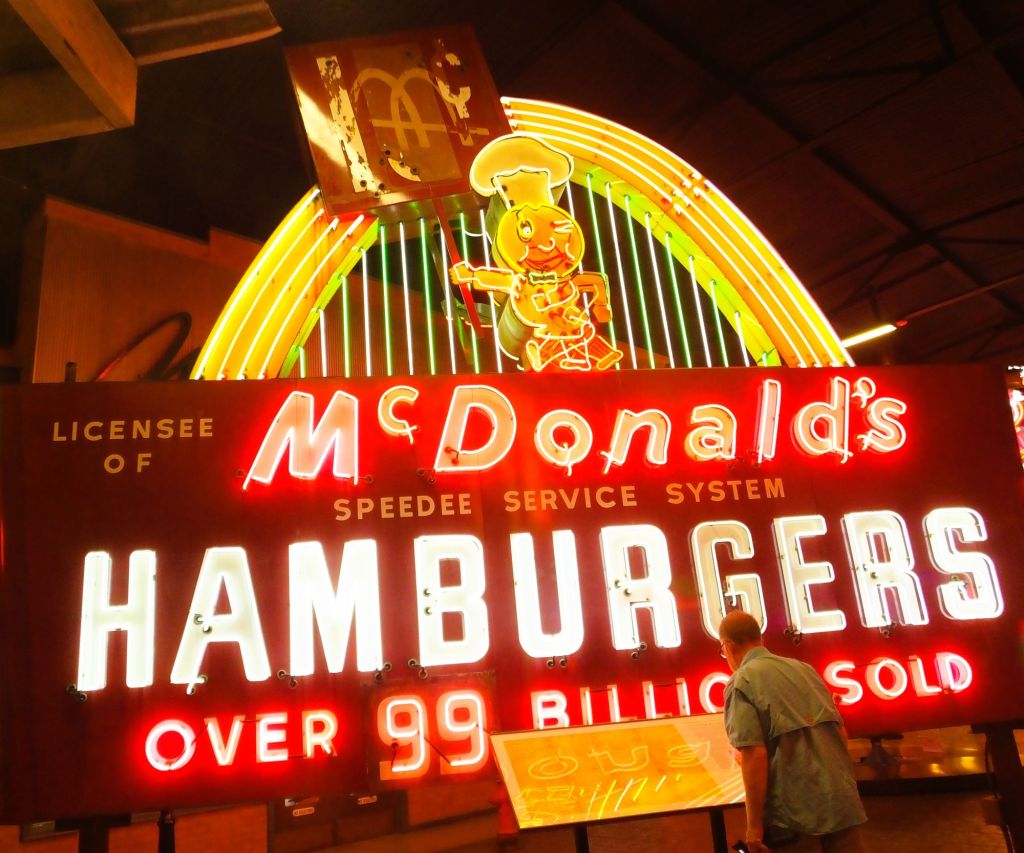
This time we continued to the west side of Cincinnati for a tour of the American Sign Museum. The museum holds more than 800 signs and other objects spanning over 100 years of American history.
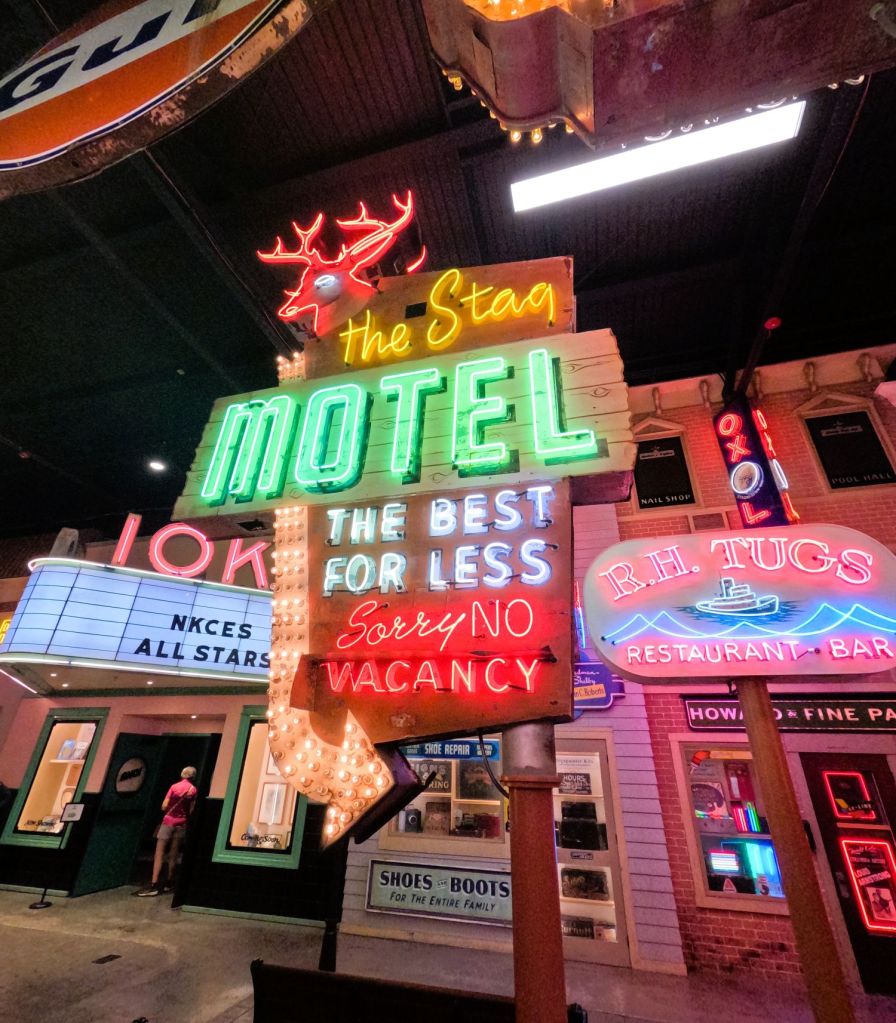
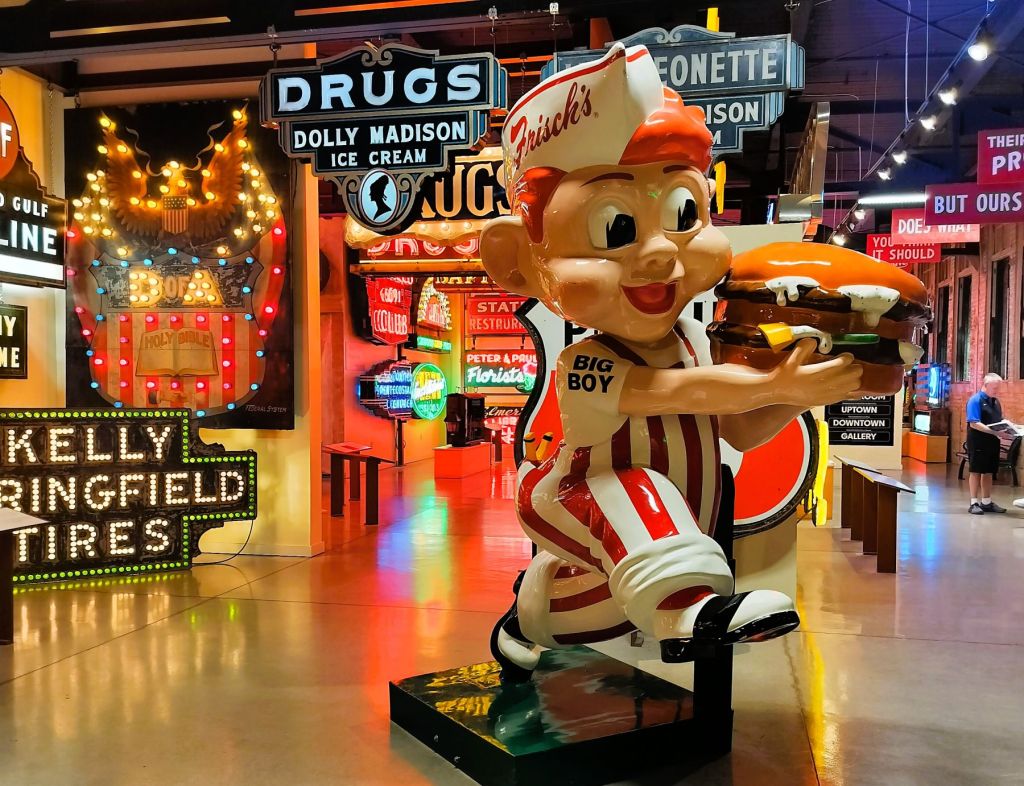
Recognize any of these signs?More signs along the museum’s sign avenueOver 99 billion sold – that’s a lot of hamburgers!
We walked along the museum’s cleverly designed indoor central avenue and were overwhelmed by a barrage of blinking bulbs, flashing lights, and bright colors: McDonalds, Holiday Inn, Phillips 66, Goodyear Tires, Frisch’s Big Boy, Rock City and many more.
Camp Washington or Skyline?
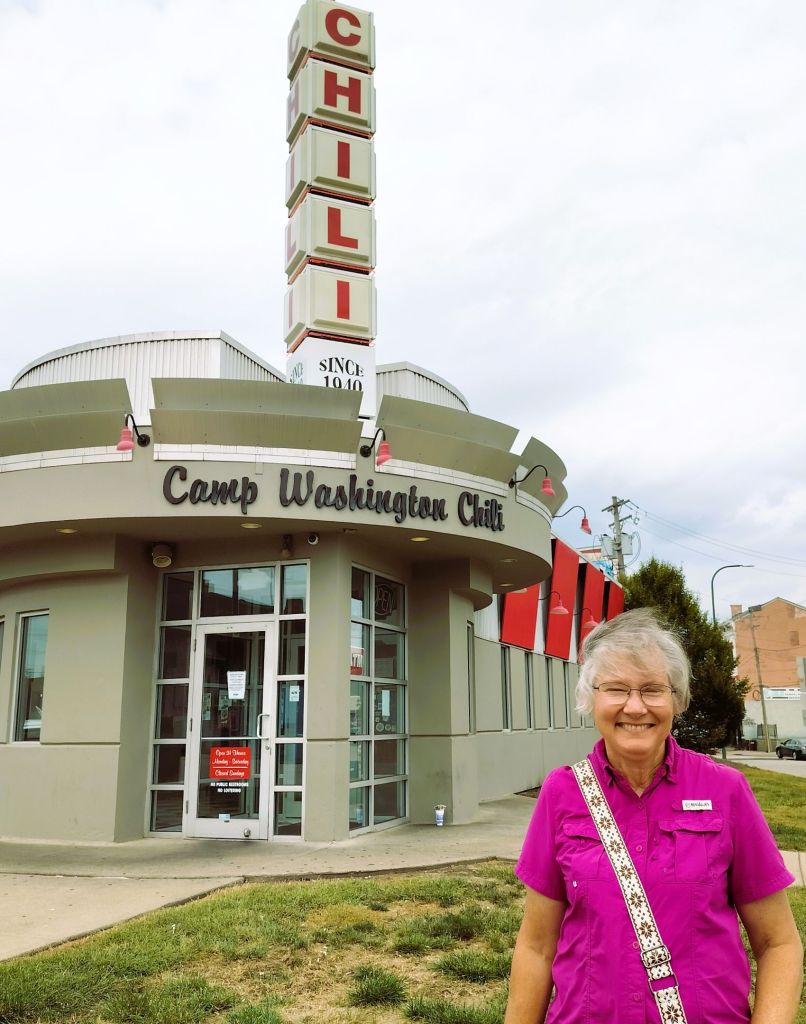
Getting ready for lunch at Camp Washington Chili
Near the museum we spotted our lunch stop for the day – Camp Washington Chili.
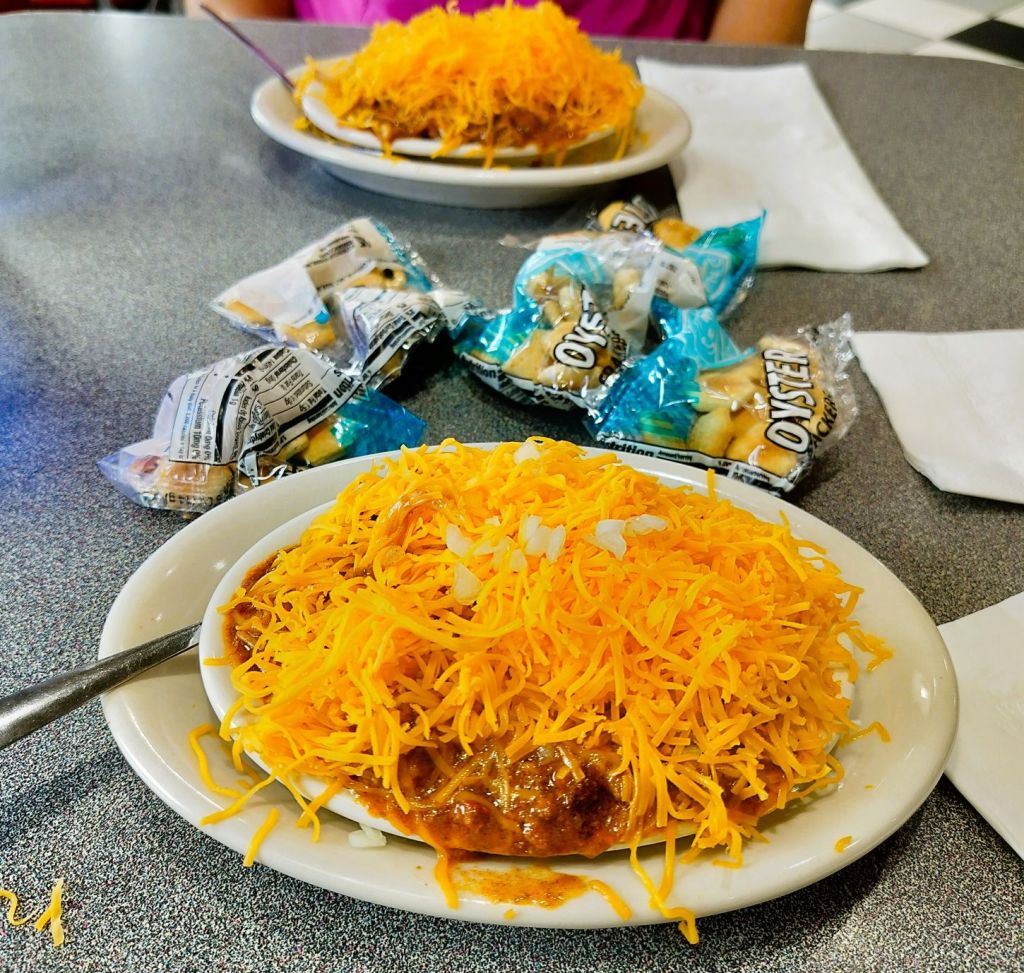
We ordered bowls of spaghetti noodles, topped with meaty chili and cheddar cheese. They added diced onions to mine, and gave us each several small bags of oyster crackers as a garnish.
Yummy lunch – no Tums needed
Our selections were delicious – the chili was mild and the proportions of toppings were perfect!
Now we have an unfortunate dilemma: friends from Cincinnati in our church fellowship group served Skyline chili several times over the years when our group joined them for dinner. Skyline chili is said to be a little different, more saucy with a mild undertone of cinnamon.
Apparently, there is a big fan base for each style of chili. How will we explain that we may have gone over to the chili dark side?
Covered Bridges and ‘Gorge’ous Hikes
In Indiana, we camped several nights near Rockville.
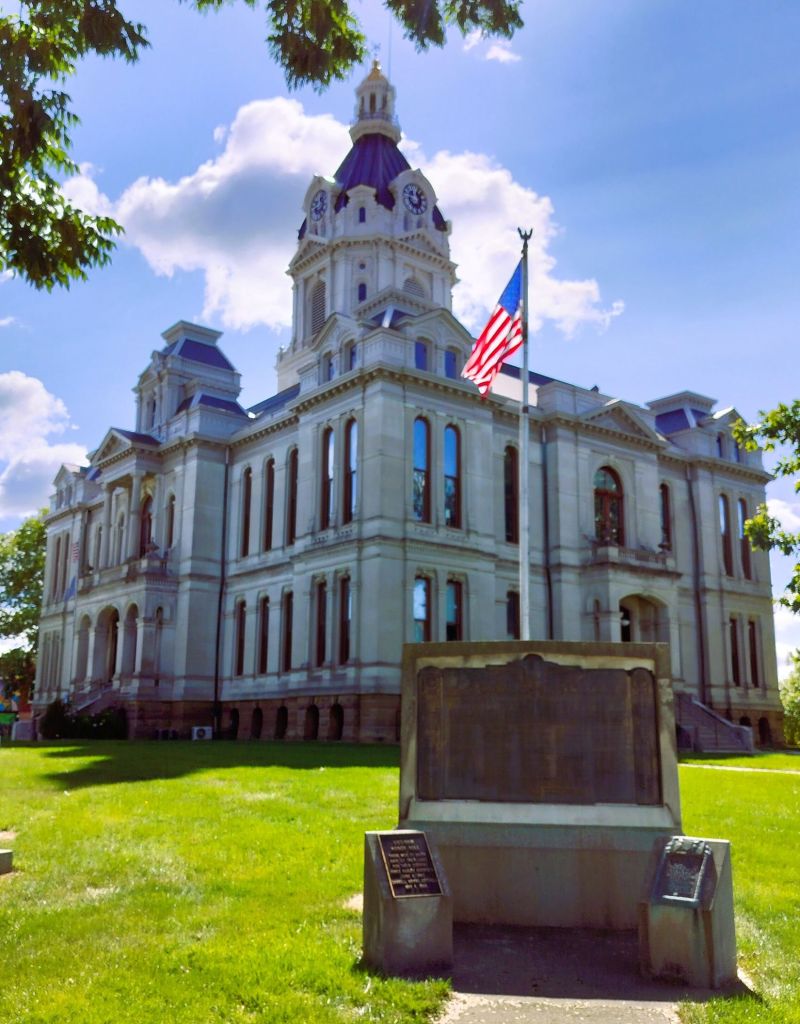
A typical small-town courthouse is surrounded by stores and restaurants in the center of Rockville
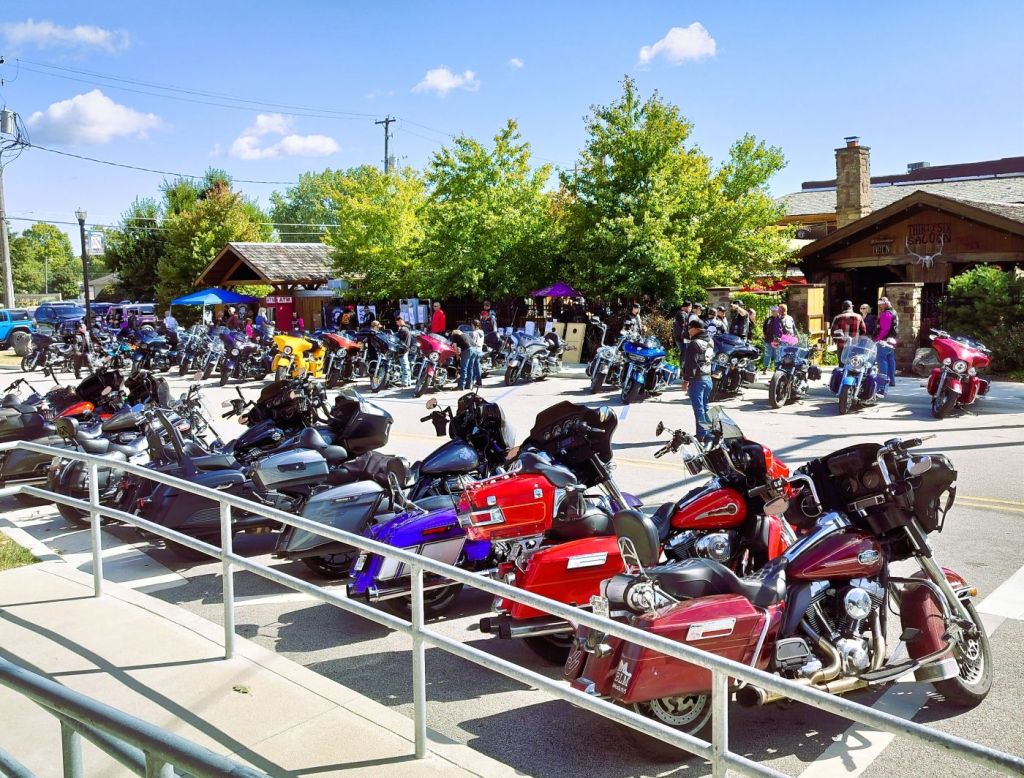
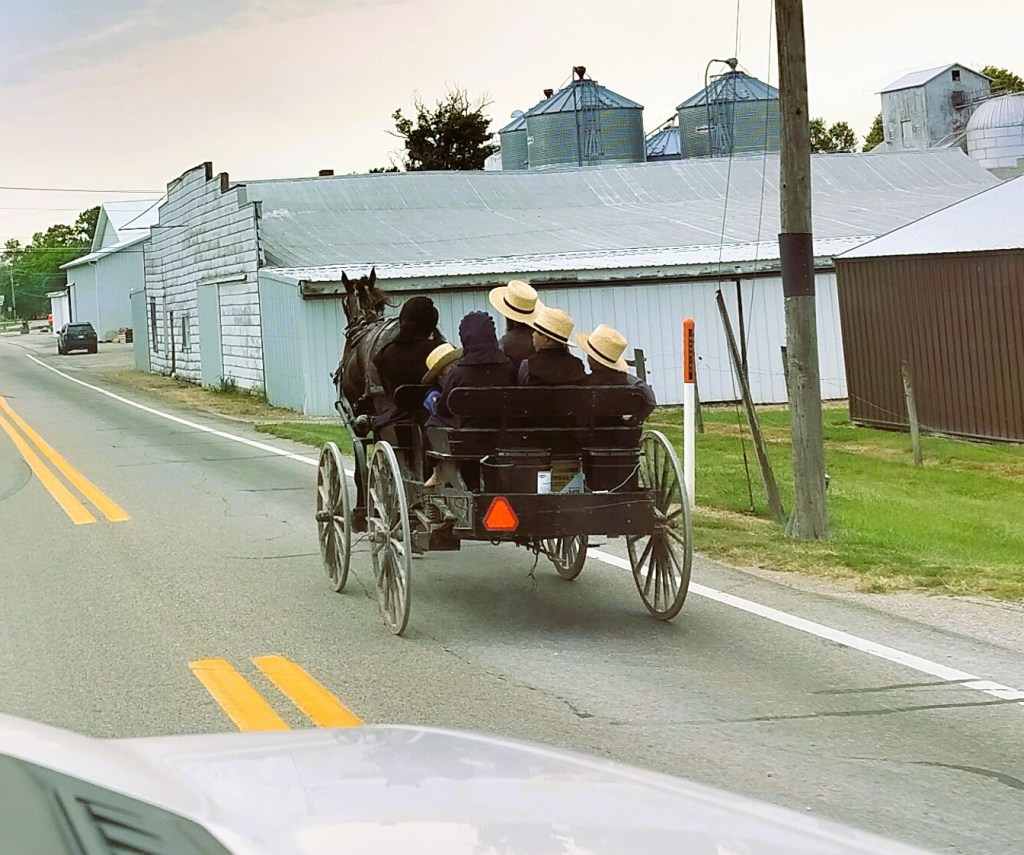
Different ways of visiting Rockville – motor cycles at the Thirty Six Saloon and an Amish family on their way to town
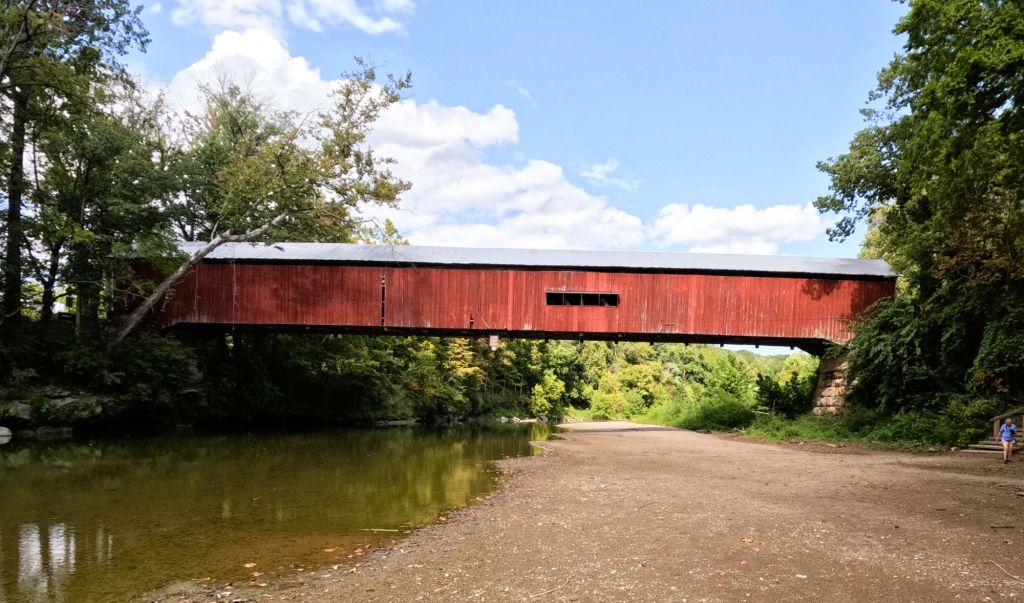
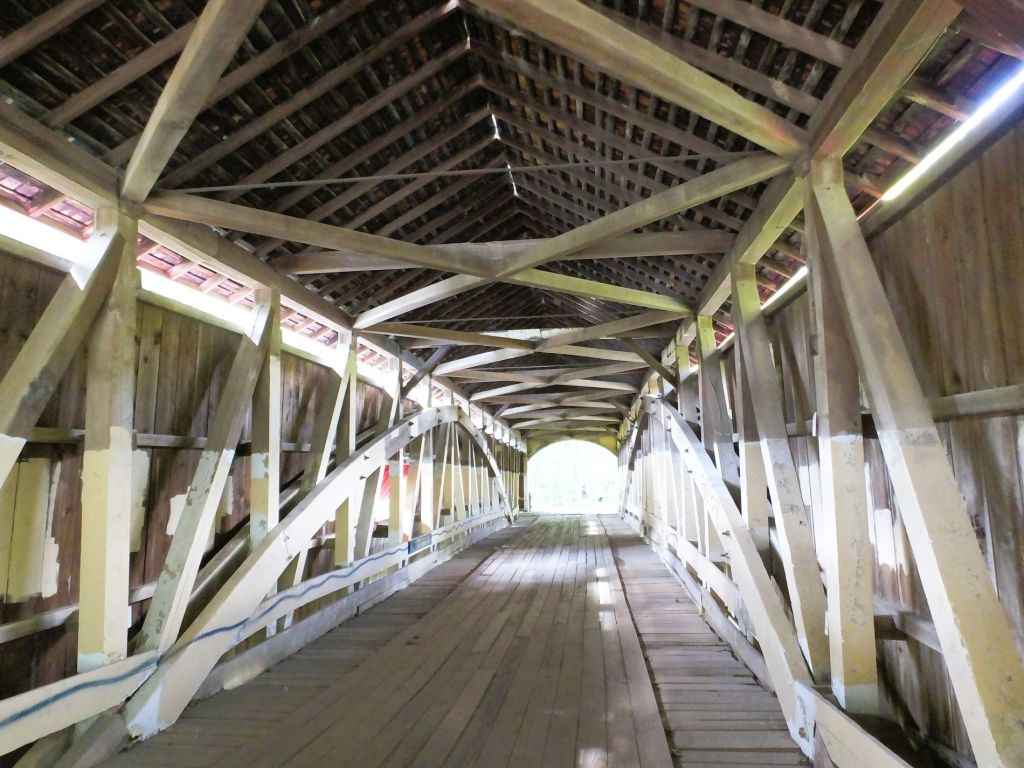
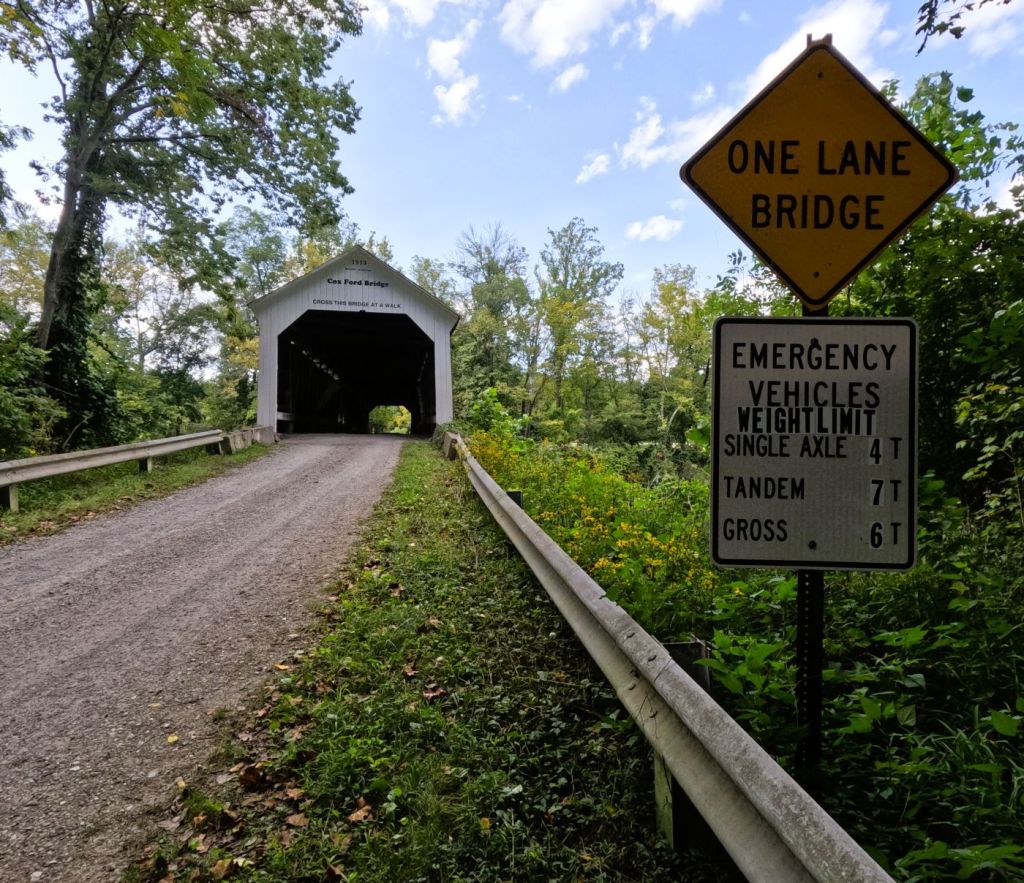
The area is noted for 31 covered bridges. We learned while walking around the town’s central square that more than two million people attend the town’s 10-day Covered Bridge Festival in October. We could not fathom the crowds as thousands of covered-bridge geeks follow established routes through the countryside to see the bridges.
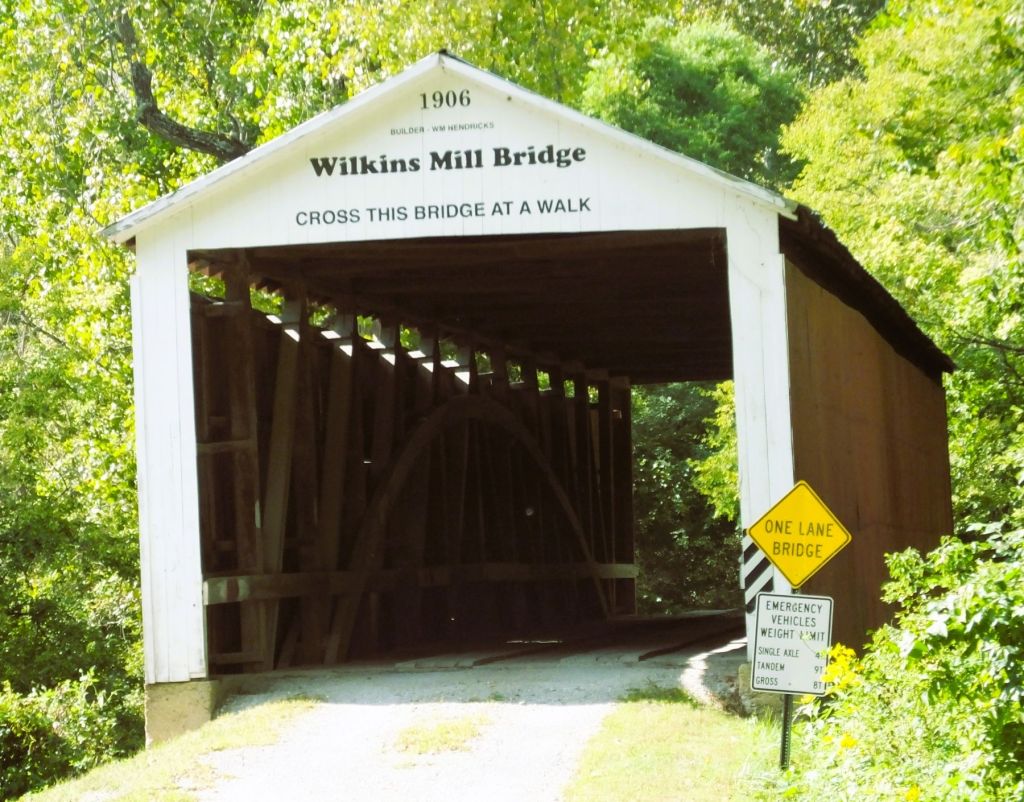
Some of the covered bridges near Rockville
We visited three bridges and found them to be interesting relics of the past. They are nicely restored and in very good condition. The overhead clearance of the bridges is about 10 feet. With Pap being 12 feet tall, this was definitely a NADA moment.
Nada Means NADA!
The next day we visited Turkey Run SP.
Kayakers on Sugar Creek paddling through Turkey Run SP
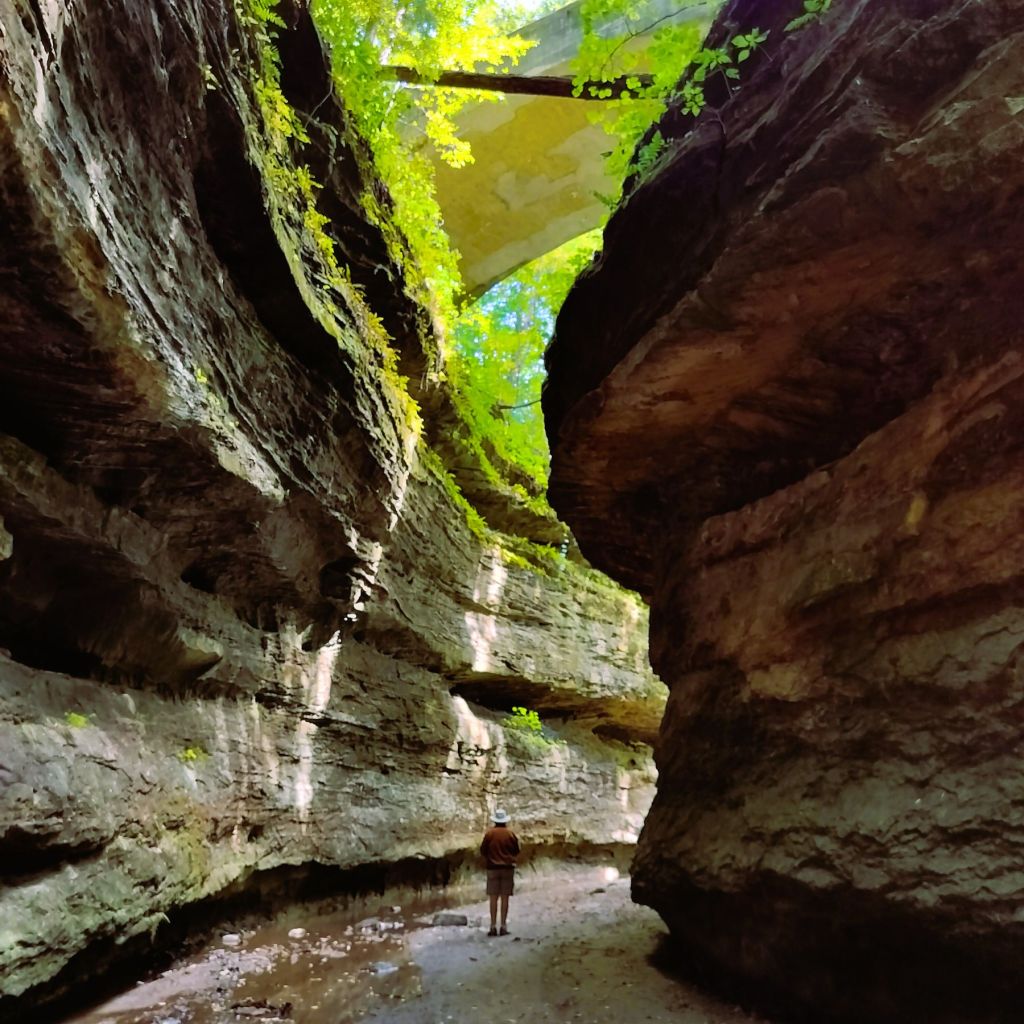
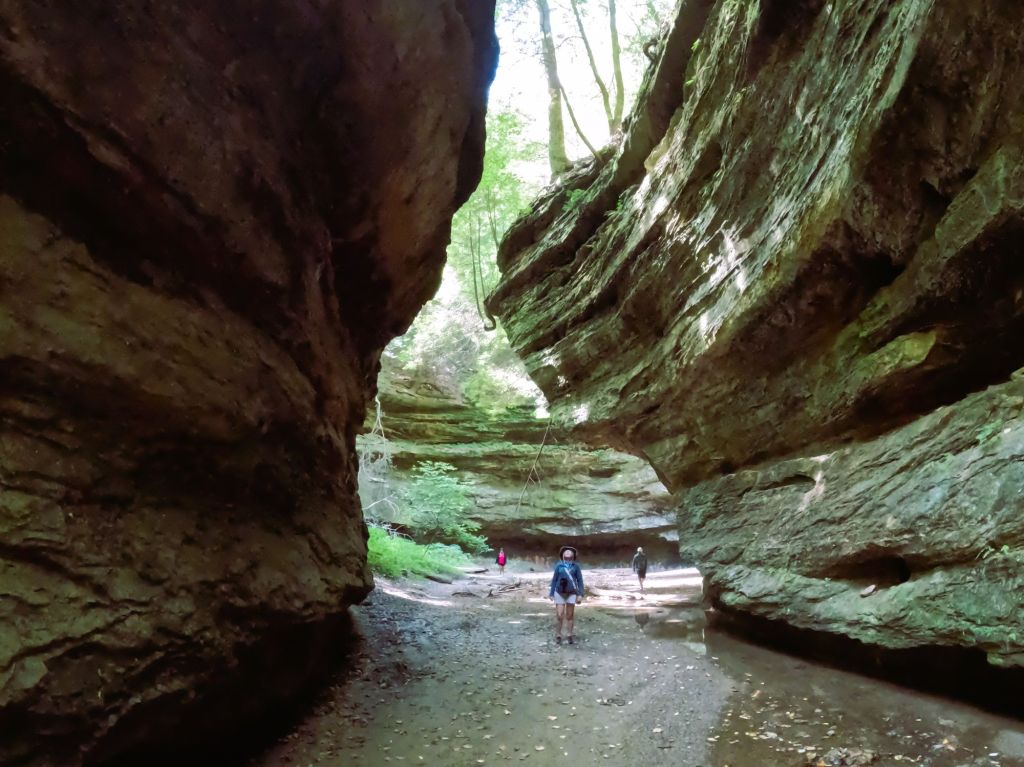
The highlight of our visit was hiking a couple of the beautiful trails that follow sandstone cliffs along Sugar Creek and traverse deep side ravines. The park has 11 trails from .5 mile to 3 miles that range from easy to very rugged.
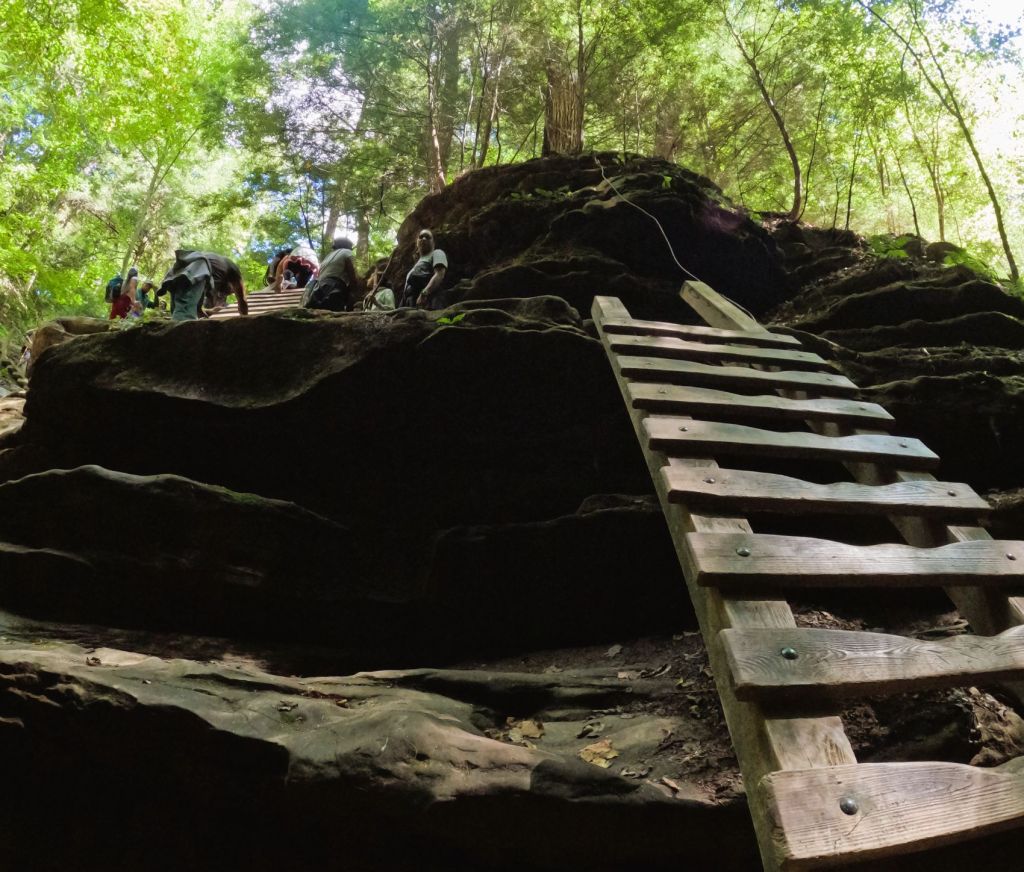
Ed leads the way through a ravineWaiting for others to climb the second of three ladders on our challenging hike. Notice the worn footboards!Pat surveys the rugged ravine walls
We hiked a 1.7 mile very rugged trail that included lots of ups and downs, three 20-foot ladders, hundreds of steps and a final slippery descent down a stream bed back to Sugar Creek.
We were tired after the hikes, and have an appreciation of the beauty of the area.
Our westward quest yielded a couple interesting RabbiTRAILS not far off our planned route.
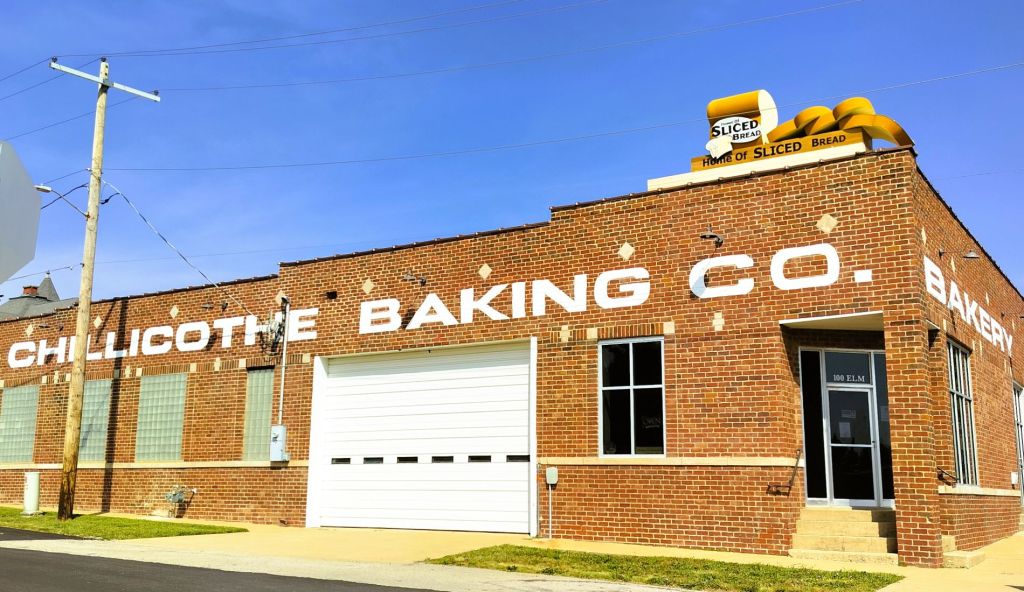
Chillicothe Baking Company – location of America’s first sale of pre-sliced bread!
Sliced Bread
On July 7, 1928, sliced bread was first offered for sale in Chillicothe, MO when Chillicothe Baking Company began using a bread slicing machine invented by Otto Rohwedder. The pre-sliced bread was placed on the bakery’s shelves and instantly changed the way consumers bought bread. The five feet long and two feet high machine was turned down by numerous bakeries before being offered to the Chillicothe bakery’s owner, Frank Bench.
Today, the building pictured is a museum and visitor center, and was unfortunately closed on the day of our visit.
Ooh Yeah – It’s Kool-Aid!
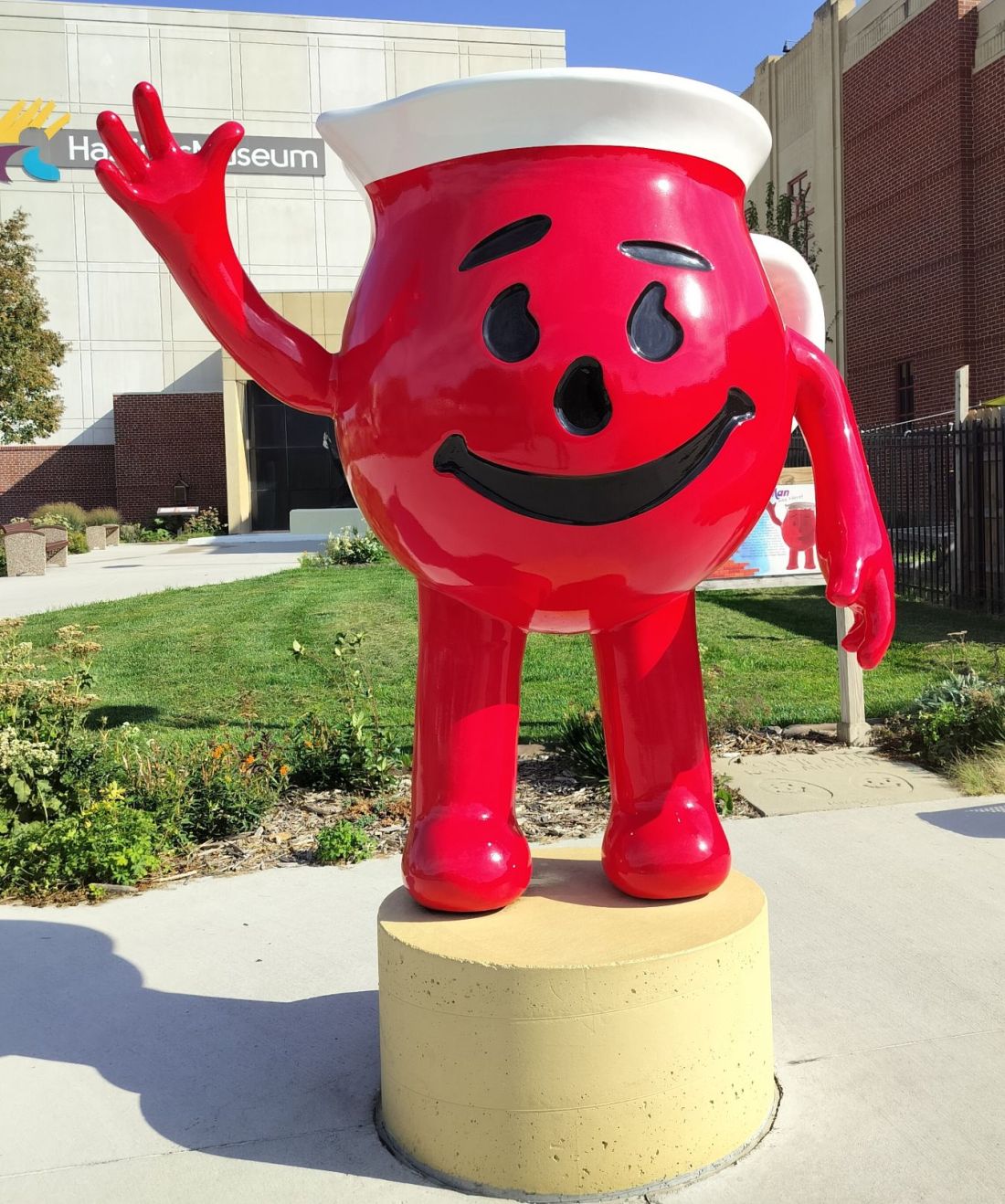
We continued to Hastings, NE where we visited the Hastings Museum of Natural and Cultural History. There, among buggies and cars, guns and a large variety of animal and bird displays, we found what we had come to see – the Kool-Aid: Discover the Dream exhibit.
Kool-Aid merch
Hastings is the birthplace of Kool-Aid. The wonderfully sweet fruit-flavored soft drink that kids (of all ages!) enjoy was the brainchild of Edwin Perkins. Pursuing his dream through hard work and ingenious marketing. Perkins created and sold many products, but in 1927 he developed Kool-Aid.
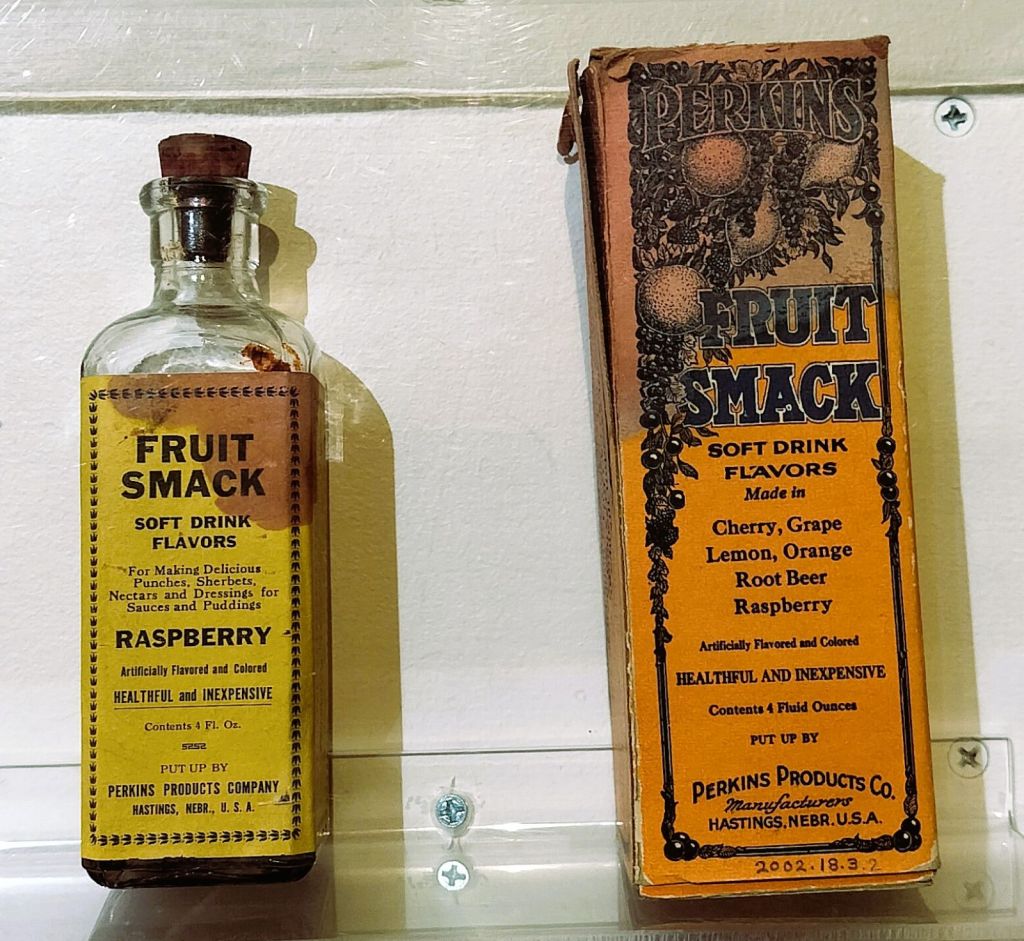
Fruit Smack was a predecessor to Kool-Aid. The little Kool-Aid packets we all know and love were one of Edwin Perkin’s ingenious ideas
Perkins created an earlier version of Kool-Aid, called Fruit Smack, in his mother’s kitchen. Once in production, it was corked and sold in bottles, which was very messy. A powdered drink was more appealing to consumers, and in 1927 Perkins’ company created Kool-Ade, later renamed Kool-Aid.
Next Week
Pat’s brother joins us in Missouri. After visiting their aunt and uncle near Kansas City, we spend five days following RabbiTRAILS across Nebraska before arriving in Saratoga, WY.
Our travels include the Strategic Air Command, runzas, Golden Spike rail yard, Chimney Rock and some Rocky Mountain seafood.
With a name like Nada, we (Ed actually) should have known better. And a caution from a passing pickup driver should have been MORE than enough warning.
More on this in a bit, but first things first…
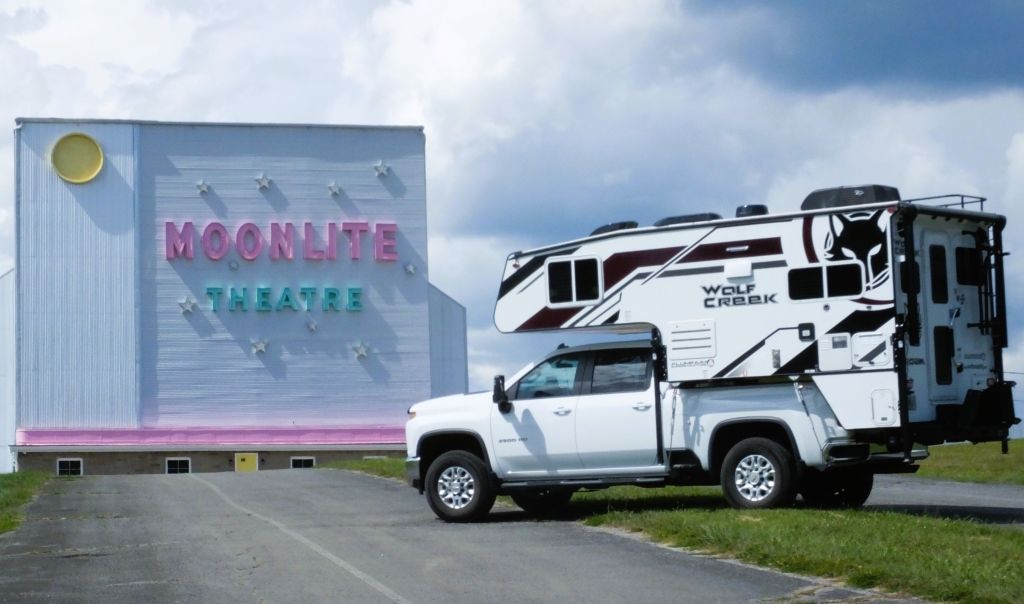
Driving in to the Moonlite drive-in
Movies at the Moonlite
Not too many years ago, baby boomers packed their kids and snacks in the car, and headed to the local drive-in theatre for the latest double feature.
There were once thousands of drive in theatres across the nation. Our hometown, Lake City, FL, had two. Our first date was at the Lake City Drive-in where we saw Roger Moore as James Bond in The Spy who Loved Me.
Fewer than 300 drive in theatres are still operating today.
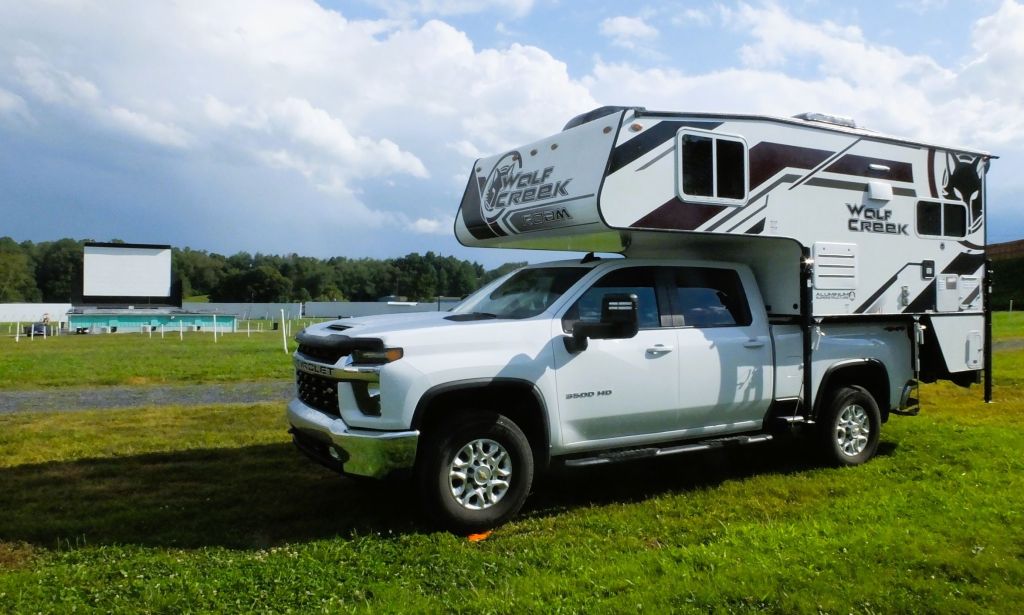
On our way to New River Gorge NP in West Virginia, we learned there is an active drive in theatre that is also a Harvest Host location. So we booked a site, arrived in the late afternoon and set up Pap. That evening we watched Jurassic World Rebirth, the latest installment in the Jurassic Park movie series, and a special 50th Anniversary version of Jaws.
Ready for the movies – we listened on Pap’s FM radio
We watched dinosaurs and sharks scurry and swim from the comfort of our truck camper. Our second drive in theatre date was very memorable!
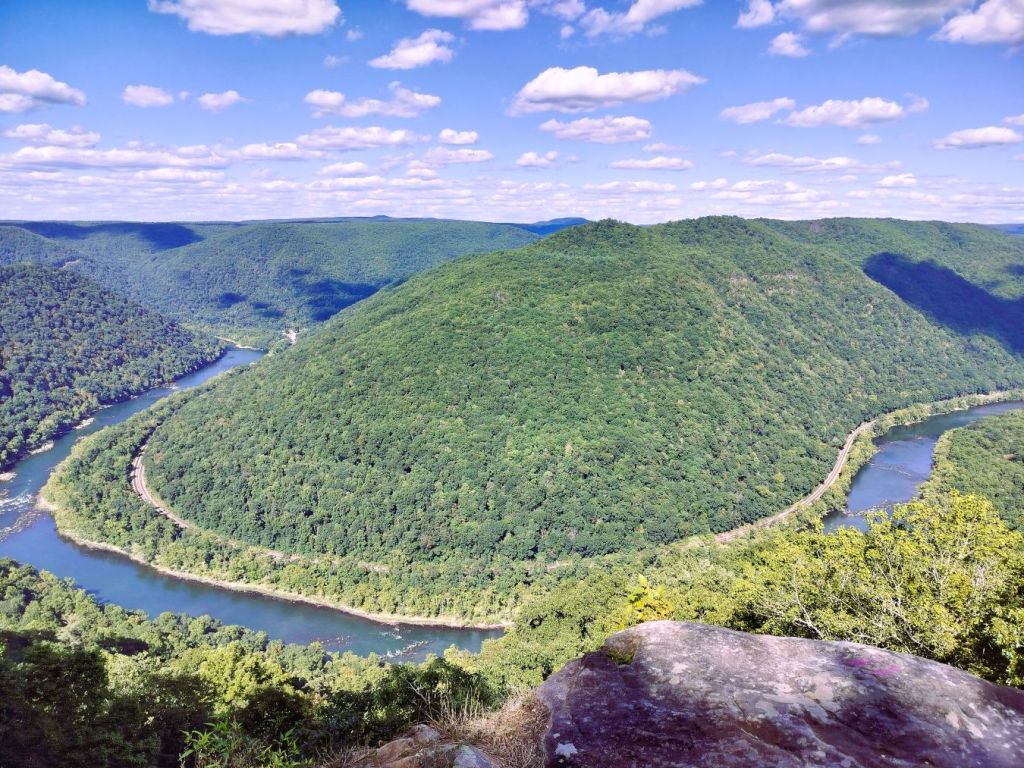
Grand view of the New River
New River and Coal Country
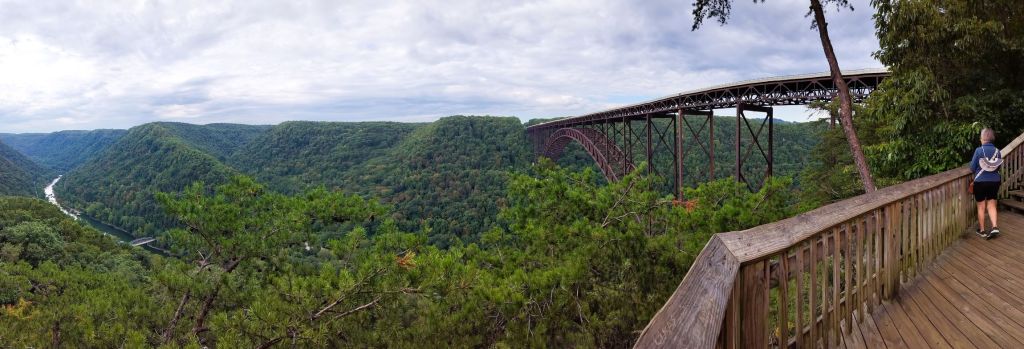
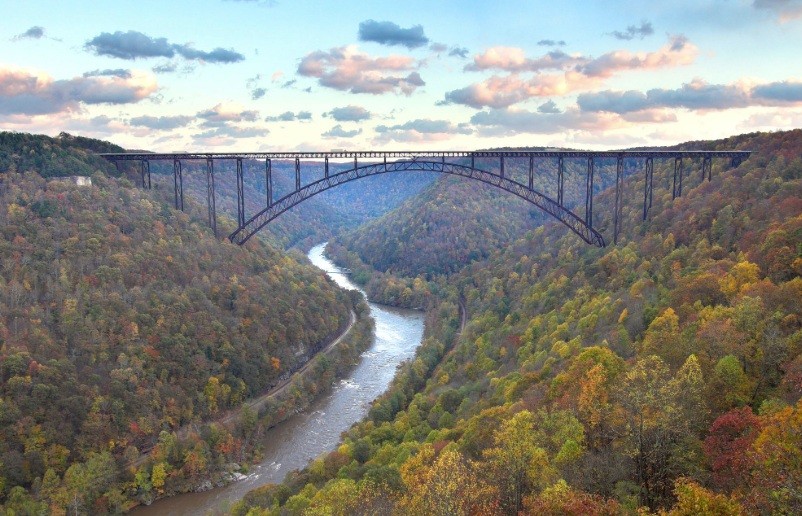
Our travels continued northward and from a campsite in Beckley WV, we made day trips to nearby New River Gorge National Park and Preserve. At Grandview, we overlooked the New River 1400 feet below as it makes a broad curve within the five-year-old park.
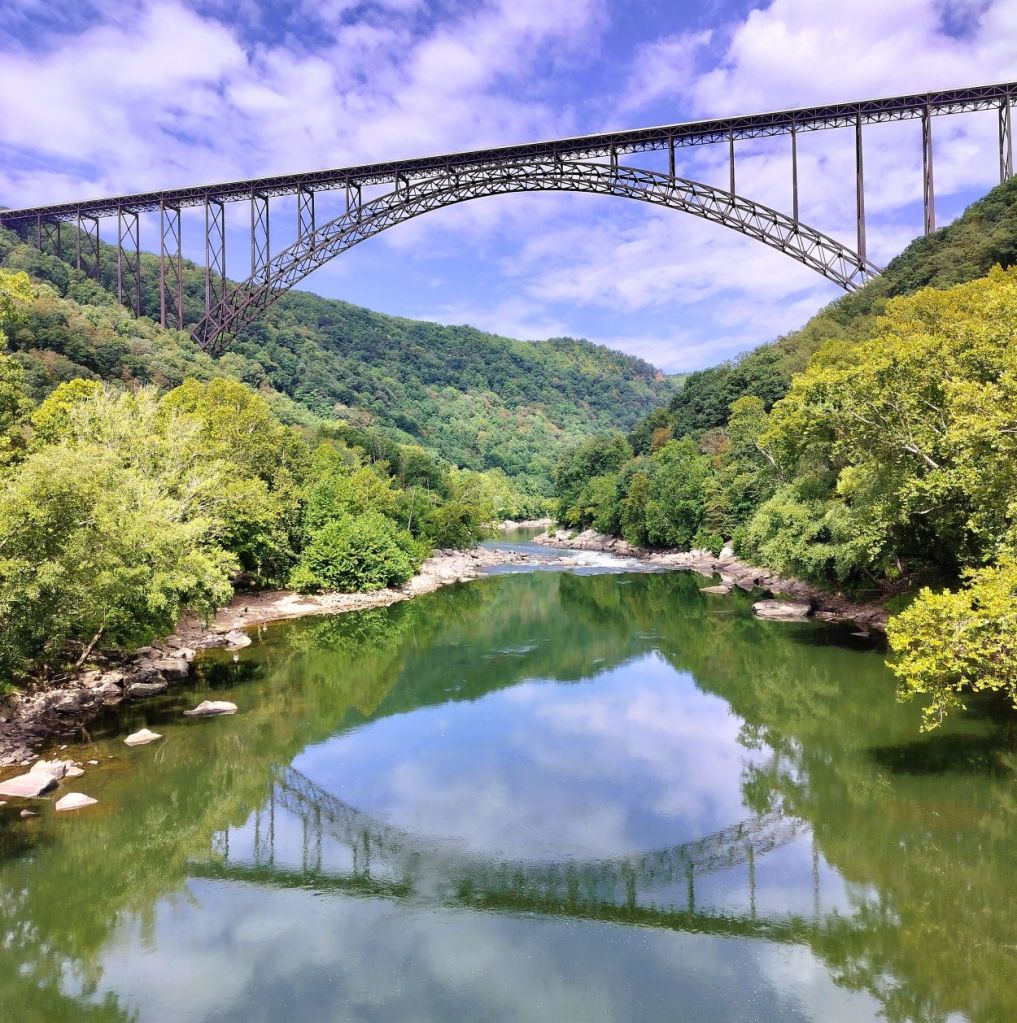
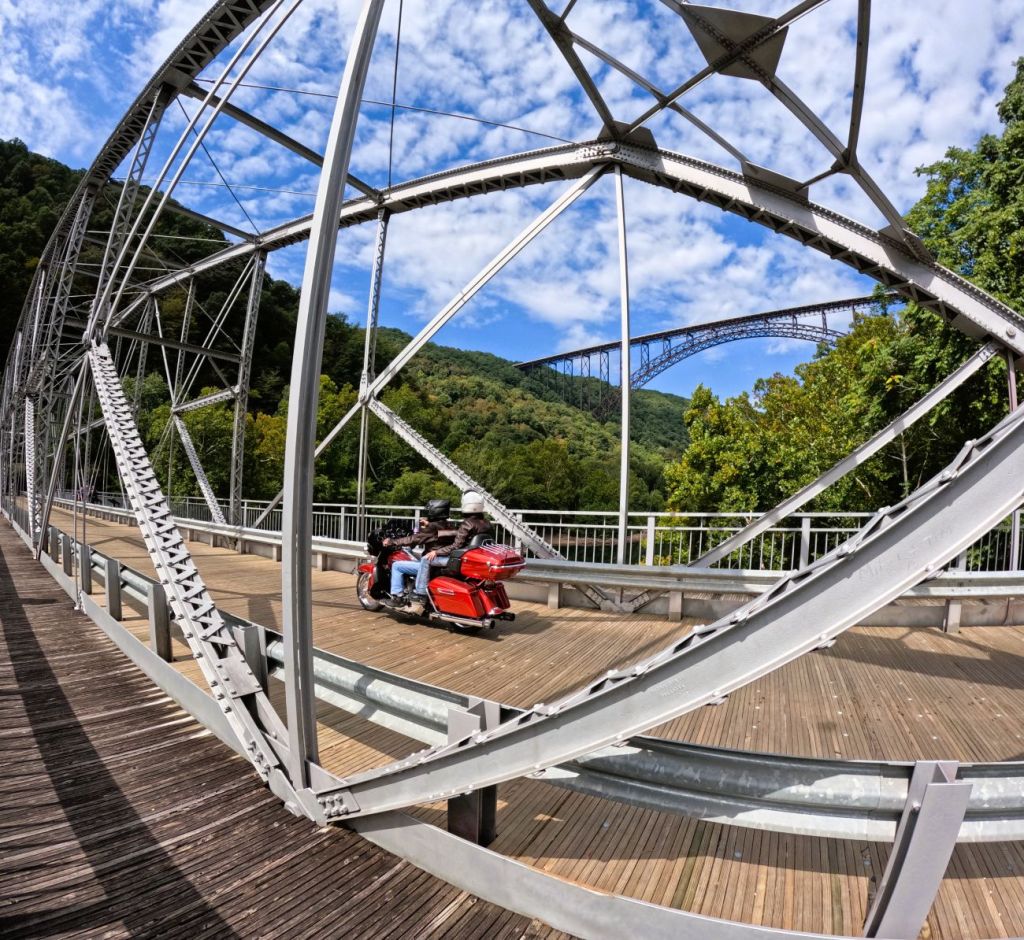
US 19 bridge across the New RiverPanorama of New River Bridge and river far belowCrossing the New River with a view of the New River Gorge Bridge above
A few miles away we visited the US 19 bridge where it crosses the New River Gorge. We marveled at the 3,030-foot steel arch span that is 876 feet above the river. Consider this – if you placed two Statues of Liberty on top of the Washington Monument there would be 20 feet to spare!
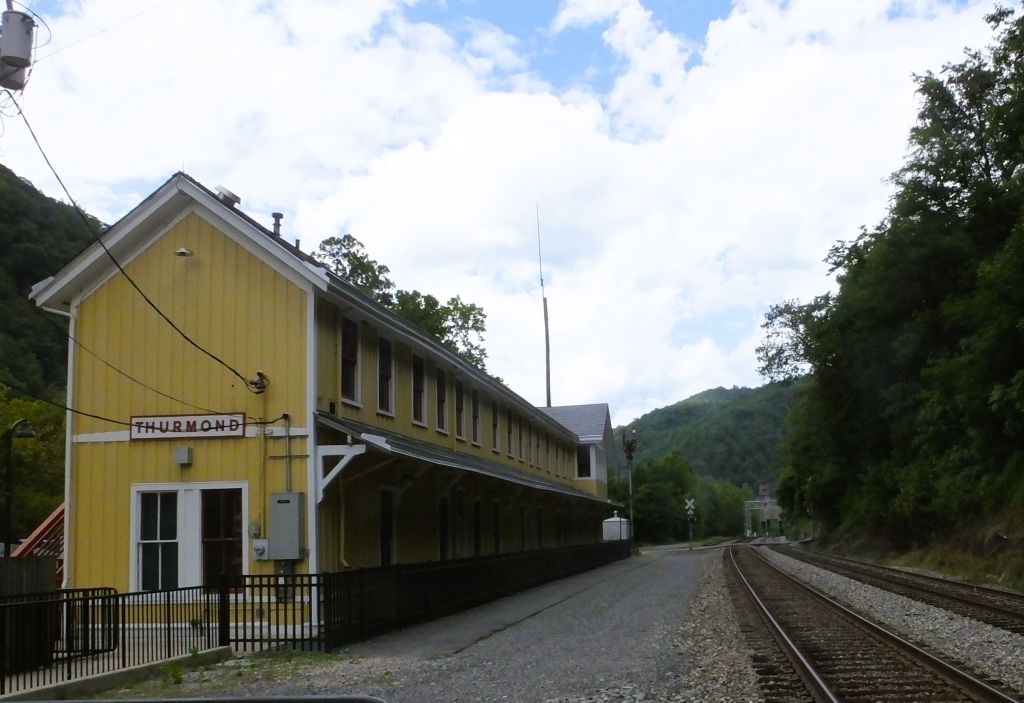
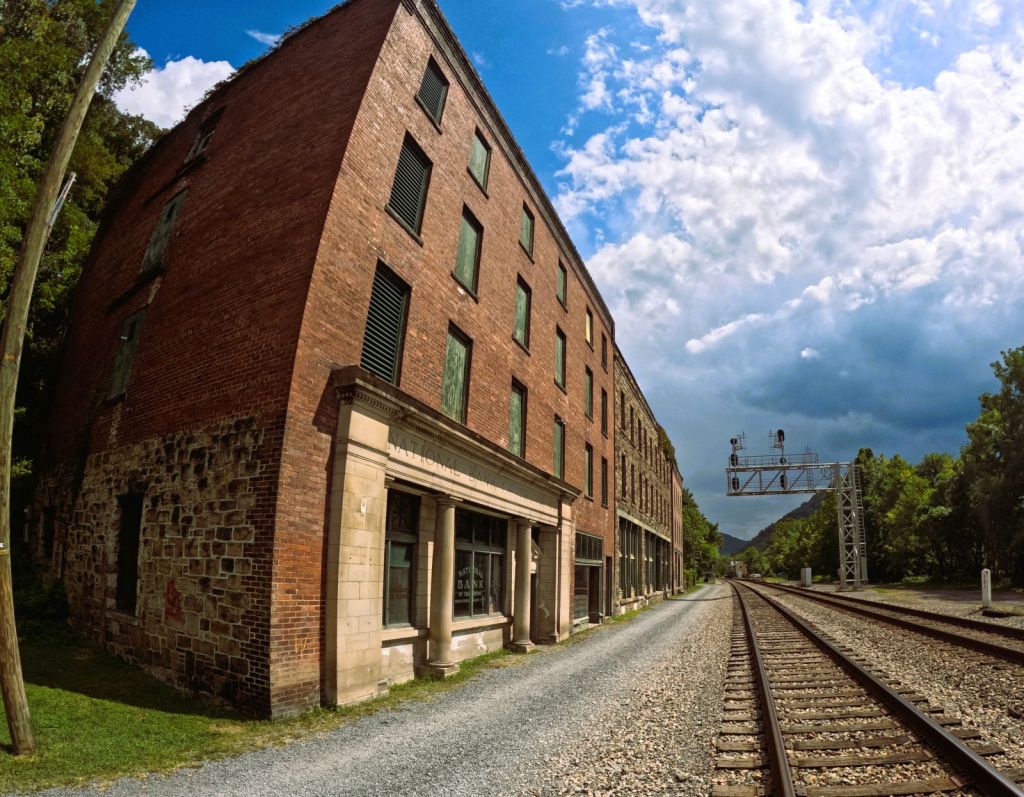
The historic Thurmond trail station is also an Amtrak stop Abandoned downtown Thurmond buildings are just a few feet from the train tracks
Railroad tracks follow the river through the gorge. Early in the 20th century coal mining towns were all along the river. Trains were frequent – there were five or more passenger trains daily and a freight train every 15 minutes.
We drove to the bottom of the gorge to see historic Thurmond, a once bustling coal mining town that is now mostly abandoned. The four remaining residents of the town are trying to preserve the town’s interesting legacy.
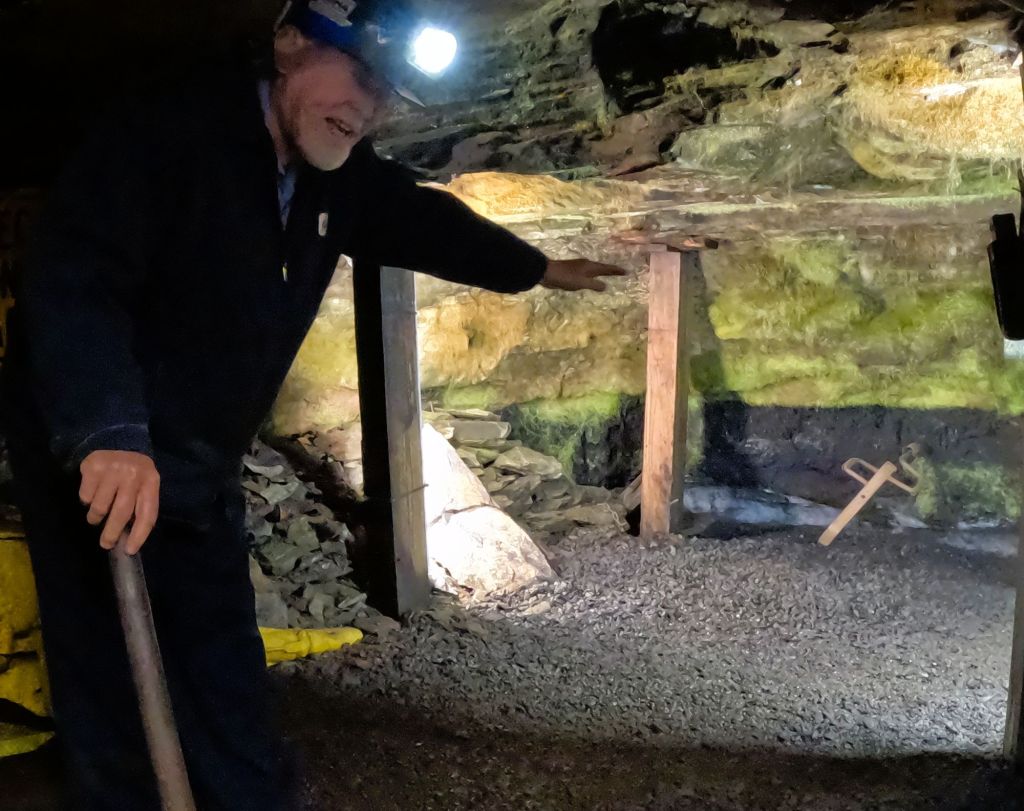
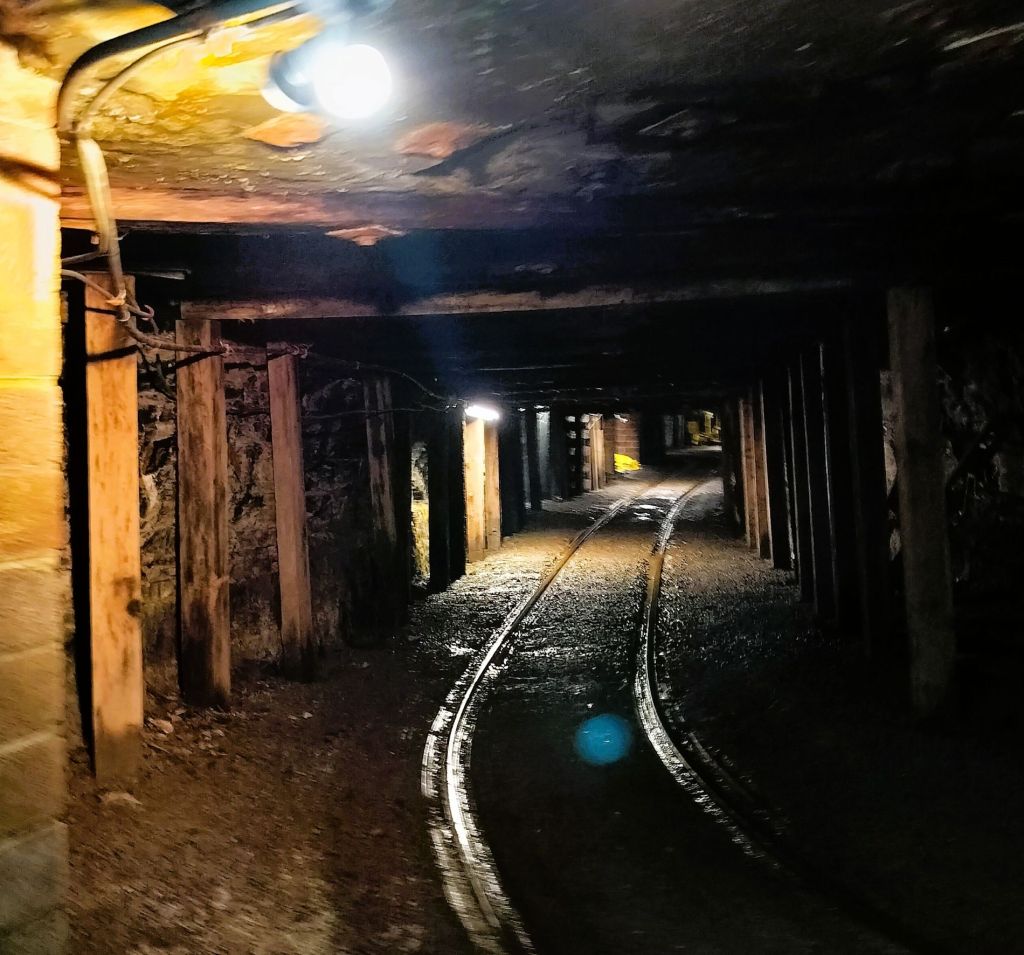
Our coal mine tour guide, Gerald, points to a layer of coal as he explains how coal was extracted and loaded onto ore wagonsWagons full of coal followed rails to the surface
Back in Beckley, we toured a coal mine. Gerald, a coal miner for more than 40 years, drove us in a coal car more than a quarter mile underground through the dark passages of a vintage coal mine. He explained historic and modern coal mining methods and equipment.
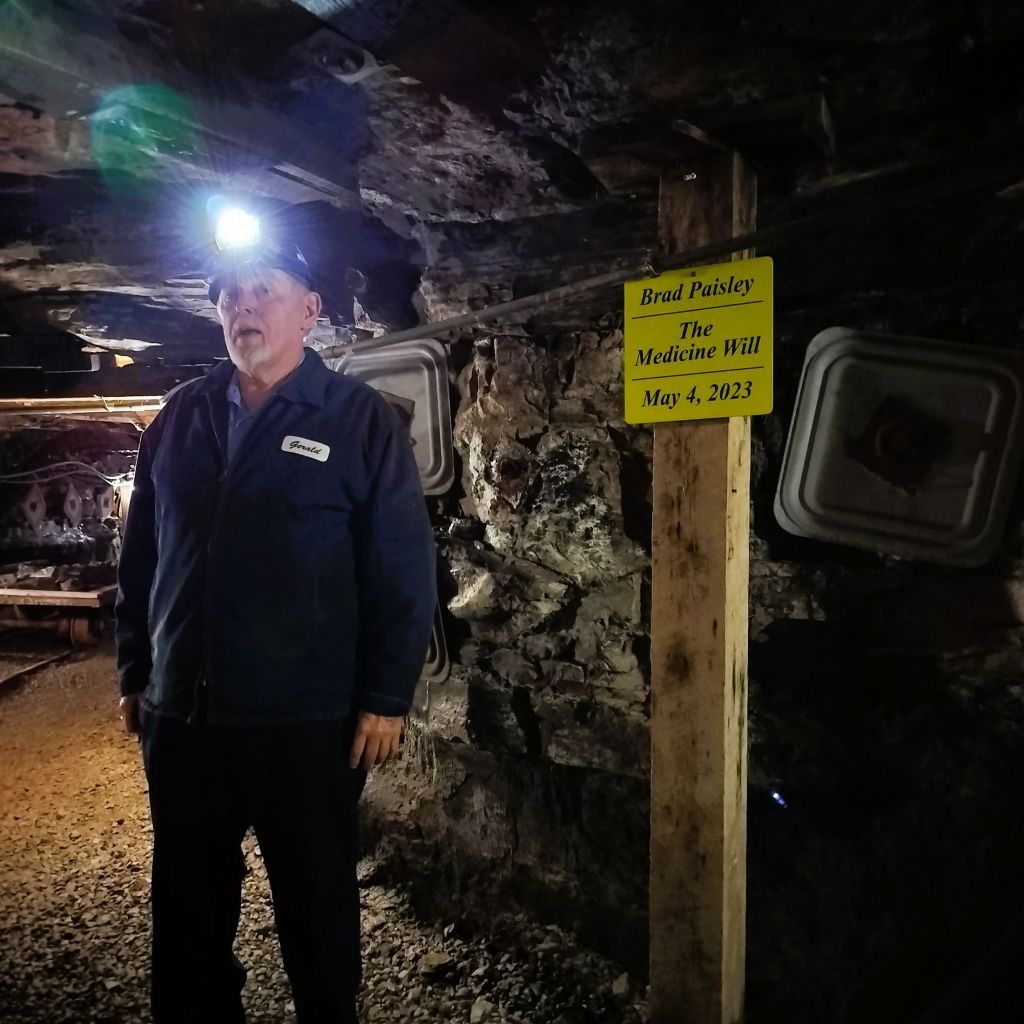
Gerald pointed to a sign labeled “Brad Paisley / The Medicine Will / May 4, 2023.” The popular country performer made a music video in the mine that is a moving story of coal mining communities dealing with various addictions, and their attempts to work together to overcome those challenges. The video is worth watching.
Hillbilly Heartburn
From Beckley, we traveled through the West Virginia mountains and passed Charleston, where we saw the gold domed state capital building from the highway.
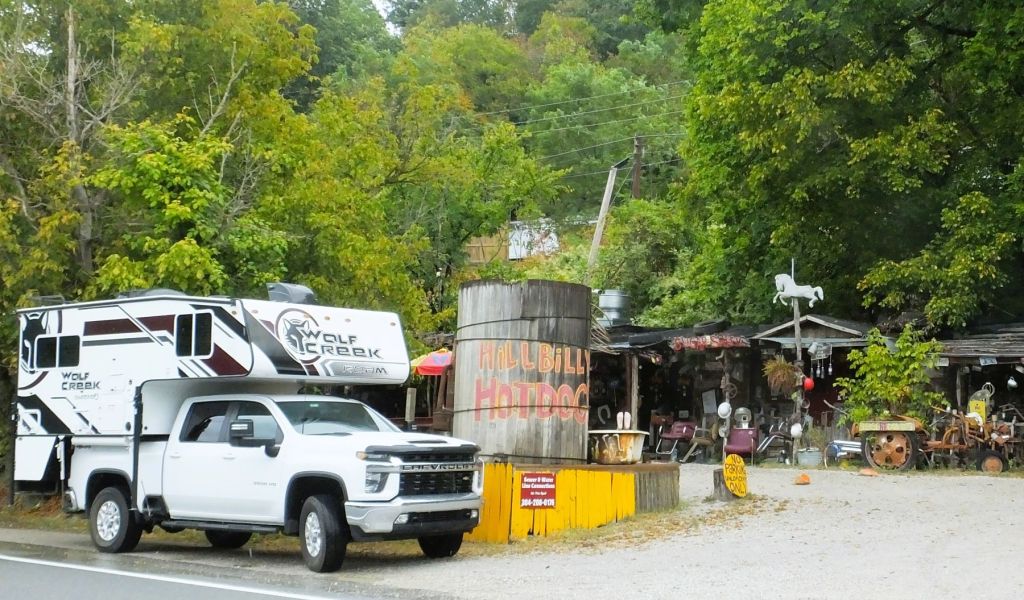
Hillbilly Hot Dogs serves flavorful hot dogs amidst funky yard treasures
We stopped for lunch at Hillbilly Hot Dogs, a quirky roadside eatery made famous by Guy Fieri on Diners, Drive-ins and Dives. HHD, as it is otherwise known, recently celebrated 25 years of Love and Weenies.
Their menu includes the homewrecker (a 15-inch one-pound weenie with two pounds of toppings) and the widowmaker (a 30-inch two-pound weenie with four pounds of toppings). We eyed the homewrecker challenge – finish in less than 12 minutes to get a special t-shirt / beat the record and it’s free.
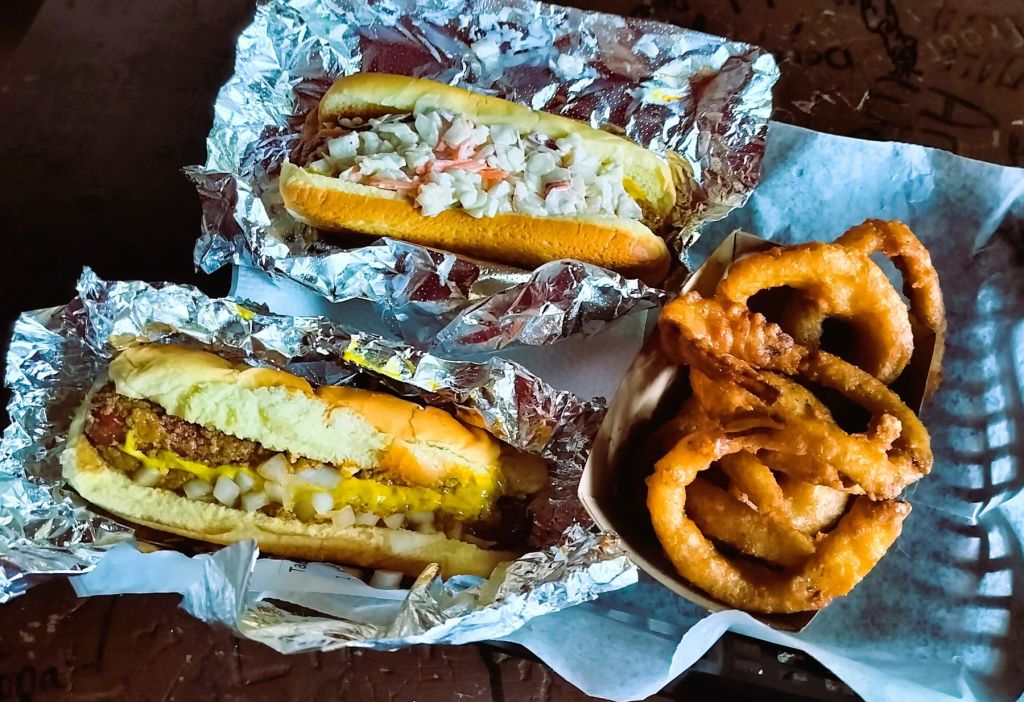
Hillbilly feast to be followed by Tums
Not wanting to risk eternal heartburn, we opted for a hillbilly dog (deep fried weenie, chili sauce, mustard and onions), a West Virginia dog (weenie, chili sauce, mustard, onions and cole slaw) and onion rings. These were well within the acid neutralizing power of a few Tums.
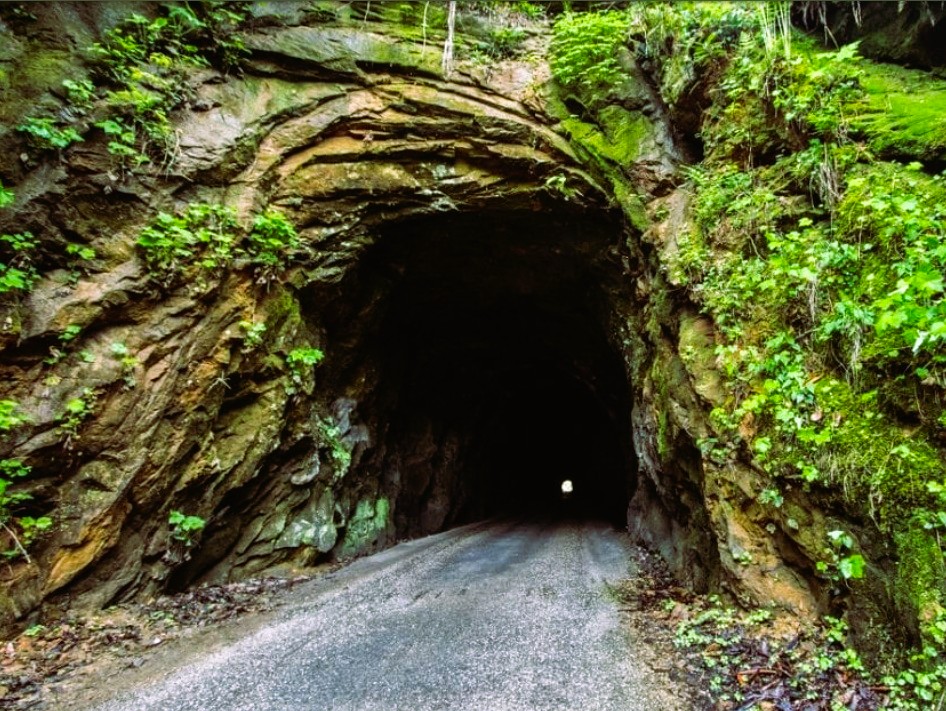
Pondering at the Nada Tunnel entrance
Nada Means NADA
We left West Virginia bound for an overnight stop near Lexington, KY. We detoured through the Red River Gorge, a National Wild and Scenic River in Daniel Boone National Forest, to drive through the Nada Tunnel, an old railroad tunnel that is reported to be 12 foot wide, 13 foot tall and 900 foot long.
Pap is a bit over 8 feet wide, 11 feet 9 inches tall and 24 feet long, so we figured we could drive through the tunnel with plenty of room to spare. Although the pickup driver recommended taking a bypass around the tunnel, I thought we would easily fit.
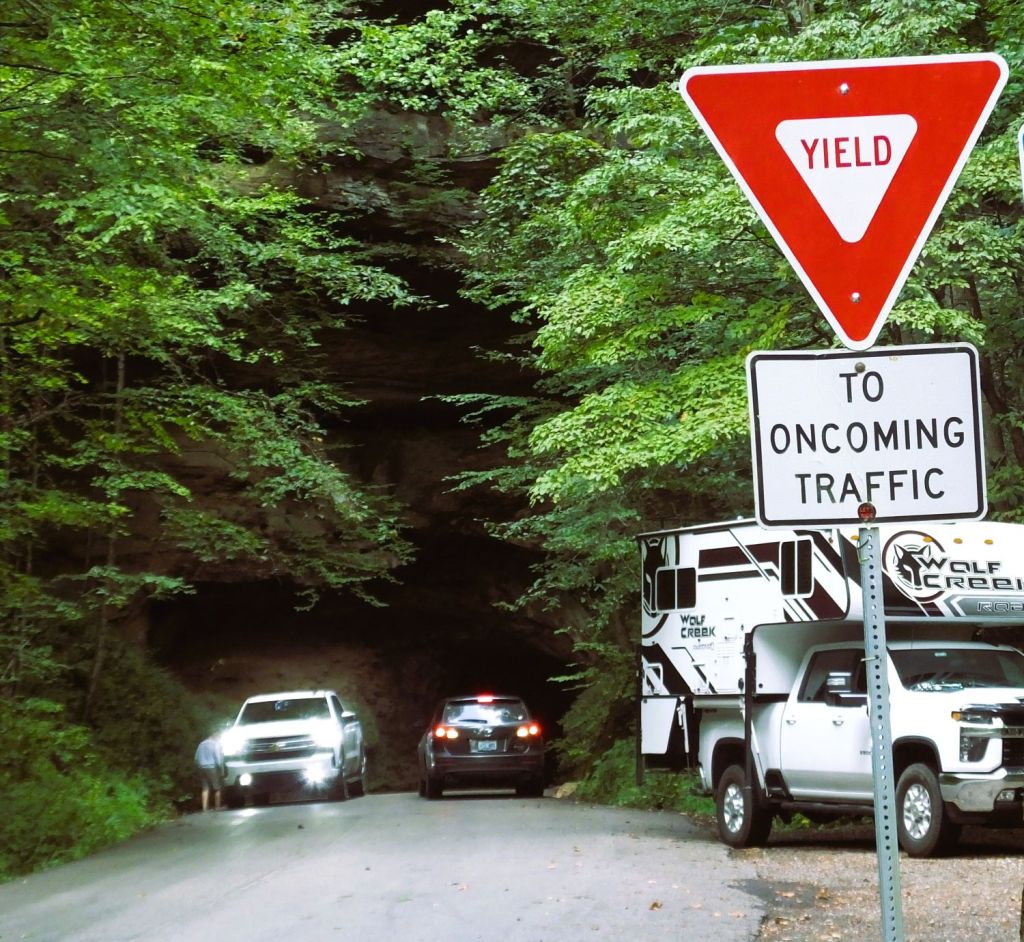
As we approached the tunnel it looked to be plenty tall. It did appear to be a little narrower than 12 feet, however. We continued on, entering the tunnel and driving VERY slowly while carefully watching our mirrors to avoid hitting the sides of the tunnel.
This is when we learned an unfortunate lesson: old tunnels are not uniform or square. Some parts are taller, some shorter, some wider and some narrower.
Creeping along, we heard a grinding noise as Pap scraped the side of the tunnel. This was not good!
So we slowed even more and made our way out of the tunnel with no further contact.
Traffic backup at the other end of the Nada Tunnel
Exiting the tunnel we stopped to check things out. There was a three-foot scrape along Pap’s passenger side roof rail. The roof material was wrinkled and cut in several spots.
That evening we performed emergency repairs with a special RV roof sealant. Additional repairs will be needed when we get home.
For hard-headed and unnecessary risk takers like me (Ed), it was a painful lesson.
Going forward, we’ll keep Pap out of railroad tunnels on narrow roads and (hopefully) avoid other risky endeavors. And, Pat will remind me that Nada means NADA!
Pat says Nada means NADA!
Next Week
Skyline or Fort Washington chili? Cincinnati natives have their favorite way chili is served over spaghetti with shredded cheese and other toppings. After checking out Cincinnati’s American Sign Museum with its multitude of vintage signs that are truly Americana, we stopped for lunch to determine our own chili preferences.
Speaking of Americana, our travels continued to an area west of Indianapolis known for lots of covered bridges. We visited a few and also hiked some interesting trails in Turkey Run State Park.
After enduring brutal summer heat in Florida, we left home on a rainy Saturday to visit family in Georgia. We often do this when we travel.
We enjoyed visits with Henry, Josh, Emilia and Liz, and with my sister, Kitty, and her husband, Mike.
Christmas in July. Breakfast for dinner. October in August?
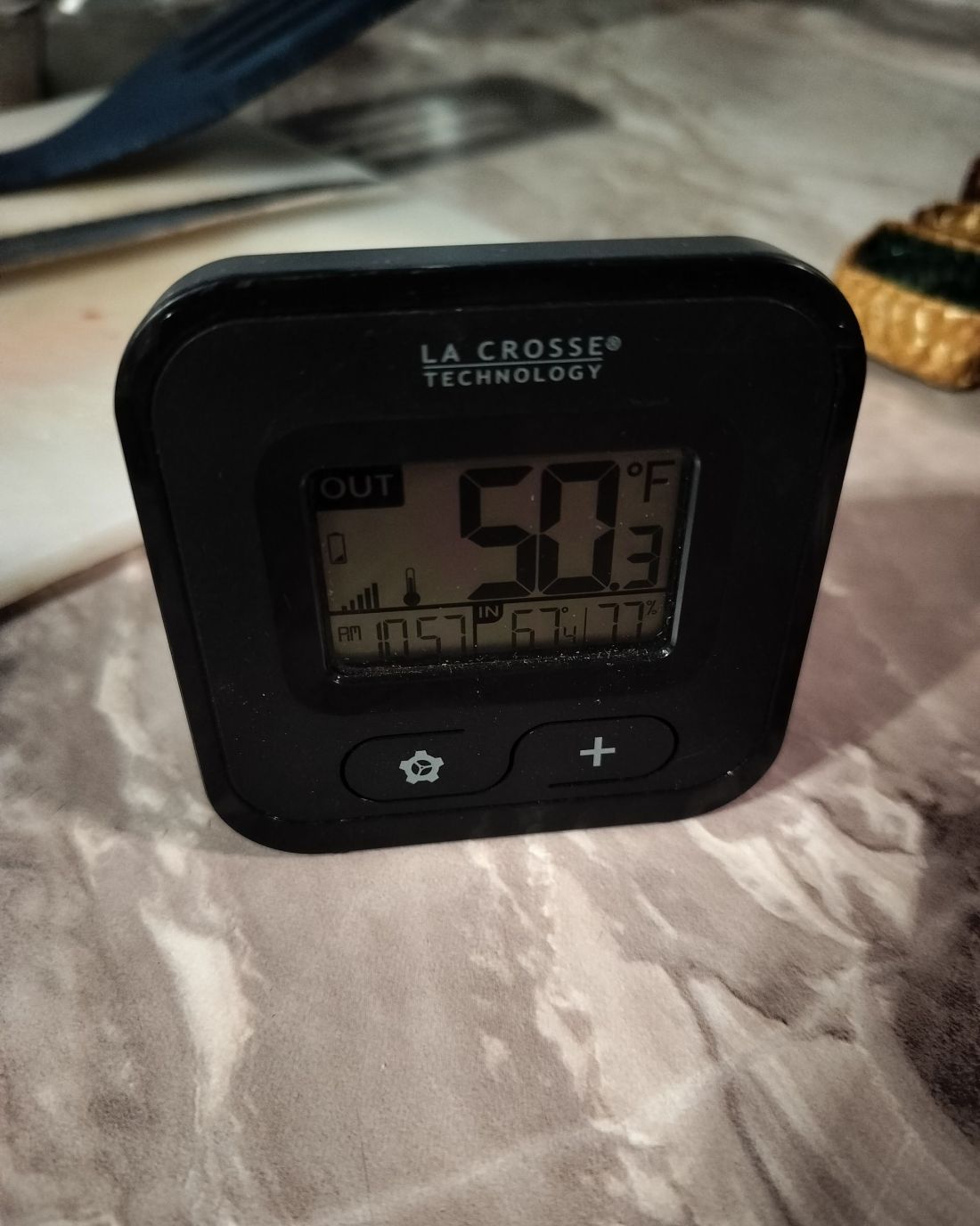
Family visits behind us, we were surprised the next morning with brisk temps (50 degrees) as we camped in Cherokee National Forest near Knoxville, TN. We fired up Pap’s furnace, arose and cooked breakfast to begin the day. Out came our jackets!
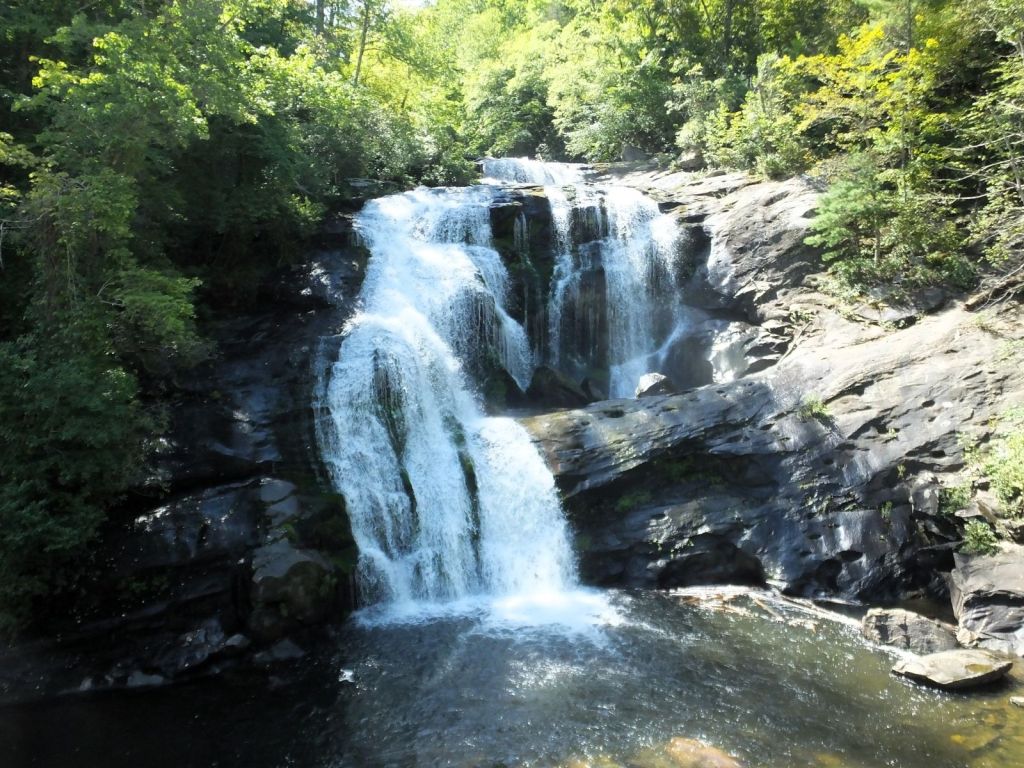
From our remote campsite on the North River we moved to Indian Boundary Campground, just 16 miles away, for the next three nights. On the way, we stopped to enjoy Baby Falls and Bald River Falls, and later rode our bicycles around Indian Boundary Lake. We continued to wear jackets in the cool October in August weather!
Bald River Falls in Cherokee National Forest
Pick a Parkway
Perhaps you have driven the Blue Ridge Parkway, a 469-mile scenic highway that winds through the Appalachian Mountains in North Carolina and Virginia, or perhaps the Skyline Drive as it continues another 105 miles from the end of the Parkway through Shenandoah National Park, just 70 miles west of Washington DC.
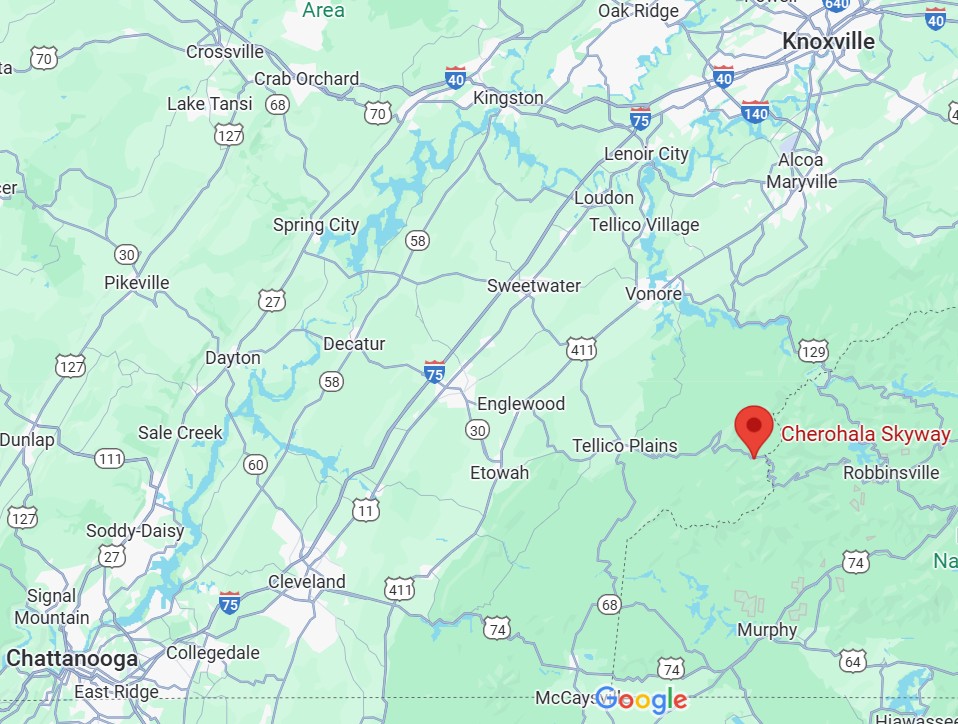
How about the Cherohala Skyway? It connects Tellico Plains, TN and Robbinsville, NC through Cherokee NF in Tennessee and Nantahala NF in North Carolina. The 43-mile scenic road rises to more than a mile high with mountain vistas, numerous overlooks and sweeping curves popular with motorcycle riders! (it’s very close to the well-known Tail of the Dragon motorcycle route)
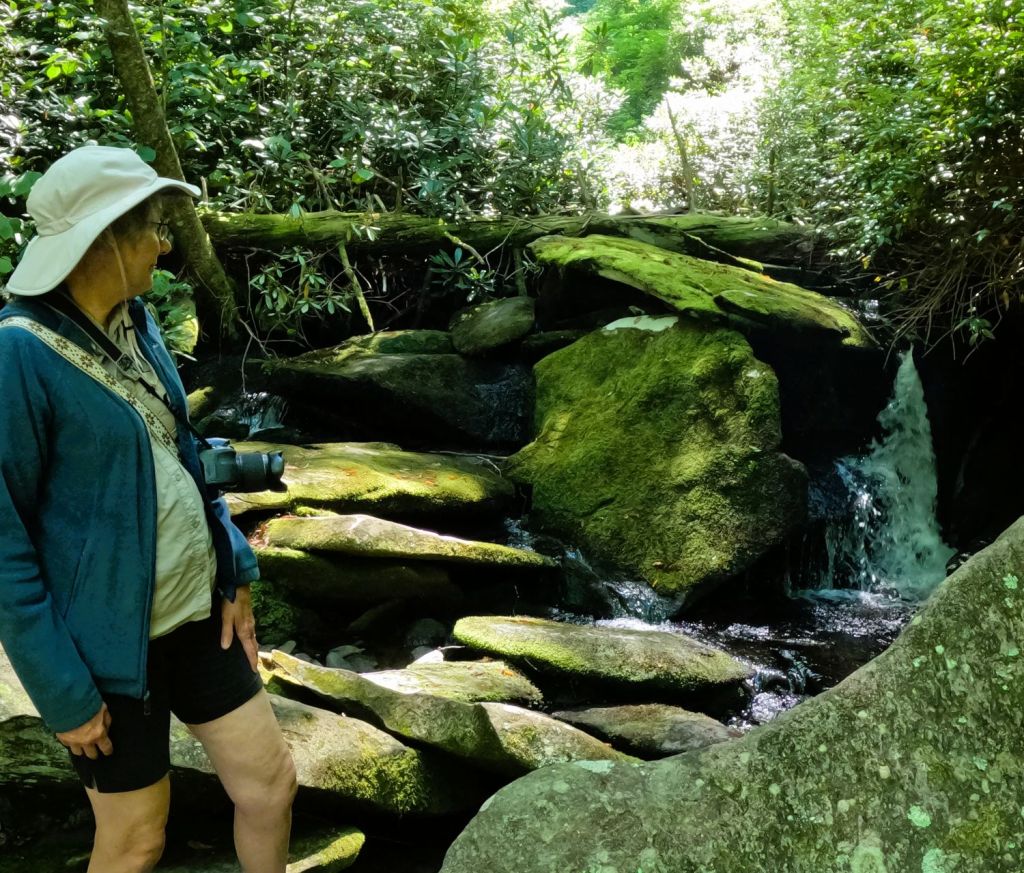
Pat views the small waterfall after our steep downhill descent
At one overlook, we hiked three miles to a small waterfall. Nearing the falls, we tightly held onto tree branches, roots and rocks as we descended the final quarter mile. We ate lunch to the sounds of rushing water and gave thanks for God’s wonderful creation!
Cades Cove
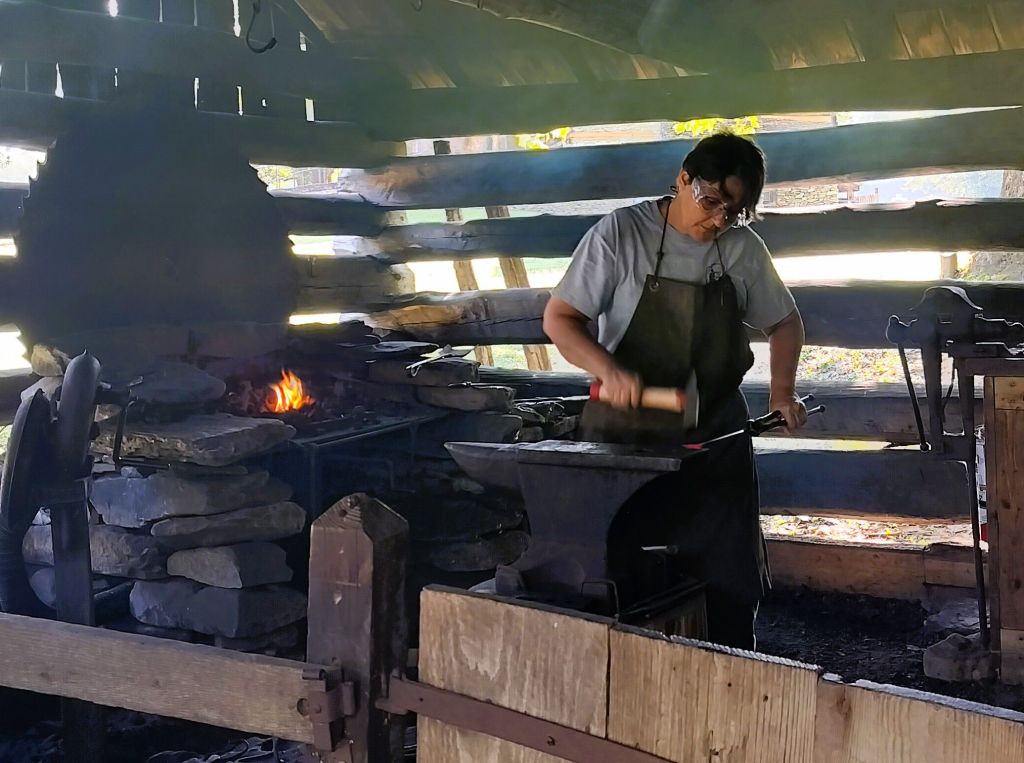
The Cable mill and homestead area in Cades Cove includes a blacksmith demonstration
The next day we left for a two-day visit to Cades Cove in Great Smoky Mountains National Park. The Cove is known for its 11-mile loop road with historic homesites and churches, and diverse wildlife (see Critter Count below).
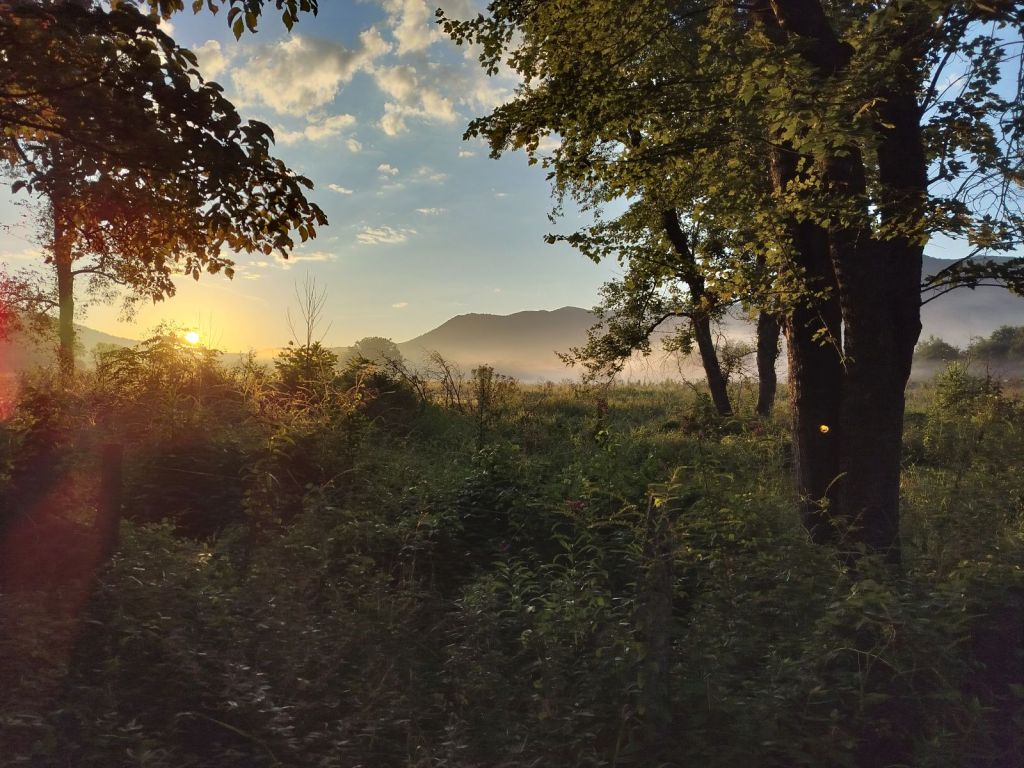
A misty early morning sunrise along the Cades Cove Loop Road
We have visited and camped at the Cove several times in the past, and although the loop road and campground were busy this time with Labor Day visitors, we enjoyed our two drives around the loop road.
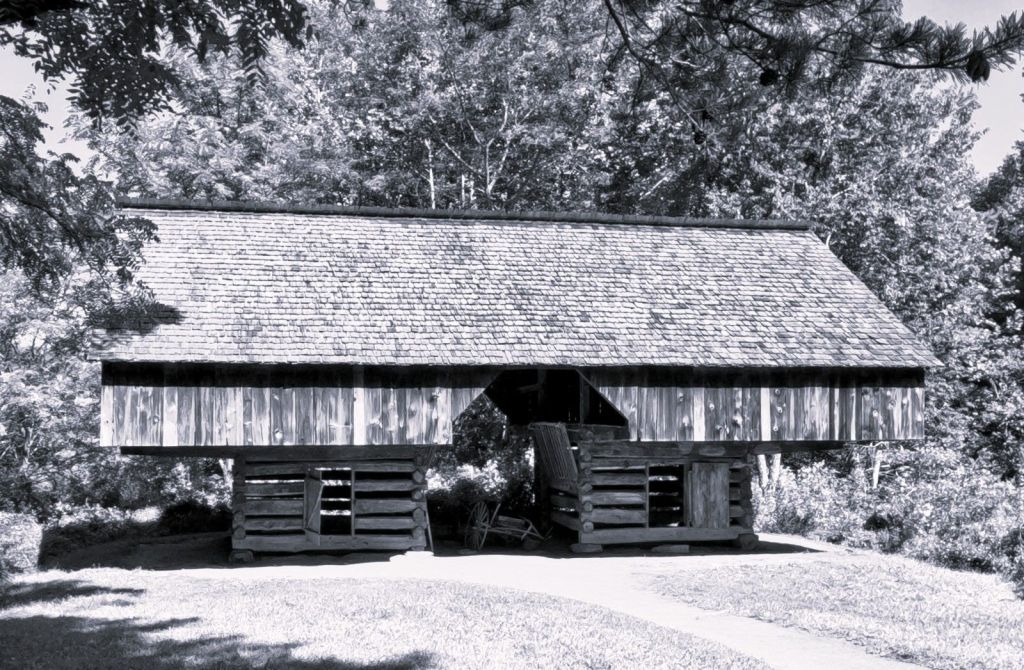
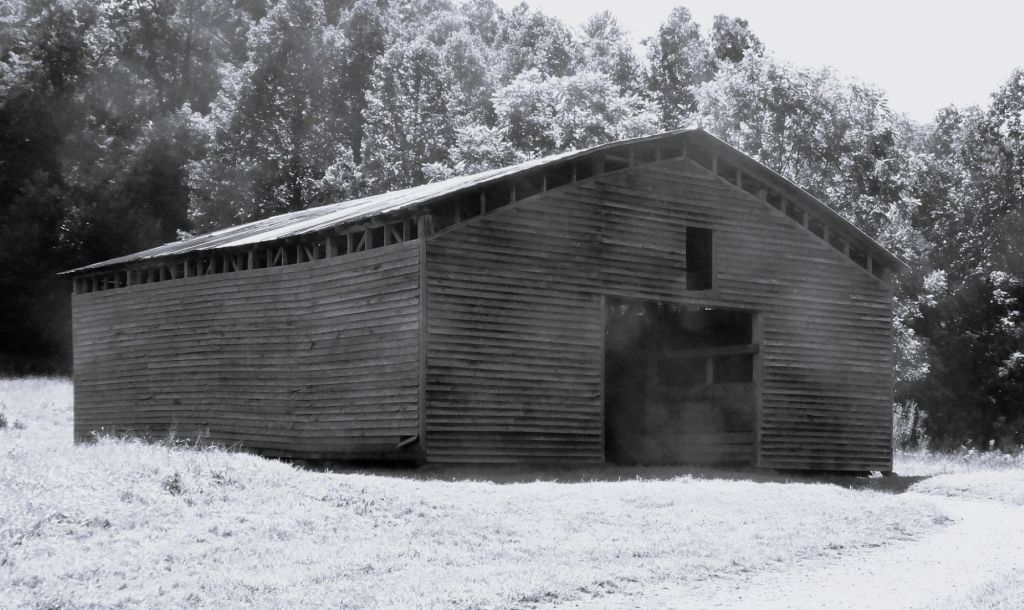
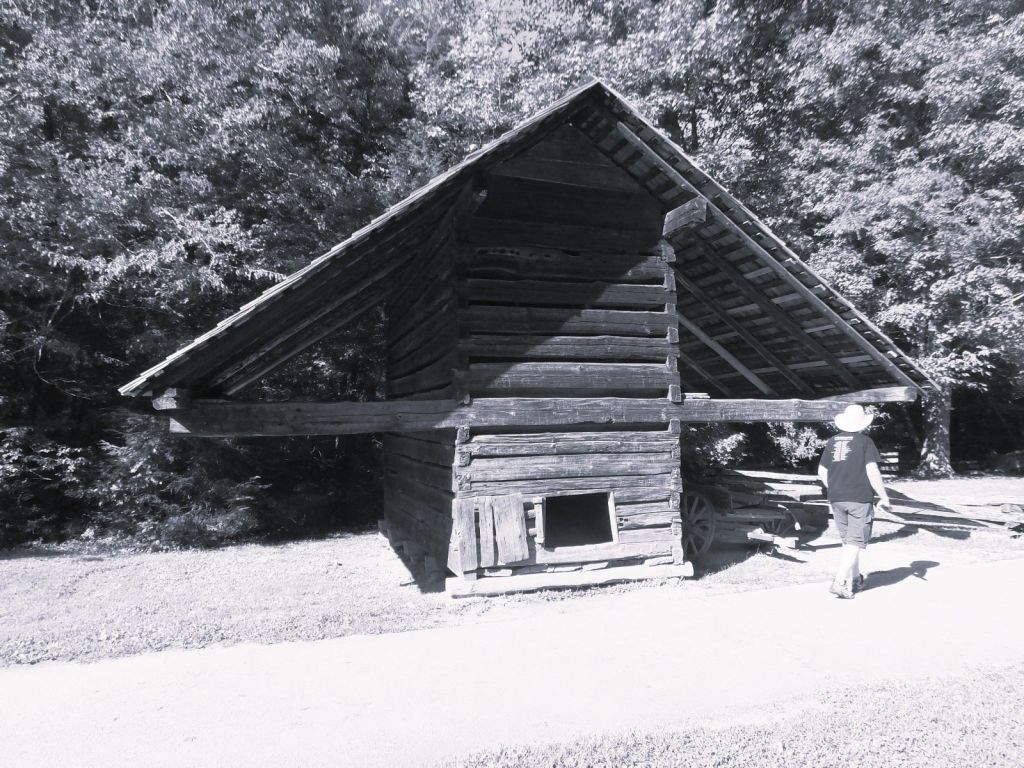
A number of historic cabins and houses (above) and barns (below) can be toured in Cades Cove
Critter Count
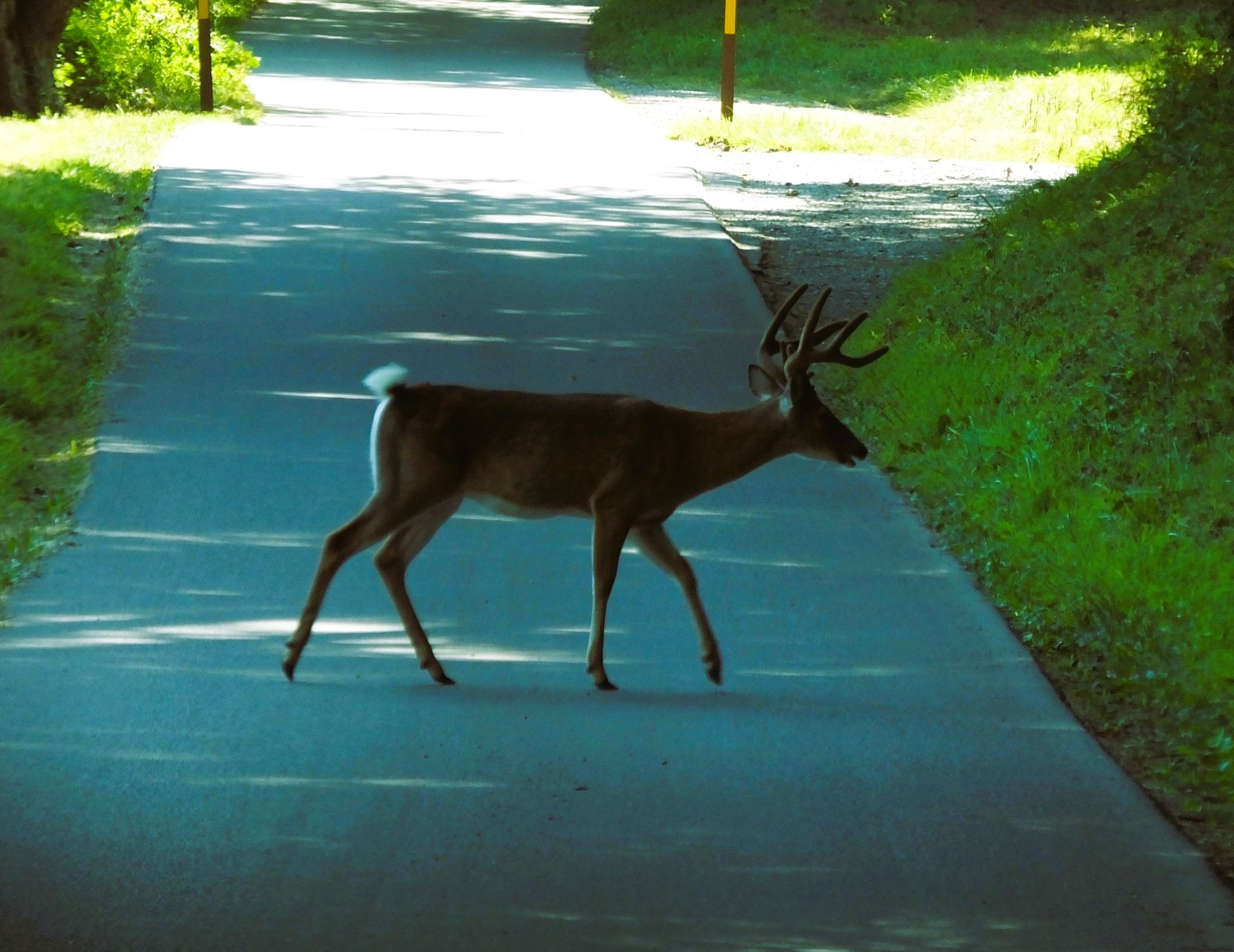
Deer – 8 Black bear – 2 (plus a couple other we just missed as evidenced by two bear jams) Turkeys – 10 Glow worms (bioluminescent larvae of fungus gnats) – lots (faintly glowing on the ground at North River Campground)
Deer and black bear were among the critters we saw in Cades Cove
Next Week
Our travels continue to a deep and very ancient gorge, and we watch dinosaurs and sharks under the moonlight.
It is hard to believe that it has been nearly nine months since the last episode of RabbiTRAILS.
Catching Up
We finished our 2024 Heartland series in December. The series included serving at Christian youth camps in Texas and Ohio, visiting four of the five Greal Lakes, and hiking and camping in New York, New Hampshire and on the backbone of Appalachians in Virginia and North Carolina.
We returned home in September just in time for heavy rains, soggy floors and Hurricane Helene.
Helene’s winds caused considerable damage in Florida and south-central Georgia before devastating communities in the North Carolina mountains. Pat and I did hurricane relief work with Samaritan’s Purse in Perry (Florida) and Valdosta (Georgia).
Earlier this year, we saddled up Percy and Pap for a short camping trip with friends at two central Florida State Parks in January. A month later we traveled to south Florida, camping at two state parks in the Florida Keys, Everglades National Park and Big Cypress National Preserve. We had an international travel trip in April/May, and served at the Texas camp in June. More on these travels in upcoming RabbiTRAILS episodes!
Forward to August 2025
It’s hot.
It’s humid.
It’s time to get on the road to find cooler temps and cool RabbiTRAILS!
Balloons…
We’re bound for the Albuquerque International Balloon Fiesta.
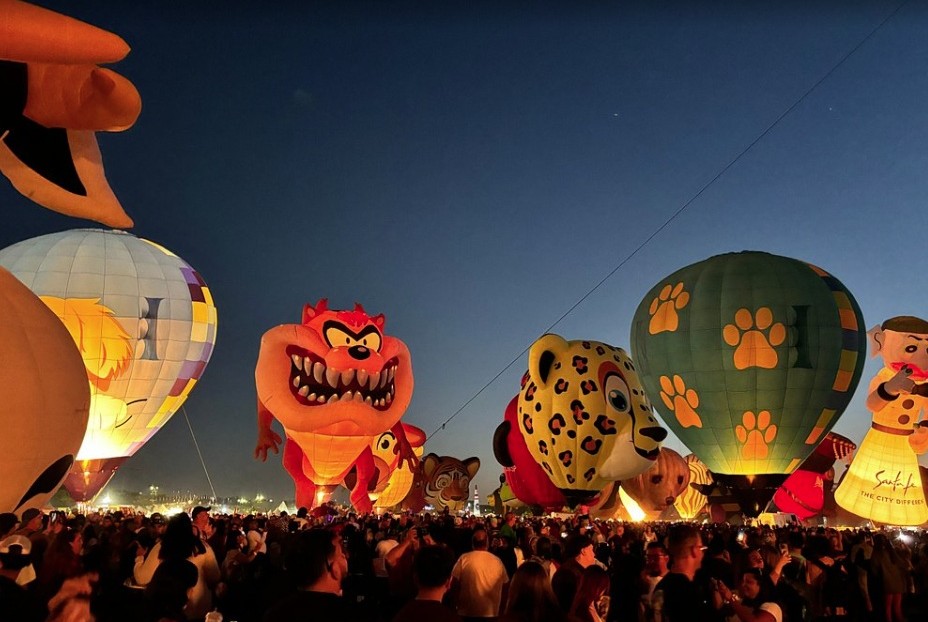
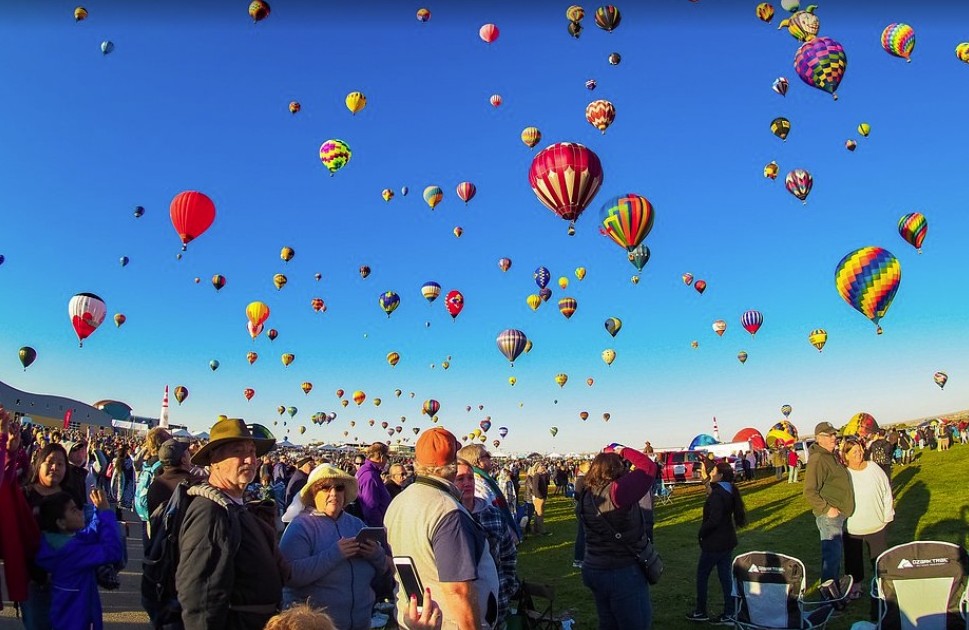
Imagine more than 500 colorful hot air balloons ascending at dawn into the New Mexico sky.
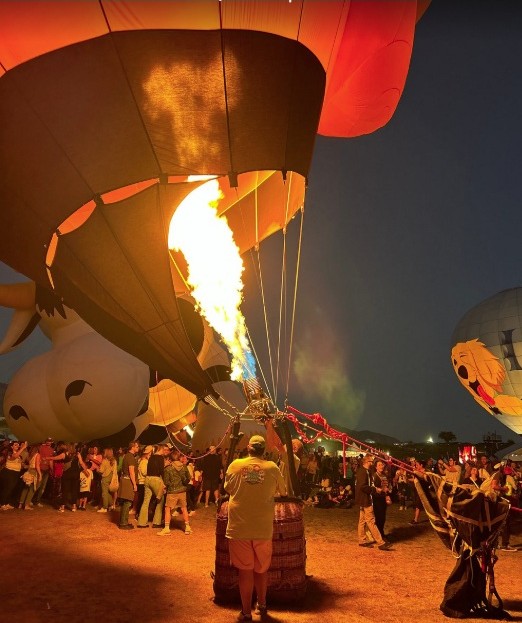
From just a few feet away, hear and feel rushing hot air as bustling crews use propane burners to fill balloons for launch.
And then they’re off, rising quickly and following air currents to the horizon.
We’ll be camping on the Fiesta grounds where we hope to capture the amazing experience.
Talk about cool!
…and Beyond
We’re planning lots of RabbiTRAILS before and after the Fiesta:
New River Gorge NP
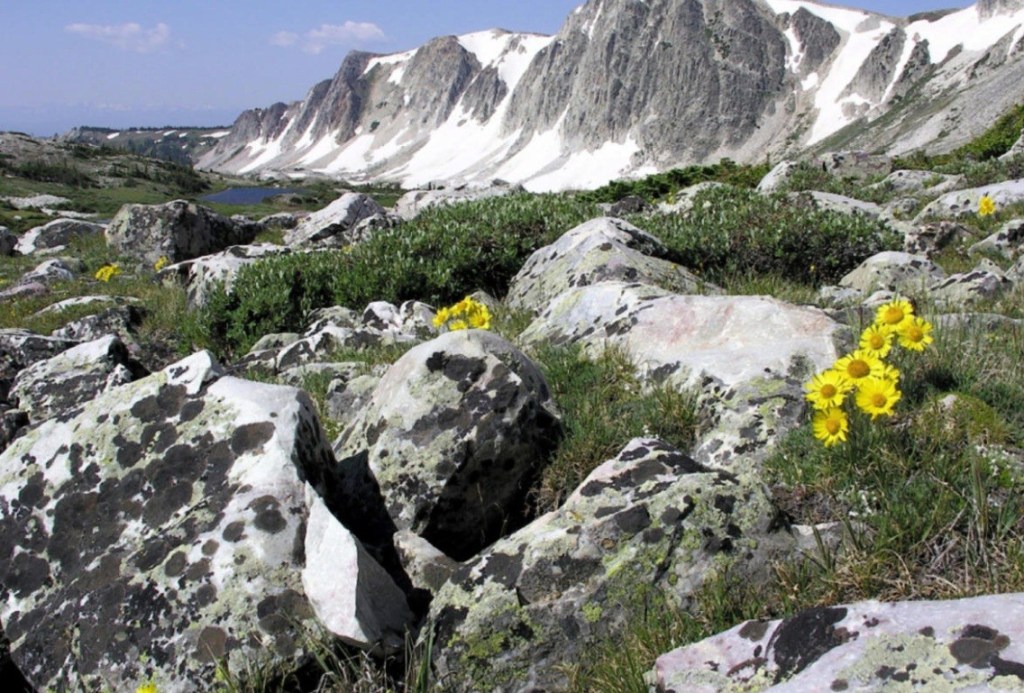
Our travels will take us to Georgia for family visits, Tennessee to hike in Cades Cove in Smoky Mountains NP, West Virginia to admire vistas at New River Gorge NP, and Kansas City for another family visit. We’ll be on the watch for runzas and tanking as we cross Nebraska, and then continue on to the Medicine Bow Mountains in southern Wyoming.
Medicine Bow Mountains
We’ll then travel south to the western side of Rocky Mountain NP and continue to Mesa Verde NP where we will explore iconic Ancestral Puebloan cliff dwellings.
Cliff Dwellings in Mesa Verde NP
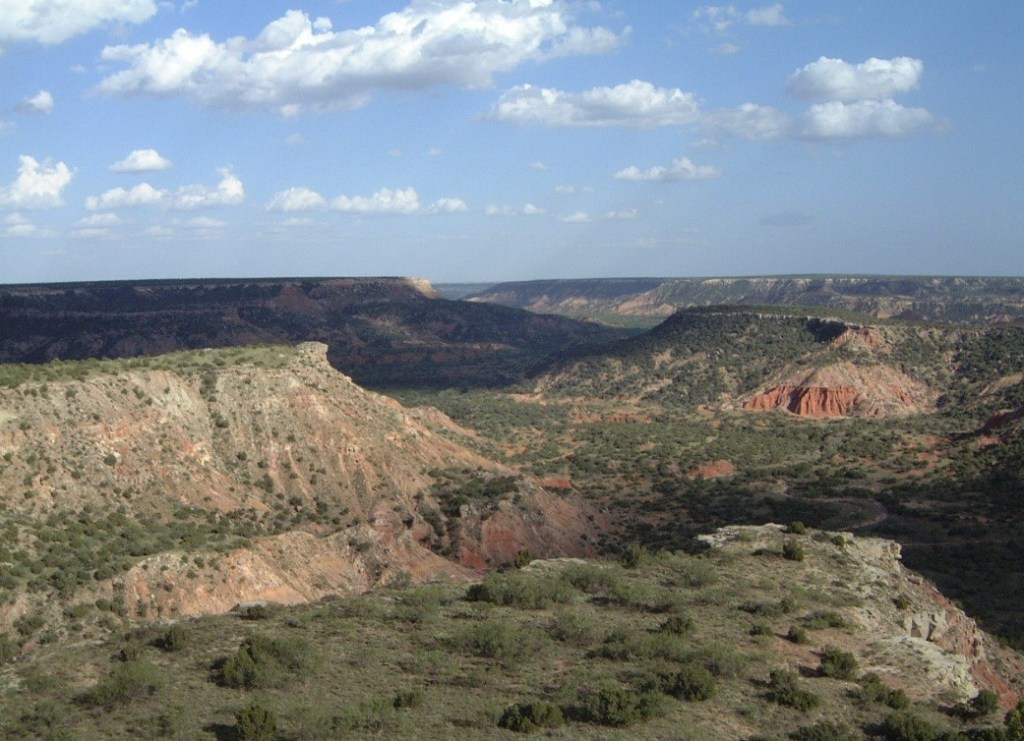
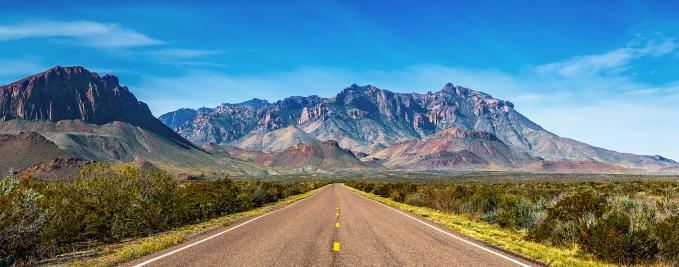
After the Fiesta, we’ll return east to Texas to visit Palo Duro Canyon SP, the second largest canyon in the US, and get really remote at Big Bend NP. Our trip will end with a stop in the Ozark and Ouachita Mountains in Arkansas.
Palo Duro CanyonBig Bend NP
Taking the Long Road…
As you can see from the itinerary above, RabbiTRAILS involve more miles and days than expected. They are NEVER direct (or dull).
That’s the fun and challenge of taking the long road!
We left New England enjoying the warm, hazy days and cool nights of mid-August.
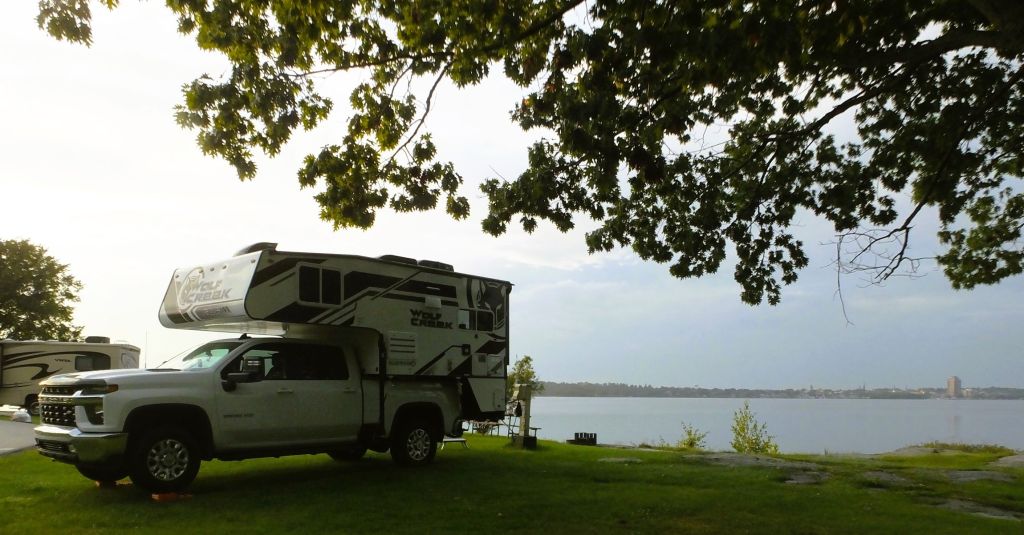
We endured several days of heavy rainfall as we crossed Vermont and New York. While camping on the St. Lawrence River, we watched big ships and wondered if any would be traveling nearly 2500 miles across the Great Lakes to Duluth, MN, a stop we made earlier this summer.
Camping on the St Lawrence River. The far shore is Ontario, Canada.
The next night we camped close to where the St Lawrence flows out of Lake Ontario. Our campground was covered with large puddles and the ground was squishy everywhere. We left our shoes on the back step of Pap to avoid tracking mud into the camper!
Fishes and Falls
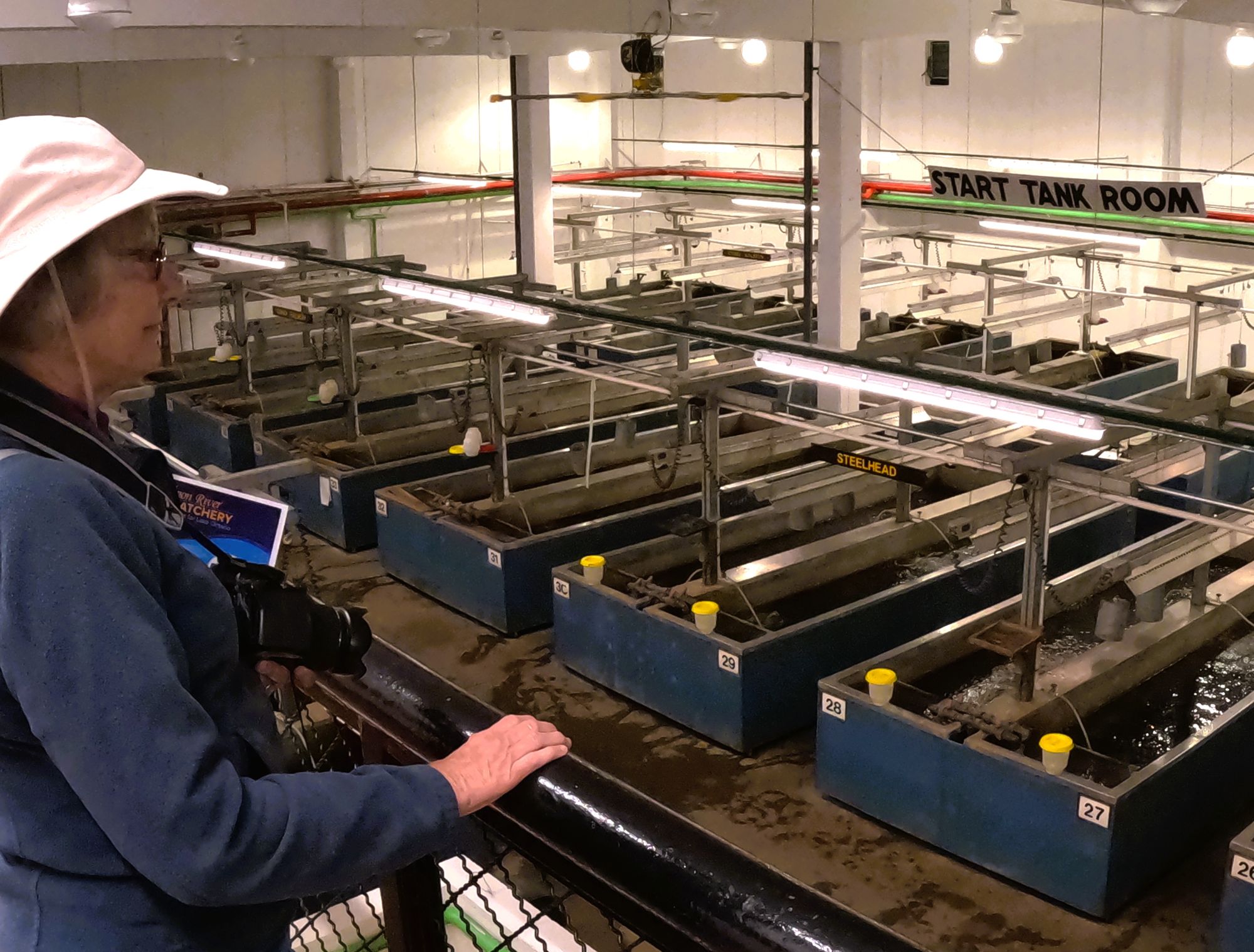
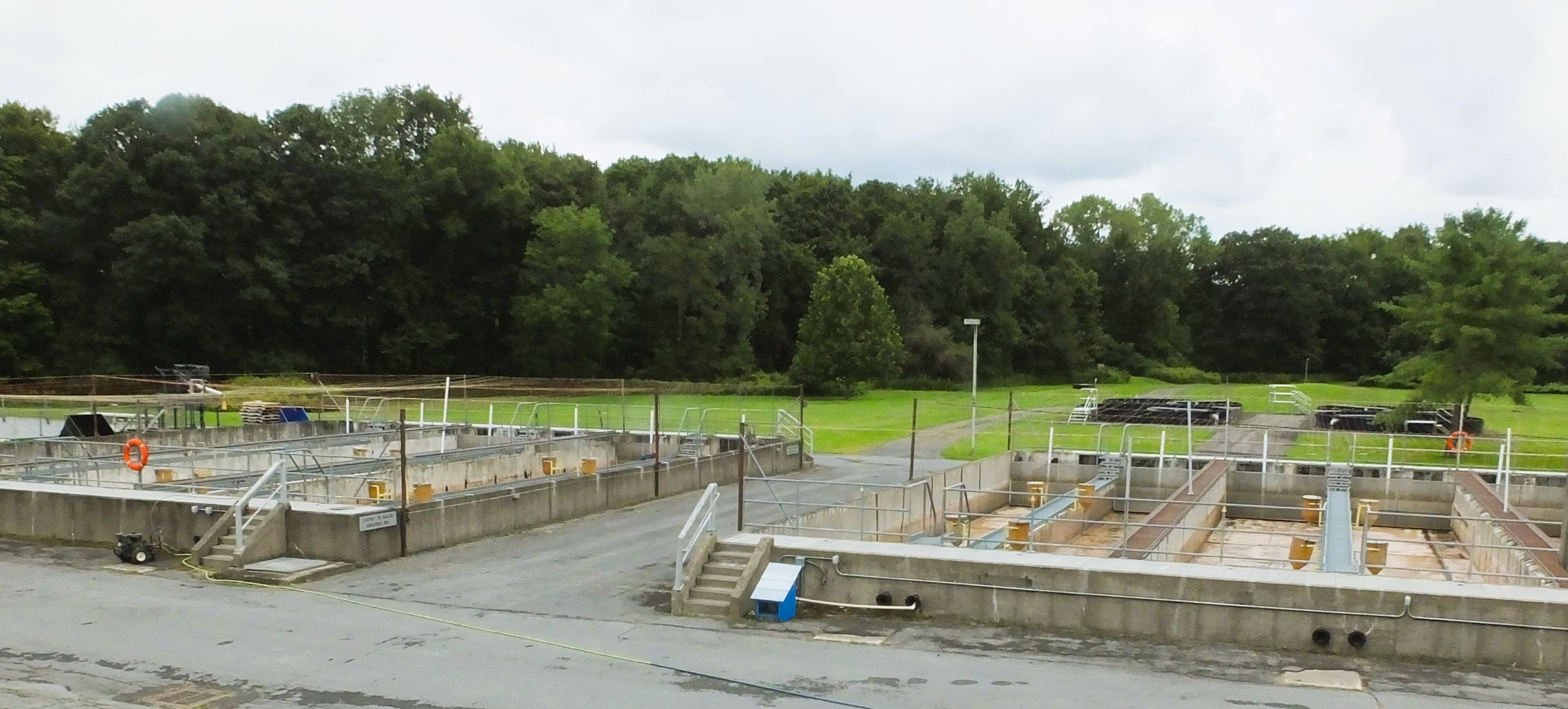
The next morning, we visited a fish hatchery nearby on the Salmon River. The hatchery was opened in 1981 to raise king and silver salmon and trout.
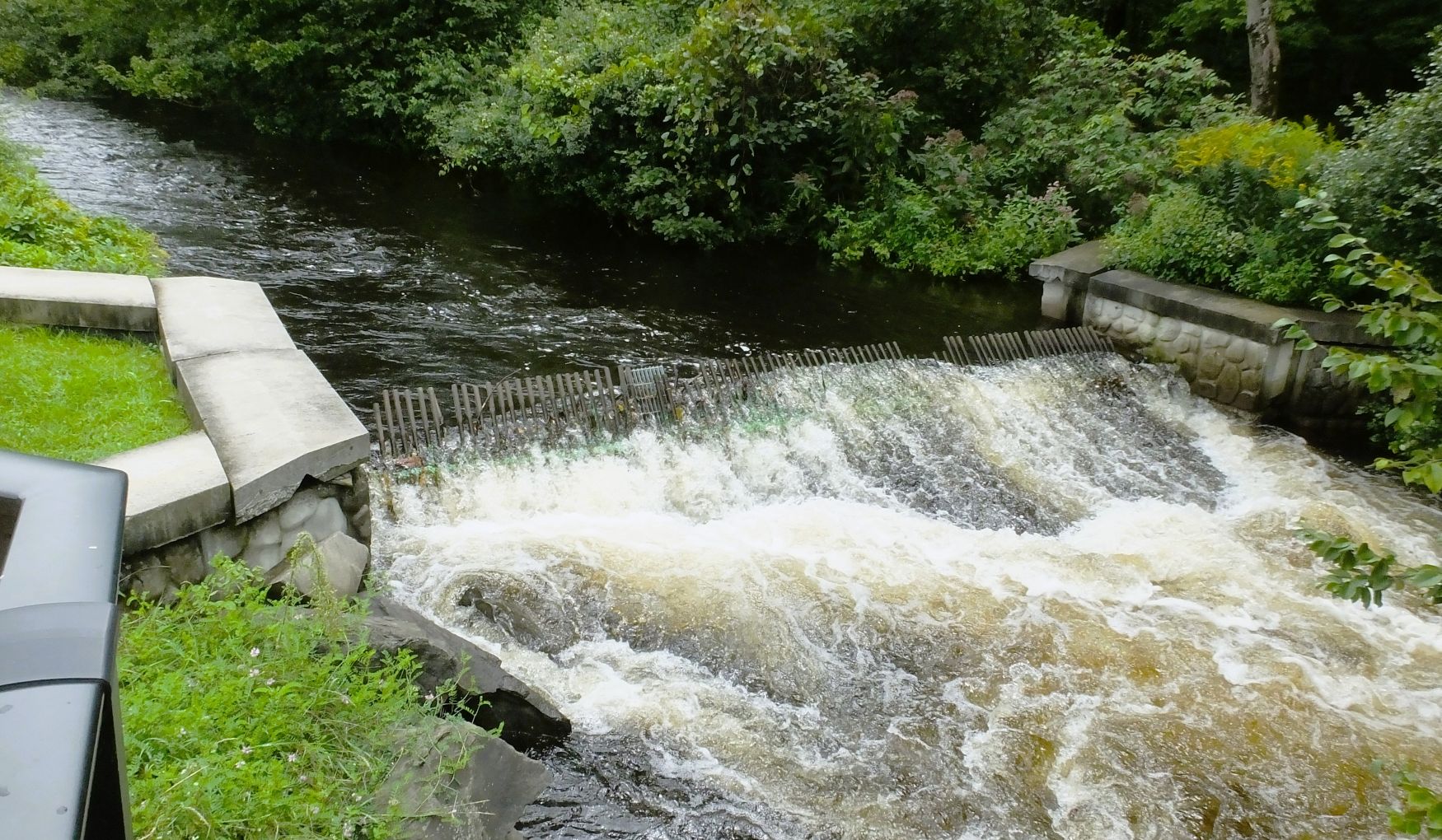
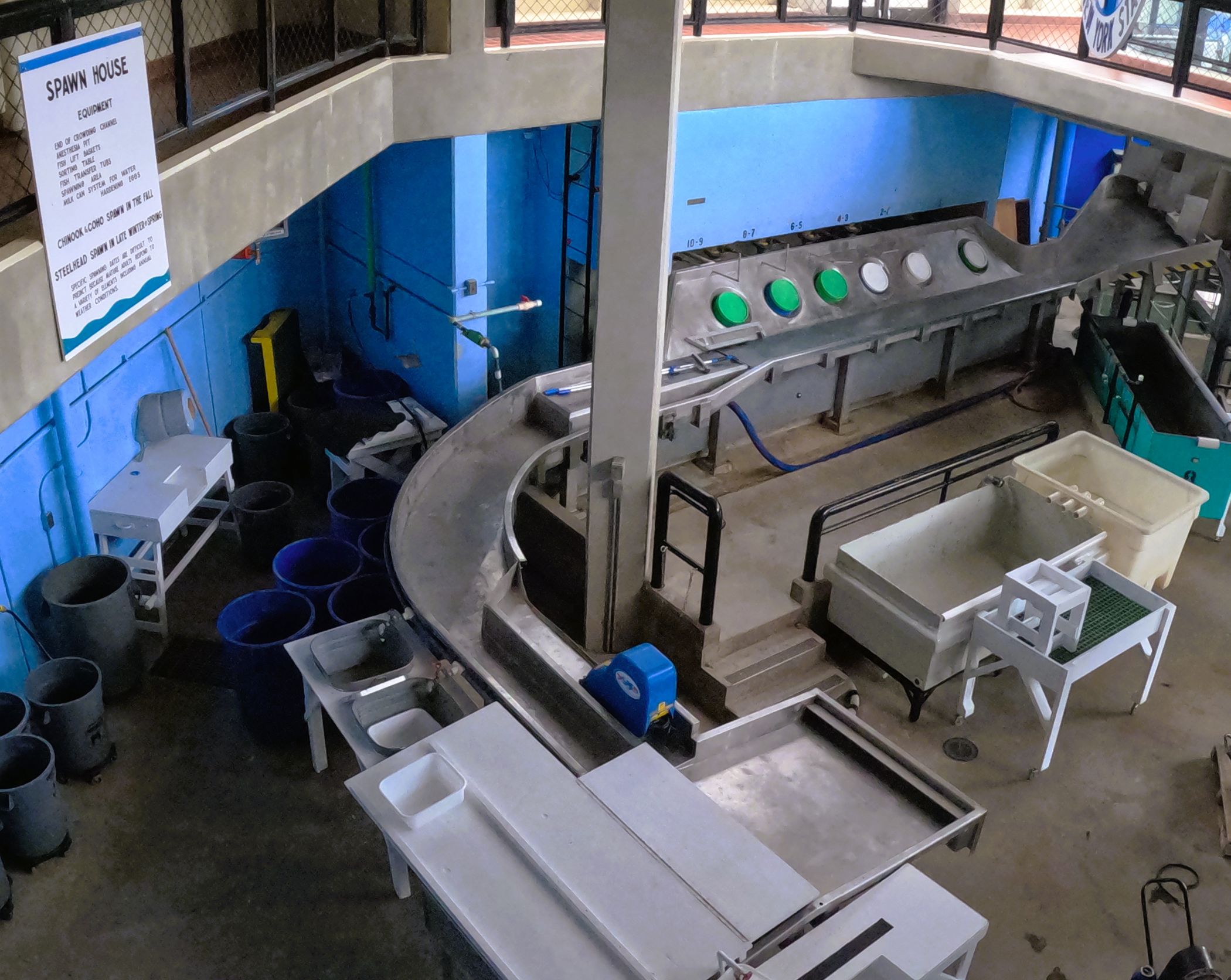
Salmon River Fish hatchery: stream where fish are directed to fish ladder, room where eggs and milt are harvested, developing fish are raised in indoor tanks and then transferred to outdoor tanks before being released
Millions of eggs are collected from adult fish, hatched, raised and released throughout New York’s Great Lakes and the rest of the state. Egg harvesting takes place in the spring and fall, so it was quiet during our visit (mid-August). We were reminded of hatcheries visited on past trips to Alaska and Oregon.
The Salmon River Falls were nearby, and we decided to check them out.
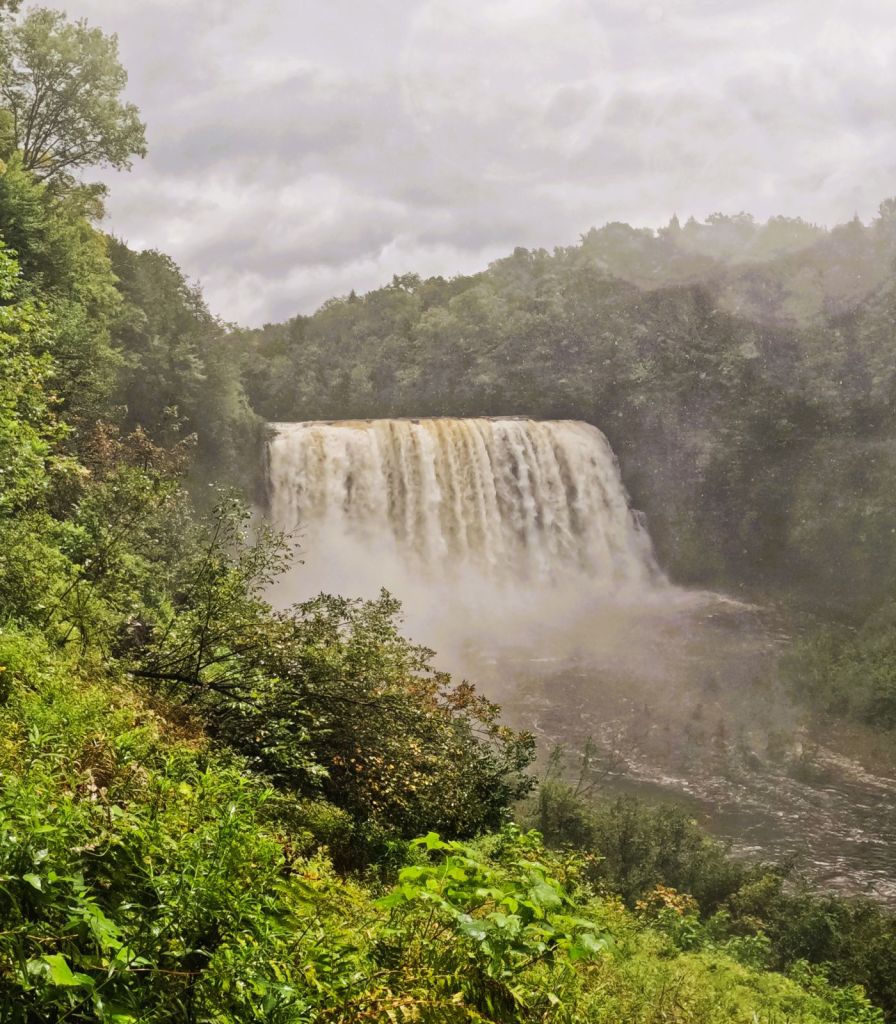
Salmon River Falls, swollen by the recent heavy rains
The falls were amazing! Swollen from the recent rains, we could hear the falls nearly a mile away. We carefully walked down a steep trail towards the base of the 110-foot falls but had to turn back to avoid being soaked by the falls’ mist cloud!
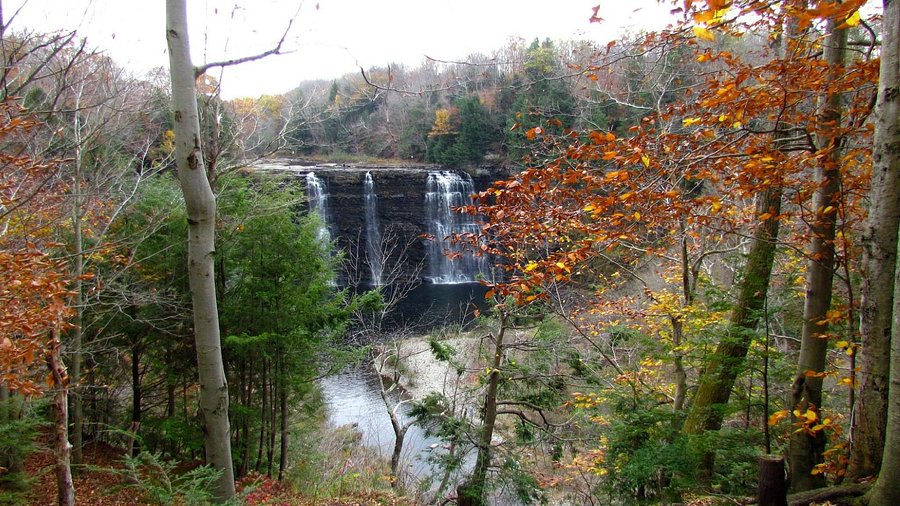
Salmon River Falls at normal water levels
More Waterfalls
Our travels continued south into Pennsylvania, enroute to Ricketts Glen State Park.
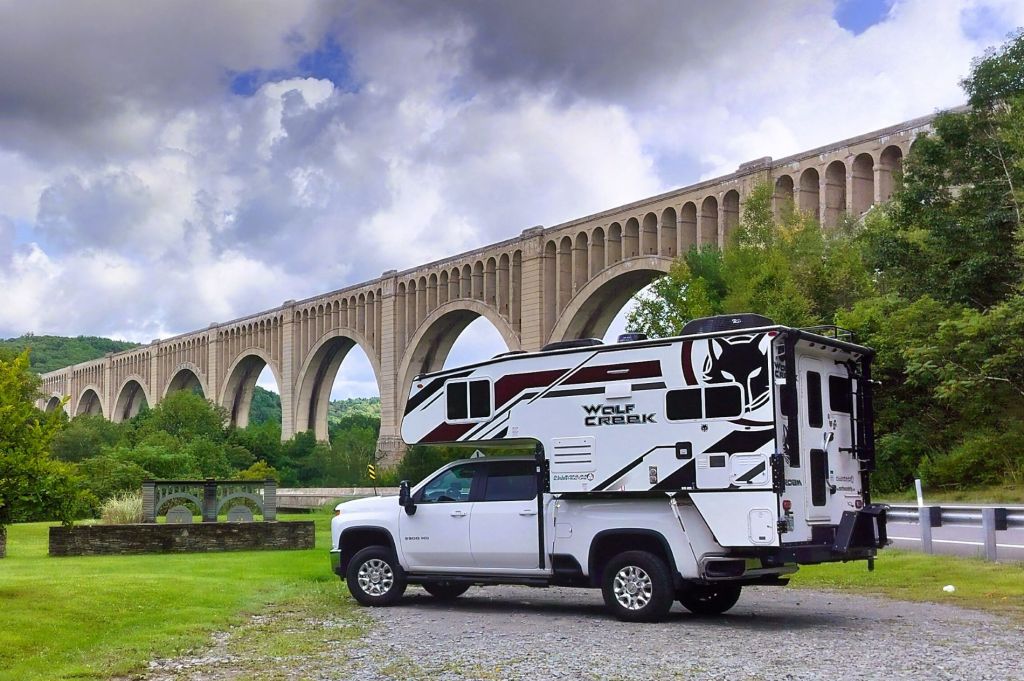
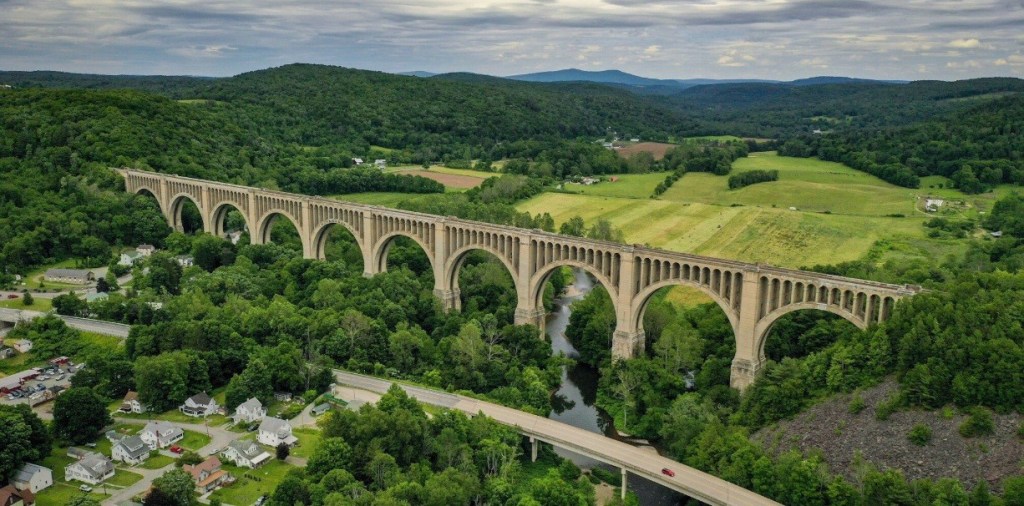
Percy and Pap posing at Tunkhannock Creek ViaductAerial view of the viaduct (image from Google)
Passing through Nicholson, PA, we stopped at the Tunkhannock Creek Viaduct. Completed in 1915, the half-mile long viaduct was the largest concrete bridge in the world at the time and regarded by some as the ninth wonder of the world. The impressive structure is nearly 300 feet tall and still in use by Norfolk Southern freight trains.
22 Falls at Ricketts Glen
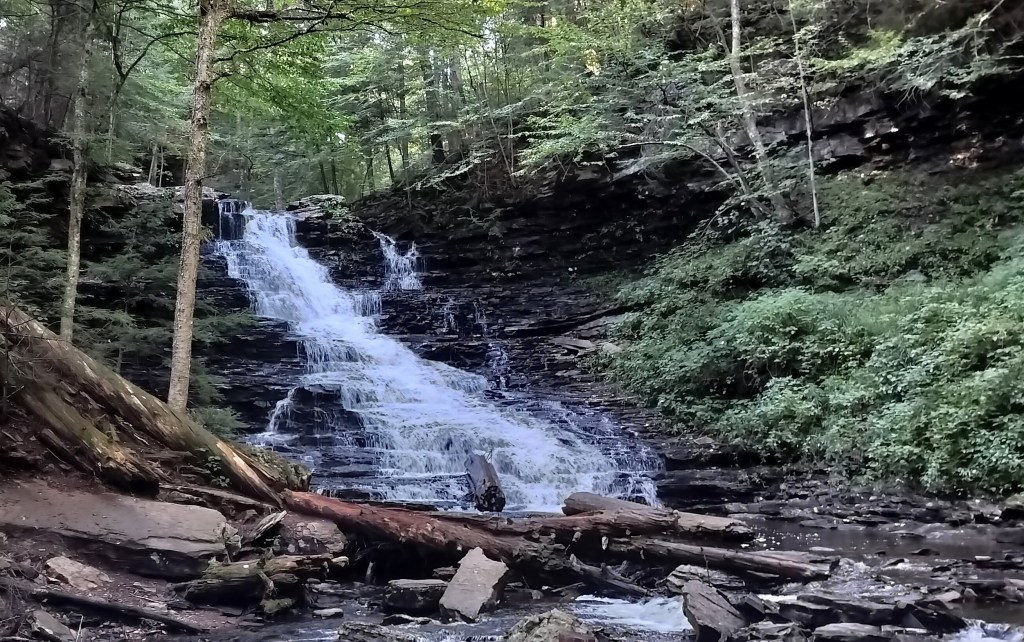
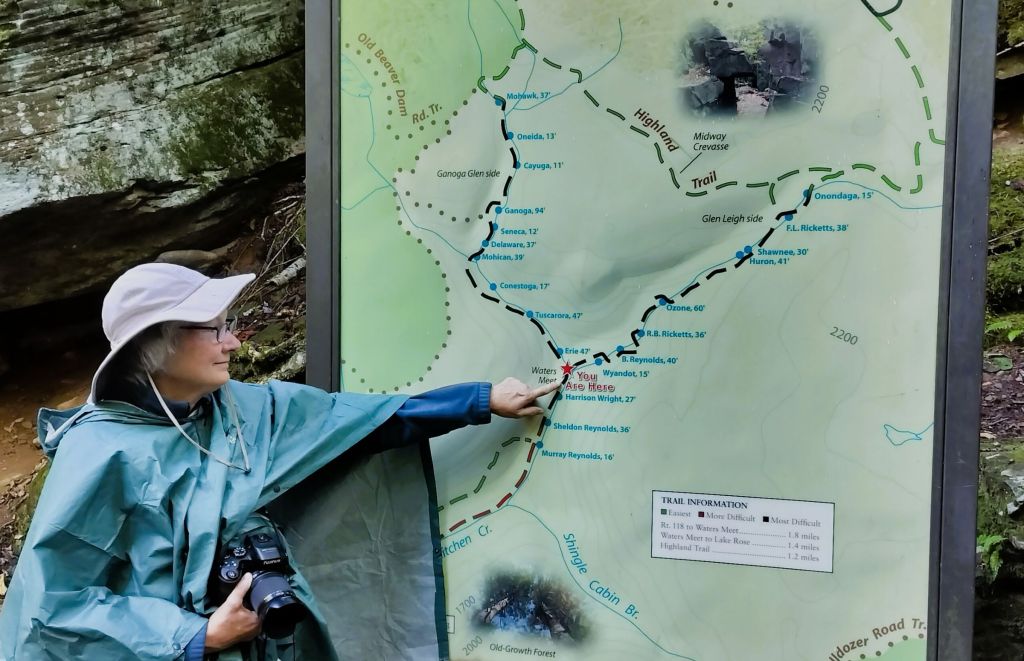
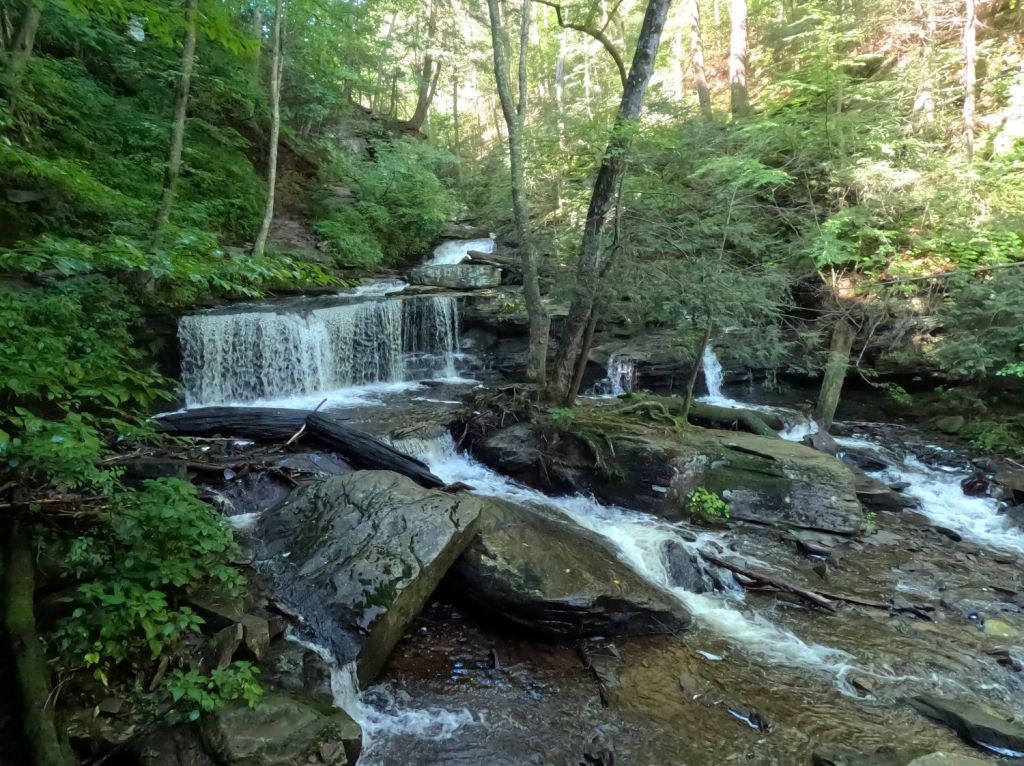
If you have a wish to see waterfalls, Ricketts Glen SP is the place for you. In just over five miles of rocky, steep trails you can view 22 named waterfalls. At 94 feet, the park’s tallest waterfall isn’t the size of Niagara (or Salmon River) Falls, but it and the other falls are beautiful.
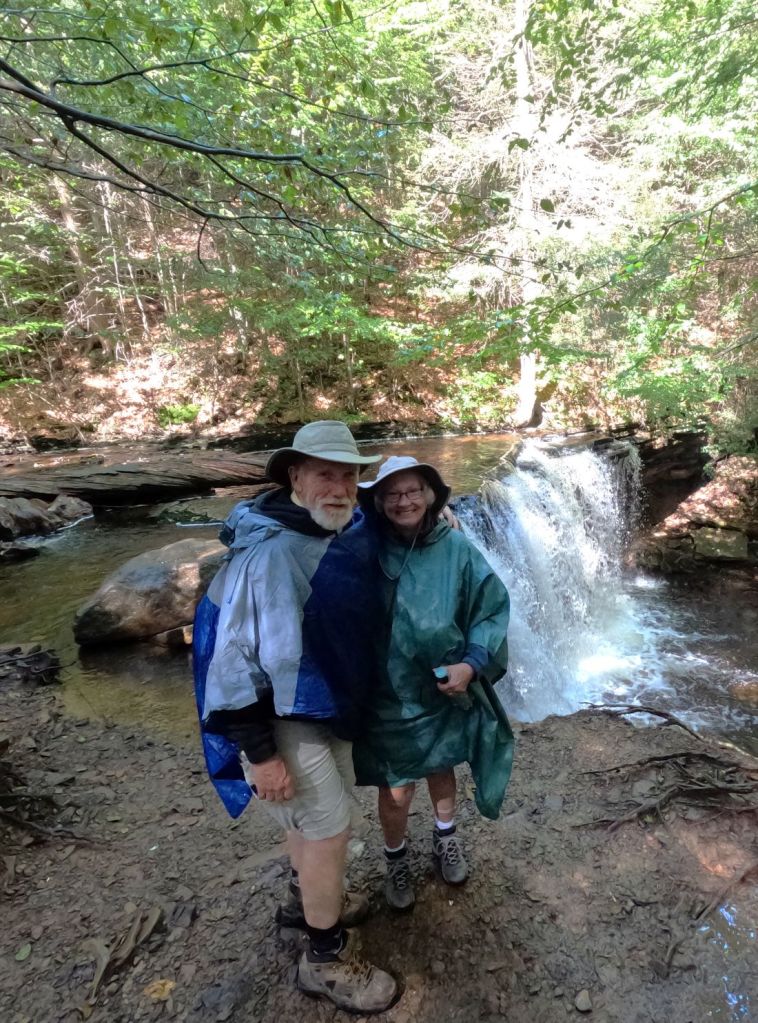
Waterfall hiking at Ricketts Glen
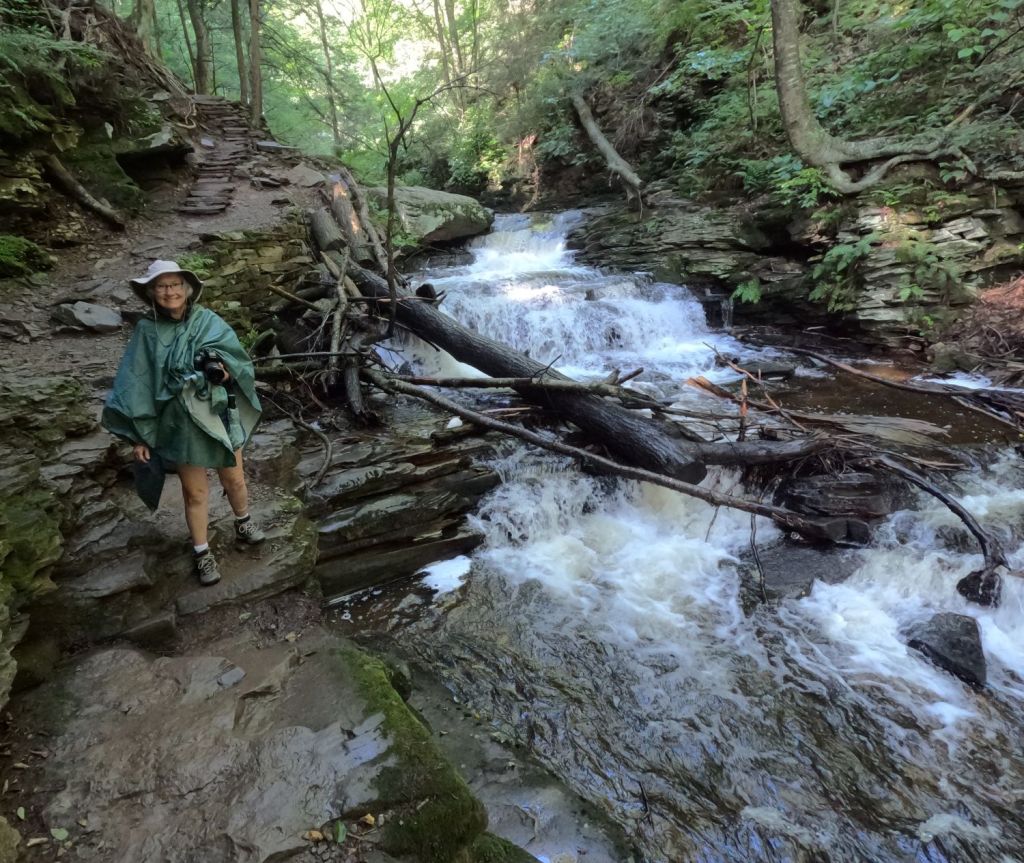
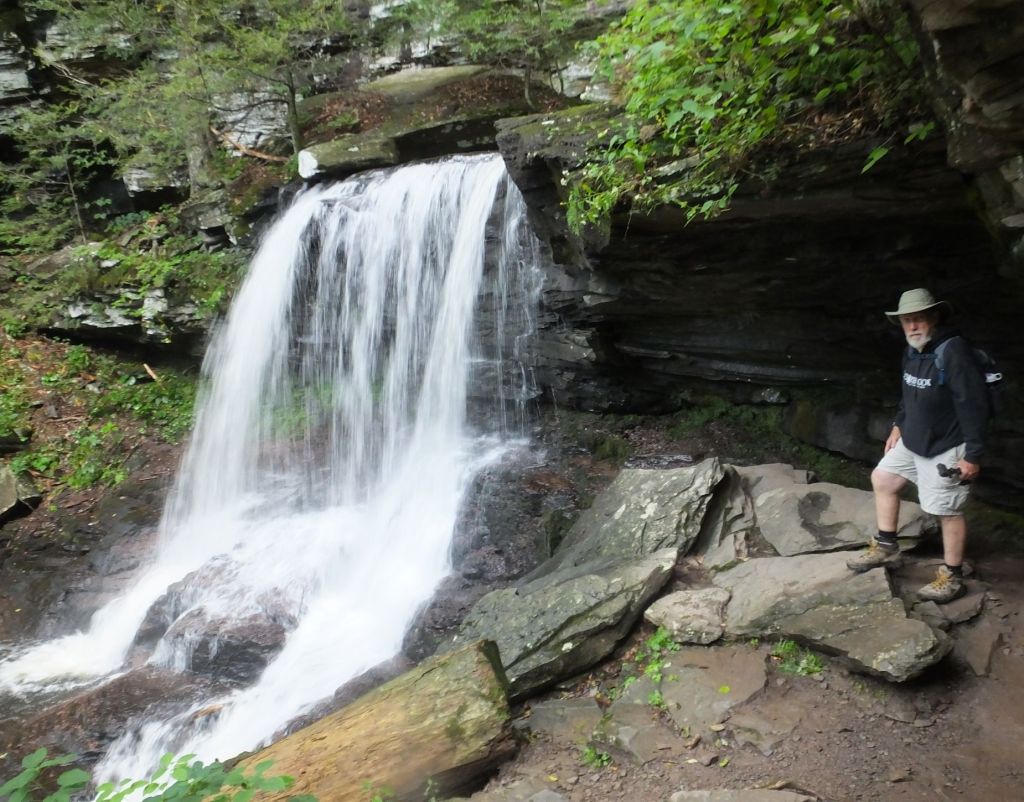
Our 3.5-mile waterfall hike went past 18 of the falls (the others are on a side trail that we didn’t take). It was raining when we started, so we carefully descended nearly 500 feet down steep slick stairs and across large boulders. The falls were various sizes, and we stopped at each to enjoy the peaceful tranquility.
Various photos of our hike to 18 waterfalls at Ricketts Glen SP
The rain had stopped by the time we reached the bottom of our descent. We paused for a snack and enjoyed talking with other hikers, comparing the falls and reviewing trail conditions.
Stopping to look at another beautiful waterfall
The return part of the trail was a little easier. Conditions were drier and, for us anyway, it always seems easier to climb a steep trail and stairs than the opposite.
The park has other trails and a nice lake. It is well worth a visit if you travel through central Pennsylvania.
Harper’s Ferry
We drove southward from Pennsylvania into Maryland, then a tiny bit of Virginia and finally West Virginia.
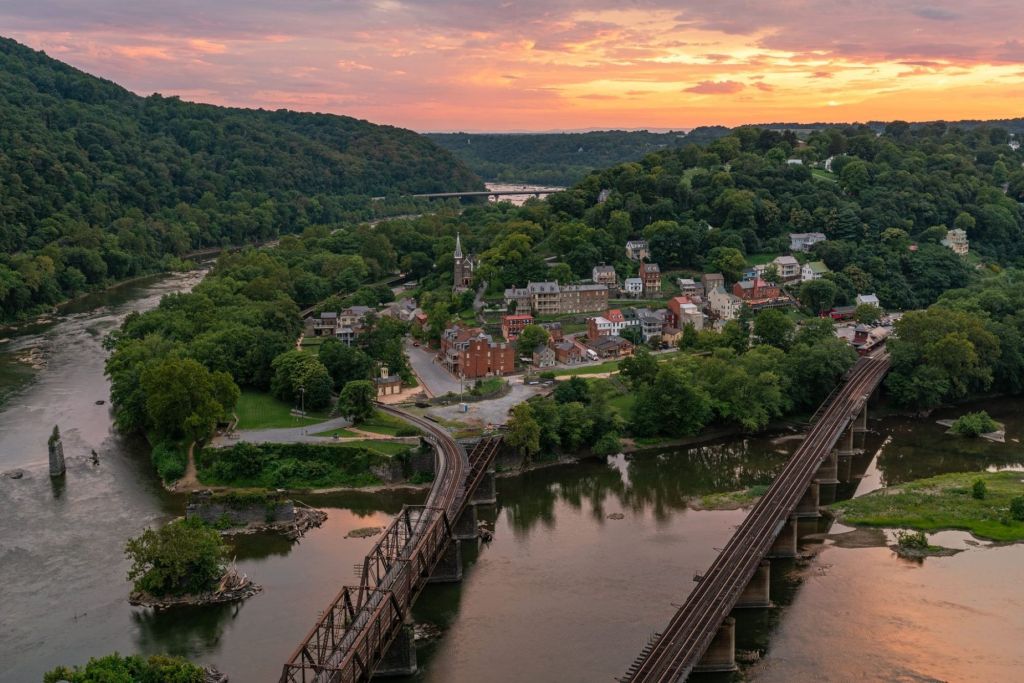
Harpers Ferry, WV (image from Google)
We visited Harpers Ferry National Historic Park at Harpers Ferry, WV. The town is at the confluence of the Potomac and Shenandoah Rivers where Maryland, Virginia and West Virginia meet. It is interesting looking around the well-preserved historic area.
We learned the town was the northernmost point of the Confederacy during the Civil War. It is also where abolitionist John Brown led a raid on the federal armory in 1859, hoping to start a slave rebellion.
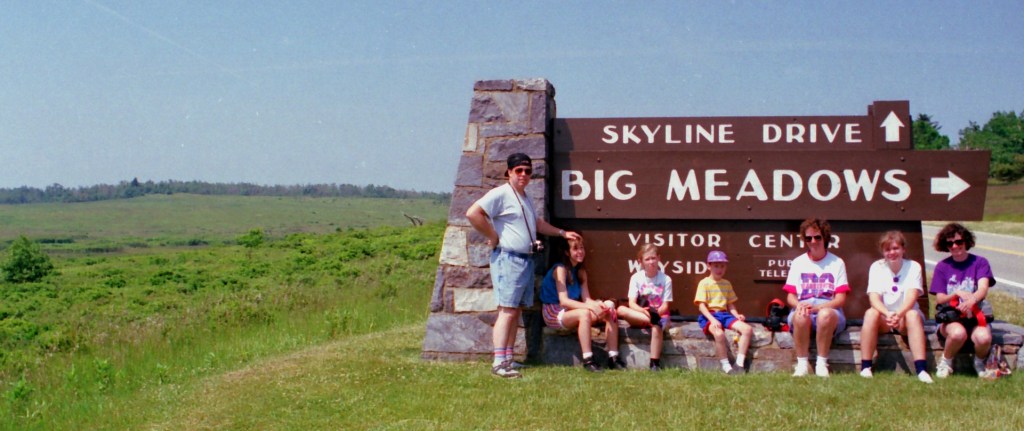
1993 Visit to Big Meadows with Pat’s sister and family
Driving the Shenandoah Skyline
Some of our favorite vacations over the years have been driving the Skyline Drive in Virginia’s Shenandoah National Park and the Blue Ridge Parkway in Virginia and North Carolina.
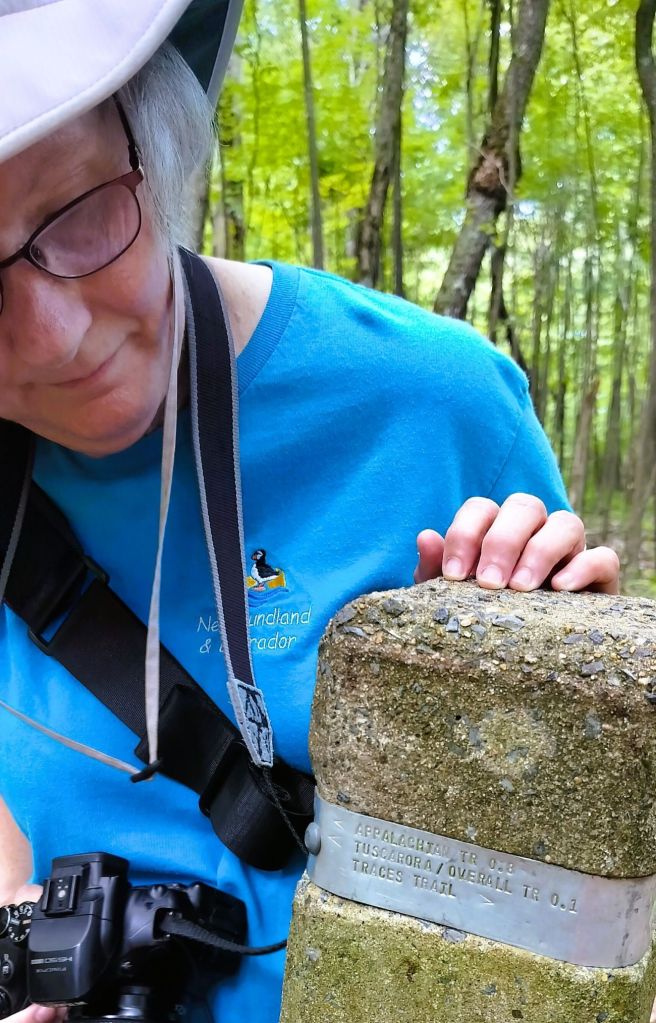
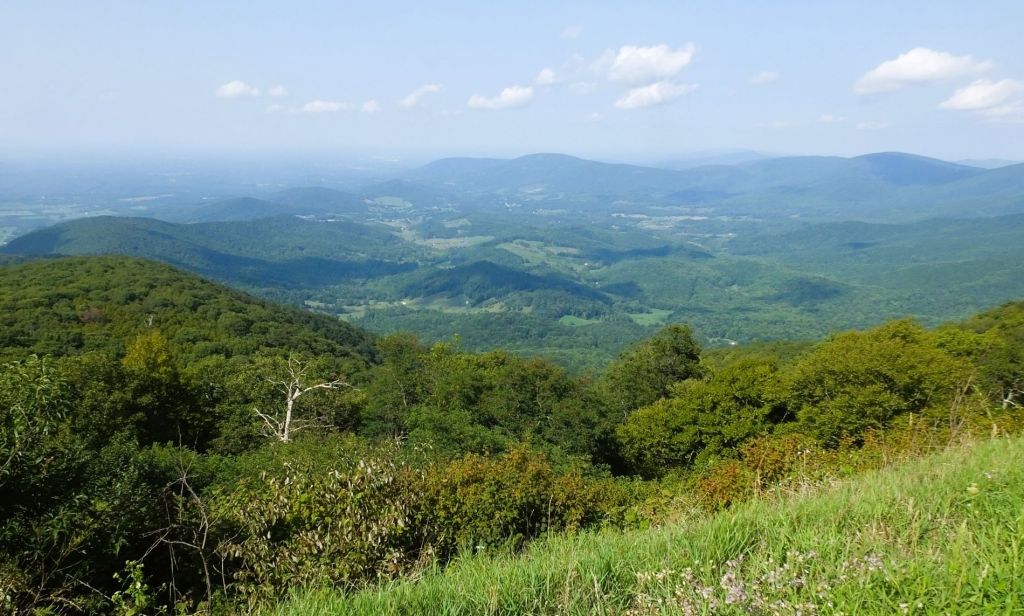
This trip we camped several nights at Matthew’s Arm campground at the northern end of the drive. We hiked several short trails that took us along the Appalachian Trail. The views of nearby valleys and distant mountains were nice, but not spectacular due to haze from fires in the far west.
Pat examines a band imprinted with trail information
This hazy view of the valley and distant mountains was still beautiful
We stopped for lunch at Big Meadows, midway on the drive, as we continued south. Maintained by periodic burning, the 136-acre meadow is the largest open area in the park. It is covered with a variety of flowering plants as well as blueberry and blackberry bushes.
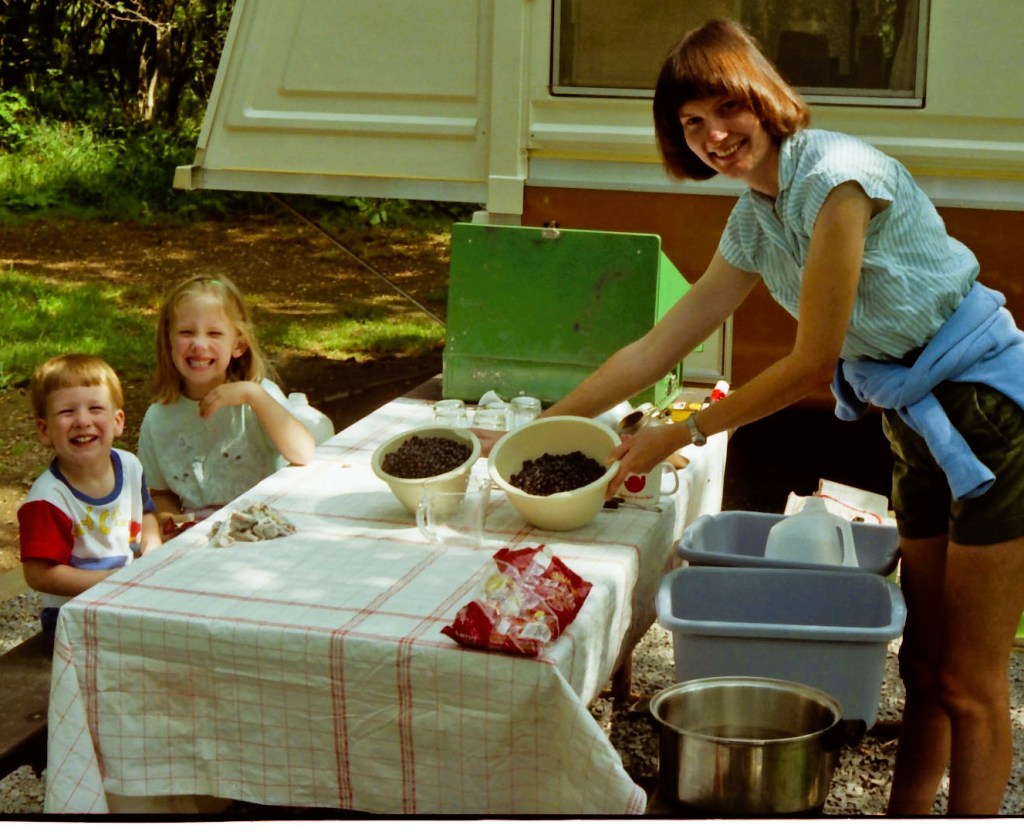
Making blueberry jam at Big Meadows in 1989
We recalled a trip with our children 35 (!) years ago when we picked blueberries and made jam at our campsite.
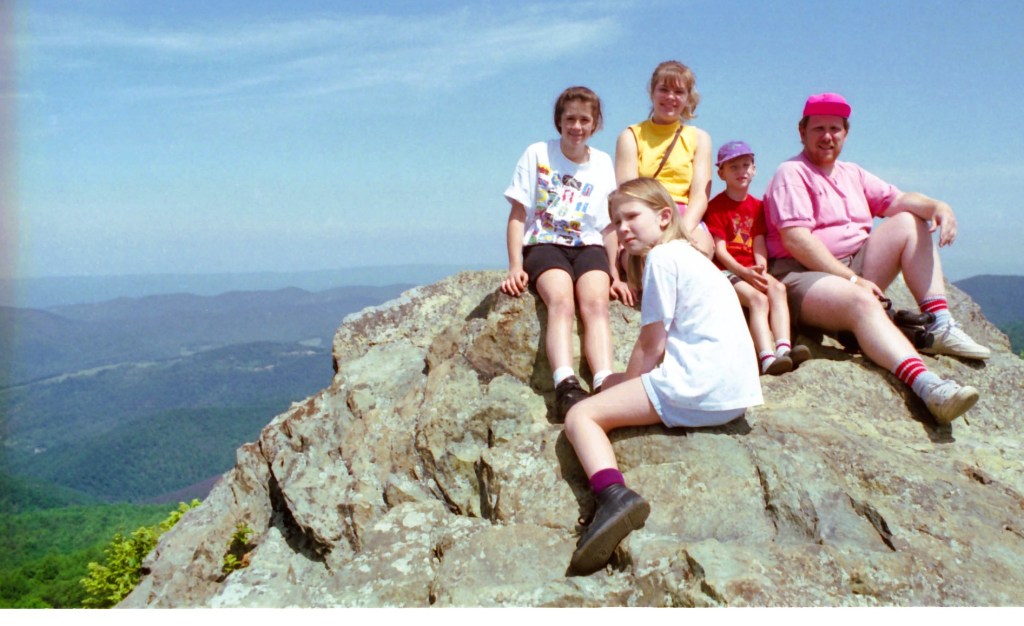
Bearfence rock scramblers, 1993
Further along we passed the trail to Bearfence. Over the years we scrambled over large, exposed boulders to a magnificent view of the distant mountains and Shenandoah Valley. One rock scaling adventure in 1993 is captured above with a photo of our children and nieces.
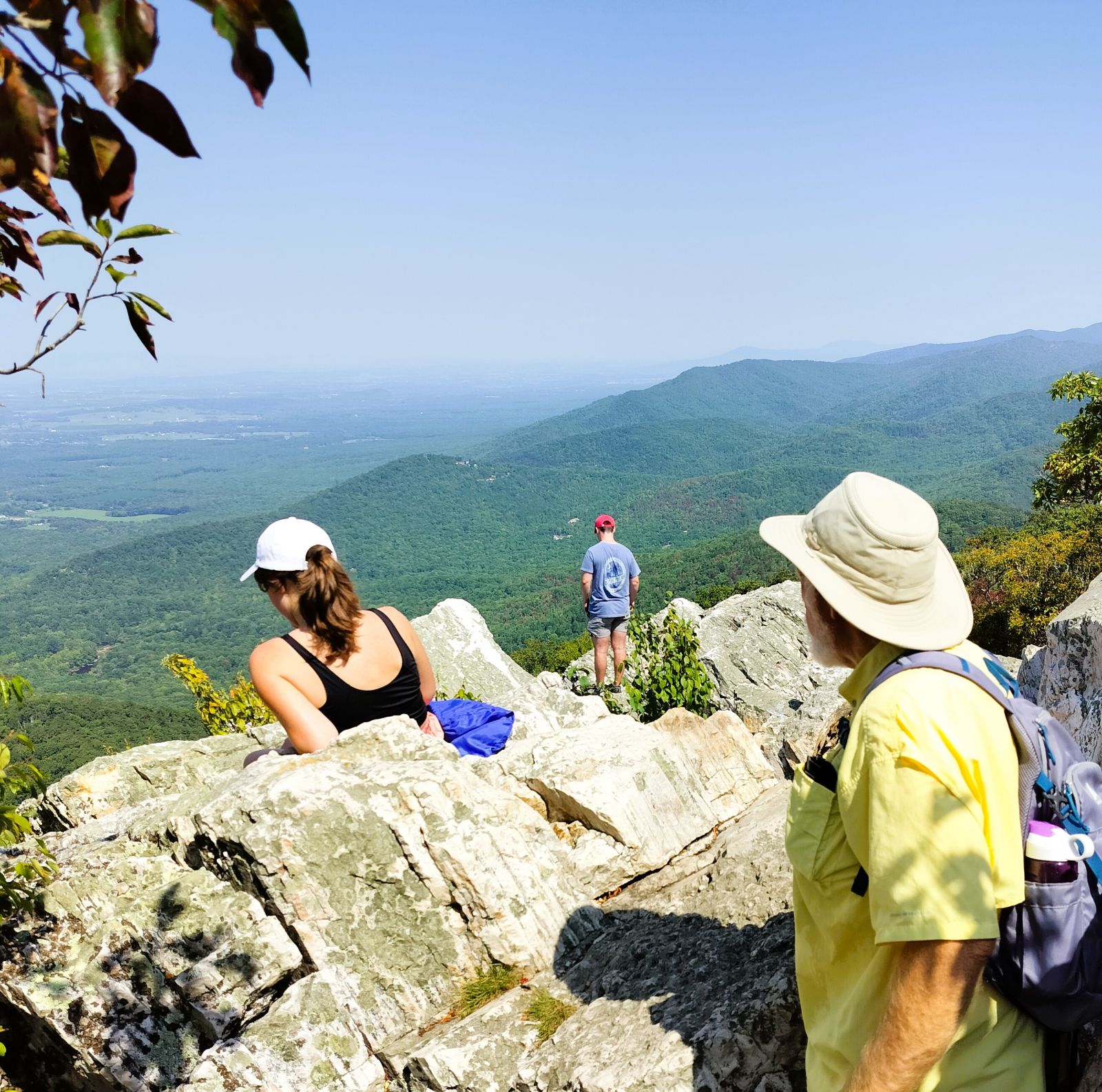
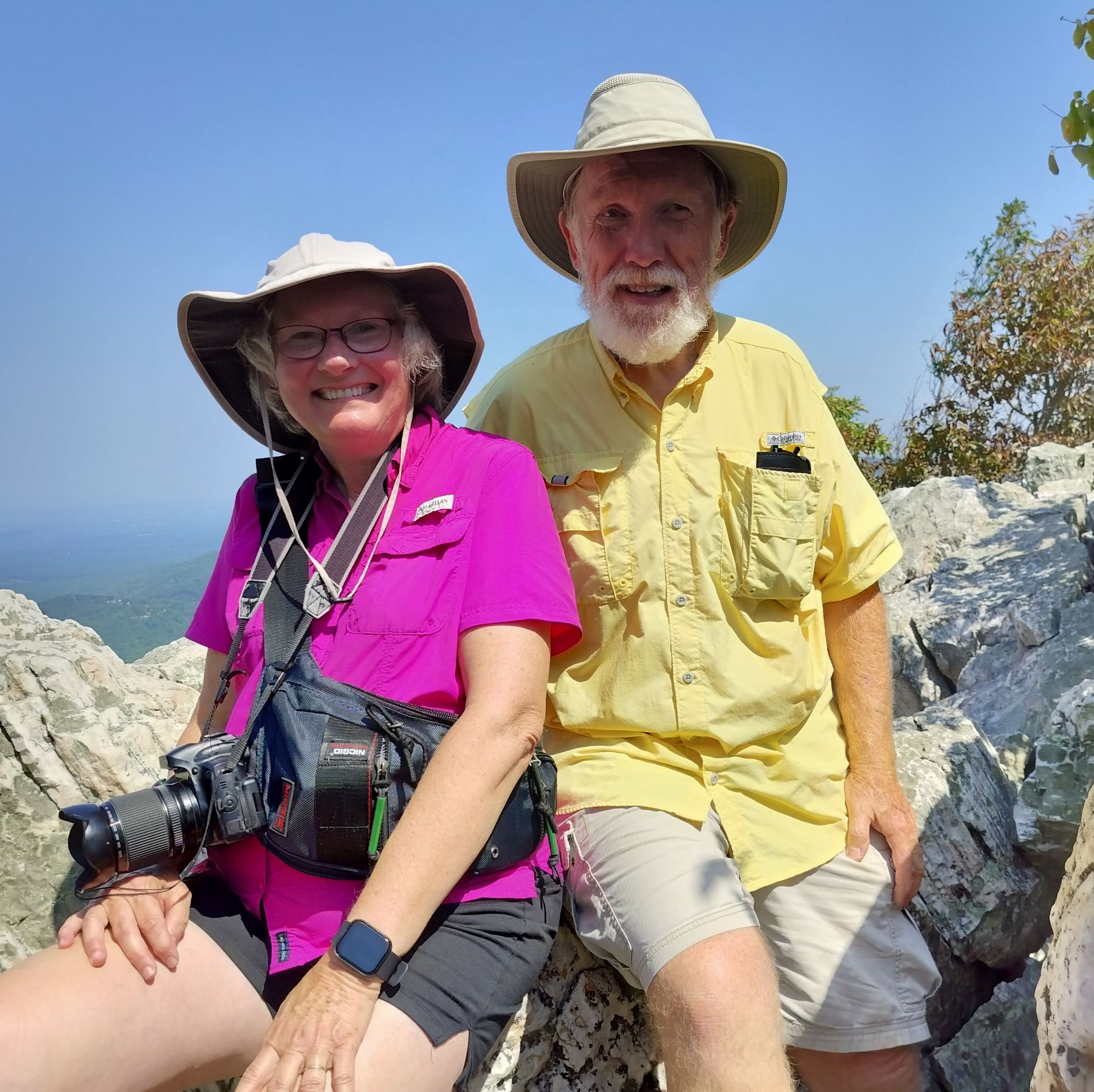
We spent a night at Lewis Mountain Campground, a new campground to us. The next day we ended our tour of the Skyline Drive with a hike to Turk Mountain. The 2.2-mile trail was steep with a 690-foot elevation gain. It ended with a short rock scramble to an outcropping with wonderful valley views. We caught up with a group of college students who passed us earlier and learned about their plans for the future. One of them took our picture to prove we made it all the way!
Photos taken at Turk Mountain viewpoint
Skylines to Blue Ridges
At the end of the 105-mile Skyline Drive the 469-mile Blue Ridge Parkway begins.
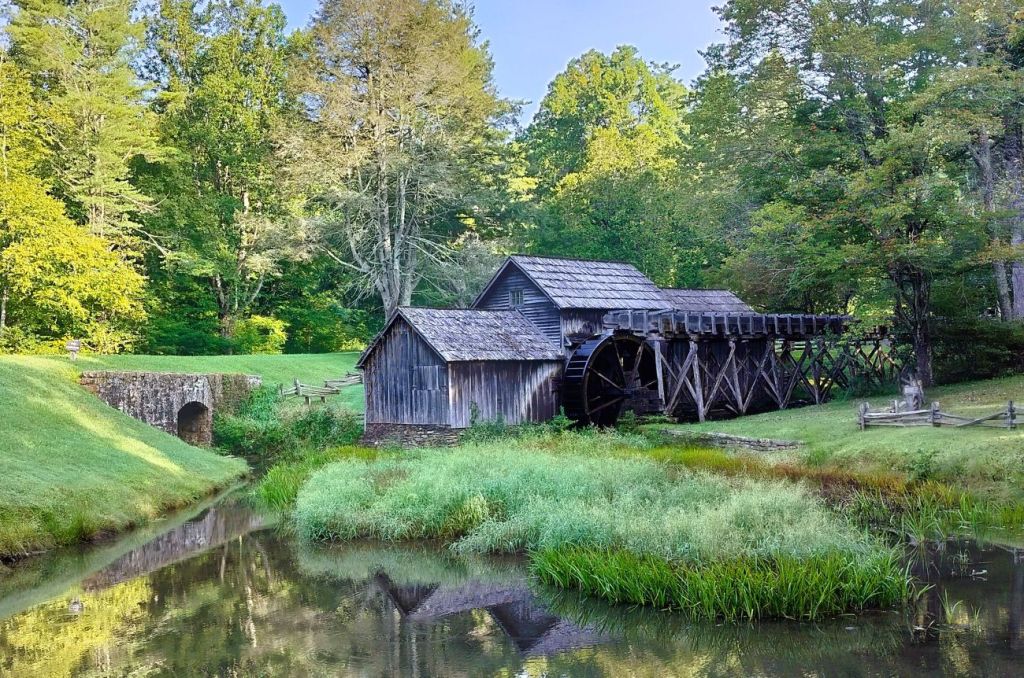
Iconic Mabry Mill at MP 176 on the Blue Ridge Parkway
We stopped at several favorite landmarks as we drove south on the parkway and made an early morning stop at picturesque Mabry Mill. The iconic landmark was built more than 100 years ago and was both a sawmill and grist mill. It is one of the most visited sites on the parkway.
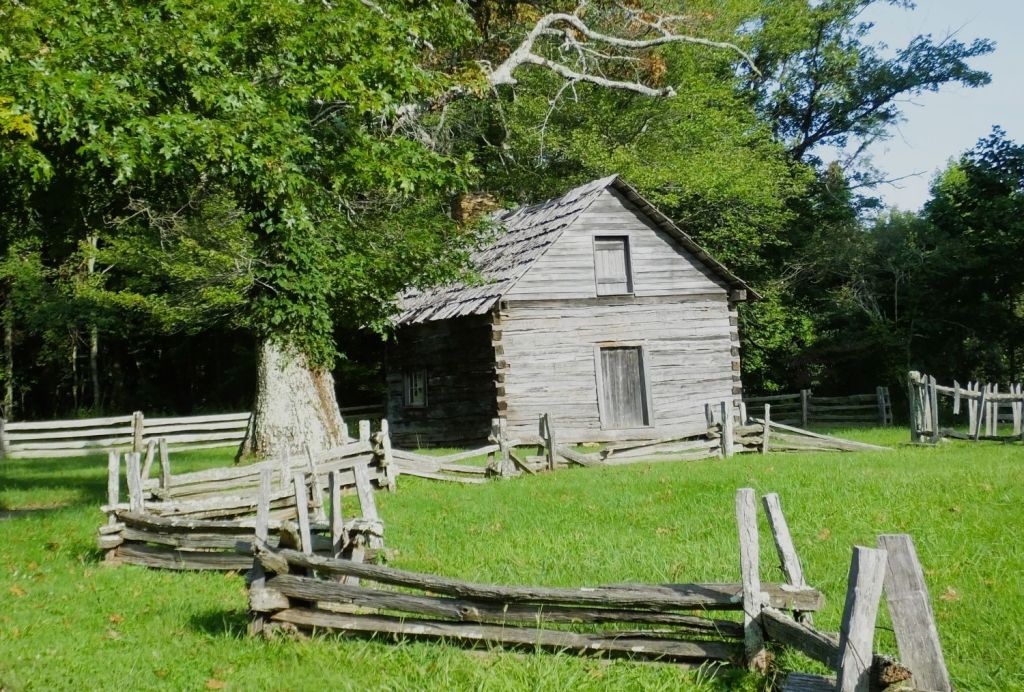
Our final stop on the parkway was at Puckett Cabin. We marveled at the story of “Aunt” Orelena Hawks Puckett, who lived in the cabin during the latter half of her 102-year life. She had a long career of midwifery, where she assisted at the births of more than 1000 babies. What an impact she had on the people in that area!
Puckett’s Cabin at MP 189 on the Blue Ridge Parkway
A few miles beyond the cabin, we left the parkway to begin the two-day trip home.
Our original plans were to spend more time in New England before returning home in late September or early October. Because of hazy conditions throughout the east, we moved more quickly than expected though.
Accustomed to longer trips, we wondered if we were going home early for some reason. We found out soon enough.
A few days after our return, intense weather struck our area.
After two evenings of considerable rainfall, the small creek in our back year rose above its banks. The creek flooded our backyard and continued to rise until it crossed the road next to our house. This has happened only one other time in nearly 40 years.
Although the rising creek never hit the house, rising groundwater began to seep into our semi-basement downstairs room. The sump pump we installed years ago (and tested right before our trip) had failed.
After an emergency late evening trip to Lowes to purchase a drill-powered pump, we drained the sump pit and began the timely process of drying out the room over the next week.
Had we not returned earlier than expected, water would have covered floor of the room. Carpet and furniture would have been damaged, and we would likely have had to deal with mold and mildew.
Giving Thanks
We are thankful!
God is our refuge and fortress in whom we trust for safety and protection – during our 2024 Heartland travels, trips in the past and journeys yet to come!
After crossing Vermont and New Hampshire, we stopped near the coast to visit a longtime friend, Norm MacLean. More than 40 years ago, we worked in the same Prudential department, ate lunch together and played racquetball with several other guys. Norm was even an usher at our wedding in 1980. His friendship and spiritual mentoring have profoundly affected my life.
Norm moved to Massachusetts, and then New Hampshire, in the ‘90s. We have enjoyed several visits with him over the years.
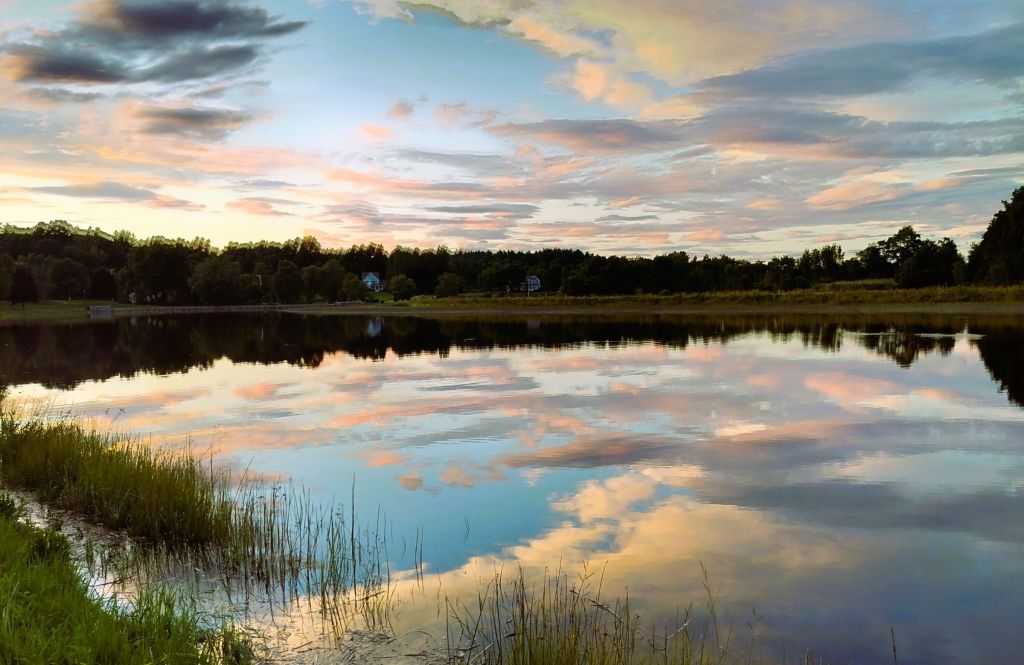
Evening photo on the Squamscott
We took a short walk from Norm’s apartment to downtown Exeter. The small village is situated on the Squamscott River, a few miles from Portsmouth. We passed Jailhouse Spring, where several locals were filling water jugs from the historied spring.
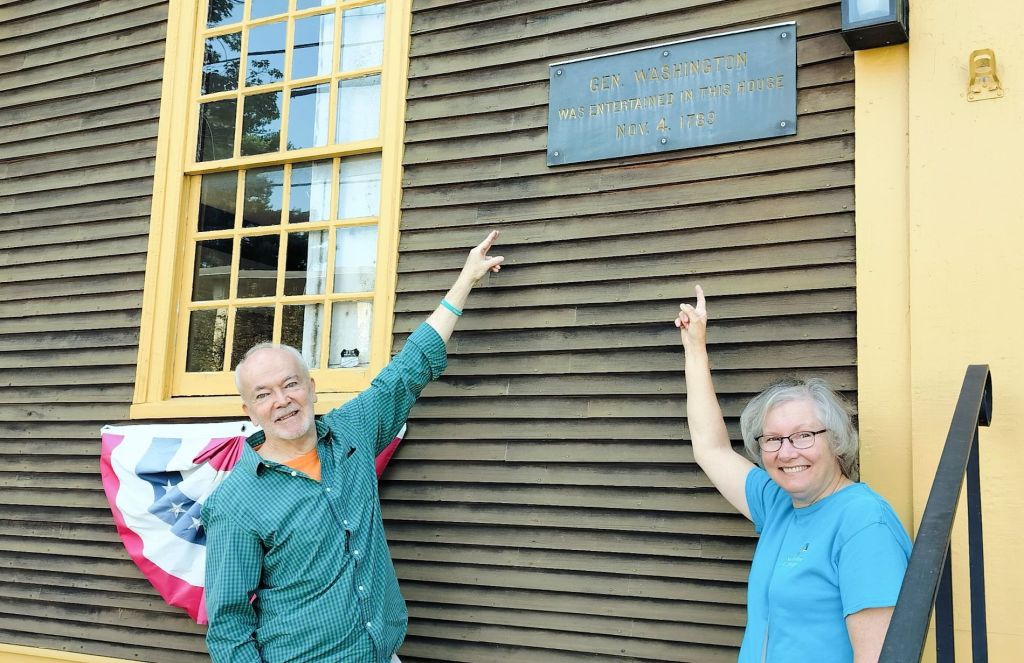
George Washington was entertained in this building on November 4, 1879. Watching YouTube by candlelight?
We admired several historic churches in the center of the town and Norm pointed out the prestigious Phillips Exeter Academy several blocks away. The school is the alma mater of three Nobel Prize winners and Meta (Facebook) founder and CEO Mark Zuckerberg.
Incident in Exeter
In addition to the numerous colonial-era landmarks in the area, Exeter was the location of one of the best-documented and publicized UFO sightings that occurred in 1965. Today, the town hosts an annual UFO festival that marks the incident and raises funds for several children’s charities in the area. Unfortunately, we were too early for this year’s festival that occurred at the end of August.
Norm was our tour guide for the day and took us to a variety of nearby attractions.
Norm hangs ten in the chilly NH surf!
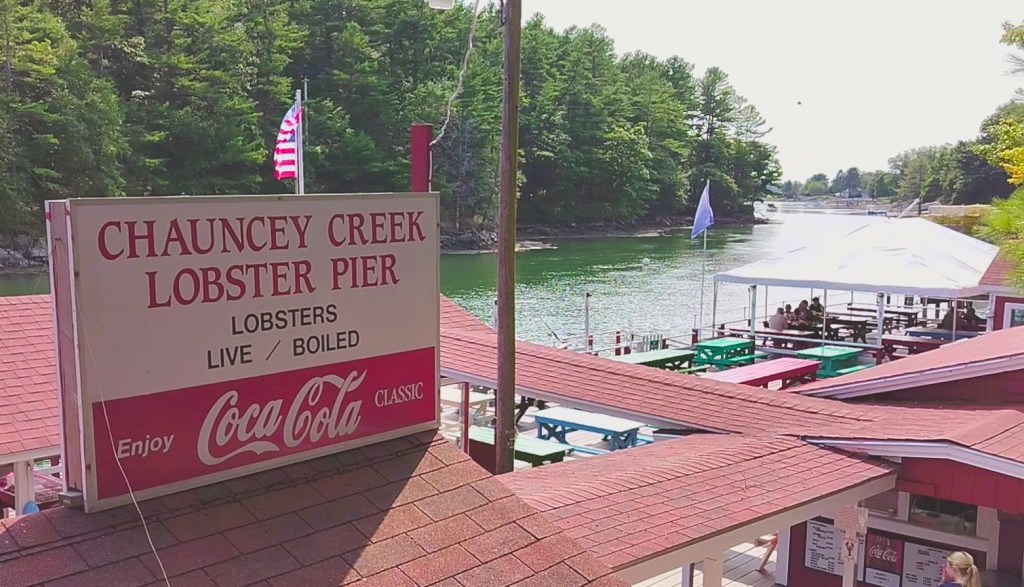
We stopped at Jenness State Beach, where wetsuit-adorned Norm surfs from time to time, and continued along the scenic coast, passing through Portsmouth and into Maine. We stopped at Chauncey Creek Lobster Pier for lunch and watched several frisky lobsters skittering around a small tank. We decided on fish and shrimp instead, enjoying our meals at an outdoor picnic table overlooking the creek.
It was a warm and sunny day to enjoy lunch at Chauncey CreekBanded lobsters waiting to be someone’s dinner
A while later we walked a short trail around Steedman’s Woods. We accessed it via Wiggly Bridge, a short span that crosses a swift flowing arm of Barrell’s Millpond. The bridge is said to be the smallest suspension bridge in the world. Regardless, it is definitely wiggly!
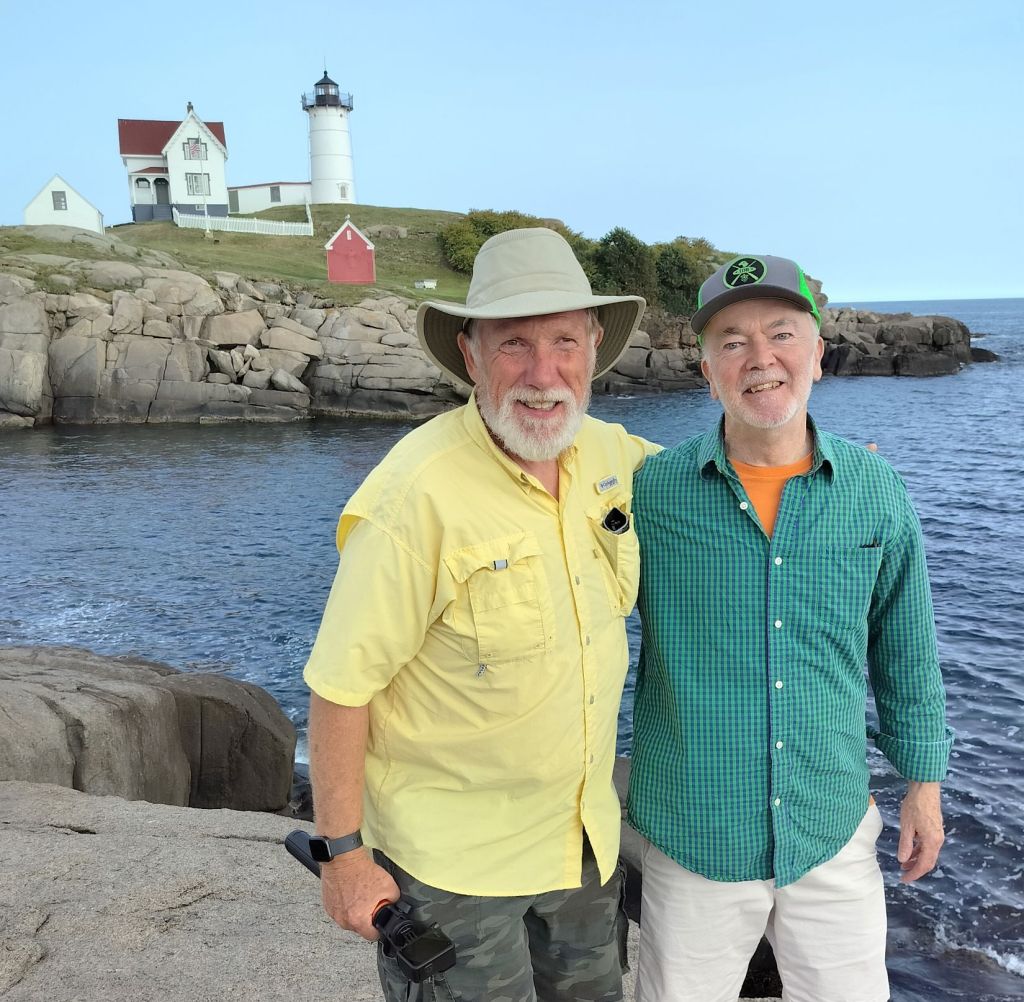
From there, we made a late afternoon stop at Nubble Lighthouse (photo at top of blog post). Sitting atop a tiny island near York, ME, the 41-foot lighthouse was built in 1879.
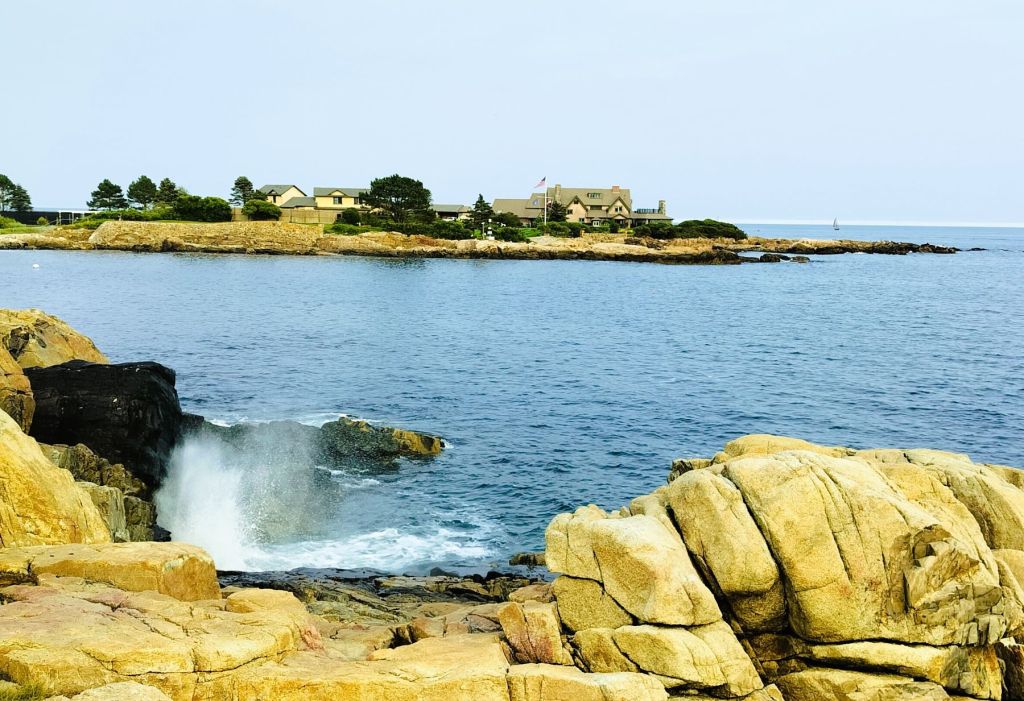
The Bush Compound at Kennebunkport
Our day came to an end as we passed through Kennebunk, ME bound for Blowing Cave Park. Beyond the park’s crashing waves and misty sea spray, is Walker’s Point Estate, summer retreat of the Bush family. It was the home of George HW (#41) and Barbara Bush.
Several vehicles were parked in front of the house. We wondered if George W (#43) and Laura Bush were visiting.
Covered Bridges
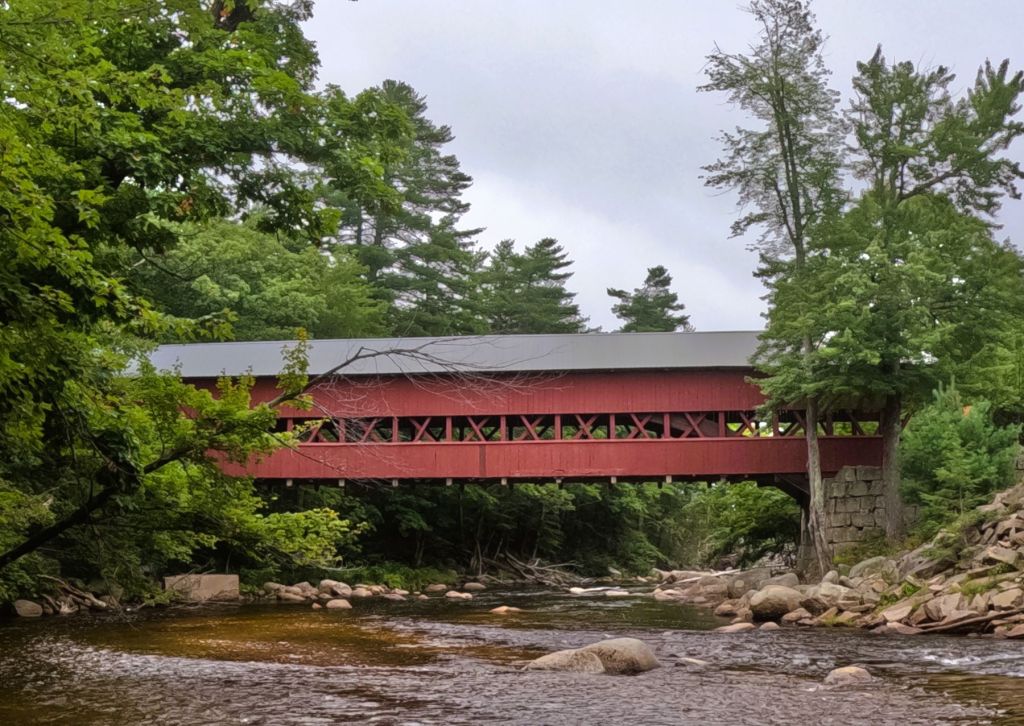
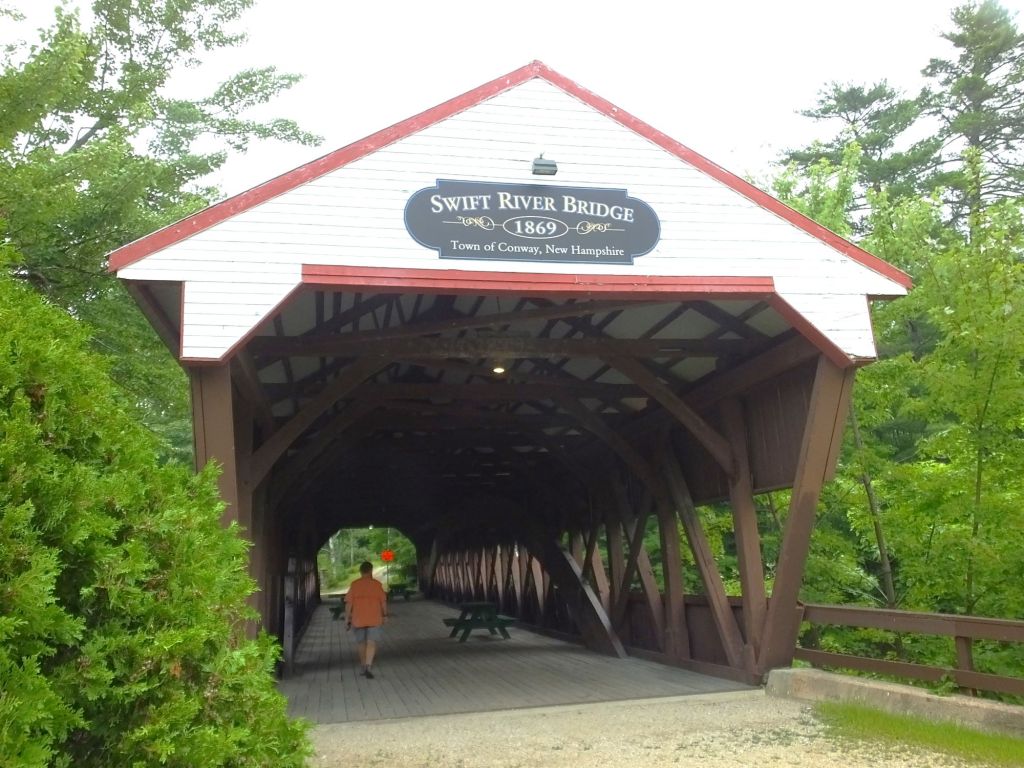
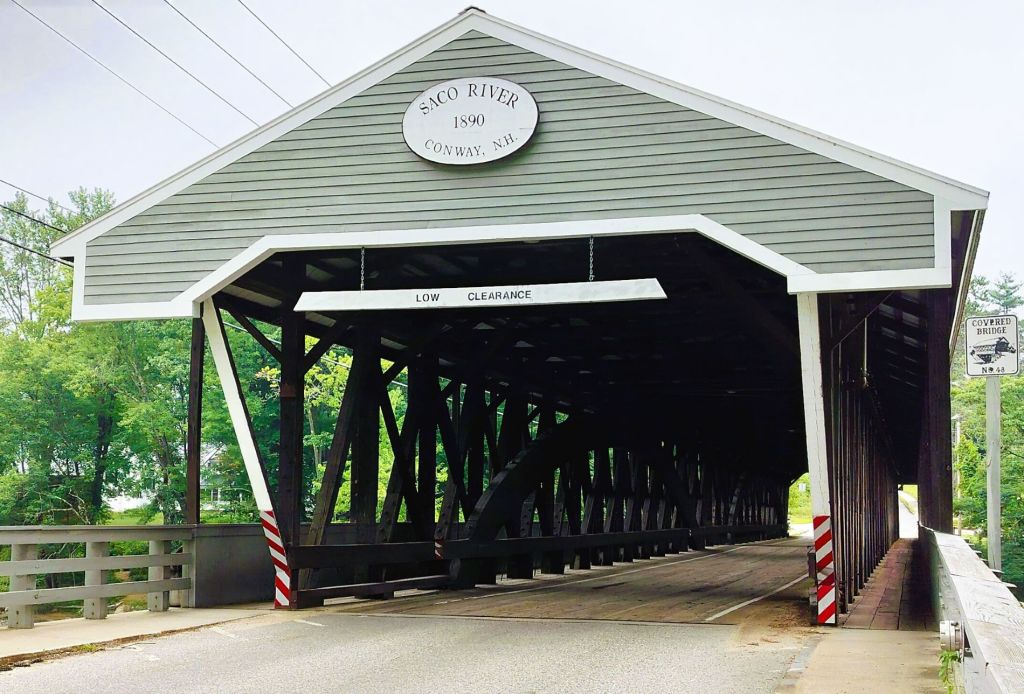
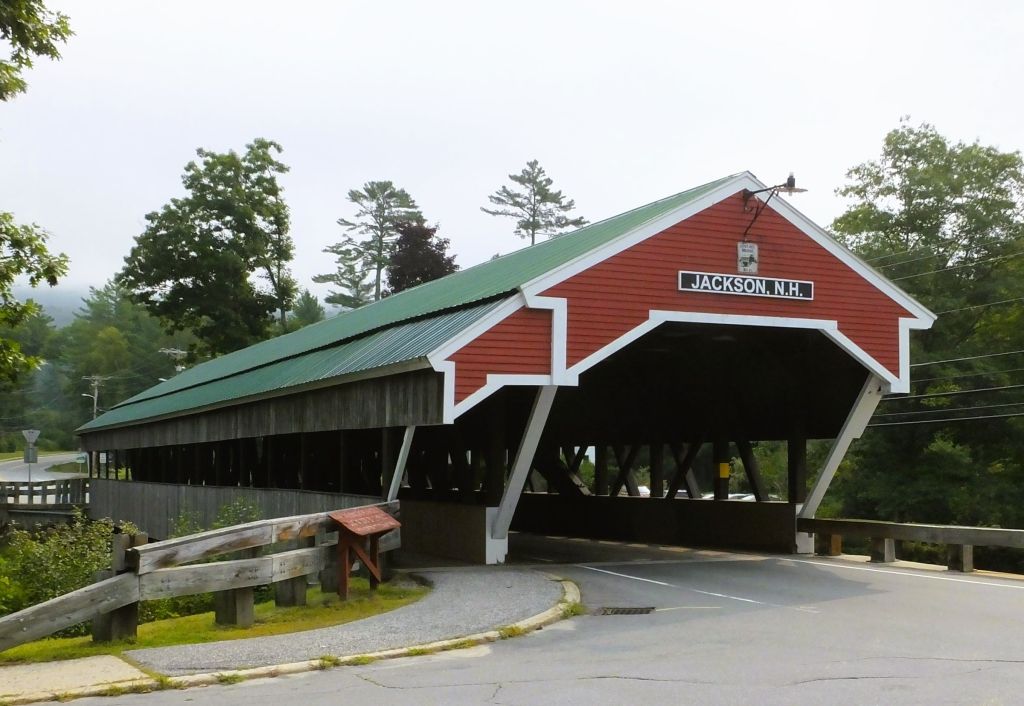
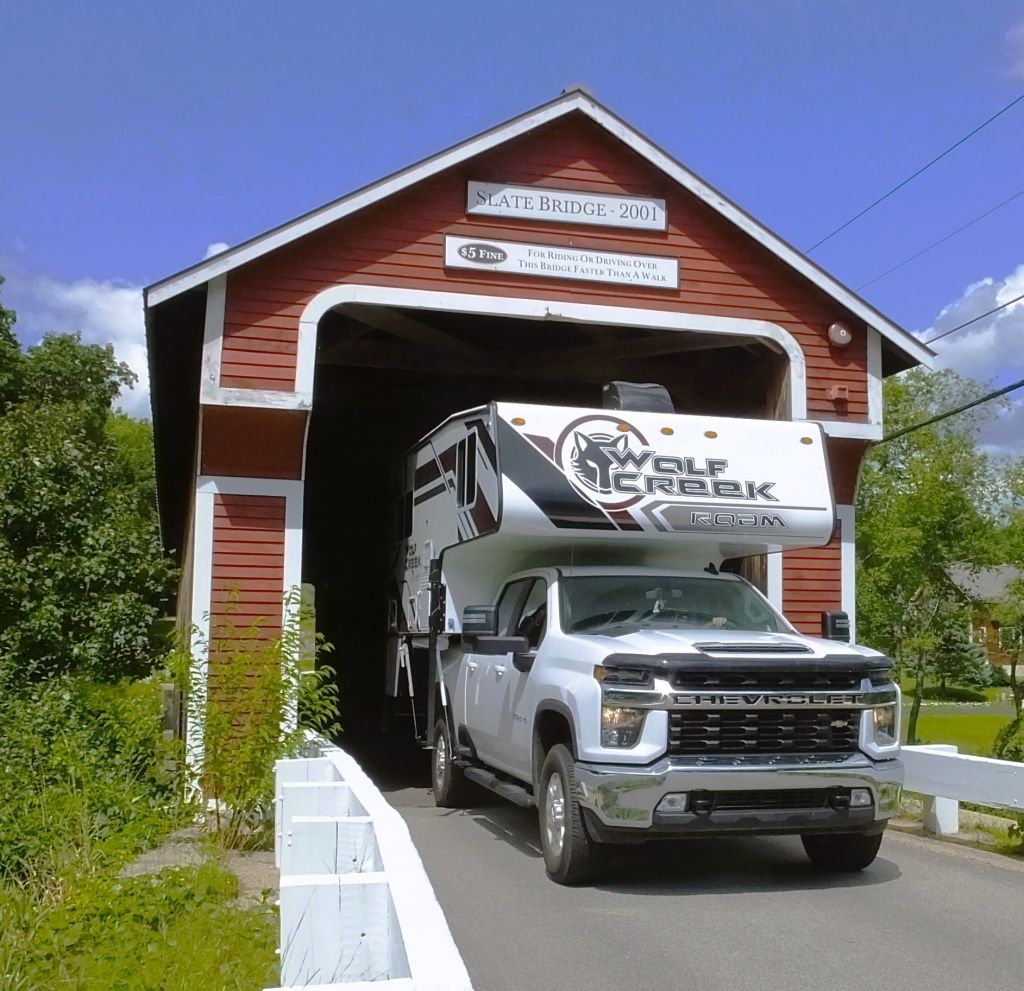
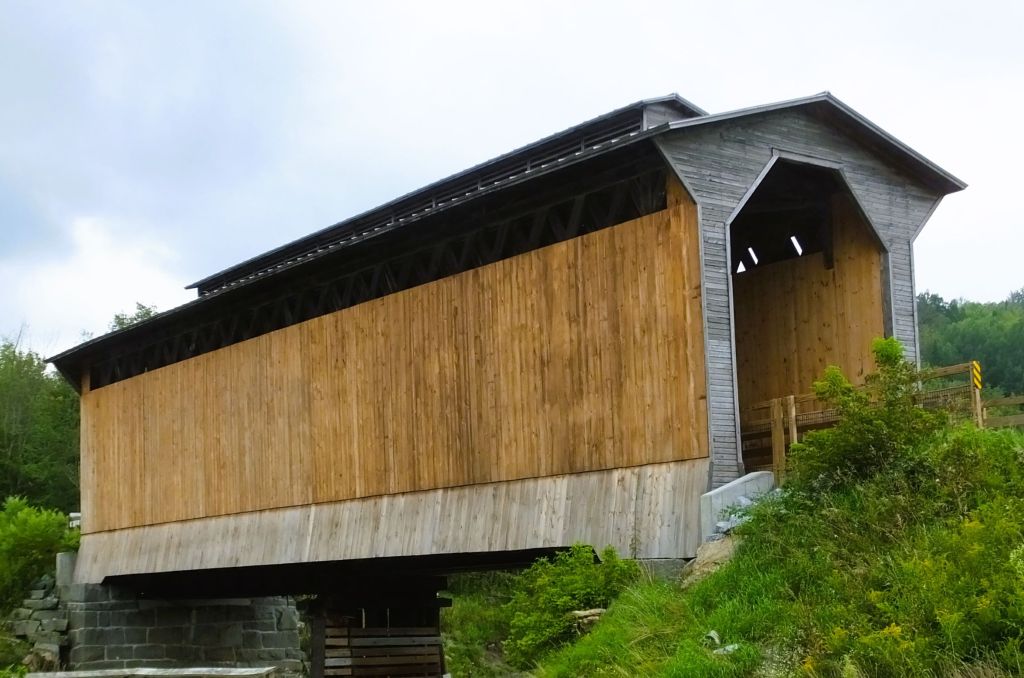
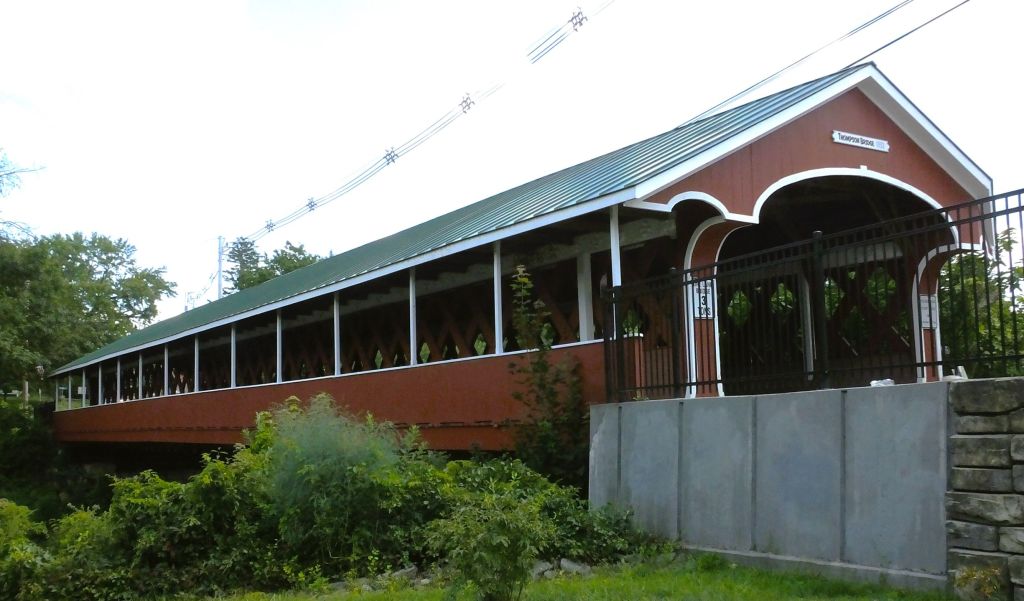
There are LOTS of beautiful covered bridges throughout New England. They are reminders of quieter and simpler times. We wonder if there is a blog dedicated to covered bridges that includes a route to the best bridges in New England.
Today, some of the bridges have been closed to vehicle traffic. Others have been rebuilt. There are even new covered bridges that resemble the old bridges. Our journey took us by (and across) several of them. We had to detour several times because Pap was too tall!
Enjoy our covered bridge photos below.
White Horse Villa
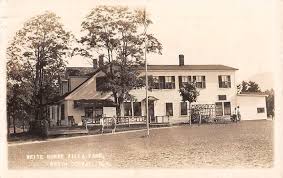
White Horse Villa in 1930 (from an old post card)
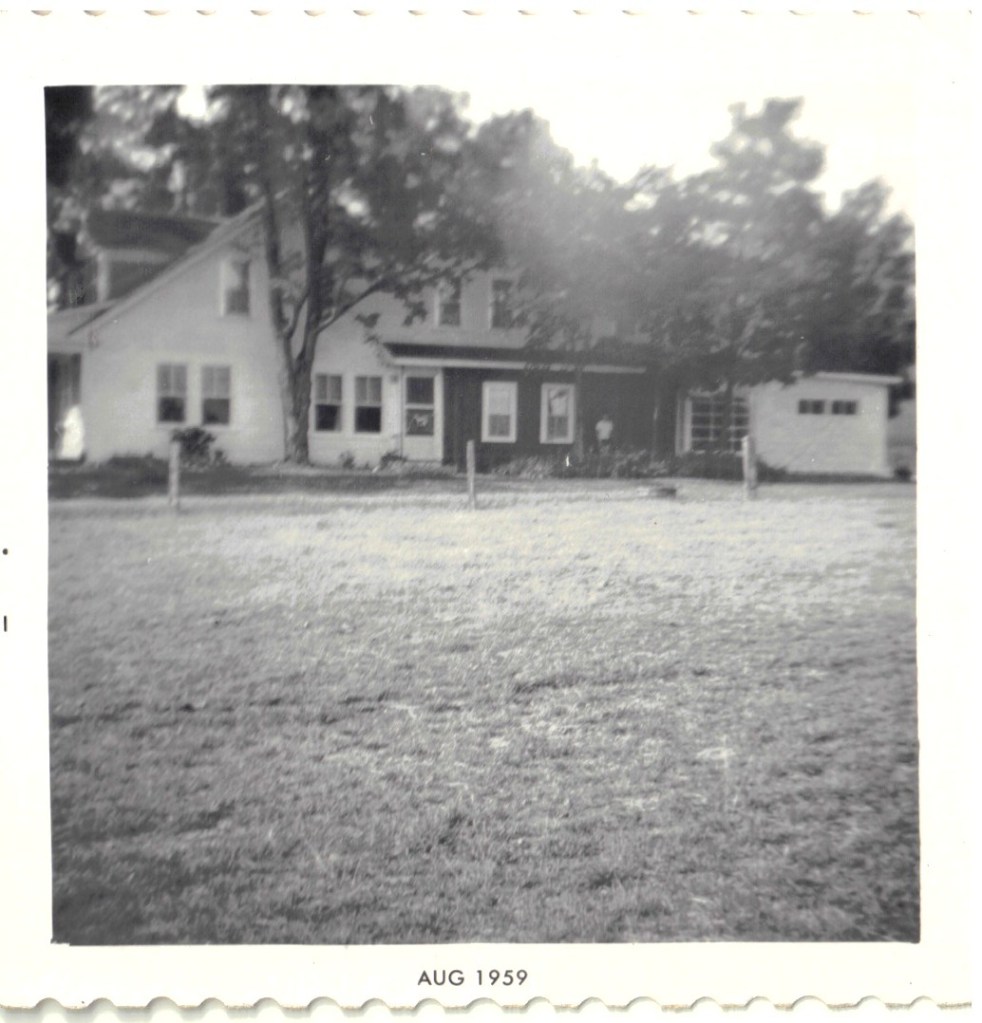
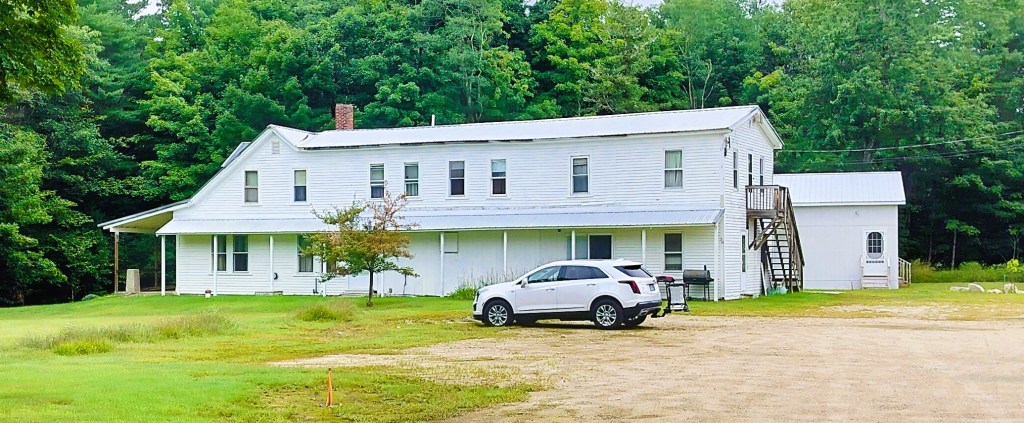
In 1954 my dad retired from the US Navy and purchased the White Horse Villa in North Conway, NH.
The Villa was built in the 1800s. It is located near White Horse Ledge, a glacier-carved 800-foot granite cliff, and an oxbow on the swift-flowing Saco River.
My dad, mom and brothers spent the next six years renovating the old place. I was born in 1957.
The house was sold in 1960 to a ski club from the Boston area (they still own the property) and our family moved to Florida.
White Horse Villa (from a family photo)White Horse Villa in 2024
Best Cinnamon Buns in Exeter
Before embarking on our coastal tour, Norm took us to two delightful cafes in downtown Exeter to sample their cinnamon buns.
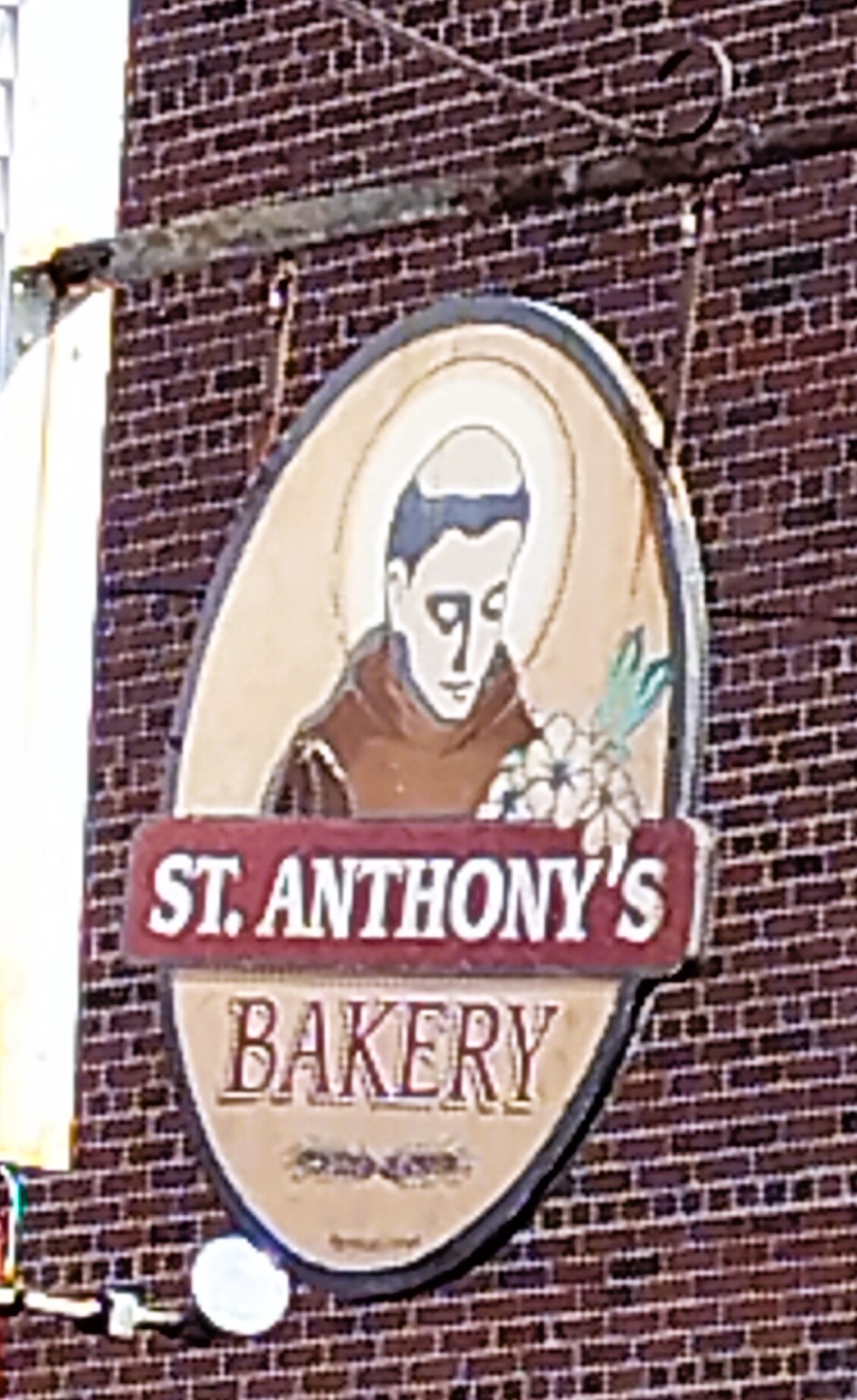
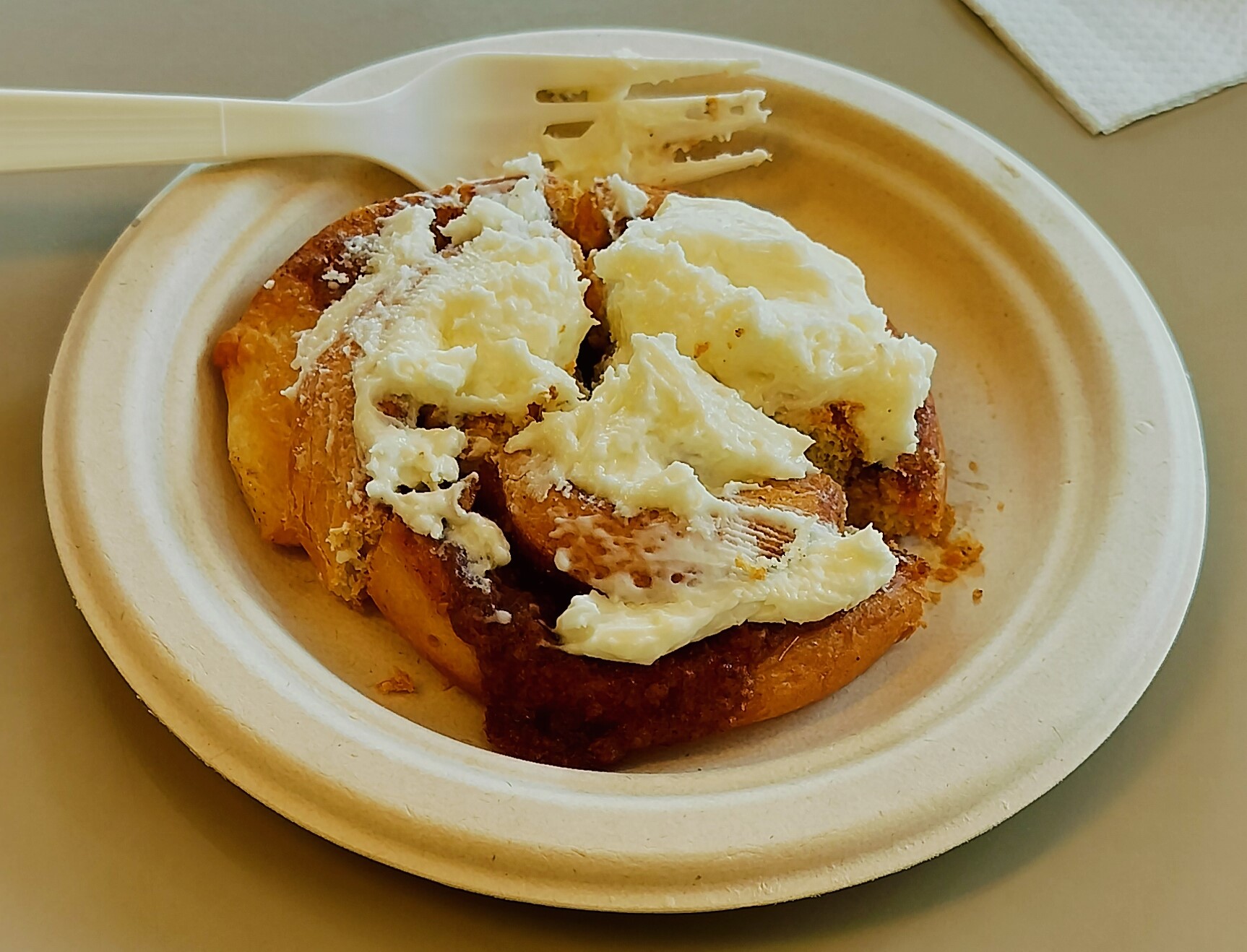
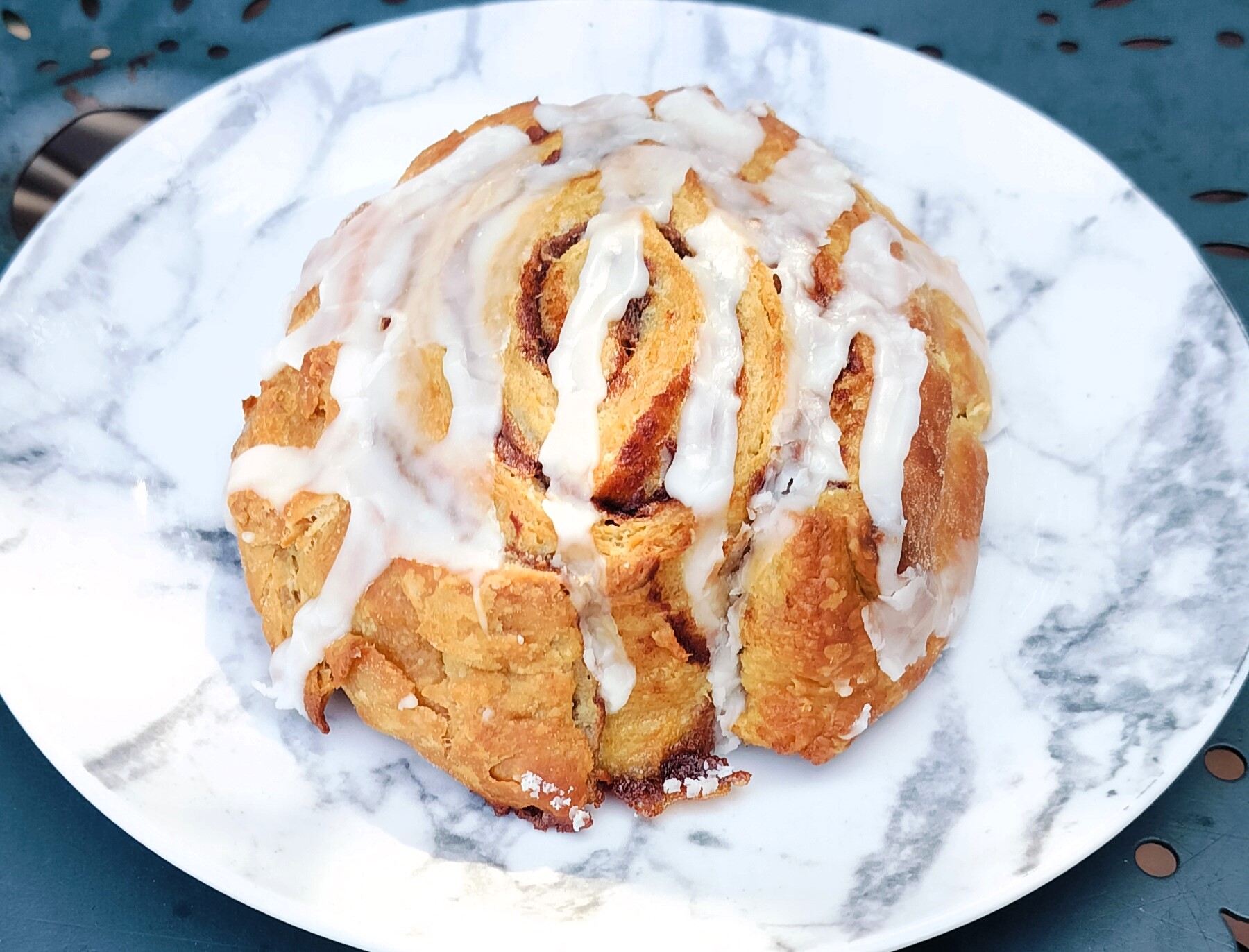
St. Anthony’s is a classic kind of place, with friendly staff and great coffee. We split our fresh flaky bun three ways, enjoying the nice cinnamon flavor and rich frosting.
A few blocks away, Me and Ollies has a more modern coffee shop vibe, where they serve up specialty coffees and baked goods. Their bun had soft and pillowy coils of a biscuit-like dough with icing drizzled on top.
The buns were unique and very good – 4s on a scale of 5!
Next Week
Our 2024 Heartland blog series wraps up with stops in Pennsylvania, West Virginia and Virginia.
We returned home several weeks earlier than originally planned. The timing was perfect, however.
(It’s been a rather eventful month since we returned home. We’ve endured Helene and Milton, two major hurricanes, and seepage in our downstairs, when our sump pump failed during heavy rains before the storms. Dried out and thankful for minimal impact from the severe weather, we hope you’ll join us as we keep those affected in prayer)
Following our second week of summer camp, we stopped in nearby Madison, Ohio to catch up on laundry and to start the drive east toward New Hampshire. We planned to visit a close friend in Exeter, NH and to continue to Conway, NH where Ed was born and where we would visit the White Horse Villa, an old boarding house that Ed’s parents once owned.
We camped that night in a parking area behind Warren Free Methodist Church in Warren, PA.
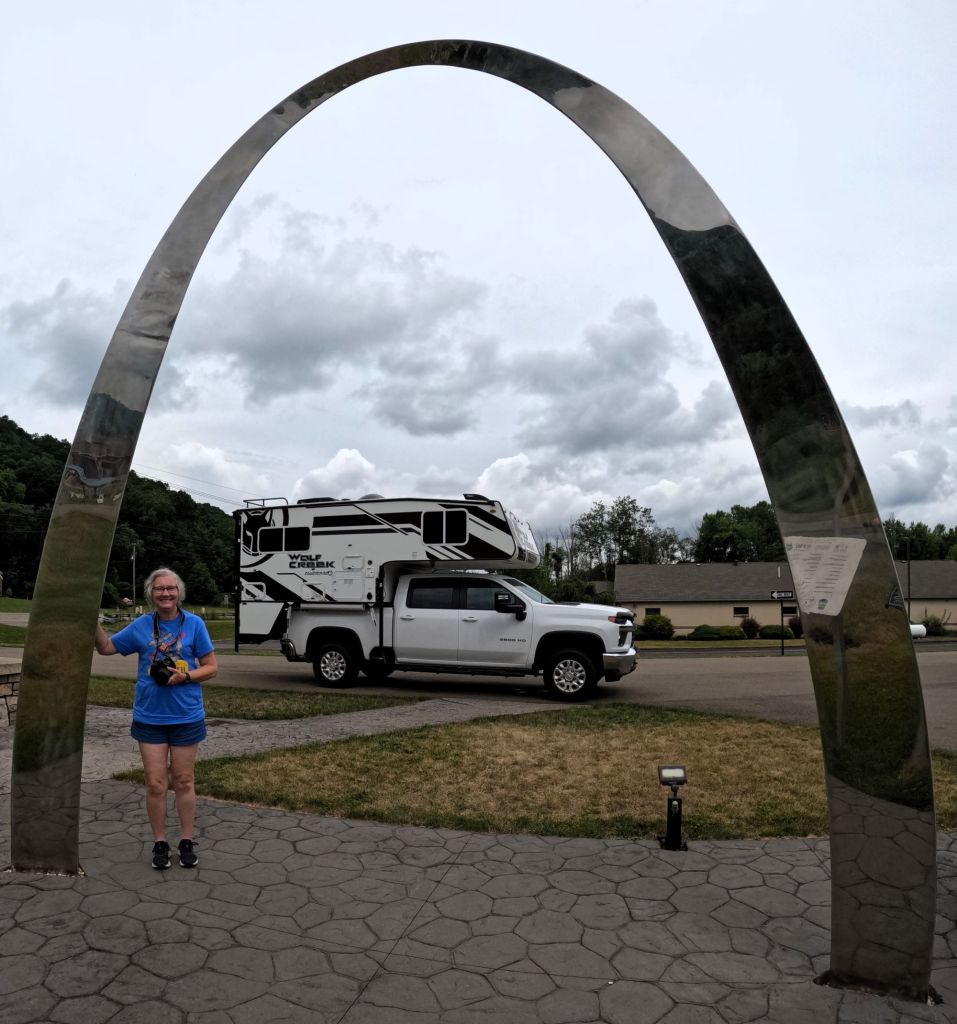
Pat and Pap pose under the Baby Arch in Warren, PA
Baby Arch
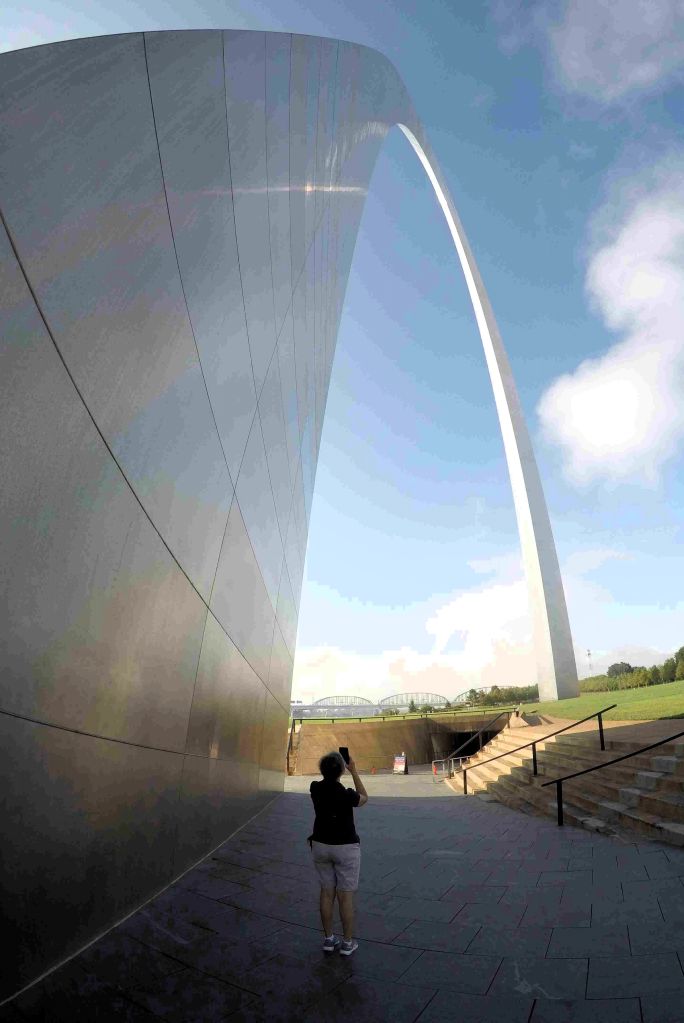
During a grocery run to a nearby Walmart, we stopped to see the 14-foot Baby Arch erected to recognize area workers who fabricated the stainless-steel pieces used to construct the Gateway Arch in St Louis, MO. They intricately measured, cut and ground wedge-shaped pieces to fit with other segments of the arch. The pieces were shipped via trains and semi-trucks to St Louis where the 630-foot arch contains more than 900 tons of stainless steel.
Pat takes a photo under the St Louis Gateway Arch in August 2021
After church the next morning, we continued north to New York.
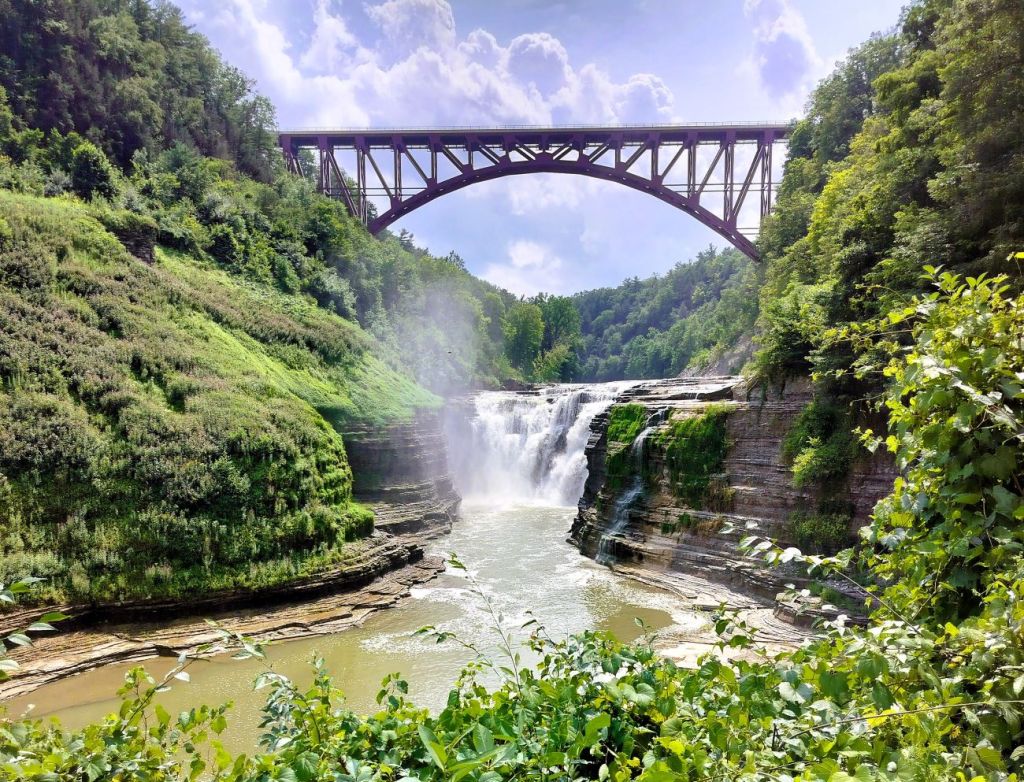
Upper Falls and Genesee Bridge at Letchworth State Park
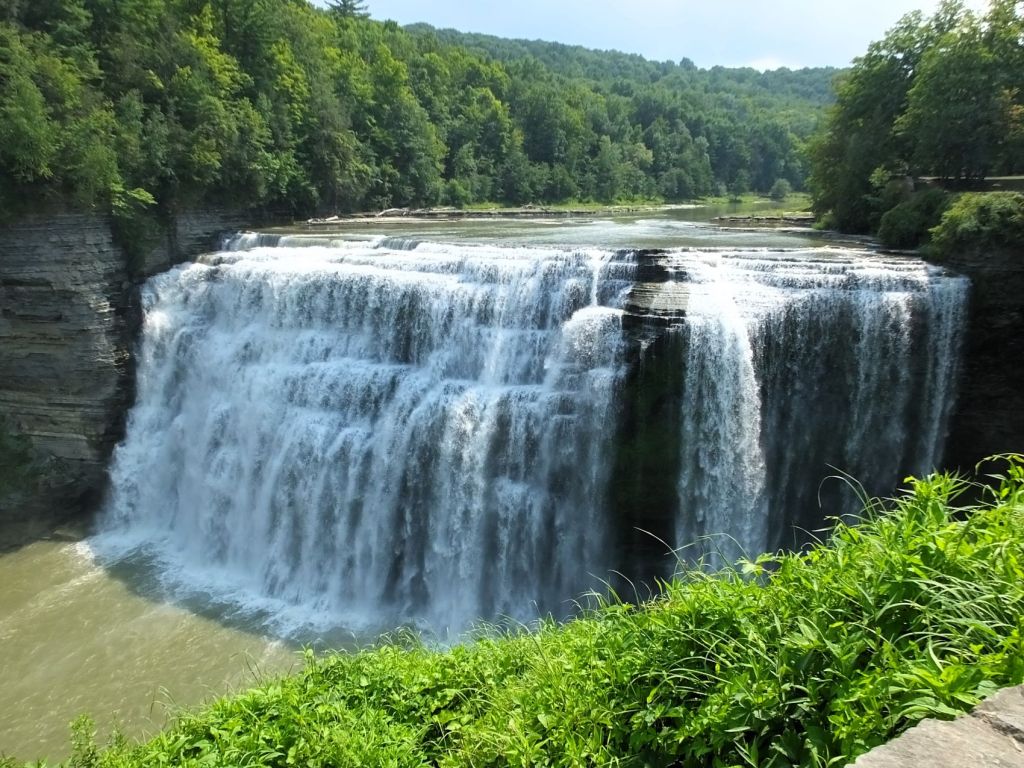
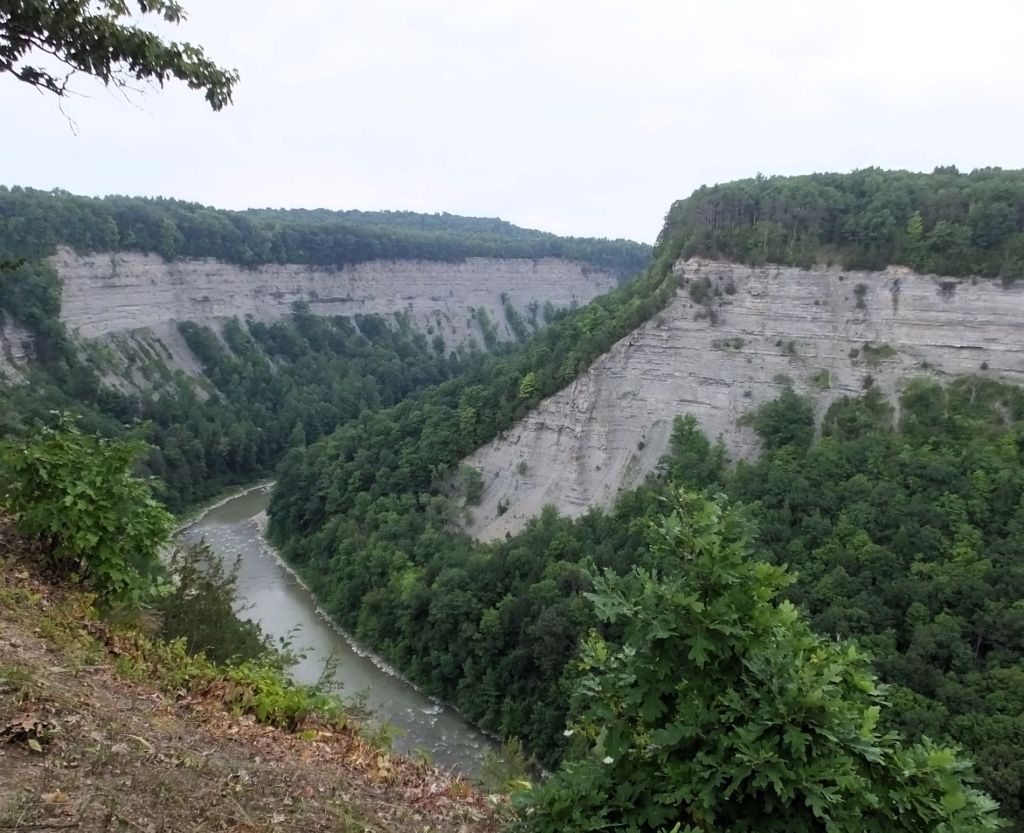
At Letchworth State Park, we hiked to three waterfalls on the Genesee River as it winds through a canyon that is up to 550 feet deep. Letchworth is renowned as the Grand Canyon of the East.
Middle Falls at Letchworth State ParkLetchworth’s Grand Canyon of the East is up to 550 feet deep
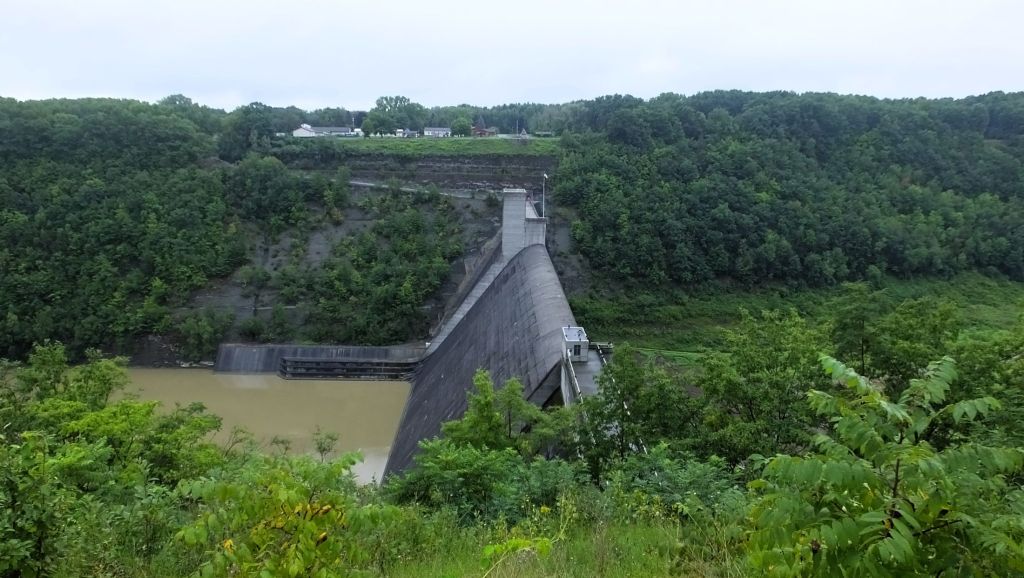
The next afternoon we toured Mt Morris Dam, several miles downriver from the waterfalls. The dam, 1028 feet long and 230 foot above the riverbed, does not have a reservoir. Instead, it is the largest concrete gravity flood control structure east of the Mississippi River. It holds excess flows of the Genesee River to prevent flooding of agricultural land and the city of Rochester, NY, 35 miles away.
Genesee River floods are prevented by the Mt Morris Dam
The visitor center at the dam has photos of repeated floods of Rochester before the dam was completed in 1954. In 1972, flood waters from Hurricane Agnes nearly crested the dam as it protected Rochester from serious flooding. We found that amazing considering the height of the dam!
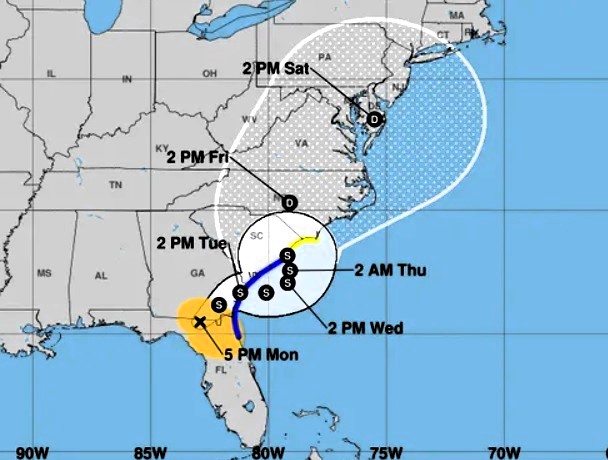
Debby’s track was just to the east of where we were camped in western New York
In the Path of Debby
Fast forward to 2024. We learned that Hurricane Debby had struck the Big Bend area of Florida and was headed up the east coast toward us. With a forecast of heavy rain and gusty winds and a track somewhat near where we were camped, we decided to stay in the Finger Lakes area in western New York for a few days to let the storm pass.
Hurricanes and RabbiTRAILS
Since retiring in 2018 have our travels distanced us from the threat of hurricanes? Nope.
Hurricane Michael struck Panama City, FL in 2018 as we returned from Alaska. We took multiple trips to the Florida Panhandle to help with Samaritan’s Purse relief efforts.
Two years later, our travels were affected by two hurricanes – by Delta, as we camped near Roanoke, VA, and a few weeks later, by Zeta north of Atlanta, GA.
In 2022, we were stranded with truck engine problems in North Sydney, Nova Scotia as Hurricane Fiona approached from the south. We escaped just in time to a safe campground a couple hundred miles away in New Brunswick. Then, after returning home, we again worked with Samaritan’s Purse in Ft. Meyers after it was devastated by Hurricane Ian.
If you’re from Florida, dealing with hurricanes is how it rolls.
Western New York – Gardens and Locks
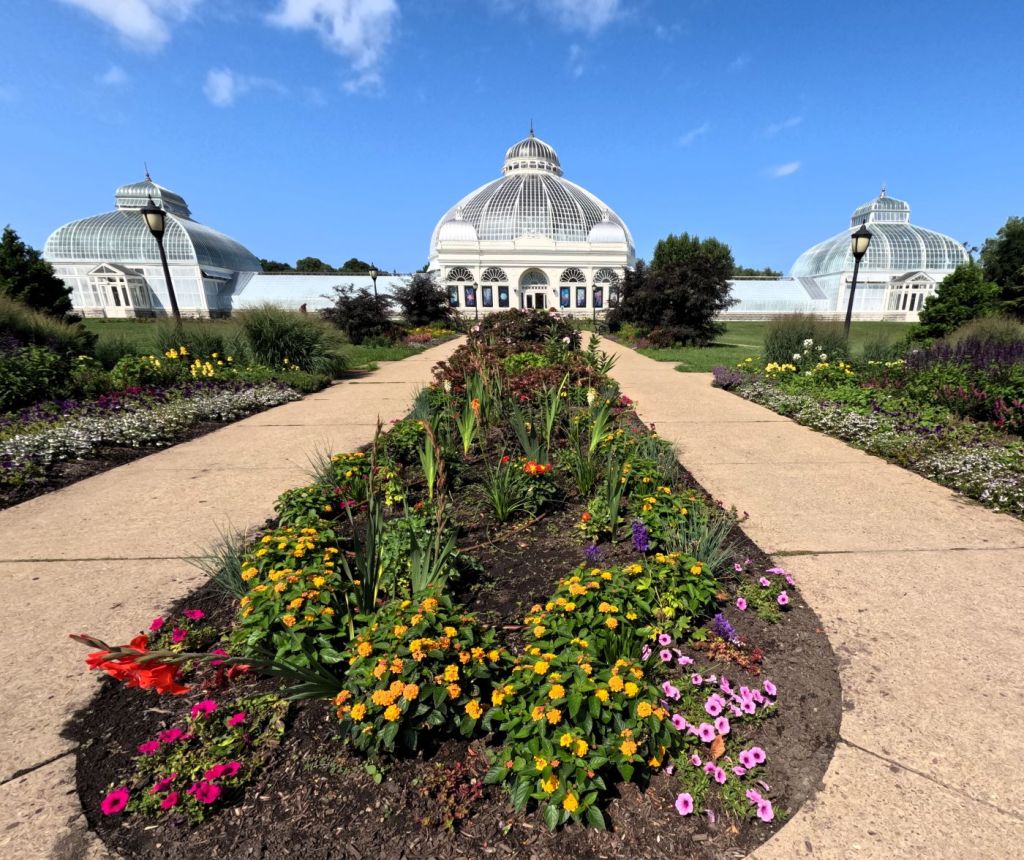
Our New York travels continued with a visit to the Buffalo Botanical Gardens. The gardens, competed at the end of the 19th century, include a magnificent glass covered conservatory that houses tropical and other plant species and several small ponds of colorful koi fish.
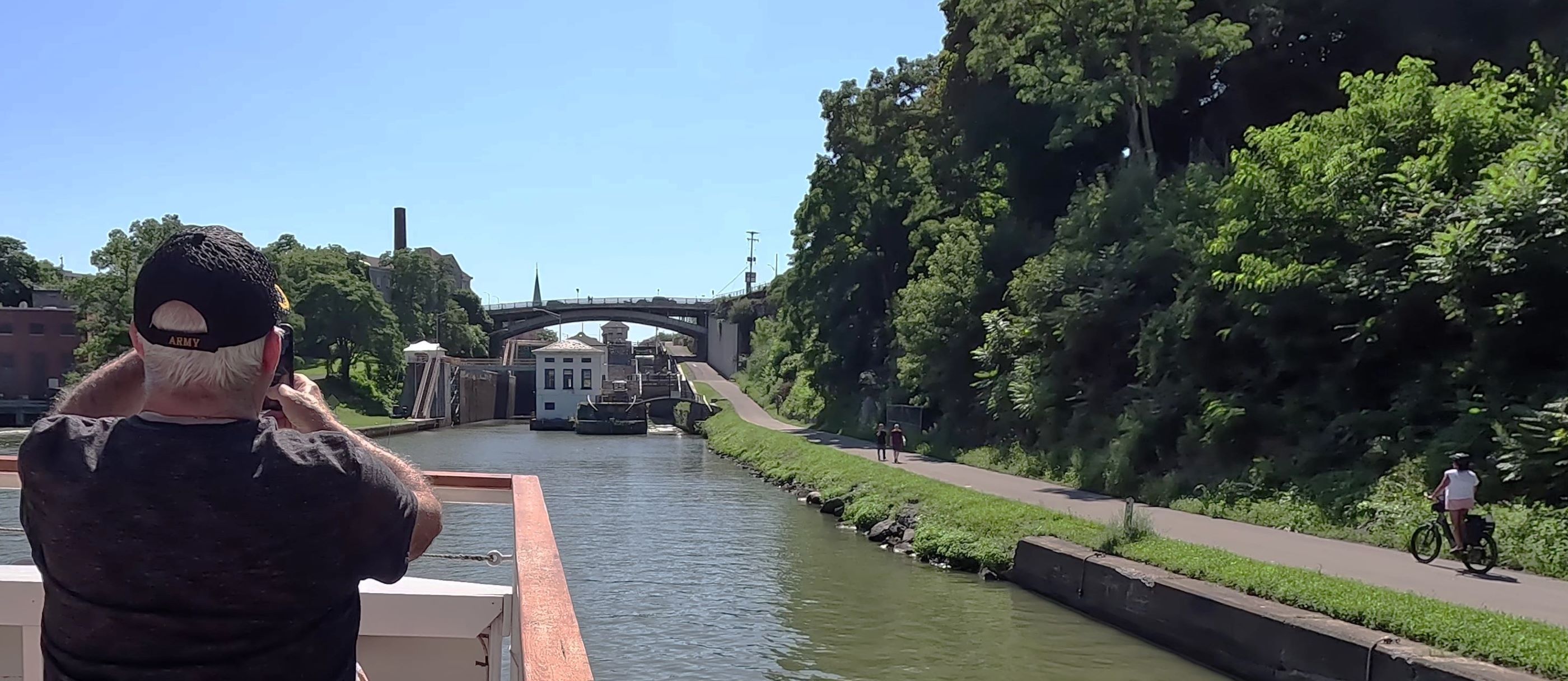
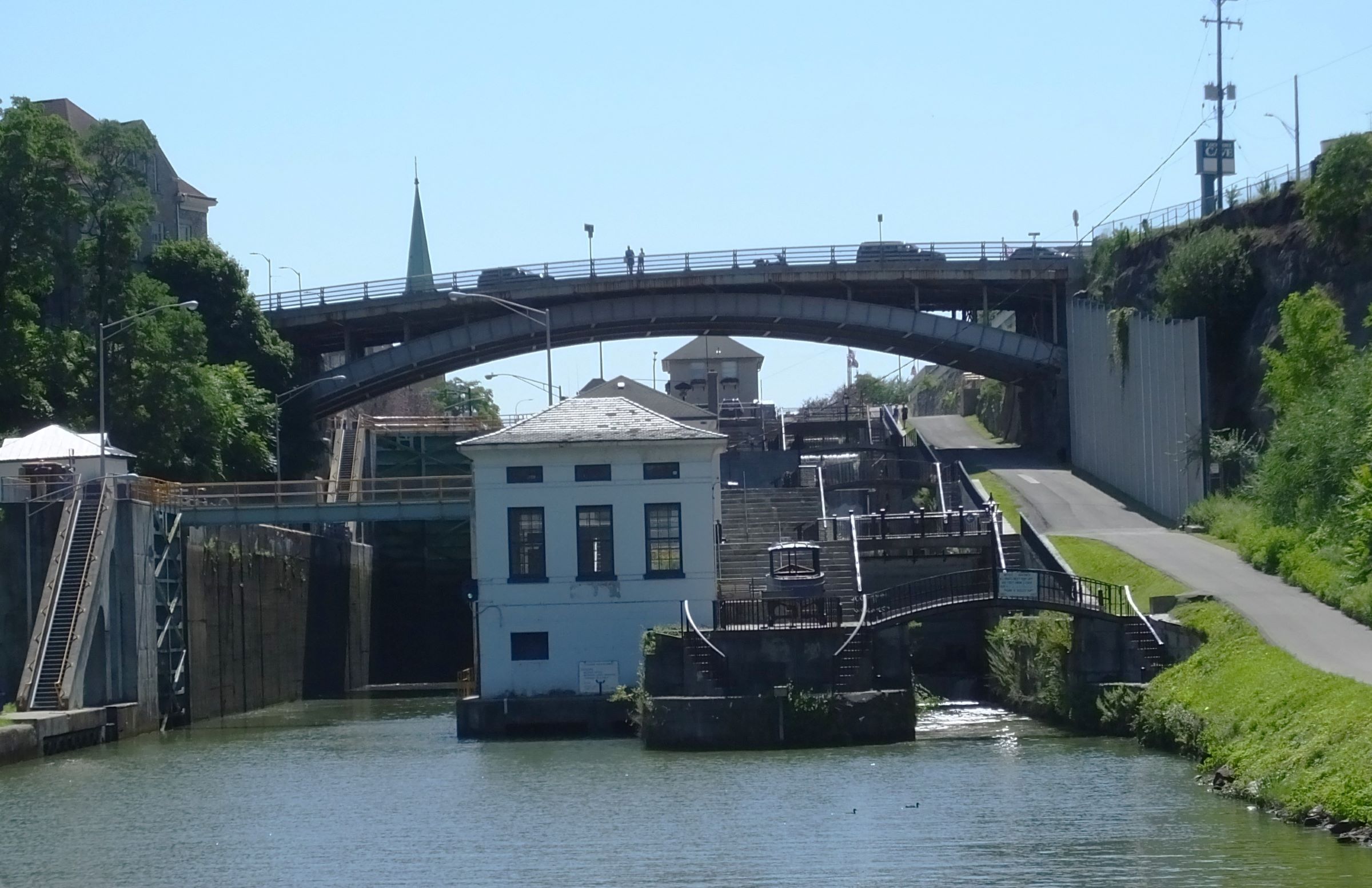
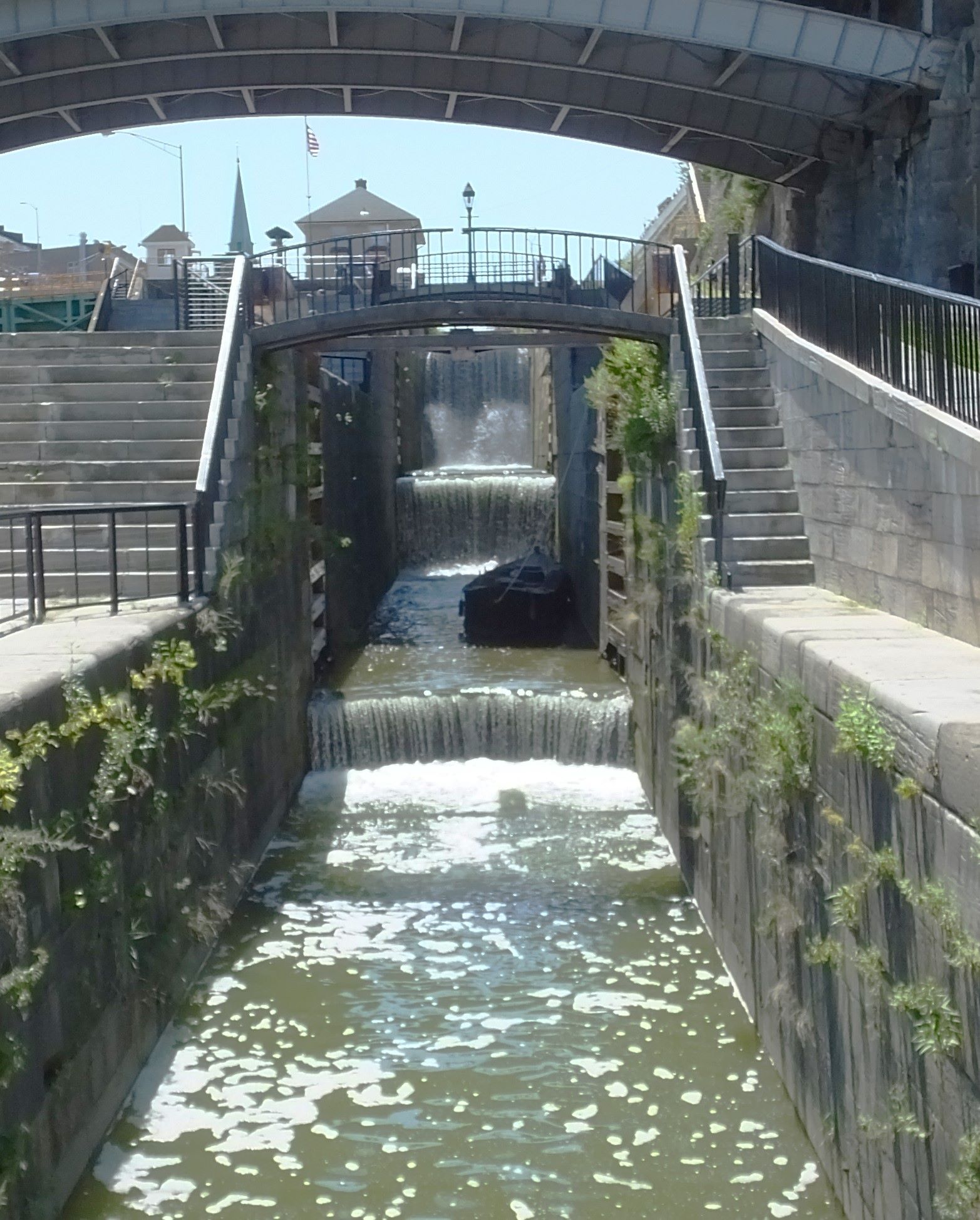
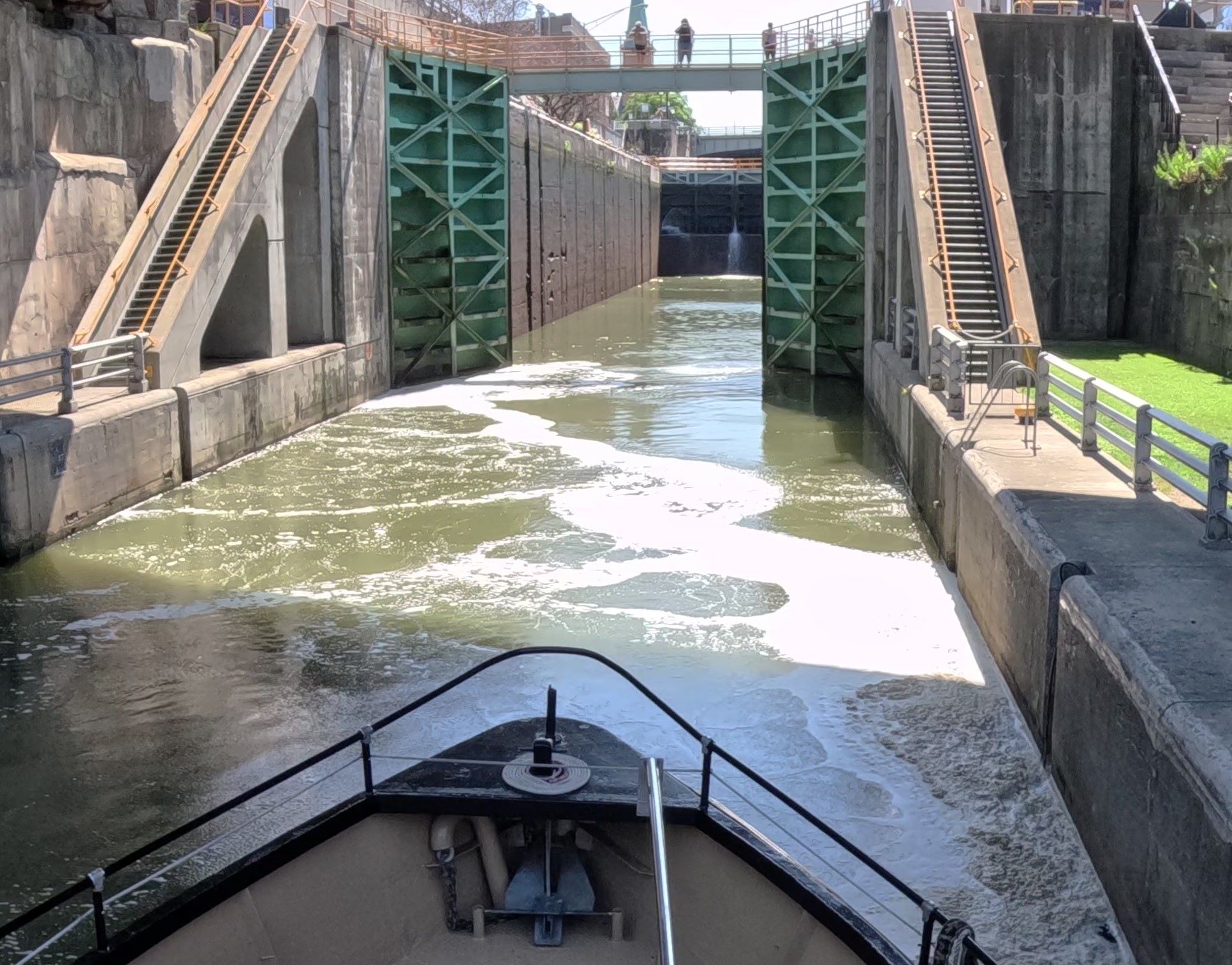
We also visited locks on the Erie Canal in nearby Lockport. During a sunny afternoon cruise, we learned the history of the locks and 363 mile canal that goes from the Hudson River westward to Buffalo and Lake Erie. Completed in 1825, the canal, sometimes called our nation’s first superhighway, was 40 foot wide and four foot deep. Today, the enlarged canal is mainly used by recreational watercraft.
There are two sets of locks at Lockport – to the right is the Flight of Five, five narrow locks originally on the canal. Those locks were replaced by two wider and taller locks in 1918.
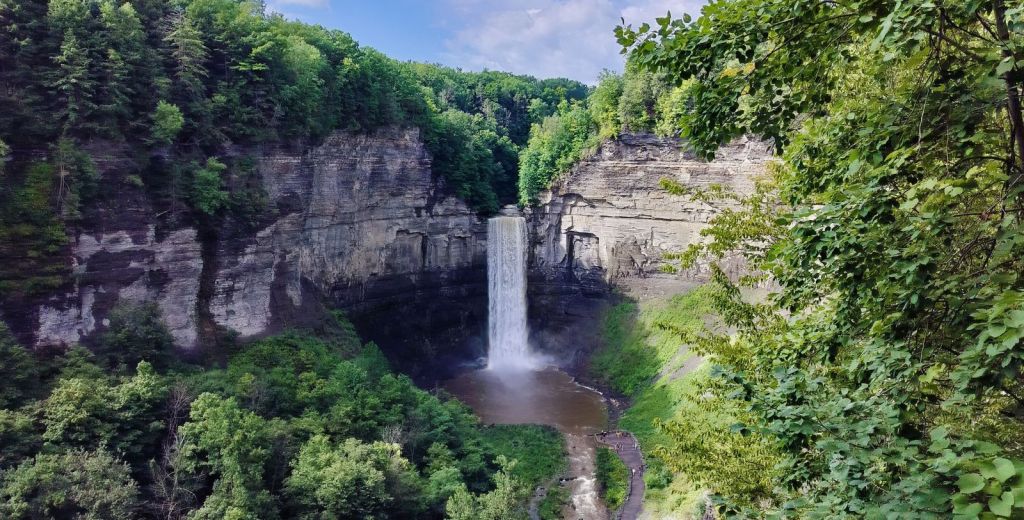
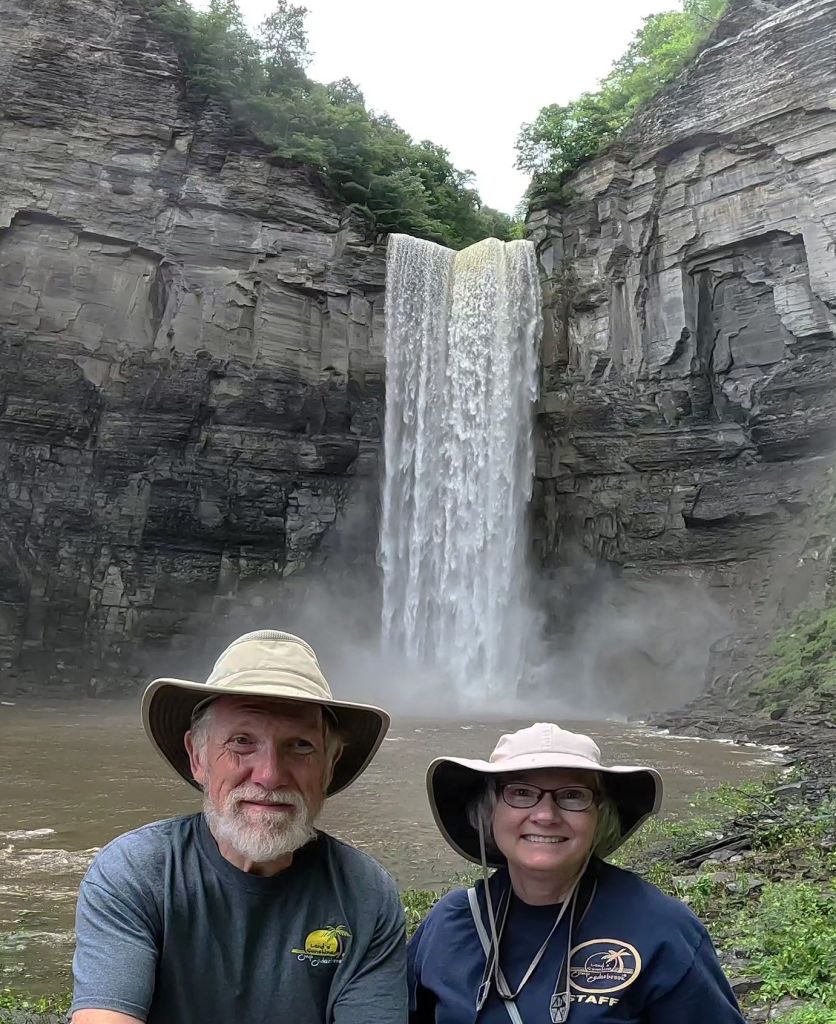
Taughannock Falls
We enjoyed a short walk to Taughannock Falls. The falls plunge 215 feet over rocky cliffs that tower nearly 400 feet above the gorge.
Thankful for moderate rainfall and no strong winds from Debby, we continued east through Vermont and New Hampshire.
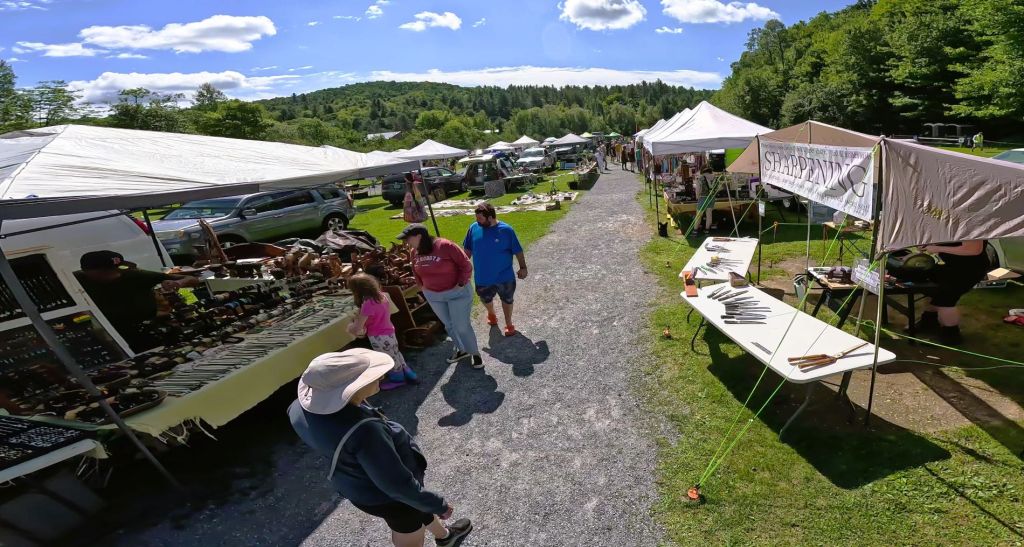
Our first view of mountains in Vermont – likely spectacular during October’s fall colorsWe enjoyed a cool Saturday afternoon at a roadside flea market in New Hampshire
Next Week
Visits to old bridges, an old house and a friend of more than 45 years in the Granite State.
(We’ve been taking a break from blogging to return home and recover from our travels. Rested and nearly caught up on everything, we return to our 2024 Heartland journey…)
Arriving at CCO for a second week of camp
As July came to an end, we arrived at Madison, Ohio for a week on staff at Cedarbrook Camp of Ohio.
This was our second week at a Cedarbrook camp this summer. There are a dozen Cedarbrook camps across the US that seek to provide a Christ-centered, safe and fun camping experience.
We served at the Land o’ Sunshine (Florida) Camp Cedarbrook for more than 25 years and began serving at other Cedarbrook camps after the Florida camp was discontinued in 2016.
Cedarbrook Camps
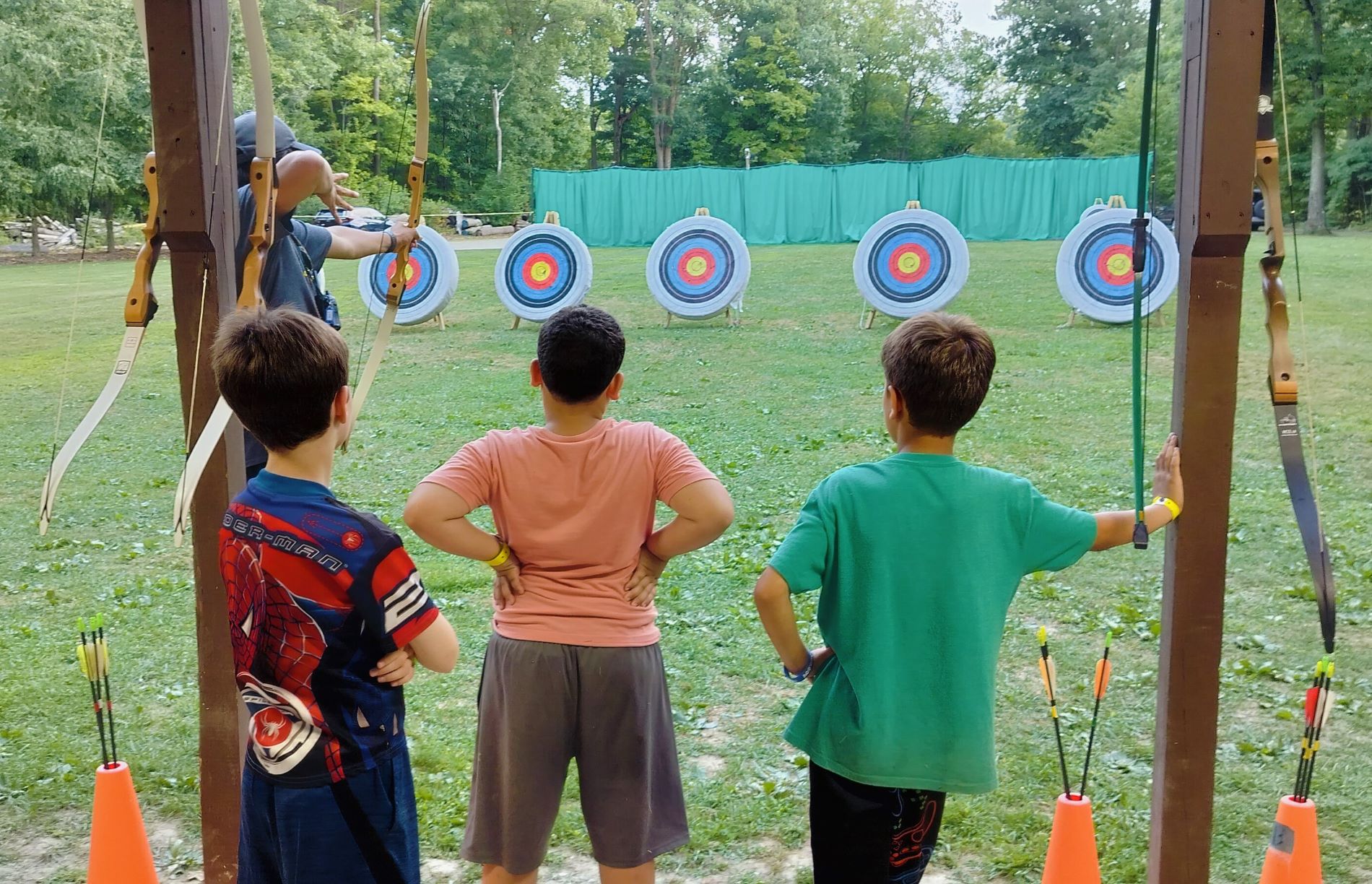
Like many other summer camps, Cedarbrook camps offer various activities like archery, riflery, camping skills, nature, crafts, swimming, canoeing and lots more. What attracts us to Cedarbrook camps is their emphasis on Christian principles in all aspects of camp and the development of practical life skills for campers. The camps are staffed by adult volunteers who view camp as personal ministry.
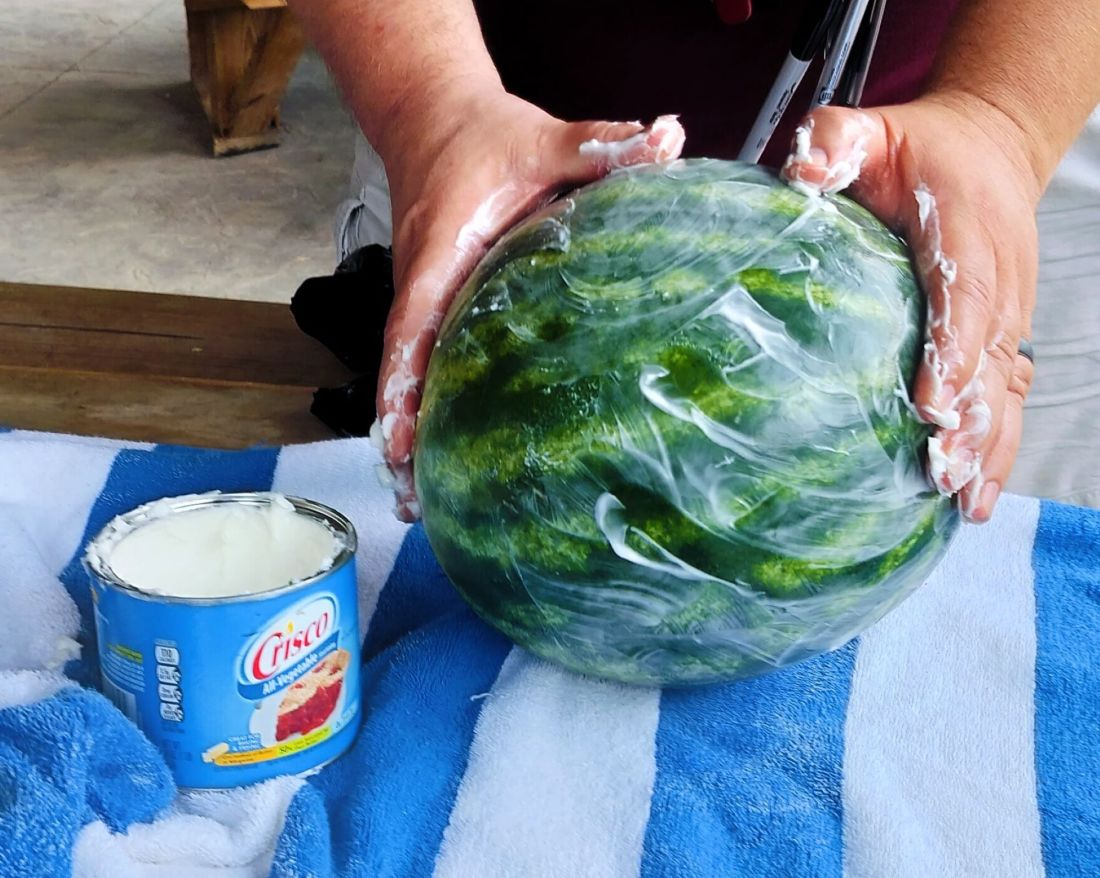
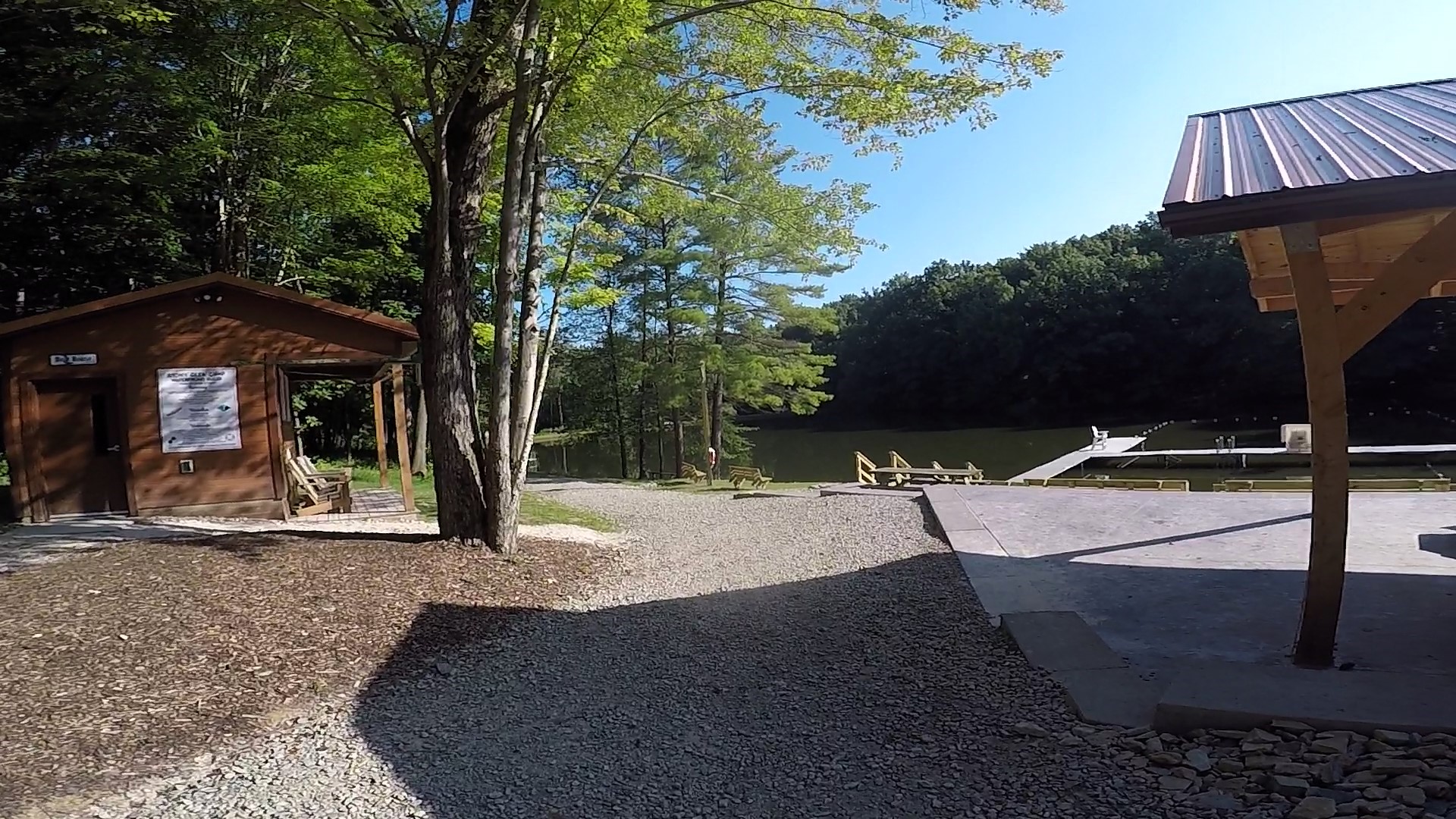
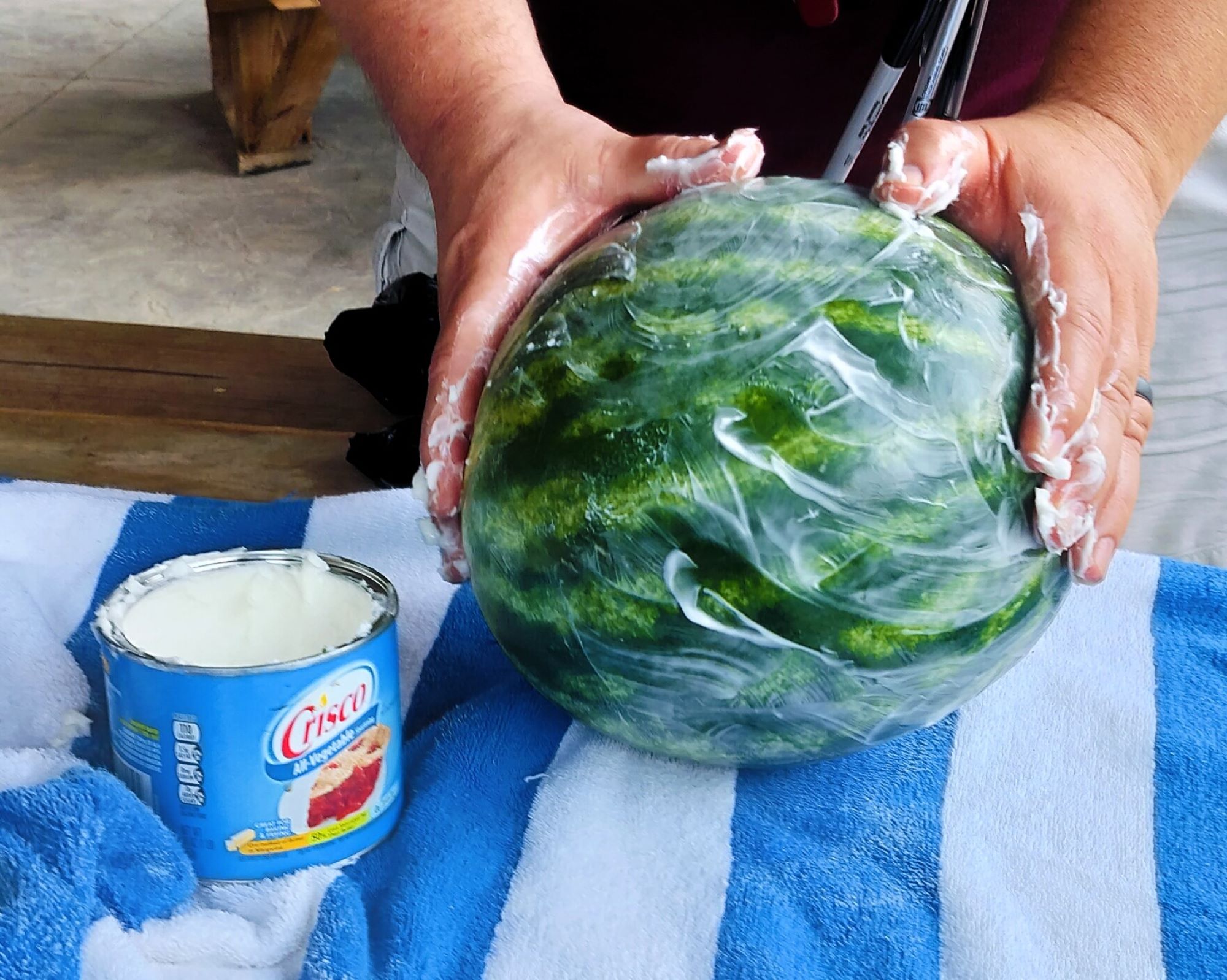
Scenes from CCO – waterfront area used for swimming, canoeing, kayaking and fishing, archery targets, and getting a watermelon ready for a fun game of greased watermelon football at the lake!
Similar…
Cedarbrook camps have many similarities. All have individual morning devotions and counselor-led Bible studies. Evening programs include fun age-specific and all-camp activities followed by singing and an evening campfire/talk. Singing ranges from traditional fun camp songs to worship and praise songs. One evening each week cabin groups cook their evening meal over a campfire.
And many Cedarbrook camps offer intense multi-year counselor leadership training for older campers.
…And Different
There are some interesting differences in the camps as well.
Heat and humidity are a challenge at camp in Texas, so the cabins and other camp buildings are air conditioned. Evening programs don’t always include a campfire.
At Ohio camp, days are mostly pleasant and nighttime temps can even get chilly (at least by Florida/Texas standards). There is no air conditioning and floor fans are sufficient.
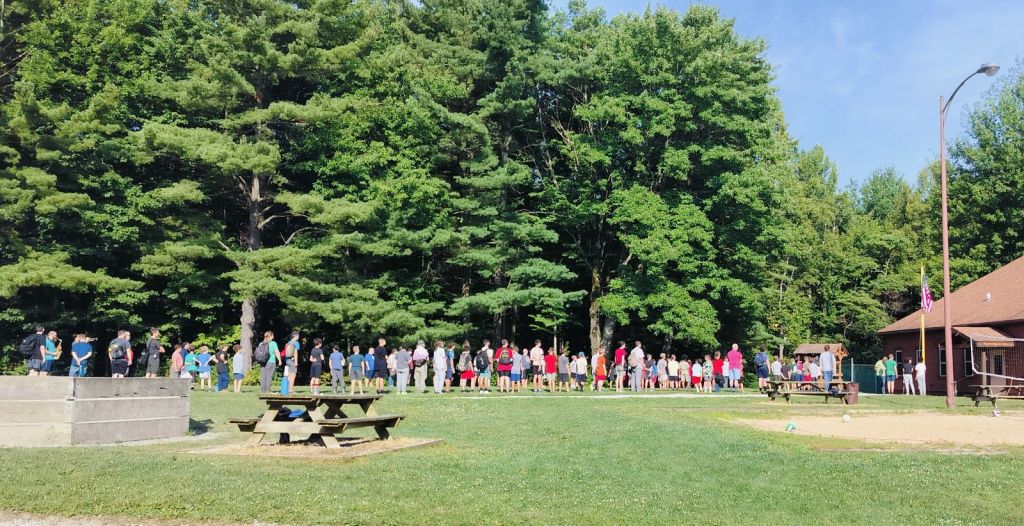
Daily flag raising
Like Texas camp, Ohio has a morning flag raising ceremony with traditional bugle calls (played on a trumpet and saxophone), the Pledge of Allegiance and the national anthem.
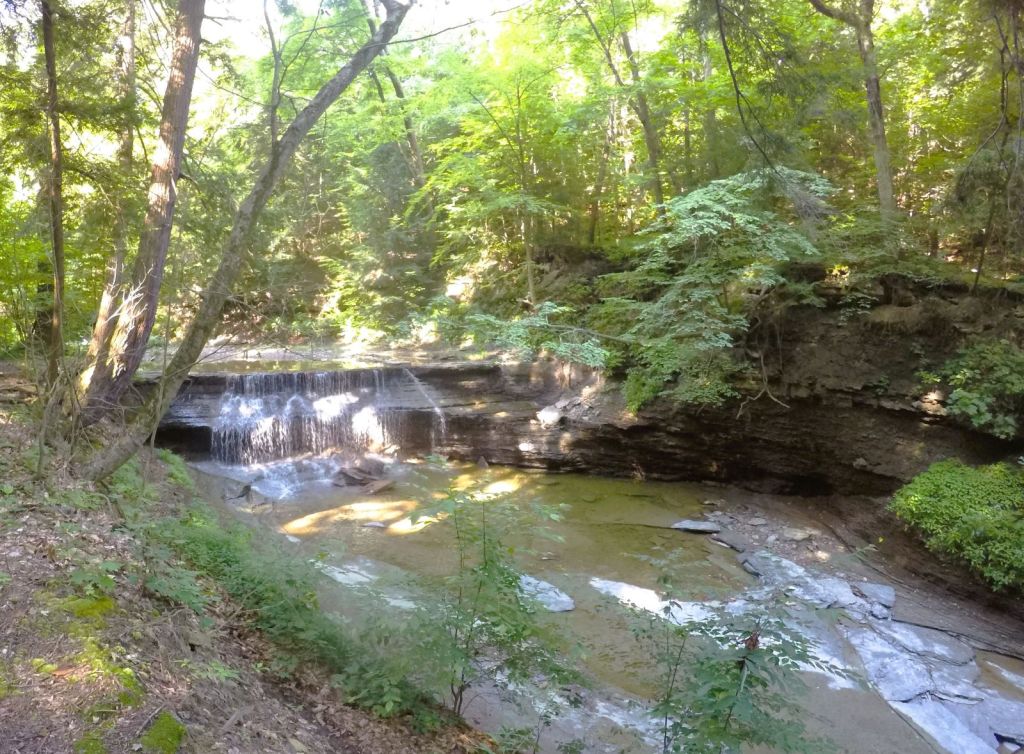
Peaceful waterfall at the bottom of the glen
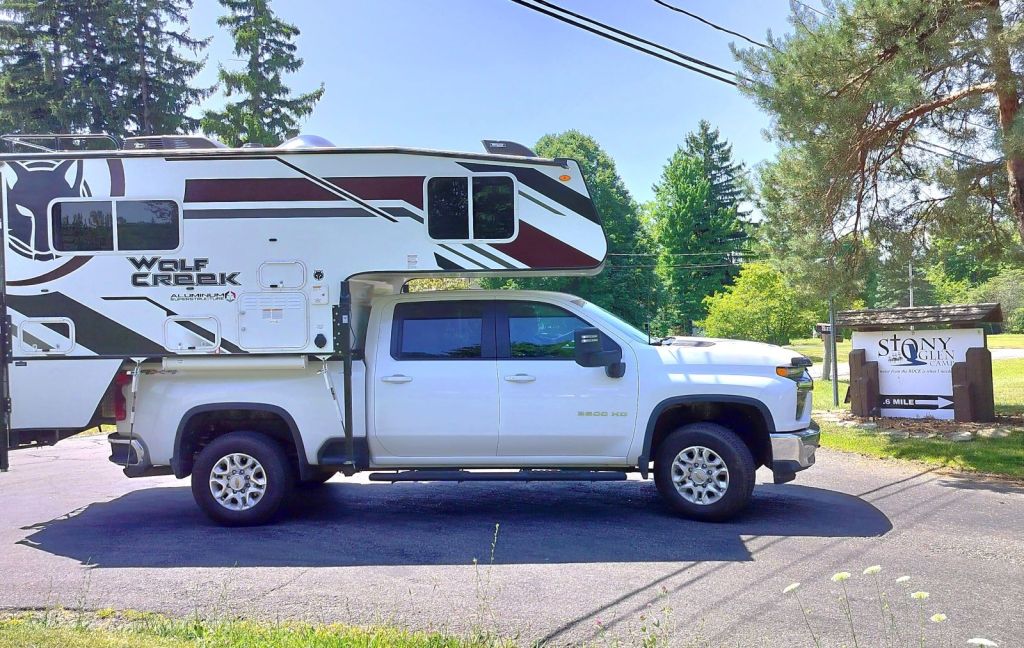
The Ohio camp uses facilities at Stony Glen Camp located 35 miles east of Cleveland. The large site is situated along the Grand River. There is a nice pond for swimming and fishing, and several ravines offering challenging hikes to scenic waterfalls.
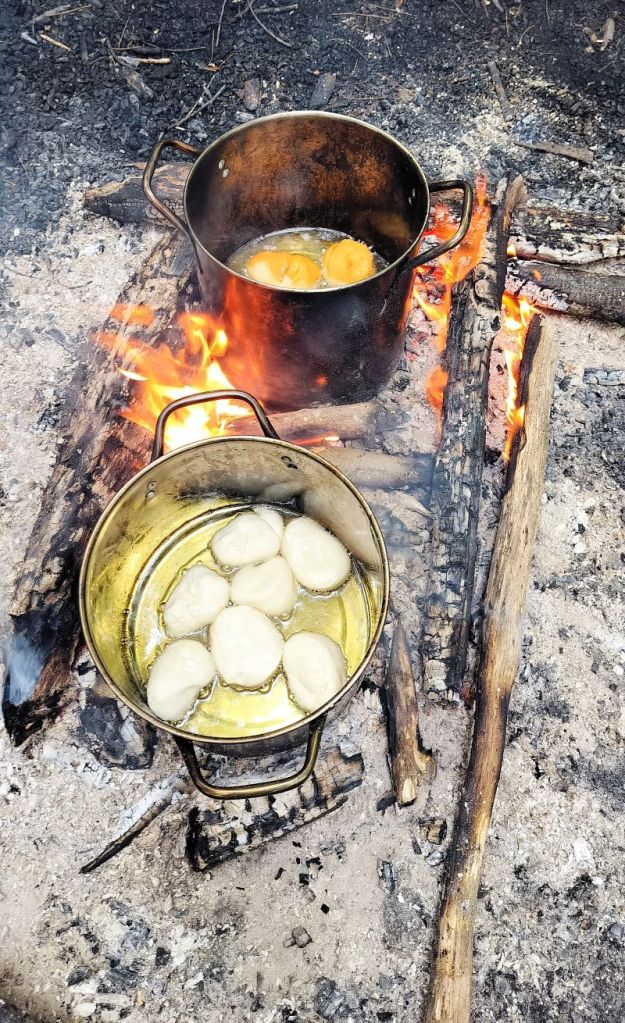
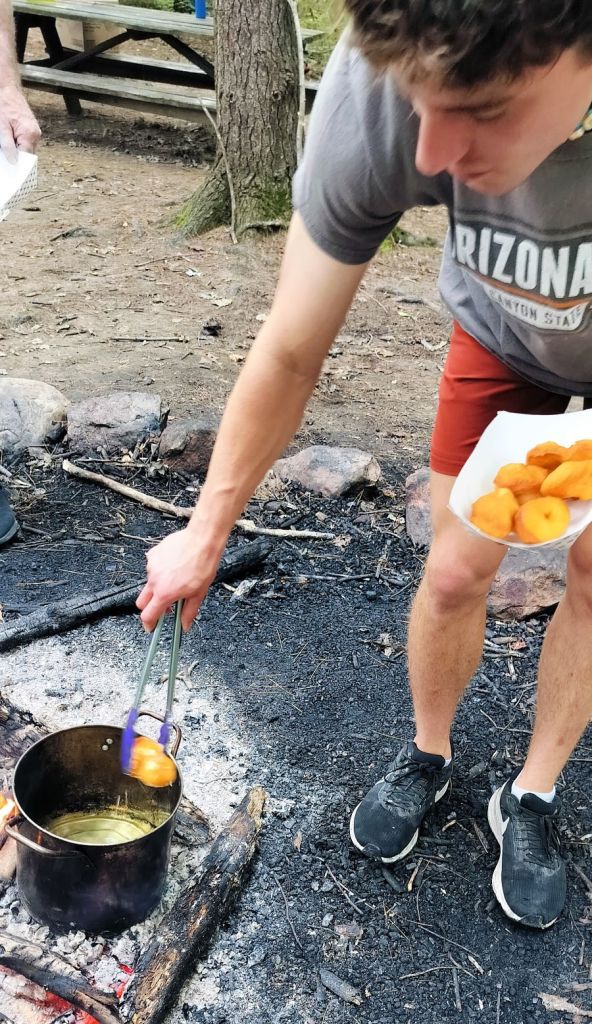
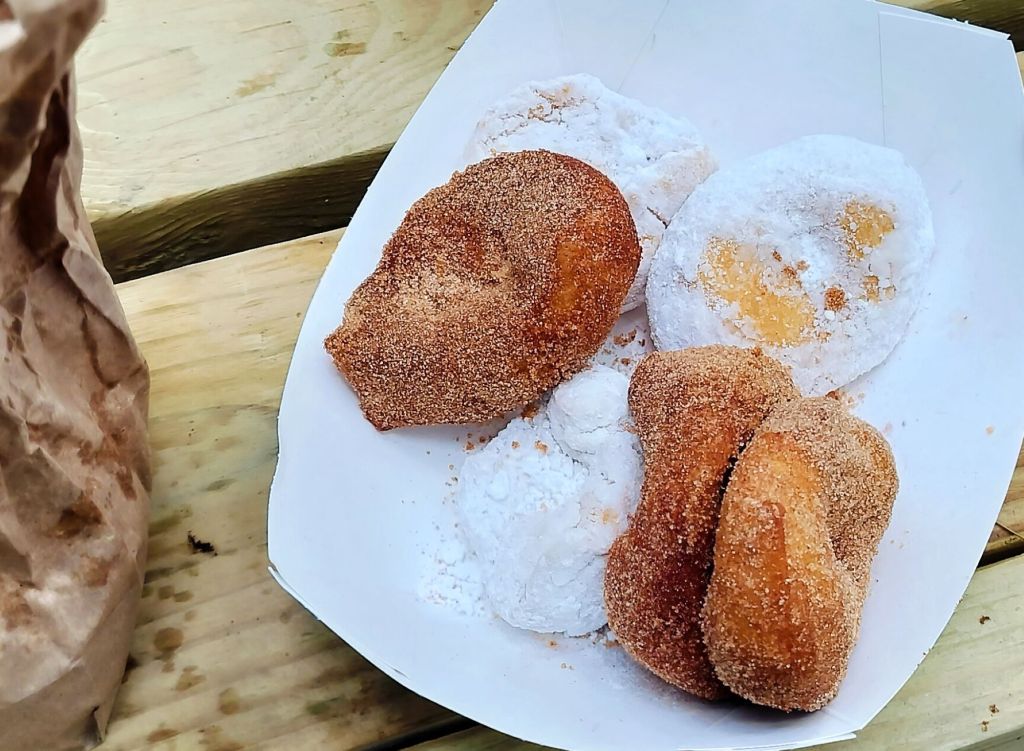
Cabin groups eat their meals family-style (Texas meals are served cafeteria-style), and, in addition to the dinner cookout each week, Ohio campers cook their breakfast over a campfire. Canned-biscuit donuts cooked in hot oil and rolled in sugar are a favorite!
Fresh-cooked donuts are a favorite at the morning cookout
Ohio camp is held for four weeks, with three weeks for girls and one week for boys.
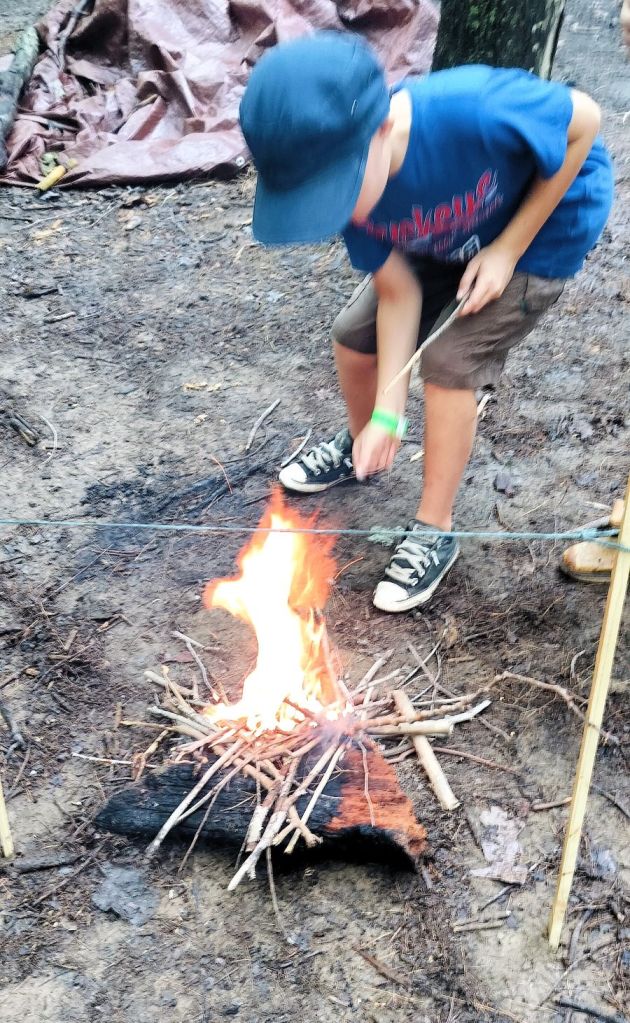
Practicing fire building skills in a string-burning contest
How We Served
Pat and I taught fire-building and outdoor cooking to third/fourth grade boys, assisted with other activities and helped close camp for the summer.
We were blessed to serve at Texas and Ohio camps this summer, and hope to return in the future.
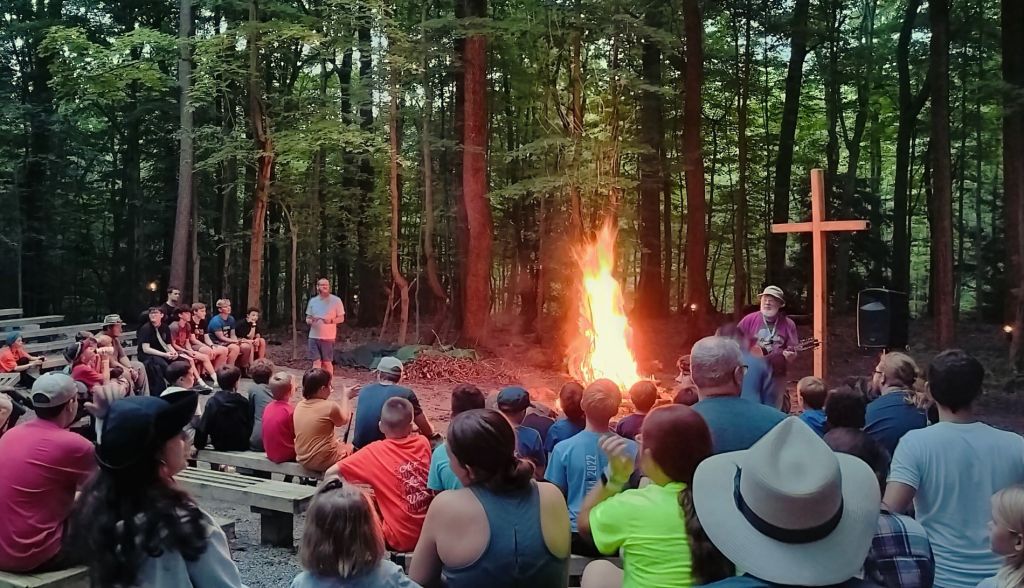
The Friday night campfire was a highlight of the week
Next Week
We head east from Ohio, with stops in Pennsylvania and New York, and hunker down for a couple days to allow Hurricane Debby to pass.
As our travels across the north shore of Lake Superior came to a close, we made a brief overnight trip across the US-Canada border to Sault Ste. Marie, Michigan. There, we purchased gas and groceries because they were much less expensive than in Canada.
We returned to Canada and continued across the top of Lake Huron, the second largest of the great lakes.
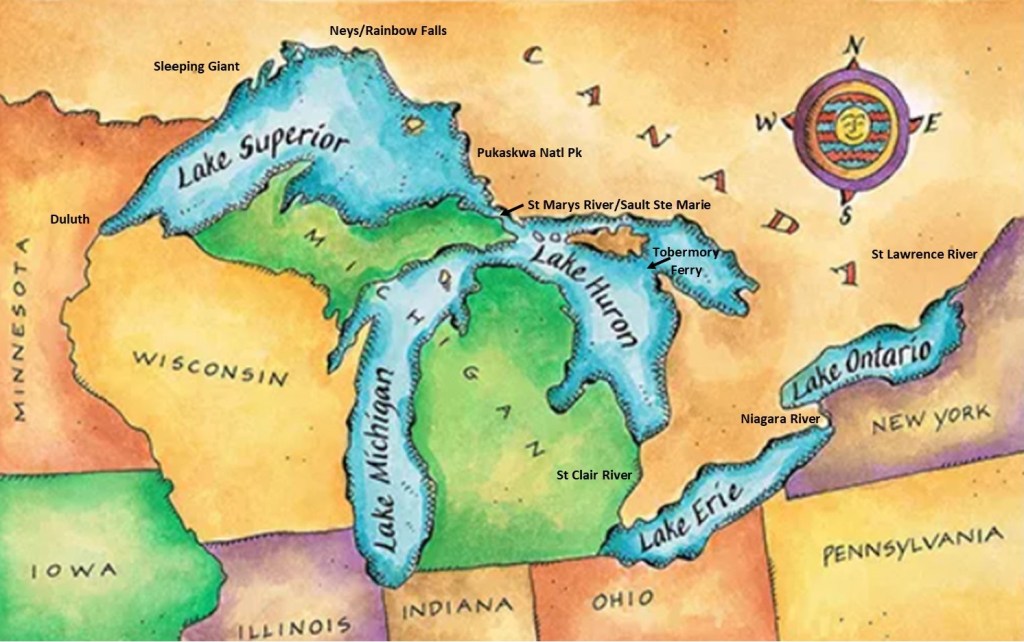
Some Great Lakes geography (see map):
Lake Superior, at 21 feet higher elevation, flows into Lake Huron via the St Mary’s River at Sault Ste. Marie. Lake Huron and Lake Michigan are the same level connected by the five-mile-wide Straits of Mackinac. Some consider the two lakes to be a single lake.
Lake Huron flows south into Lake Erie via the St. Clair River near Detroit. Lake Erie empties into Lake Ontario via the Niagara River, and Lake Ontario continues on to the Atlantic Ocean via the St Lawrence River.
Back to the USA!
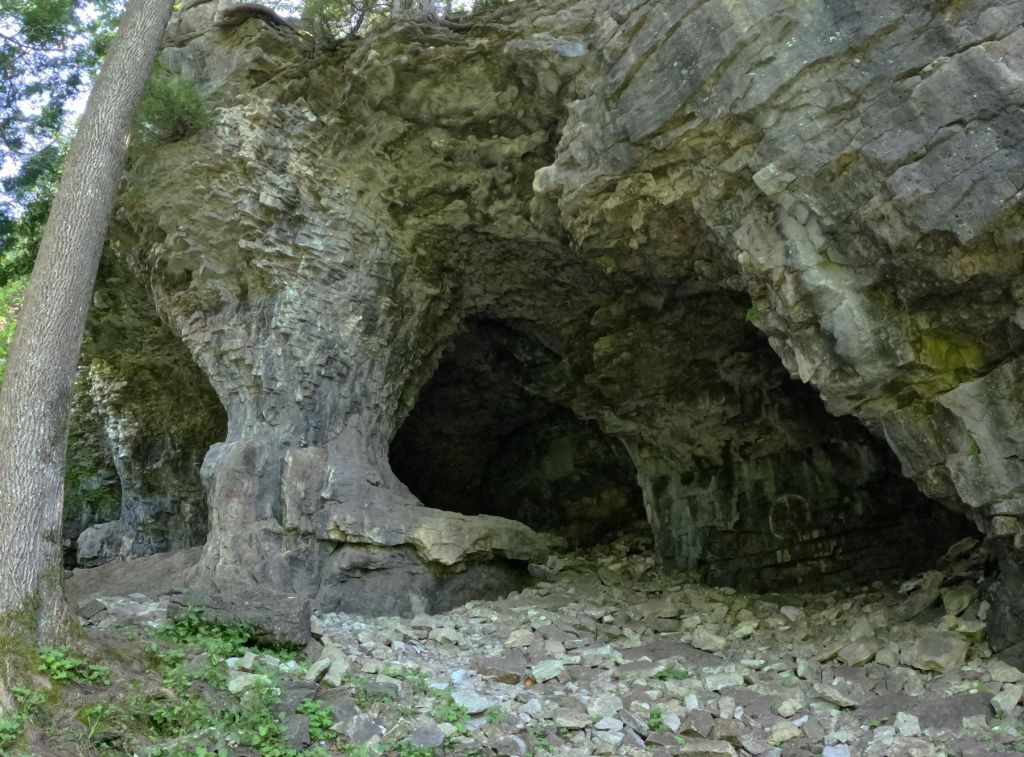
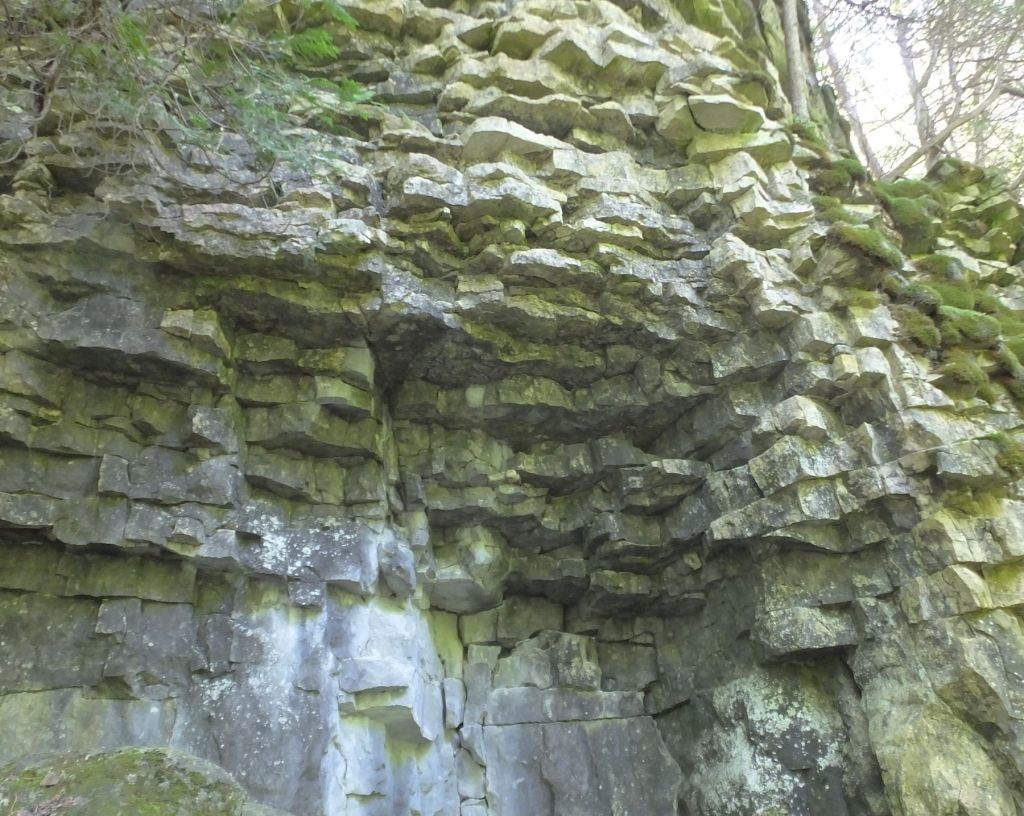
We cut our Lake Huron tour in half by taking a ferry across Lake Huron to Tobermory, Ontario. At nearby Wiarton, we hiked to Bruce’s Cave burrowed underneath the Niagara Escarpment. The escarpment runs from Wisconsin to New York and is the same formation associated with Niagara Falls.
Bruce’s Cave, near Wiarton, Ontario
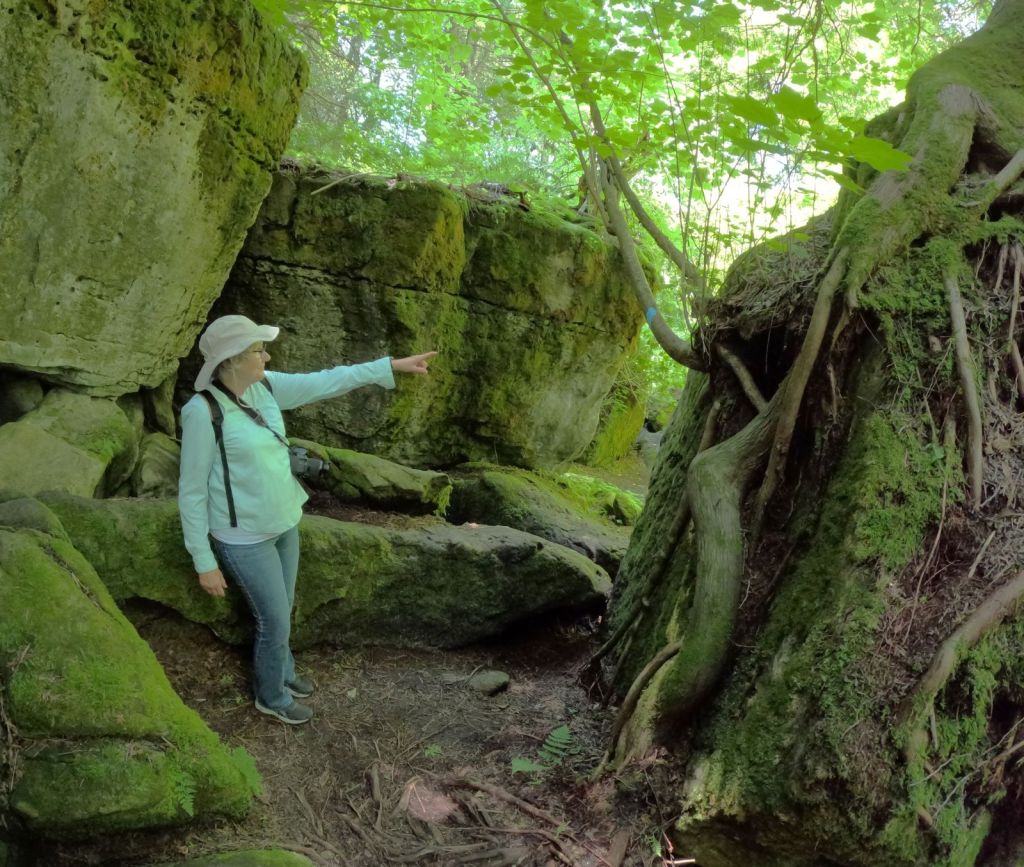
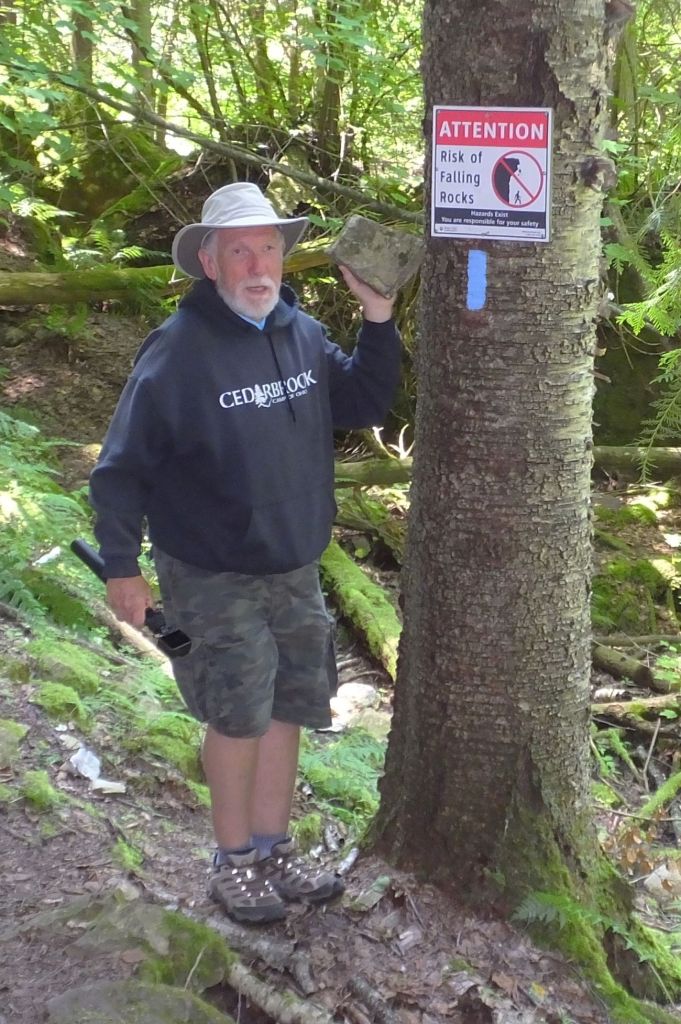
Our escarpment hike included hiking through narrow passages and rock scrambling amidst interesting rock layers
We drove south to Port Huron, Michigan and Ohio. It was about a week before our second planned week on staff at Cedarbrook Camp of Ohio, so we decided to visit the Air Force Museum near Dayton, Ohio.
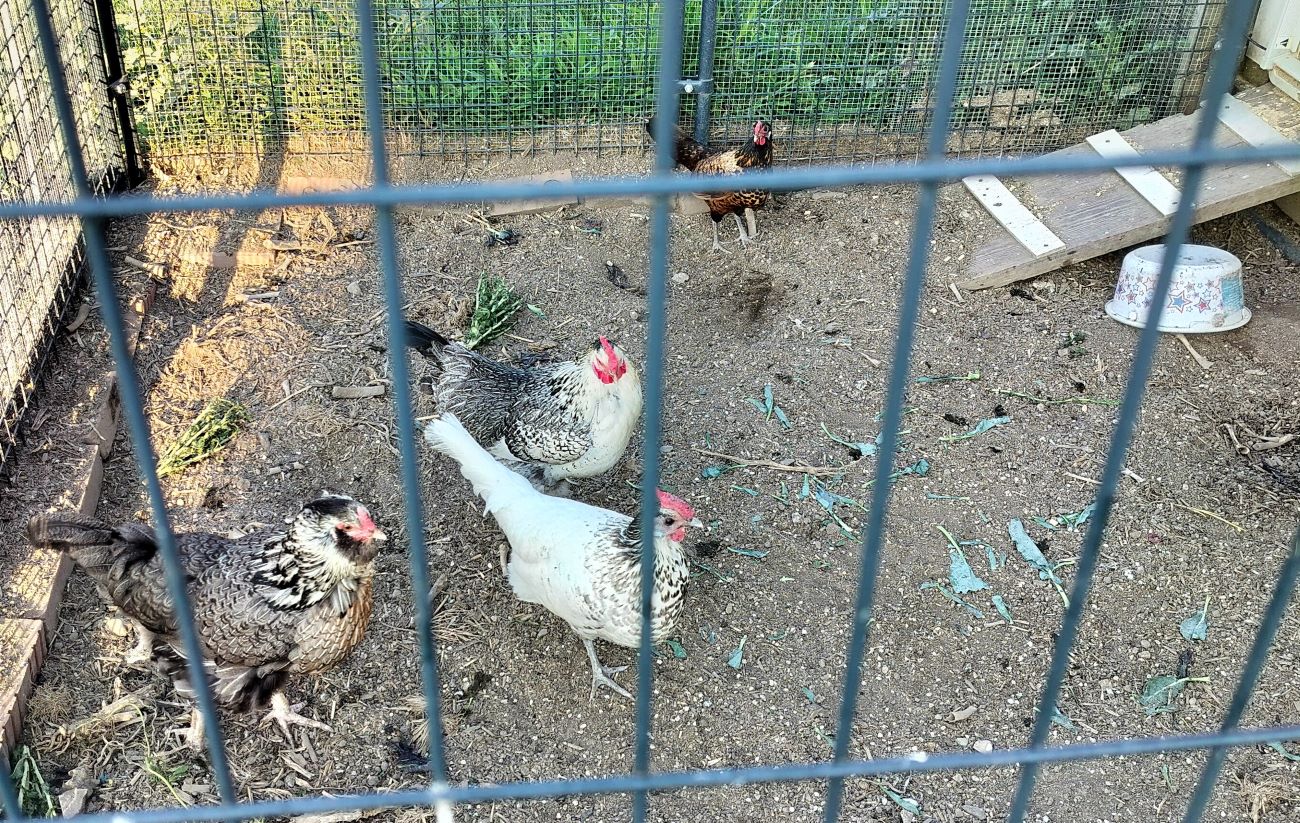
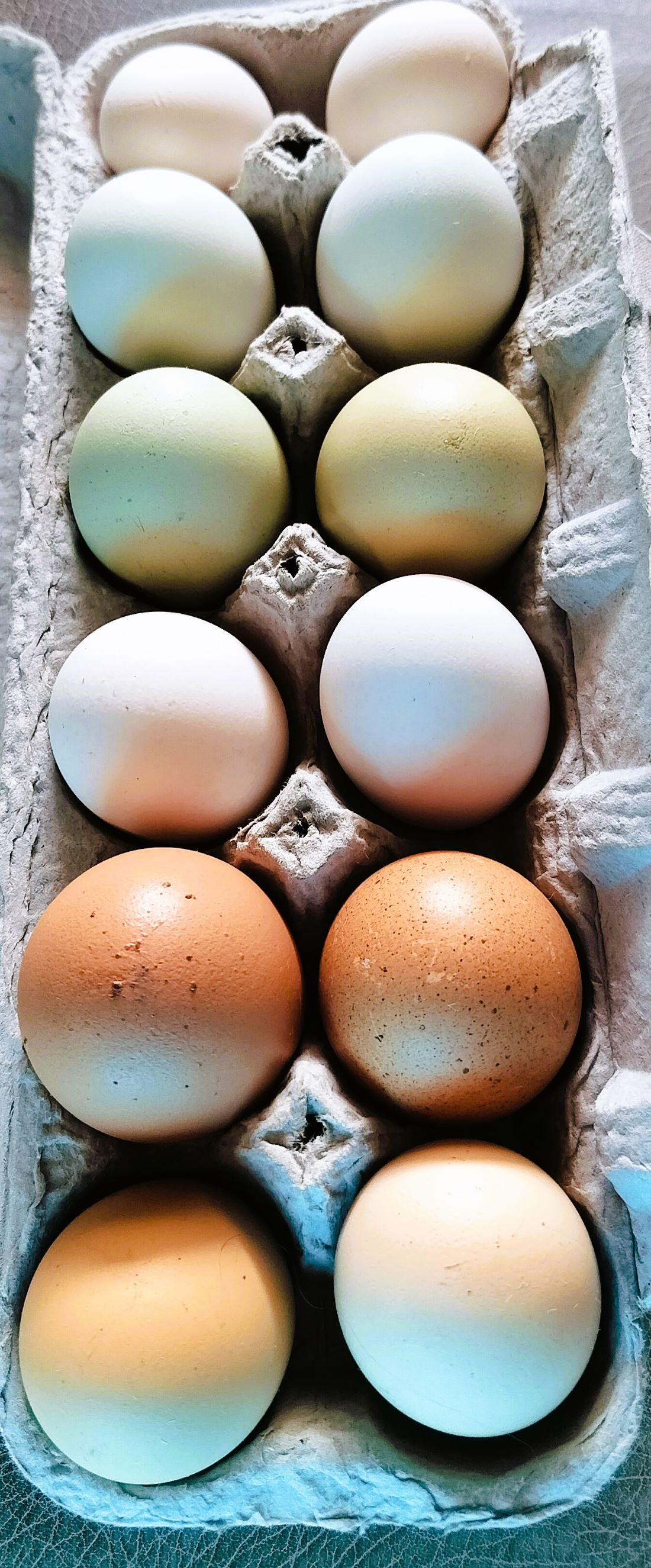
Our Ada, Ohio chicken ambassadors laid multicolored eggs
Eggs and Footballs in Ada
Halfway to Dayton, we spent the night at a Harvest Host location in Ada, Ohio. Our host’s home was located a mile out of town, surrounded by soybean and corn fields. The owner had several laying hens, and we purchased a dozen multicolored farm fresh eggs that we enjoyed for breakfast over the next several mornings.
The colorful eggs tasted the same to us.
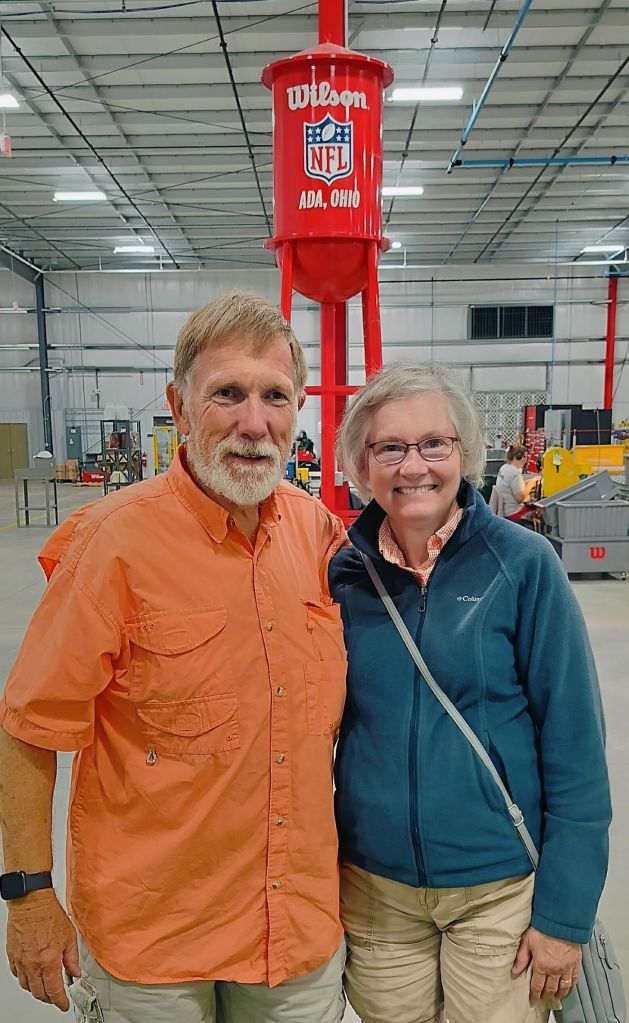
Touring the football production facilities in Ada
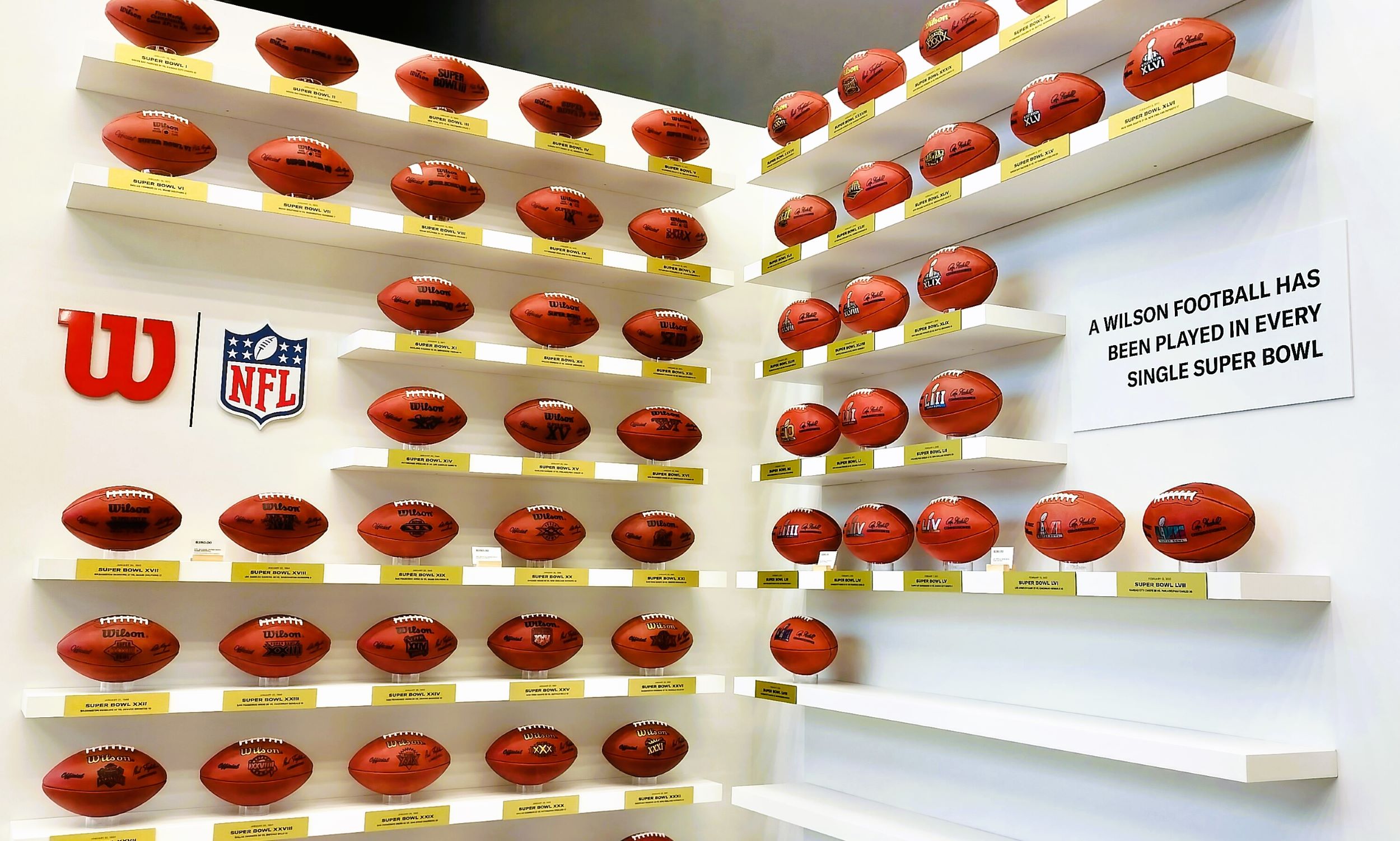
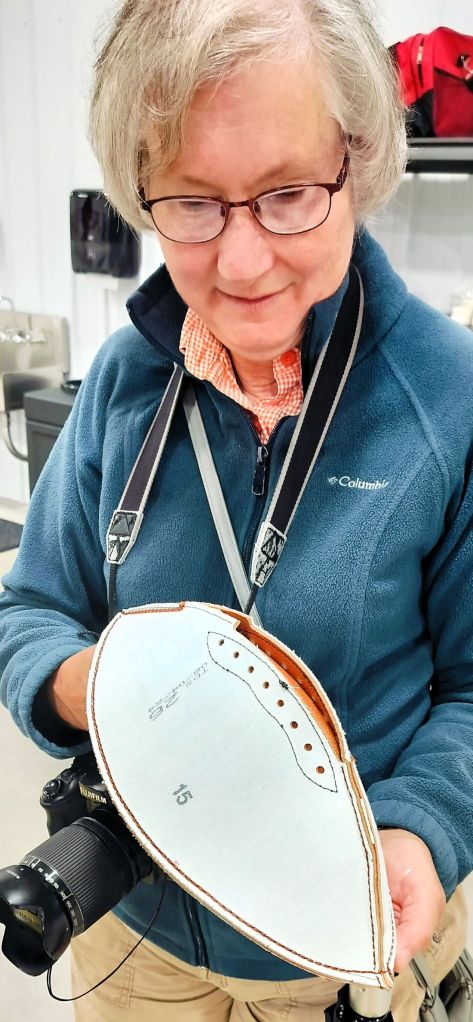
Eggs aside, Ada has the interesting distinction of having a Wilson Sporting Goods factory where every leather official-size NFL football has been handcrafted since 1955.
Super Bowl footballs on display, including one from Super Bowl XXXIX
We toured the busy football manufacturing plant, watching large pieces of leather being cut into four-piece football-shaped stacks. The stacks are sewn together with a special liner. An inflatable bladder is then inserted into each ball before it is stitched, and various lettering and logos are applied. Each football includes an RFID chip used to track the ball’s location during NFL games.
Pat examines an inside-out football; as each ball is turned right-side out, an inflatable bladder is inserted and the ball is stitched
National Museum of the US Air Force
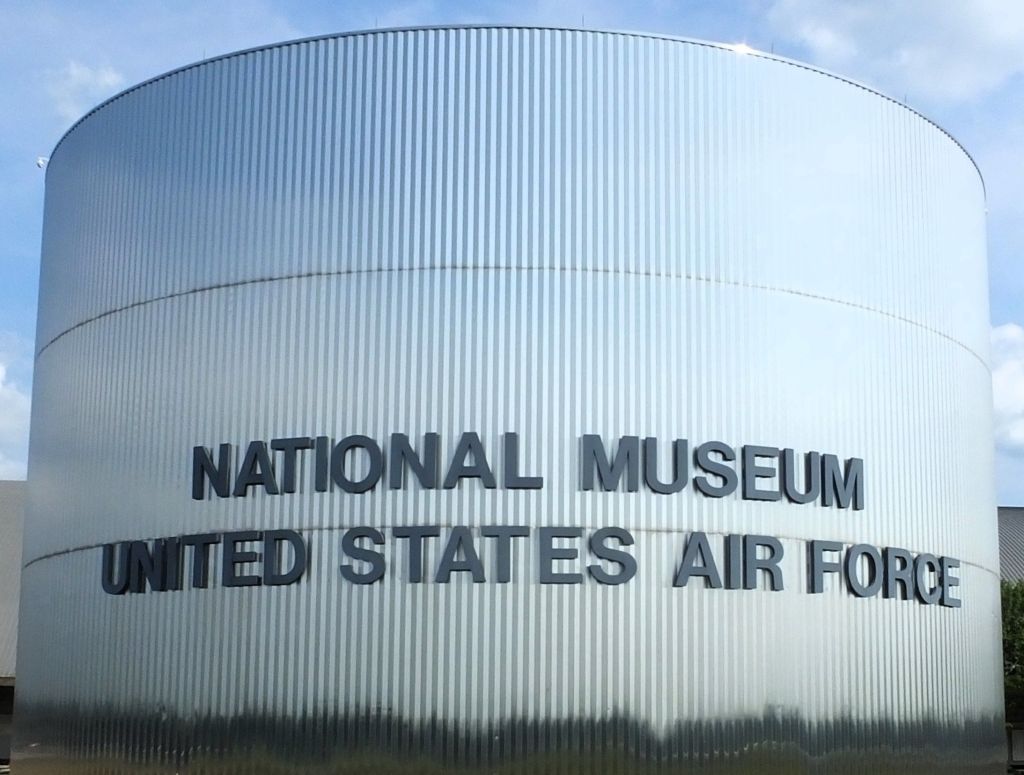
From Ada, we traveled to Dayton, Ohio where we spent two days touring the amazing National Museum of the US Air Force.
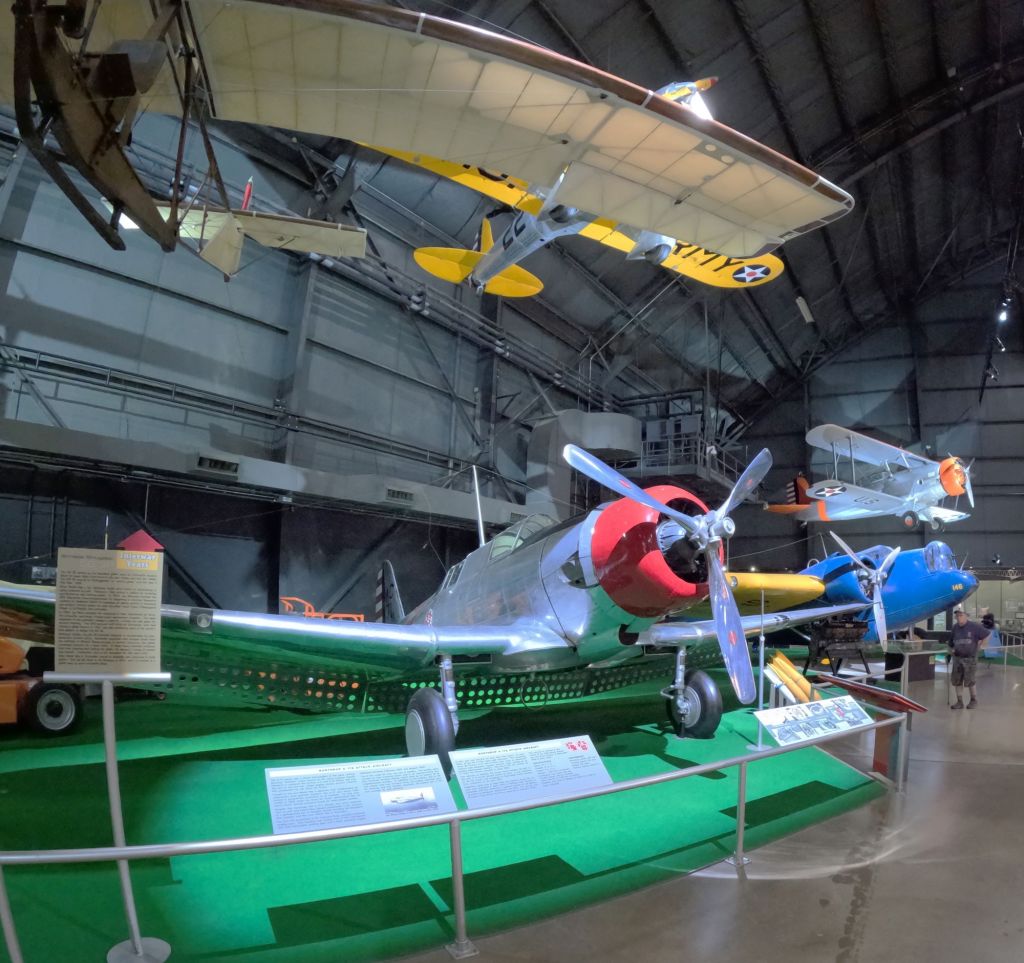
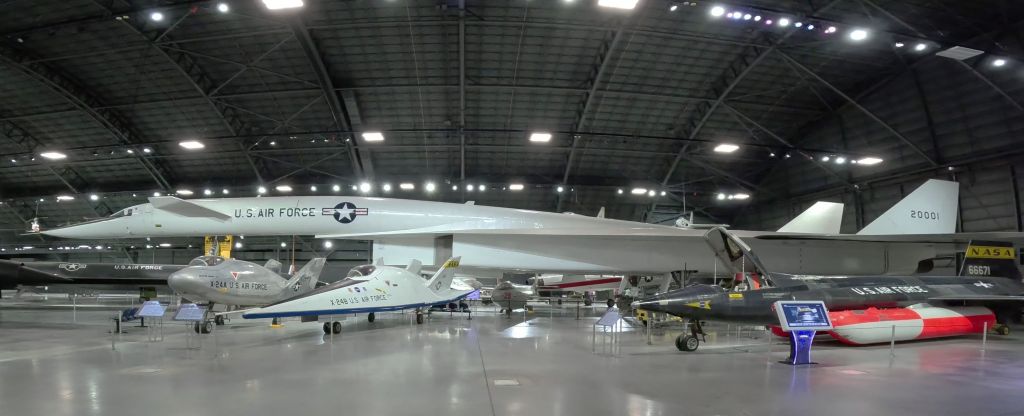
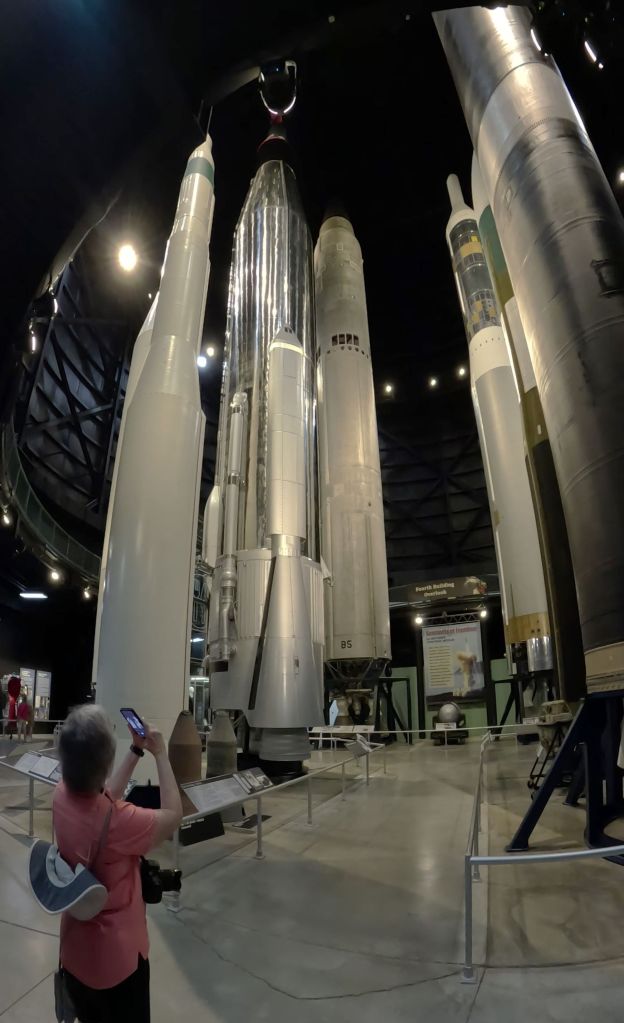
Two days are hardly enough to walk through the museum that is housed in four large hangars on Wright-Patterson Air Force Base. Hundreds of planes, helicopters, drones, missiles, a space shuttle mockup and more are displayed.
One hangar is dedicated to the history of air flight from the Wright Brothers to WWII
The museum is divided into four main sections – history of flight from the Wright Brothers to WWII, Korea and Vietnam, the Cold War era and the modern Air Force.
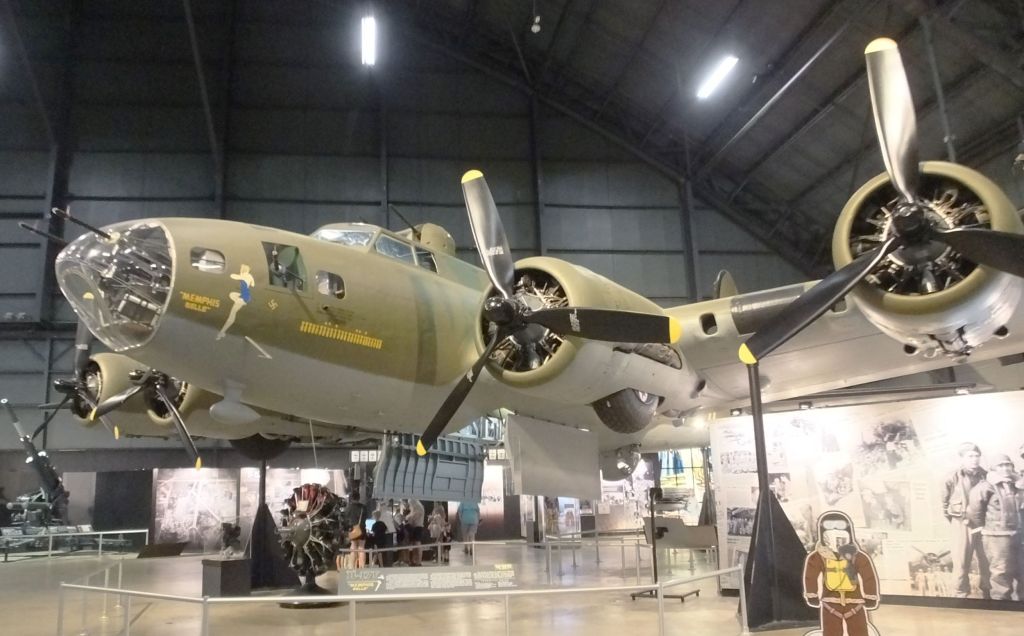
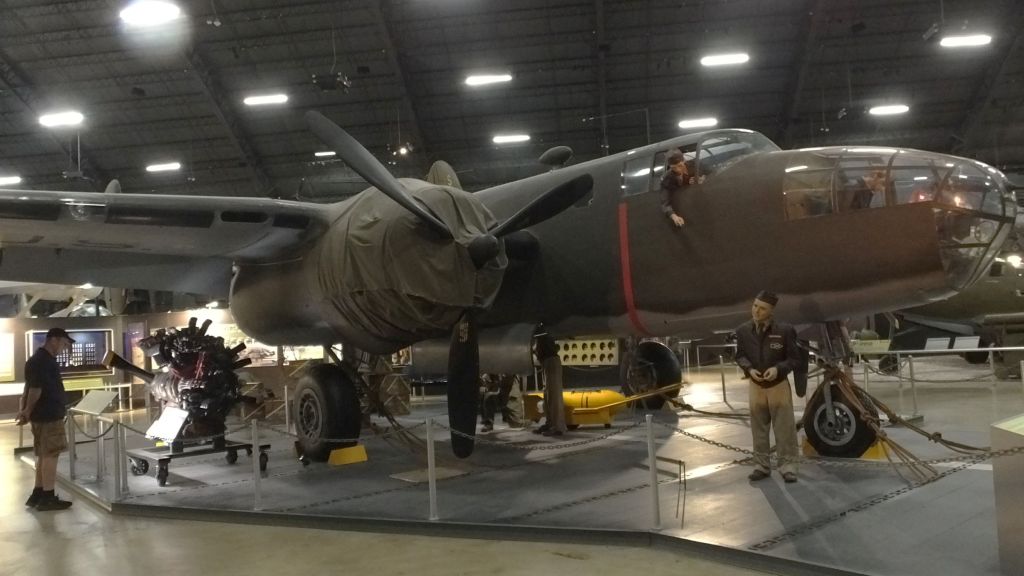
WWII bombers including the B-17 Memphis Belle and a B-25 Mitchell
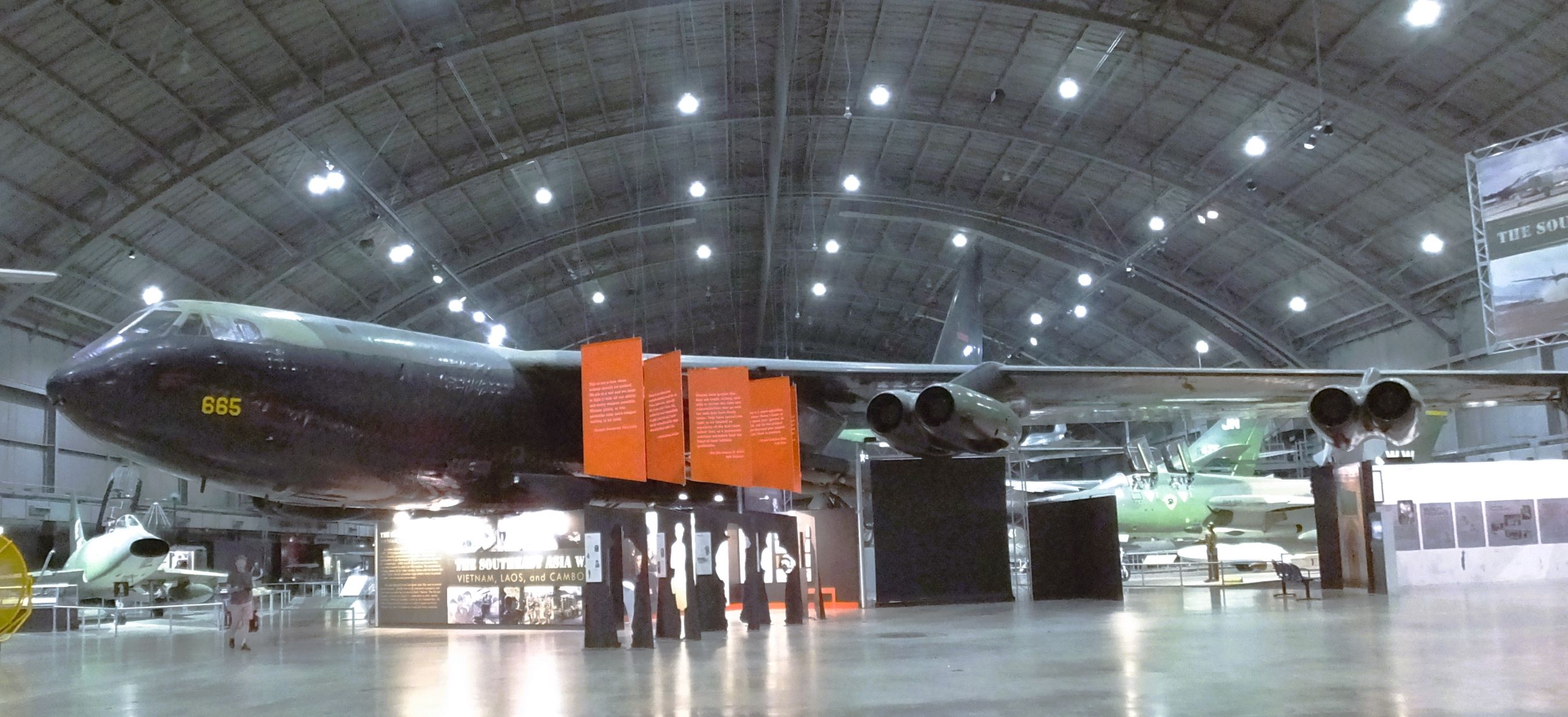
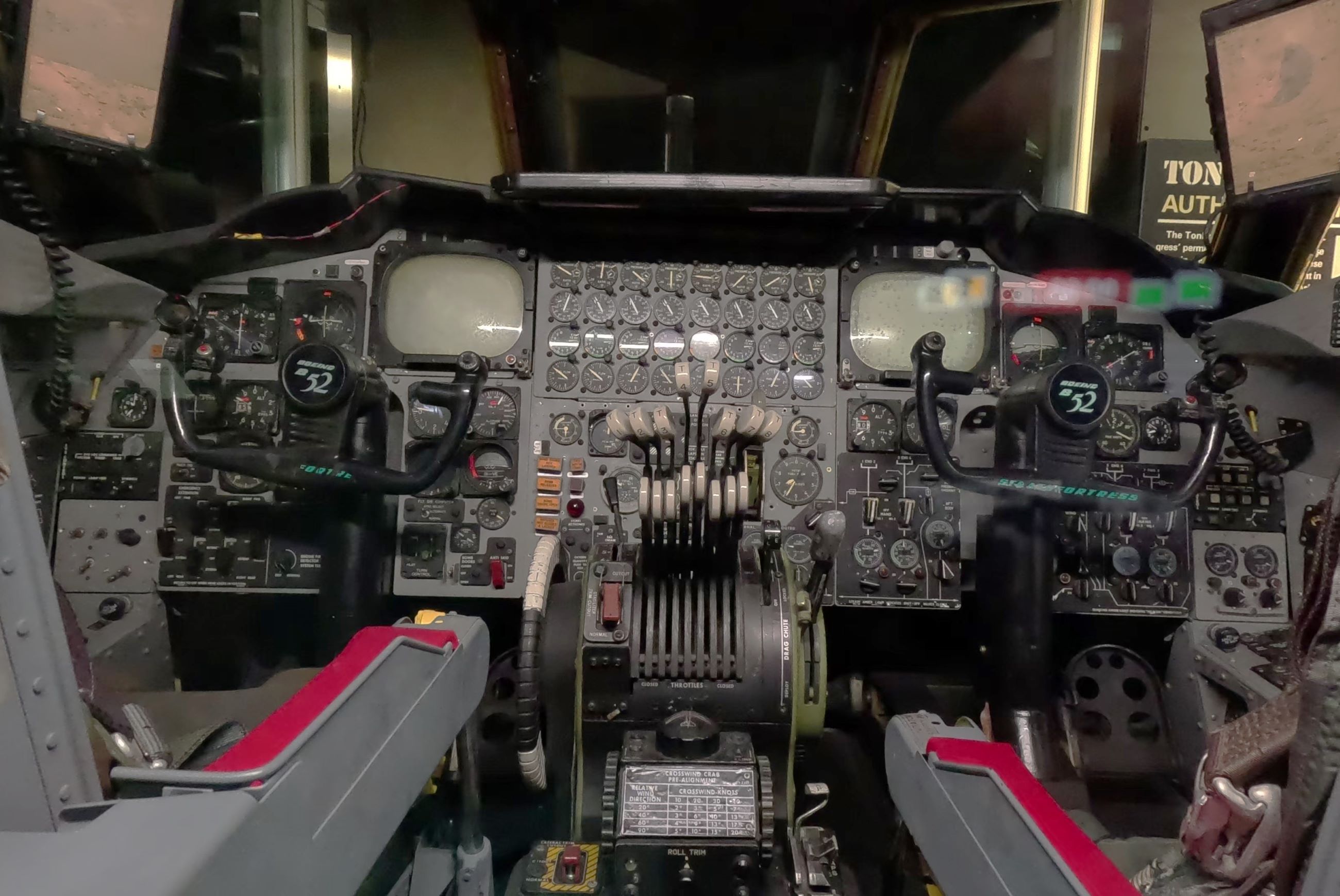
For more than 60 years, the B-52 Stratofortress has been the backbone of the US strategic bomber force; a B-52 cockpit is filled with levers and instruments
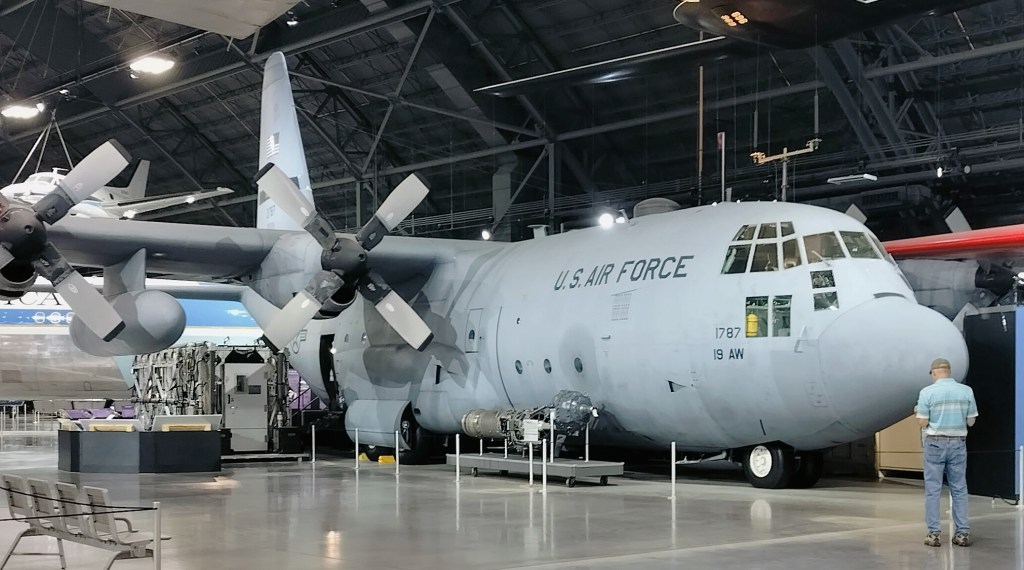
The C-130 Hercules is a medium-sized multi-role transport aircraft that supports military operations world-wide; Josh, our son-in-law, and James, Pat’s brother, worked on these aircraft at Warner-Robins AFB in GeorgiaA 1960s prototype of the supersonic XB-70 Valkyrie; B1 and B2 stealth aircraft are also on display
The museum includes displays of an assortment of Air Force missiles and rockets
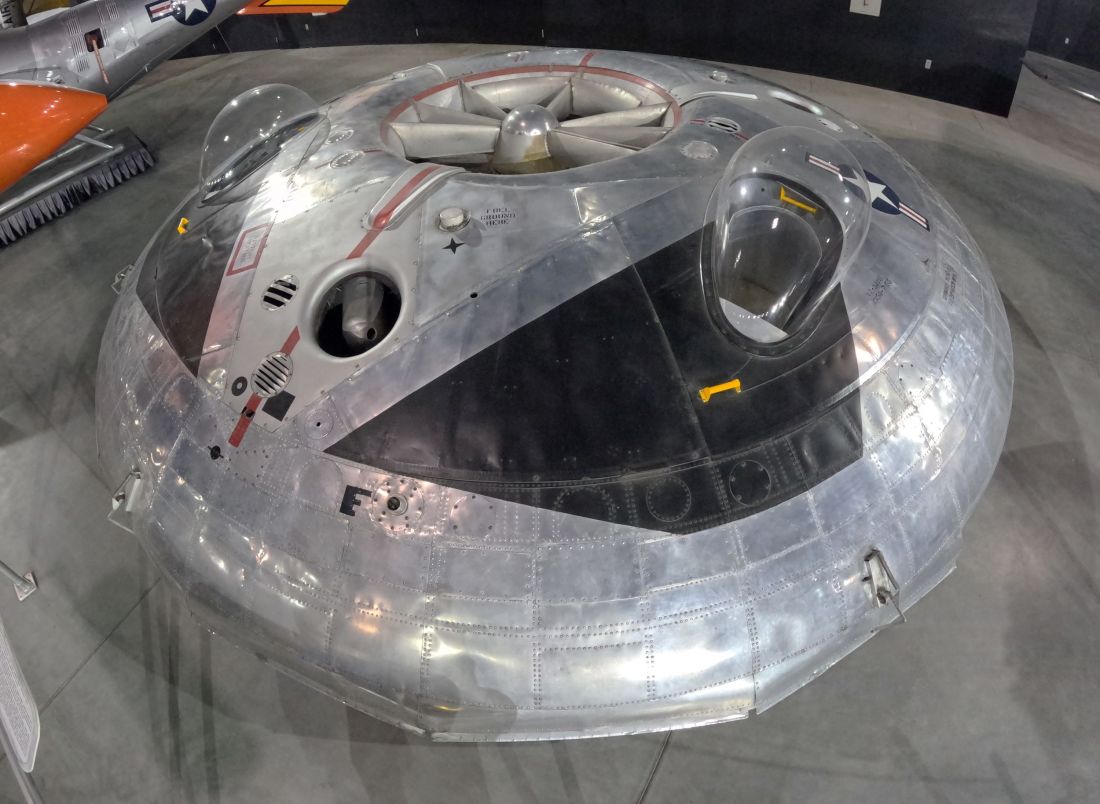
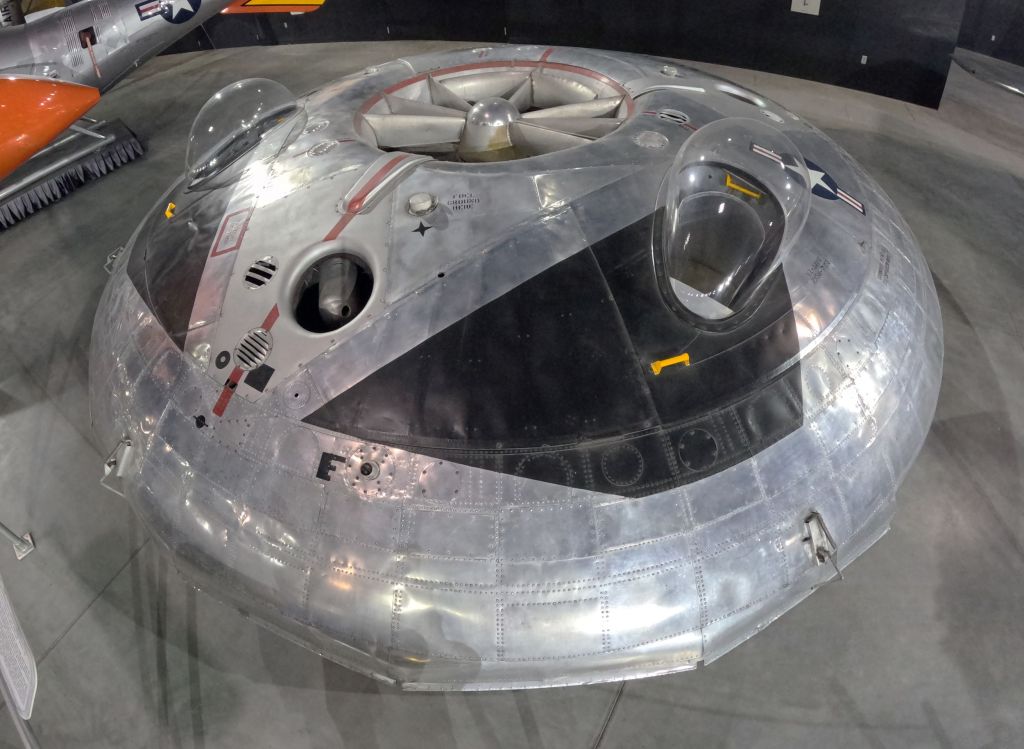
The museum included a 1950s prototype VZ-9AV Avrocar; it resembled ‘flying saucers’ from movies of that time period
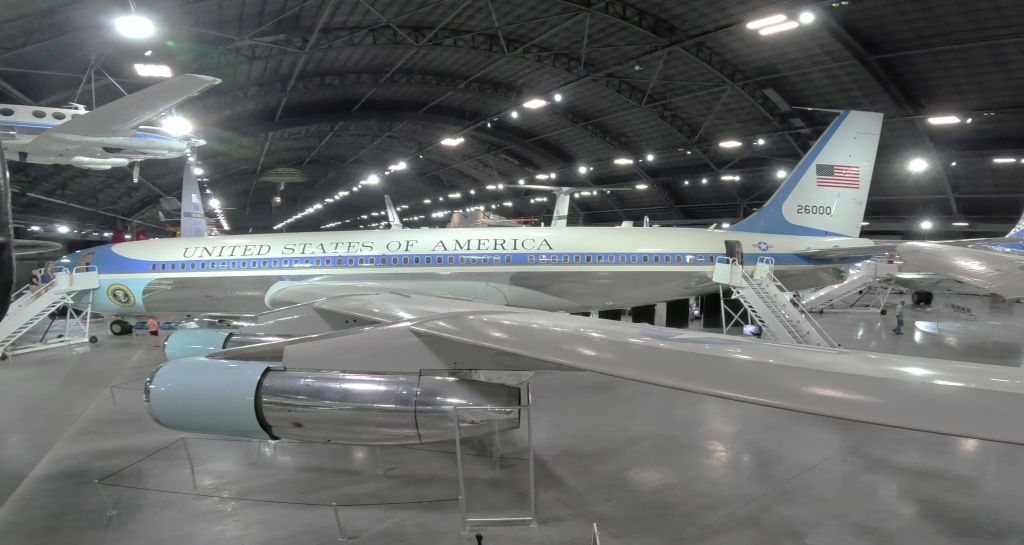
Several airplanes used by US presidents were on display, including the customized Boeing 707 that was in service when Lyndon Johnson was sworn into office following the assassination of President John F. Kennedy on November 22, 1963.
SAM26000, the customized Boeing 707 used by several US Presidents, was in service thru 1990
Next Week
We spend our second week on staff at Cedarbrook Camp of Ohio, about an hour east of Cleveland.
















 Take the LONG Road...