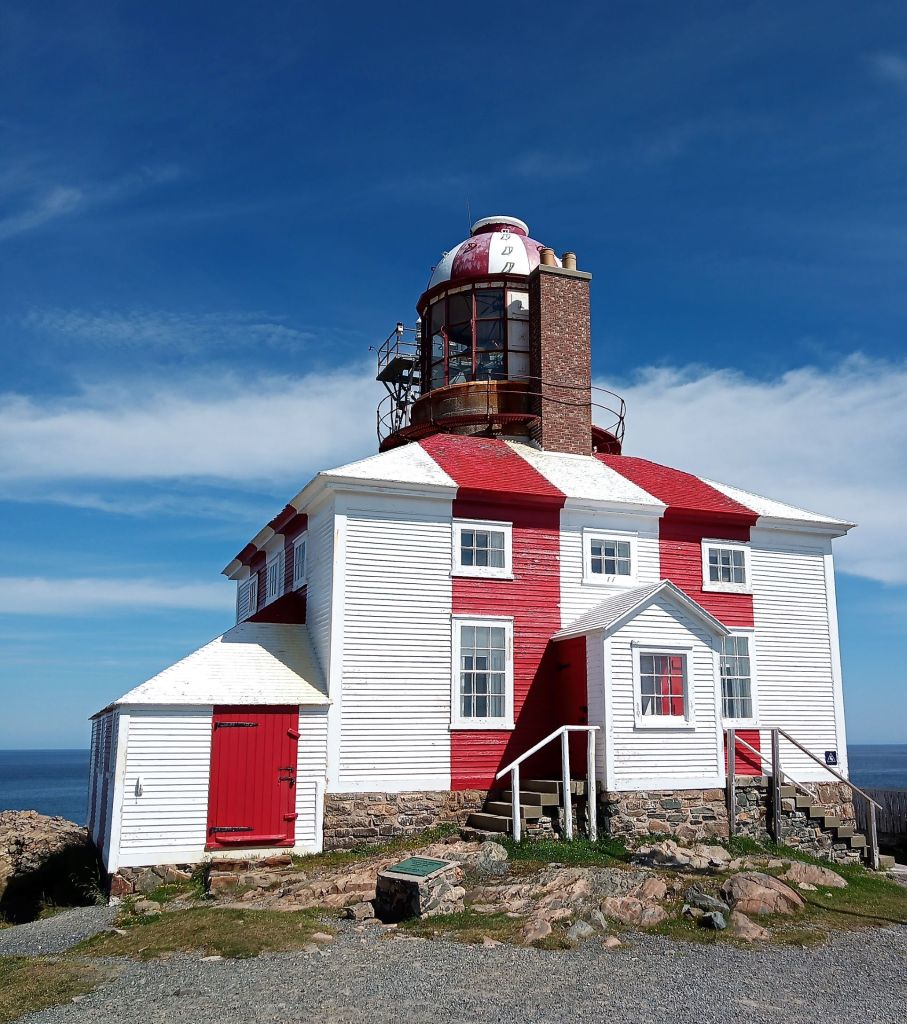
We Took the Long LONG ROAD

(2022 Newfoundland Ep 12)
As the end of August neared, we could tell the NF weather was about to change.  Days were becoming shorter, nights were getting cooler and we were having to wear sweatshirts and long pants more and more.

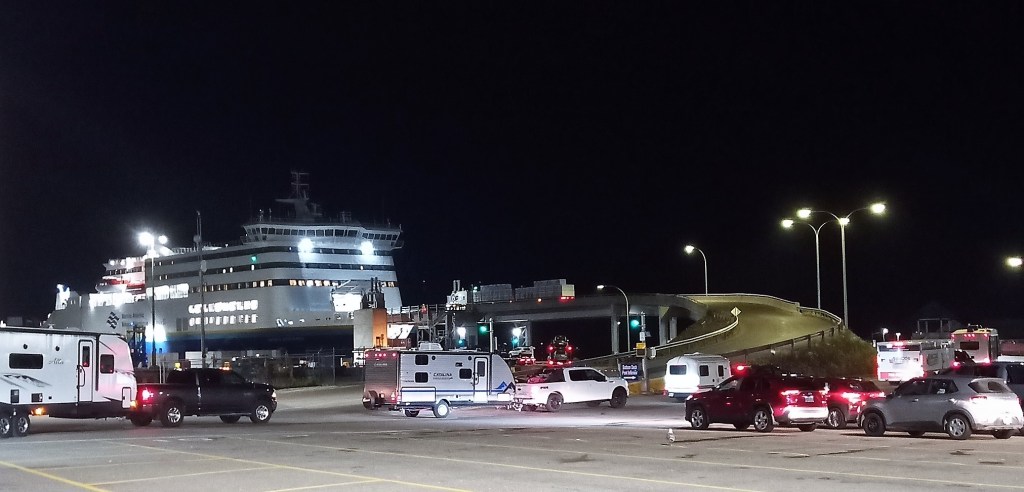
It was time to start back toward Port aux Basques for the ferry ride to Nova Scotia.

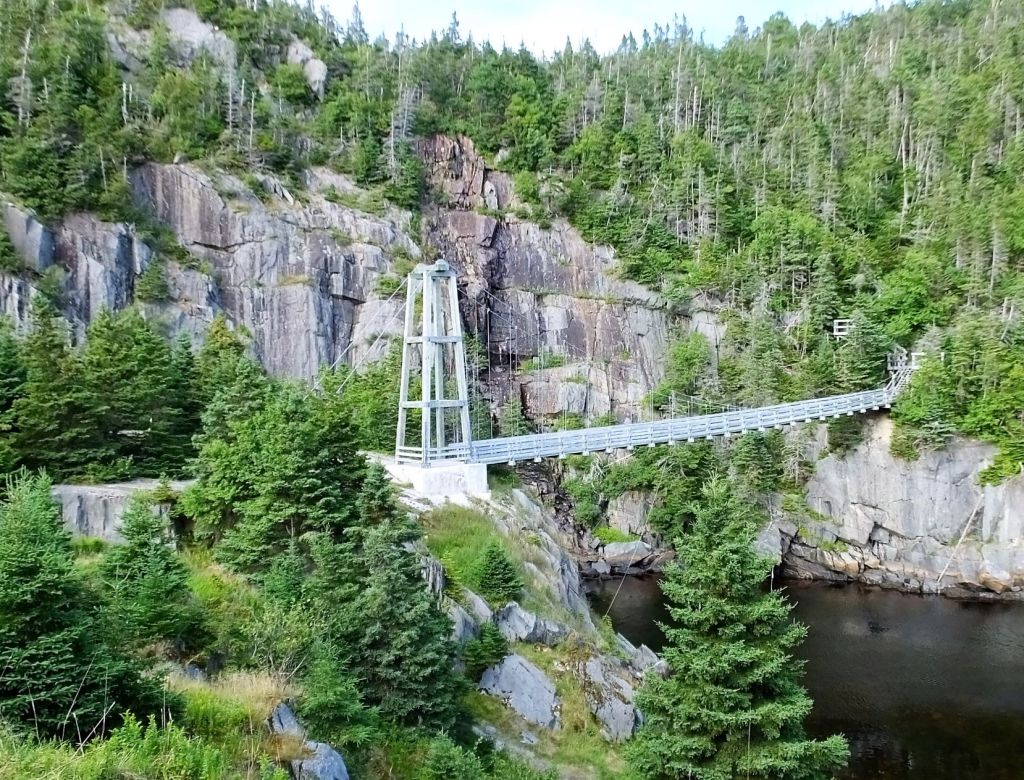
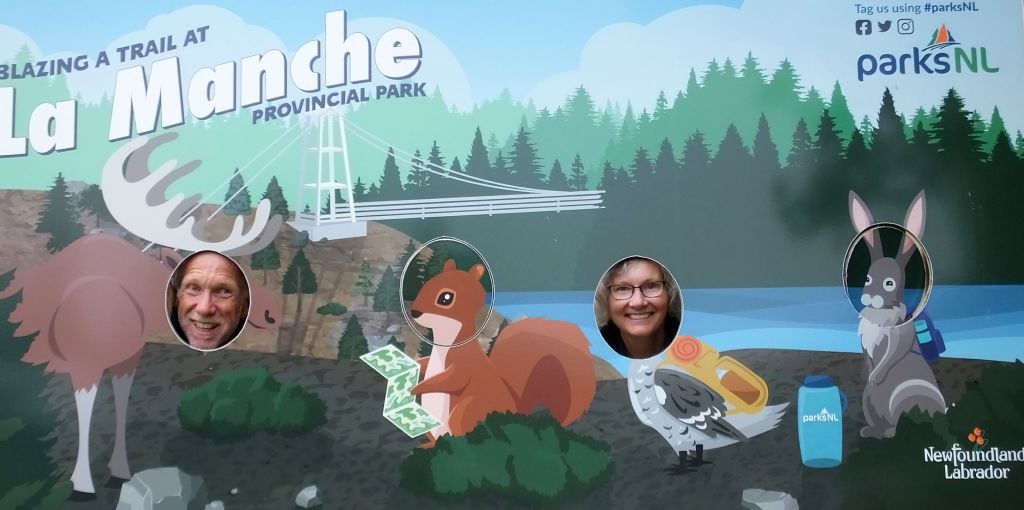
From St Johns we drove south on the Avalon Peninsula to La Manche Provincial Park. The park is named for a nearby fishing village that was abandoned following a severe winter storm in January 1966.   Most of the remote town was washed away including a suspension bridge that connected both sides of the harbor.
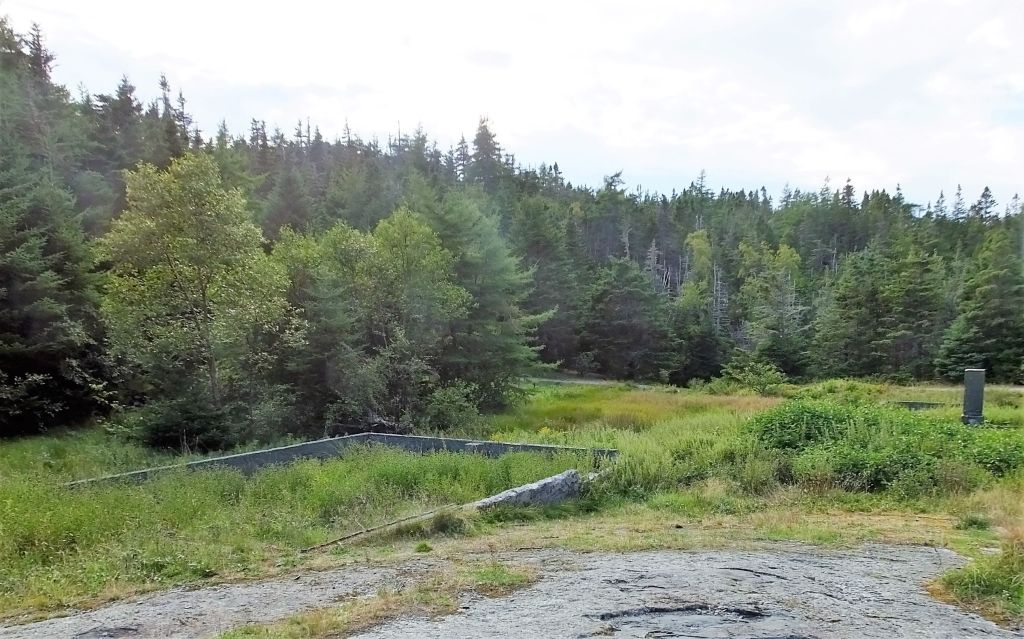
La Manche ruins
New La Manche suspension bridge

We decided to visit the new bridge built by the East Coast Trail Association in 1999.   According to NF hiking time given to us by a park ranger, it was 20 minutes up a steep fire road to where the trail started and another 20 minutes down a rocky, moderately steep trail to the bridge and La Manche village ruins.  Actual hiking time was more than double that!
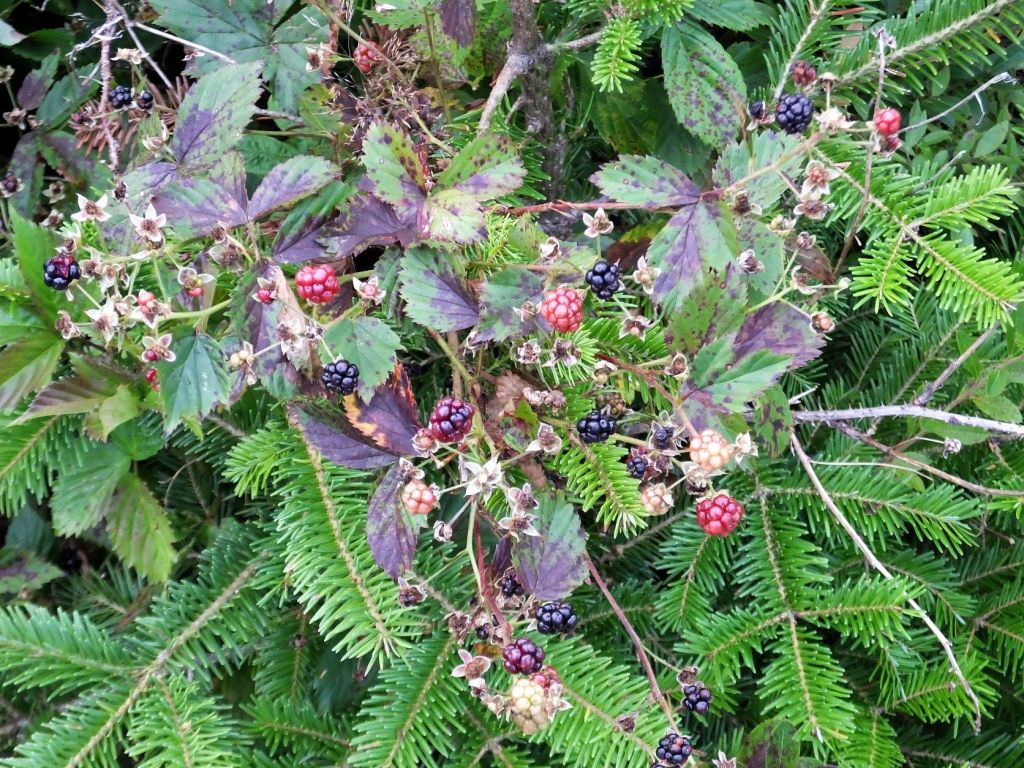
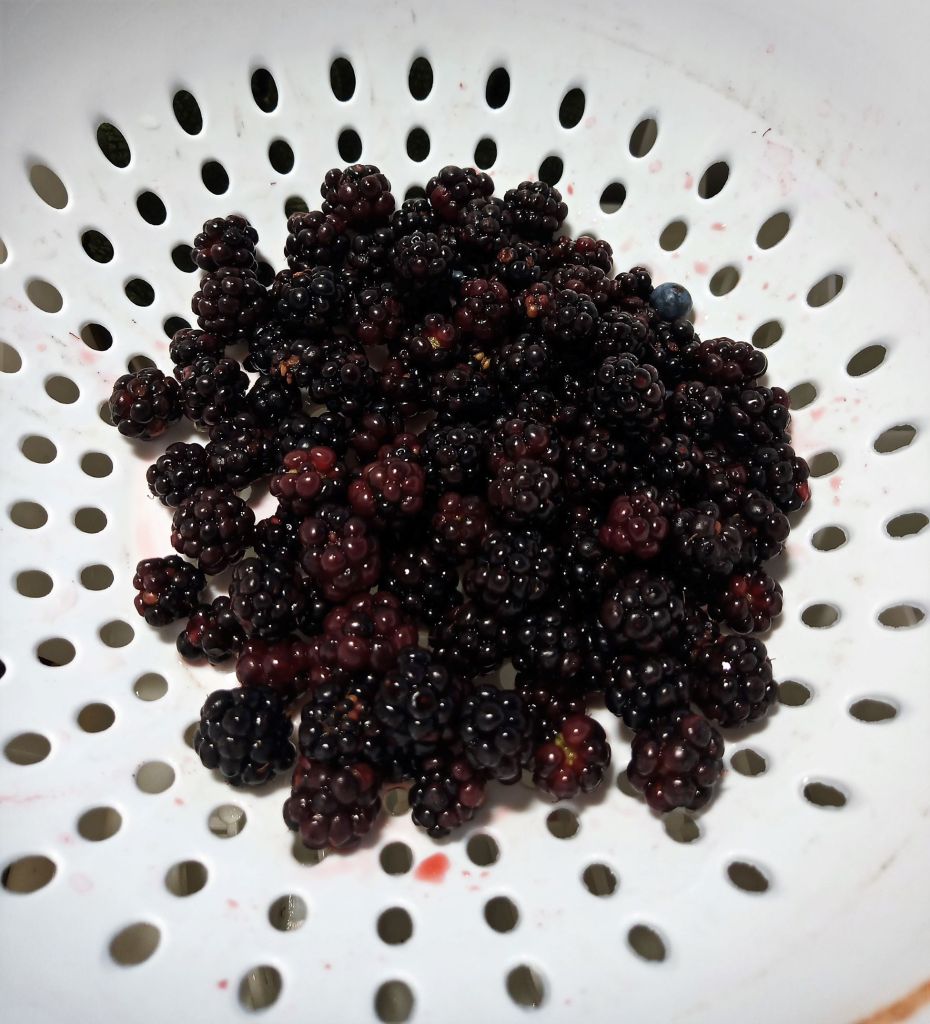
We hiked the fire road and met Marsha Tulk, who was picking blackberries.  Marsha is the coauthor of “Food, Culture, Place: Stories, Traditions and Recipes of Newfoundland.”  We wondered about what her plans were for the berries, and when we stopped to do our own berry picking as we returned to the campground, she was gone. Maybe we’ll find out in her next book!
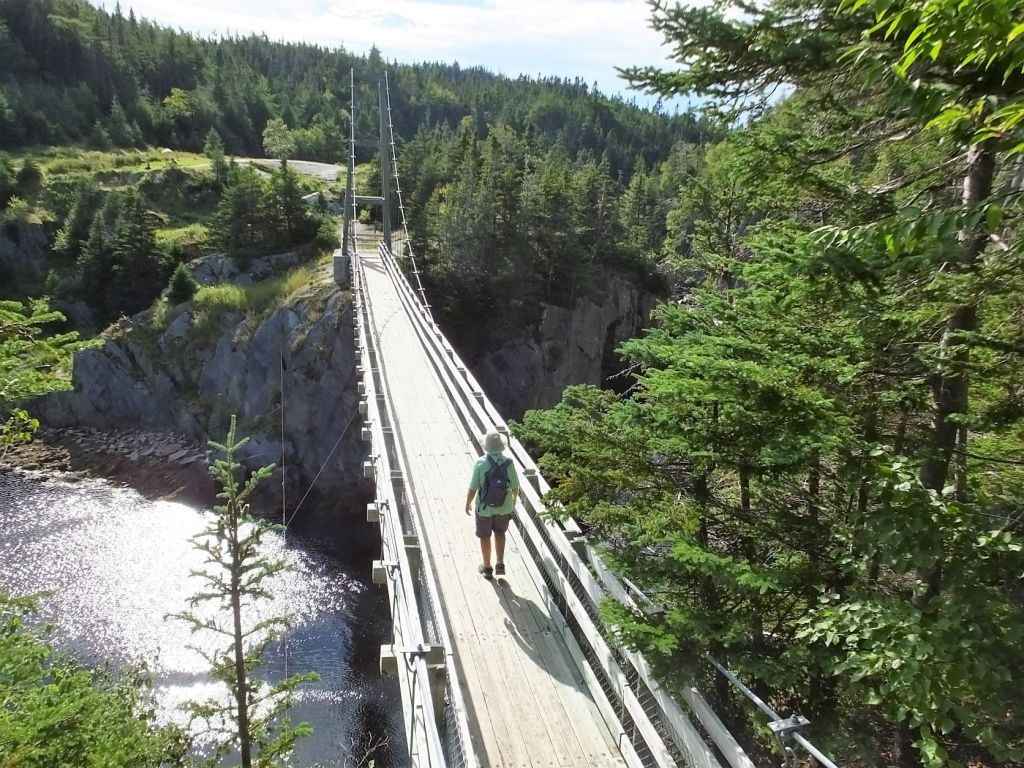
The suspension bridge was an unexpected sight on the narrow, steep-sided harbor.  “La Manche” means “the sleeve” in French and seems to be a fitting name for the town.
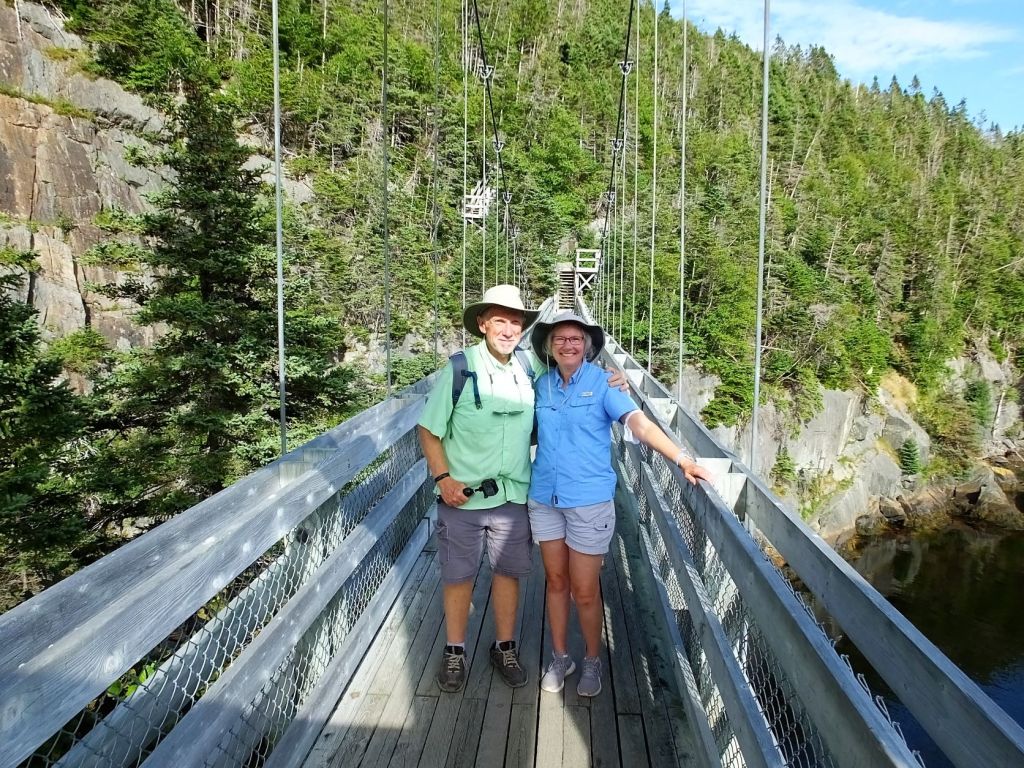
Together on the La Manche suspension bridge

The next day, as we drove a few miles south of La Manche, we stopped at Best Friends Restaurant and Giftshop.  The owner recommended visiting Ferryland Lighthouse and enjoying the food and view from the Million Dollar View Restaurant nearby.  (tip – ask locals about the best sights and places to eat) 
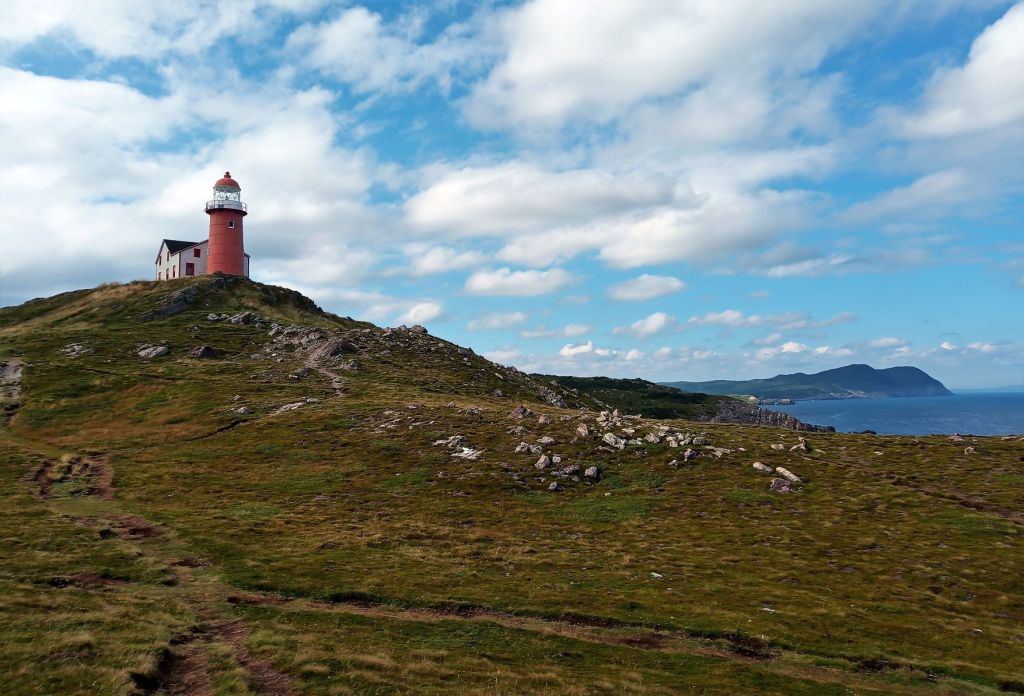
Ferryland Lighthouse

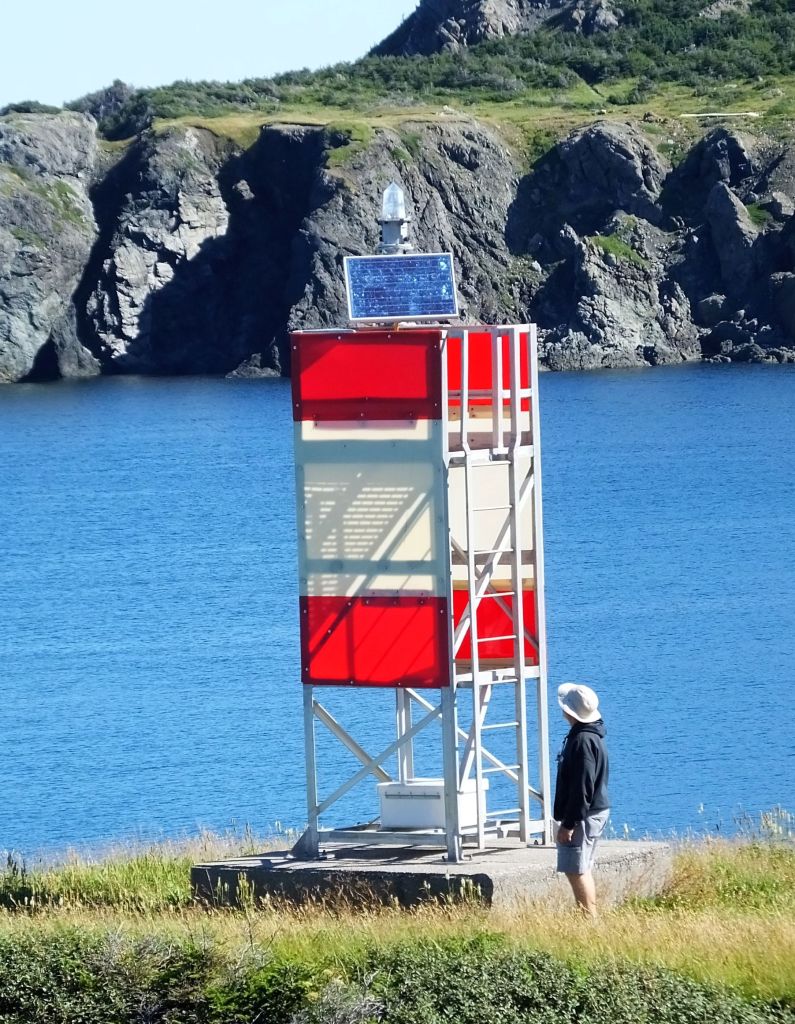
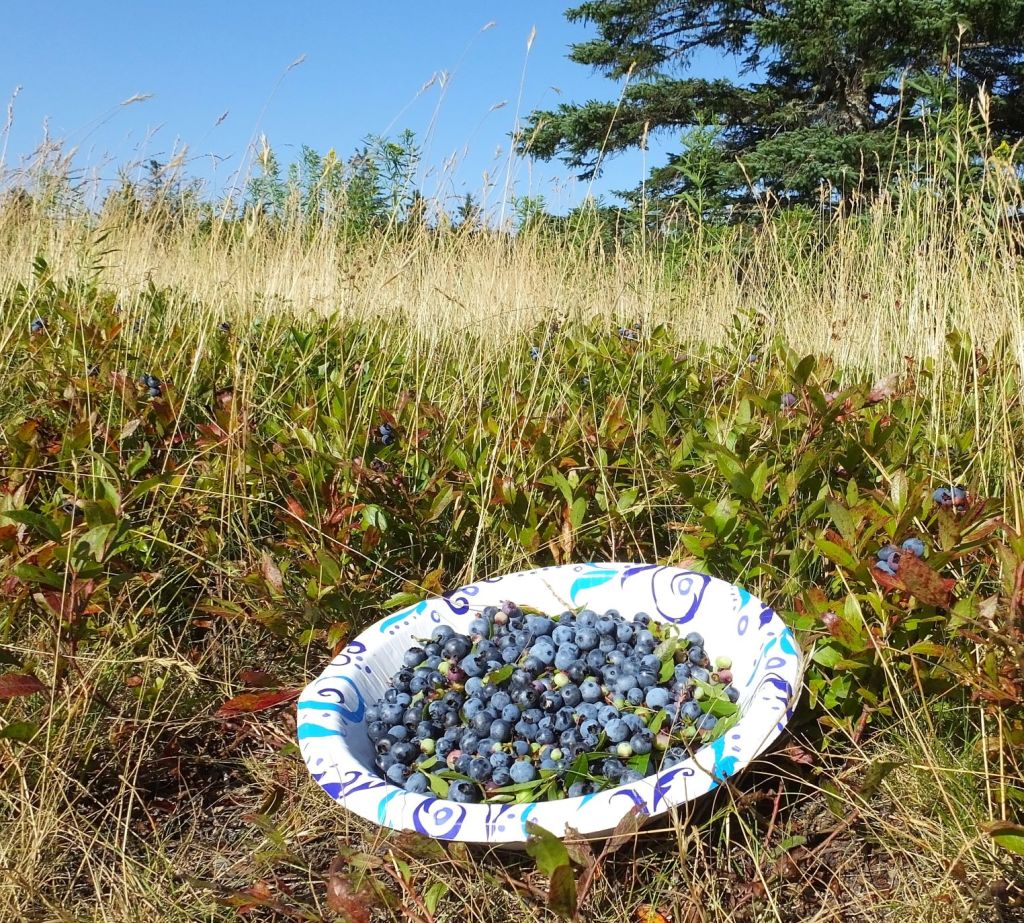
We hiked across a narrow causeway to the island location of the lighthouse.  Like many other NF lighthouses, the rugged coastline view was breathtaking.  As we returned to the parking lot, we found bushes loaded with blueberries and picked nearly a quart of berries in just a few minutes.  At the causeway, thick fog was rolling in. It was a good time to be leaving.
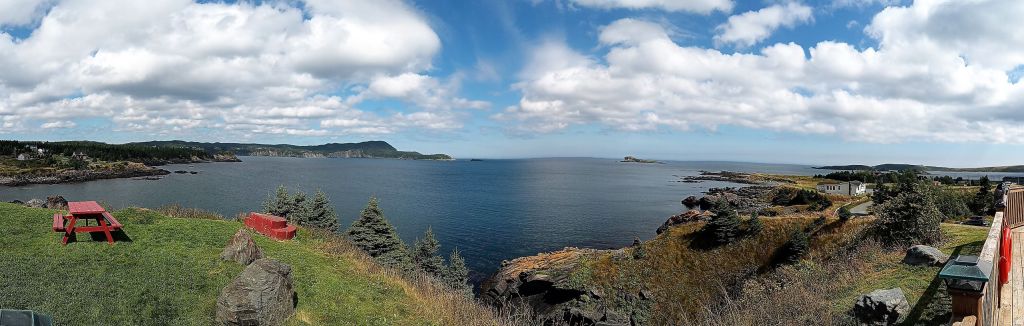
Million Dollar View

We stopped for dinner and to check out the view at the Million Dollar View Restaurant.  It was worth every Loonie!
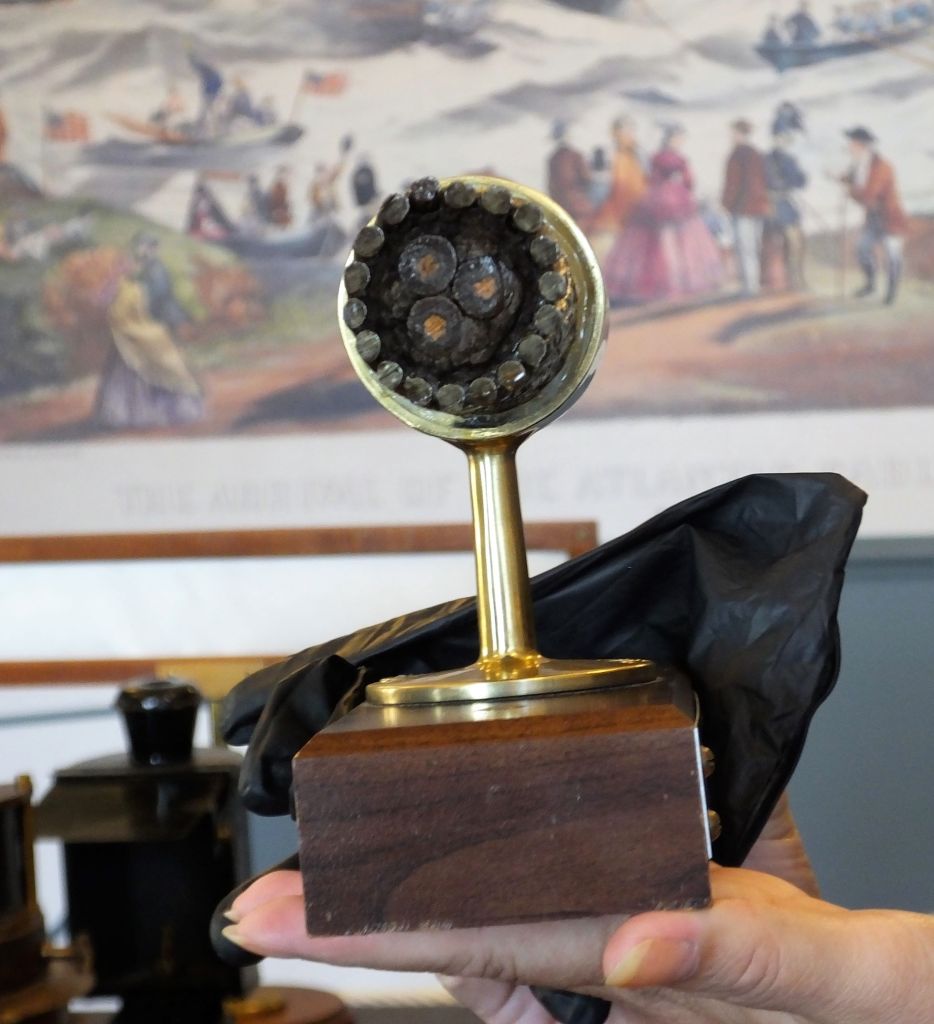
Cross section of transatlantic cable

The next day, we began the drive back across NF and camped near Greens Harbor for several nights.  We found a most unexpected RabbiTRAIL nearby:  in the town of Heart’s Content the first transatlantic telegraph cable linking Europe and North America was landed in 1866.  A portion of the Cable Station Provincial Historic Park is a small museum with information about the communications cable.  Most of the building houses the original electric equipment used to operate the cable.  Several large control rooms are full of components in remarkable condition!
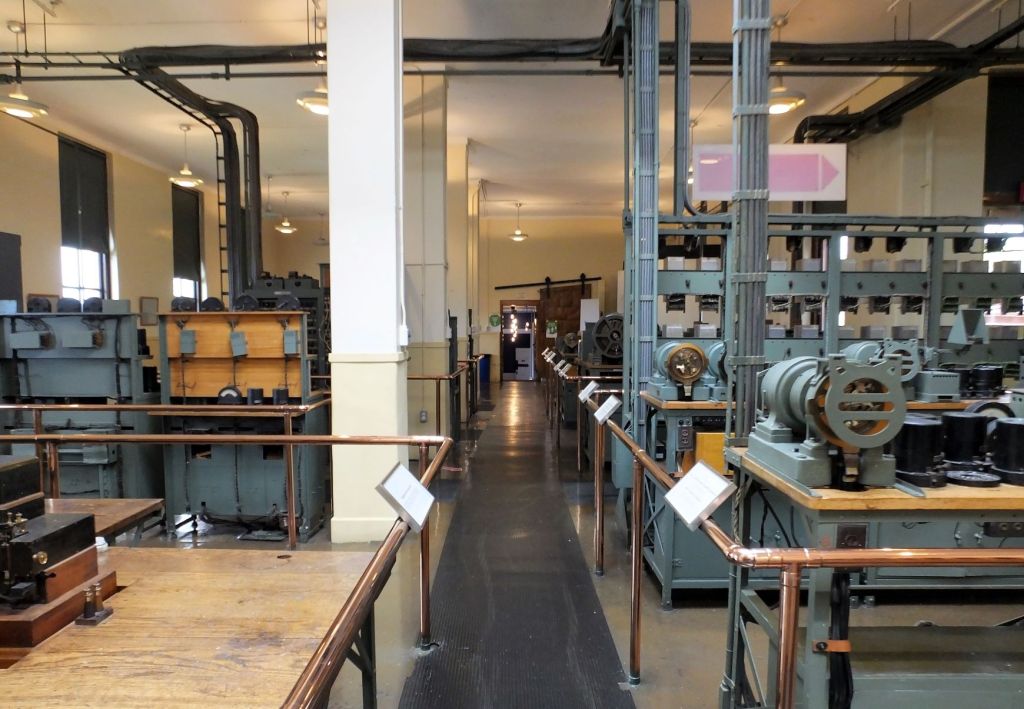
One of the transatlantic cable control rooms

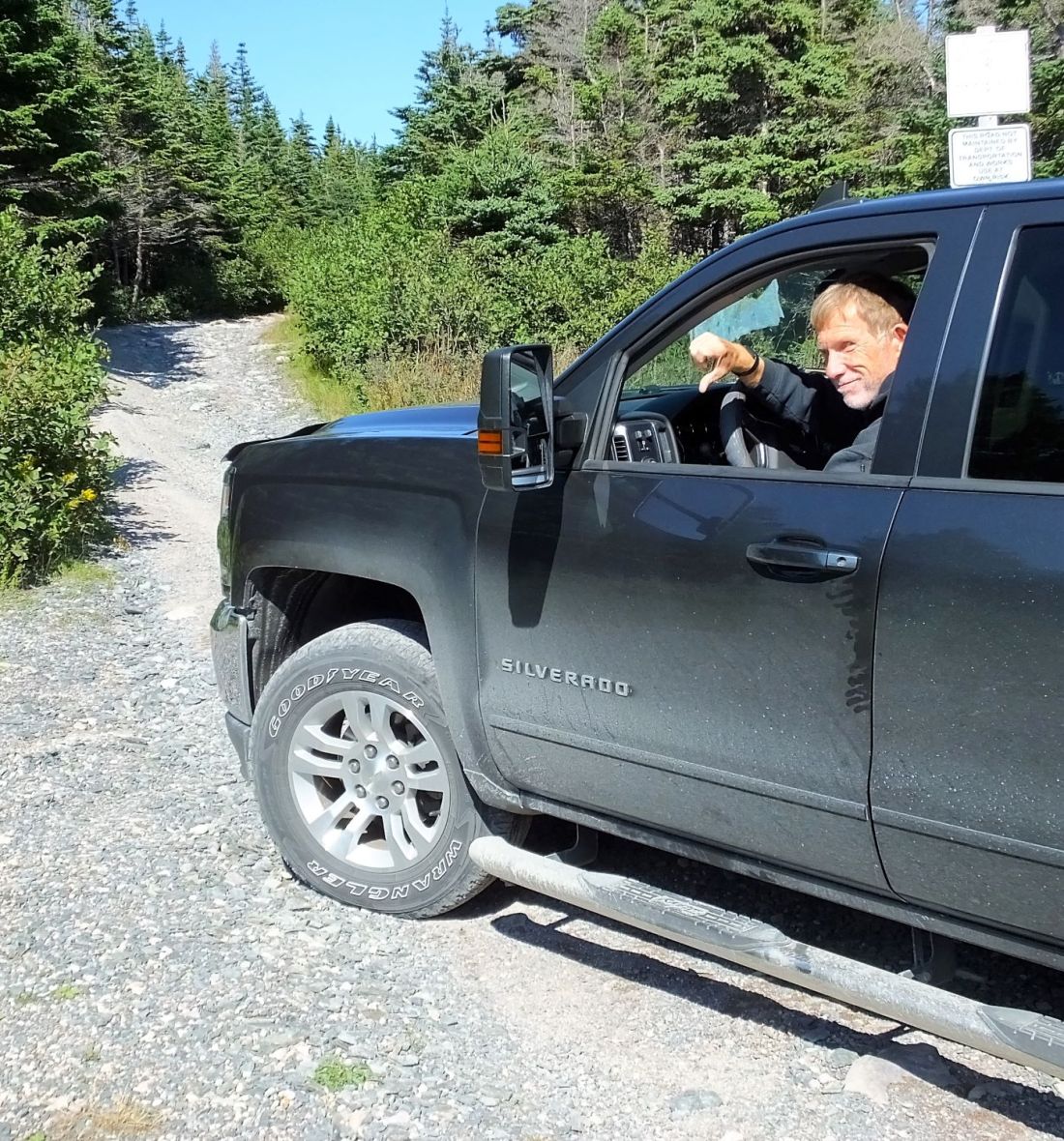
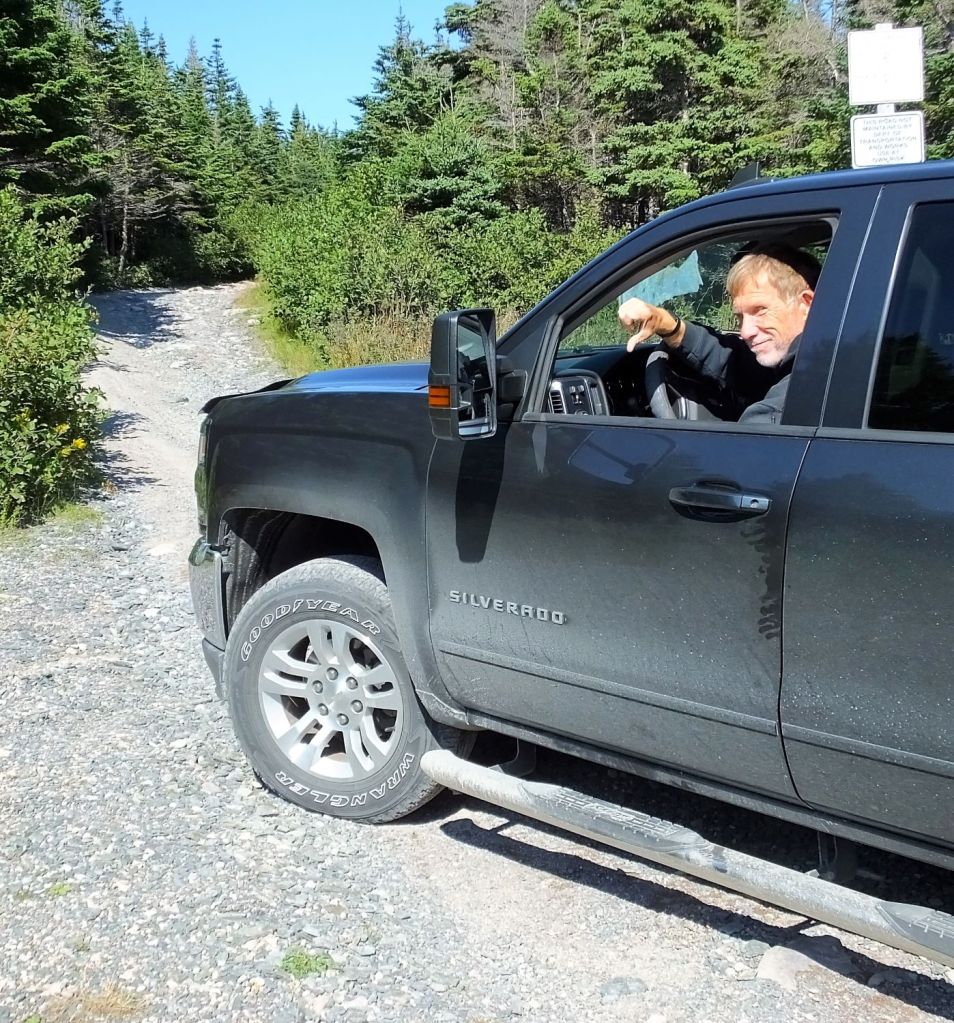
When we continued, we decided to take an unimproved (e.g. dirt) road along the western coast of the peninsula and a paved highway back along the eastern coast.  After several miles of dusty and somewhat bumpy roads, a road sign warned “This Road Not Maintained by Department of Transportation and Works.  Use at Own Risk.”  The road ahead resembled a goat path, with deep ruts and rocks.  Based on two VERY stressful experiences driving on four-wheel drive roads in Utah in 2021 (where Max’s step rails were bent), we decided not to follow this NF RabbiTRAIL!
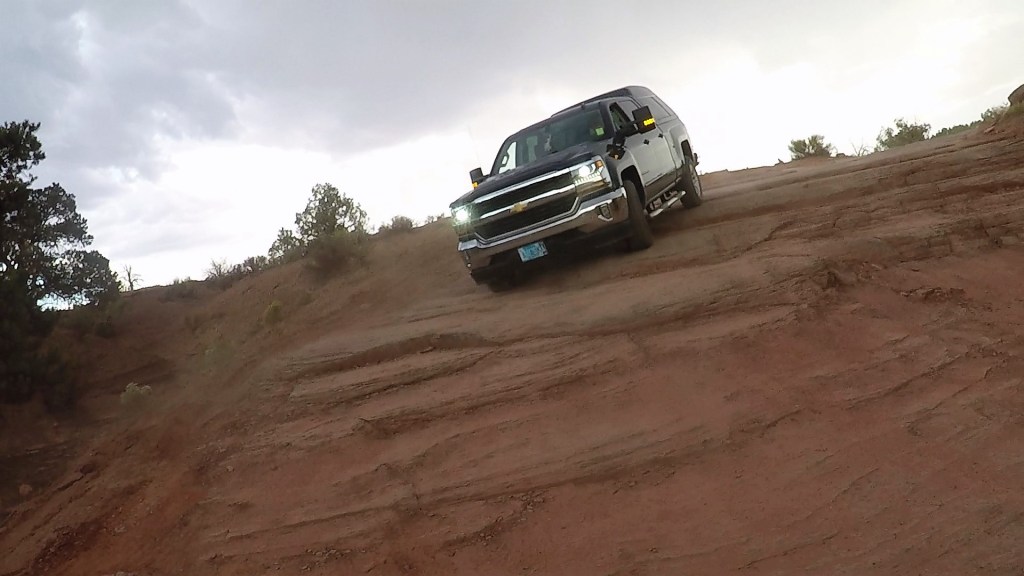
Stressful four-wheeling with Max – Canyonlands NP Sept 2021
Thumbs down on this RabbiTRAIL – a wise choice in 2022!

We backtracked to the paved highway and drove the long road to the tip of the peninsula.  We were intrigued by stone walls that marked off historical sustenance gardens in the small fishing village of Grates Cove.  We drove through the town but did not see the walls.  At a small park on the edge of town we found a trail up a hillside to an overlook.   From that vantagepoint we saw the walls!
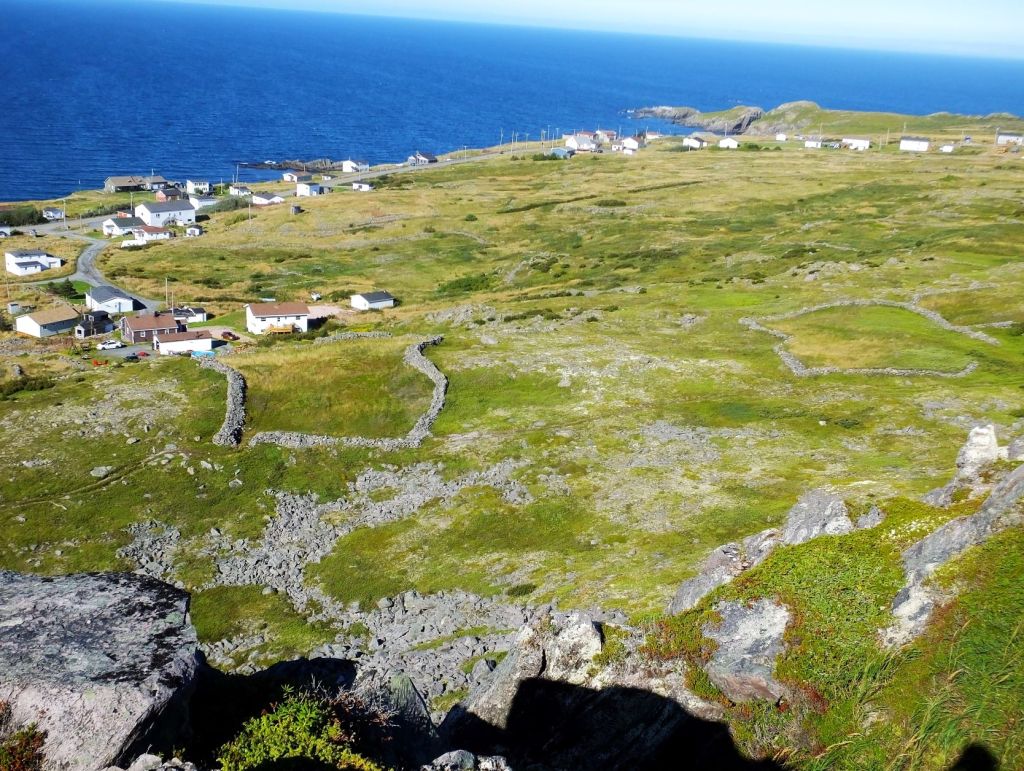
Stone walls at Grates Cove

A pod of porpoises (at least 5)
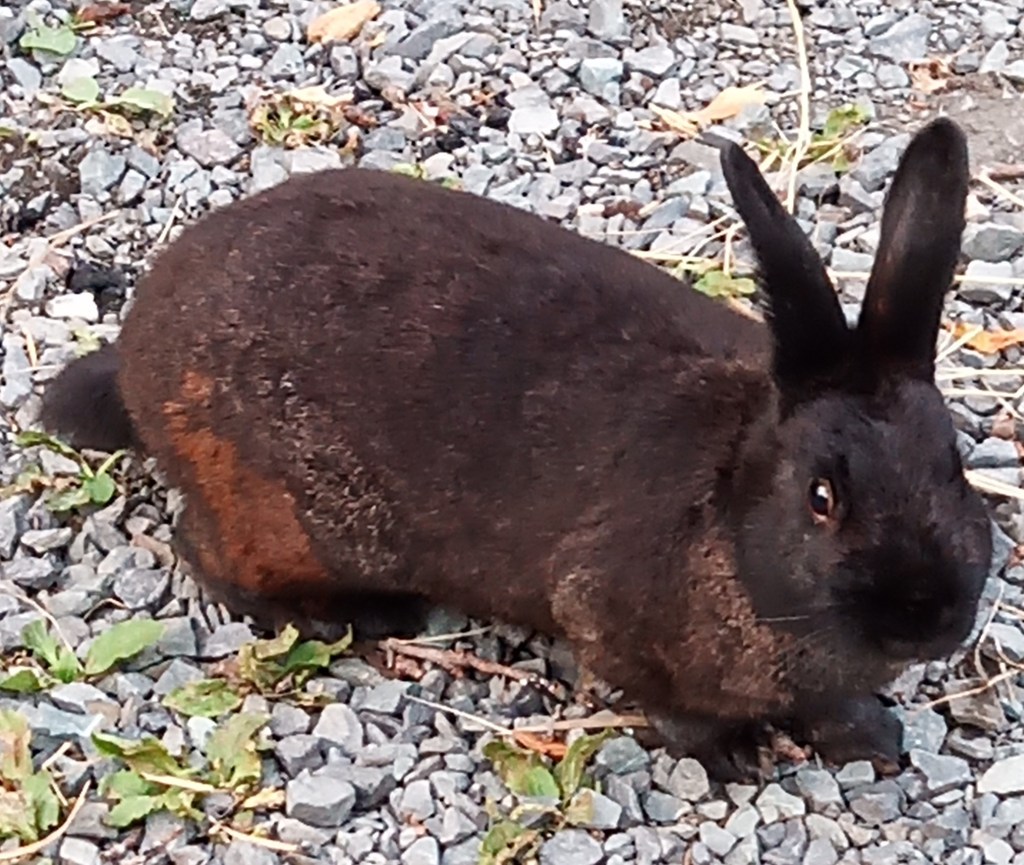
Two black rabbits
Next week:  A 9-11 Story and We Leave the Island Again
St John’s: City Sights and Sunrises

(2022 Newfoundland Ep 11)

(Last week’s special blog post was about our challenges dodging Fiona.  This week, we are praying for family, friends and the many persons in Florida and the Carolinas affected by Hurricane Ian) 

We return now to blog time and our arrival at St John’s, NF.

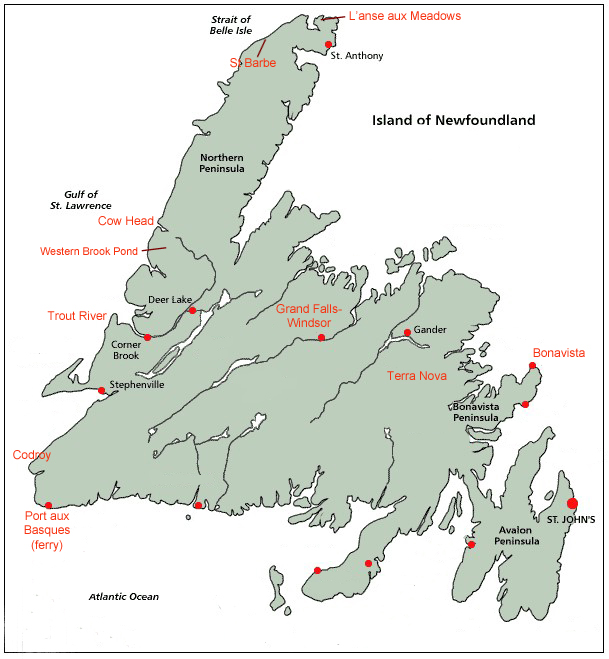
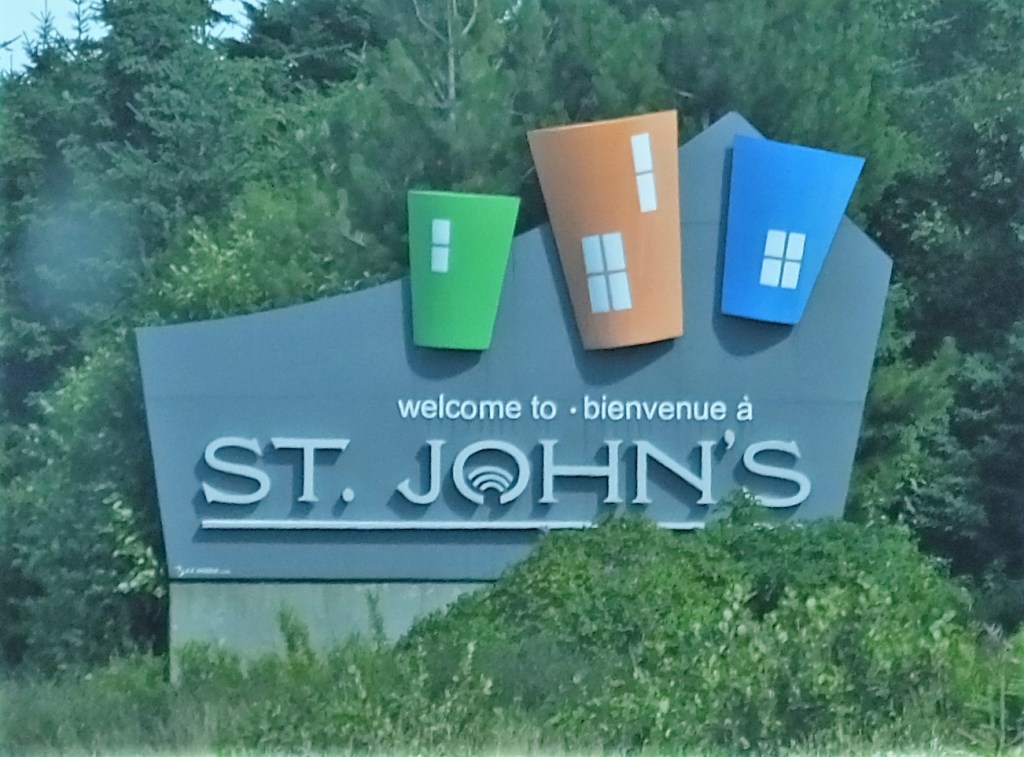
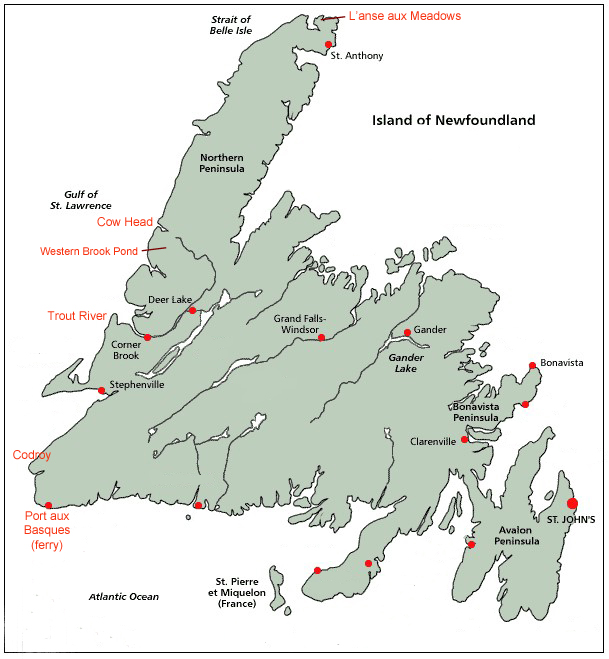
We arrived at St John’s (right side of map above) more than three weeks and 2000 miles after coming to Port aux Basques.  Despite having only 115,000 residents, St John’s feels like a BIG CITY.  There are lots of stores, a few high-rise buildings, and busy highways.  Downtown St John’s was especially crowded because of two large cruise ships that were docked for the weekend.

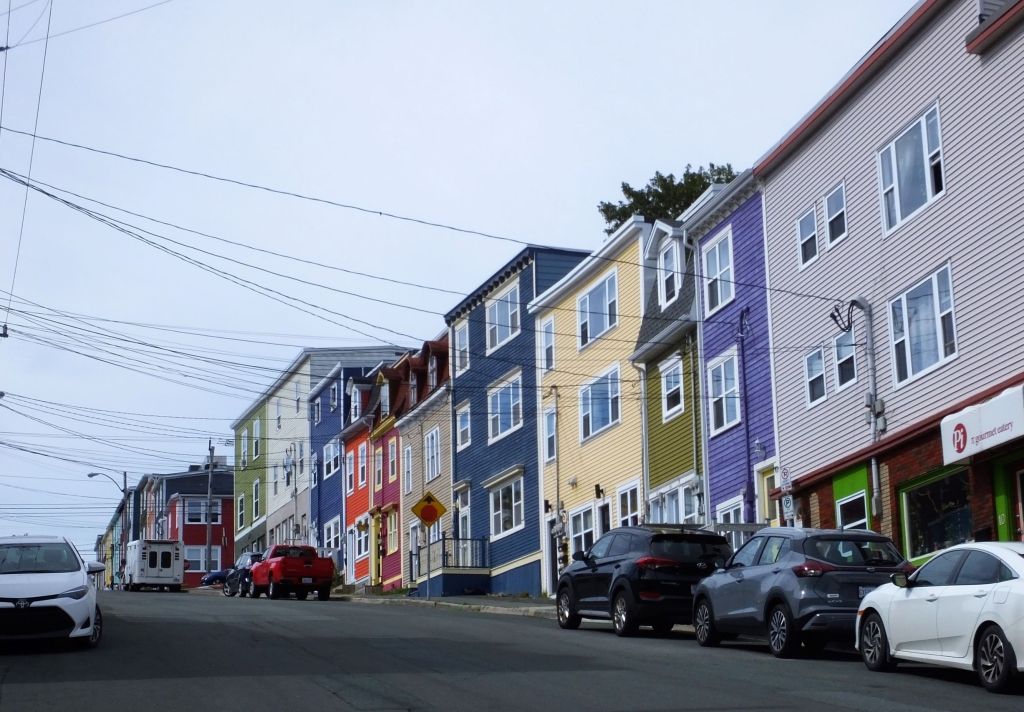
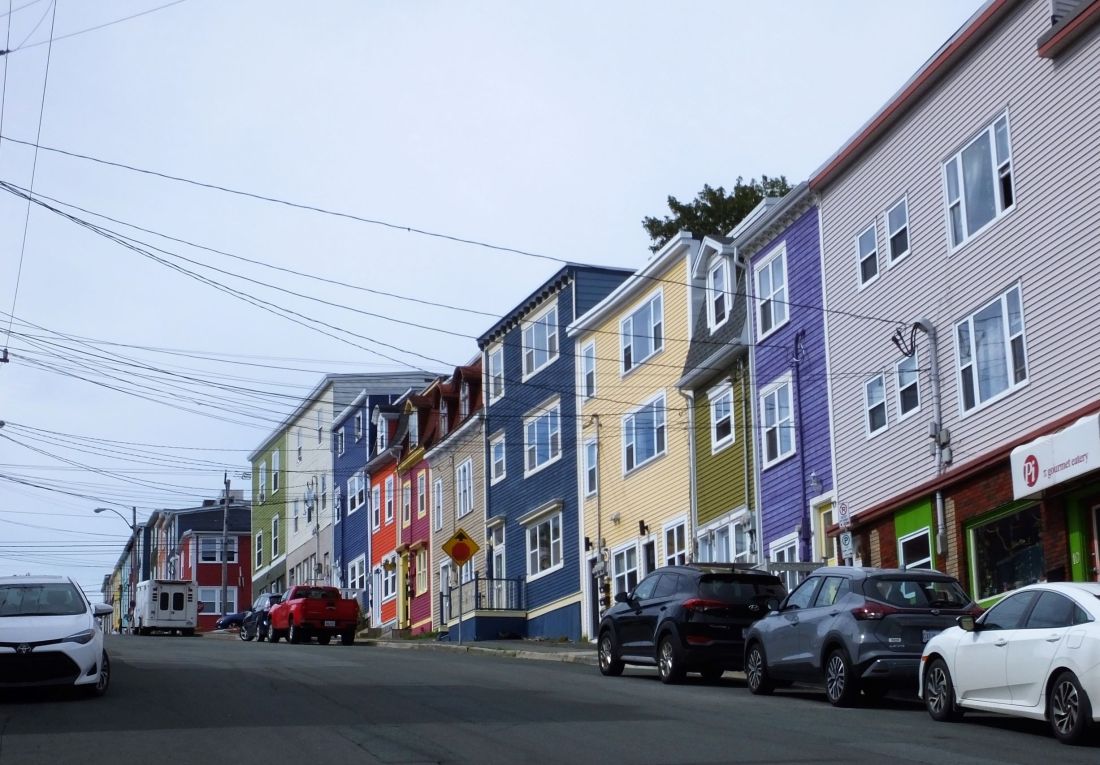
St John’s is very hilly.  Colorful townhouse-style residences line many of the narrow downtown streets – these streets are often described as ‘jellybean rows.’

An uphill ‘jellybean row’

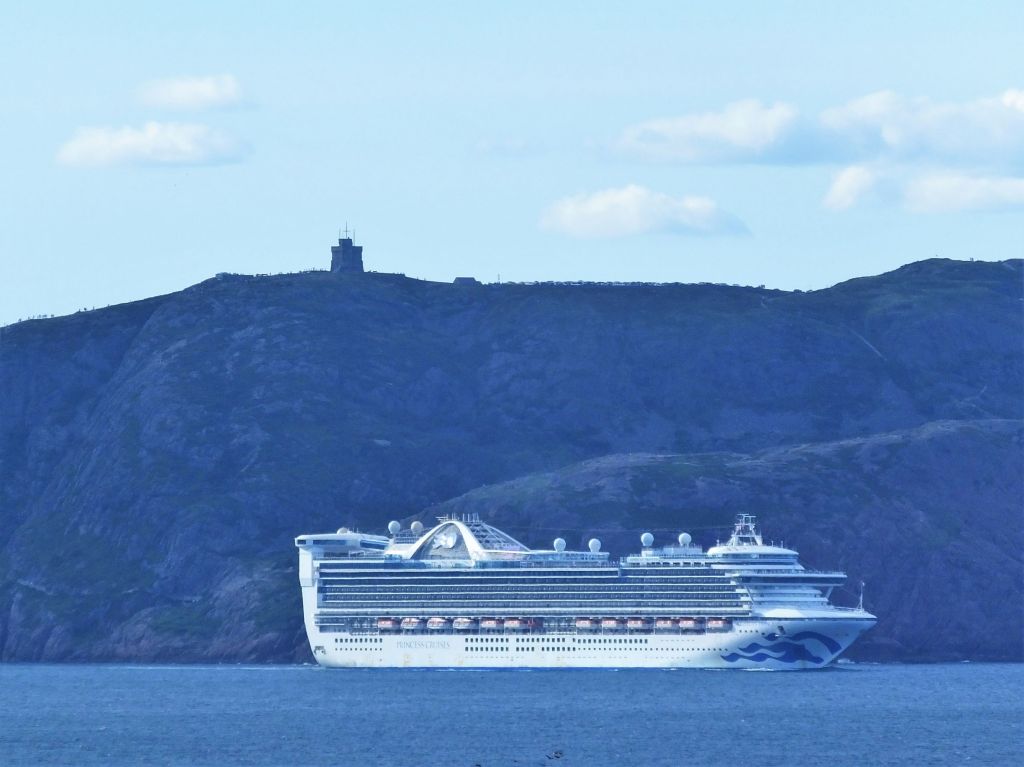
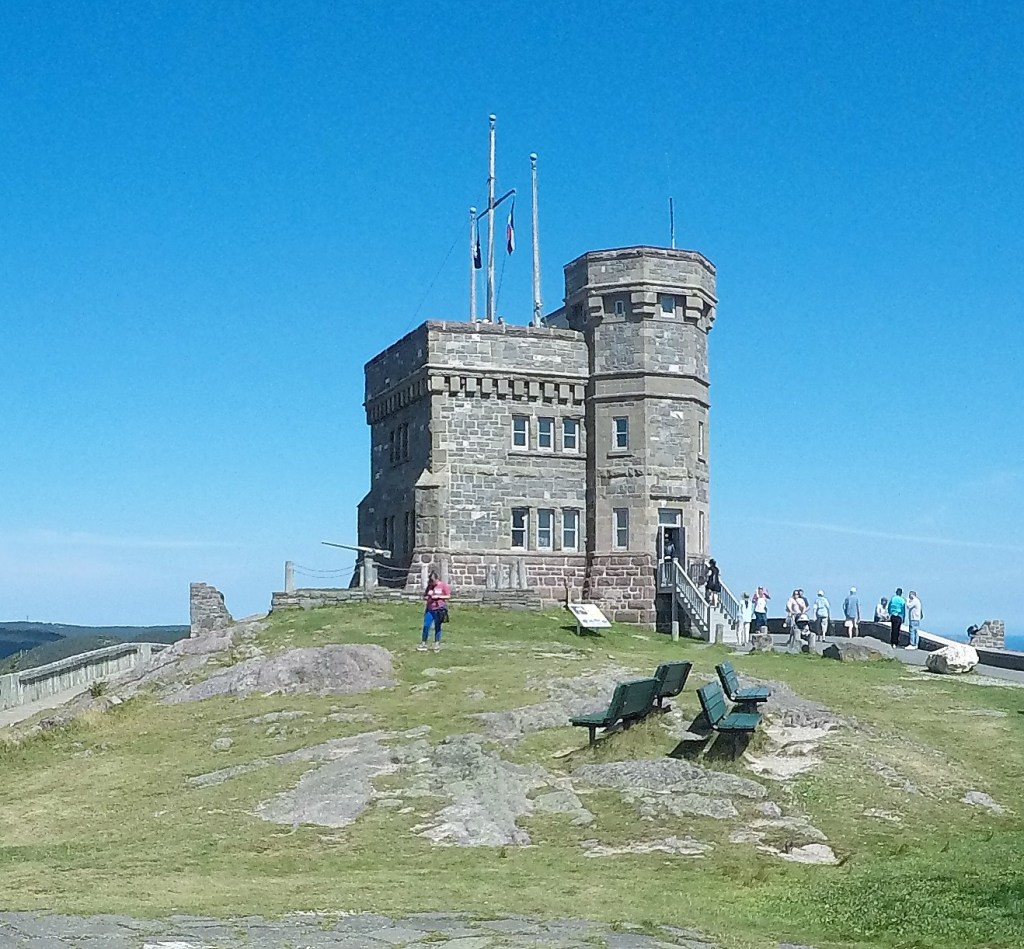
A couple miles to the east, Signal Hill overlooks the city, and 50 foot Cabot Tower sits atop the hill.  The tower was built around the turn of the 20th century to commemorate the 400th anniversary of the discovery of NF by Italian explorer John Cabot. 

A cruise ship leaves St John’s with Signal Hill and Cabot Tower above
Cabot Tower
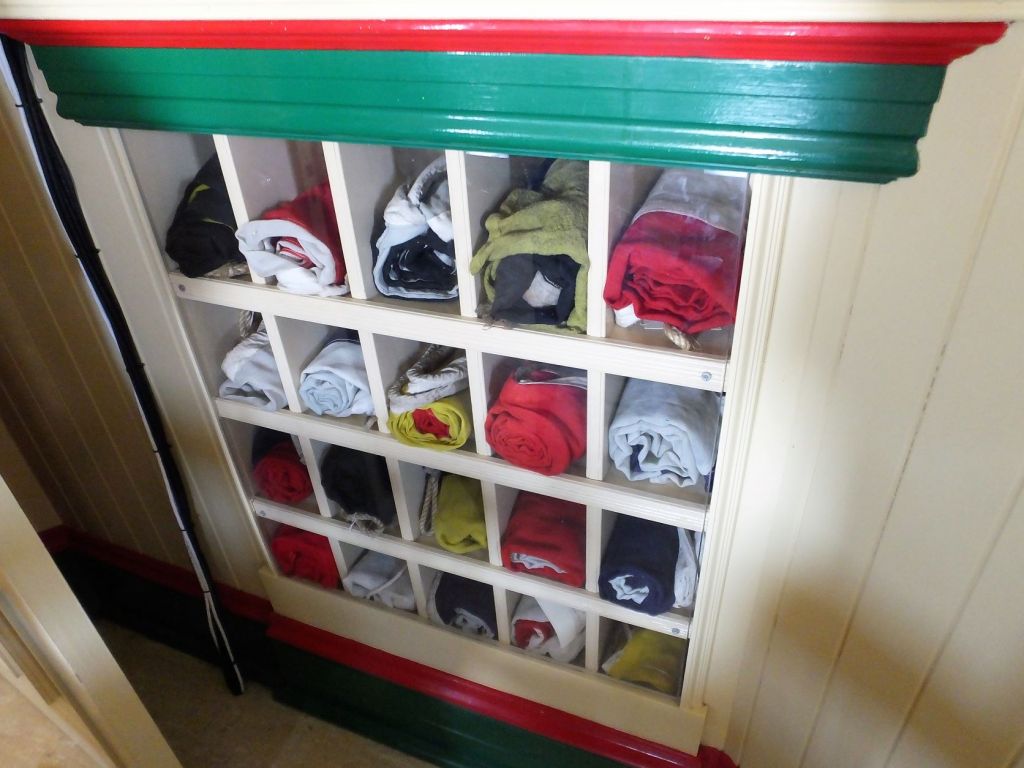
Cabot Tower signal flags

Signal Hill has an interesting history.  Flags were flown on the hill as ships approached the harbor from the early 1700s through the mid-20th century.  In 1901, Guglielmo Marconi received the first wireless message from England on the hill (the Morse Code letter ‘S’), and in 1920, one of the first transatlantic transmissions of the human voice was made there.

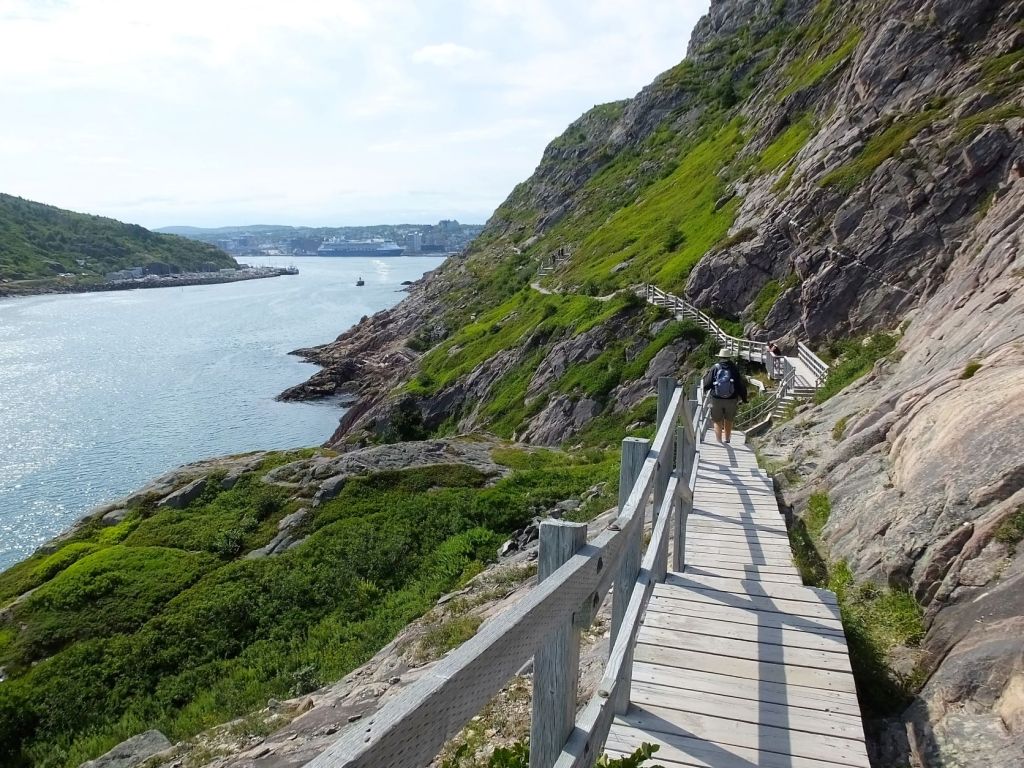
Cliffside trail at base of signal hill
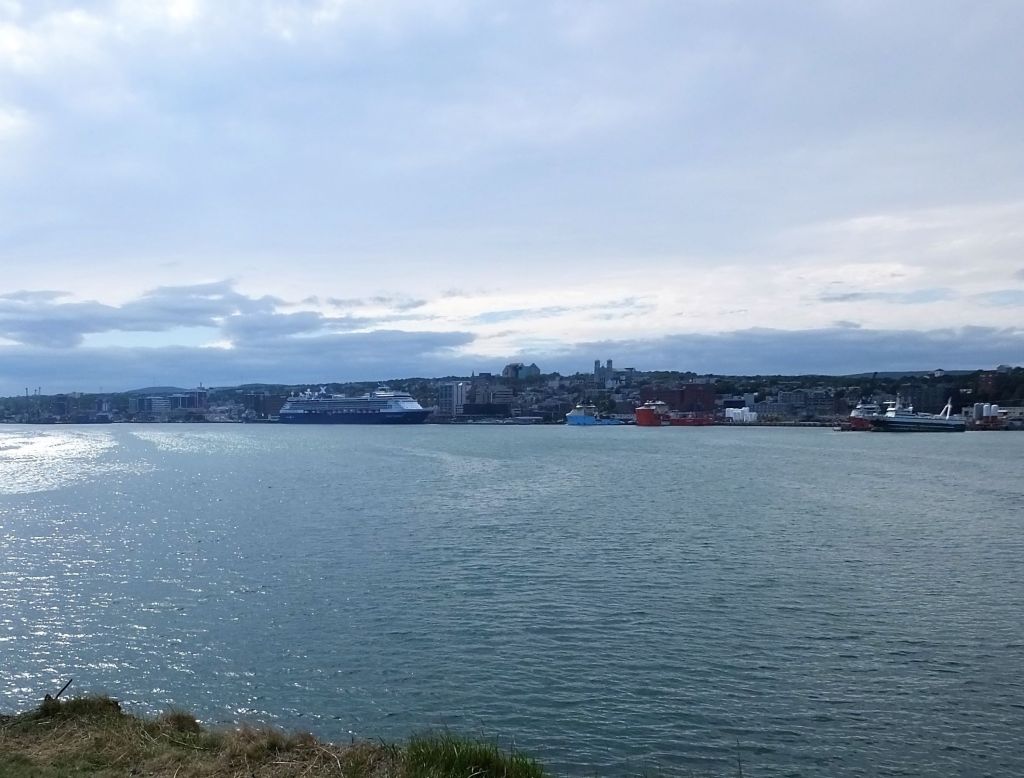
St John’s harbor from cliffside trail

After touring Cabot Tower, we descended a steep series of stairs and then hiked along an amazing cliffside trail overlooking the Atlantic Ocean.   The trail continued along the narrow inlet to the St John’s harbor with views of the downtown and cruise ships.  A short section of the trail followed a very narrow cliffside ledge.  We were glad for chains to hold on to!  This trail would definitely be on our top 10 list of most scenic hikes!

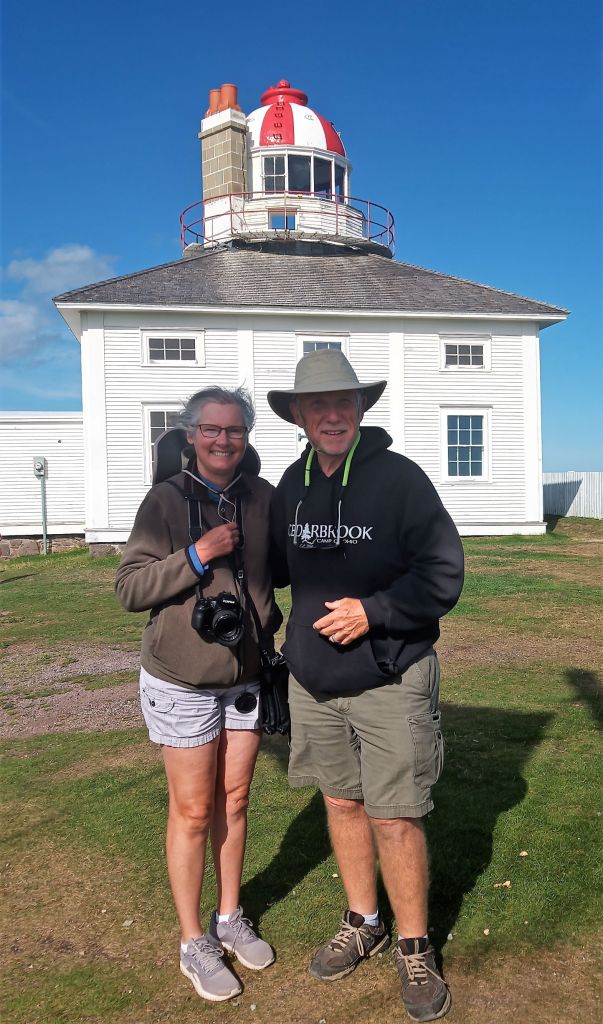
Posing at Cape Spear Lighthouse

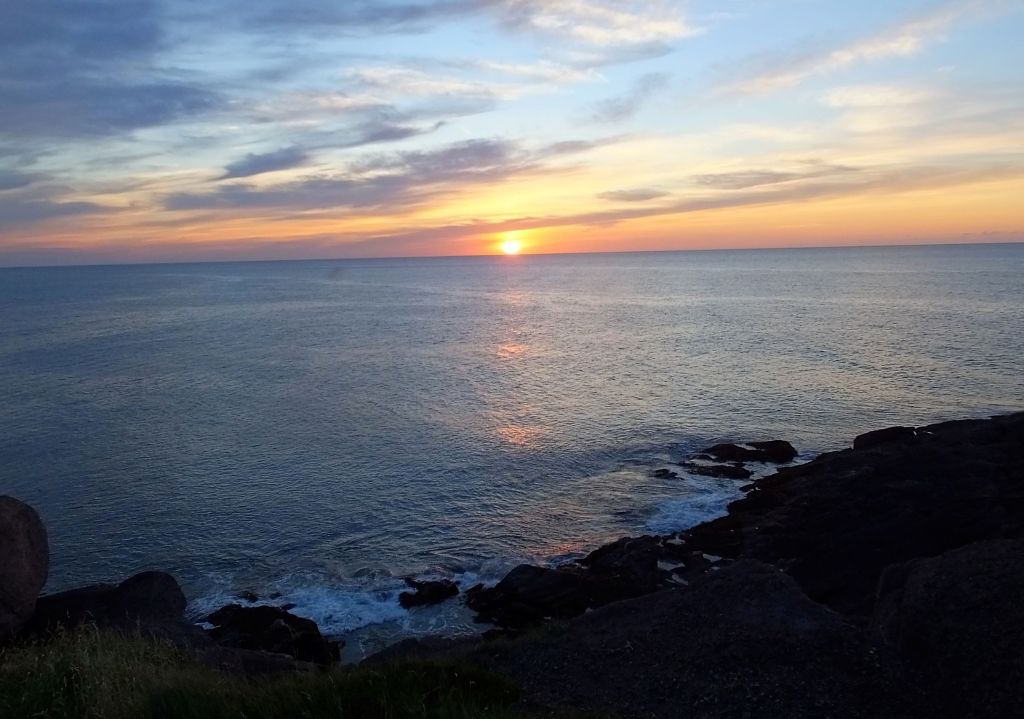
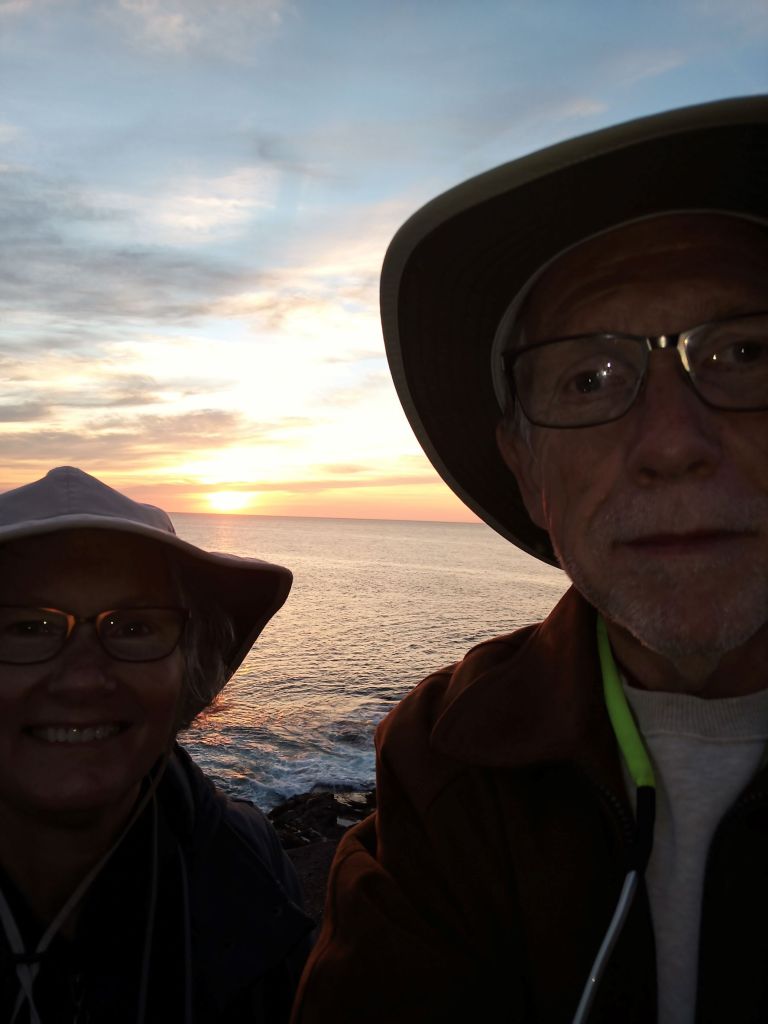
We got up at 4 am the next morning for a 30-minute drive to Cape Spear to see where the sun rises first in North America.  We weren’t disappointed – it was a pleasant morning with a few colorful clouds on the horizon. 

North America’s first sunrise on August 29
Cape Spear sunrise BC (*before coffee)

After welcoming the new day, we returned to town and stopped at Tim Horton’s for breakfast.  ‘Timmy H’, as we call it, is a Canadian institution that serves great coffee and donuts. They are located throughout NF and Canada.

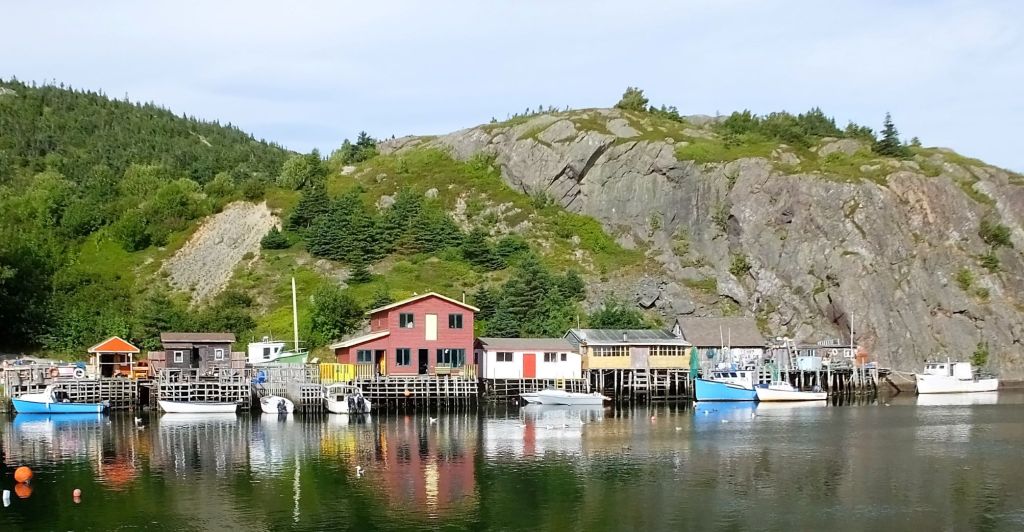
Quidi Vidi

Our time in St John’s ended with a little downtown shopping and a visit to Quidi Vidi, a quirky and picturesque fishing village nearby.   At the Quidi Vidi Brewery Company, visitors get ‘screeched’ to become honorary NF citizens.  When we heard this involved drinking rum and kissing a codfish, we respectfully declined the ceremony!

One rabbit at the campground
(not many critters in the city unless you count 6000 cruise ship passengers)

Next week:  we spend a few days on the Avalon Peninsula south of St Johns and begin traveling back to Port aux Basques.  Enroute, we follow one amazing RabbiTRAIL and decline another.

We Interrupt this Blog For A Special Update

(2022 Newfoundland Ep 10)

Hello all, as with most travel blogs, RabbiTRAILS postings lag real time by several weeks.  In blog time, the next post will be about St Johns, NF. 

Meanwhile, it is Sept 24 real time and we’re safely back on ‘mainland’ Canada close to the Maine border.

The last eight days have been tough.  We’ve prayed, we’ve been patient and we’ve been blessed.

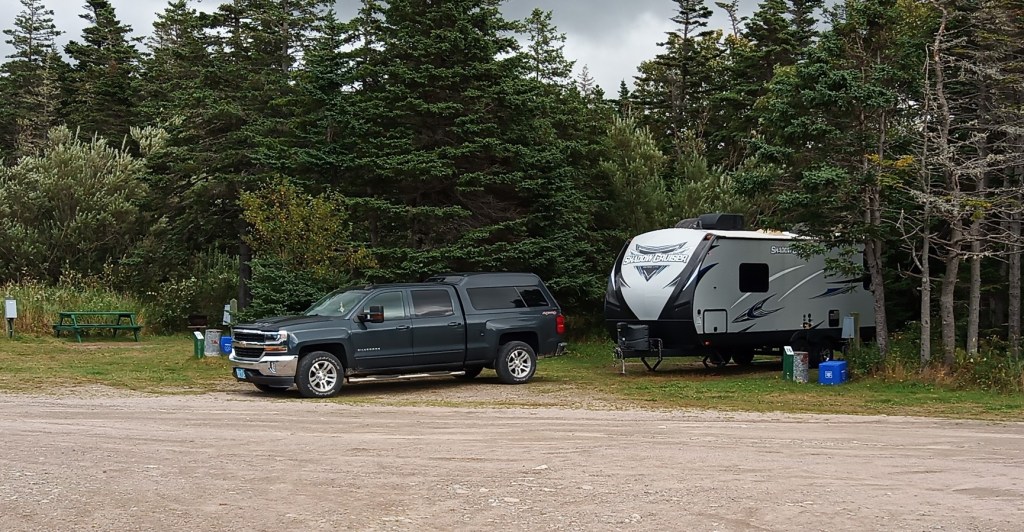
Max and Oscar, last day in Newfoundland

On Friday, Sept 16 we rose early to prepare to board the seven hour ferry back to Nova Scotia, after six weeks on Newfoundland.  When I started Max to hitch to Oscar, I heard an unusual tapping sound in the engine.  The tapping continued as I revved the engine.  Then the check engine light came on. 

Pat and I prayed for wisdom about what we should do.  We didn’t want to give up our reserved slot on the ferry as a number of people at the campground had been waiting for several days after several recent ferry cancellations (including the ferry from the prior evening).  In addition, the Chevy dealer in Port aux Basques (ferry departure town) was very small and we were concerned about repair timeframes and availability of parts. 

We decided to ride the ferry and take Max to a dealer Sydney, Nova Scotia, a sizeable town near the ferry landing. We tried to make an appointment online with the dealer as we waited to board the ferry – the next available appointment was Sept 26.  So, we called and left a message on the service department voice mail explaining our desperate situation.  A few minutes later they returned our call and we set an appointment for 9:30 am on Monday, Sept 19.   

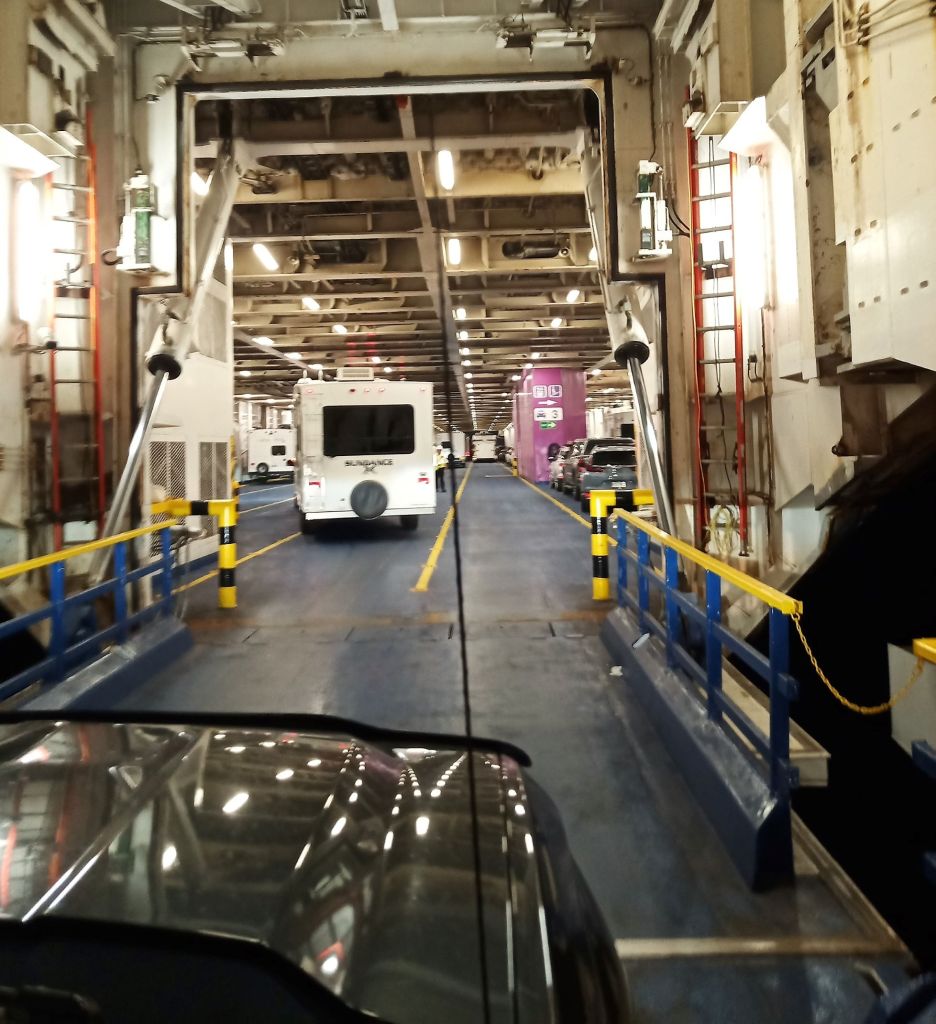
As we drove onto the ferry, the tapping continued but the check engine light was no longer on.

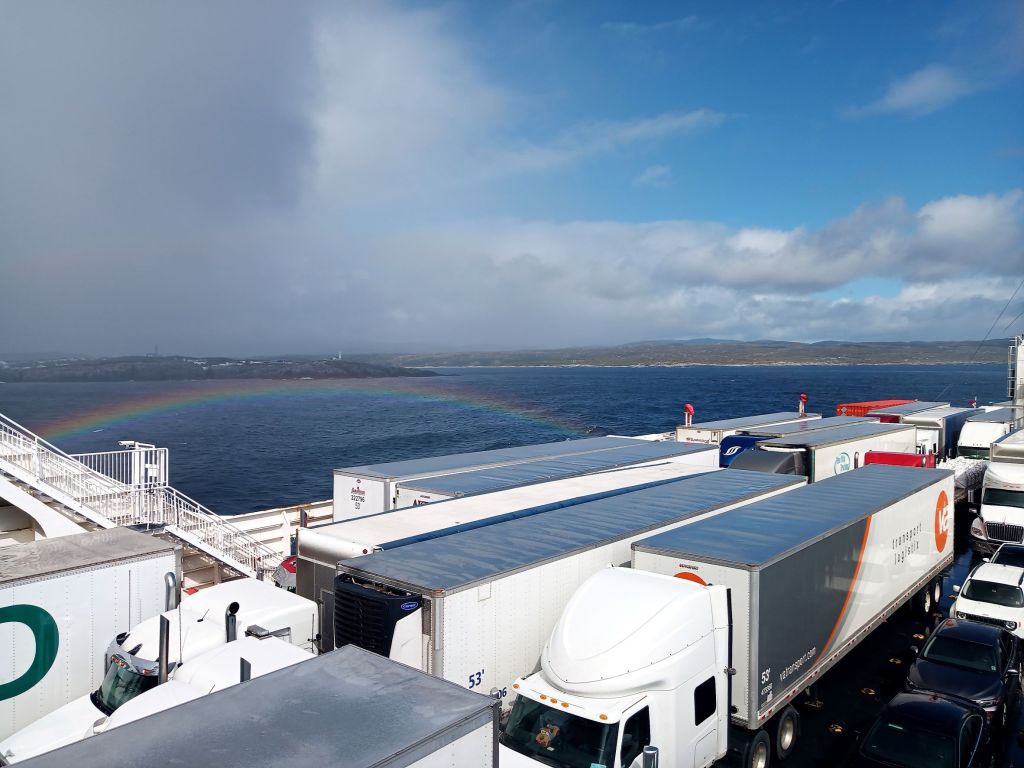
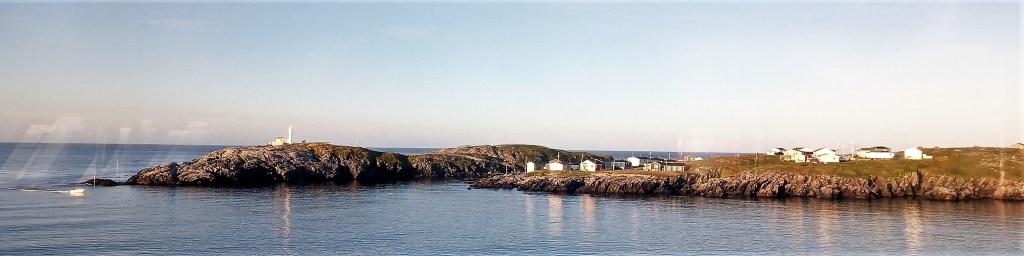
Final view of Newfoundland

The ferry arrived at North Sydney early Friday evening.  We camped nearby and didn’t drive Max over the weekend. 

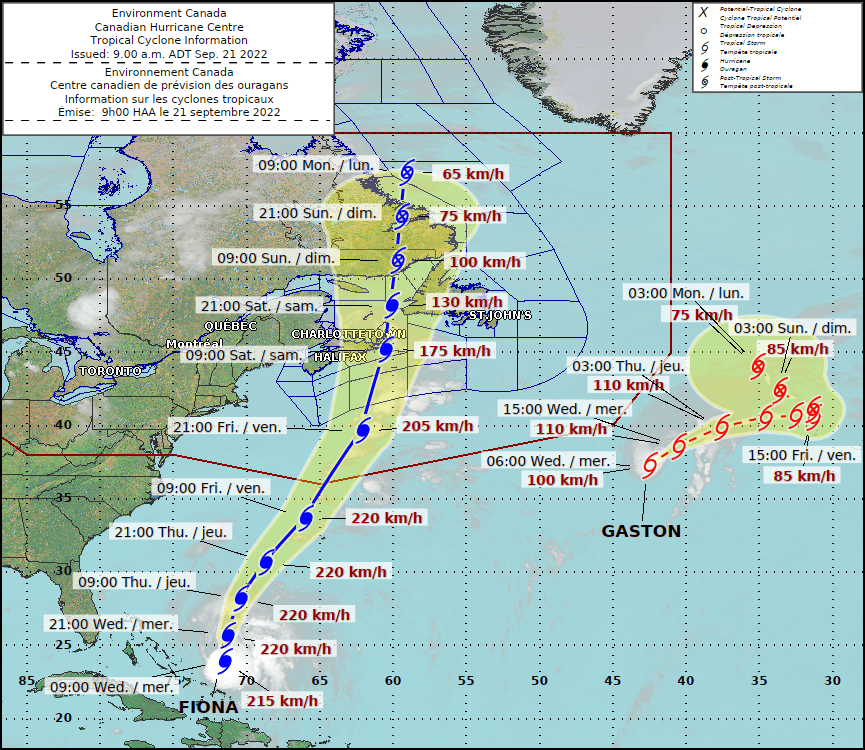
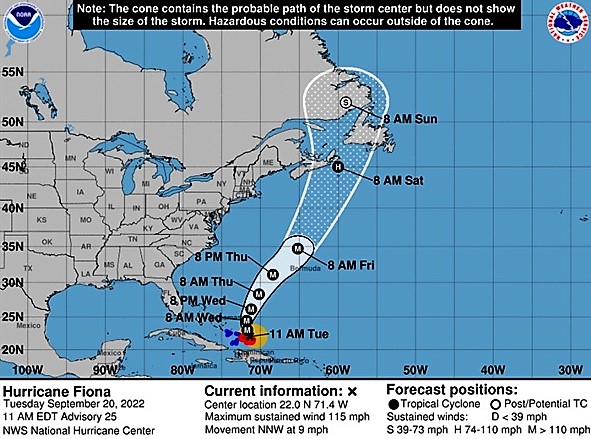
Meanwhile, Hurricane Fiona was in the news. After hitting Puerto Rico and the Dominican Republic, the storm was forecast to remain in the Atlantic, to intensify and to possibly impact Canada late in the coming week.

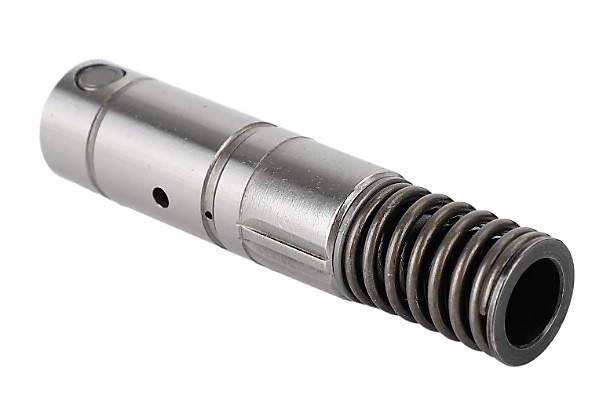
Engine valve lifter

On Monday morning, the Chevy service advisor gave us bad news about Max.  The valve lifters for #1 and #4 cylinders were damaged and needed to be replaced.  They recommend replacing all eight valve lifters. 

The lifters weren’t in stock but we were told a dealer in Halifax, NS might have them.  The Sydney dealer hoped to complete the repairs by late Tuesday . 

A little later the service advisor told us the parts weren’t available after all and couldn’t be located elsewhere.  The dealer would have to order the parts and it could take two days to two weeks (or longer) for the parts to come in.

Monday’s updated Fiona projection was a track toward Sydney, at the northeast tip of Nova Scotia, sometime late Friday evening or early Saturday morning.

Pat and I prayed, and then called the Chevy dealer in Halifax.  They located the parts at two other Chevy dealers in eastern Nova Scotia.  The parts were available at the first dealer we called and by mid-afternoon the parts were ordered!  They would be picked up Tuesday morning and delivered by the end of the day.

We decided to leave Max at the dealer and the service manager, Dennis, graciously shuttled us to our campground more than 20 miles away.

By Tuesday Fiona intensified and was projected to hit Sydney late Friday with sustained winds of more than 110 mph!  We were stranded with no vehicle and no way to move Oscar.

The parts did not arrive at the dealer until after closing on Tuesday.  Early Wednesday morning the dealer texted us the parts had come in and repairs were underway!

The repairs were finished by 3 pm, and again, Dennis kindly picked us up at the campground to retrieve Max.

Meanwhile, Fiona continued toward Sydney with no significant change in projected path or strength.  The storm was projected to have devastating impact on the area. 

We left Thursday morning with Max happily purring and were surprised the highways weren’t crowded.  We drove nearly 500 miles westward over the next two days, and we have been in Grand Falls, New Brunswick, as Fiona hit Nova Scotia early this morning.   It’s been very windy and cold all day. Skies began to clear this afternoon.

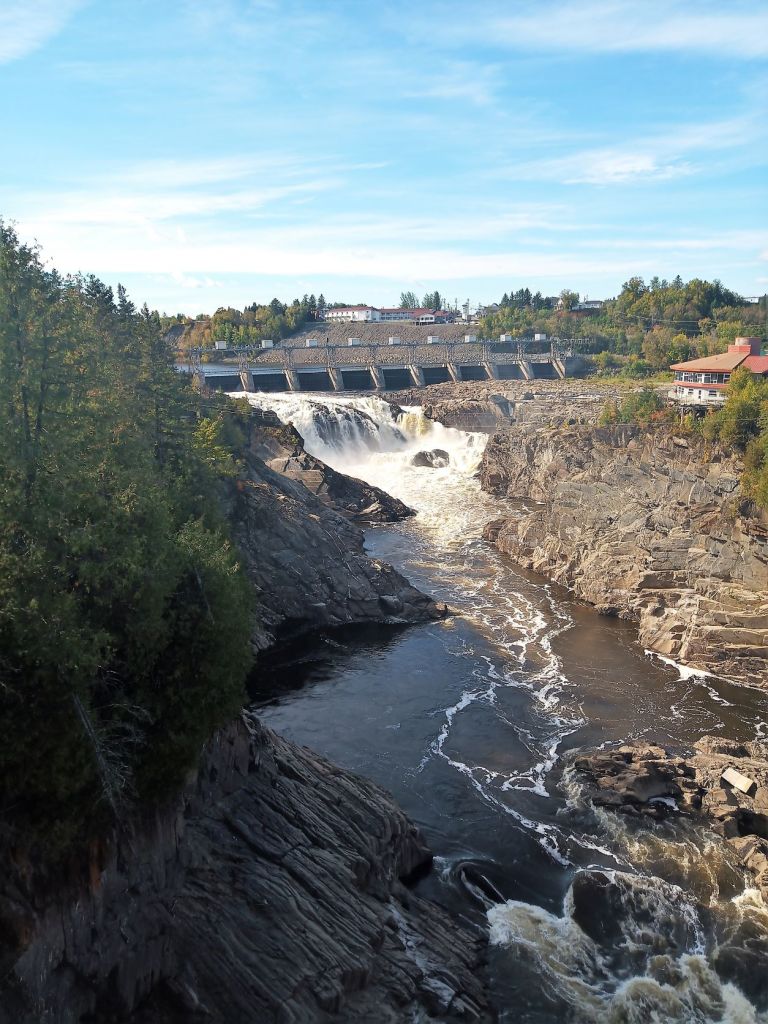
Grand Falls, New Brunswick

Fiona is said to be the worst hurricane ever to strike Canada.  Many on Nova Scotia, Prince Edward Island and western Newfoundland have lost power, and there has been widespread wind and flood damage.  Please join with us as we pray for the many persons affected by Fiona in Canada and the Caribbean.

Pat and I praise God for His provision and protection over the last eight days:  

  • we had just completed a six week, 3000-mile trip across Newfoundland, much of it in very remote locations.  The problems didn’t occur until our the last day on the island.
  • we were able to quickly locate available parts.
  • Dennis and others at the Chevy dealerships worked to successfully resolve our dilemma.
  • the campground manager was remarkably flexible as we renewed our site several times and great campground facilities made five days of being stranded bearable
  • friends and family who prayed for our situation and offered timely encouragement.

We’re thankful for the opportunities God gives us to trust Him and develop faith, and pray that our thoughts, attitude and actions bring Him glory!  This was true for Max’s repairs and Hurricane Fiona, and is true now for Ian, as it targets Florida this coming week.

Next week:  we return to blog time for Jellybeans, a cliff trail and a first sunrise in North America during our St. Johns visit.

Fish Facts, A Lighthouse and More

(2022 Newfoundland Ep 9)

After two weeks exploring western NF and Labrador, we decided it was time to head to the east side of the island. 

We drove the Trans Canada Highway (TCH), the main road that zig zags across NF toward St Johns.  No guesswork on the route to take – the TCH is the only highway that crosses the island.

Atlantic Salmon at Grand Falls

The mountains of western NF gave way to rocky hills and freshwater lakes of central NF.  We camped several nights along the Exploits River in Grand Falls-Windsor and visited the Salmonid Interpretation Center, where we learned about (almost) all things Atlantic salmon.

Grand Falls panorama

Leon, a guide at the center, provided lots of interesting details.

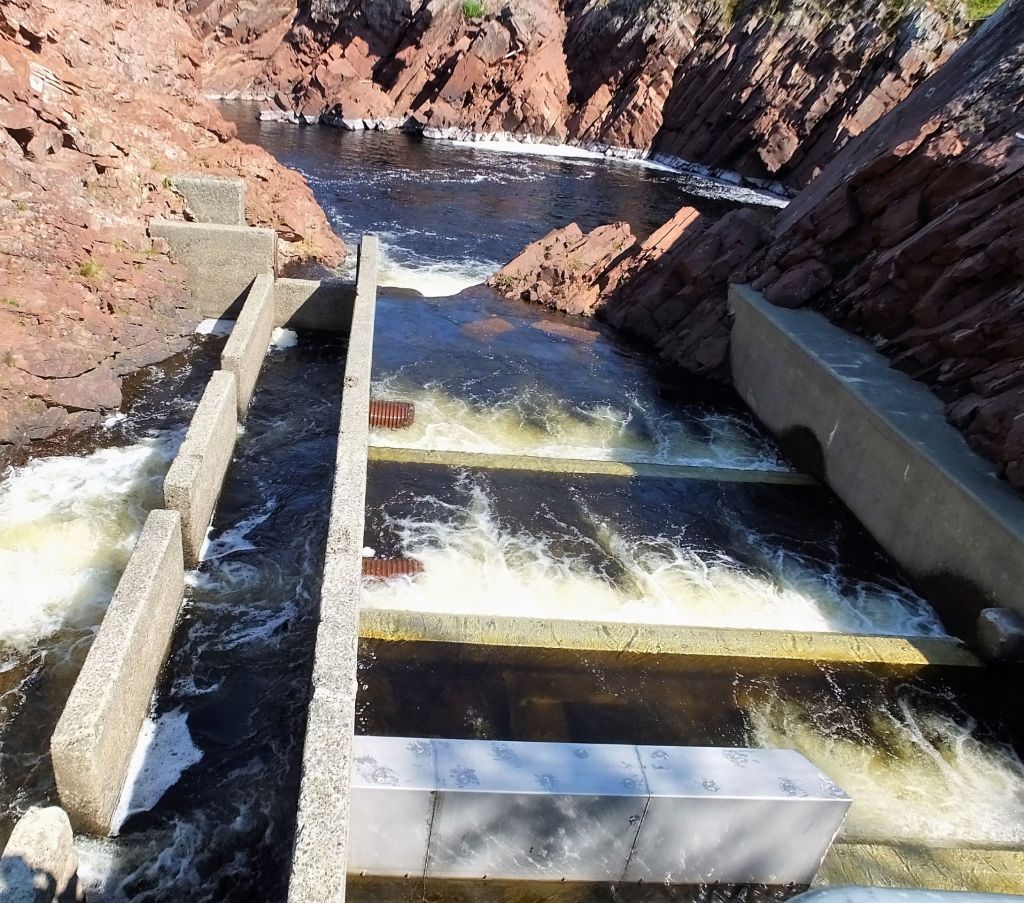
Grand Falls fish ladder

Unlike their Pacific brethren, Atlantic salmon do not die after spawning.  After the salmon fry swim to the ocean to mature, they return to the section of river where they were born several times to spawn.  The fish have a salt-filled gland that makes it like they never left the ocean.

In 1984, someone had the idea to turn the Exploits River, NF’s longest, into a world class salmon river.  The salmon could not reach the river above the falls so fish ladders were built to help them swim up and downstream. 

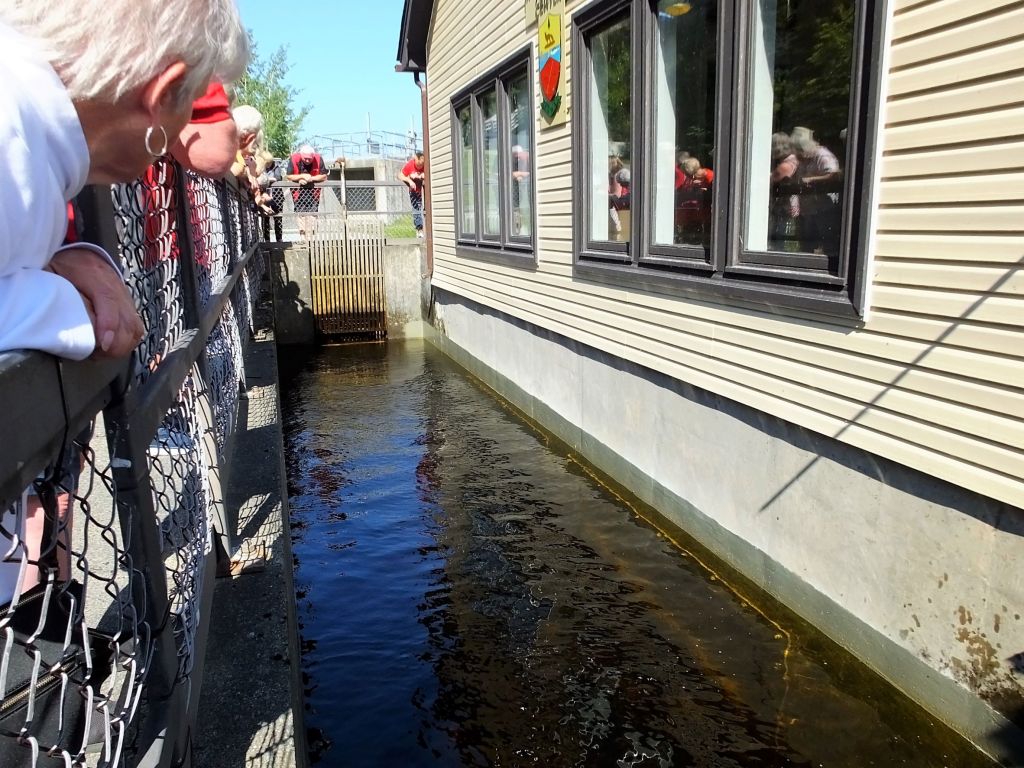
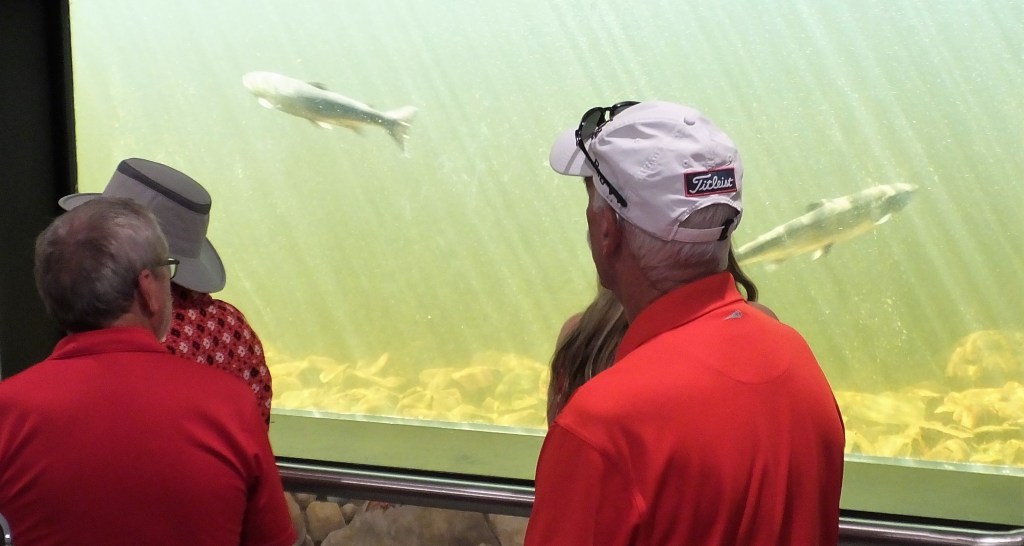
Salmon viewing tank

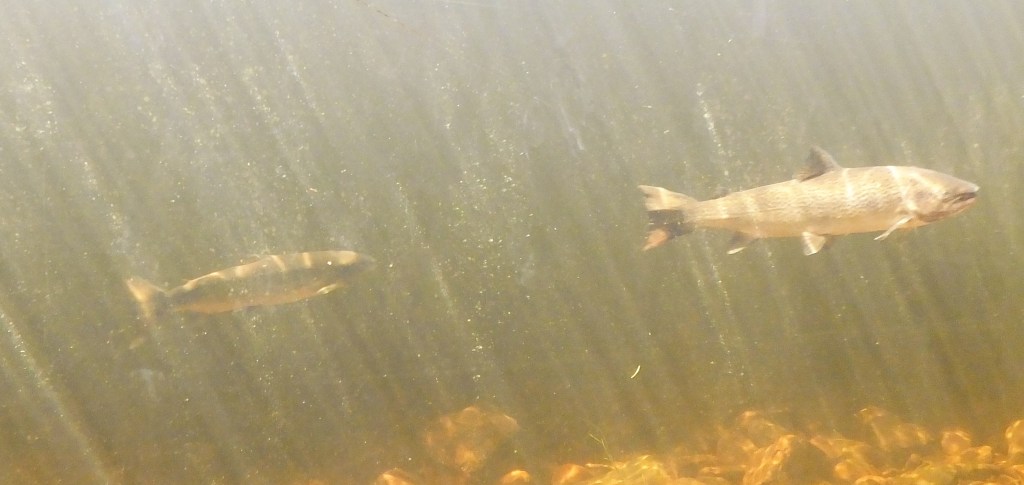
The center monitors the fish as they come and go from the upper river in an underground viewing room. The salmon population is thriving.

Leon also explained that all Atlantic salmon ordered in restaurants or purchased in grocery stores are farmed – Atlantic salmon are not ‘wild’ like those caught in the Pacific.

Salmon seen from underground observation room

Hiking at Terra Nova National Park

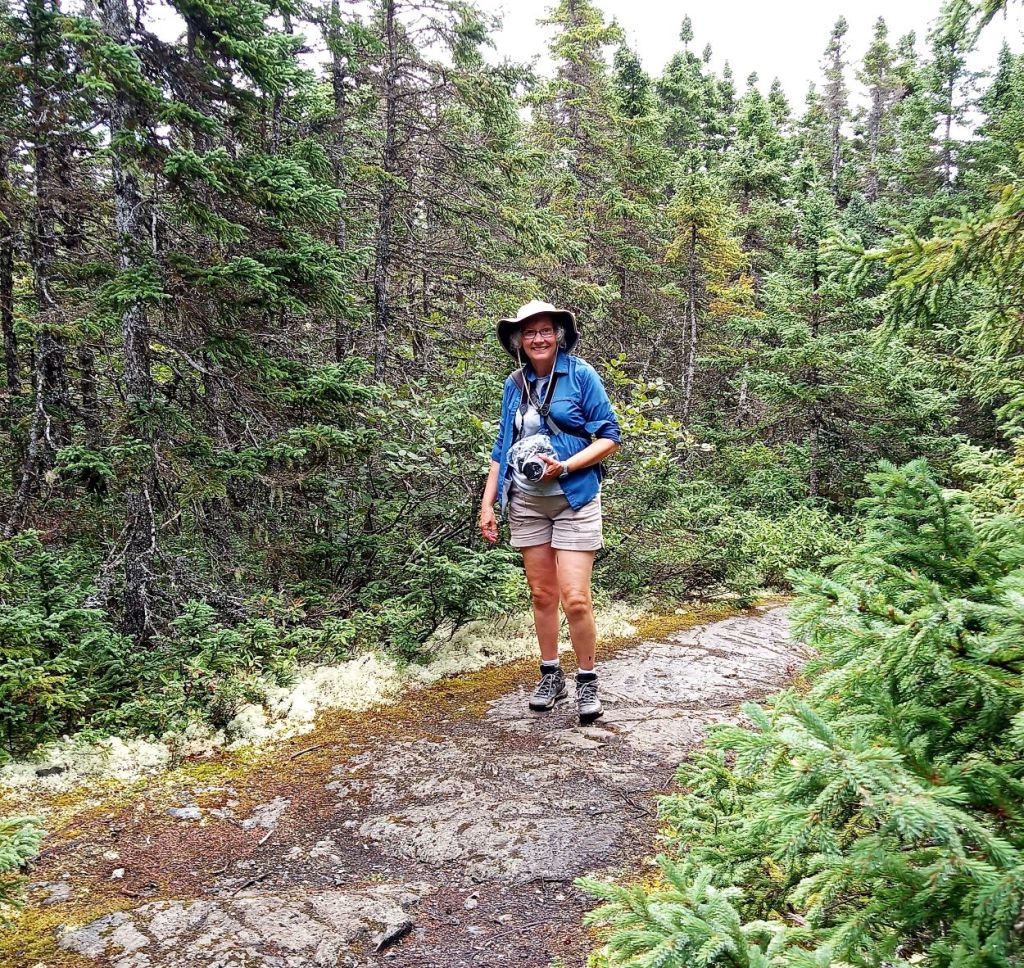
Leaving fish trivia behind, we continued eastward to Terra Nova National Park.  Over the next few days, we hiked a number of trails typical to the area.  The trails often start by skirting freshwater lakes or streams, continue through dense fir and spruce forests, then up steep hills (often with many stairs) to views of the rugged coast or freshwater lakes. 

Dense fir and spruce forests on a typical Terra Nova hike
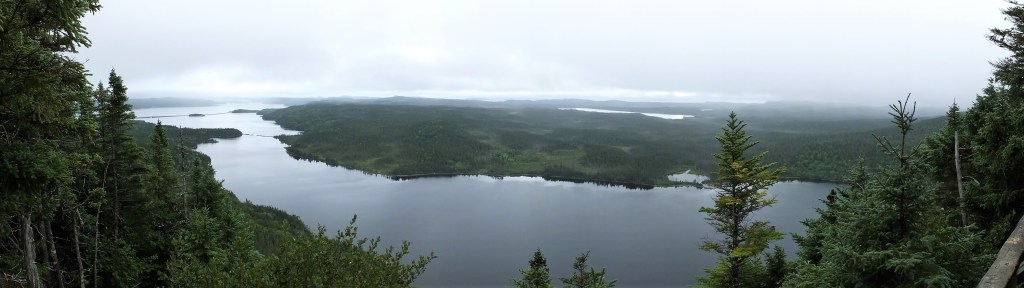
View of Southwest Arm from top of Malady Head Trail
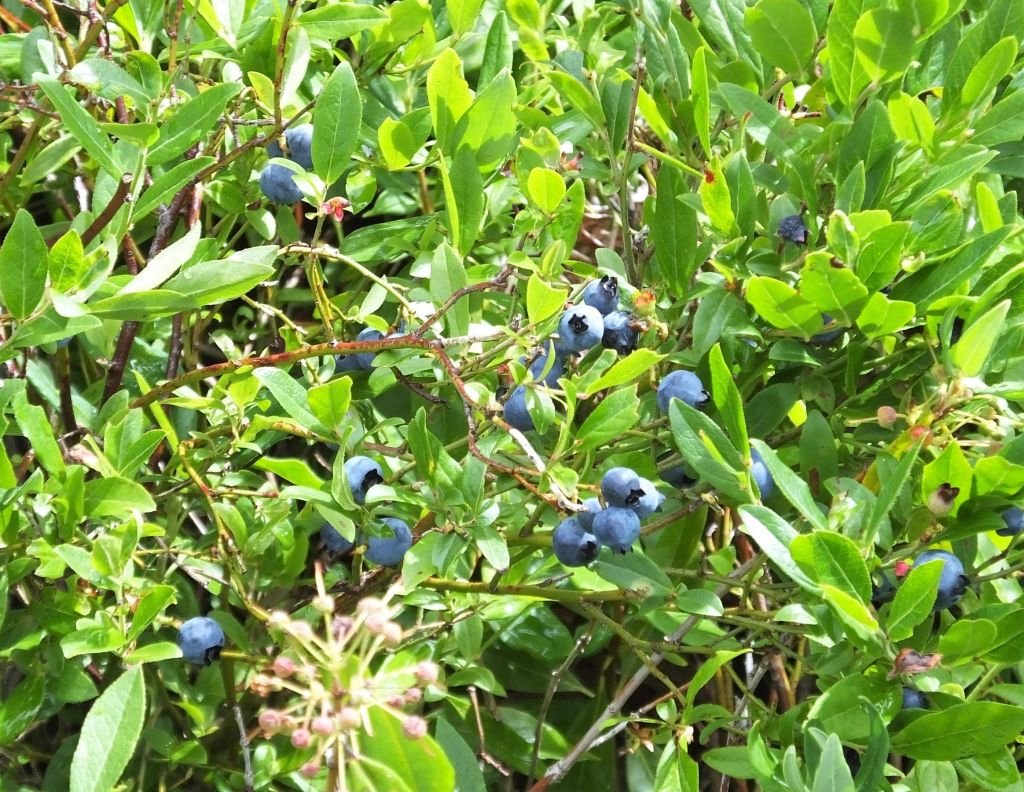
Ripe blueberries along the Louil Hill Trail

We crossed a boggy area on one trail with plentiful blueberry bushes and stopped for a few minutes to pick ripe berries. For the next couple days, we enjoyed them in pancakes and with yogurt.  We were blessed by the find, as most of the blueberry bushes in the area had already passed their prime.

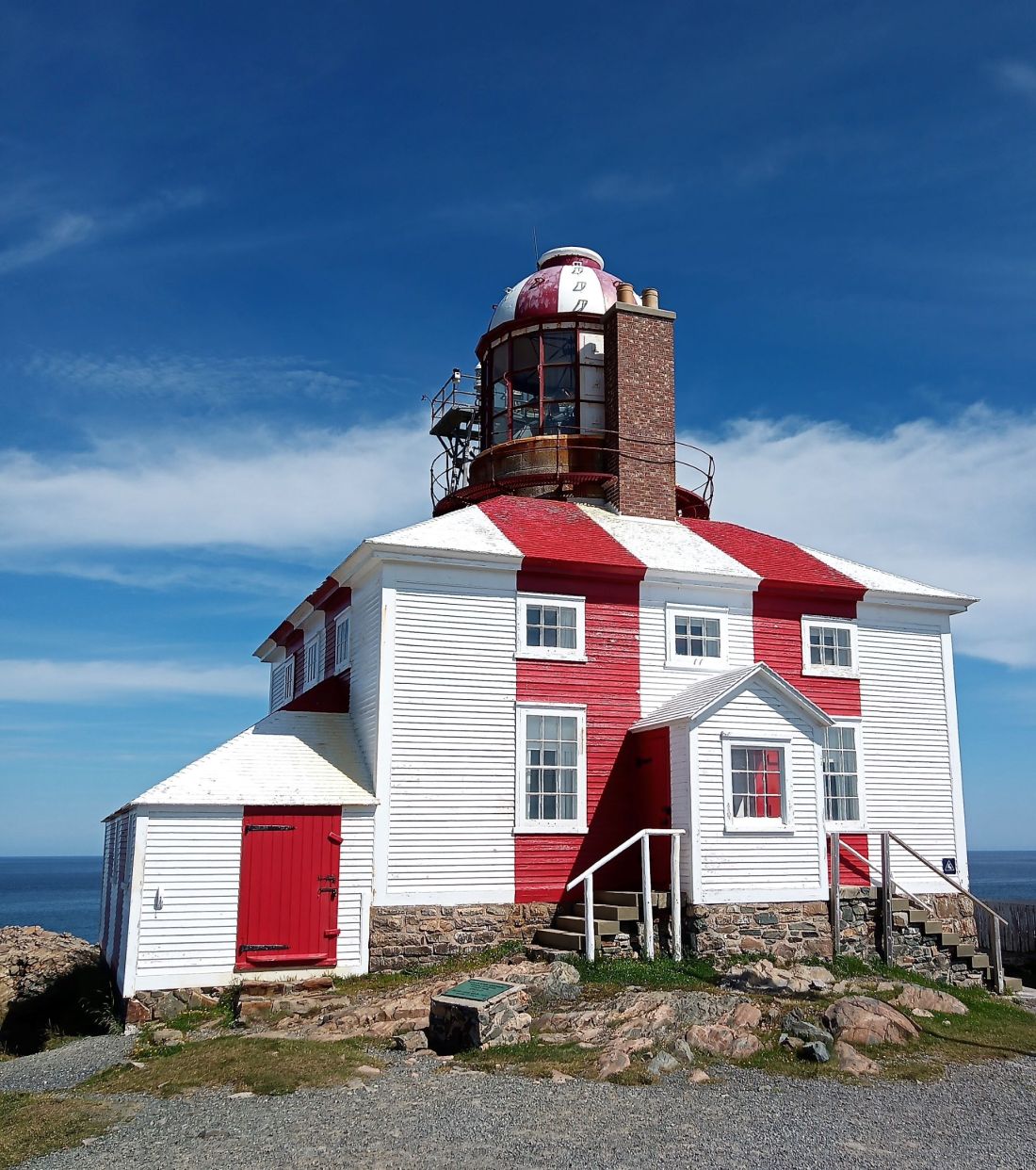
Bonavista lighthouse

Bonavista Lighthouse

From Terra Nova we drove to a remote lighthouse on the Bonavista Peninsula, another one of the must-see destinations in NF. 

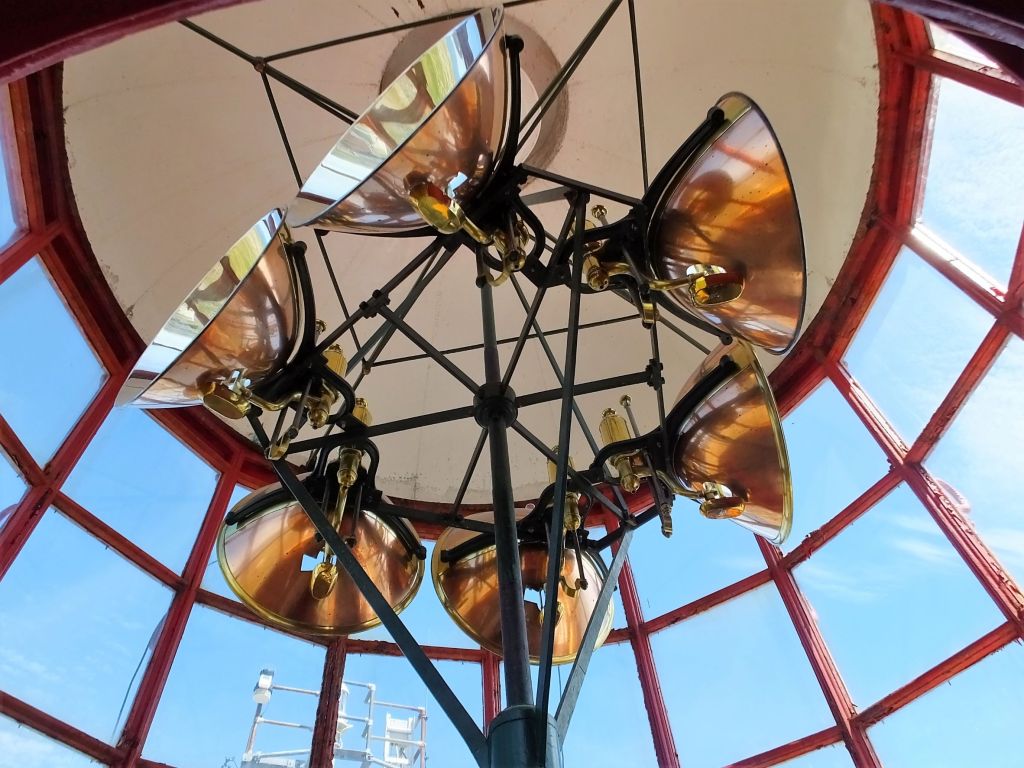
Unusual light reflectors in the Bonavista Lighthouse

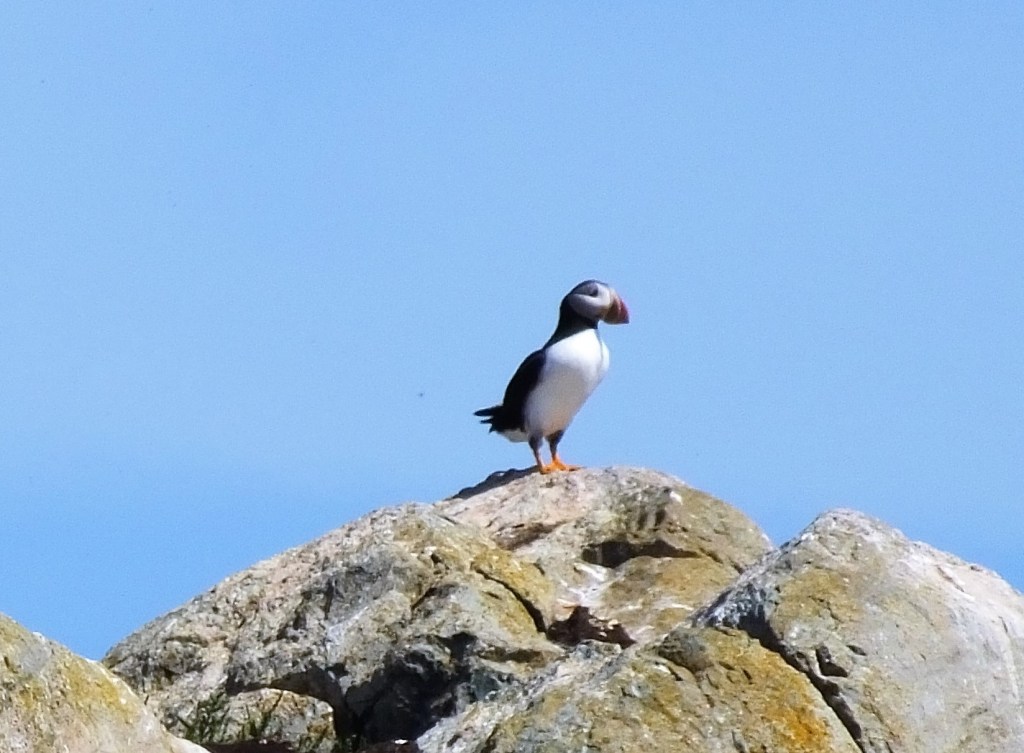
In 1997, we visited the Bonavista Lighthouse with our children, Liz and Phil, and while climbing the lighthouse, we saw whales breaching in the waters nearby. This time we were not so fortunate to see whales, but we did see multitudes of cute puffins, nesting in and flying around rugged rock cliffs near the lighthouse. We also saw two moose along the road a few miles before we reached the lighthouse. 

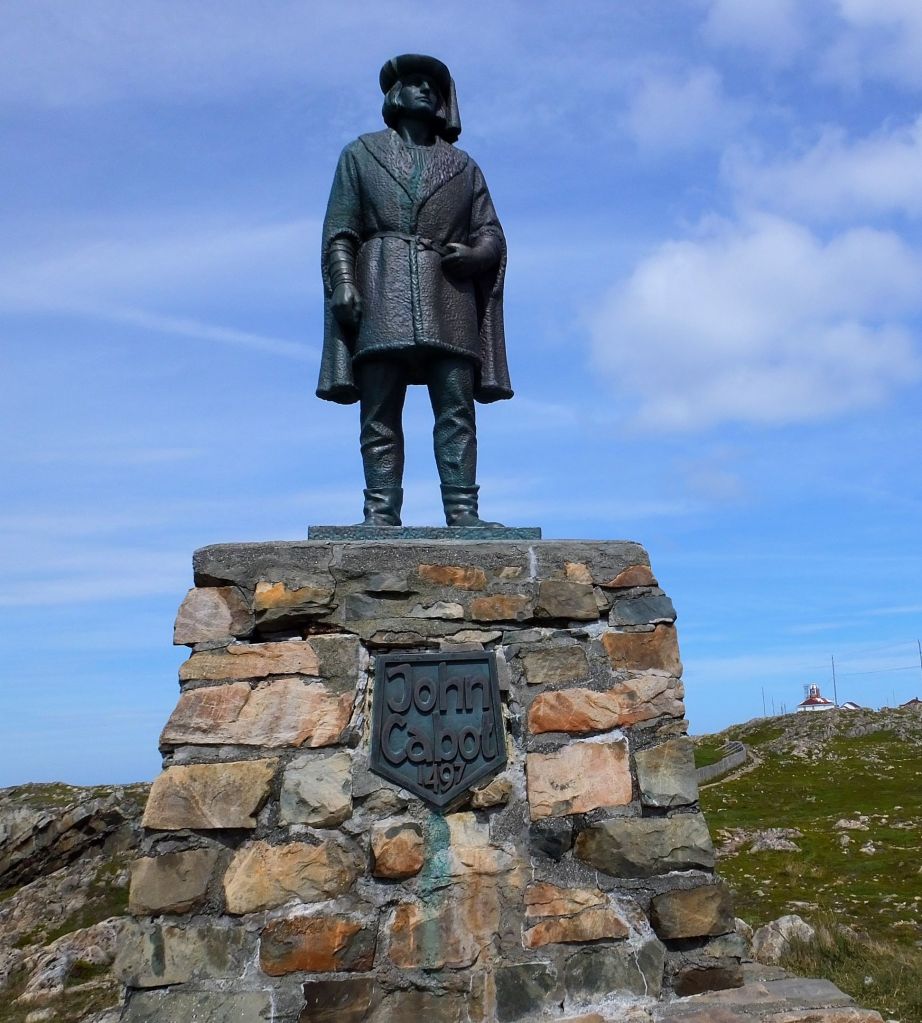
In 1497, Venetian explorer John Cabot made landfall in the Bonavista area while seeking a passage to Asia
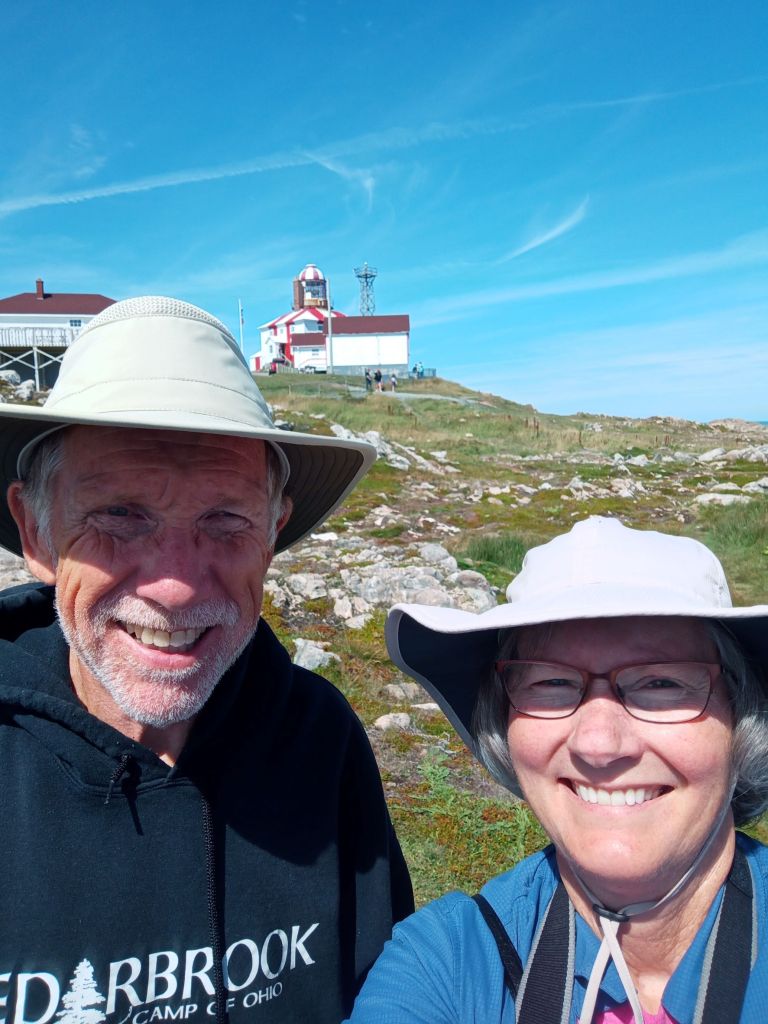
2022 explorers from Florida
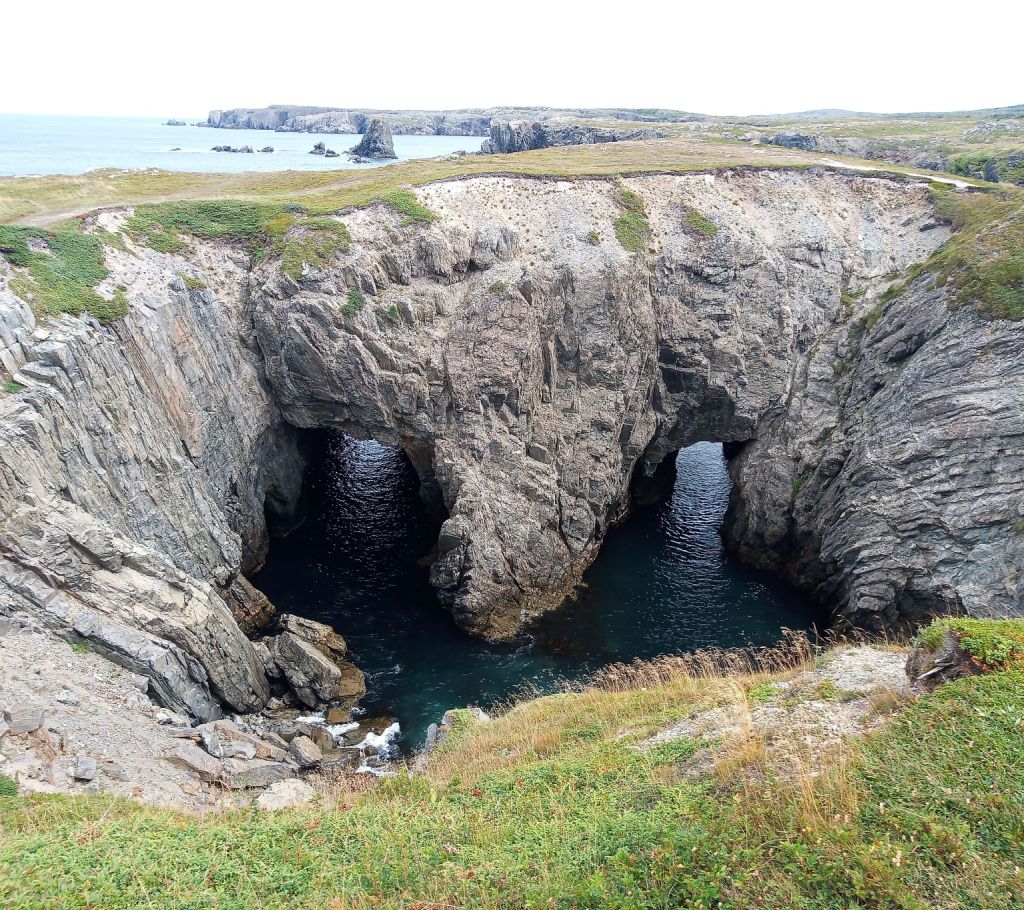
Dungeon rock formation

We also visited a provincial park a short distance away to see the Dungeon, a collapsed rock formation with two wave-carved sea caves that resemble the eye sockets of a skull.  It was an unexpected and interesting sight!

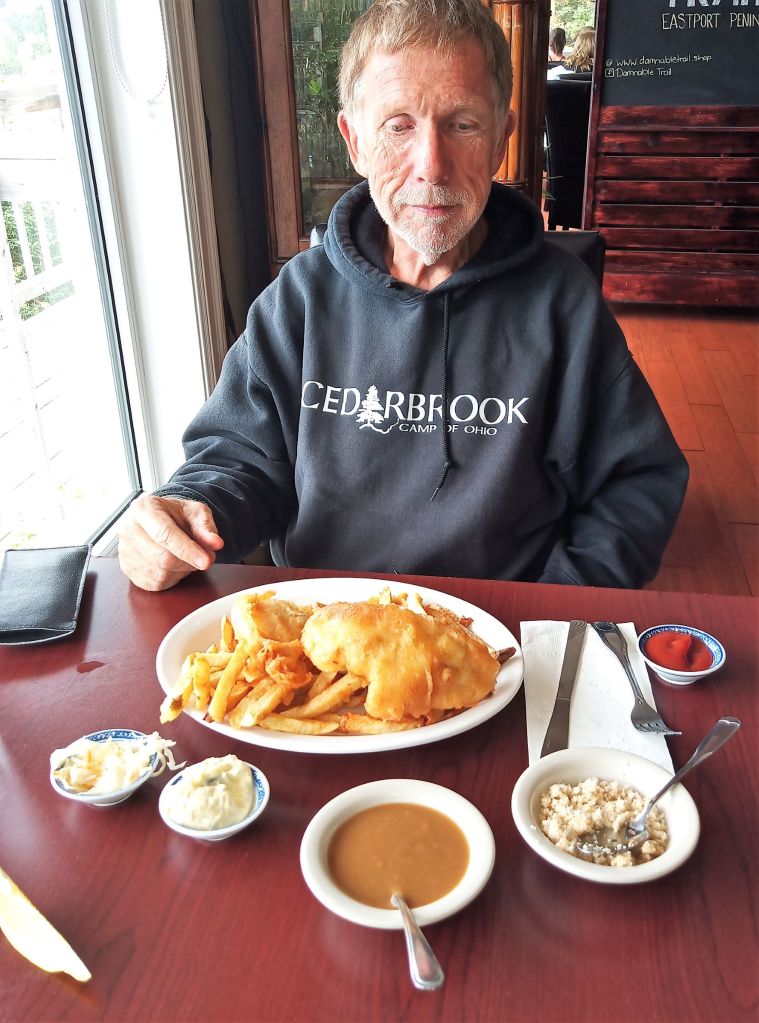
Fish and NF-style chips

Fish and Chips

Before leaving to complete our eastward trek to St Johns, we enjoyed fish and chips at Chucky’s, a restaurant that overlooks a picturesque, secluded harbor.  Since coming to Canada, we have tried fish and chips several times and Chucky’s was by far the best.  The chips were prepared ‘Newfoundland’ style – with dressing (dry breadcrumbs) and gravy.  The restaurant was a bit hard to find (even with Google Maps) in a town aptly named “Happy Adventure!”

Two moose (a momma and her baby)
Hundreds of cute puffins
Atlantic salmon
A few squirrels

Next week:  Jellybeans, a cliff trail and a first sunrise in North America as we visit St. Johns

We Leave Newfoundland

Labrador and Newfoundland

(2022 Newfoundland Ep 8)

After learning about Vikings exploring L’Anse aux Meadows, we decided to do some exploring of our own (kind of). 

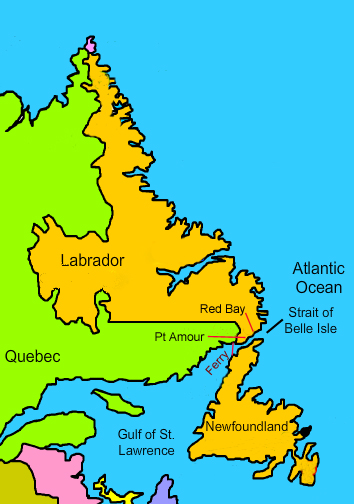
We left Oscar in NF and took a two hour ferry voyage across the Strait of Belle Isle to Labrador.

Part of the Canadian province of NF and Labrador, Labrador extends almost to the North Pole and is nearly three times the size of NF.  It is sparsely populated with 26,500 persons compared to more than 500,000 in NF.

Florida is a little more than half the size of Labrador with more than 21 million residents!

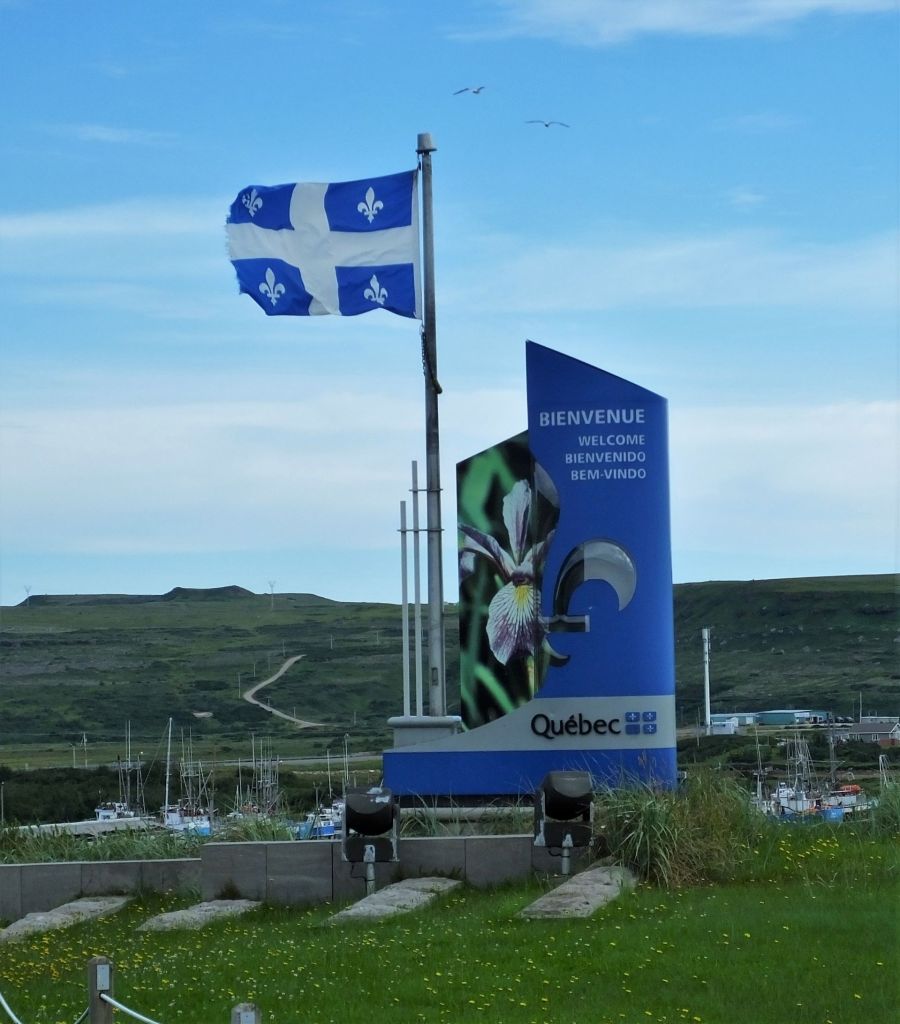
Welcome to Blanc Sablon, Quebec
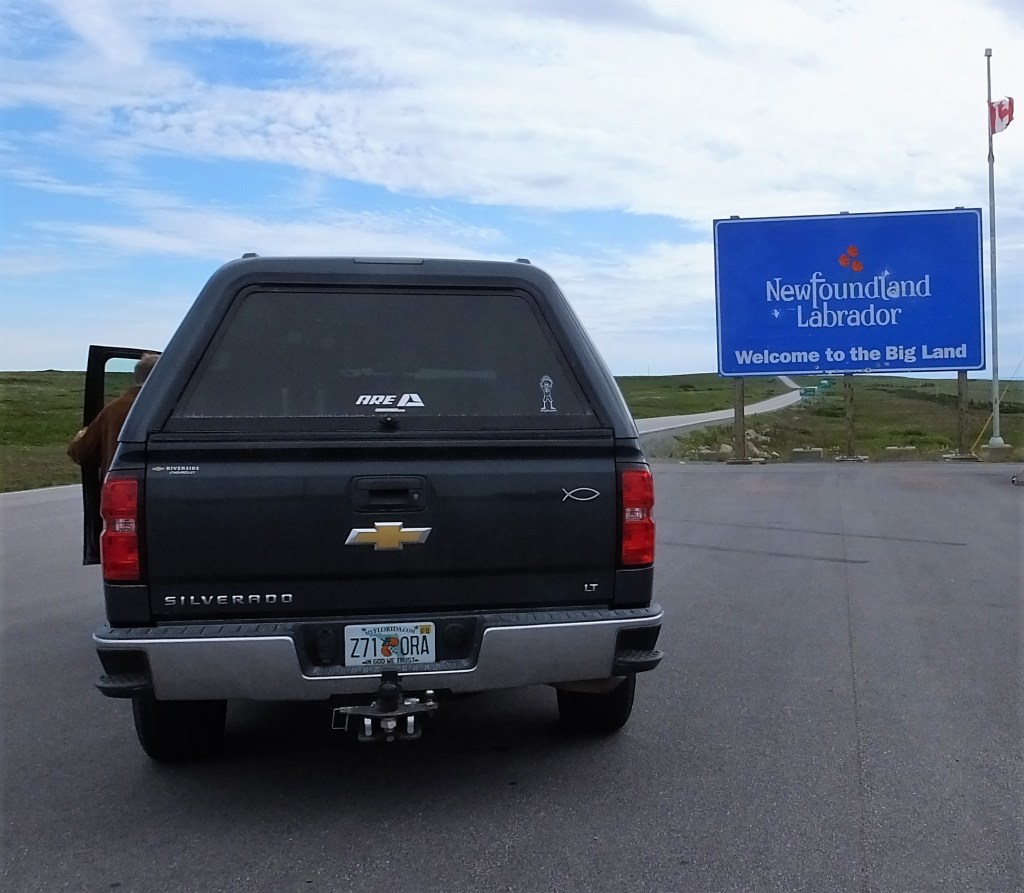
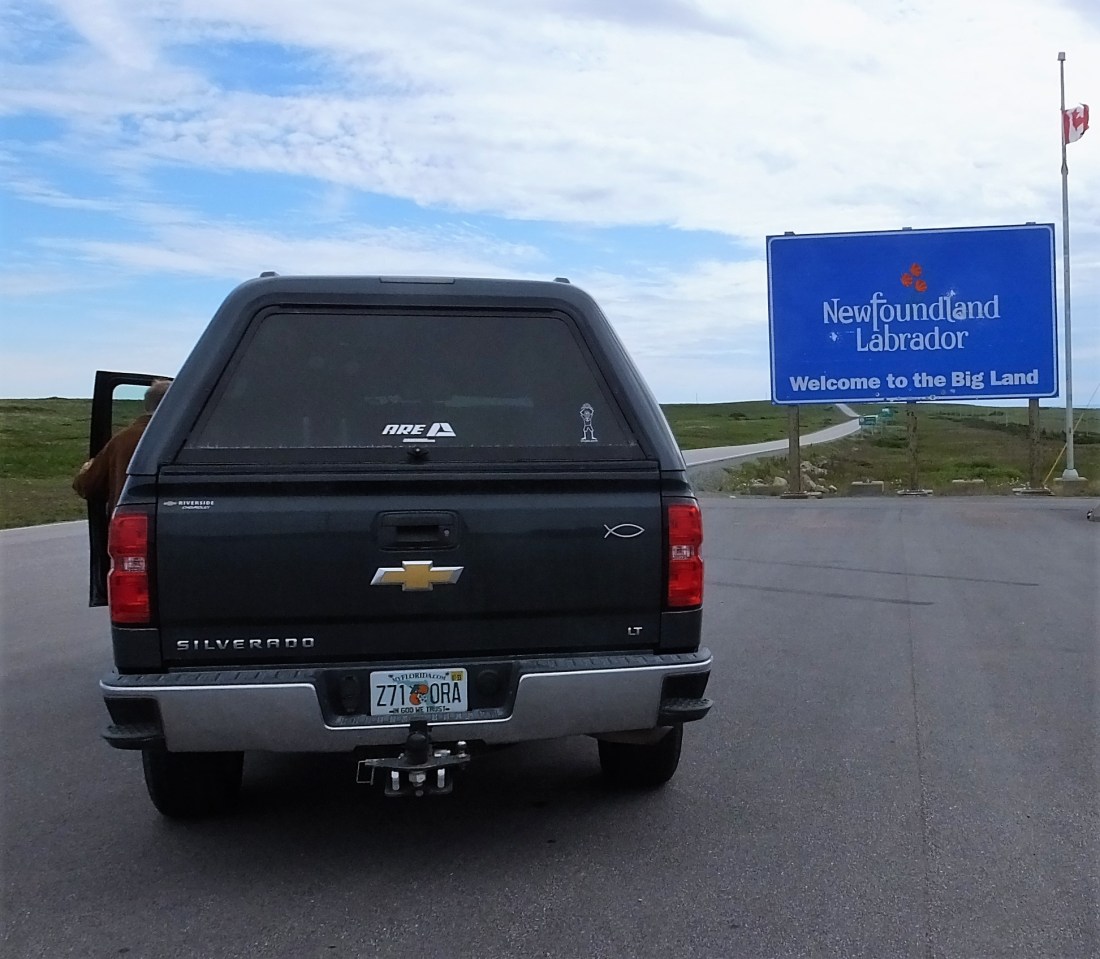
Welcome to Labrador, the Big Land

Our ferry arrived in the small town of Blanc Sablon, in a remote corner of Quebec.  All of the signs were French-English.  After a short drive, we crossed into Labrador and the signs were English-French!

We drove along the coast to Red Bay, site of a long-abandoned settlement where, in the 17th and 18th centuries, whale oil was produced and shipped to fill the lamps of Europe.  Over time, the whale population declined and production ended.

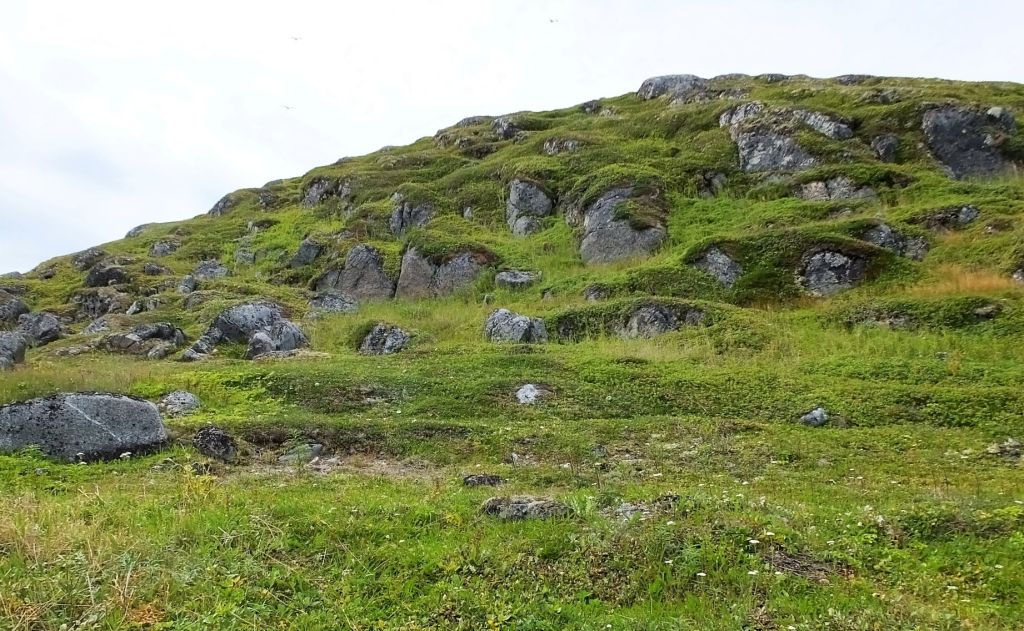
Relic mounds where the Red Bay whaling community used to be

We hiked a short loop trail on Saddle Island to see the faded relics of the oil production.  There were mounds where stoves rendered the oil and where barrels to hold the oil were assembled.

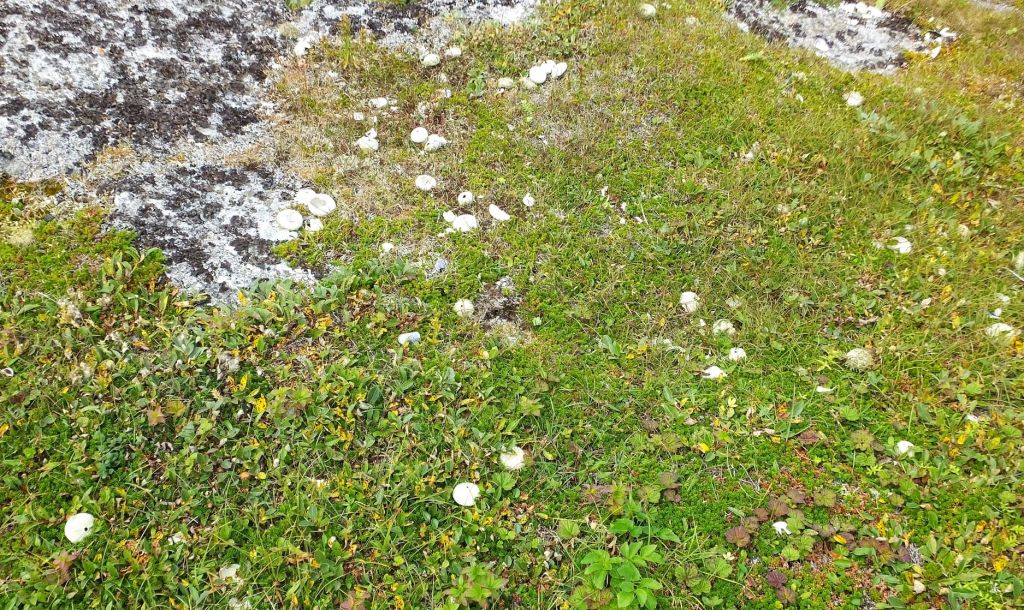
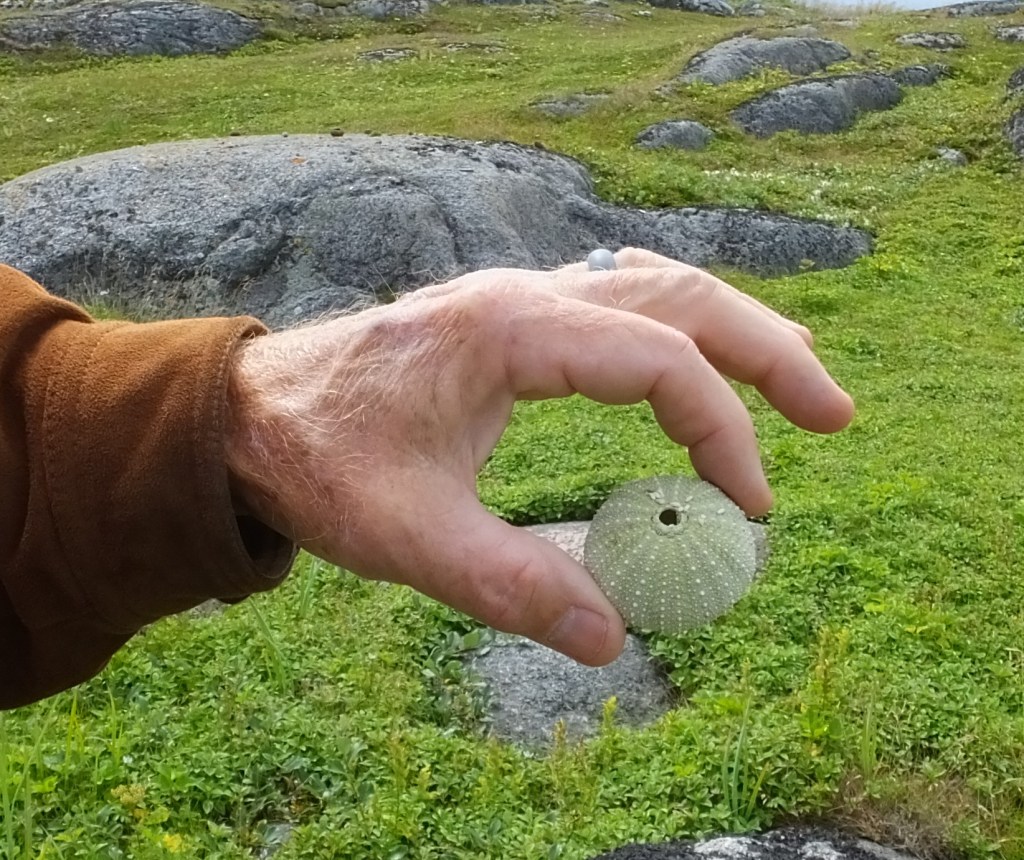
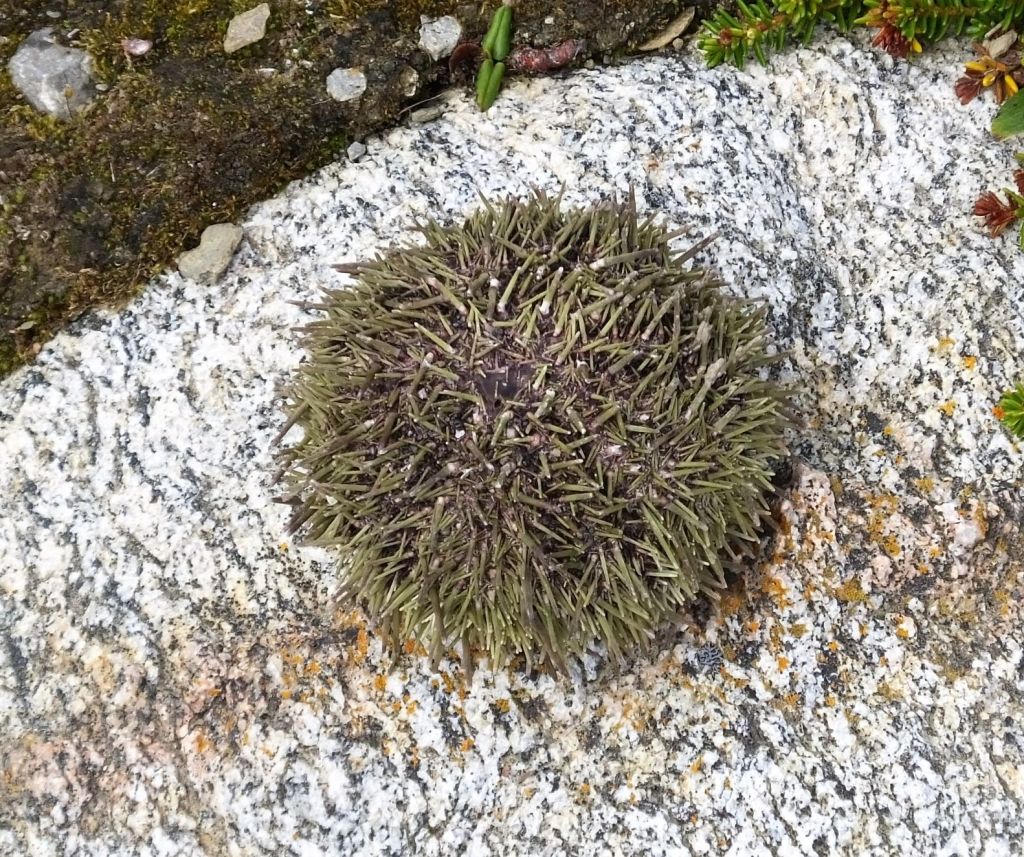
Dried urchins looked like eggshells

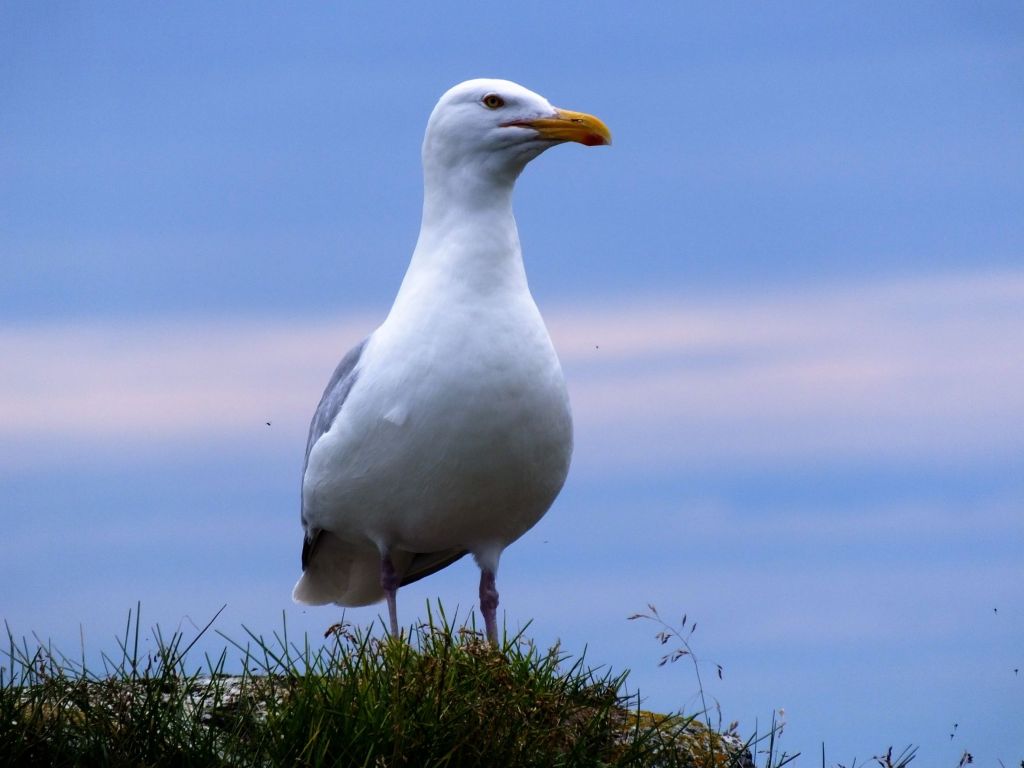
Portions of the trail were littered with what appeared to be egg shells.  Closer examination revealed they were actually dried sea urchin shells.  Nearby, seagulls were dropping live urchins on the rocks, eating the contents and leaving the shells to dry in the sun.

Closeup of an urchin-eating seagull

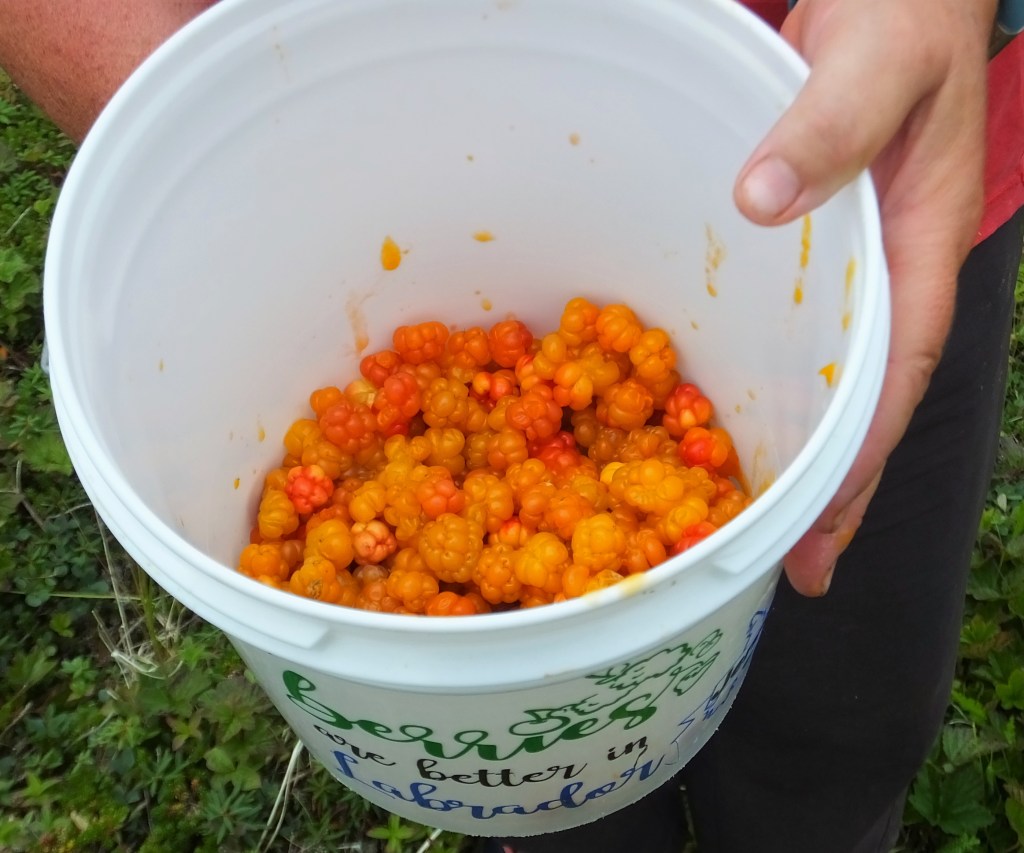
Bakeapple berries

A bit further, we met Jennifer, a Labrador native, who showed us her half-full bucket of yellow-orange bakeapple berries.  Getting enough berries to make jam is a lot of work considering each bakeapple plant produces only one raspberry-sized berry.

In case you are wondering, bakeapple jam is very tart!

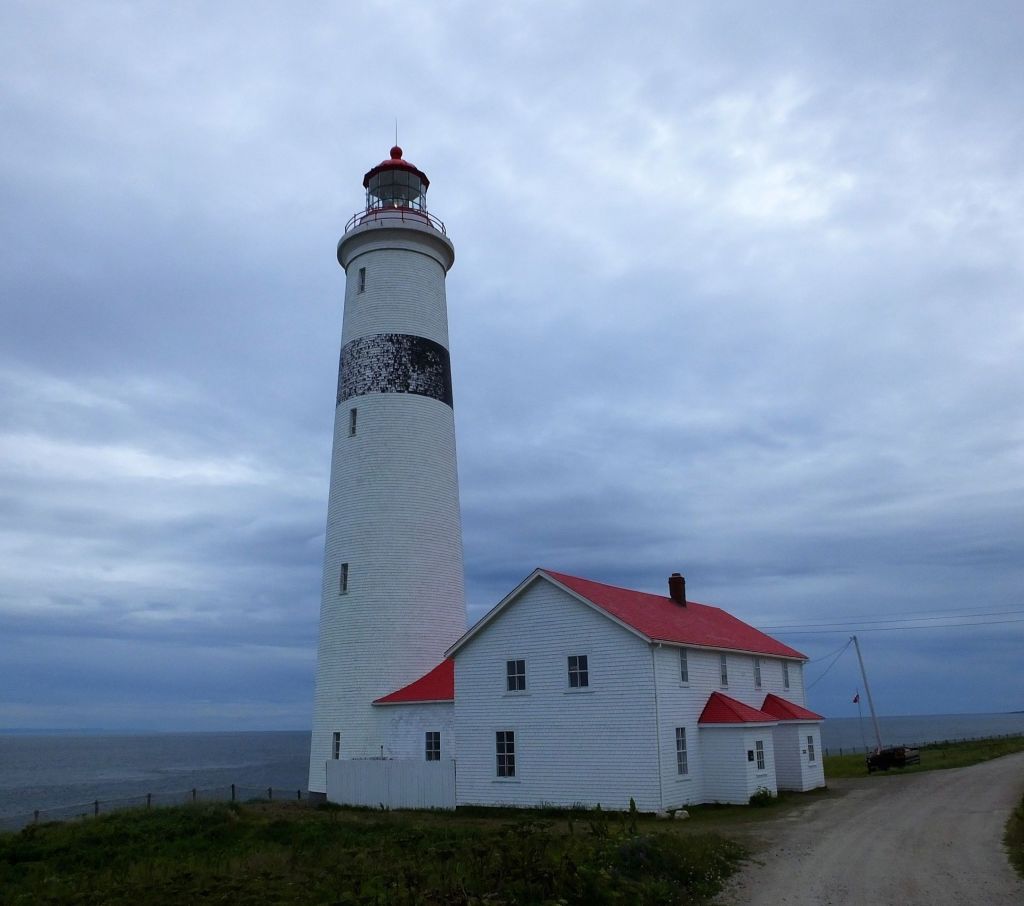
Point Amour Lighthouse
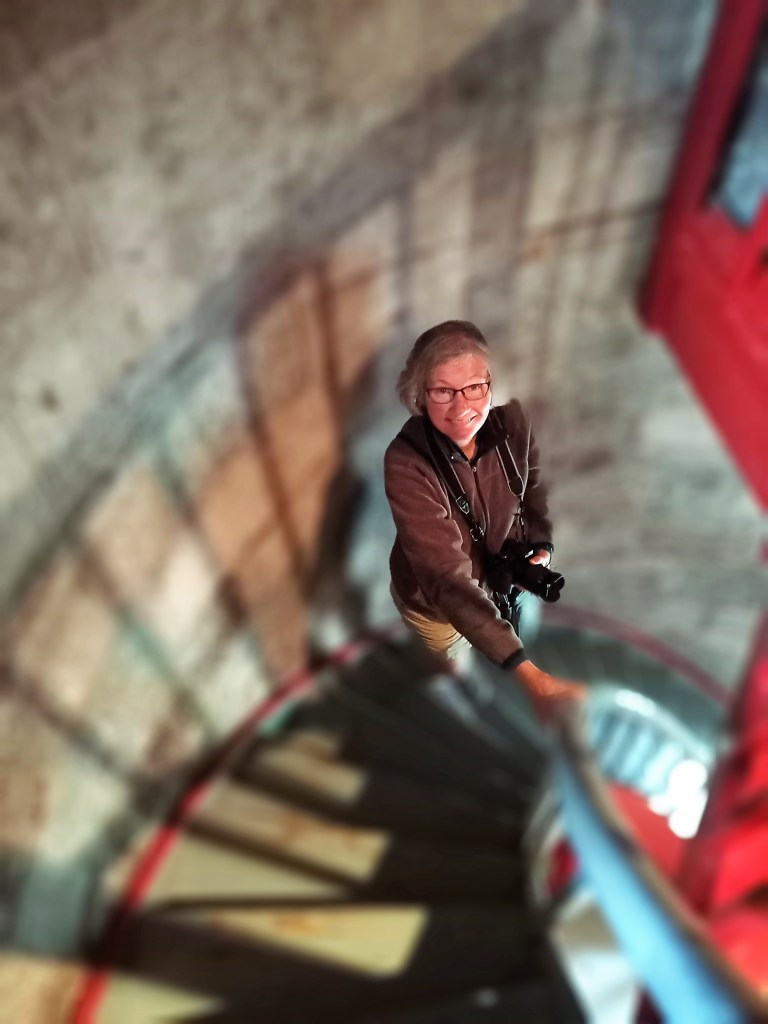
Pat climbing the Point Amour Lighthouse

Later that afternoon we climbed 132 steps to the top of the Point Amour Lighthouse.  At 33 meters, the lighthouse is the second tallest in Canada.  It is historically significant to the south Labrador seacoast as one of four lighthouses that guided mid-1800s ships sailing through the ice flows and strong currents of the Strait of Belle Isle.

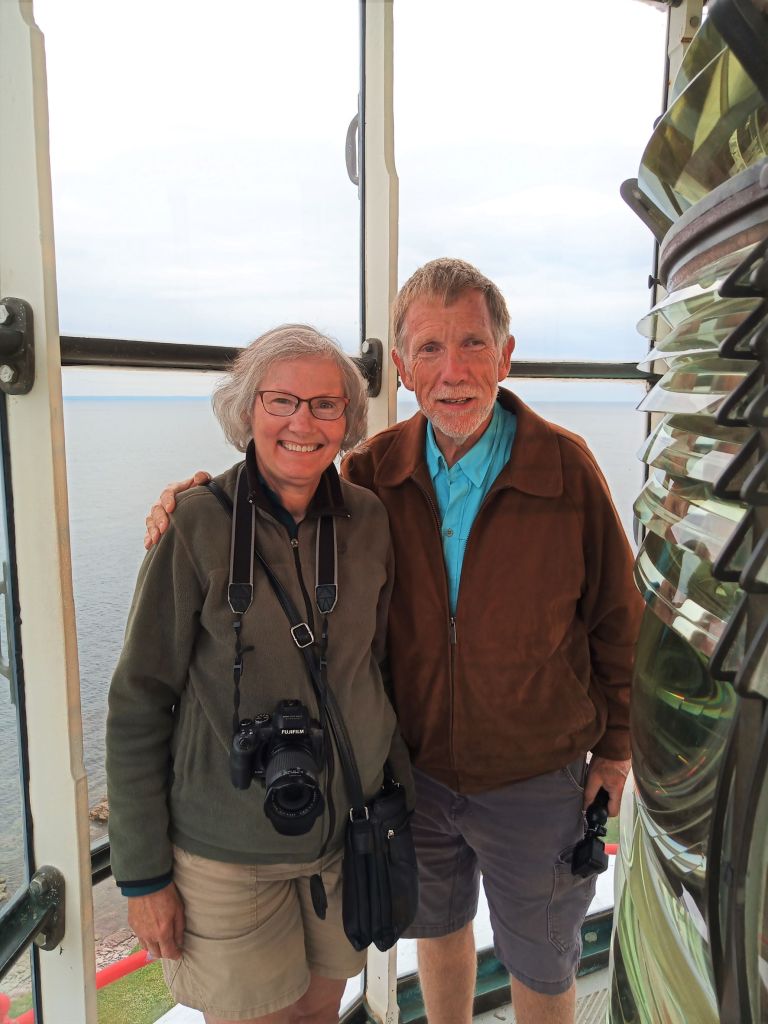
Unlike many lighthouses we have climbed, we were able to enter the very top of the lighthouse, where the light and lens are located. The view below was amazing!

At the top of the lighthouse

The coastal route we followed eventually connects with the 750-mile Trans Labrador Highway that continues west across Labrador to Quebec.  Because the highway is very remote, you are provided a satellite phone in case of problems.  We considered driving the highway, but with up to 300 miles between gas stations (our range is 225-250 miles towing Oscar) and uncertain road conditions, we decided on an overnight visit to Labrador instead.

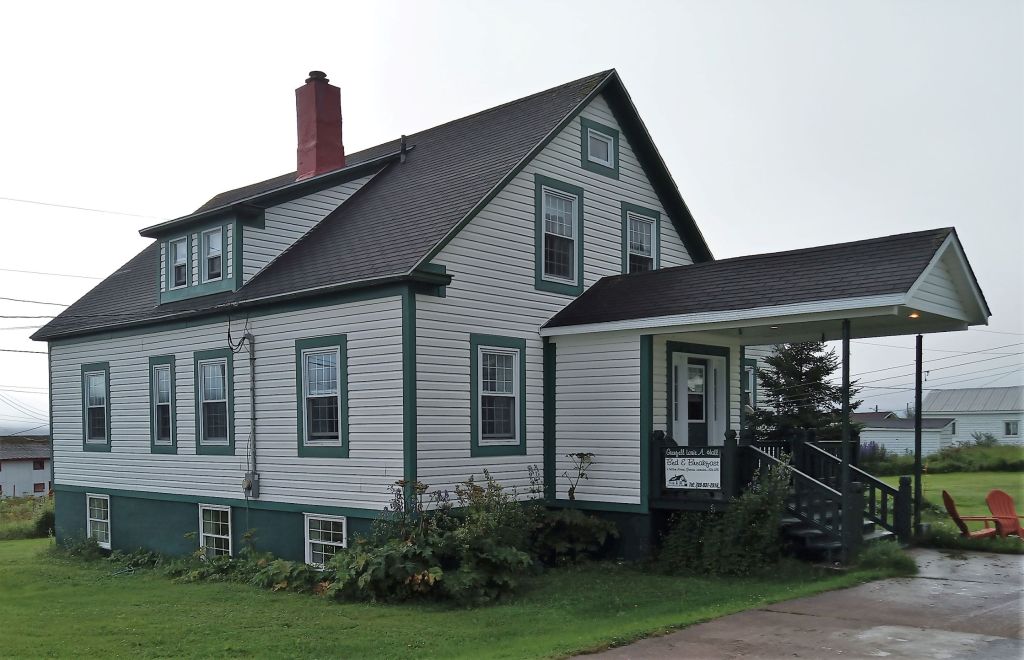
Grenfell B&B in Forteau, Labrador

We spent the night at Grenfell Bed and Breakfast in Forteau.  The B&B was originally a nursing hospital built in 1946 by the International Grenfell Association.  The association was founded by Wilfred Grenfell, a British medical missionary who devoted his life to improving the health of residents of coastal communities in Labrador and NF.

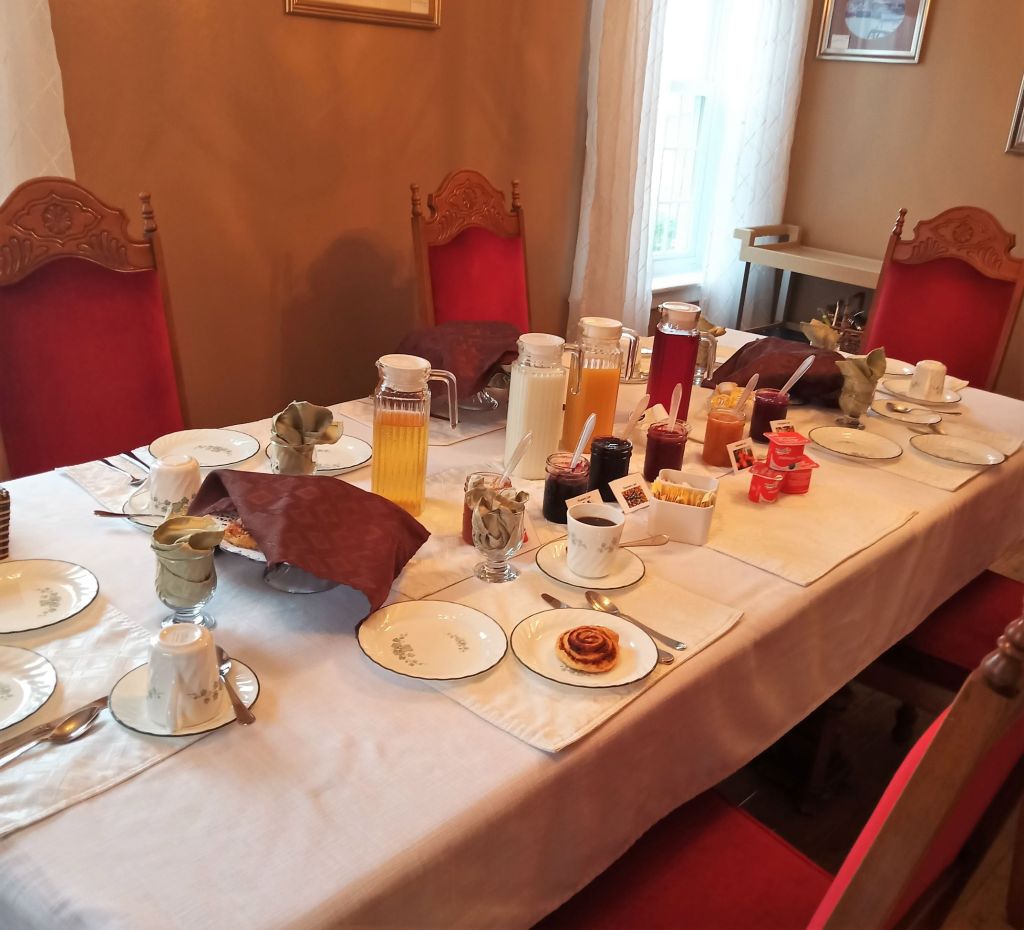
A wonderful breakfast spread

After a restful night, our host, Peggy, offered a spread of breads and pastries, homemade jellies and jams, and other items for breakfast.  (BTW, if you are interested in operating a B&B, Peggy says the B&B is for sale!)

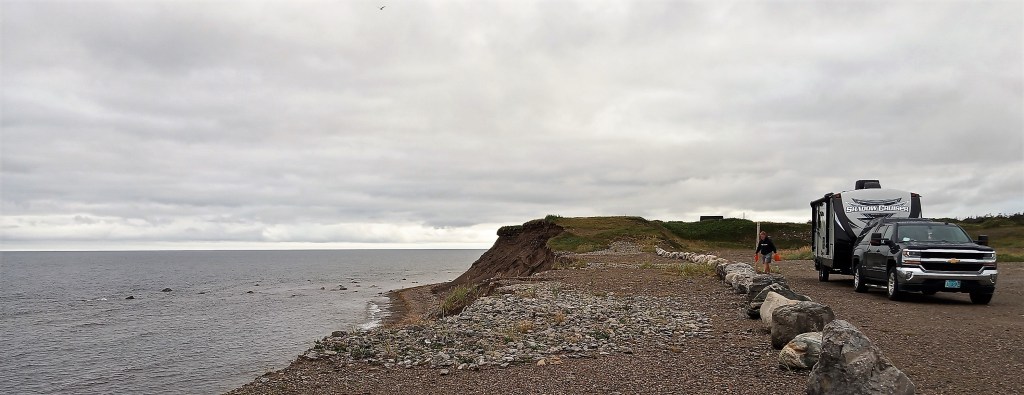
Camping by a seaside cliff

We ferried back to St Barbe later that day, where we were reunited with Oscar.  That night we boondocked in a pulloff next to the ocean near Gros Morne NP. We continued south the next morning on the Northern Peninsula and then east toward central NF.

Two whales
Several small squirrels
Ravens and seagulls

Next week: something’s fishy in central NF!

Viking Horns and Moose Antlers

(2022 Newfoundland Ep 7)

From Gros Morne, we traveled on a very rainy day toward the L’anse aux Meadows (LAM) National Historic Site.  LAM is one of those ‘you have to visit’ places in NF.   We took numerous potholed sections of the highway a little more slowly than normal and arrived at Viking Campground near LAM late in the afternoon. 

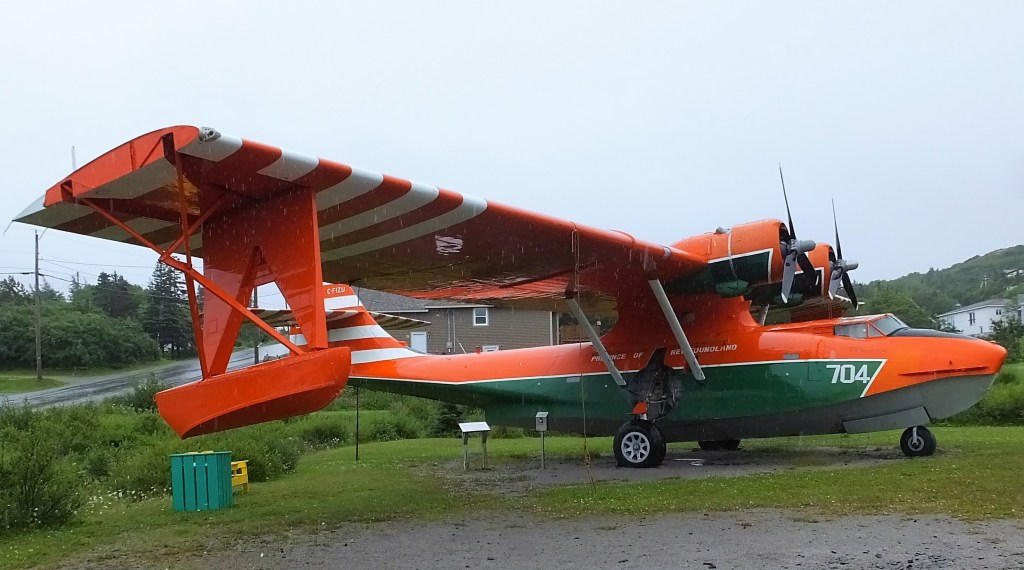
It was raining the next morning, so we drove a few miles into St Anthony, the largest town on the north tip of the peninsula.  Although we decided not to hike several of the interesting looking trails in the area (guess we are fair weather hikers), we did avail ourselves of several civilized amenities such as a grocery store and gas station!  We were intrigued by a restored plane in a small city park.  The plane, a water bomber, is a memorial to two local pilots who lost their lives several years ago in a similar plane while dropping water on a forest fire out west. This was touching and unexpected RabbiTRAIL.

A nicely restored CAS water bomber

By evening, the rain stopped, and we contemplated our visit to LAM.

L’anse aux Meadows view

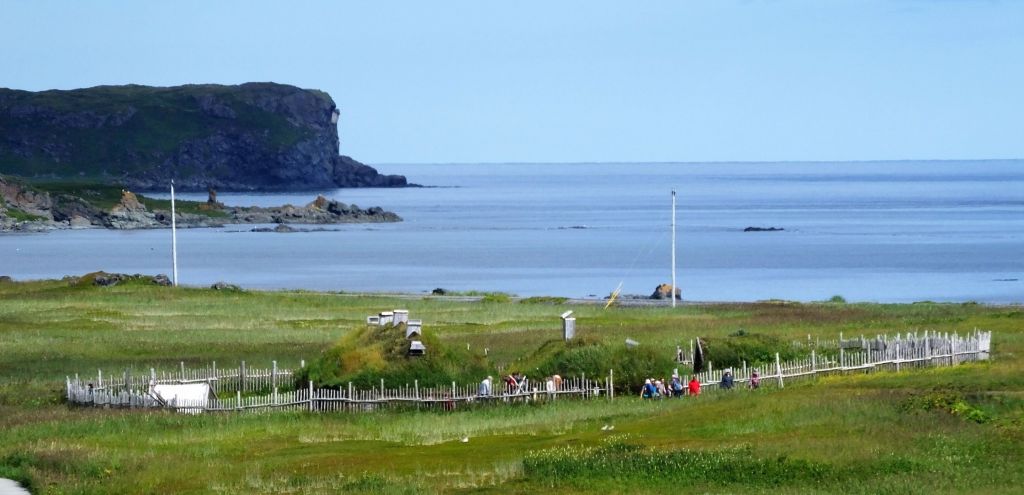
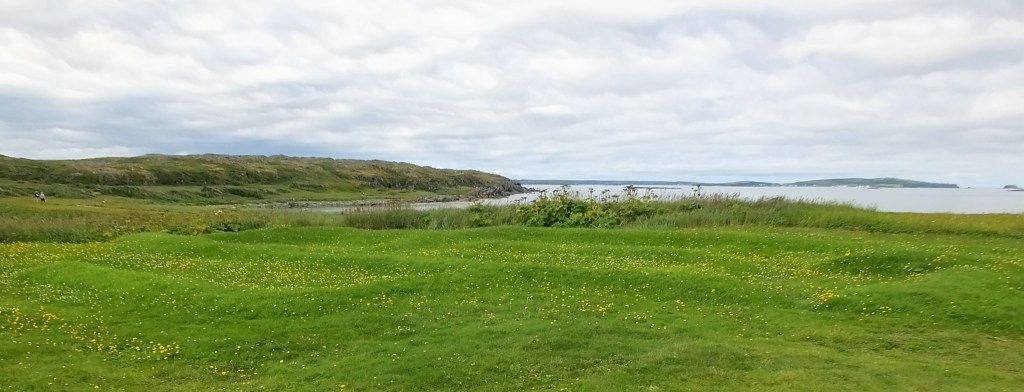
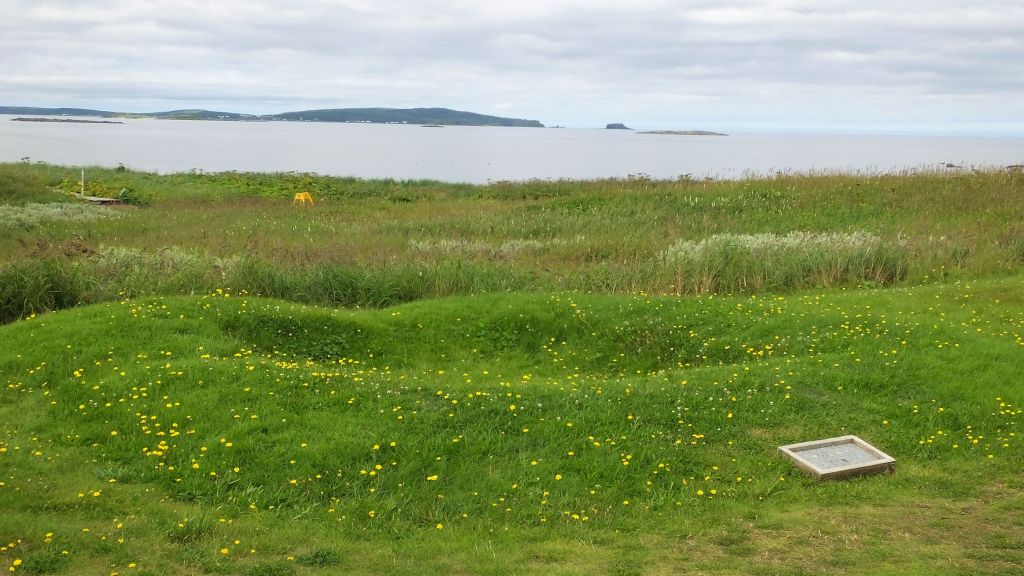
At the visitor center we learned LAM is the only confirmed Viking settlement in North America, dating to about 1000 years ago.  The turf structures excavated at the site resemble those in Norse Greenland and Iceland of that timeframe.  There is evidence of woodworking and iron production, likely for ship repair.  LAM represents the connection of eastward migrating peoples across North America with those from Europe.

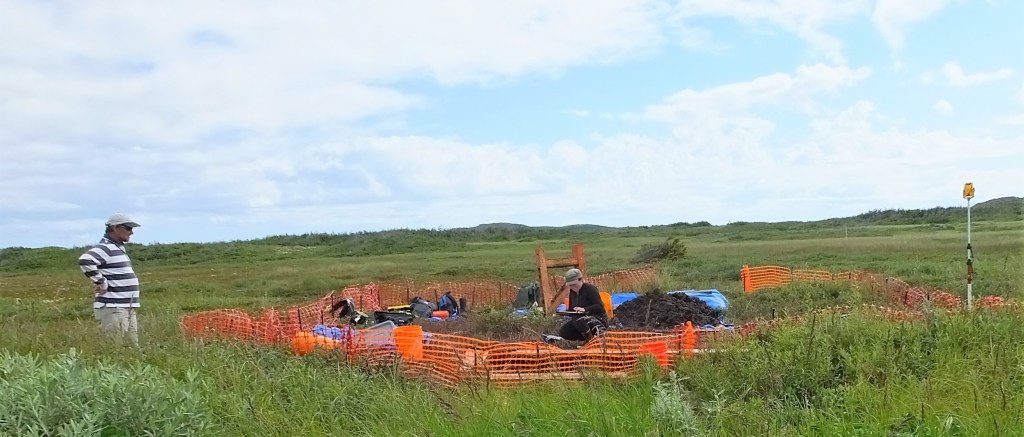
Current excavation

The visitor center overlooks the site, where there are several mounds and depressions of where the settlement was located.  One is currently being excavated.  The site is a short distance from the Strait of Belle Isle shoreline.  Across the strait is Labrador, and during the spring and early summer, icebergs are often seen.   We visited in mid-August and the ‘bergs were gone by then.

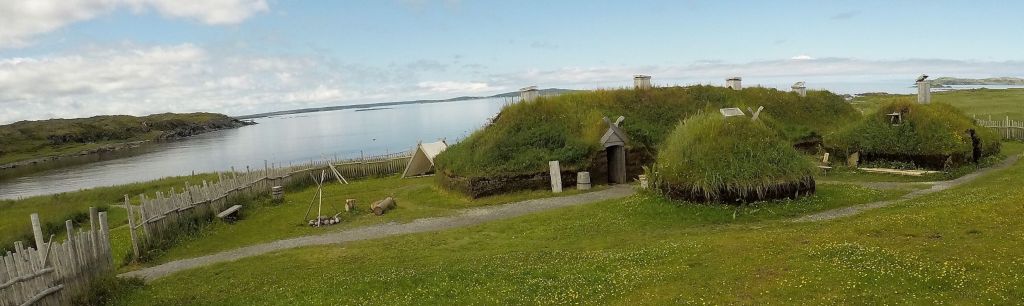
Recreated Viking longhouse – no Hobbits present

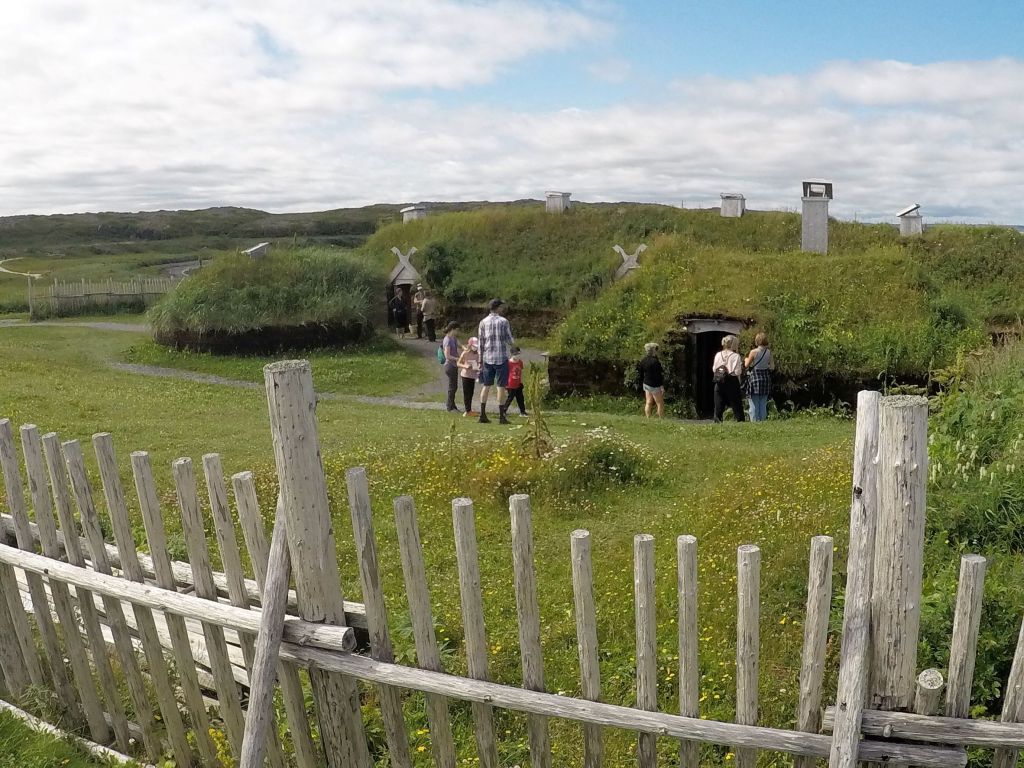
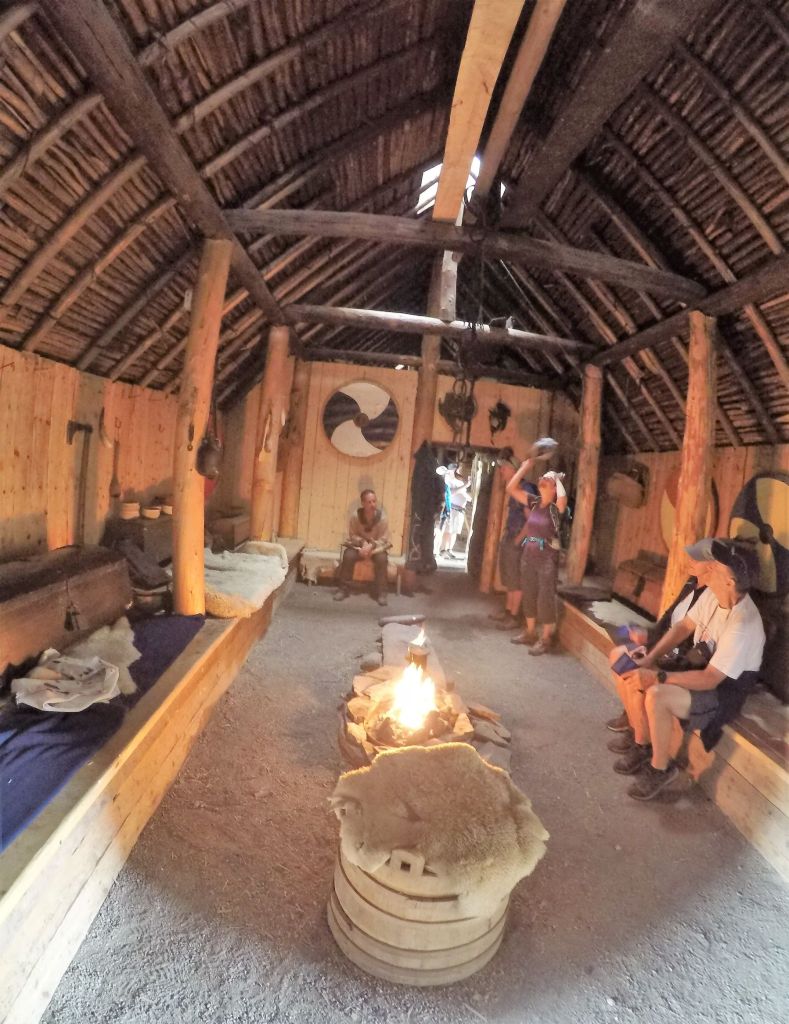
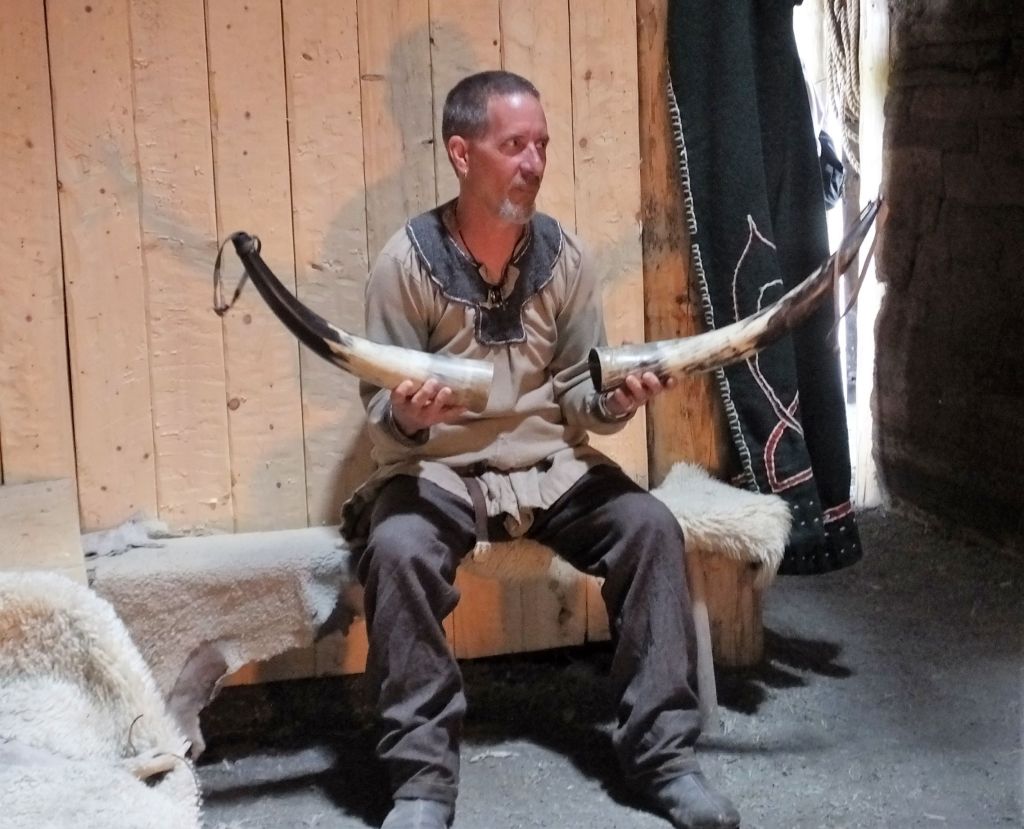
A Viking longhouse, recreated based on findings from the nearby mounds, can be toured at the site.  The longhouse is a bit reminiscent of the Hobbit houses in Lord of the Rings. 

Longhouse visitors

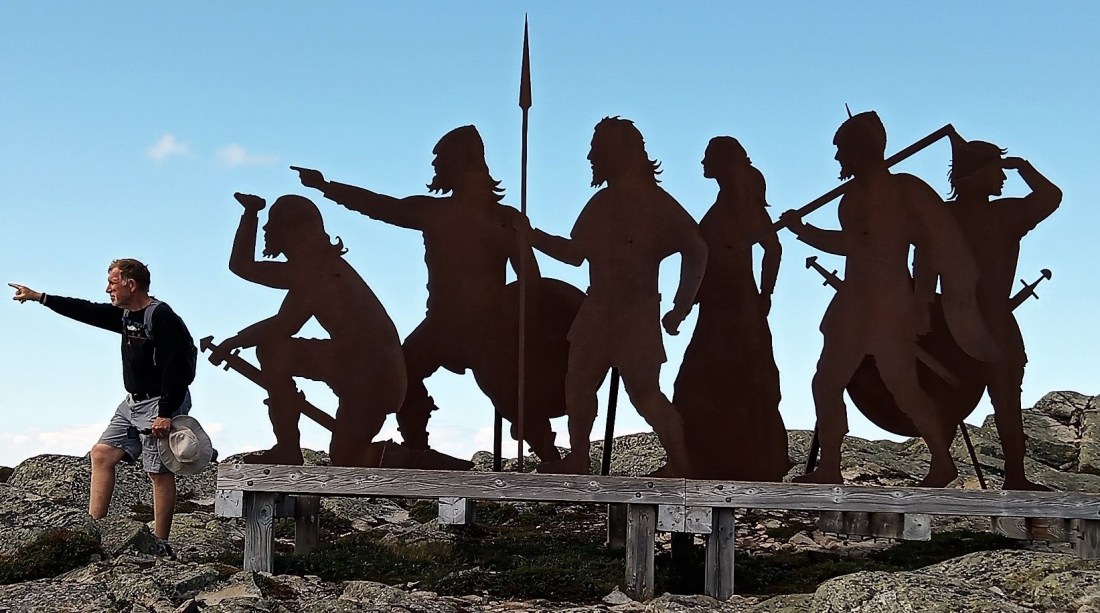
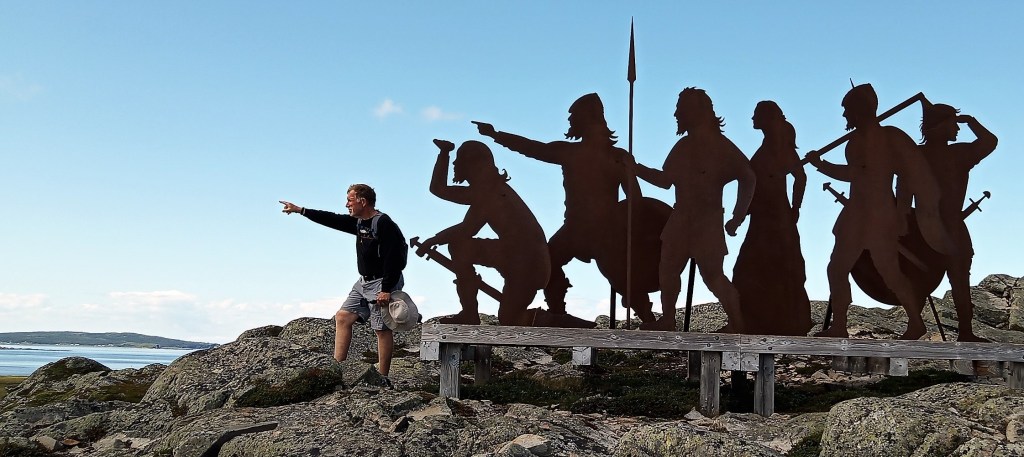
We hiked a two-mile trail around the site, enjoying views of the shoreline and berry-filled meadows.  The trail ended atop a small hill where a steel sculpture of Vikings overlooks the site.

Seashore near LAM, where the sea meets the sky
Becoming part of the LAM Viking sculpture
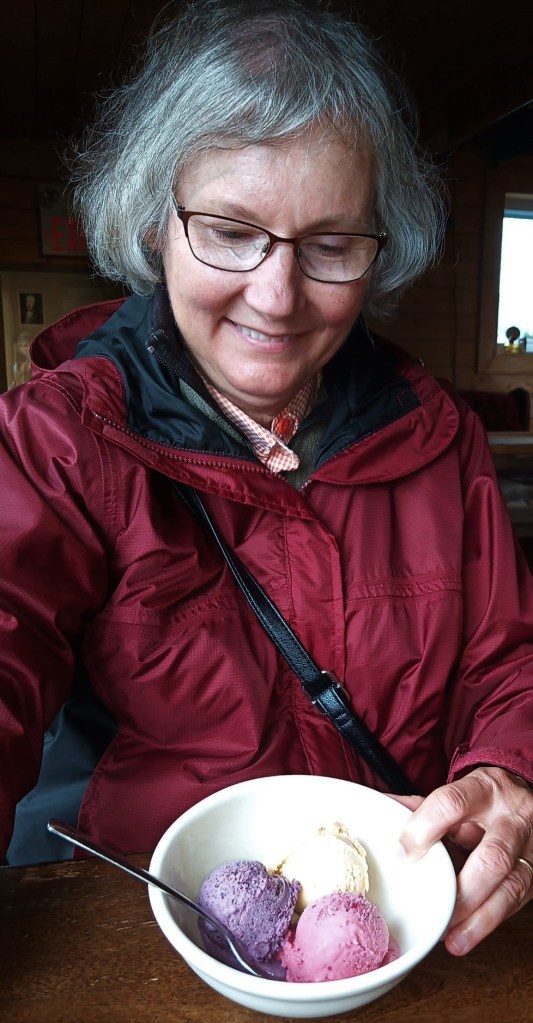
Wild berry flavored ice cream

Later that afternoon, we visited several small towns along the seashore.  There were fishing boats, lobster traps and such, a reminder of daily life in the area.  At Emily’s Crafts and Jams, within eyesight of LAM, we bought crowberry jelly and learned that while all of the owner’s children live and work in the area, her grandchildren have moved away to work in larger towns and cities.  Other Newfoundlanders share similar stories – a harbinger that NF’s small towns will get ever smaller due to our changing way of life.

We stopped at Dark Tickle Company in Saint Lunaire-Griquet. where they produce jams, sauces, chocolates and more from wild berries of NL and Labrador.  ‘Dark Tickle’ refers to a nearby narrow channel (tickle) surrounded by high hills.  We sampled scoops of berry-flavored ice cream – blueberry, partridgeberry and bakeapple.  Each has a distinctive color and taste.

The Moose and Python Conundrum

What do moose and pythons have in common?  They are invasive species!

Two of 120,000 NF moose

As pythons are to Florida, Moose are to NF.  The antlered mammals, largest member of the deer family, are not native to the island – they were introduced in 1878 and 1904.  Since then, like Burmese pythons in south Florida, moose have multiplied rapidly.  Today NF has an estimated moose population of 120,000.

NF has native caribou, but no deer like the ones throughout the US.   We wondered why, then, there is a sizeable town near Gros Morne named Deer Lake.  I asked several Newfoundlanders about this and got different answers from each person.  One thought the name was related to deerflies that proliferate in the area, another thought it had to do with the indigenous people and their name for caribou, and a third (and apparently correct) was caribou are similar to the reindeer in Europe.  Thus, it was decided to name the town Deer Lake, not Caribou Lake.  There are likely other name theories.      

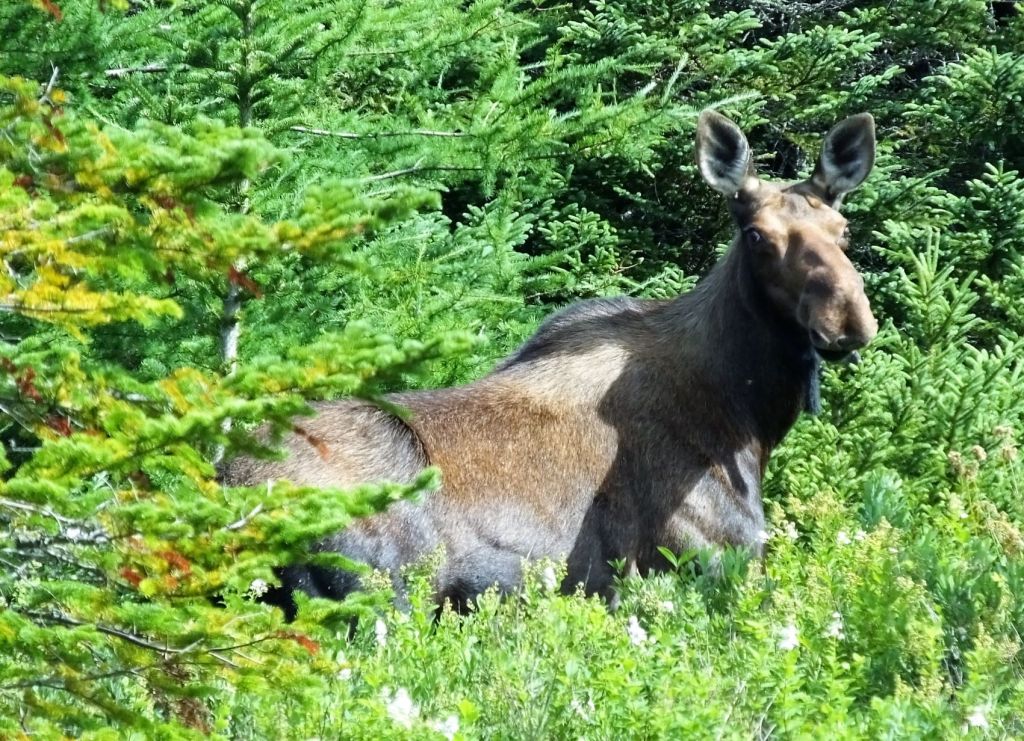
We (actually Pat) saw our first NF moose, a momma and her baby, while on the Western Brook Boat Tour at Gros Morne.  Going forward, we will include a moose and other critter count in RabbiTRAILS.

Two moose
Lots of seagulls, a few ravens and other birds

Next Week:  we decide to leave NF

Mountain Views and Sea Swept Vistas

(2022 Newfoundland Ep 6)

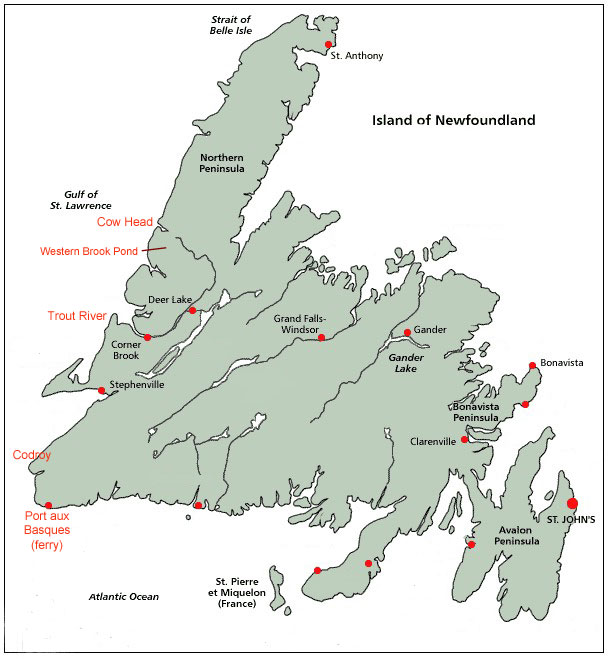
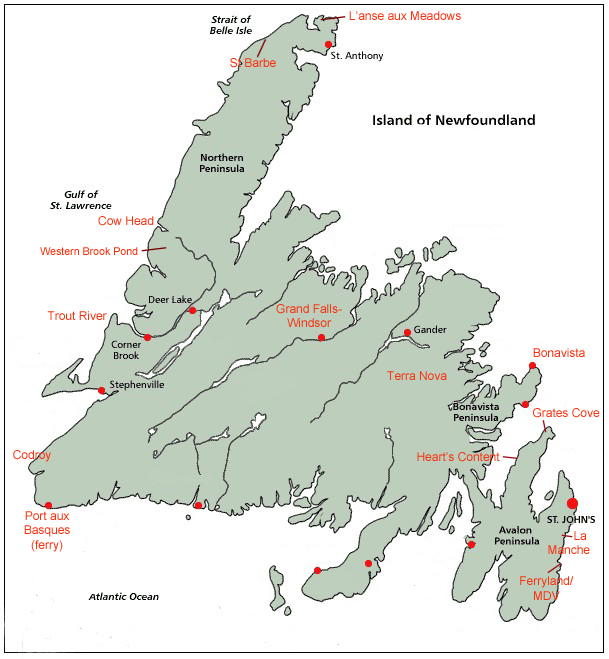
Map of Newfoundland showing some of our stops

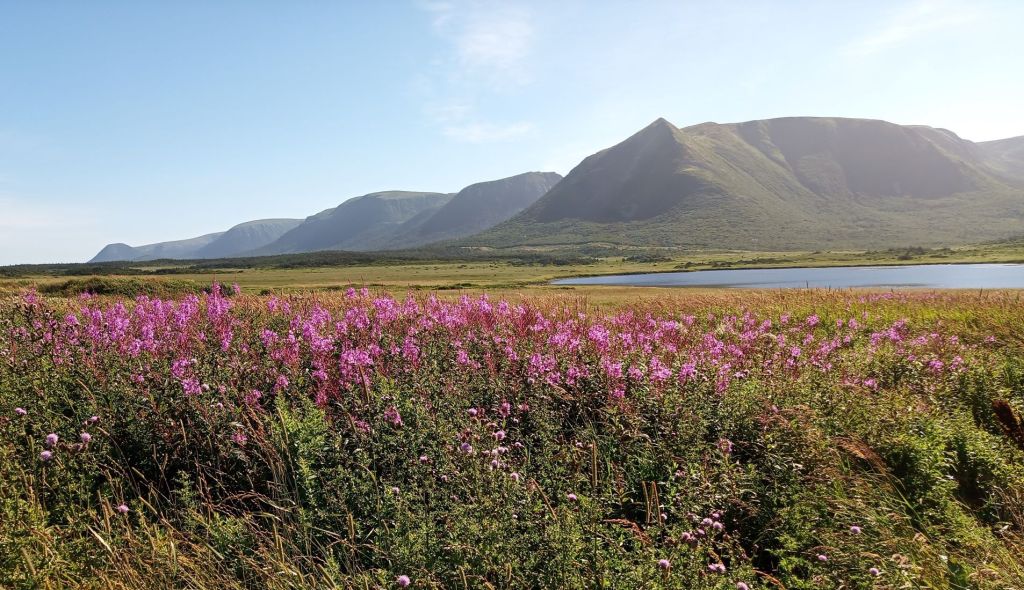
We arrived on Newfoundland (NF) early on August 6 after a redeye ferry ride from Nova Scotia.  At a gravel parking lot a few miles from the ferry landing, we cooked breakfast and viewed the Long Range Mountains to the east.  The range is an outlying extension of the Appalachian Mountains – western NF is surprisingly mountainous.

View of Long Rang Mountains across a field of fireweed flowers

We continued to our campsite overlooking the Codroy Valley.  After resting for most of the day, we completed the August 7 RabbiTRAILS blog post.

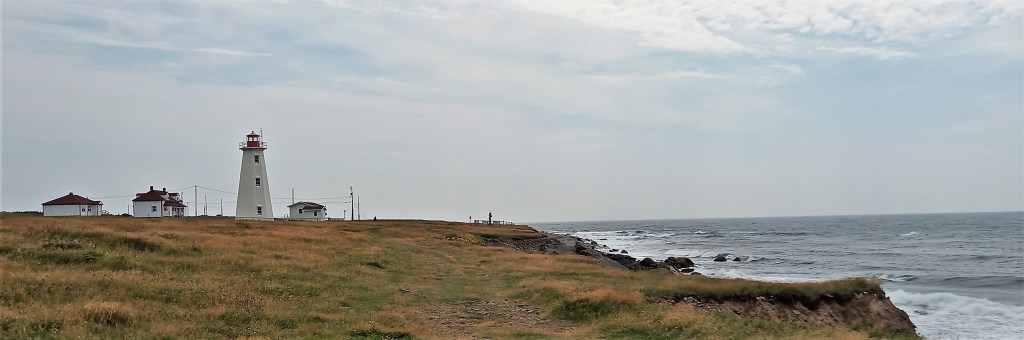
Cape Anguille Lightstation

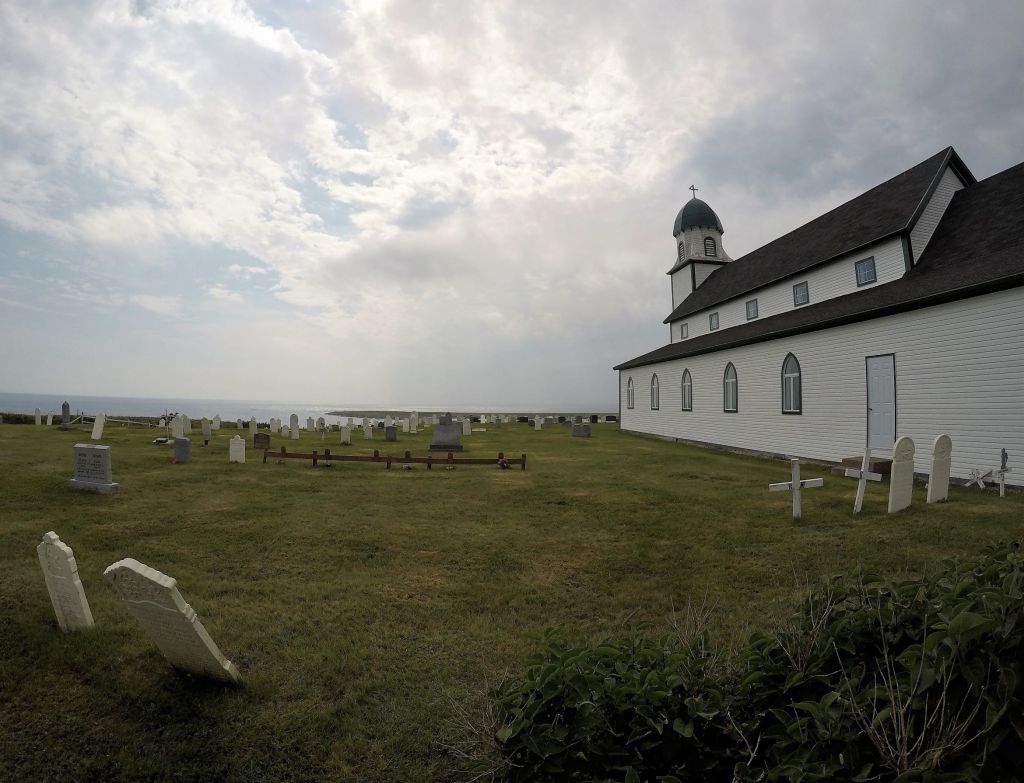
The next morning we drove around the sparsely populated area and visited the Cape Anguille Lightstation on the westernmost point of NF.  We ate lunch and enjoyed the solitude of the windswept place.  Later, we visited a nearby town and walked around a church that dramatically sits on cliffs overlooking the ocean.

Anglican Church at Codroy

The next day our travel plans almost changed.  We were driving towards Trout River Pond in Gros Morne National Park.  As we neared Corner Brook, the largest town in western NF, our tire pressure monitoring system (TPMS) alerted that the right rear tire on Oscar had dropped 20 percent.  We exited the Trans Canada Highway to air up the tire and to go grocery shopping.  As I was getting the inflator ready, the TPMS again alerted the tire pressure had dropped another 5 percent.  Action was needed!
Pat went shopping while I removed the tire.  I rolled the tire over to a Canadian Tire store just across the street. (Thank you, Lord!)   They were busy and couldn’t look at the tire for several hours.  Finally, they called and said they found a fishhook in the tire!  Although a careful check revealed the hook didn’t penetrate the inside of the tire, they redid the tire bead and put in a new valve stem. We’ve had no further problems with the tire. 

I guess Oscar was a big one that got away.

Our trip resumed.  We arrived at the VERY small fishing community of Trout River after 6 pm and followed signs to the nearby national park campground.  We crossed three narrow wooden plank bridges to a gravel road with lots of potholes.  The campground was nowhere in sight. 

We considered turning back to find somewhere else but decided to go a little further.  Shortly we arrived at a very nice campground, home for the next three nights.

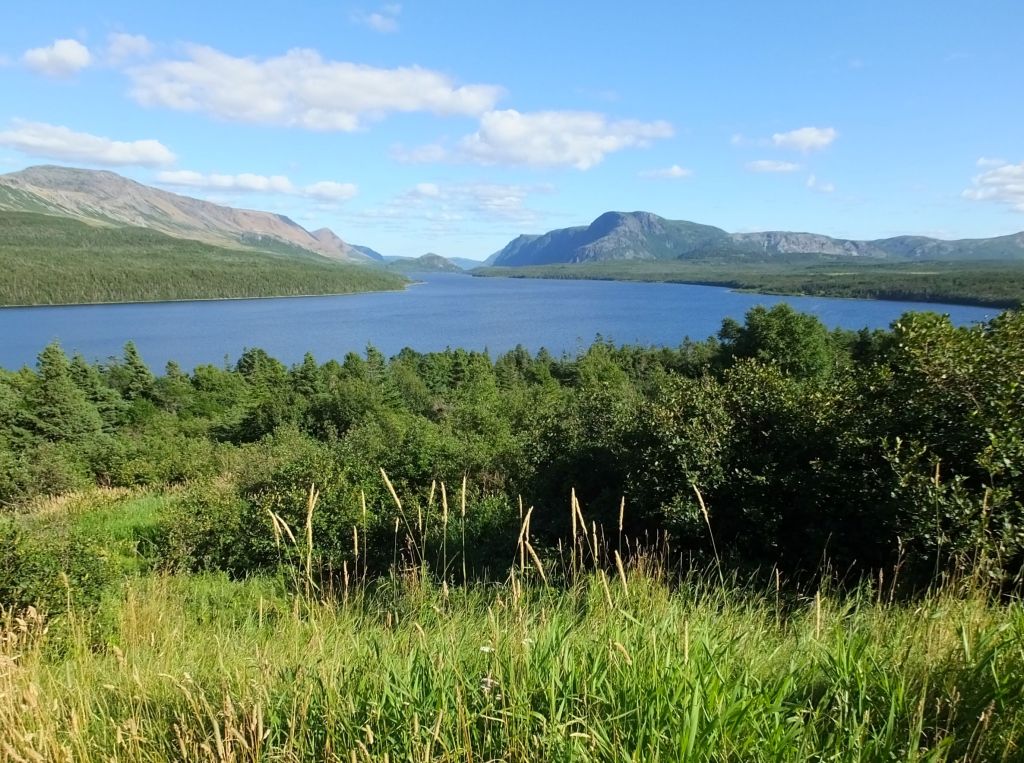
Trout River Pond, near our campground
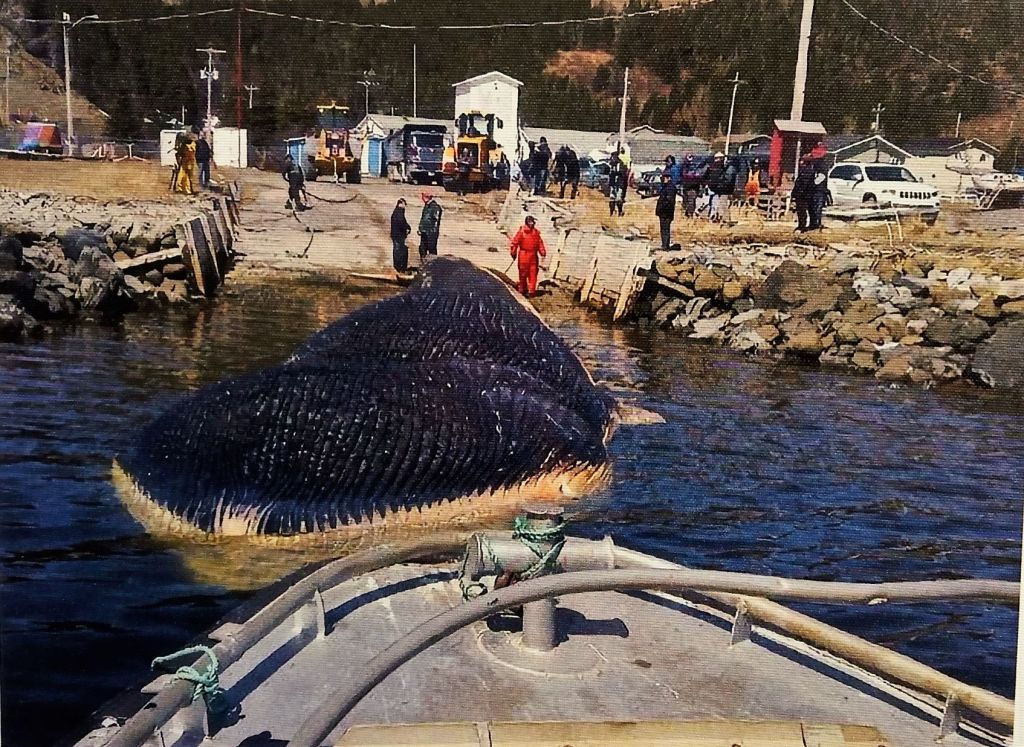
Trout River’s whale of a tale

Trout River’s ‘15 minutes of fame’ occurred in April 2014, when a blue whale carcass drifted to shore coming to rest on an icy beach near town.  By May, the ice drifted off leaving the grounded whale carcass.  After remaining on the beach for several weeks, the massive mammal was towed to another location for ‘dismantling.’   Today, the whale skeleton is on display at the Royal Ontario Museum in Toronto.

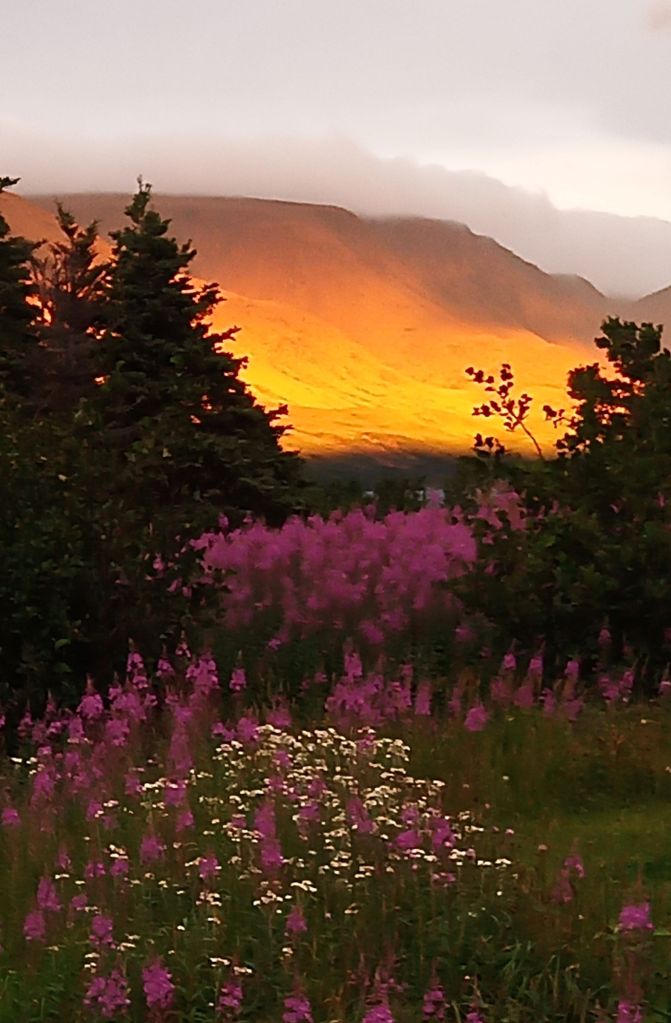
Dinnertime view of flowers and sunshine on the distant mountains
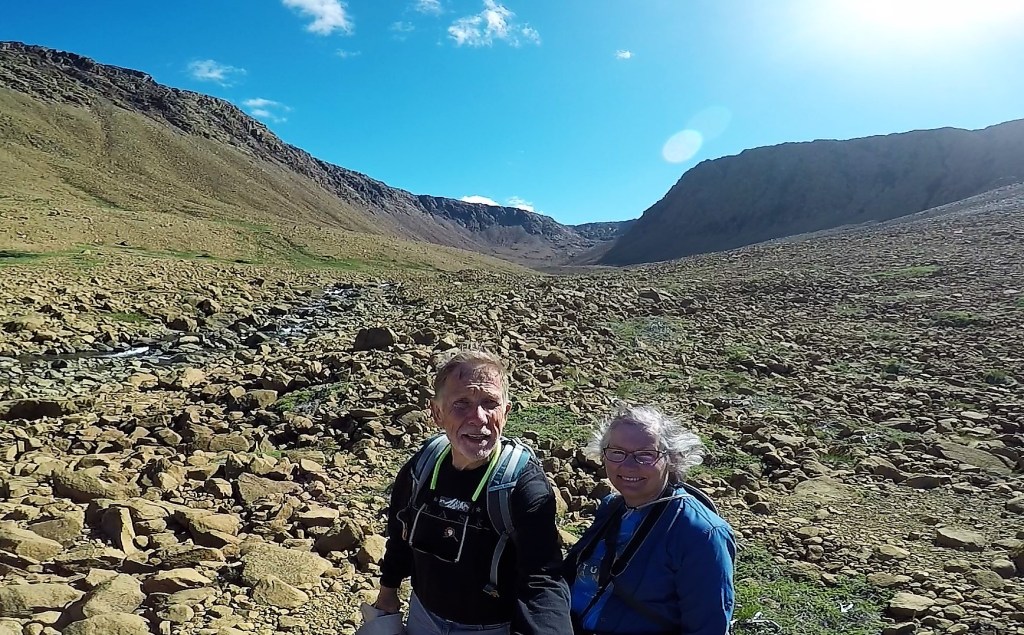
Tablelands selfie

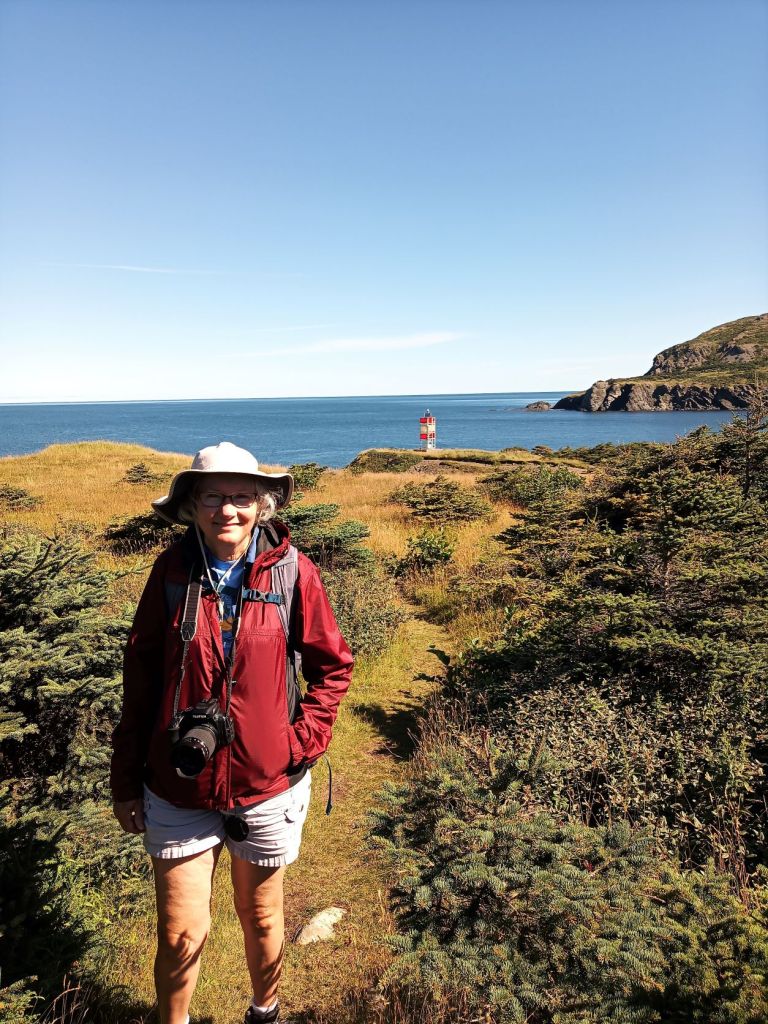
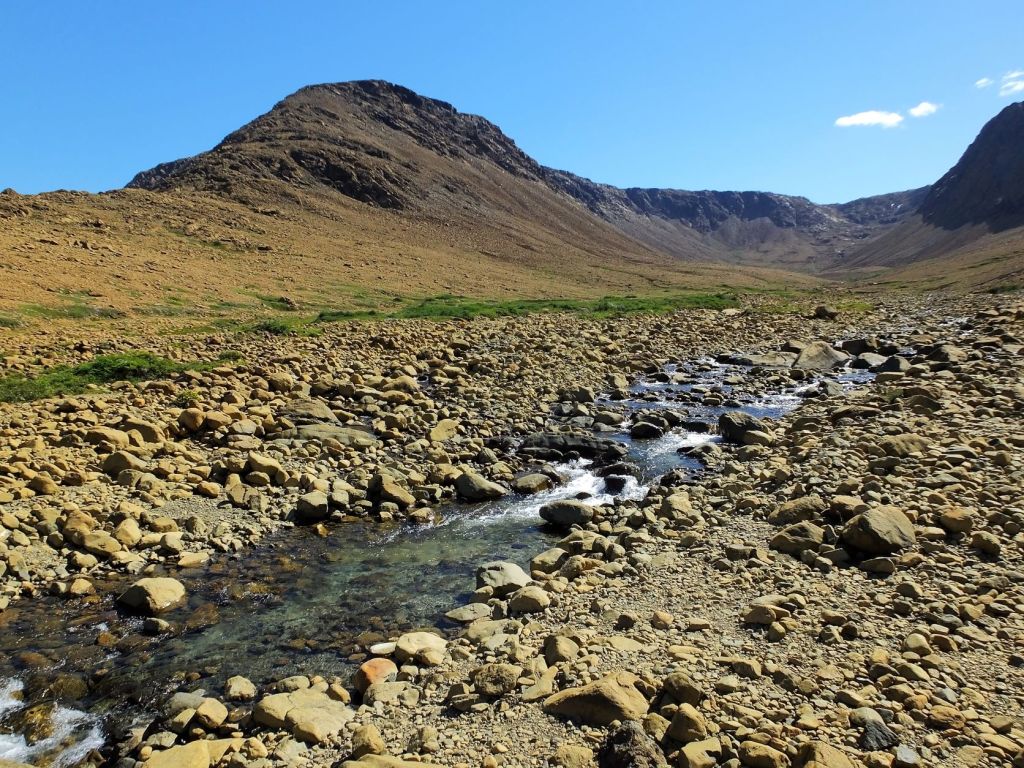
The next day was a three hike day: from Trout River, we hiked to a small lighthouse and then to a remote ocean lookout.  Later, we hiked the Tablelands Trail several miles away.  The mostly barren Tablelands consist of a geological feature found in few places in the world – a mountain pushed up from the earth’s mantle.  Aside from a few areas with small plants and grass, the terrain is barren and is said to resemble the surface of the moon and mars.
A creek flows through the heart of the Tablelands
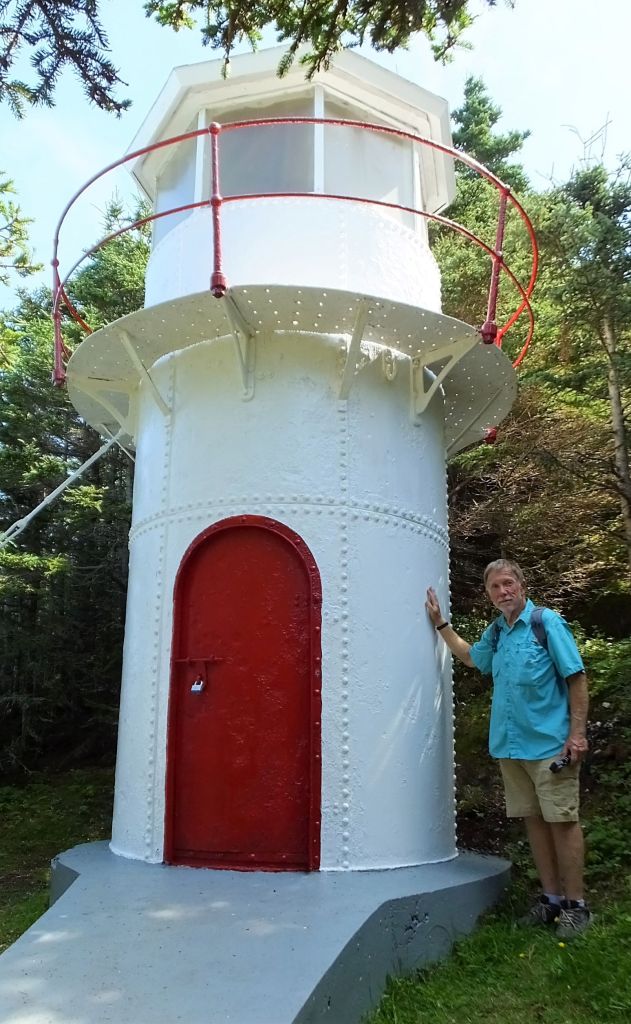
Restored Cow Head Lighthouse

Our travels continued north to a national park campground near Cow Head.  The town got its name for a rock along the coast that an early explorer thought resembled a cow’s head.  We biked to town and then across a small spit of land to an island, where the inspirational rock is said to viewable from the Point of the Head trail.  We looked and looked and couldn’t find any formations that resembled a bovine skull.  The hike was beautiful anyway.

Point of the Head vista – no Cow Heads in sight

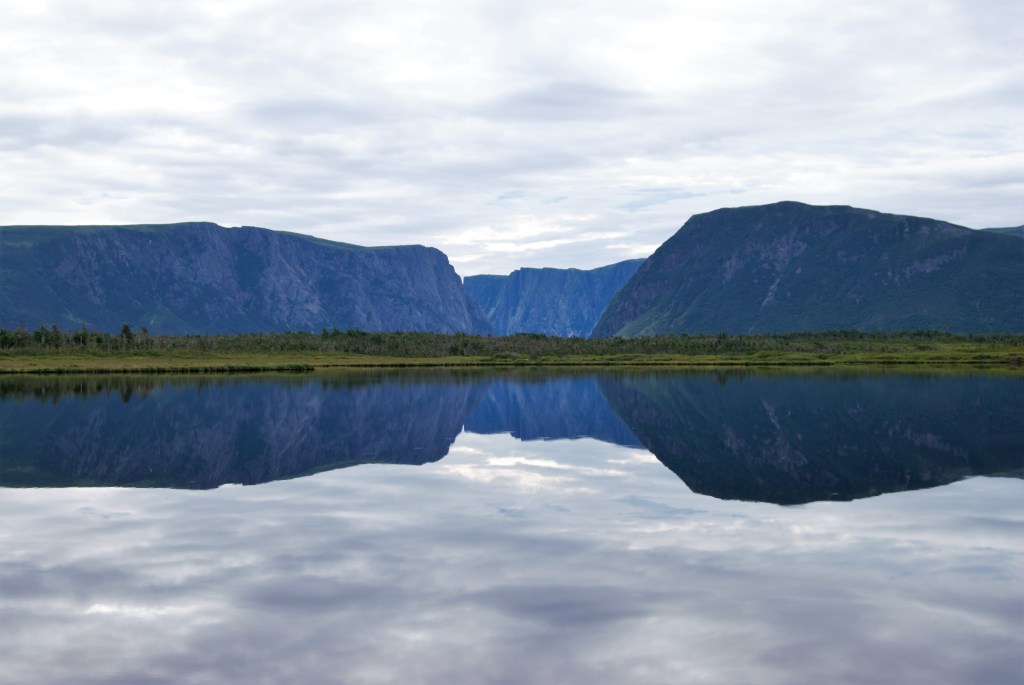
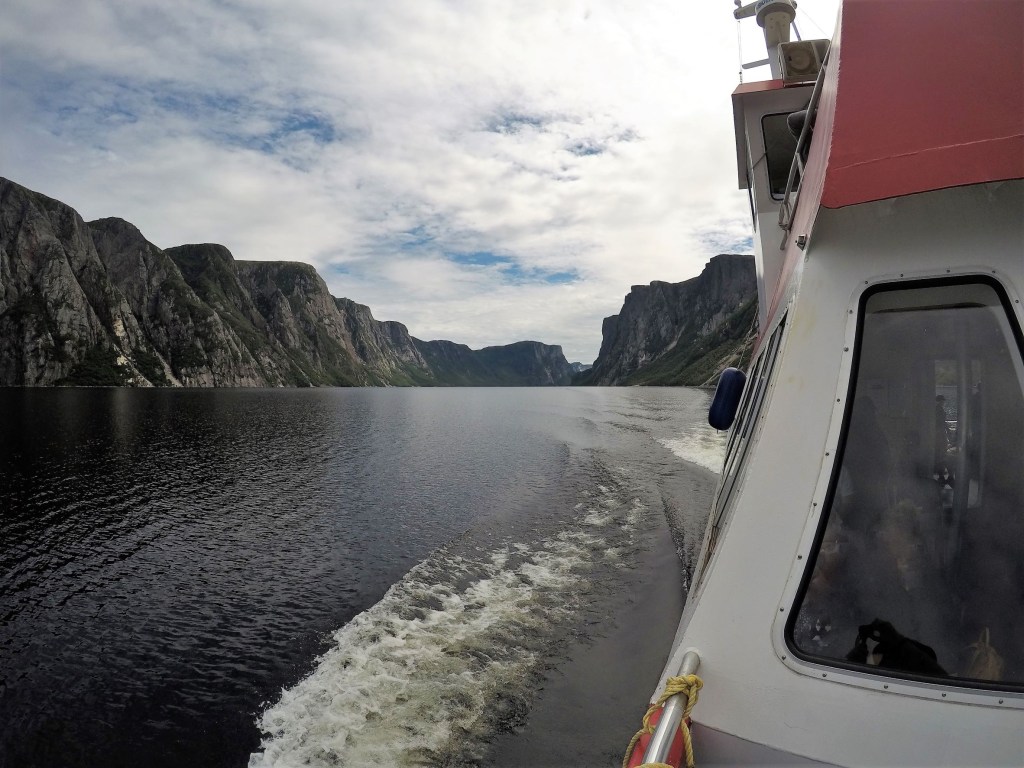
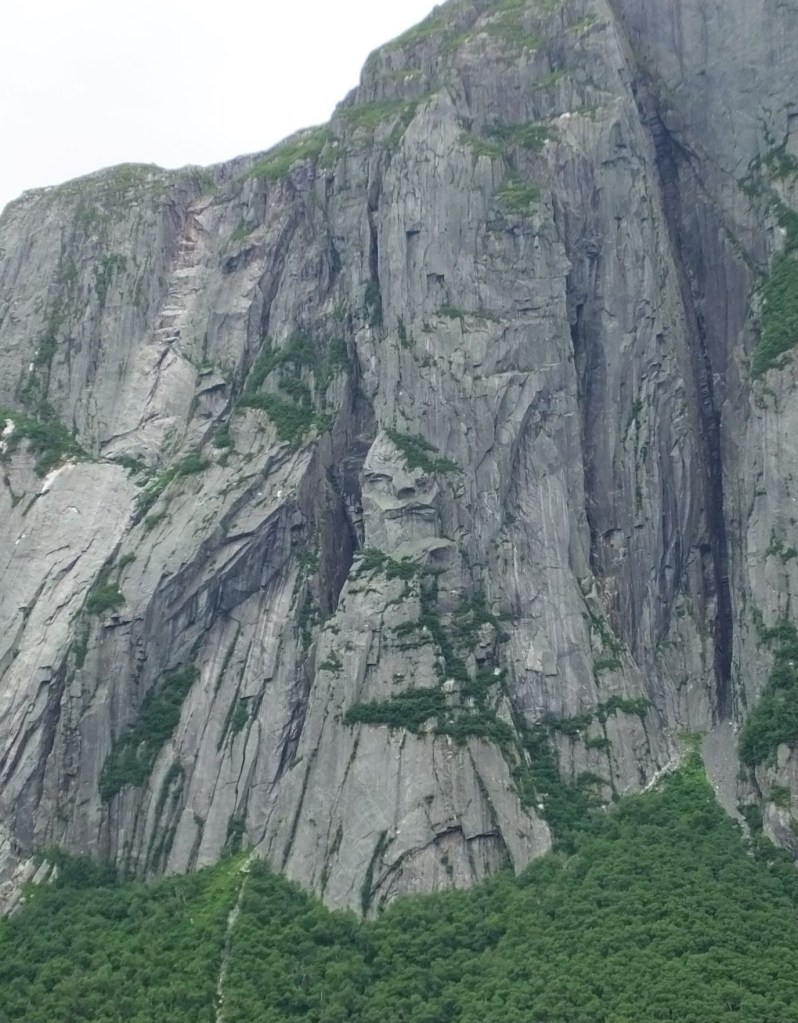
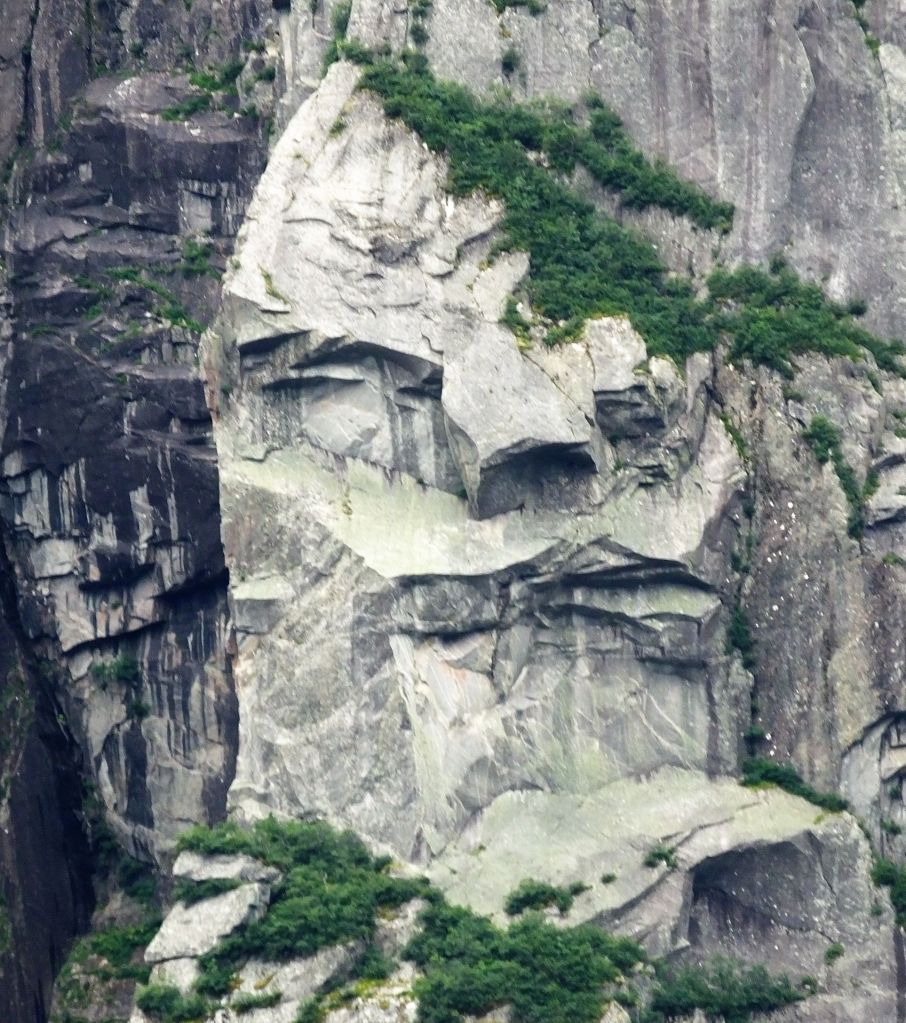
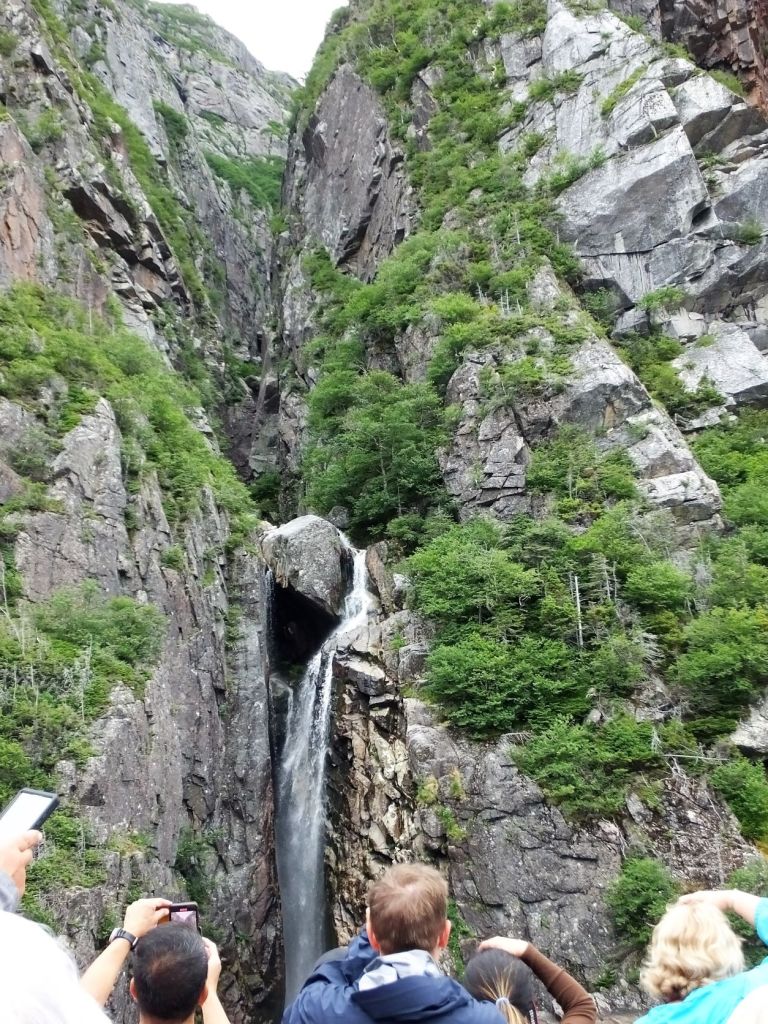
While at Cow Head, we enjoyed one of ‘top 10’ things to do while on NF – the Western Brook Boat Tour.  After a 1.8 mile hike from the parking lot, our morning boat ride started on the mirror smooth pond just west of the Long Range Mountains.  The trip took us nearly ten miles into a narrow freshwater fjord with two thousand foot cliffs on either side.  We learned the pond has a maximum depth of 541 ft and is ultraoligotrophic, low in nutrients so it supports a few slow growing plants and animals. 

Reflection of distant mountains at start of Western Brook Boat Tour
View from the boat

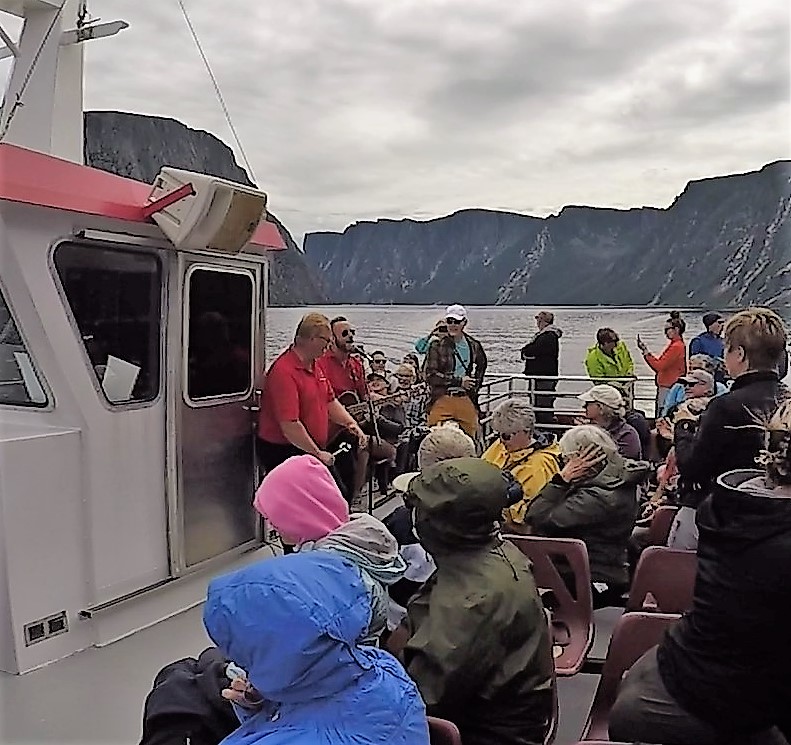
As we returned to the tour starting point, patches of sun broke through the clouds.  As the ride ended, we were entertained with an impromptu performance of NF folk tunes by the boat’s talented crew.

NF music on Western Brook Pond

Next week:  learn what moose and pythons have in common, the significance of a Viking settlement at the northern tip of NF, and why we decide to leave the island.    

High Tides and Redeye Rides

(2022 Newfoundland Ep 5)

After two and a half weeks and 2425 miles, we arrived in Canada, crossing the border between Calais, Maine and Saint Stephen, New Brunswick.  The crossing was uneventful.  We used ArriveCAN, a database and phone app, where we uploaded our passport and Covid immunization information. Should you have plans to visit our neighbor to the north, we suggest completing the ArriveCAN information to avoid delays or other issues.

Our first night in Canada was near Saint Stephen and the next day we continued to Fundy National Park. 

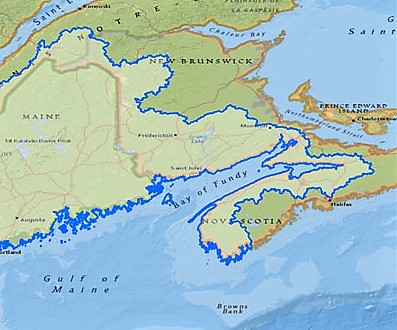
Fundy NP is situated on the Bay of Fundy, between New Brunswick and Nova Scotia provinces, and is home of the highest tides in the world. 

Fundy beach wanderers at low tide

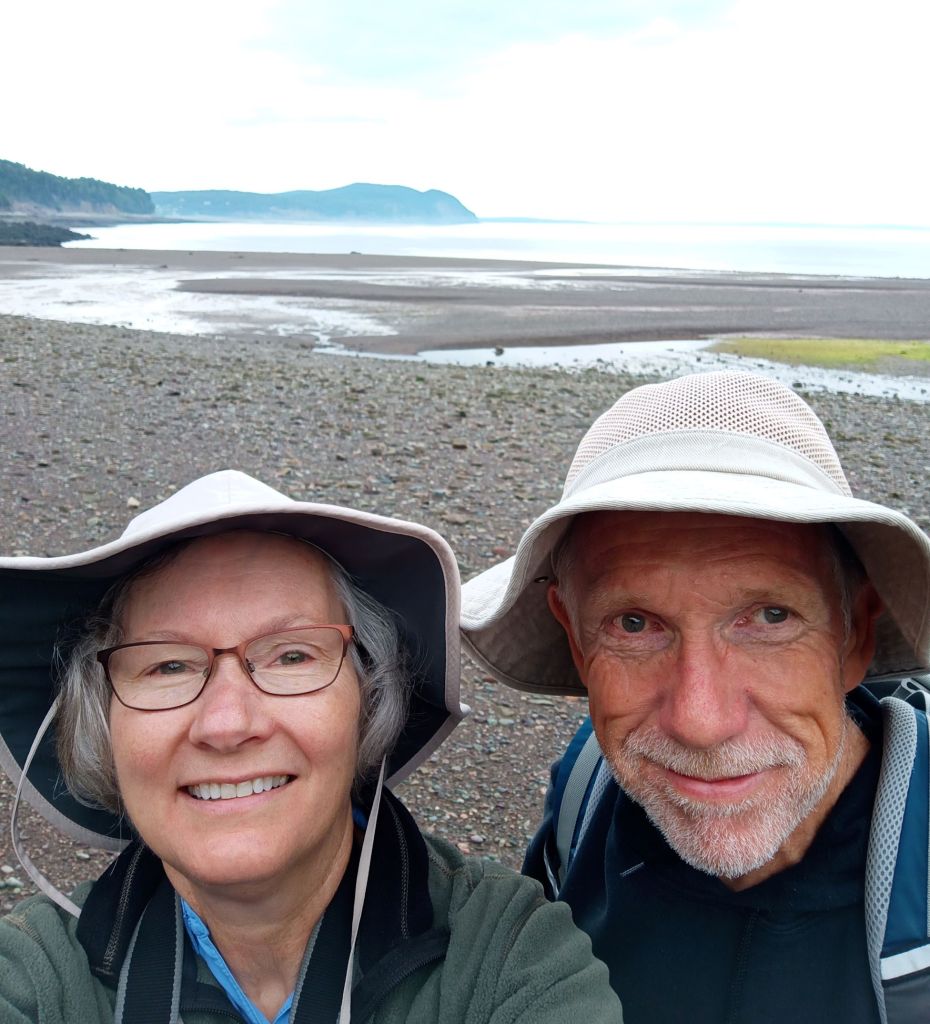
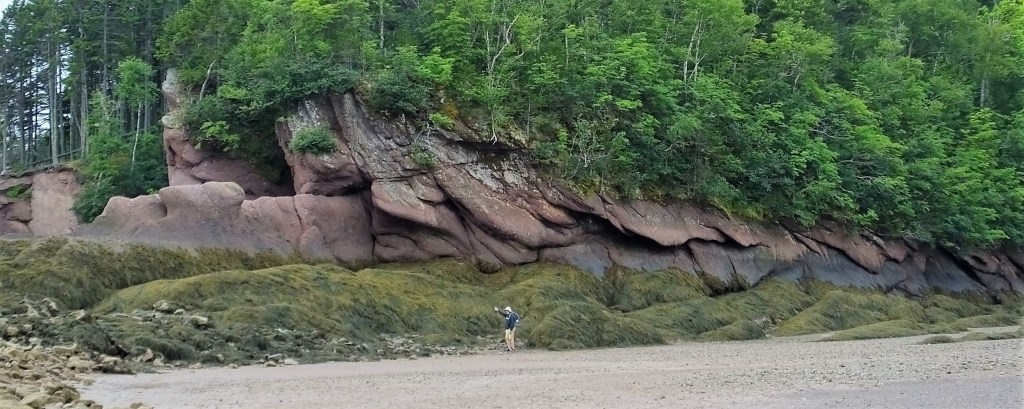
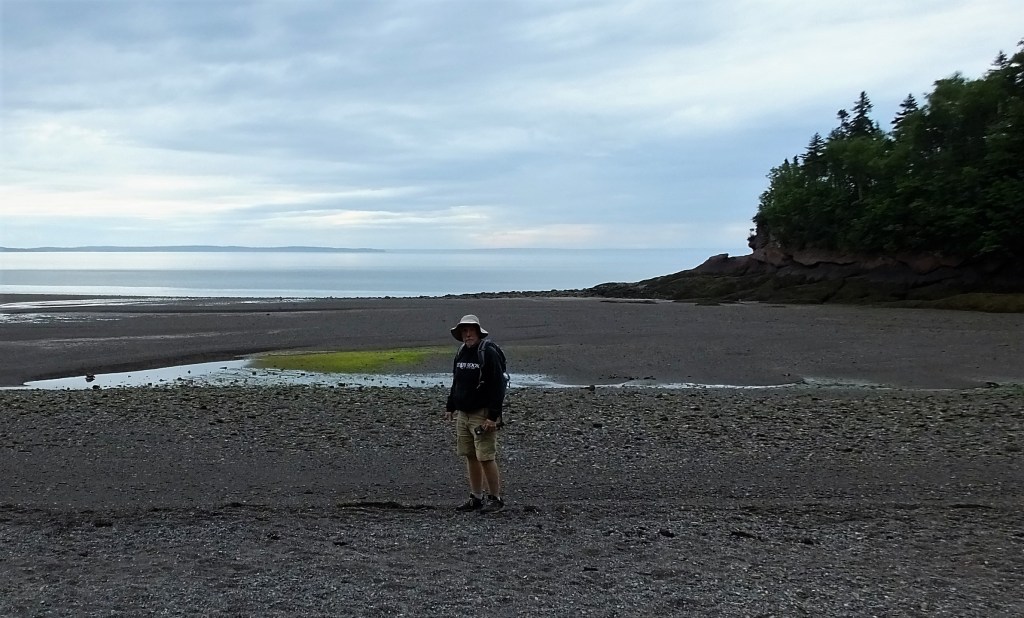
From a grassy bluff above Herring Cove Beach, we descended more than 150 stairs and found ourselves alone on a quiet and serene beach.  It was low tide and the edge of the water was more than 200 yards away.  Above the beach were the natural rock walls of the bluff and we could see where the tide would rise on the rocks over 50 foot above! 

Pointing to the high tide line far above
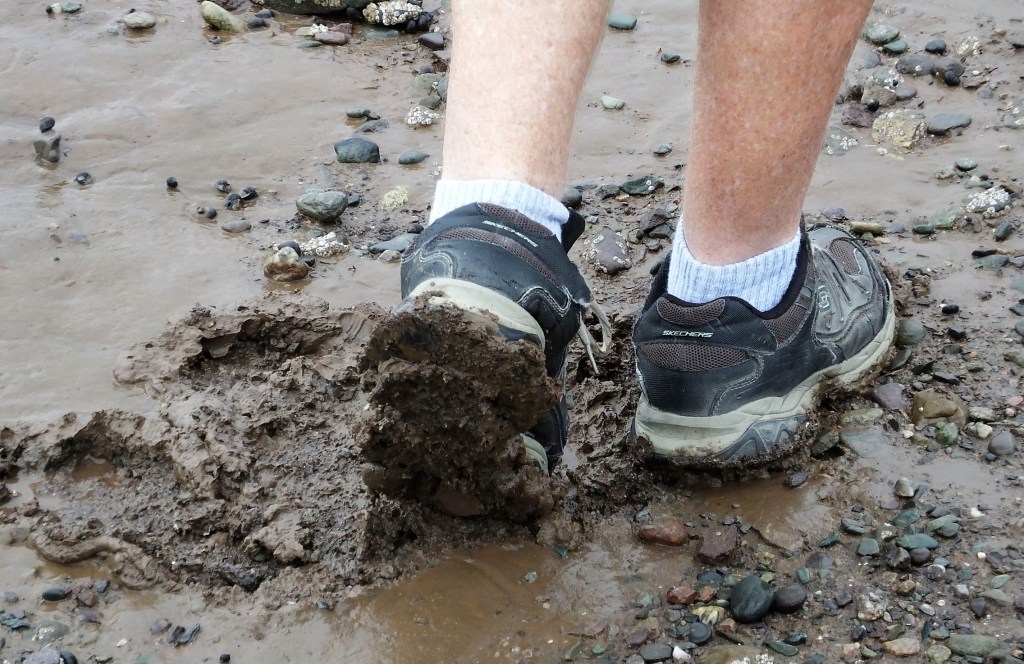
Some areas between the low and high tide lines consisted of thick muck!

The tide started to come in. Rocks and mucky areas visible just a few minutes earlier were soon under water.

Twice each day an estimated 100 billion tons of water flow in and out of the bay – more than twice the combined total flow of the world’s rivers over the same period.  The tides rise and fall an astounding 52 feet!

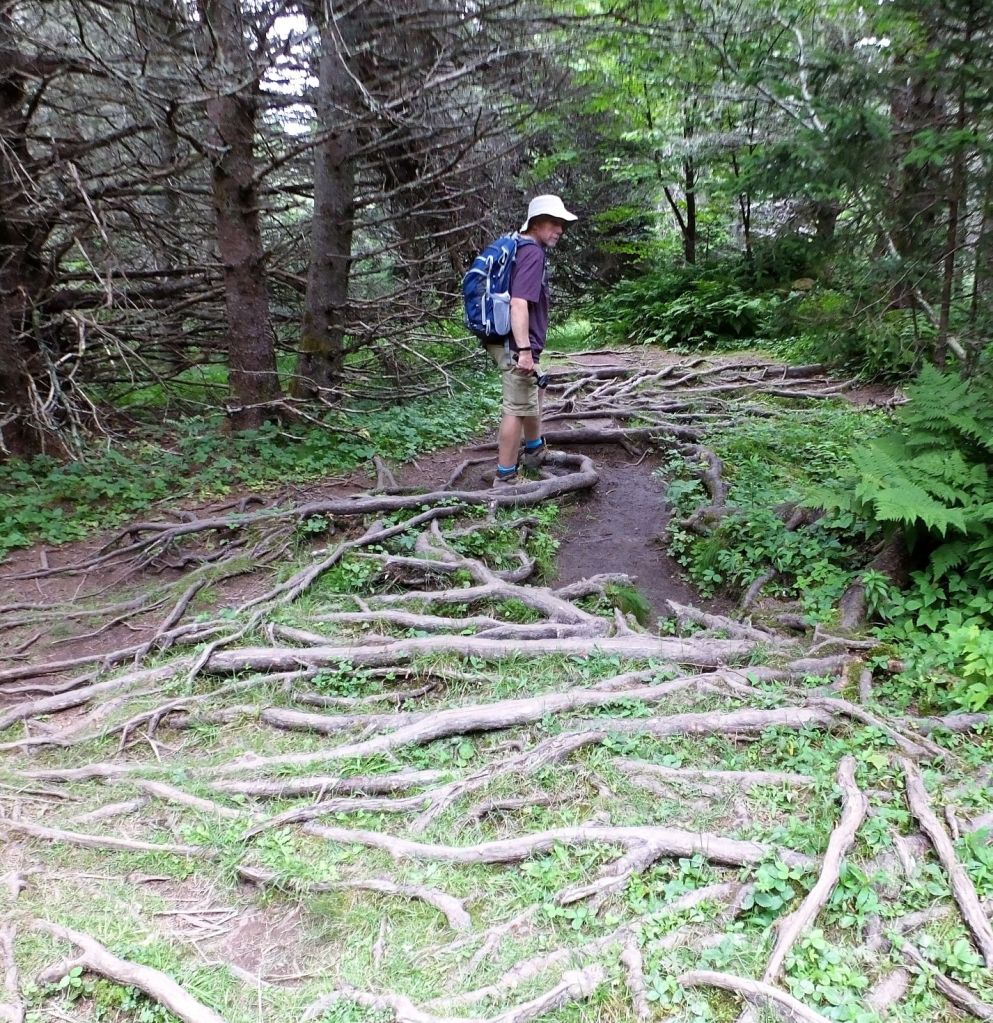
Leaving the beach, we climbed the stairs to hike the Matthew’s Head Trail.  The trail follows the bluff above the bay for more than a mile.  We enjoyed our lunch and a beautiful view.  Not wanting to repeat an unfortunate hiking experience at Grand Teton a couple of years ago when I tripped and dislocated a finger, we had to proceed slowly and carefully due to many exposed tree roots and rocks on the trail.  We are thankful we completed the trail with no mishaps!

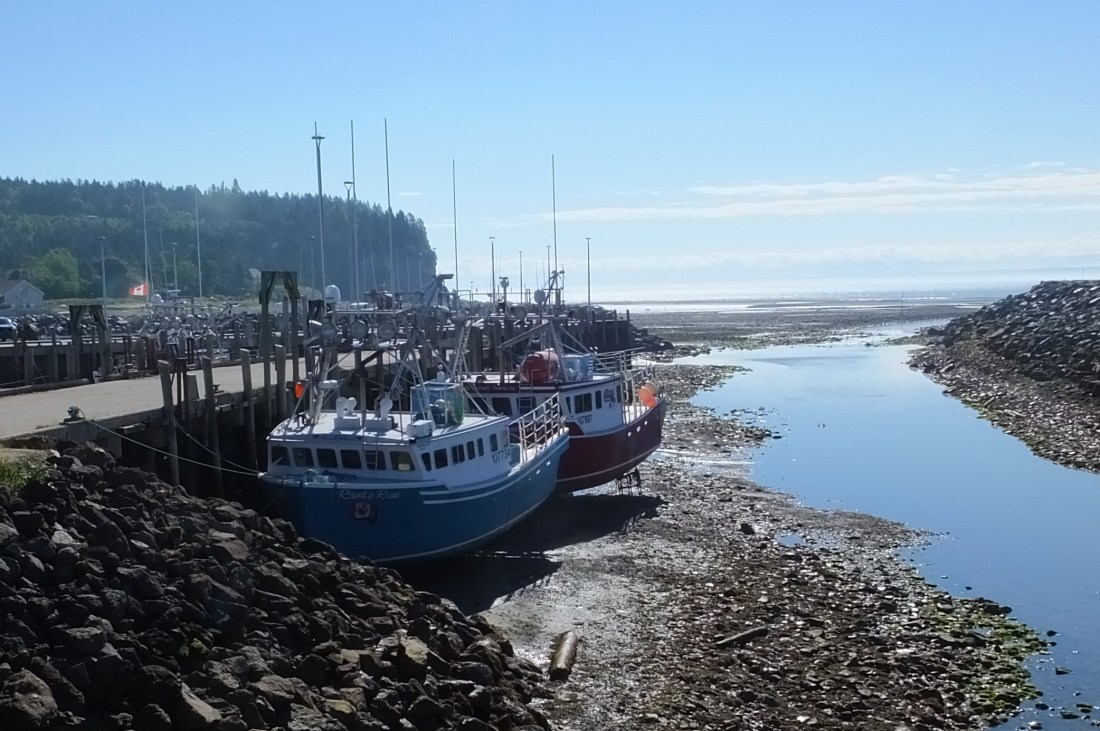
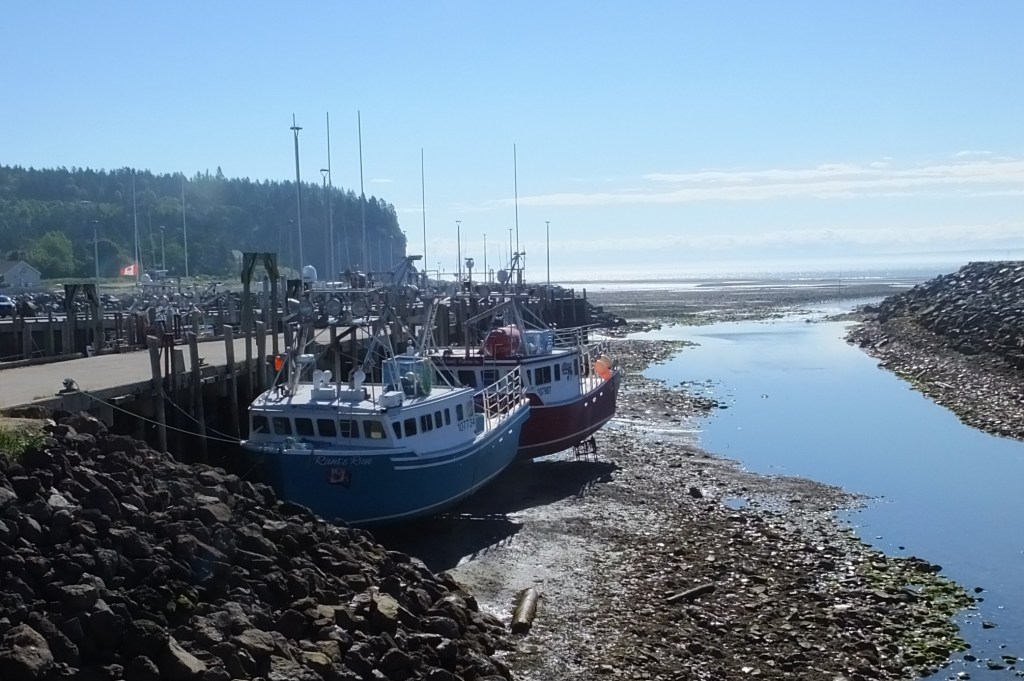
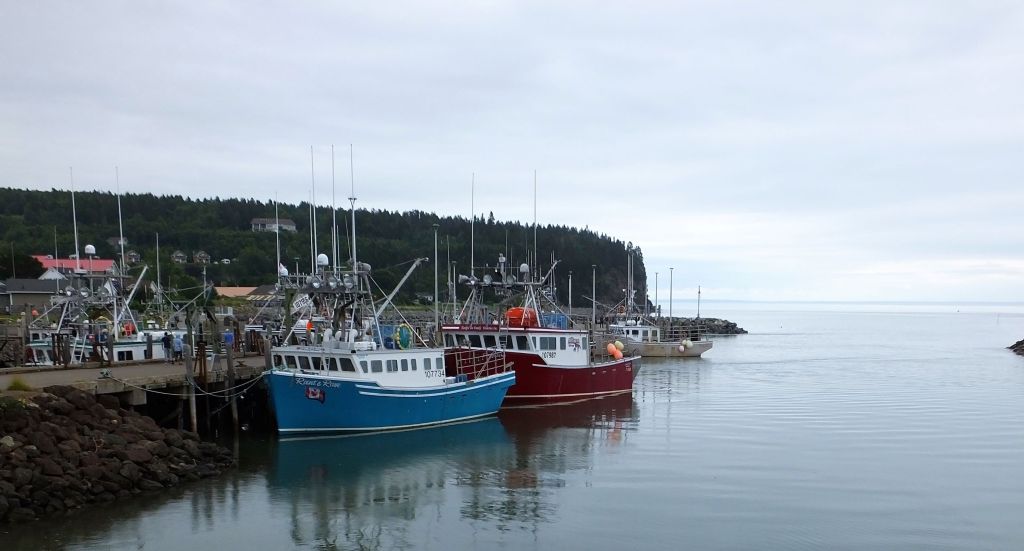
After our hike we drove to Alma, a small town just outside the park, to look around.  We noticed several colorful fishing boats propped up above the water far below. 

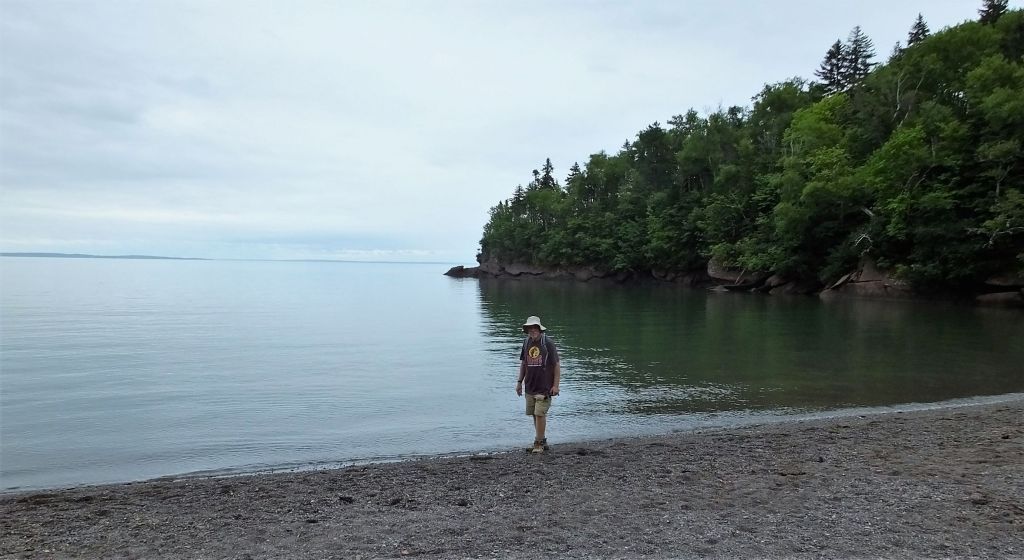
We returned to the beach at high tide and stood at the high tide line again. It was amazing how different the beach looked.  Back in Alma, the once propped boats where now floating on a wide tidal creek. 

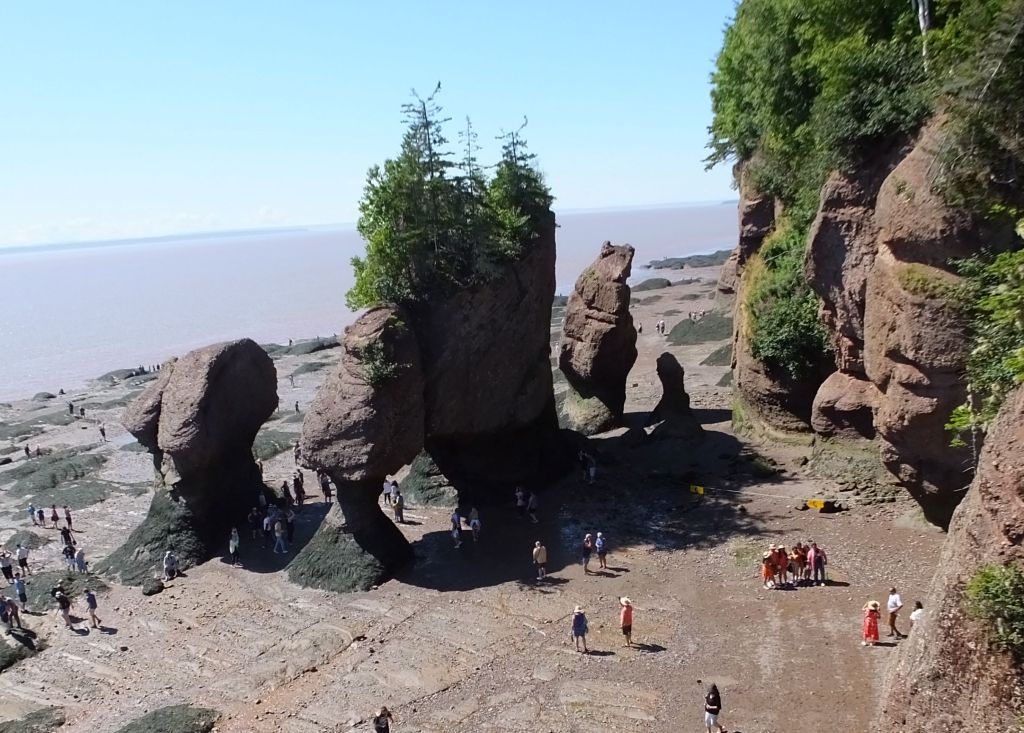
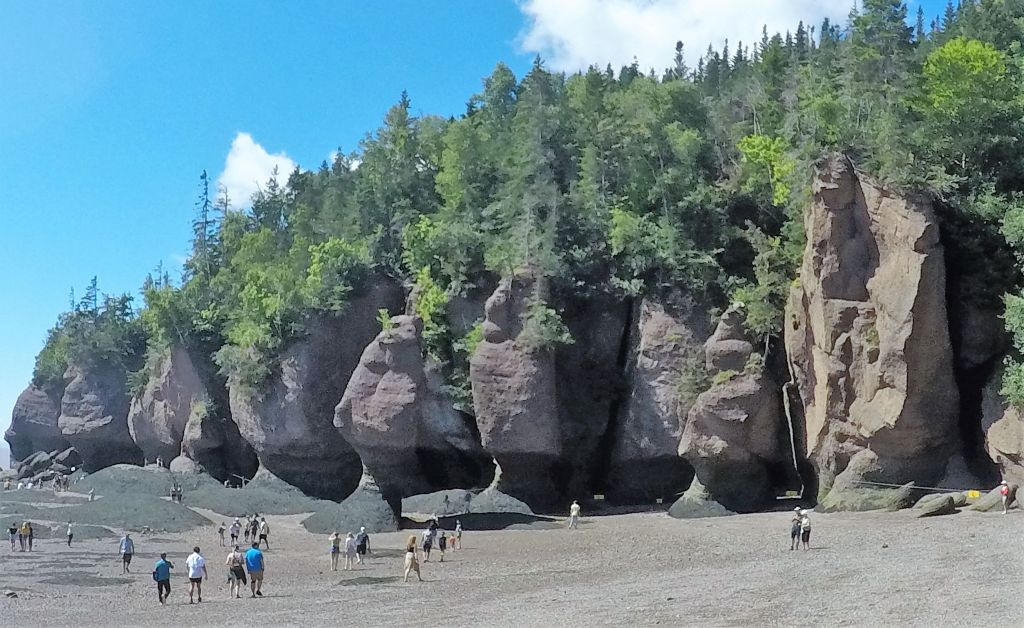
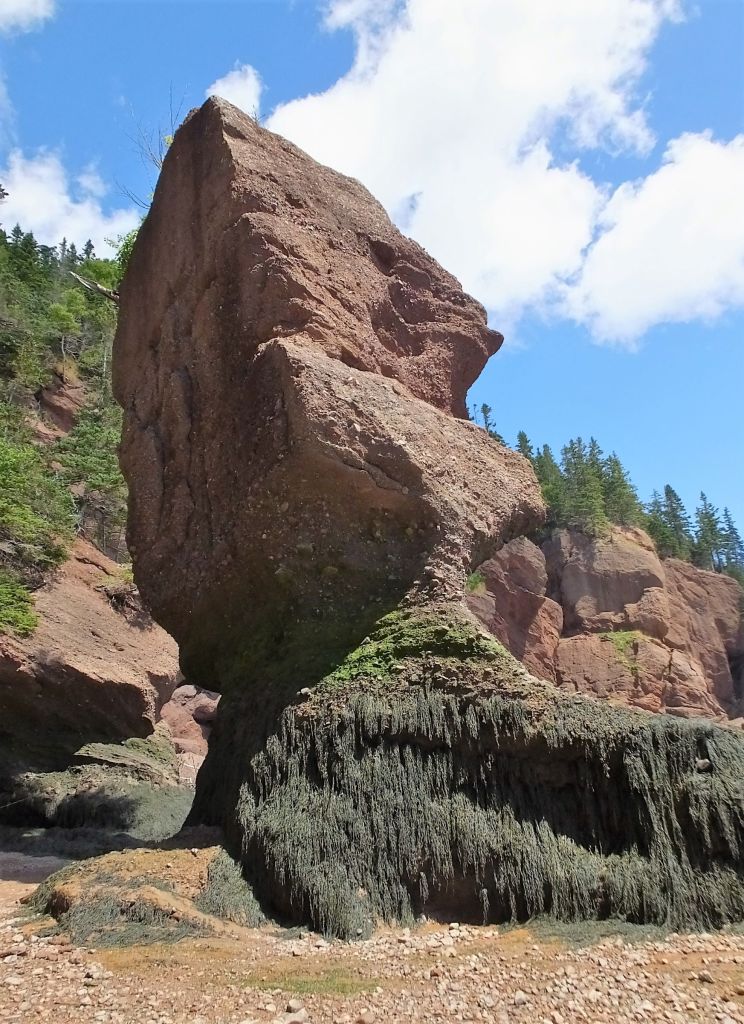
The next day we visited unusual rock formations at the nearby Hopewell Rocks Provincial Park.  The rocks were formed by the rising and falling tides, and reminded us of Bryce Canyon and Arches National Parks. There were tall ‘hoodoos’ nearly a 100 feet high. 

Hopewell Rocks

We were surprised to see dozens of people lined up to buy tickets to see the rocks – the park is very popular.

We picked and enjoyed wild blueberries with Greek yogurt

We camped the next two nights at the Earltown, Nova Scotia farm residence of Andrew and Patty Morrow.  They invited us for an amazing breakfast, and we later walked their property and then a short distance into town.  We couldn’t resist purchasing a loaf of fresh cranberry-blueberry-raisin bread at the Earltown General Store. 

Andrew, a native Newfoundlander, shared Newfoundland travel suggestions and coached us on the correct pronunciation of his home province – he said Newfoundland rhymes with understand!. 

We continued north to North Sydney, Nova Scotia and prepared to board a Marine Atlantic ferry for a seven hour ‘cruise’ to Port aux Basque, Newfoundland.   We had a few hours to spare before our 11:45 pm ‘red eye’ ferry departure, so we took time to do what all travelers must do from time to time – laundry!

Early morning arrival at Port aux Basques, Newfoundland

Next week – we arrive on Newfoundland and spend a couple of nights at a campsite overlooking the Codroy Valley.  We continue on to Gros Morne National Park where bad roads threaten to change our plans!

Acadia NP: Coves, Carriage Roads and Cadillac

(2022 Newfoundland Ep 4)

After saying goodbye to our friend Norm, we pointed Max and Oscar northeast for our next stop at Acadia National Park on the Maine coast.

We arrived at Ellsworth, Maine that afternoon, a few miles north of the park.  We saw lots of signs for Maine lobster – lobster dinners, lobster rolls, lobster chowder, fresh and steamed lobsters from roadside stands with large steaming pots.  Despite these temptations, we decided to wait for Newfoundland lobster.

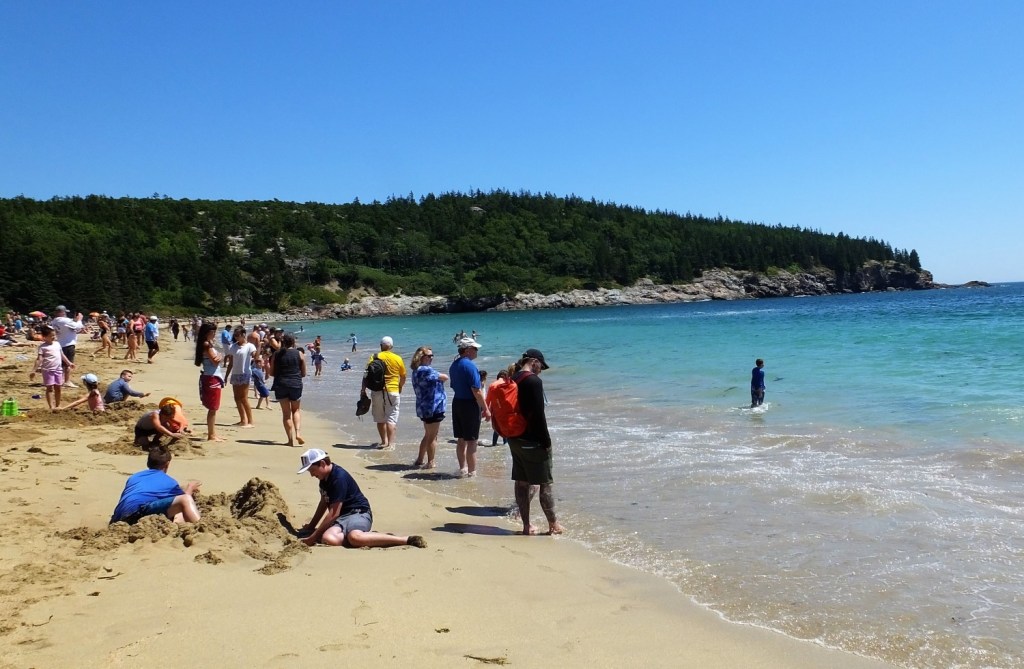
Hanging out at Sand Beach

The next morning we visited the park visitor center to get our bearings and to get our National Park book stamped.  We decided to take a free shuttle bus around the 27-mile park loop road.  The first stop was at Sand Beach, a beautiful beach where we ate a picnic lunch and watched visitors enjoying the sand, waves and summer sun.  Honestly, it was hard to get excited about the beach, considering the frigid temperature of the water and fantastic beaches we have in Florida.

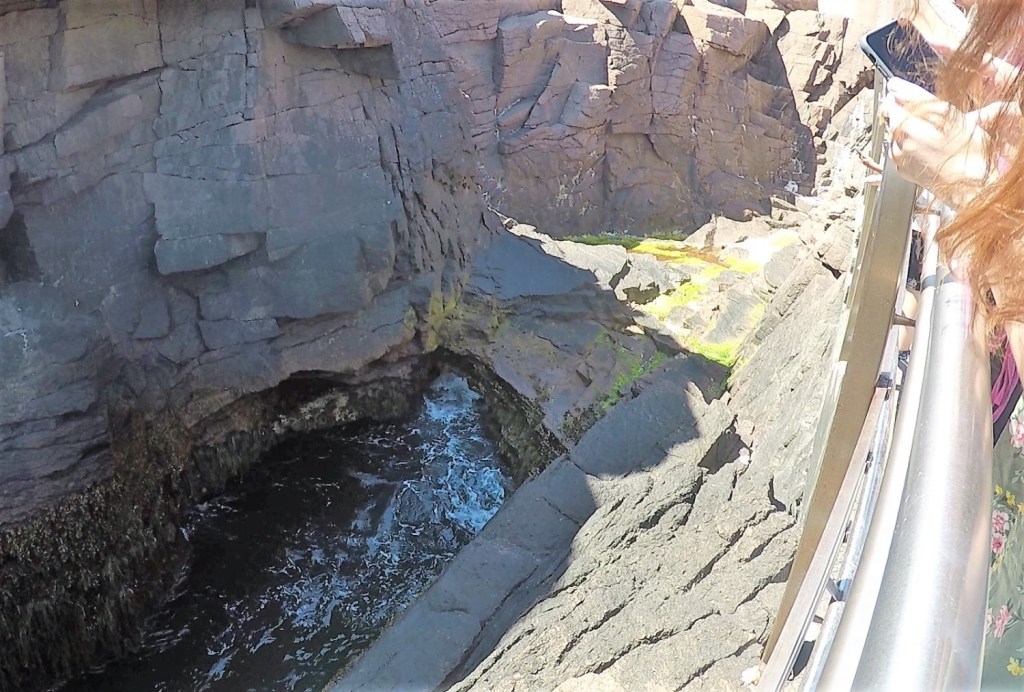
Waiting for thunder…

From Sand Beach we walked about a mile to Thunder Hole.  Thunder Hole is a natural formation that thunders loudly when sea water races up a narrow inlet to a small cavern.  The thunder is loudest just before high tide. We were there a little early and had to settle for fainter, distant thunder.

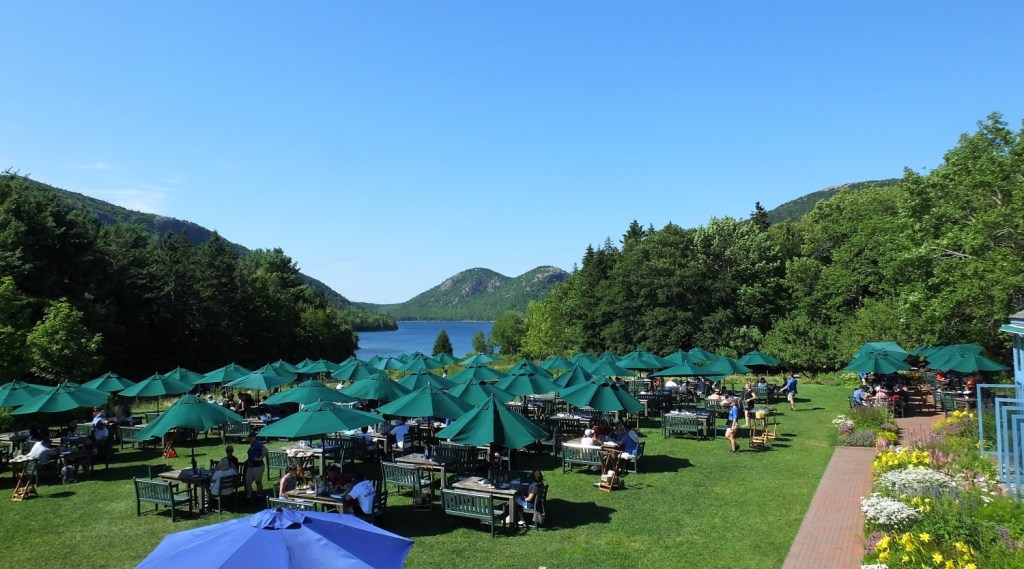
Lunch on the Jordan Pond House Lawn

We reboarded the shuttle and rode to Jordan Pond House.  Many were enjoying dining on the lawn, an appealing grassy area dotted with chairs, tables and green umbrellas.   Having already eaten lunch, we opted for a 2-mile trail along the east side of the pond and then another trail back to the loop road and a shuttle bus stop.  Little did we know that the shuttle no longer stopped at that location.  As we considered whether to go back to Jordan Pond House or to continue along the road to the next shuttle stop, a volunteer park ranger and his wife from Tennessee kindly offered us a ride back to the visitor center.  We enjoyed visiting with them and learned we had much in common – RVing and past travels to Alaska and the US west.  

Deciding which way to go on an Acadia Carriage Road

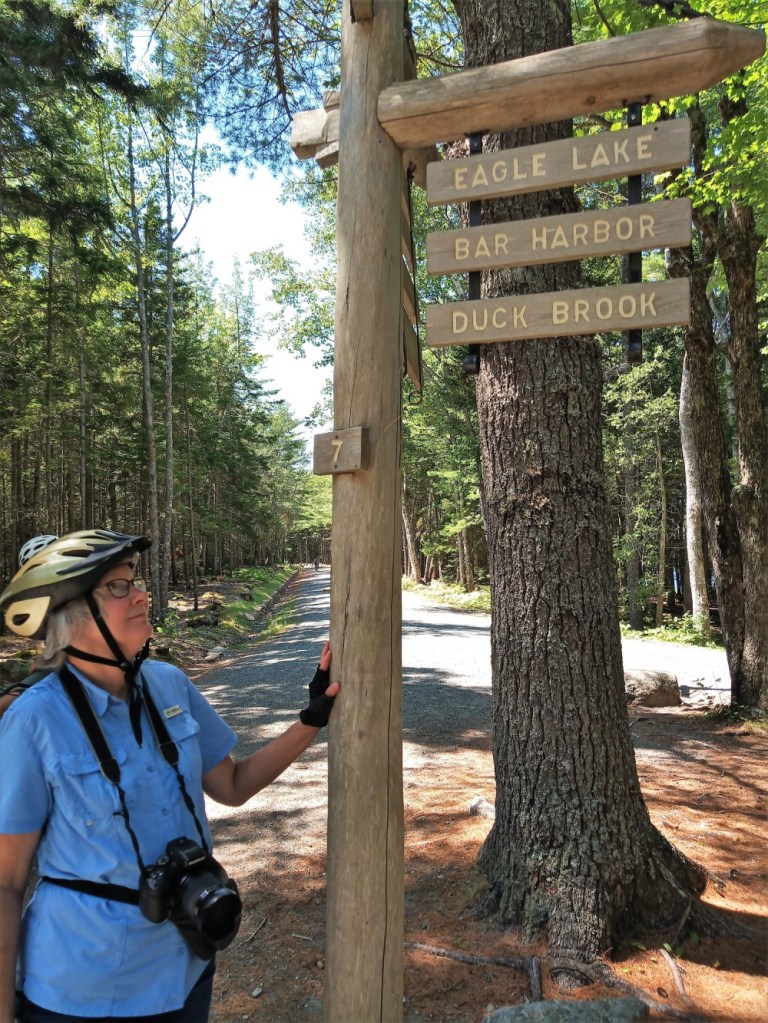
We packed a lunch the next morning and set out to ride our bikes on Acadia’s carriage roads.  Forty-five miles of gravel lanes, gifted by philanthropist John D. Rockefeller, run throughout the park and are used by hikers, horseback and carriage riders, and cyclists.

From the visitor center we circled Eagle Lake and returned for a total of 12 miles.

Although the roads are designed so they are not too steep for horse drawn carriages, there were some rather substantial and long hills that required us to walk our bikes.  Of course, the rides back down were lots of fun!

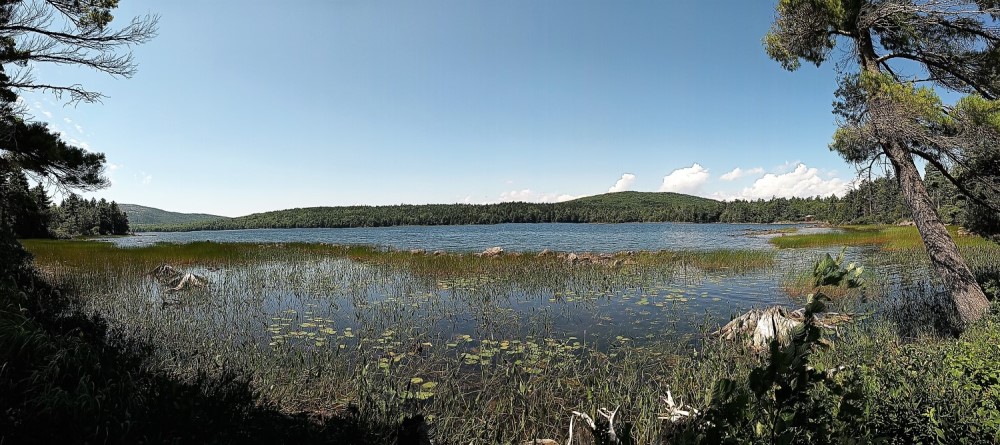
Serene Eagle Lake view

A drive to Cadillac Mountain is not to be missed when visiting Acadia.  At 1530 feet, it is the highest point in the park and offers great views of Bar Harbor town and the Maine coastline.   Many get up early to see America’s earliest sunrise from the mountain. Sunrise the next day was at 4:37 am and that would have meant we leave our campsite at 2 am.
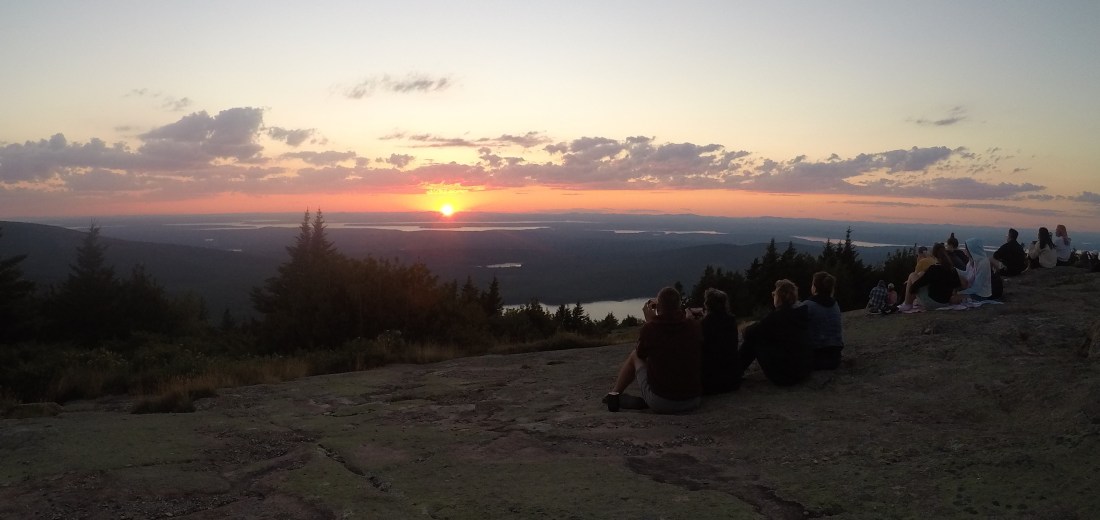
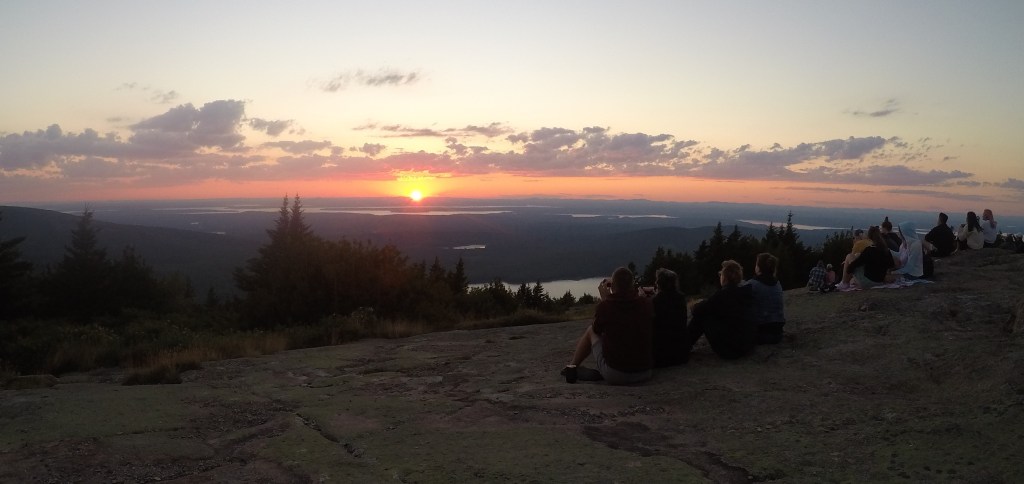
We decided to see the sunset instead.  We brought our dinner and were rewarded with a beautiful close to the day.       

Sunset on Cadillac Mountain

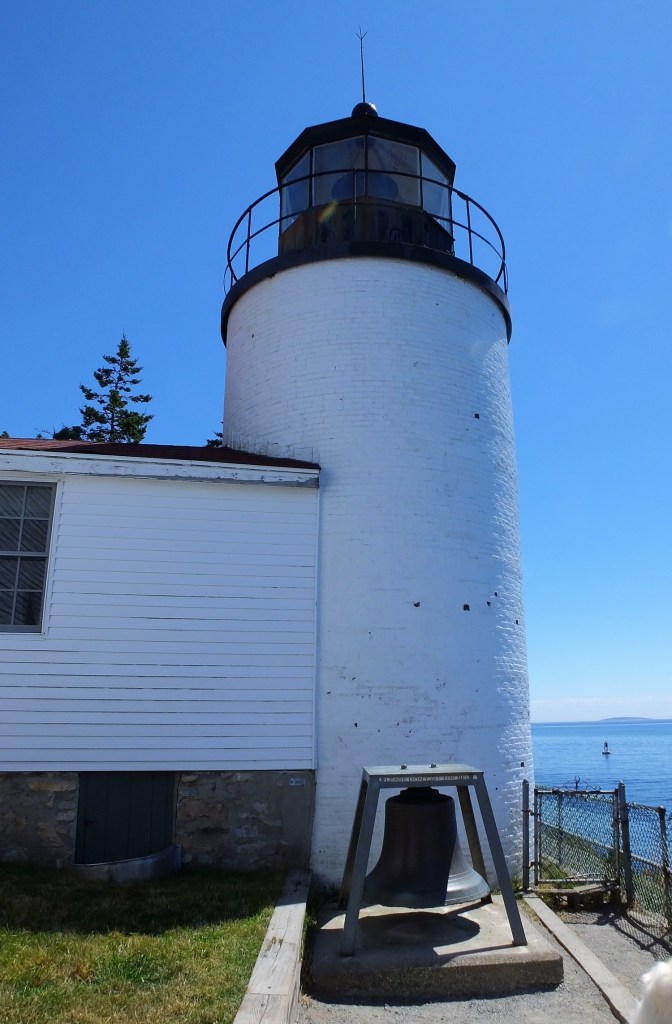
During our final day at Acadia we explored the lesser visited western side of the park.  We visited the picturesque and much photographed Bass Harbor Lighthouse and hiked to Ship Harbor, a beautiful, secluded cove. 

Next week:  we cross the border into Canada, travel through New Brunswick and Nova Scotia, and arrive in Newfoundland.

Iron Sharpening Iron

(2022 Newfoundland Ep 3)

Prov 27:17 gives a perspective on the value of a friend.  “Iron sharpens iron, So one man sharpens another.”  Indeed, caring friends are blessing and a treasure for life.   

Old friends

As we continued northward to Newfoundland, Pat and I caught up with an iron-sharpening friend like this.   We visited Norm Maclean, a long-time friend who moved from Jacksonville to New Hampshire (via Massachusetts) more than 25 years ago. 

Norm and I started working Prudential Financial around the same time in 1978 and became lunch buddies.  During after-lunch walks Norm shared his faith in Jesus Christ with me.  I was what today would be best described as a ‘seeker,’ one who has questions about the Christian faith.  Norm patiently answered my faith questions day after day, and after Pat and I were married in 1980, I trusted Christ and became a Christian on December 21, 1980.

Many historic mills, like this one in Exeter, have been converted to condos, apartments and businesses

Our friendship continued with weekly racquetball games until Norm married and moved to Massachusetts in the mid-90s.   

We’ve kept in touch via phone calls, emails and a few short visits over the years.  This time we had more than two days to reconnect.

Norm now lives in Exeter, NH, a few miles west of Portsmouth.  Exeter’s claim-to-fame is a story of a UFO abduction that allegedly took place in the ‘60s.  They even have a UFO festival in early September that Norms says is a sight to behold.  We’re sorry we’ll miss it!

It was hot – even for Florida

We arrived on a very hot Sunday afternoon and after setting up at our campsite, we joined Norm for ice cream and conversation on the Exeter waterfront.  We learned about the church he attends and updated Norm on what was happening at our church, Christian Family Chapel.  Ice cream finished, we took an after dark walk around Phillips Exeter Academy and several other downtown buildings.

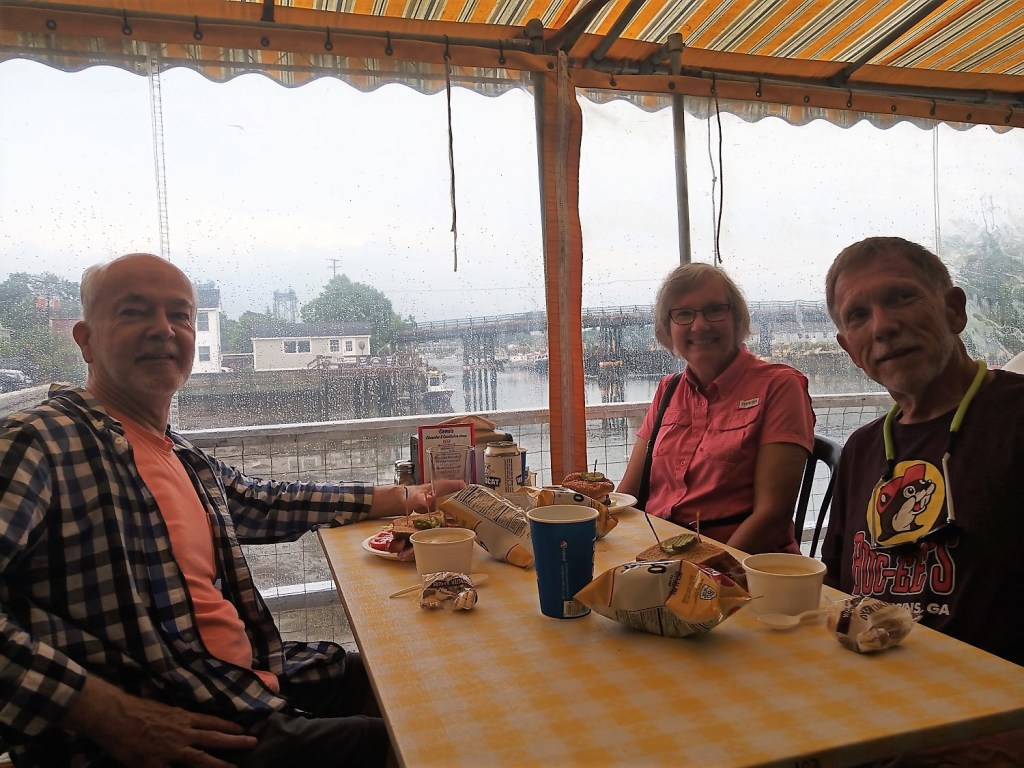
The next morning it was drizzling lightly and much cooler.  After touring Exeter a bit more, we drove a short ways to Portsmouth.  Norm showed us some of his favorite places and we had lunch at Geno’s Chowder and Sandwich Shop on the waterfront.  Because Geno’s lobster rolls were rather pricey, we opted for chowder.  Our wait person brought samples of lobster, fish and clam chowder (all were great), and we decided on clam.

Chowda and fellowship at Genos

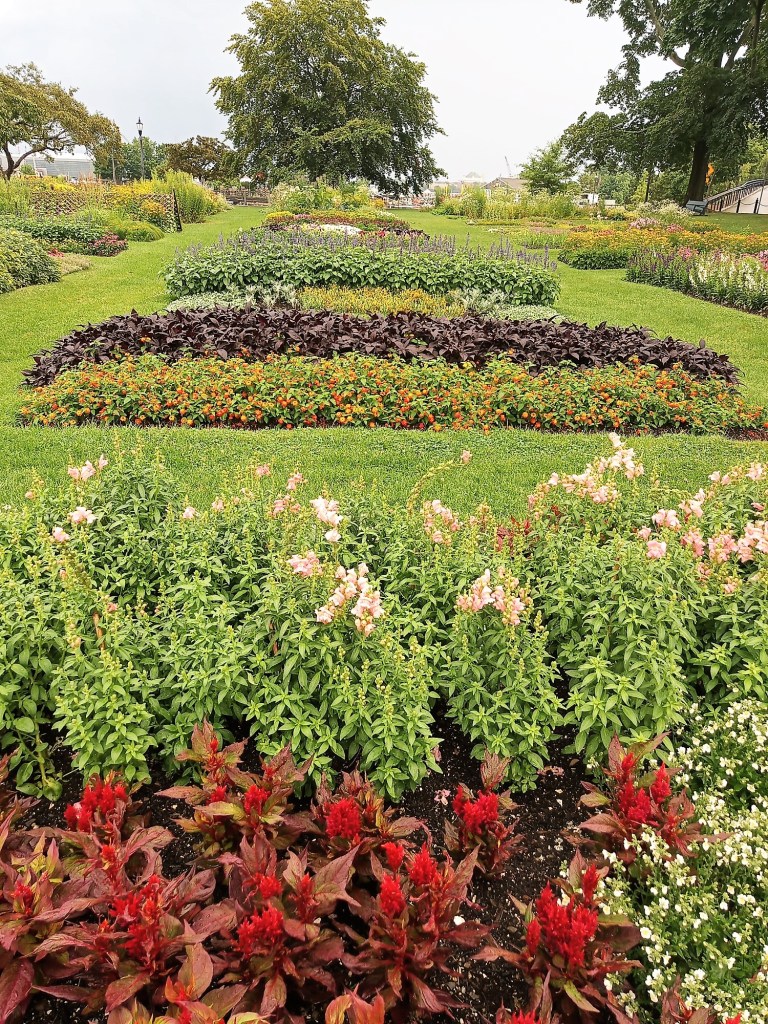
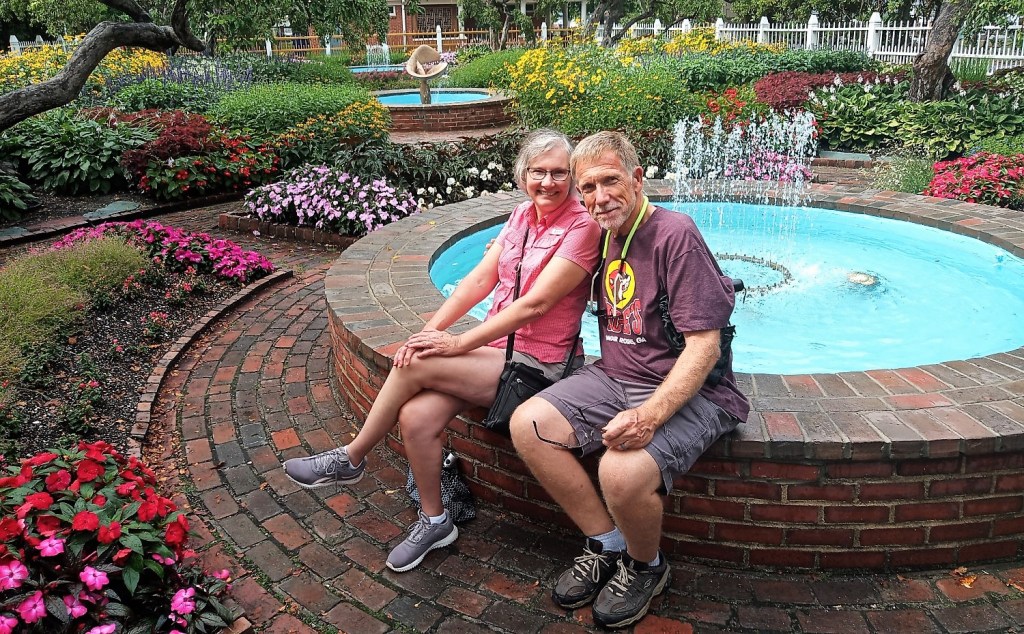
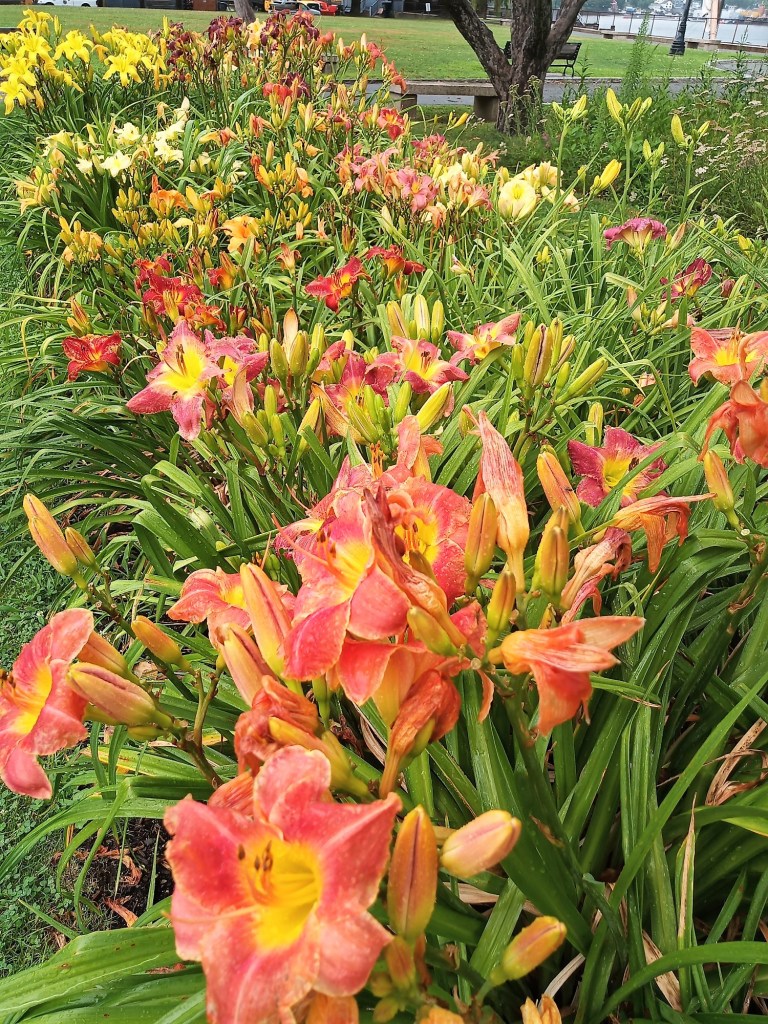
After lunch we walked to the nearby Trial Gardens, flower gardens on the Portsmouth waterfront that have a beautiful assortment of flowers and ornamental plants.  Pat really liked that! 

We finished the day with a stop at Jenness State Beach, where Norm likes to surf.  The waves were small and the boards were long, but they really do surf in New Hampshire!

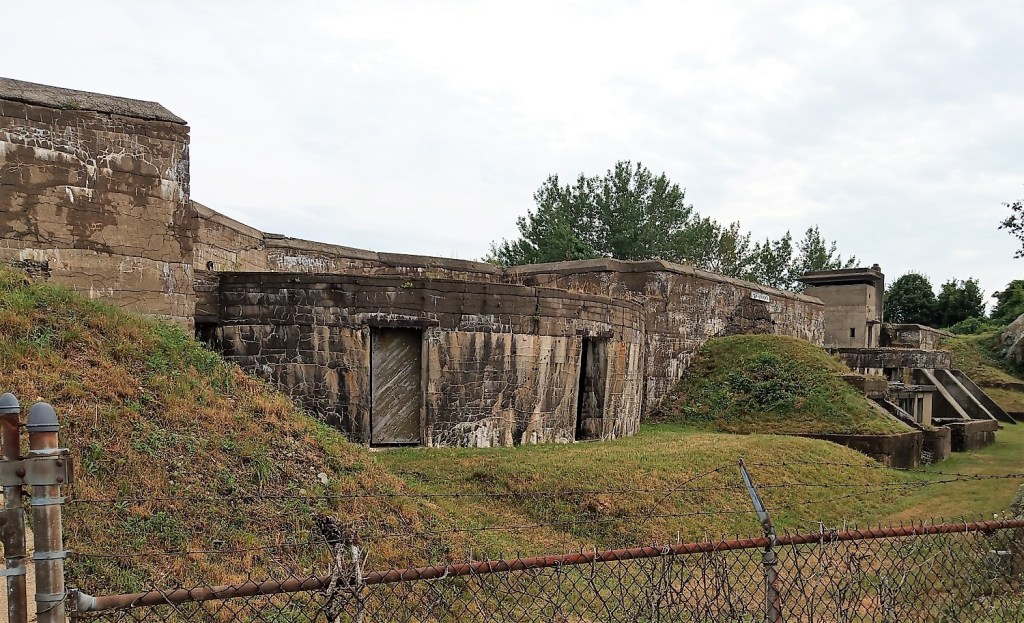
One of many port fortifications in the Portsmouth area
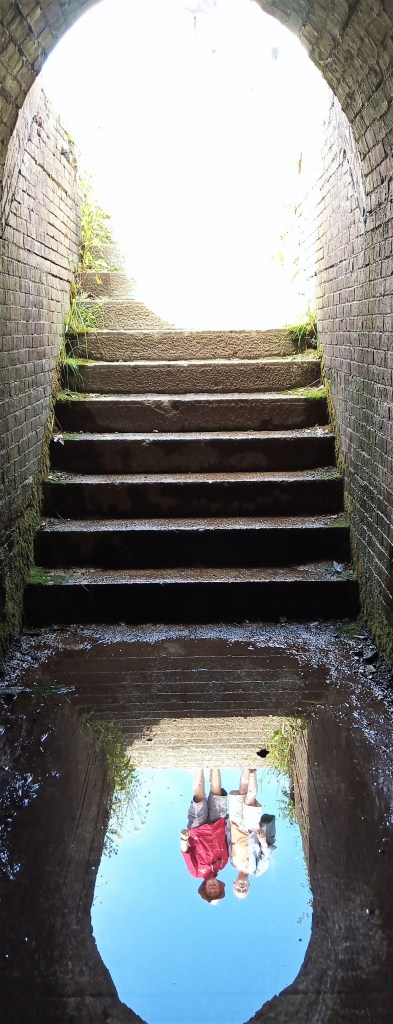
Interesting bunker reflection

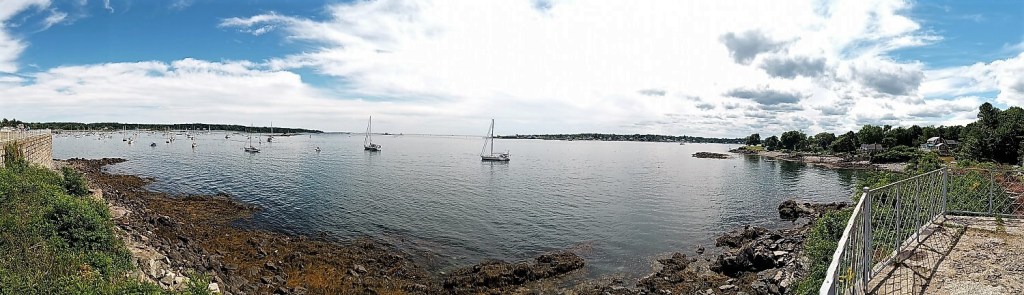
The next morning we returned to Portsmouth to visit a number of interesting fortifications that overlook the mouth of the Piscataqua River. around the port.  Portsmouth has long been deemed to have strategic value and the fortifications were built to protect the port from invasion from Britain (revolutionary and 1812 wars) and Germany (WWI and WWII).  We had a picnic lunch at Fort McClary State Historic Site in Maine on the north side of the river and learned that location has been repurposed for each of the wars above. 

Fortifications on both sides of the river ranged from a large wooden tower with narrow slots for cannons and muskets to large concrete bunkers that contained large 20-in guns, like those found on battleships.   At Odiorne State Park in New Hampshire we hiked to several large concrete structures that once housed large guns and are now covered with graffiti.  The massive bunkers reminded Pat and me of the Dharma Initiative on the TV series Lost.

Later, we rode our bicycles around Portsmouth to see a number of old homes and a few cemeteries, and enjoyed pizza in the basement of Portsmouth Gas Light Co. in the bustling and beautifully-restored Portsmouth downtown area.  What history were in those walls.

Piscataqua River panorama from Fort McClary

After our two day visit, we said farewell to Norm.  Our trip resumed north the next morning to Acadia National Park up the Maine Coast.

In closing, take the long road to visit friends and family as you travel.  You’ll never regret taking time to reconnect and never know what Rabbitrails you’ll experience in the process.